Topic: [Discuss] NASA's Artemis II mission (Orion)
Robert Pearlman Editor
Posts: 57226 From: Houston, TX Registered: Nov 1999
posted 04-04-2026 06:44 PM
quote:Originally posted by perineau: How close did Apollo 13 come to the lunar surface during their flight?
Apollo 13's closest approach to the moon was approximately 160 miles (254 km). Jim Lovell, Fred Haise and Jack Swigert got a whole lot closer than will the Artemis II, whose closest approach on Monday (April 6) is expected to be 4,066 miles (6,544 km) of the surface.
GACspaceguy Member
Posts: 3342 From: Guyton, GA Registered: Jan 2006
posted 04-05-2026 07:57 AM
I keep seeing in the news that this crew will see parts of the far side of the moon that no humans have seen. What will they see that the Apollo CM pilot would not have seen?
Jim Behling Member
Posts: 2071 From: Cape Canaveral, FL Registered: Mar 2010
posted 04-05-2026 08:02 AM
High latitude regions. Back in the day when the shuttle flew due east at an inclination of 28.5 degrees, the crew never saw Canada or Europe. Apollo landing sites were equatorial.
Axman Member
Posts: 971 From: Derbyshire UK Registered: Mar 2023
posted 04-05-2026 08:51 AM
It's because they will be higher above the surface on the far side than any Apollo was and will therefore be able to see farther north and south on the dark side terminator line.
All a little bit academic, unmanned probes have seen and already photographed every square inch in better detail and at far more angles and under more optimal lighting conditions than anything new that the Artemis 2 crew will see. It's just about the first time human eyes have seen a particular spot is all.
Robert Pearlman Editor
Posts: 57226 From: Houston, TX Registered: Nov 1999
posted 04-05-2026 09:12 AM
Also, lighting. Apollo missions were targeted for days when the lighting was optimal for the near side.
There will be areas on the far side in light that were hidden in shadow during the Apollo observations.
Geologists who are on the Artemis II science team say that the human eye can detect qualities that cameras cannot. It was Jack Schmitt who first noticed the "orange soil" on Apollo 17 and other Apollo astronauts described seeing colors on the moon that never appeared in photos. That is the value of having human eyes on site.
Robert Pearlman Editor
Posts: 57226 From: Houston, TX Registered: Nov 1999
posted 04-05-2026 09:34 AM
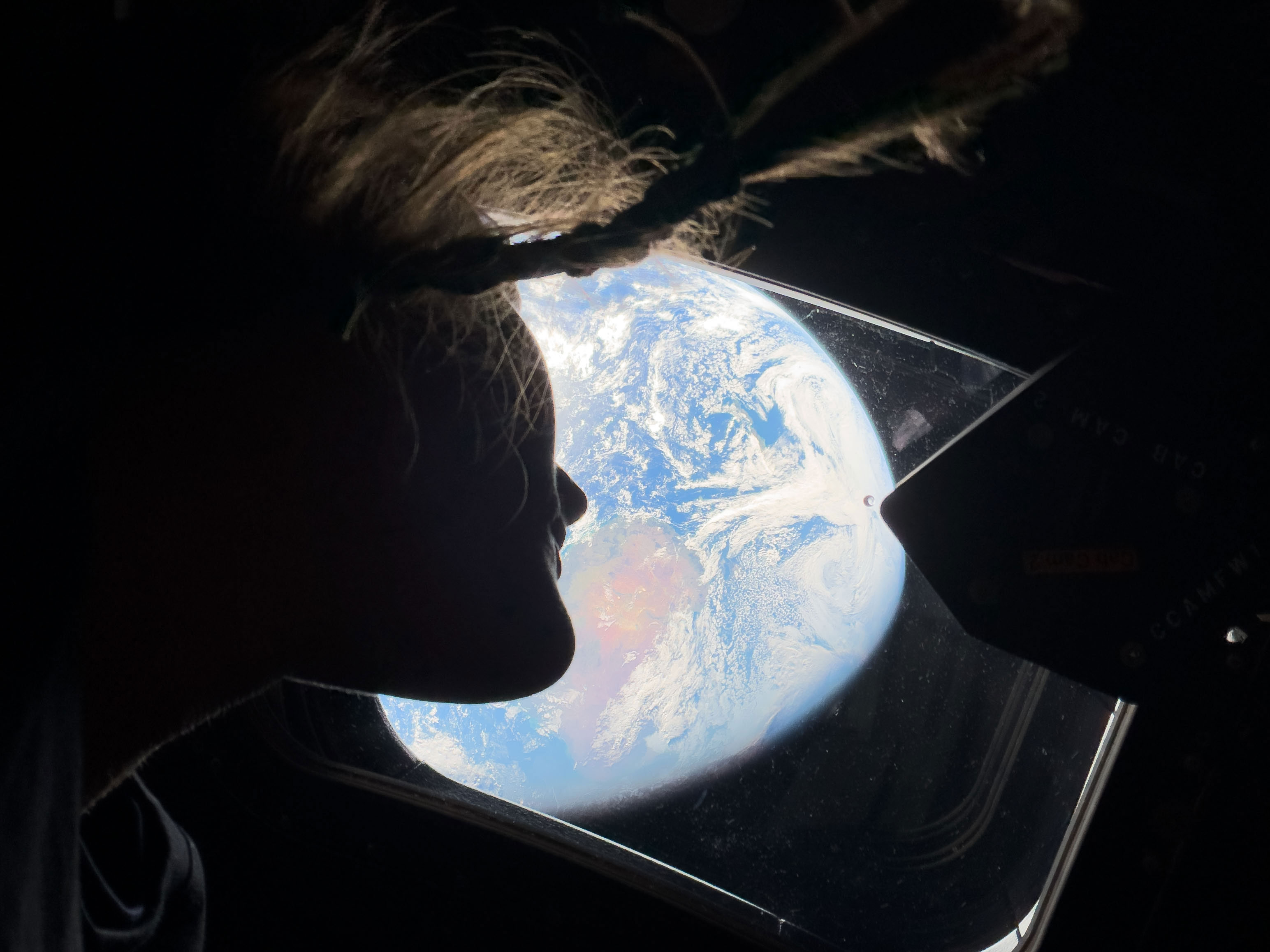
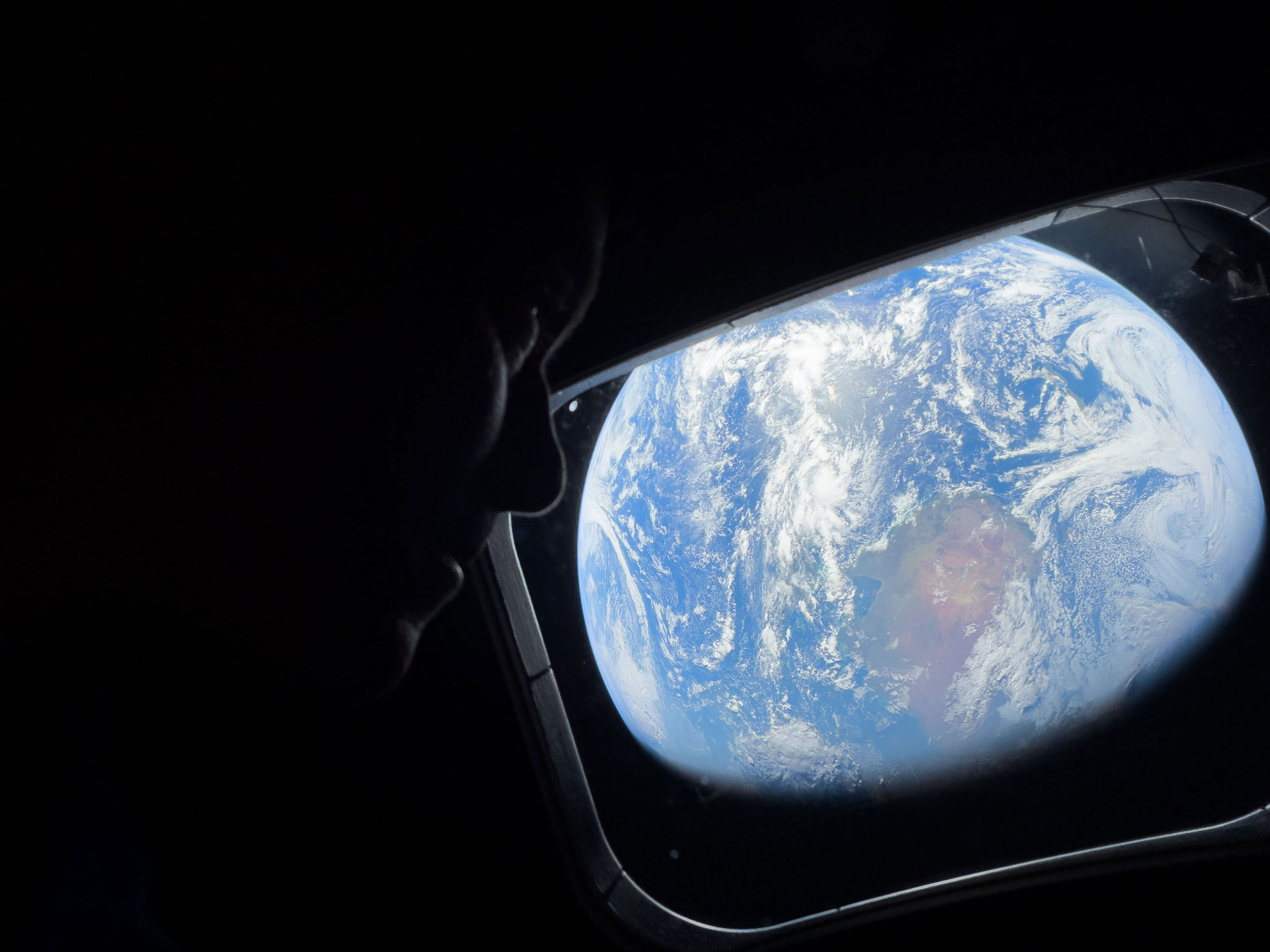
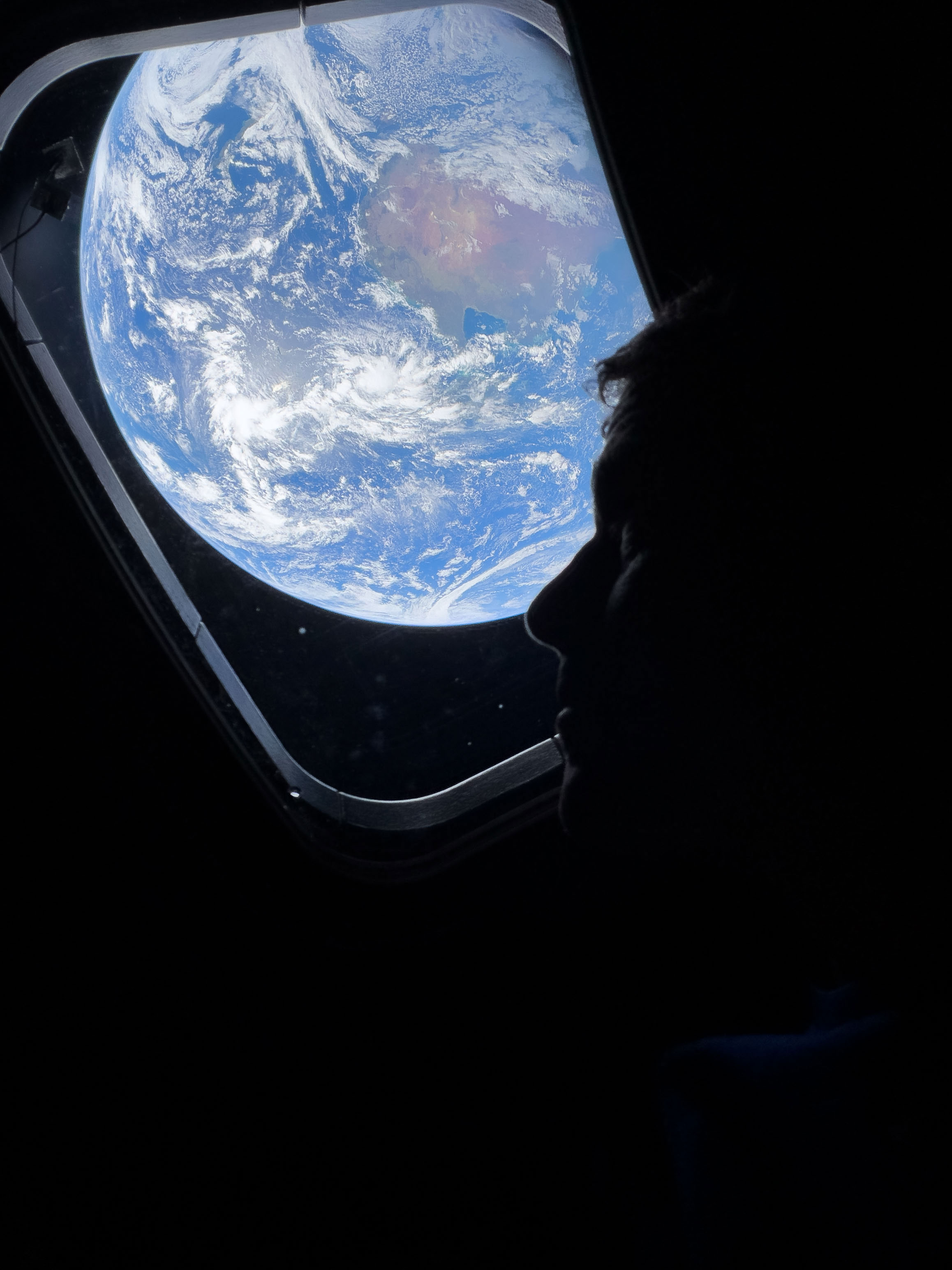
New photos release:
NASA astronaut and Artemis II mission specialist Christina Koch peers out of one of the Orion spacecraft's main cabin windows, looking back at Earth, as the crew travels towards the Moon.
NASA astronaut and Artemis II Commander Reid Wiseman peers out of one of the Orion spacecraft's main cabin windows, looking back at Earth, as the crew travels towards the Moon.
NASA astronaut and Artemis II Commander Reid Wiseman peers out of one of the Orion spacecraft's main cabin windows, looking back at Earth, as the crew travels towards the Moon.
Robert Pearlman Editor
Posts: 57226 From: Houston, TX Registered: Nov 1999
posted 04-05-2026 11:52 AM
Today's (Flight Day 5) wake up call to the crew began with "Working Class Heroes" by CeeLo Green, followed by this special message:
Hello Reid, Victor, Christina, and Jeremy, this is Apollo 16 astronaut Charlie Duke. John Young and I landed on the moon in 1972 in the lunar module we named Orion. I'm glad to see a different kind of Orion helping return humans to the moon as America charts the course to the lunar surface.
Below you on the moon is a photo of my family. I pray it reminds you that we in America and all of the world are cheering you on. Thanks to you and the whole team on the ground for building on our Apollo legacy with Artemis. Godspeed and safe travels home.
Robert Pearlman Editor
Posts: 57226 From: Houston, TX Registered: Nov 1999
posted 04-05-2026 05:13 PM
NASA video
NASA leaders are providing status updates, answering media questions, and discussing mission activities for flight day five.
GACspaceguy Member
Posts: 3342 From: Guyton, GA Registered: Jan 2006
posted 04-06-2026 06:29 AM
quote:Originally posted by Axman: It's because they will be higher above the surface...
Thank you for the input on the far side viewing. While I knew that the Apollo fights were equatorial I just assumed that the moon diameter allowed for full viewing of the far side except the further reaches very near the poles.
Next thought on Apollo, were any of the Apollo astronauts at the launch? Also, I am curious why there is no media discussions with former moon explorers.
Maybe I have just missed it but I would have thought interviews with those who had "been there before" would be in the main media. Maybe they want to de-emphasize the early history for the new firsts.
Edit: I guess I should have read Sunday's media as Charlie Duke was in discussion with the crew. Very appropriate for an Easter discussion as Charlie has a wonderful ministry.
Robert Pearlman Editor
Posts: 57226 From: Houston, TX Registered: Nov 1999
posted 04-06-2026 07:17 AM
Not so much in discussion, rather Duke recorded part of the crew's wake-up call for flight day five. (I posted a transcript of what he said upthread).
Duke and Rusty Schweickart, along with Apollo engineers Charlie Mars, JoAnn Morgan and John Tribe spoke with the Associated Press.
Robert Pearlman Editor
Posts: 57226 From: Houston, TX Registered: Nov 1999
posted 04-06-2026 08:00 AM
On Sunday (April 5), flight day five, Jeremy Hansen was presented with his gold astronaut pin:
We have a long standing tradition in the astronaut office, the traditional astronaut pin, and when you fly in space you change from silver to gold.
Robert Pearlman Editor
Posts: 57226 From: Houston, TX Registered: Nov 1999
posted 04-06-2026 08:15 AM
Also dropping this list here for future reference, here are the astronauts (and others) who have or will serve as capcom during the Artemis II mission:
Stanley Love - Ascent, Orbit 3 (4/2), Orbit 1 (4/6-10)
Posts: 1573 From: Staten Island, New York USA Registered: Nov 2007
posted 04-06-2026 09:12 AM
quote:Originally posted by Robert Pearlman: On Sunday (April 5), flight day five, Jeremy Hansen was presented with his gold astronaut pin...
And when he returns to earth, Hansen, a Colonel in the RCAF, will receive his Canadian Armed Forces astronaut wings. Only two others have worn it: Col. (ret.) Chris Hadfield; and Julie Payette, when she served as Governor-General of Canada.
Robert Pearlman Editor
Posts: 57226 From: Houston, TX Registered: Nov 1999
posted 04-06-2026 10:46 AM
Today's (flight day 6) wake up call included a message from Jim Lovell recorded before his death in August 2025:
Hello Artemis II! This is Apollo astronaut Jim Lovell. Welcome to my old neighborhood.
When Frank Borman and Bill Anders and I orbited the moon on Apollo 8, we got humanity's first up-close look at the moon and got a view of the home planet that inspired and united people around the world. I am proud to pass that torch on to you as you swing around the moon and lay the groundwork for missions to Mars for the benefit of all.
It is historic day and I know how busy you will be, but do not forget to enjoy the view. So, Reid, Victor, Christina and Jeremy and all the great teams supporting you, good luck and godspeed from all of here on the good Earth.
Reid Wiseman reacted:
That was an awesome message from Jim Lovell. Very cool to hear him welcome us to the neighborhood. It is going to be a good day.
Robert Pearlman Editor
Posts: 57226 From: Houston, TX Registered: Nov 1999
posted 04-06-2026 11:59 AM
NASA video
We're about to fly around the Moon.
On Monday, April 6, the four astronauts of Artemis II will travel farther from Earth than any humans in history — breaking the record set by Apollo 13 in 1970.
They'll sail around the far side of the Moon, photographing lunar features never before seen by human eyes. At their closest point, they'll pass roughly 4,000 miles above the lunar surface.
Highlights include:
1:56 p.m. EDT (1756 UTC): Artemis II crew surpasses the Apollo 13 distance record
2:45 p.m. EDT (1845 UTC): Lunar observation period begins
6:47 p.m. EDT (2247 UTC): Predicted loss of communications as Artemis II heads behind the moon (roughly 40 minutes)
7:02 p.m. EDT (2302 UTC): Artemis II's closest approach to the Moon
7:05 p.m. EDT (2305 UTC): Artemis II reaches its furthest distance from Earth
thisismills Member
Posts: 629 From: Michigan Registered: Mar 2012
posted 04-06-2026 12:50 PM
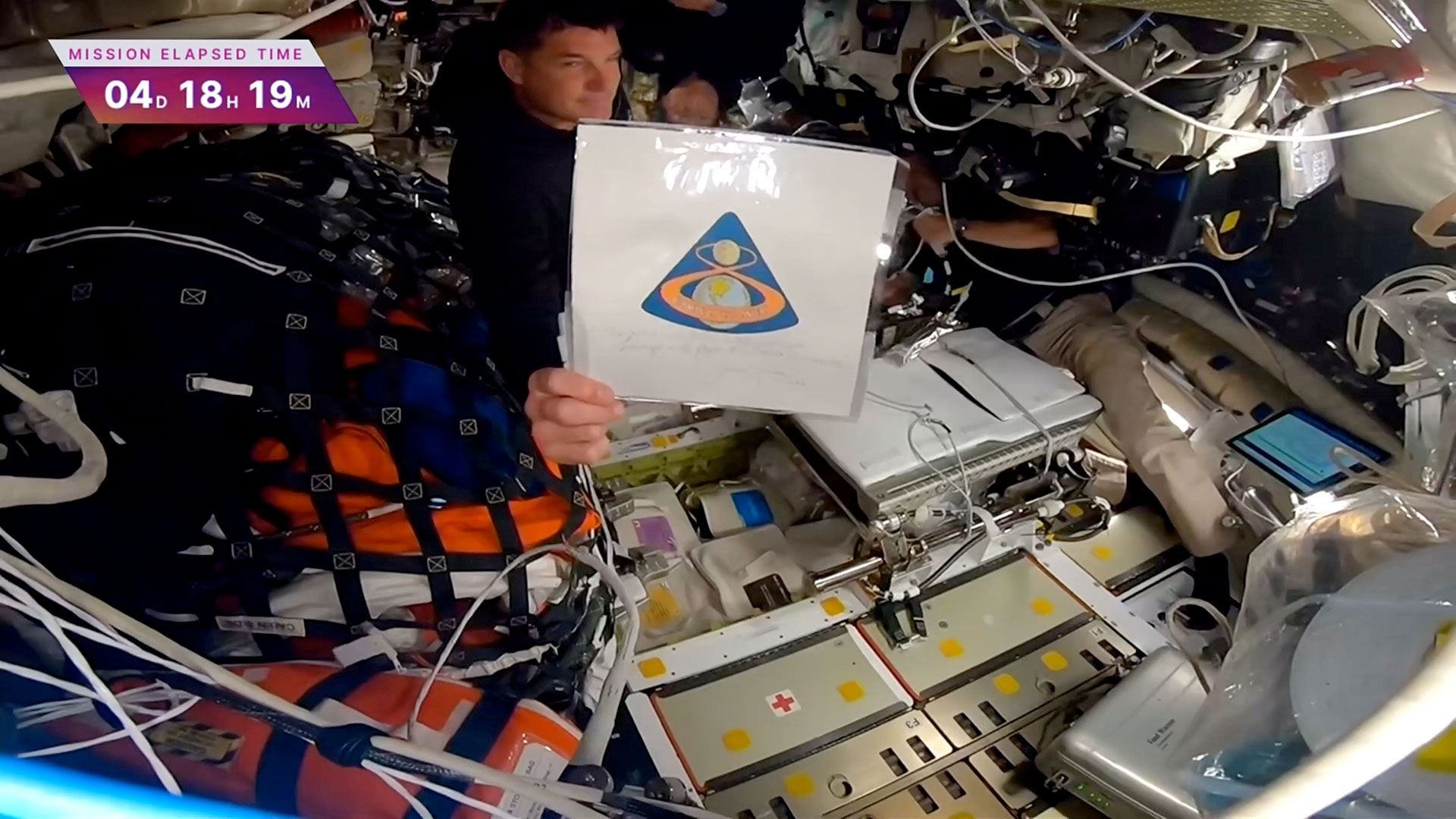
Really nice to see the Lovell family providing a flown Apollo 8 beta cloth patch for the Artemis II crew to fly on their mission, it was shown today on the broadcast as they approach the moon.
Robert Pearlman Editor
Posts: 57226 From: Houston, TX Registered: Nov 1999
posted 04-06-2026 06:29 PM
The Apollo 8 Beta cloth patch is inscribed:
This patch was flown on the Apollo Eight spacecraft to the flight to the moon 21-27 Dec 1968 — James Lovell, navigator
Dave Ginsberg Member
Posts: 245 From: Redmond, Washington, USA Registered: Dec 2007
posted 04-06-2026 11:23 PM
Is there a link to the recorded video of the crew talking about the Apollo 8 Beta cloth? I tuned in today just as they were concluding. The official NASA all-day recording seems to begin several minutes after that point in time.
Robert Pearlman Editor
Posts: 57226 From: Houston, TX Registered: Nov 1999
posted 04-07-2026 12:55 AM
Here you go:
Robert Pearlman Editor
Posts: 57226 From: Houston, TX Registered: Nov 1999
posted 04-07-2026 08:33 AM
New photos:
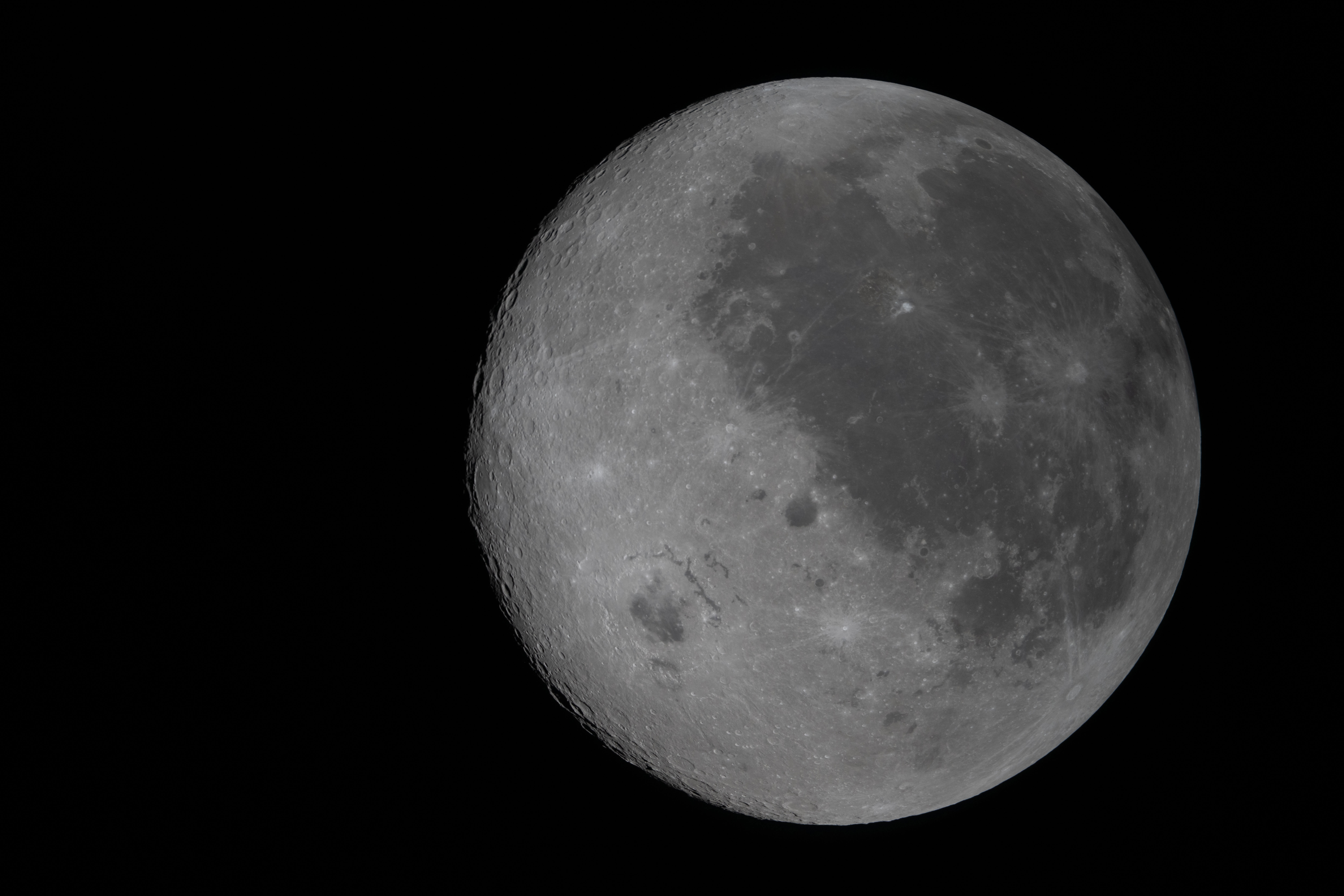
In this fully illuminated view of the Moon, the near side (the hemisphere we see from Earth), is visible on the right. It is identifiable by the dark splotches that cover its surface. These are ancient lava flows from a time early in the Moon's history when it was volcanically active.
The large crater west of the lava flows is Orientale basin, a nearly 600-mile-wide crater that straddles the Moon's near and far sides. Orientale's left half is not visible from Earth, but in this image we have a full view of the crater. Everything to the left of the crater is the far side, the hemisphere we don't get to see from Earth because the Moon rotates on its axis at the same rate that it orbits round us.
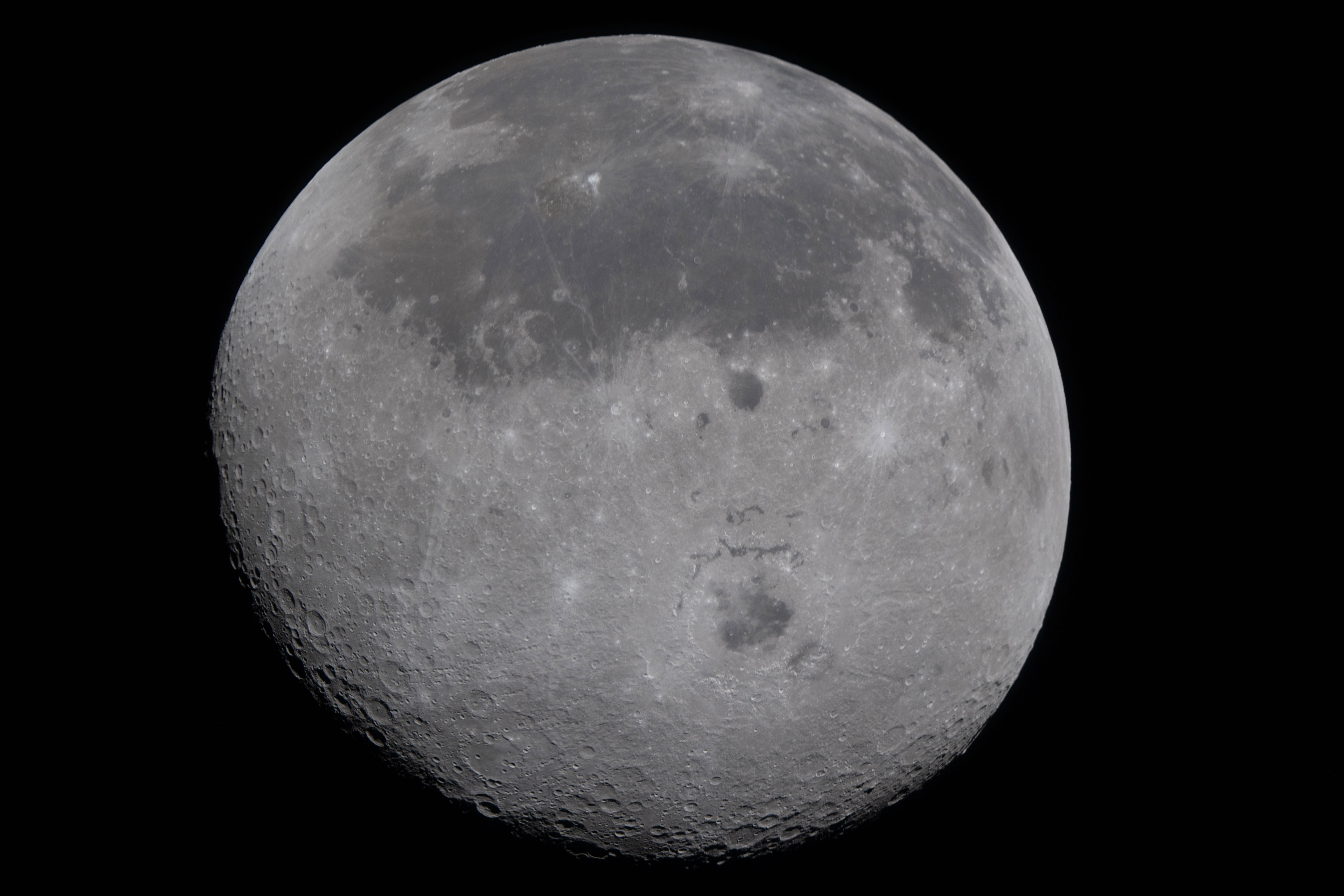
In this view of the Moon, the near side (the hemisphere we see from Earth), is visible at the top half of the Moon disk. It is identifiable by the dark splotches. These are ancient lava flows from a time early in the Moon's history when it was volcanically active. The large crater that appears below the lava flows, dark in the center, is Orientale basin, a nearly 600-mile-wide crater that straddles the Moon's near and far sides as is partly visible from Earth on the edge of the Moon.
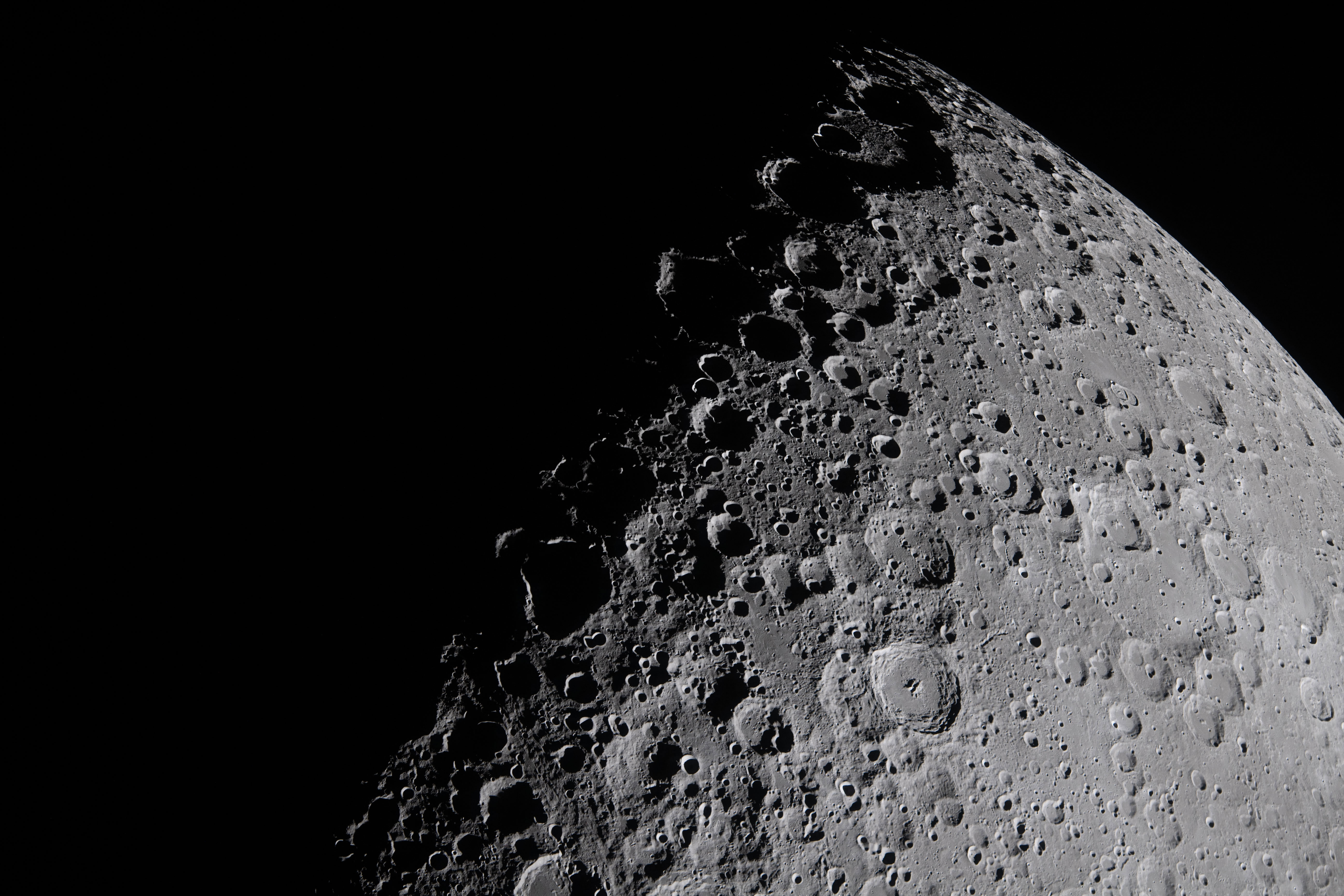
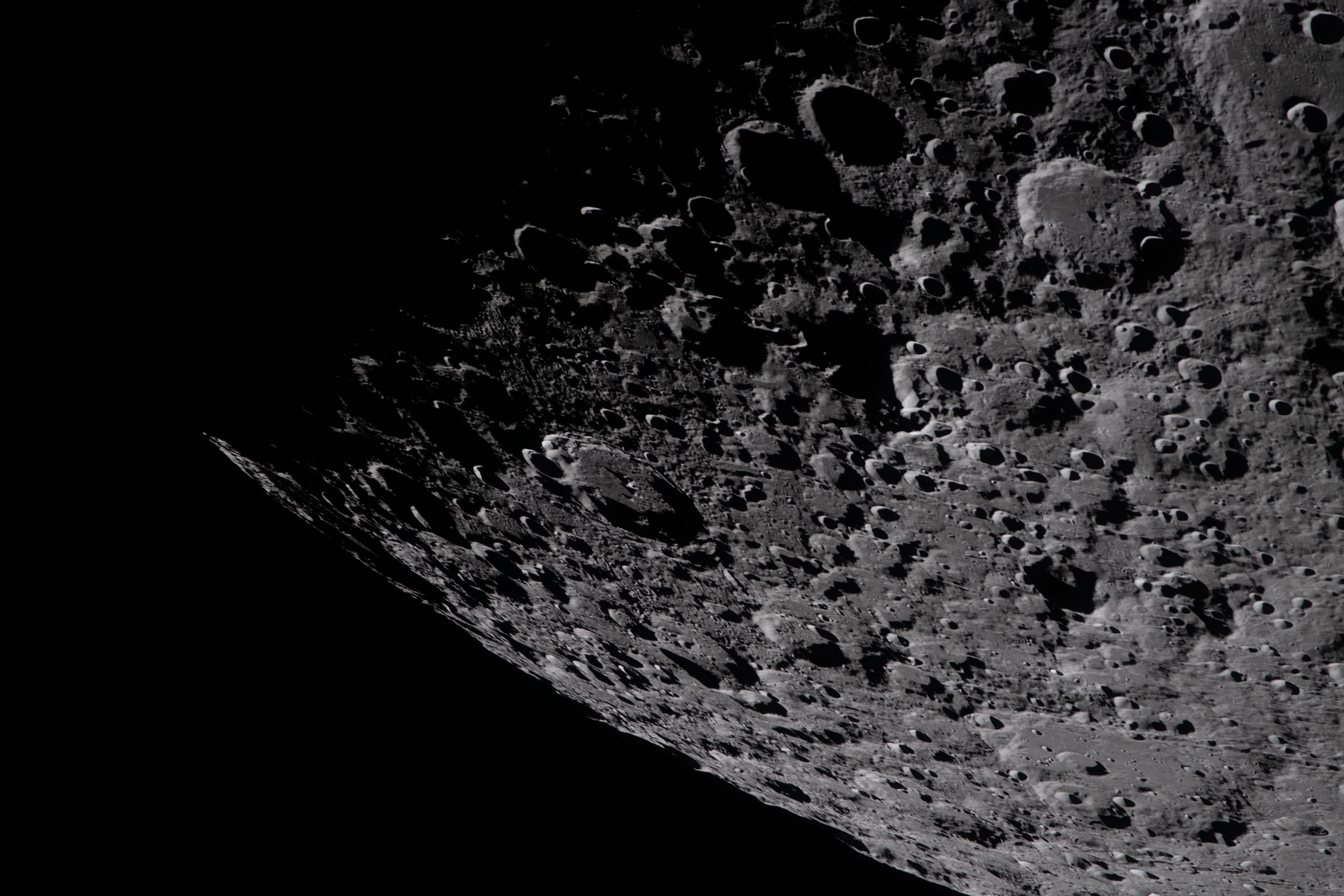
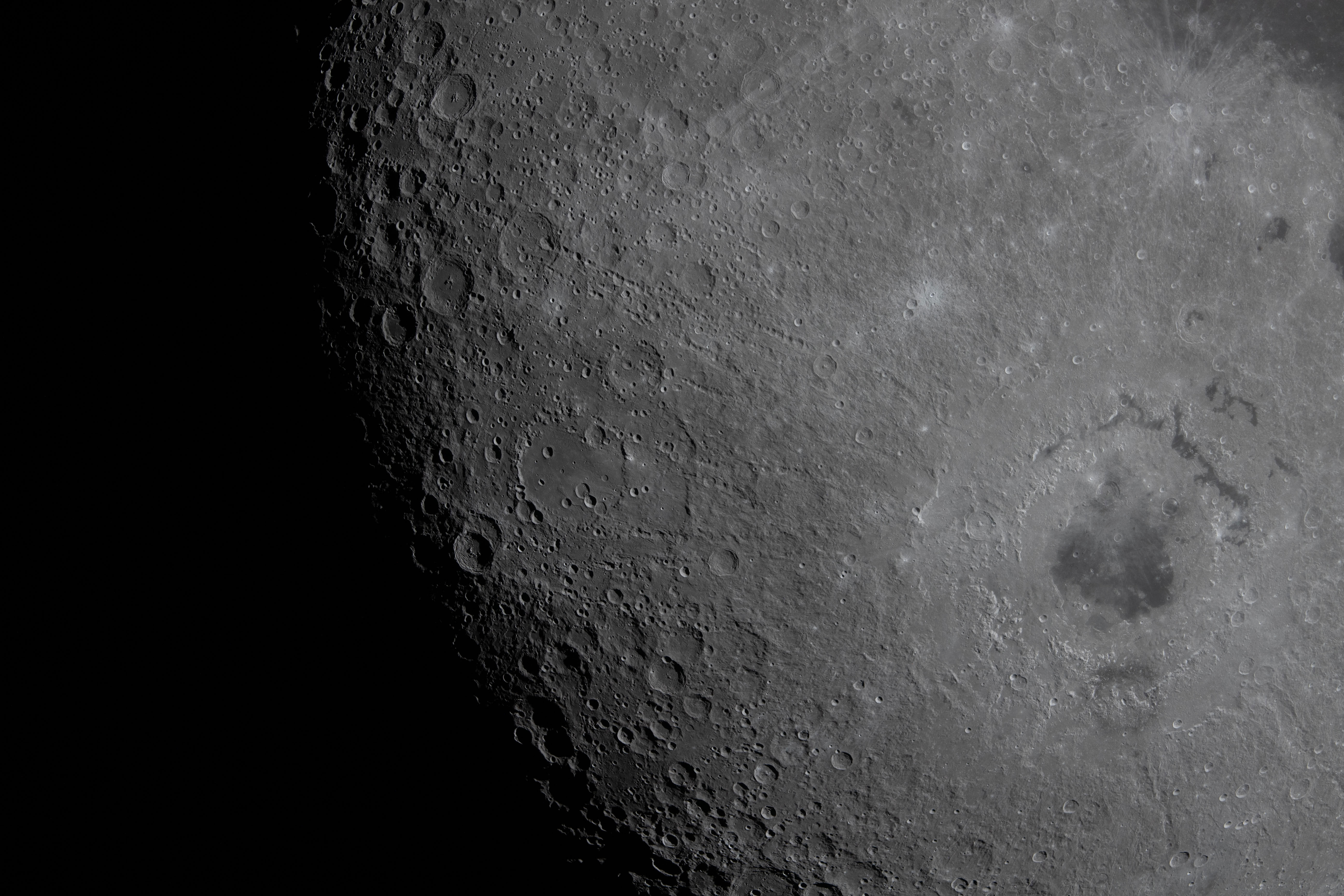
The Artemis II crew captures a portion of the Moon coming into view along the terminator – the boundary between lunar day and night – where low-angle sunlight casts long, dramatic shadows across the surface.
This grazing light accentuates the Moon's rugged topography, revealing craters, ridges, and basin structures in striking detail. Features along the terminator such as Jule Crater, Birkhoff Crater, Stebbins Crater, and surrounding highlands stand out. From this perspective, the interplay of light and shadow highlights the complexity of the lunar surface in ways not visible under full illumination.
The image was captured about three hours into the crew's lunar observation period, as they flew around the far side of the Moon on the sixth day of the mission.
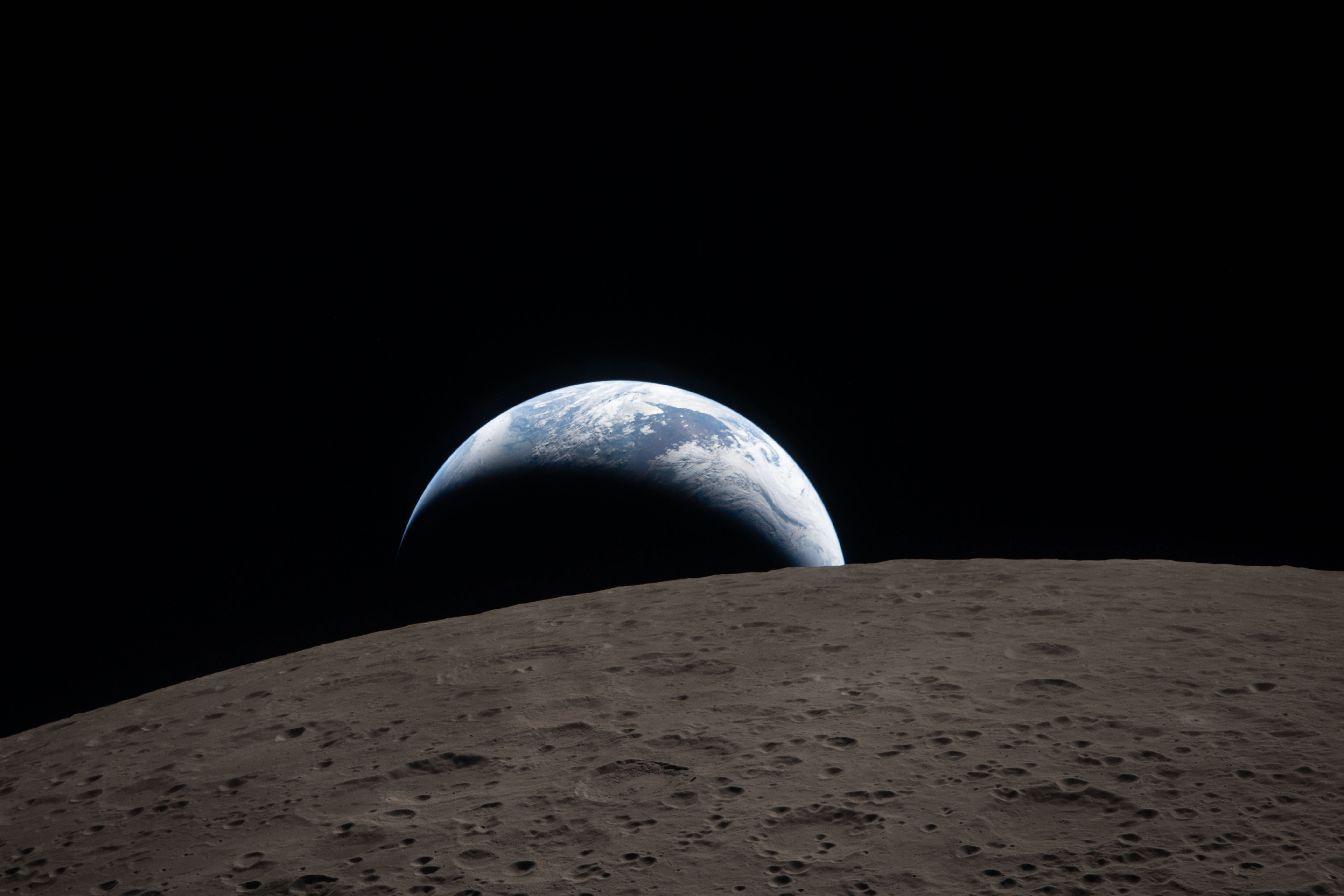
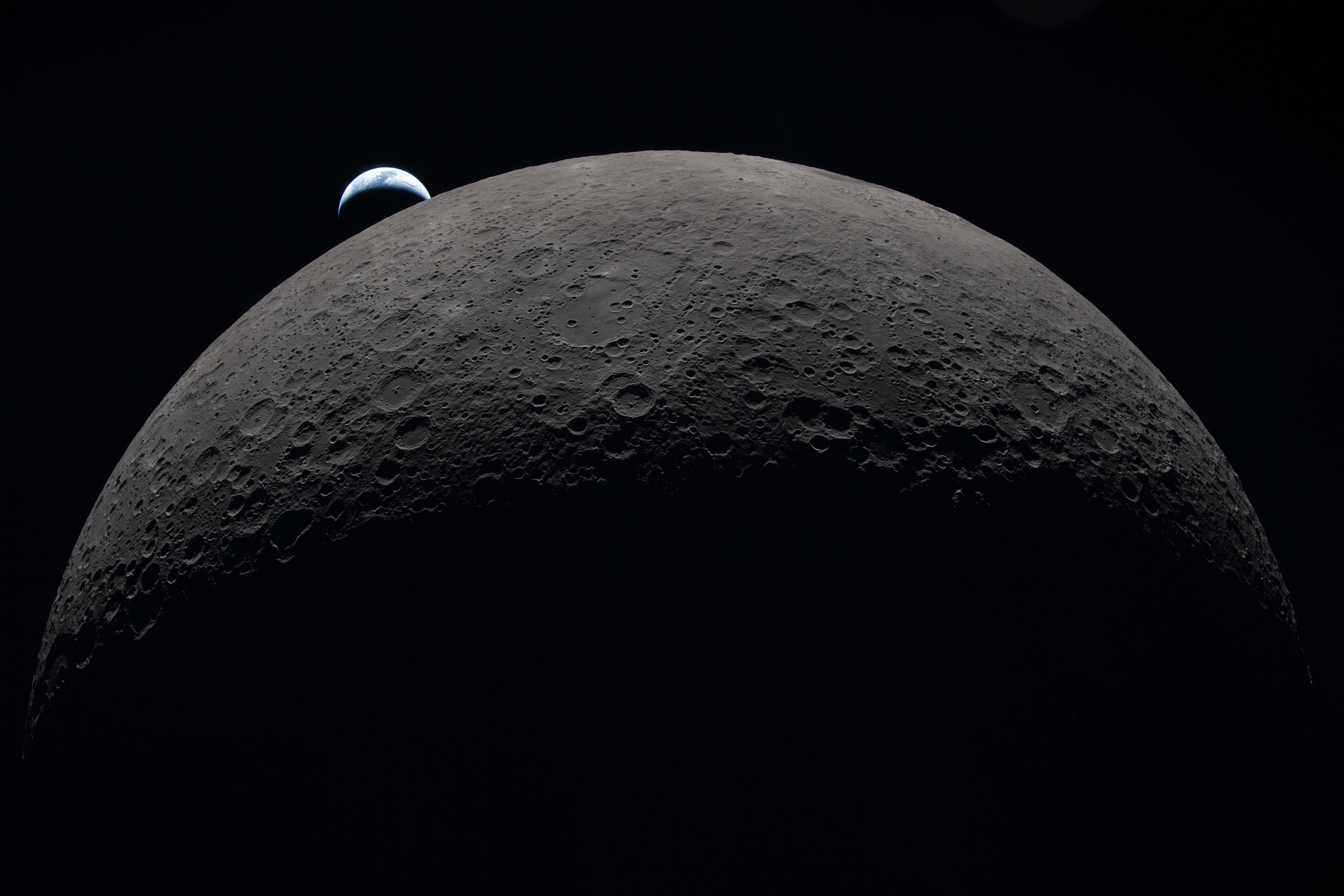
Earthset captured through the Orion spacecraft window at 6:41 p.m. EDT, April 6, 2026, during the Artemis II crew's flyby of the Moon. A muted blue Earth with bright white clouds sets behind the cratered lunar surface.
The dark portion of Earth is experiencing nighttime. On Earth's day side, swirling clouds are visible over the Australia and Oceania region.
In the foreground, Ohm crater has terraced edges and a flat floor interrupted by central peaks. Central peaks form in complex craters when the lunar surface, liquefied on impact, splashes upwards during the crater's formation.
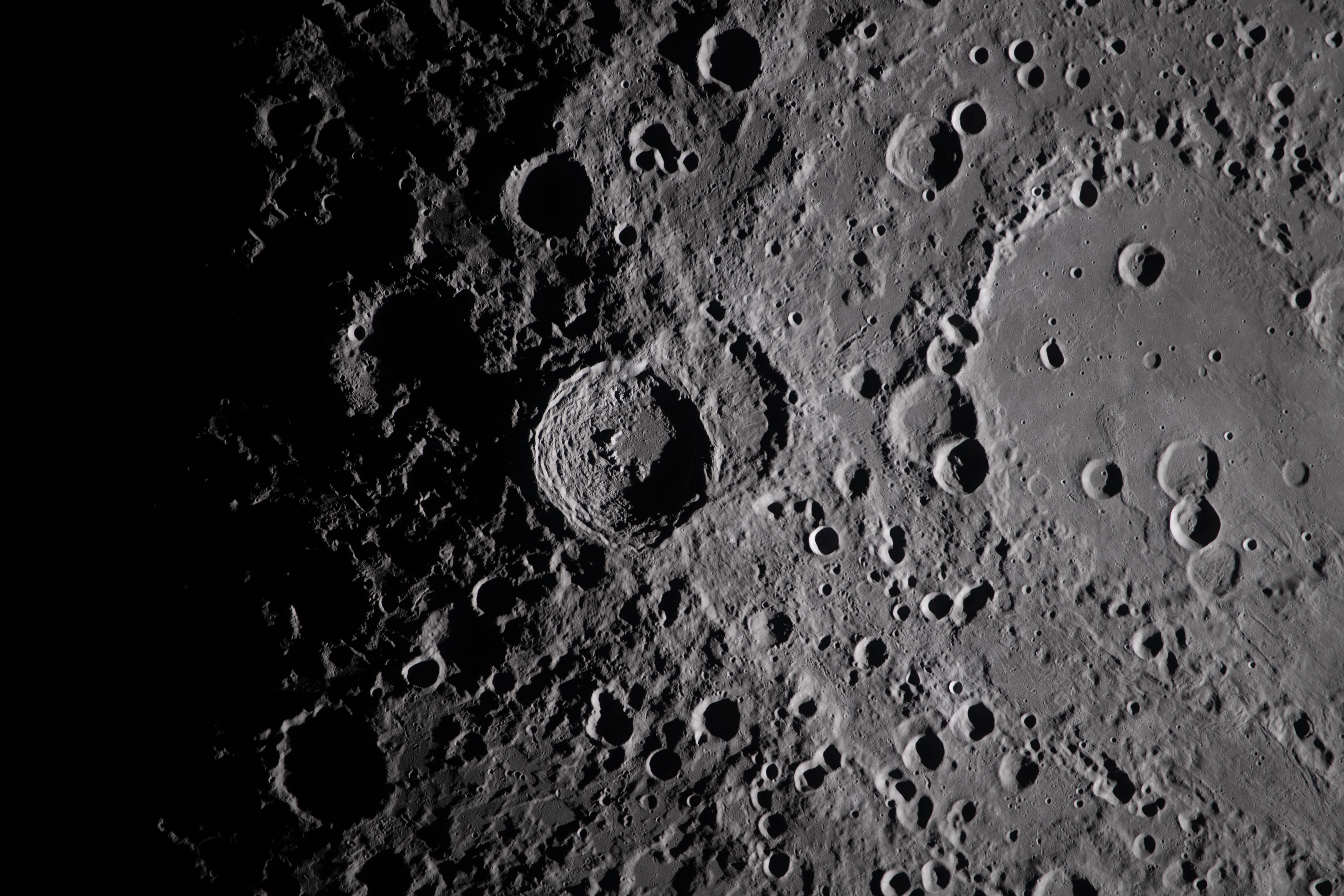
Captured by the Artemis II crew, the heavily cratered terrain of the eastern edge of the South Pole-Aitken basin is seen with the shadowed terminator – the boundary between lunar day and night – at the top of the image. The South Pole-Aitken basin is the largest and oldest basin on the Moon, providing a glimpse into an ancient geologic history built up over billions of years.
A close-up view taken by the Artemis II crew of Vavilov Crater on the rim of the older and larger Hertzsprung basin. The right portion of the image shows the transition from smooth material within an inner ring of mountains to more rugged terrain around the rim. Vavilov and other craters and their ejecta are accentuated by long shadows at the terminator, the boundary between lunar day and night. The image was captured with a handheld camera at a focal length of 400 mm, as the crew flew around the far side of the Moon.
Our planet draws closer to passing behind the Moon in this image captured by the Artemis II crew during their lunar flyby, about six minutes before Earthset. Earth is in a crescent phase, with sunlight coming from the right. The dark portion of Earth is experiencing nighttime. On Earth's day side, swirling clouds are visible over muted blue in the Australia and Oceania region.
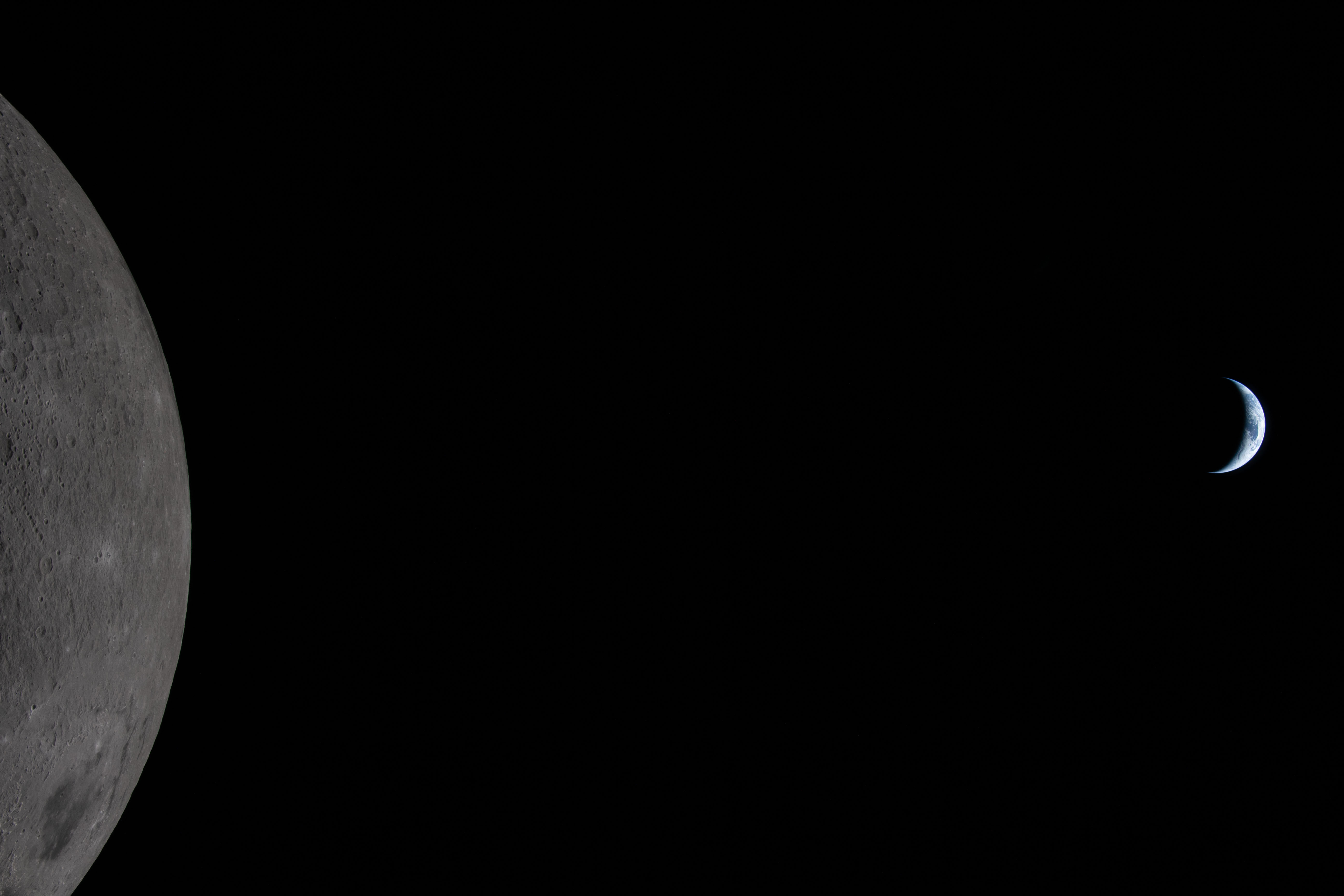
Earth appears tiny as the Moon looms large in this photo taken by the Artemis II crew during their lunar flyby on April 6, 2026.
Taken 36 minutes before Earthset, our home planet is visible in the blackness of space off the limb of the illuminated Moon. Earth is in a crescent phase, with sunlight coming from the right. Orientale mare basin, with its dark floor of cooled lava and outer rings of mountains, covers nearly the lower third of the imaged lunar surface. Different colors in the mare hint at its mineral composition. The lines of small indentations above Orientale are secondary crater chains, formed by material ejected during a violent primary impact. Both of the new craters that the Artemis II crew has suggested names for – Integrity and Carroll – are in full view.
The edge of the visible surface of the Moon is called the "lunar limb." Seen from afar, it almost looks like a circular arc – except when backlit, as in other images captured by the Artemis II crew.
Earth sets at 6:41 p.m. EDT, April 6, 2026, over the Moon’s curved limb in this photo captured by the Artemis II crew during their journey around the far side of the Moon. Orientale basin is perched on the edge of the visible lunar surface. Hertzsprung Basin appears as two subtle concentric rings, which are interrupted by Vavilov, a younger crater superimposed over the older structure. The lines of indentations are secondary crater chains formed by ejecta from the massive impact that created Orientale.
The dark portion of Earth is experiencing nighttime. On Earth’s day side, swirling clouds are visible over the Australia and Oceania region.
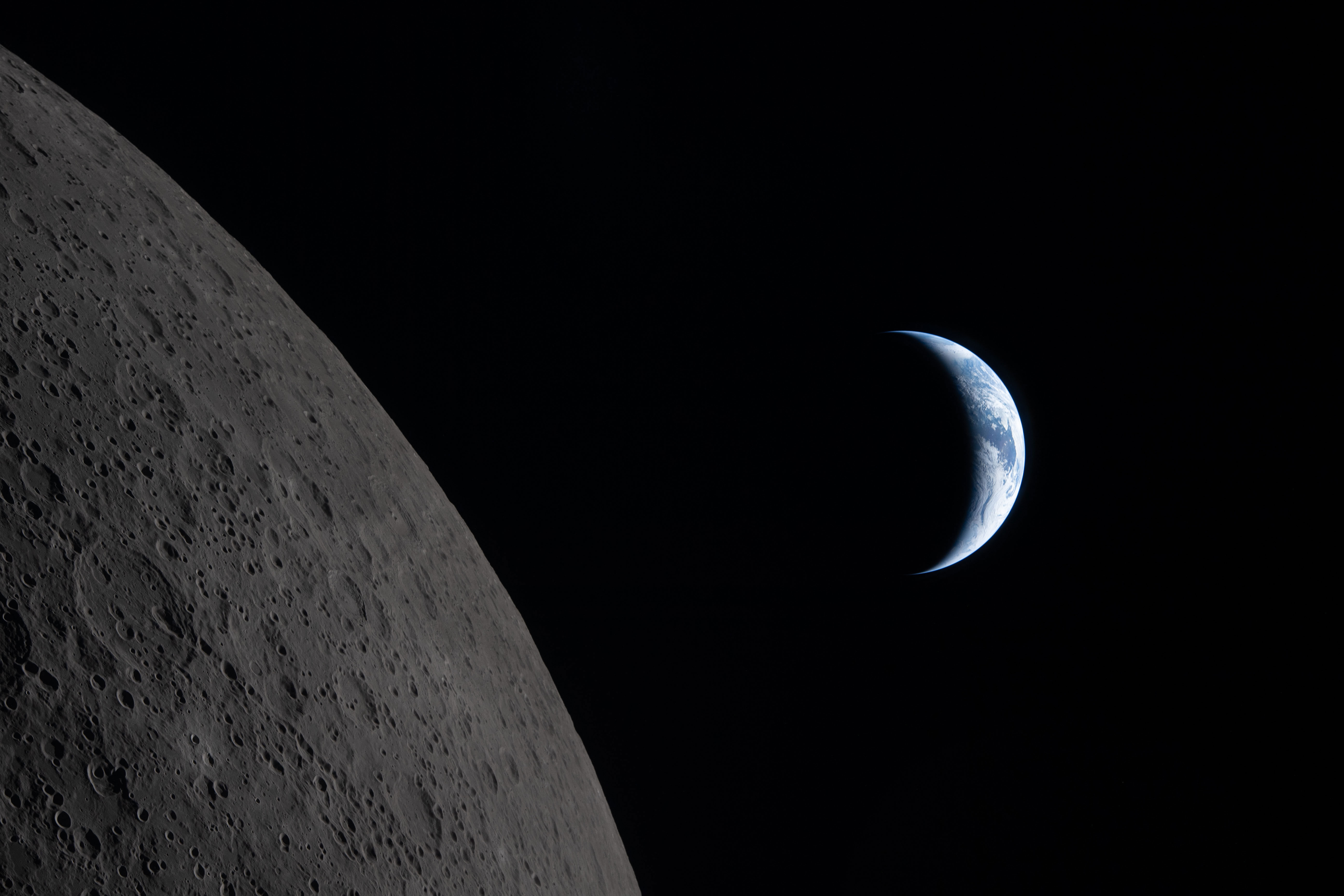
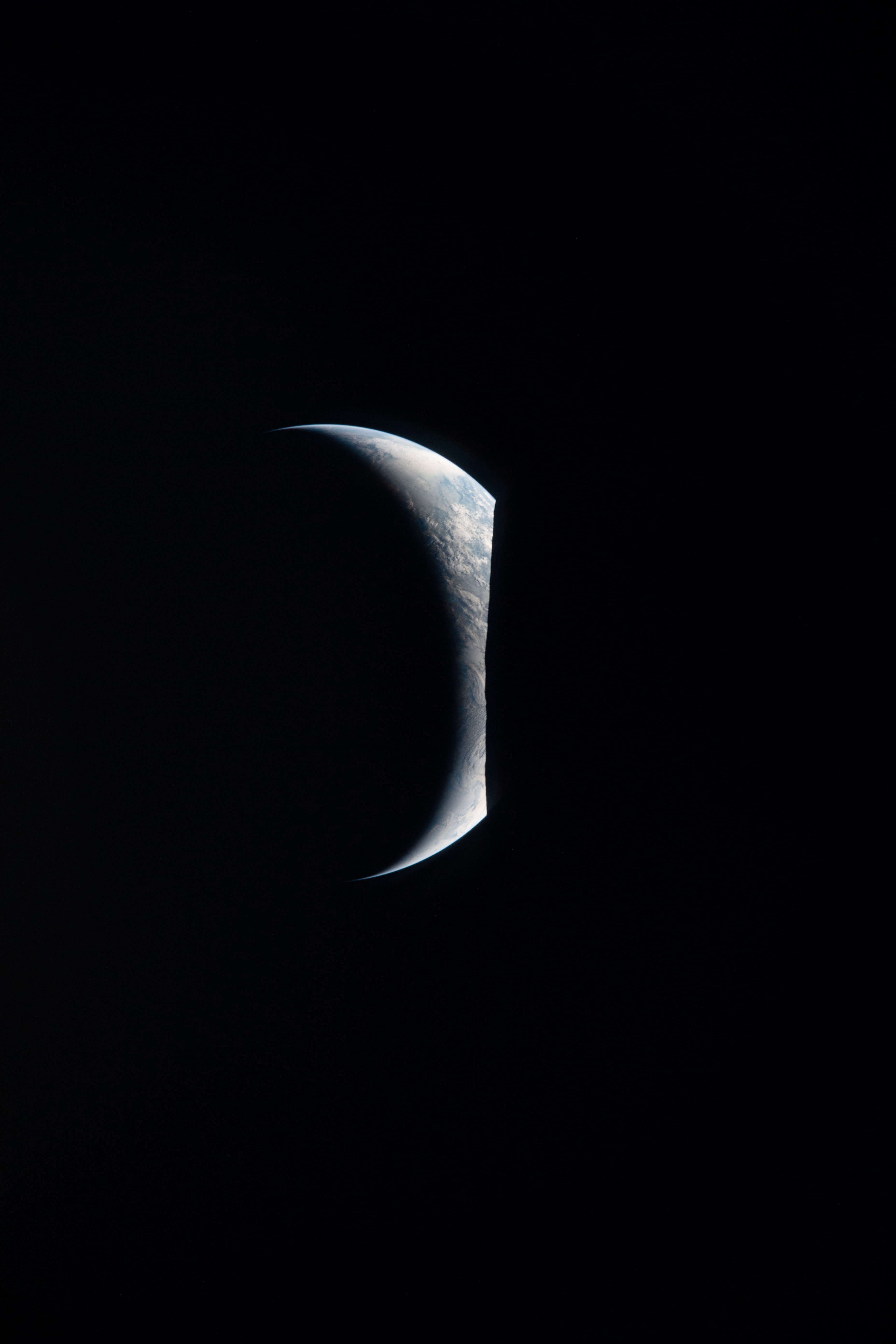
Earthrise captured through the Orion spacecraft window at 7:22 p.m. ET during the Artemis II crew's flyby of the Moon's far side. Earth appears as a delicate crescent, with only its upper edge illuminated. The planet's soft blue hue and scattered white cloud systems stand out against the blackness of space, while the lower portion fades into night.
Taken with a 400 mm lens, the image, Earthrise, reveals a striking alignment of Earth and Moon, with the Moon in the top foreground and the Earth below. Along the lunar horizon, rugged terrain is silhouetted against the bright crescent Earth. Both bodies are oriented with their north poles to the left and south poles to the right, offering a unique perspective of our home planet from deep space. This photo was rotated 90 degrees clockwise for standard viewing orientation.
During their lunar flyby observation period, the Artemis II crew captured this image at 3:41 p.m. EDT, showing the rings of the Orientale basin, one of the Moon's youngest and best-preserved large impact craters. These concentric rings offer scientists a rare window into how massive impacts shape planetary surfaces, helping refine models of crater formation and the Moon's geologic history. At the 10 o'clock position of the Orientale basin, the two smaller craters – which the Artemis II crew has suggested be named Integrity and Carroll – are visible. These features highlight how crew observations can directly support surface feature identification and real-time science.
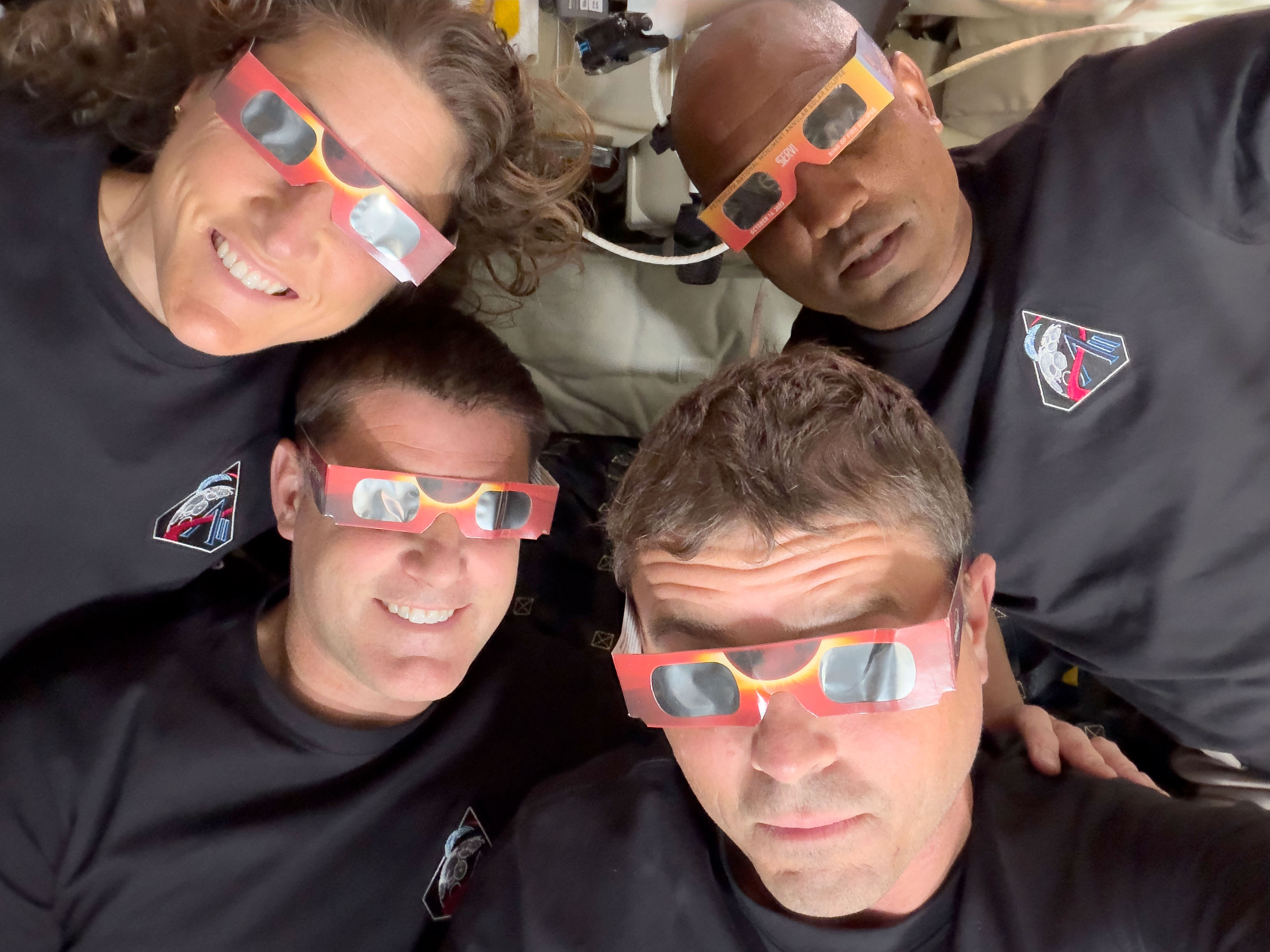
The Artemis II crew – Mission Specialist Christina Koch (top left), Mission Specialist Jeremy Hansen (bottom left), Commander Reid Wiseman (bottom right), and Pilot Victor Glover (top right) – uses eclipse viewers, identical to what NASA produced for the 2023 annular eclipse and 2024 total solar eclipse, to protect their eyes at key moments during the solar eclipse they experienced during their lunar flyby. This was the first use of eclipse glasses at the Moon to safely view a solar eclipse.
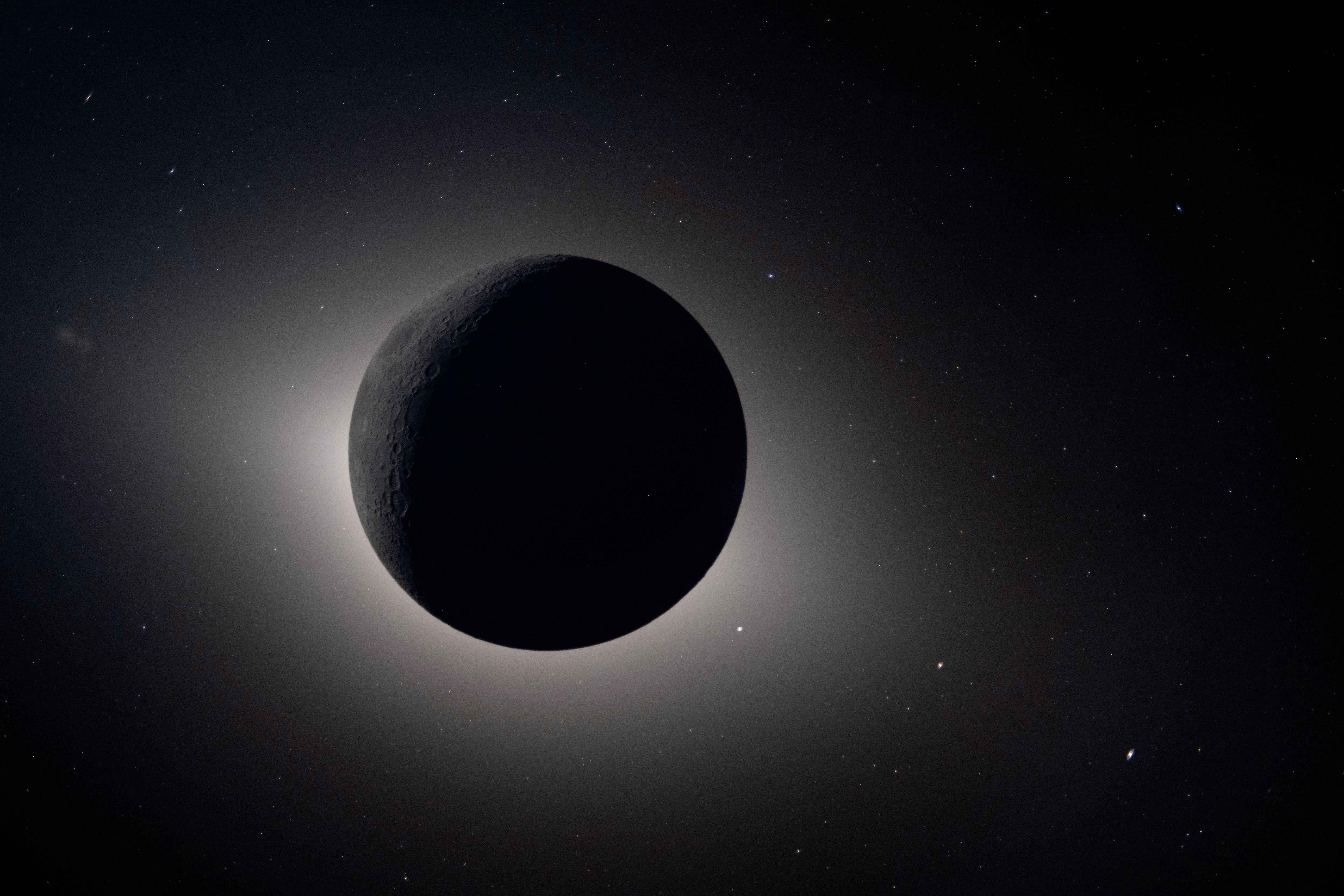
Captured by the Artemis II crew during their lunar flyby on April 6, 2026, this image shows the Moon fully eclipsing the Sun. From the crew's perspective, the Moon appears large enough to completely block the Sun, creating nearly 54 minutes of totality and extending the view far beyond what is possible from Earth. The corona forms a glowing halo around the dark lunar disk, revealing details of the Sun's outer atmosphere typically hidden by its brightness.
Also visible are stars, typically too faint to see when imaging the Moon, but with the Moon in darkness stars are readily imaged. This unique vantage point provides both a striking visual and a valuable opportunity for astronauts to document and describe the corona during humanity's return to deep space. The faint glow of the nearside of the Moon is visible in this image, having been illuminated by light reflected off the Earth.
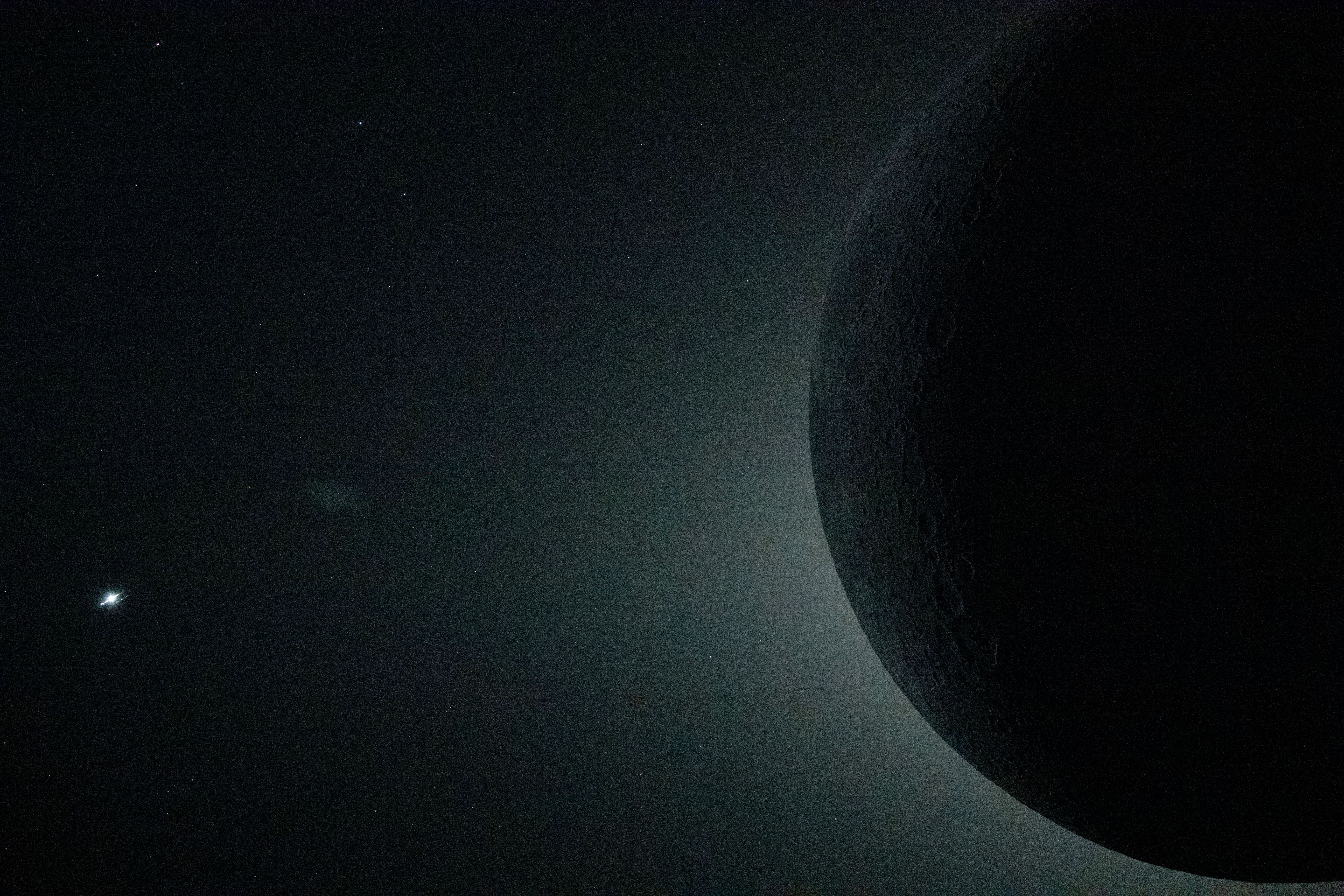
A close-up view from the Orion spacecraft during the Artemis II crew's lunar flyby on April 6, 2026, captures a total solar eclipse, with only part of the Moon visible in the frame as it fully obscures the Sun. Although the full lunar disk extends beyond the image, the Sun's faint corona remains visible as a soft halo of light around the Moon's edge. From this deep-space vantage point, the Moon appeared large enough to sustain nearly 54 minutes of totality, far longer than total solar eclipses typically seen from Earth.
This cropped perspective emphasizes the scale of the alignment and reveals subtle structure in the corona during the rare, extended eclipse observed by the crew. The bright silver glint on the left edge of the image is the planet Venus. The round, dark gray feature visible along the Moon's horizon between the 9 and 10 o'clock positions is Mare Crisium, a feature visible from Earth. We see faint lunar features because light reflected off of Earth provides a source of illumination.
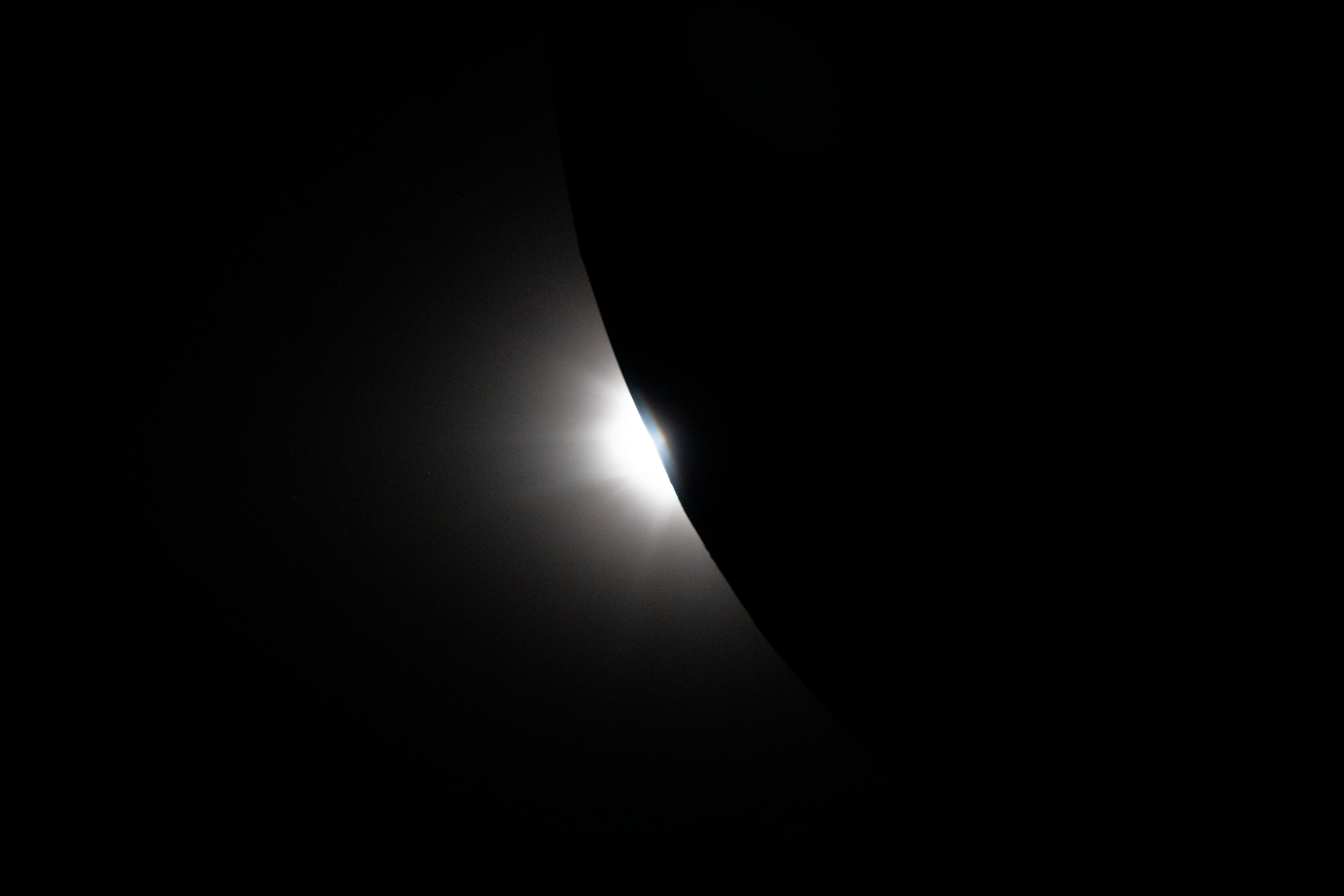
Captured from the Orion spacecraft near the end of the Artemis II lunar flyby on April 6, this image shows the Sun beginning to peek out from behind the Moon as the eclipse transitions out of totality. Only a portion of the Moon is visible in frame, its curved edge revealing a bright sliver of sunlight returning after nearly an hour of darkness.
In final moments of the eclipse observed by the crew, the reemerging light creates a sharp contrast against the Moon's silhouette and reveals lunar topography not usually visible along the lunar limb.
This fleeting phase captures the dynamic alignment of the Sun, Moon, and spacecraft as Orion continues its journey back from the far side of the Moon.
Headshot Member
Posts: 1505 From: Vancouver, WA, USA Registered: Feb 2012
posted 04-07-2026 10:37 AM
The third from the last image of the Moon framed by the sun's corona is one of the most awesome pictures I have ever seen.
thisismills Member
Posts: 629 From: Michigan Registered: Mar 2012
posted 04-07-2026 12:04 PM
I agree with this comment, exactly what I was feeling.
I looked at the image for a long time after seeing it for the first time. Its so amazing that I was hesitant to believe it to be a real photo. My eyes and brain somehow could not process such beauty.
Such an amazing visual phenomenon to capture, thank you Artemis II.
oly Member
Posts: 1580 From: Perth, Western Australia Registered: Apr 2015
posted 04-07-2026 09:15 PM
quote:Originally posted by Headshot: The third from the last image of the Moon framed by the sun's corona is one of the most awesome pictures I have ever seen.
This image was taken using the Nikon Z9 camera, which is in the process of being flight qualified, and taken on Artemis II after the crew requested to do so less than 10 days prior to launch.
Headshot Member
Posts: 1505 From: Vancouver, WA, USA Registered: Feb 2012
posted 04-07-2026 11:07 PM
Thanks for the info. I have read that this Nikon camera is impressive and it appears to be so. I hope there will be no issues with getting it flight qualified as it has acquitted itself admirably.
Robert Pearlman Editor
Posts: 57226 From: Houston, TX Registered: Nov 1999
posted 04-08-2026 09:21 AM
The modified GoPro cameras mounted to the solar array wings also did a good job capturing the same scene:
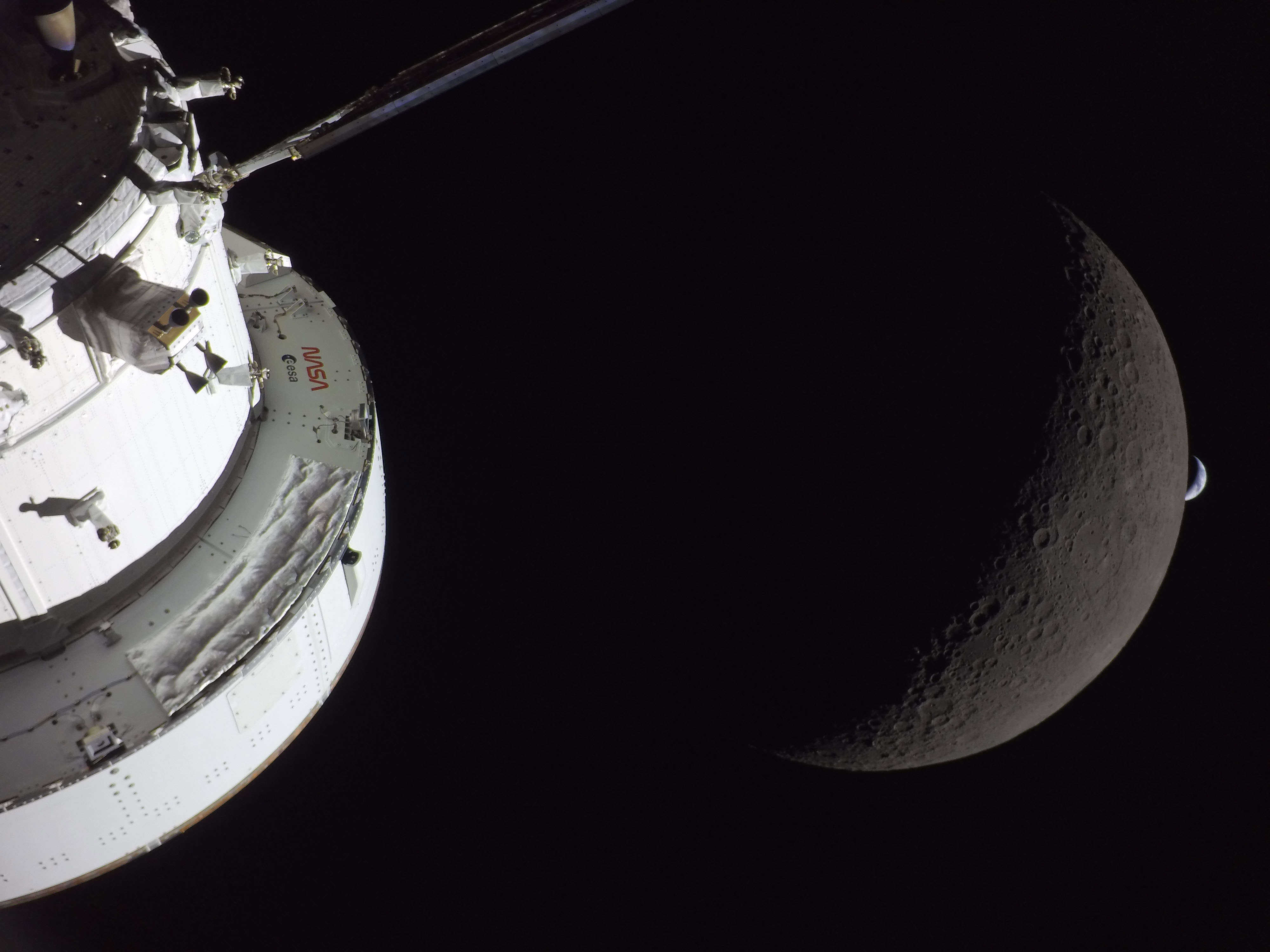
NASA's Orion spacecraft captures the Moon and the Earth in one frame during the Artemis II crew's deep space journey at 6:42 p.m. ET on the sixth day of the mission. The right side of NASA's Orion spacecraft is seen lit up by the Sun. A waxing crescent Moon is visible behind it. And then, a crescent Earth, tiny compared to the Moon, is about to set below the Moon's horizon on the right.
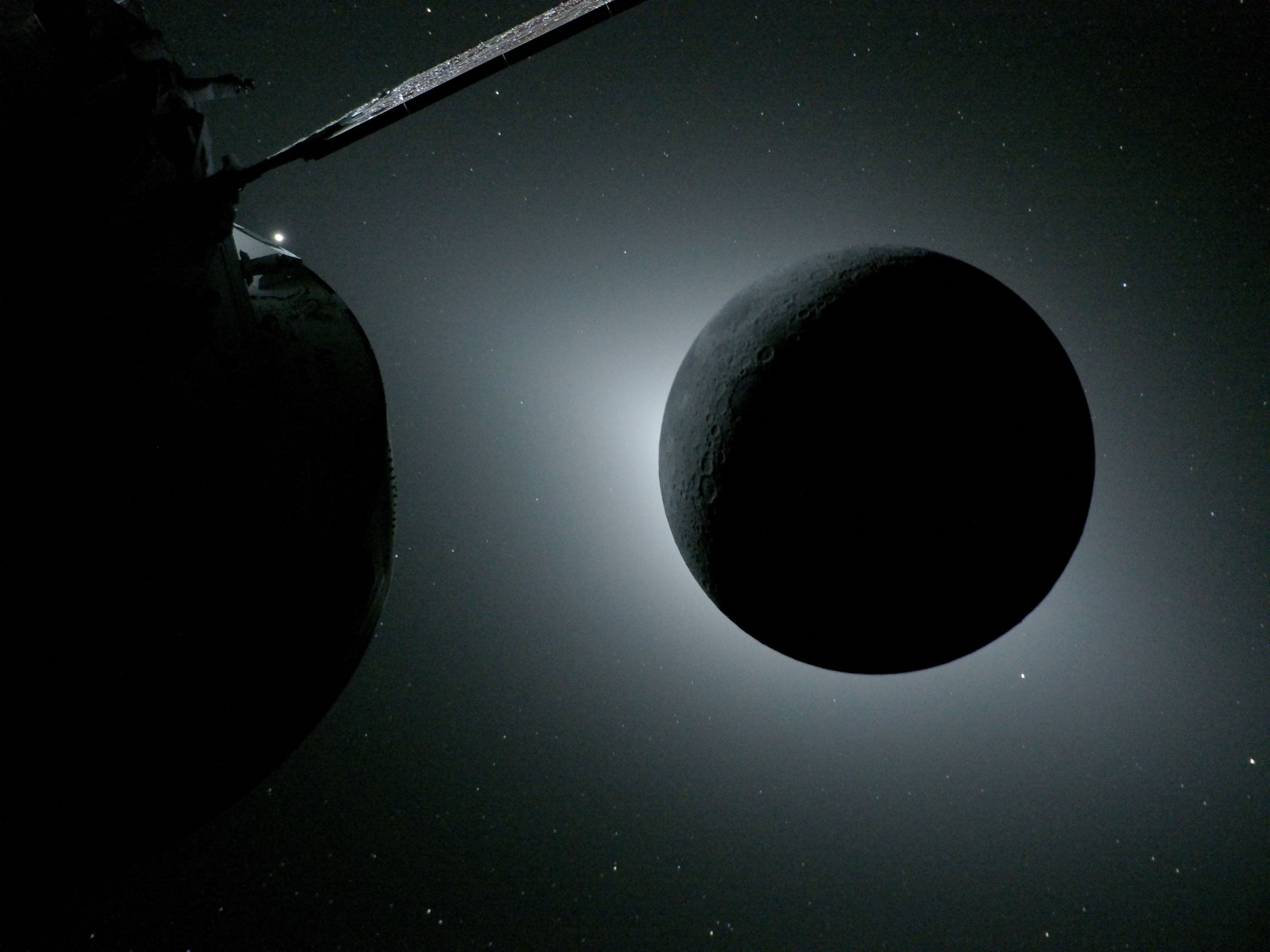
The Moon, backlit by the Sun during a solar eclipse, is photographed by NASA's Orion spacecraft on April 6, 2026, during the Artemis II mission. Orion is visible in the foreground on the left. Earth is reflecting sunlight at the left edge of the Moon, which is slightly brighter than the rest of the disk. The bright spot visible just below the Moon's bottom right edge is Saturn. Beyond that, the bright spot at the right edge of the image is Mars.
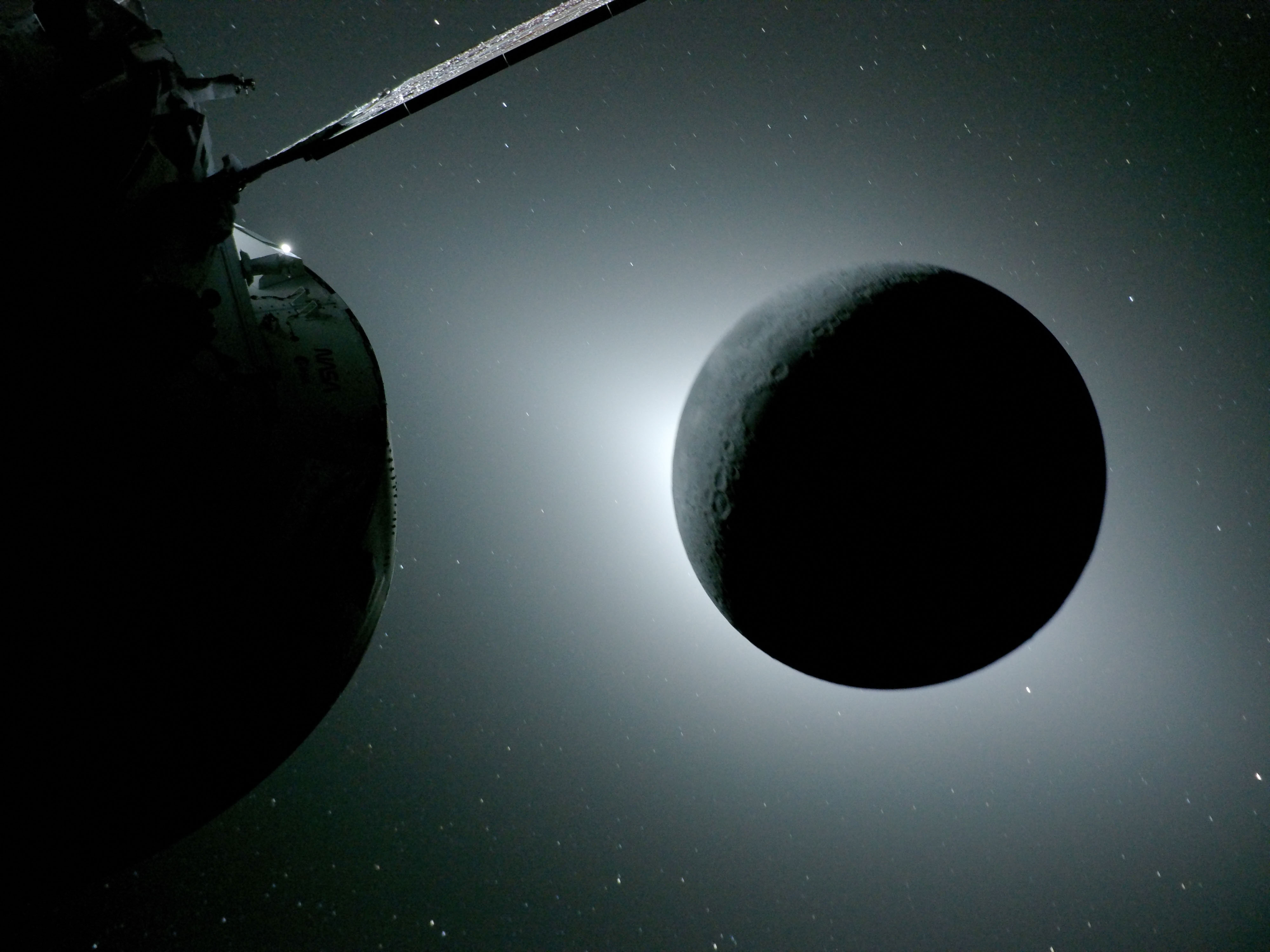
The Moon, seen here backlit by the Sun during a solar eclipse on April 6, 2026, is photographed by one of the cameras on the Orion spacecraft's solar array wings. Orion is visible in the foreground on the left. Earth is reflecting sunlight at the left edge of the Moon, which is slightly brighter than the rest of the disk. The bright spot visible just below the Moon's bottom right edge is Saturn. Beyond that, the bright spot at the right edge of the image is Mars.
Headshot Member
Posts: 1505 From: Vancouver, WA, USA Registered: Feb 2012
posted 04-08-2026 10:27 AM
For some reason this quote popped into my mind regarding the last few pictures:
"... Meanwhile, this ship arranges its own eclipses." - Lt. Jerry Farman, to Commander Adams of United Planets Cruise C57D
dogcrew5369 Member
Posts: 776 From: Statesville, NC Registered: Mar 2009
posted 04-08-2026 04:39 PM
From the epic photos going around, the moon with Earth in the background to the truly amazing and beautiful eclipse photos, one thing kept popping into my mind — the score to "2001."
I've always loved that theme. An appropriate theme for such magnificent images my mind can barely comprehend. Just wow!
This should inspire so many young people to follow their dreams in the stars.
Blackarrow Member
Posts: 3994 From: Belfast, United Kingdom Registered: Feb 2002
posted 04-08-2026 05:37 PM
One point which occurred to me was that in 1968, it was the "Earthrise" image which captured the world's imagination. Now in 2026, it seems to be the "Earthset" images having the same effect.
The one image I have seen of "Earthrise 2026" is startling, but does not seem to have captured anyone's imagination. I haven't seen it anywhere in the media. I think the reason is that, however remarkable the content of the image, it just doesn't have the same aesthetic power of the "Earthset" images.
In particular, I am mesmerized by the image taken at 6.41pm EDT which really demonstrates how small and far away Earth is, compared to the huge, brooding mass of the Moon. Chilling, thrilling and exhilarating!
Robert Pearlman Editor
Posts: 57226 From: Houston, TX Registered: Nov 1999
posted 04-08-2026 06:06 PM
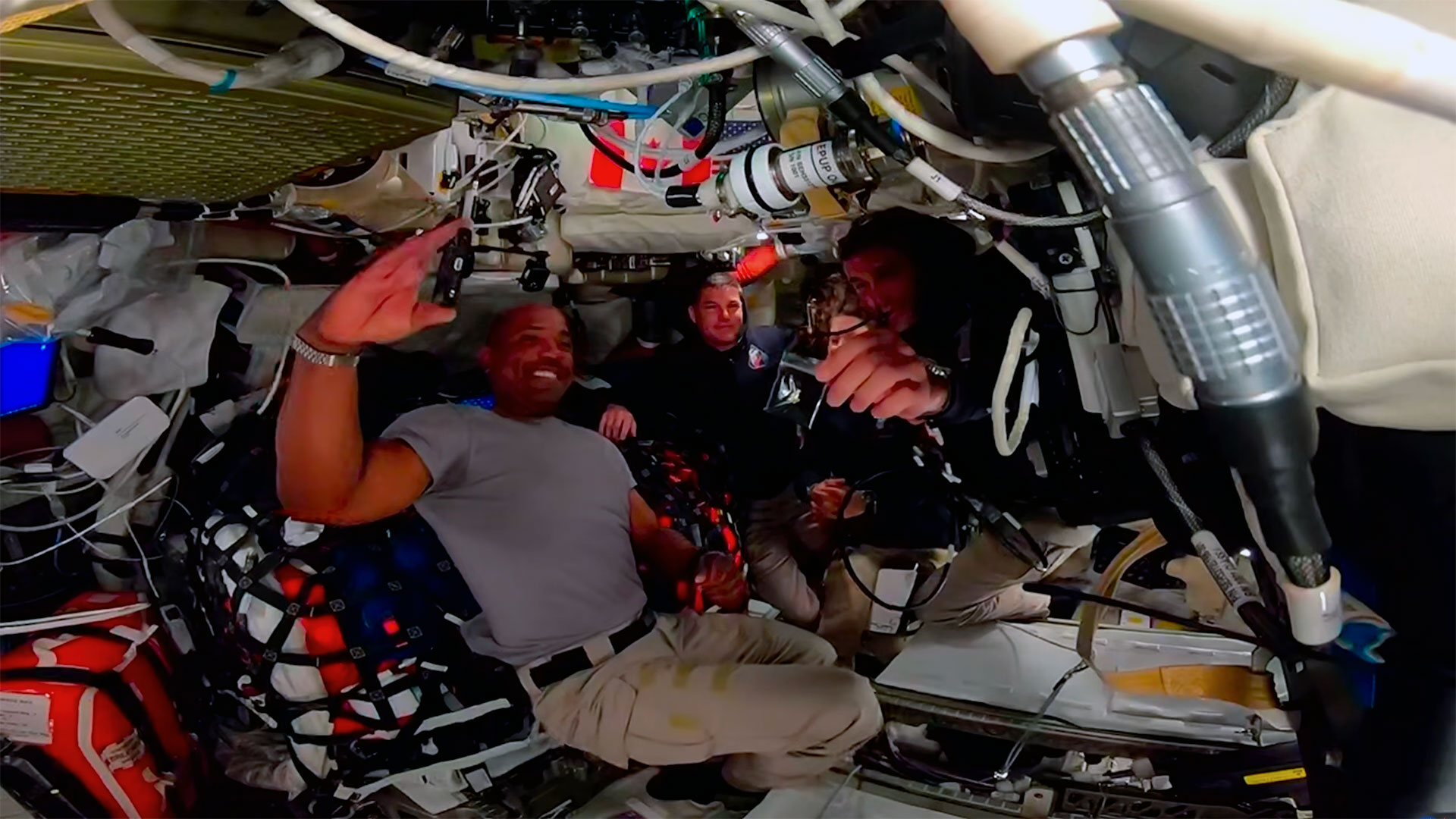
Artemis II mission specialist Jeremy Hansen is seen through a window of the Orion spacecraft while on his way to the moon. This selfie-style photo was taken using a camera on the end of one of Orion's solar array wings on flight day 4 of the approximately 10-day test flight, when Orion was more than halfway to the moon.
Artemis II mission specialist Christina Koch (center) and Commander Reid Wiseman (top) are seen through windows of the Orion spacecraft while on their way to the moon.
Artemis II mission specialist Christina Koch is seen through a window of the Orion spacecraft while on her way to the moon. Koch is holding "Rise," the zero gravity indicator that launched with the crew.
Robert Pearlman Editor
Posts: 57226 From: Houston, TX Registered: Nov 1999
posted 04-08-2026 09:39 PM
NASA video
Join us as Artemis II astronauts aboard the Orion spacecraft hold a news conference to answer media questions on their way home to Earth.
Philip Member
Posts: 6439 From: Brussels, Belgium Registered: Jan 2001
posted 04-09-2026 07:14 AM
The crew module of the Orion capsule "Integrity" is due to reenter Earth's atmosphere on Friday, April 10.
The splashdown in the Pacific Ocean off the coast of San Diego, California is estimated around 8:08 p.m. EST (1:00 AM GMT - Greenwich Mean Time).
Headshot Member
Posts: 1505 From: Vancouver, WA, USA Registered: Feb 2012
posted 04-09-2026 02:34 PM
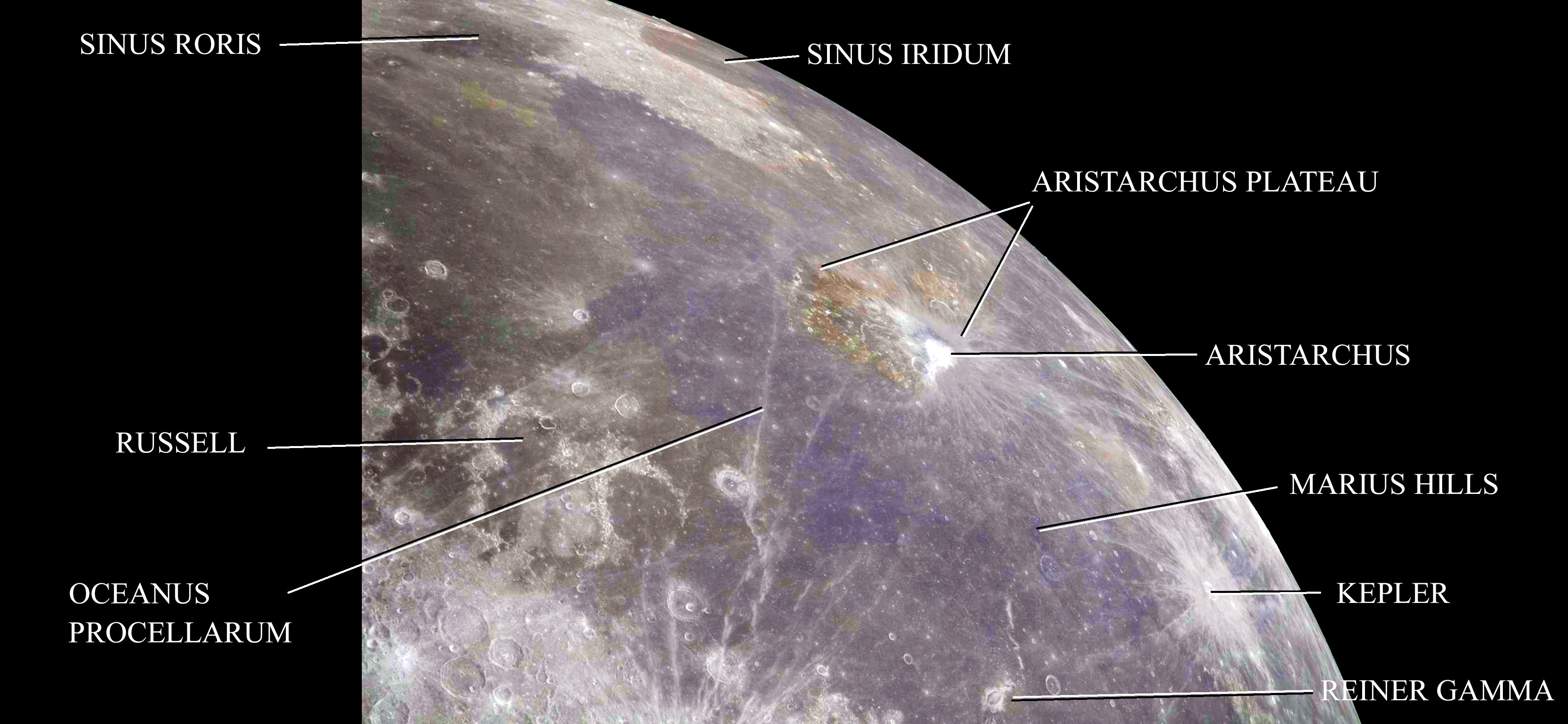
I processed the art002e12028 image to highlight regional color differences, which indicates reflective and compositional differences on the lunar surface. This image really shows the interesting varieties of materials on the Artistarchus Plateau.
I have also added names of some interesting features. I can only image the kind of information the Artemis Science Group will get out of these images.
Blackarrow Member
Posts: 3994 From: Belfast, United Kingdom Registered: Feb 2002
posted 04-09-2026 04:31 PM
At the risk of sounding a discordant note, it looks like the U.S. and Canadian flags have been switched around inside Integrity, with the Stars and Stripes now on the left instead of the right. What could possibly have brought that about?
GACspaceguy Member
Posts: 3342 From: Guyton, GA Registered: Jan 2006
posted 04-09-2026 05:03 PM
I believe it was incorrect protocol earlier as the US flag should be first on a US ship. Someone must have noticed.
Blackarrow Member
Posts: 3994 From: Belfast, United Kingdom Registered: Feb 2002
posted 04-10-2026 08:12 AM
That's what I thought.
Robert Pearlman Editor
Posts: 57226 From: Houston, TX Registered: Nov 1999
posted 04-10-2026 04:09 PM
NASA video
Around the Moon and back. Watch the Artemis II astronauts come home.
rjurek349 Member
Posts: 1250 From: Northwest Indiana Registered: Jan 2002
posted 04-10-2026 07:41 PM
That was so awesome to watch. Seeing those parachutes open brought back a flood of memories -- like so many moments throughout this mission.
A big thank you, Robert, for all your great reporting on this: you kept us right there.
Welcome home Artemis II!
Robert Pearlman Editor
Posts: 57226 From: Houston, TX Registered: Nov 1999
posted 04-10-2026 08:31 PM
Thank you Rich! Indeed, what a mission! One for the history books.
A big thank you to Intuitive Machines whose support made our coverage possible.
And thank you to all who read collectSPACE over the past 10 days. Our web stats show we had an influx of new visitors and I have a backlog of forum membership registrations to approve. Glad to have you all here!
Welcome home Artemis II!
Blackarrow Member
Posts: 3994 From: Belfast, United Kingdom Registered: Feb 2002
posted 04-10-2026 08:47 PM
I confess that I was a bit apprehensive leading up to re-entry and splashdown, but that made the tremendous success all the sweeter. What an amazing mission, what an amazing crew. It was a long time coming, but it was worth the wait. Congratulations, NASA... and now on to Artemis III.
Whew!
Robert Pearlman Editor
Posts: 57226 From: Houston, TX Registered: Nov 1999
posted 04-10-2026 09:27 PM
NASA video
After a trip around the Moon, Artemis II is back on Earth. Join us as agency leaders talk about today's splashdown and answer questions from the media.







 posted 04-04-2026 06:44 PM





 advertisement