Topic: [Discuss] NASA's Artemis II mission (Orion)
Robert Pearlman Editor
Posts: 57226 From: Houston, TX Registered: Nov 1999
posted 05-08-2026 11:29 AM
Newly released footage of the crew during their reentry and splashdown:
Headshot Member
Posts: 1505 From: Vancouver, WA, USA Registered: Feb 2012
posted 05-08-2026 02:48 PM
Good video.
Robert Pearlman Editor
Posts: 57226 From: Houston, TX Registered: Nov 1999
posted 05-12-2026 10:33 AM
Oprah video
After their extraordinary, history-making trip around the moon, Oprah has an in-depth conversation with the crew of Artemis II.
Robert Pearlman Editor
Posts: 57226 From: Houston, TX Registered: Nov 1999
posted 05-12-2026 10:37 AM
PBS News Hour video
Senators from the Commerce Committee hosted the crew of the Artemis II lunar flyby mission to congratulate them. Committee chairs Sens. Ted Cruz (R-TX) and Maria Cantwell (D-WA) delivered brief remarks before the astronauts spoke themselves.
Cruz then gifted each of them a framed copy of a Senate resolution commemorating their achievement of flying farther in space than any human.
Robert Pearlman Editor
Posts: 57226 From: Houston, TX Registered: Nov 1999
posted 05-13-2026 10:16 AM
CTV News video
Canada's Prime Minister Carney speaks with Artemis II crew.
Robert Pearlman Editor
Posts: 57226 From: Houston, TX Registered: Nov 1999
posted 07-02-2026 08:28 PM
NASA release
NASA's Artemis II Breaks Agency Streaming Record
NASA's live coverage of the Artemis II mission mission drew unprecedented public interest – including more than 149.4 million views of the launch, lunar flyby, splashdown on NASA-owned platforms, including the 24/7 streams covering the mission and the Orion spacecraft views – demonstrating strong, sustained global engagement throughout the mission.
Around the Clock Live Broadcast
NASA's Artemis II Crew Launches to the Moon broadcast set unprecedented viewership records across the agency's streaming platforms, drawing a combined peak of 3,662,554 viewers—rising to 3.66 million when including more than 411,130 concurrent viewers on X and Twitch—surpassing previous milestones, including the launches of Artemis I (2022) and the James Webb Space Telescope (2021–2022). The launch generated 23.9 million total views across NASA platforms, with 16.6 million people watching live, underscoring the mission's broad national and global appeal from liftoff onward. NASA en español's dedicated broadcast also reached a landmark peak of 458,366 concurrent viewers and has since amassed 2.8 million total views, highlighting the mission's strong resonance with Spanish‑speaking audiences and expanding the global reach of Artemis communications.
NASA's Artemis II Lunar Flyby broadcast delivered one of the largest peak audiences ever recorded across the agency's streaming platforms, reaching 1,471,069 total concurrent viewers – driven largely by 897,789 on YouTube, one of NASA's strongest single platform performances – along with an additional 190,221 viewers on X and Twitch, underscoring the mission's broad global reach and sustained excitement. Together, the Artemis II launch and Moon flyby broadcasts have redefined NASA's livestreaming benchmarks, demonstrating record-breaking public interest in humanity's return to the Moon. As of April 13, the flyby broadcast has accumulated 40 million views across NASA+, YouTube, X, and Twitch, highlighting the intense and enduring engagement surrounding Artemis II.
Pre‑splashdown coverage across major outlets emphasized the "riskiest moments" still ahead—particularly Orion's reentry and heat‑shield performance—framing the return as the mission's climax and driving heightened public attention. As anticipation grew, audience interest that had already surged during the record‑setting launch only intensified: Artemis II's liftoff drew 3,662,554 peak viewers, but global curiosity about the crew's safe return pushed splashdown viewership even higher to 3,838,418, a 4.8% increase that reflected widespread investment in the mission's outcome as viewers tuned in to witness the critical reentry sequence, confirm crew safety, and celebrate humanity's first journey around the Moon in more than 50 years. NASA's Artemis II Crew Comes Home generated 29.5 million total views across NASA-owned platforms, with an estimated 24.1 million occurring during the live return sequence—an exceptional level of engagement that underscores the deep public interest carried through the mission's final and most critical moments.
Major entertainment platforms including HBO Max, Netflix, Peacock, and Amazon Prime Video exponentially expanded NASA's global footprint by placing Artemis II in front of hundreds of millions of potential viewers worldwide, with HBO Max reaching 120–150 million global subscribers; Netflix reaching 325 million paid subscribers and covering 54% of global households; Peacock contributing 36–41 million U.S. subscribers; and Amazon Prime Video reaching up to 275 million global subscribers. Together, these partners enabled NASA to reach mainstream, international, and non-traditional audiences at a scale unattainable through NASA-owned channels alone.
Websites
NASA's Artemis II mission drove a major surge in traffic across the agency's websites, with NASA.gov recording 125.1 million pageviews between April 1 and 10 – more than double the roughly 50 million logged in all of March – reflecting intense public interest in following the mission in real time. On launch day alone, NASA sites saw 17.6 million pageviews from 8.3 million visitors, with the Artemis Real-Time Orbit Website (AROW) drawing 797,796 pageviews,
Interest spiked again during the April 6 lunar flyby, generating 16.5 million pageviews from 6.2 million visitors; AROW registered 1.9 million pageviews – boosted by more than 440,000 Google referrals – while the NASA homepage reached 2.3 million. Splashdown day brought another surge to NASA-owned websites, with more than 16 million pageviews from 6.1 million visitors as audiences followed the Artemis II crew's return; AROW drew over 1 million pageviews and surpassed 11 million cumulative views since launch. Together, these metrics show sustained, high-volume engagement across all mission milestones, with live hubs, broadcast pages, and real-time tracking consistently ranking among the most-visited content throughout launch, flyby, and splashdown.
Social Media
Public reaction to NASA's Artemis II mission remained largely steady across launch week, with neutral and positive posts dominating the online conversation. Neutral sentiment consistently led daily discussion, ranging from 47 to 60 percent, while positive reactions accounted for 30 to 42 percent, fueled by excitement over the crew's historic lunar journey, striking mission imagery, and renewed interest in deep space exploration. Engagement spiked around major mission milestones, with NASA accounts generating 35 million engagements on splashdown day content alone and 261 million from March 27 to April 13, underscoring how closely audiences followed each phase. Strong amplification from major news outlets, brands, and international partners, further boosted visibility and cemented Artemis II as a global cultural moment.
NASA's Artemis II mission drove major social media growth across the agency's flagship and mission‑specific accounts, with follower numbers climbing steadily from rollout through the lunar flyby and splashdown. Internal tracking shows NASA's flagship Instagram account added more than 4.6 million followers, while the Artemis‑dedicated Instagram account grew by 2 million—a 66% increase over the course of the mission. Significant gains were also recorded across X, Facebook, and YouTube, including a 2 million increase in YouTube subscribers and NASA's flagship Facebook page climbing by 1.7 million. Collectively, these gains highlight how Artemis II's human‑spaceflight narrative, real‑time crew updates, and highly visual moments drew millions of new followers across platforms.
Mission Images
NASA has long shaped its legacy through unforgettable imagery—pictures that don't just document history but become part of it. Artemis II carries that tradition forward with a growing collection of images capturing every phase of the mission, from the anticipation of launch to the sweep of a lunar flyby and splashdown. For those eager to explore more, the mission's dedicated image galleries offer a rich visual journey, complemented by additional photos on the NASA Headquarters official Flickr account and the NASA Image and Video Library.
NASA Campaigns
Moon Mascot: NASA Artemis II ZGI Design Challenge
Last year, the Moon mascot design contest received thousands of submissions from more than fifty countries for the Artemis II mission's zero‑gravity indicator. This plush item serves a special purpose — it begins to float once the astronauts reach space, signaling the onset of zero gravity. It also provides a comforting reminder of Earth when the crew is far from home.
Ultimately, the Artemis II astronauts selected "Rise"—inspired by the iconic Earthrise photograph captured during the Apollo 8 mission and designed by Lucas Ye of Mountain View, California—as the zero‑gravity indicator that will accompany them around the Moon. "Rise" also features a small pouch that will carry an SD card containing all 5.6 million names submitted through the Send Your Name with Artemis campaign.
Send Your Name with Artemis II
NASA invited the public to join the agency's Artemis II test flight as four astronauts ventured around the Moon and back to test the systems and hardware needed for deep space exploration. As part of the agency's "Send Your Name with Artemis II" effort, anyone could claim their spot by signing up before Jan. 21, 2026. Participants launched their names aboard the Orion spacecraft and SLS (Space Launch System) rocket alongside NASA astronauts Reid Wiseman, Victor Glover, Christina Koch, and CSA (Canadian Space Agency) astronaut Jeremy Hansen.
Online Collaborations
Google Doodle
The April 1, 2026, Google Doodle celebrated the launch of Artemis II, the NASA mission that sent astronauts around the Moon and back for the first time in more than 50 years. During the approximately 10‑day voyage, the crew tested the spacecraft's systems while traveling farther into deep space than any human had gone since the Apollo program. This critical test flight brought us one step closer to a long‑term return to the Moon and future missions to Mars.
Spotify Playlist: The Artemis II Crew's Wake-up Songs
NASA's official playlist for the Artemis II mission featuring songs selected by the crew for their historic 10-day journey around the Moon.
Merriam-Webster Dictionary
Merriam-Webster highlighted the Artemis II mission on their official Facebook page, engaging with astronauts in deep space to discuss the experience of traveling farther than any human before.
Offline Collaborations
NASDAQ, New York
Nasdaq celebrated the successful launch of NASA's Artemis II mission, marking humanity's return to the Moon after more than 50 years.
Empire State Building, New York
Red, white, and blue for the Artemis II crew. Welcome back to Earth.
Sphere, Las Vegas
As the astronauts on Orion reached their closest approach to the Moon, the sphere celebrated this milestone here on Earth. NASA provided the Sphere with a 3D model of the Orion spacecraft and unique soundbites from the April 1, 2026, launch to help design the moon, spacecraft, and flight path to match the real-life version.
Piccadilly Lights, London
London's Piccadilly Lights celebrated the lunar flyby of Artemis II, where the four astronauts aboard the Orion spacecraft went deeper into space than ever before.
Robert Pearlman Editor
Posts: 57226 From: Houston, TX Registered: Nov 1999
posted 07-14-2026 02:00 PM
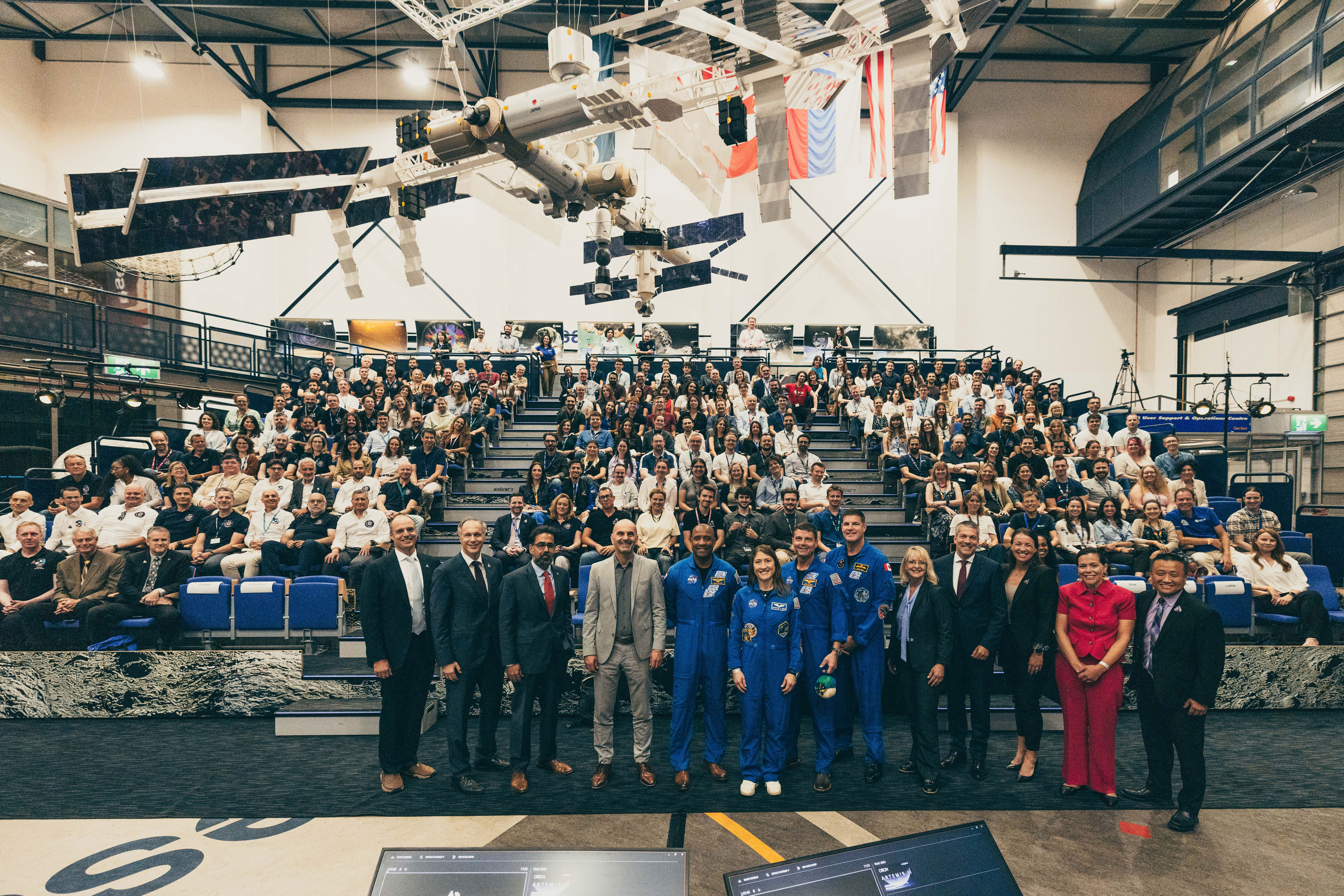
Yesterday (July 13), the four Artemis II astronauts visited ESA's technical site in the Netherlands, where they met the team behind the European Service Module.
Photo credit: ESA/P. Servent
Later this week, the crew will also visit European Service Module prime contractor Airbus in Bremen, Germany, and Thales Alenia Space in Turin, Italy, which built the module's structure.
There is no information yet about any public appearances.
Robert Pearlman Editor
Posts: 57226 From: Houston, TX Registered: Nov 1999
What did four astronauts see, notice, and document as they traveled around the Moon during NASA’s Artemis II mission?
Through photographs, spoken observations, drawings, and annotations, the Artemis II crew created a unique scientific record — one that is now available to the science community and the public for further study. Explore highlights here, and find the full suite of reports and select data resources at the bottom of the page.
Headshot Member
Posts: 1505 From: Vancouver, WA, USA Registered: Feb 2012
posted 10-08-2026 01:56 PM
Thanks for posting this link Robert. I have been waiting for the PSR release since the beginning of October. I recalled that, during Artemis II's closest approach to the Moon, NASA said the science results would be released in six months ... and they were!
Robert Pearlman Editor
Posts: 57226 From: Houston, TX Registered: Nov 1999
posted 10-10-2026 06:17 AM
NASA/JSC/Simeon Schmauß video
Artemis II splashed down on April 11, 2026, 00:07:27UTC southwest of San Diego after a 10 day mission around the Moon. This video shows the re-entry of the Orion capsule from the Cabcam2, which is mounted to the pilot’s forward window.
The camera audio captured the dynamic noises from re-entry, including intermittent banging sounds from the RCS thrusters. The thruster plumes also interact with the air, causing rapid changes in the plasma tail.
Occasionally, callouts by CapCom Jackie Mahaffey can be heard which were played over speaker to the astronauts. The voices from the astronauts can also be heard but are almost unintelligible since the camera/microphone was mounted directly to the window.
The video starts with Orion at approximately 2000 km above the surface while flying at 9.2 km/s. The actual reentry starts approximately 10 minutes later when Orion reached the Entry Interface at 122 km (400 kft) altitude, now flying at 11km/s.
The Orion spacecraft uses spaceflight-hardened GoPro Hero 4 Black cameras to capture engineering videos. While these cameras provided spectacular views during the mission, most videos were also captured with the GoPro “SuperView” capture mode enabled which stretches the original 4:3 aspect ratio to 16:9 nonuniformly, causing the horizon to appear warped. I have reverted this distortion using the “GoPro Reframe” plugin in DaVinci Resove. Due to a bug in the plugin, there are a couple of frame jumps in the video. I hope to fix that in a future version.
The video was also carefully upscaled to 4K, mainly to reduce video compression artefacts. Finally, the contrast and colors of the video were significantly enhanced, since a lot of soot was deposited on the window during reentry clouding the view.
I also reprocessed the audio to reduce the electronic interference noise and reversed the automatic gain that was applied by the GoPro.
00:00 Astronauts reflecting in the window
04:44 Earth comes into view
07:16 Moonset
09:23 Start of Reentry
10:23 Service module disintegration
19:10 Parachute Deployment
23:16 Splashdown
Robert Pearlman Editor
Posts: 57226 From: Houston, TX Registered: Nov 1999
posted 10-12-2026 09:33 PM
Fédération Aéronautique Internationale World Air Sports Federation release
Artemis II astronauts receive their official FAI World Record certificates in Houston
The four Artemis II mission astronauts – Reid Wiseman, Victor Glover, Jeremy Hansen and Christina Koch – each received official FAI World Record certificates for their achievements on 30 October 2026 at a public event in Houston, USA.
The framed certificates describe the FAI Astronautic World Records attained by the crew during the mission in April 2026 to the far side of the moon, in which they voyaged further into space than humans have ever previously travelled:
FAI Astronautic Record for Altitude above the Earth while in Earth orbit: On 2 April 2026 the Artemis II crew reached 70 149 km (43 588 miles) above Earth's surface, surpassing the previous 1966 record of 1 369 km set by Gemini 11 and the female record of 1 408 km set in September 2024 by the Polaris Dawn mission crew, Sarah Gillis and Anna Menon.
FAI Astronautic Record for Distance to Earth: On 6 April 2026, the Artemis II crew reached a distance of 406 767 km (252 753 miles) from Earth. This distance surpassed the previous official FAI Astronautic Record of 377 668.9 km set by Apollo 8 in 1968 and the 1970 Apollo 13 mission of 400 171 km, in which the damaged spacecraft was brought safely back to Earth under emergency circumstances.
FAI Astronautic Records - Female category: Christina Koch, the female Artemis II crew member holds two records in her name: Distance to Earth and Altitude above Earth while in Earth orbit.
The record certificates were presented by FAI President, Greg Principato, and Amy Spowart, President and CEO of the FAI Member for the USA, the National Aeronautic Association, whose Contest and Records Board worked closely with NASA to ratify the record.
The event, held at the University of Houston's Fertitta Center, celebrated the achievements of the crew with a Q&A in which the four astronauts responded to questions from the public about their voyage around the Moon.







 posted 05-08-2026 11:29 AM




 advertisement