Topic: NASA's OSIRIS-REx to return asteroid sample
Robert Pearlman Editor
Posts: 53874 From: Houston, TX Registered: Nov 1999
posted 05-25-2011 03:18 PM
NASA release
NASA to launch science mission to asteroid in 2016
NASA will launch a spacecraft to an asteroid in 2016 and use a robotic arm to pluck samples that could better explain our solar system's formation and how life began. The mission, called Origins-Spectral Interpretation-Resource Identification-Security-Regolith Explorer, or OSIRIS-REx, will be the first U.S. mission to carry samples from an asteroid back to Earth.
"This is a critical step in meeting the objectives outlined by President Obama to extend our reach beyond low-Earth orbit and explore into deep space," said NASA Administrator Charlie Bolden. "It's robotic missions like these that will pave the way for future human space missions to an asteroid and other deep space destinations."
NASA selected OSIRIS-REx after reviewing three concept study reports for new scientific missions, which also included a sample return mission from the far side of the moon and a mission to the surface of Venus.
Asteroids are leftovers formed from the cloud of gas and dust -- the solar nebula -- that collapsed to form our sun and the planets about 4.5 billion years ago. As such, they contain the original material from the solar nebula, which can tell us about the conditions of our solar system's birth.
After traveling four years, OSIRIS-REx will approach the primitive, near Earth asteroid designated 1999 RQ36 in 2020. Once within three miles of the asteroid, the spacecraft will begin six months of comprehensive surface mapping. The science team then will pick a location from where the spacecraft's arm will take a sample. The spacecraft gradually will move closer to the site, and the arm will extend to collect more than two ounces of material for return to Earth in 2023. The mission, excluding the launch vehicle, is expected to cost approximately $800 million.
The sample will be stored in a capsule that will land at Utah's Test and Training Range in 2023. The capsule's design will be similar to that used by NASA's Stardust spacecraft, which returned the world's first comet particles from comet Wild 2 in 2006. The OSIRIS-REx sample capsule will be taken to NASA's Johnson Space Center in Houston. The material will be removed and delivered to a dedicated research facility following stringent planetary protection protocol. Precise analysis will be performed that cannot be duplicated by spacecraft-based instruments.
RQ36 is approximately 1,900 feet in diameter or roughly the size of five football fields. The asteroid, little altered over time, is likely to represent a snapshot of our solar system's infancy. The asteroid also is likely rich in carbon, a key element in the organic molecules necessary for life. Organic molecules have been found in meteorite and comet samples, indicating some of life's ingredients can be created in space. Scientists want to see if they also are present on RQ36.
"This asteroid is a time capsule from the birth of our solar system and ushers in a new era of planetary exploration," said Jim Green, director, NASA's Planetary Science Division in Washington. "The knowledge from the mission also will help us to develop methods to better track the orbits of asteroids."
The mission will accurately measure the "Yarkovsky effect" for the first time. The effect is a small push caused by the sun on an asteroid, as it absorbs sunlight and re-emits that energy as heat. The small push adds up over time, but it is uneven due to an asteroid's shape, wobble, surface composition and rotation. For scientists to predict an Earth-approaching asteroid's path, they must understand how the effect will change its orbit. OSIRIS-REx will help refine RQ36's orbit to ascertain its trajectory and devise future strategies to mitigate possible Earth impacts from celestial objects.
Michael Drake of the University of Arizona in Tucson is the mission's principal investigator. NASA's Goddard Space Flight Center in Greenbelt, Md., will provide overall mission management, systems engineering, and safety and mission assurance. Lockheed Martin Space Systems in Denver will build the spacecraft. The OSIRIS-REx payload includes instruments from the University of Arizona, Goddard, Arizona State University in Tempe and the Canadian Space Agency. NASA's Ames Research Center at Moffett Field, Calif., the Langley Research Center in Hampton Va., and the Jet Propulsion Laboratory in Pasadena, Calif., also are involved. The science team is composed of numerous researchers from universities, private and government agencies.
This is the third mission in NASA's New Frontiers Program. The first, New Horizons, was launched in 2006. It will fly by the Pluto-Charon system in July 2015, then target another Kuiper Belt object for study. The second mission, Juno, will launch in August to become the first spacecraft to orbit Jupiter from pole to pole and study the giant planet's atmosphere and interior. NASA's Marshall Space Flight Center in Huntsville, Ala., manages New Frontiers for the agency's Science Mission Directorate in Washington.
Robert Pearlman Editor
Posts: 53874 From: Houston, TX Registered: Nov 1999
posted 09-04-2012 11:43 AM
NASA release
NASA announces asteroid naming contest for students
Students worldwide have an opportunity to name an asteroid from which an upcoming NASA mission will return the first samples to Earth.
Scheduled to launch in 2016, the mission is called the Origins Spectral Interpretation Resource Identification Security Regolith Explorer (OSIRIS-REx). Samples returned from the primitive surface of the near-Earth asteroid currently called (101955) 1999 RQ36 could hold clues to the origin of the solar system and organic molecules that may have seeded life on Earth. NASA also is planning a crewed mission to an asteroid by 2025. A closer scientific study of asteroids will provide context and help inform this mission.
"Because the samples returned by the mission will be available for study for future generations, it is possible the person who names the asteroid will grow up to study the regolith we return to Earth," said Jason Dworkin, OSIRIS-REx project scientist at NASA's Goddard Space Flight Center in Greenbelt, Md.
The competition is open to students under age 18 from anywhere in the world. Each contestant can submit one name, up to 16 characters long. Entries must include a short explanation and rationale for the name. Submissions must be made by an adult on behalf of the student. The contest deadline is Sunday, Dec. 2, 2012.
The contest is a partnership with The Planetary Society in Pasadena, Calif.; the Massachusetts Institute of Technology's (MIT) Lincoln Laboratory in Lexington; and the University of Arizona in Tucson.
A panel will review proposed asteroid names. First prize will be awarded to the student who recommends a name that is approved by the International Astronomical Union Committee for Small-Body Nomenclature.
"Our mission will be focused on this asteroid for more than a decade," said Dante Lauretta, principal investigator for the mission at the University of Arizona. "We look forward to having a name that is easier to say than (101955) 1999 RQ36."
The asteroid was discovered in 1999 by the Lincoln Near Earth Asteroid Research (LINEAR) survey at MIT's Lincoln Laboratory. LINEAR is part of NASA's Near Earth Observation Program in Washington, which detects and catalogs near-Earth asteroids and comets. The asteroid has an average diameter of approximately one-third of a mile (500 meters).
"We are excited to have discovered the minor planet that will be visited by the OSIRIS-REx mission and to be able to engage students around the world to suggest a name for 1999 RQ36," said Grant Stokes, head of the Aerospace Division at MIT Lincoln Laboratory and principal investigator for the LINEAR program.
The asteroid received its designation of (101955) 1999 RQ36 from the Minor Planet Center, operated by the Smithsonian Astrophysical Observatory in Cambridge, Mass. The center assigns an initial alphanumeric designation to any newly discovered asteroid once certain criteria are met to determine its orbit.
"Asteroids are just cool and 1999 RQ36 deserves a cool name!" said Bill Nye, chief executive officer for The Planetary Society. "Engaging kids around the world in a naming contest will get them tuned in to asteroids and asteroid science."
Robert Pearlman Editor
Posts: 53874 From: Houston, TX Registered: Nov 1999
posted 05-01-2013 10:22 AM
The Planetary Society release
Nine-Year-Old Names Asteroid Target of NASA Mission in Competition Run by The Planetary Society
Asteroid (101955) 1999 RQ36 now has the much friendlier name "Bennu," thanks to a 3rd-grade student from North Carolina. That's good, because the asteroid now called Bennu will soon have a visitor. NASA's Origins-Spectral Interpretation-Resource Identification-Security-Regolith Explorer (OSIRIS-REx) spacecraft is scheduled to launch in 2016, visit Bennu in 2018, and return a sample of the asteroid to Earth in 2023.
The name is the winning entry in an international student contest. Michael Puzio, a nine-year-old in North Carolina, suggested the name because he imagined the Touch-and-Go Sample Mechanism (TAGSAM) arm and solar panels on OSIRIS-REx look like the like neck and wings in drawings of Bennu, which Egyptians usually depicted as a gray heron.
More than 8,000 students from dozens of countries around the world entered the Name that Asteroid! competition. The contest was a partnership among the University of Arizona; The Planetary Society; and the Lincoln Near Earth Asteroid Research (LINEAR) survey at the Massachusetts Institute of Technology's Lincoln Laboratory.
Contestants submitted one name along with a short explanation for their choice. Names were required to comply with naming guidelines from the Minor Planet Center. The competition partners assembled a Review Panel to select the winner and send the winner's name to the International Astronomical Union (IAU) Committee for Small Body Nomenclature, which officially approves the name.
Bruce Betts, Director of Projects for the Planetary Society and a judge in the competition, commented on the new name: "The name 'Bennu' struck a chord with many of us right away. While there were many great entries, the similarity between the image of the heron and the TAGSAM arm of OSIRIS-REx was a clever choice. The parallel with asteroids as both bringers of life and as destructive forces in the solar system also created a great opportunity to teach about planetary science."
"The process of choosing a name was much harder than we first imagined it would be", said Dante Lauretta, Principal Investigator of the OSIRIS-REx mission and another of the judges. "There were many excellent entries that would be fitting names and provide us an opportunity to educate the world about the exciting nature of our mission."
When he learned he had won the contest, Puzio said, "It's great! I'm the first kid I know that named part of the solar system!"
The heron-TAGSAM parallel wasn't the only similarity that struck the judges. The god Bennu was commonly associated with the gods Atum, the primeval deity, and Re, the Sun god. Astronomers think that the OSIRIS-REx target asteroid is a primitive object that dates back to the creation of the Solar System because earthly analogues for the asteroid Bennu are carbonaceous chondrite meteorites, which have compositions that are very similar to that of the Sun. In fact, our own Solar System was "reborn" from the remnants of stellar explosions more than 4.5 billion years ago, so origins, rebirth and duality are all part of the story of this asteroid.
Puzio's entry was one of 39 semifinalists. Semifinalists ranged in age from 5 to 17 and came from the USA, Brazil, France, India, Italy, the Netherlands, and Turkey. For more about the contest, and the finalists and semifinalists and their entries, including photos, visit: planetary.org/name.
The LINEAR survey team discovered the asteroid in 1999, early in NASA's Near Earth Observation Program, which detects and catalogs near-Earth asteroids and comets.
When an asteroid is first discovered, it is given a provisional designation like "1999 RQ36." The first four digits tell you what year it was discovered. The last four characters tell you when in that year it was discovered. 1999 RQ36 was the 916th object observed in the first half of September 1999. Once the asteroid's orbit is precisely known, it is then issued an official sequential number; 1999 RQ36 was the 101,955th asteroid to receive a number, so it is now formally known as 101955. Only about 5 percent of numbered asteroids have been given names, and Bennu is now one of these.
Robert Pearlman Editor
Posts: 53874 From: Houston, TX Registered: Nov 1999
posted 05-17-2013 08:43 AM
NASA release
NASA's Asteroid Sample Return Mission Moves into Development
NASA's first mission to sample an asteroid is moving ahead into development and testing in preparation for its launch in 2016.
The Origins-Spectral Interpretation Resource Identification Security Regolith Explorer (OSIRIS-REx) passed a confirmation review Wednesday called Key Decision Point (KDP)-C. NASA officials reviewed a series of detailed project assessments and authorized the spacecraft's continuation into the development phase.
OSIRIS-REx will rendezvous with the asteroid Bennu in 2018 and return a sample of it to Earth in 2023.
"Successfully passing KDP-C is a major milestone for the project," said Mike Donnelly, OSIRIS-REx project manager at NASA's Goddard Space Flight Center in Greenbelt, Md. "This means NASA believes we have an executable plan to return a sample from Bennu. It now falls on the project and its development team members to execute that plan."
Bennu could hold clues to the origin of the solar system. OSIRIS-REx will map the asteroid's global properties, measure non-gravitational forces and provide observations that can be compared with data obtained by telescope observations from Earth. OSIRIS-REx will collect a minimum of 2 ounces (60 grams) of surface material.
"The entire OSIRIS-REx team has worked very hard to get to this point," said Dante Lauretta, OSIRIS-REx principal investigator at the University of Arizona in Tucson. "We have a long way to go before we arrive at Bennu , but I have every confidence when we do, we will have built a supremely capable system to return a sample of this primitive asteroid."
The mission will be a vital part of NASA's plans to find, study, capture and relocate an asteroid for exploration by astronauts. NASA recently announced an asteroid initiative proposing a strategy to leverage human and robotic activities for the first human mission to an asteroid while also accelerating efforts to improve detection and characterization of asteroids.
Robert Pearlman Editor
Posts: 53874 From: Houston, TX Registered: Nov 1999
posted 12-12-2013 09:38 AM
NASA release
Countdown Begins for NASA's OSIRIS-REx Asteroid Mission
NASA's OSIRIS-REx asteroid sample return mission began its countdown on December 9, at 7:43 PM EST, with 999 days remaining until the opening of the mission's launch window in September 2016.
"This is a pioneering effort, both technologically and scientifically," said Dante Lauretta, OSIRIS-Rex principal investigator from the University of Arizona, Tuscon. "Starting the countdown clock carries a lot of symbolism for us. After December 9, we will have a constant reminder of the time remaining to send OSIRIS-REx on his quest to return a sample of asteroid Bennu"
OSIRIS-REx is a University of Arizona-led mission that will visit a primitive, carbonaceous asteroid named Bennu in 2018, obtain a sample from its surface, and return it to the Earth in 2023.
"999 days seems a long time to get the spacecraft on the pad, but we know that time will pass quickly. There is a lot of work to do before our spacecraft begins its journey, and we have to be very disciplined to get everything done in time, " said Mike Donnelly, OSIRIS-REx project manager at NASA's Goddard Space Flight Center in Greenbelt, Md.
The world will be able to follow along on the university team website, and receive daily updates about the mission and asteroid science on Facebook. Twitter followers will get a special treat, as the spacecraft begins to report on its progress as it is comes together at the Lockheed Martin facility in Littleton, CO.
"Osiris was formed from pieces scattered across ancient Egypt, where he awoke as the bringer of life and ruler of the underworld," said Lauretta. "Our spacecraft has a similar story — it will be consist of components fabricated in locations around the world, that once together, will allow us to connect with a near-Earth object that is an accessible remnant from the formation of our solar system."
The OSIRIS-REx mission promises to help scientists address some basic questions about the composition of the very early solar system, the source of organic materials and water that made life possible on Earth, and to better predict the orbits of asteroids that represent collision threats to the Earth.
Robert Pearlman Editor
Posts: 53874 From: Houston, TX Registered: Nov 1999
posted 01-15-2014 12:22 PM
NASA release
NASA Invites Public to Send Names on an Asteroid Mission and Beyond
NASA is inviting people around the world to submit their names to be etched on a microchip aboard a spacecraft headed to the asteroid Bennu in 2016.
The "Messages to Bennu!" microchip will travel to the asteroid aboard the agency's Origins-Spectral Interpretation Resource Identification Security Regolith Explorer (OSIRIS-REx) spacecraft. The robotic mission will spend more than two years at the 1,760-foot (500-meter) wide asteroid. The spacecraft will collect a sample of Bennu's surface and return it to Earth in a sample return capsule.
"We're thrilled to be able to share the OSIRIS-REx adventure with people across the Earth, to Bennu and back," said Dante Lauretta, principal investigator of the OSIRIS-REx mission from the University of Arizona in Tucson. "It's a great opportunity for people to get engaged with the mission early and join us as we prepare for launch."
Those wishing to participate in "Messages to Bennu!" should submit their name online no later than Sept. 30.
After a person submits their name, they will be able to download and print a certificate documenting their participation in the OSIRIS-REx mission.
"You'll be part of humankind's exploration of the solar system --How cool is that?" said Bill Nye, chief executive officer of The Planetary Society, the organization collecting and processing the entries.
Participants who "follow" or "like" the mission on Facebook will receive updates on the location of their name in space from launch time until the asteroid samples return to Earth in 2023. Facebook fans also will be kept apprised of mission progress and late-breaking news through regular status updates.
The OSIRIS-REx mission goal is to address basic questions about the composition of the very early solar system, the source of organic materials and water that made life possible on Earth, and to better predict the orbits of asteroids that represent collision threats to the Earth. It will collect a minimum of 2 ounces (60 grams) of surface material.
Once the sample return capsule deploys, the spacecraft will be placed into a long-term solar orbit around the sun, along with the microchip and every name on it.
"It is exciting to consider the possibility that some of the people who register to send their names to Bennu could one day be a part of the team that analyzes the samples from the asteroid 10 years from now," said Jason Dworkin, mission project scientist at NASA's Goddard Space Flight Center, Greenbelt, Md.
This mission will assist the agency in its efforts to identify the population of potentially hazardous near-Earth objects, as well as those suitable for asteroid exploration missions. The asteroid initiative brings together the best of NASA's science, technology and human exploration efforts to achieve President Obama's goal of sending humans to an asteroid by 2025.
Robert Pearlman Editor
Posts: 53874 From: Houston, TX Registered: Nov 1999
posted 04-10-2014 10:10 AM
NASA release
Construction to Begin on NASA Spacecraft Set to Visit Asteroid in 2018
NASA's team that will conduct the first U.S. mission to collect samples from an asteroid has been given the go-ahead to begin building the spacecraft, flight instruments and ground system, and launch support facilities.
This determination was made Wednesday after a successful Mission Critical Design Review (CDR) for NASA’s Origins Spectral Interpretation Resource Identification Security Regolith Explorer (OSIRIS-REx). The CDR was held at Lockheed Martin Space Systems Company in Littleton, Colo., April 1-9. An independent review board, comprised of experts from NASA and several external organizations, met to review the system design.
"This is the final step for a NASA mission to go from paper to product,” said Gordon Johnston, OSIRIS-REx program executive at NASA Headquarters, Washington, DC. “This confirms that the final design is ready to start the build-up towards launch.”
OSIRIS-REx is scheduled to launch in the fall of 2016, rendezvous with the asteroid Bennu in 2018 and return a sample of it to Earth in 2023. The spacecraft carries five instruments that will remotely evaluate the surface of Bennu. After more than a year of asteroid reconnaissance, the spacecraft will collect samples of at least 2 ounces (60 grams) and return them to Earth for scientists to study.
"Successfully passing mission CDR is a major accomplishment, but the hard part is still in front of us -- building, integrating and testing the flight system in support of a tight planetary launch window," said Mike Donnelly, OSIRIS-REx project manager at NASA's Goddard Space Flight Center in Greenbelt, Md.
Key mission objectives focus on finding answers to basic questions about the composition of the very early solar system and the source of organic materials and water that made life possible on Earth. The mission will also aid NASA’s asteroid initiative and support the agency's efforts to understand the population of potentially hazardous near-Earth objects and characterize those suitable for future asteroid exploration missions. The initiative brings together the best of NASA's science, technology and human exploration efforts to achieve President Obama's goal of sending humans to an asteroid by 2025.
"The OSIRIS-REx team has consistently demonstrated its ability to present a comprehensive mission design that meets all requirements within the resources provided by NASA," said Dante Lauretta, principal investigator from the University of Arizona, Tucson. "Mission CDR was no exception. This is a great team. I know we will build a flight and ground system that is up to the challenges of this ambitious mission."
Robert Pearlman Editor
Posts: 53874 From: Houston, TX Registered: Nov 1999
posted 09-02-2014 03:37 PM
NASA release
NASA invites public to submit messages for asteroid mission time capsule
NASA is inviting the worldwide public to submit short messages and images on social media that could be placed in a time capsule aboard a spacecraft launching to an asteroid in 2016.
Called the Origins-Spectral Interpretation-Resource Identification-Security-Regolith Explorer (OSIRIS-REx), the spacecraft will rendezvous with the asteroid Bennu in 2019, collect a sample and return the cache in a capsule to Earth in 2023 for detailed study. The robotic mission will spend more than two years at the 1,760-foot (500-meter)-wide asteroid and return a minimum of 2 ounces (60 grams) of its surface material.
Topics for submissions by the public should be about solar system exploration in 2014 and predictions for space exploration activities in 2023. The mission team will choose 50 tweets and 50 images to be placed in the capsule. Messages can be submitted Sept. 2-30.
"Our progress in space exploration has been nothing short of amazing," says Dante Lauretta, OSIRIS-REx principal investigator at the University of Arizona, Tucson. "I look forward to the public taking their best guess at what the next 10 years holds and then comparing their predictions with actual missions in development in 2023."
This event is the second of NASA's efforts to engage space enthusiasts around the world in the OSIRIS-REx mission, following the agency's January invitation to participate in Messages to Bennu, which asked the public to submit their names to be etched on a microchip aboard the spacecraft.
"It is exciting to think that some people may formulate predictions then have the chance to help make their prediction a reality over the next decade," said Jason Dworkin, OSIRIS-REx project scientist at NASA's Goddard Space Flight Center in Greenbelt, Maryland.
When the sample return capsule returns to Earth in 2023 with the asteroid material, the mission team will open the time capsule to view the messages and images, at which time the selected submissions will be posted online.
"OSIRIS-REx has to take many years to perform a complex asteroid sample return," said Bruce Betts, the director of science and technology at The Planetary Society in Pasadena, California, a public outreach partner on the asteroid mission. "A time capsule capitalizes on the long duration of the mission to engage the public in thinking about space exploration -- where are we now, and where will we be."
Robert Pearlman Editor
Posts: 53874 From: Houston, TX Registered: Nov 1999
NASA's groundbreaking science mission to retrieve a sample from an ancient space rock has moved closer to fruition. The Origins Spectral Interpretation Resource Identification Security Regolith Explorer (OSIRIS-REx) mission has passed a critical milestone in its path towards launch and is officially authorized to transition into its next phase.
Key Decision Point-D (KDP-D) occurs after the project has completed a series of independent reviews that cover the technical health, schedule and cost of the project. The milestone represents the official transition from the mission's development stage to delivery of systems, testing and integration leading to launch. During this part of the mission's life cycle, known as Phase D, the spacecraft bus, or the structure that will carry the science instruments, is completed, the instruments are integrated into the spacecraft and tested, and the spacecraft is shipped to NASA's Kennedy Space Center in Florida for integration with the rocket.
"This is an exciting time for the OSIRIS-REx team," said Dante Lauretta, principal investigator for OSIRIS-Rex at the University of Arizona, Tucson. "After almost four years of intense design efforts, we are now proceeding with the start of flight system assembly. I am grateful for the hard work and team effort required to get us to this point."
OSIRIS-REx is the first U.S. mission to return samples from an asteroid to Earth. The spacecraft will travel to a near-Earth asteroid called Bennu and bring at least a 60-gram (2.1-ounce) sample back to Earth for study. OSIRIS-REx carries five instruments that will remotely evaluate the surface of Bennu. The mission will help scientists investigate the composition of the very early solar system and the source of organic materials and water that made their way to Earth, and improve understanding of asteroids that could impact our planet.
OSIRIS-REx is scheduled for launch in late 2016. The spacecraft will reach Bennu in 2018 and return a sample to Earth in 2023.
"The spacecraft structure has been integrated with the propellant tank and propulsion system and is ready to begin system integration in the Lockheed Martin highbay," said Mike Donnelly, OSIRIS-REx project manager at NASA's Goddard Space Flight Center in Greenbelt, Maryland. "The payload suite of cameras and sensors is well into its environmental test phase and will be delivered later this summer/fall."
The key decision meeting was held at NASA Headquarters in Washington on March 30 and chaired by NASA's Science Mission Directorate.
On March 27, assembly, launch and test operations officially began at Lockheed Martin in Denver. These operations represent a critical stage of the program when the spacecraft begins to take form, culminating with its launch. Over the next several months, technicians will install the subsystems on the main spacecraft structure, comprising avionics, power, telecomm, thermal systems, and guidance, navigation and control.
The next major milestone is the Mission Operations Review, scheduled for completion in June. The project will demonstrate that its navigation, planning, commanding, and science operations requirements are complete.
Robert Pearlman Editor
Posts: 53874 From: Houston, TX Registered: Nov 1999
posted 03-31-2015 06:00 PM
Lockheed Martin release
Lockheed Martin Begins Final Assembly of NASA's OSIRIS-REx Spacecraft
In a clean room facility near Denver, Lockheed Martin technicians began assembling a NASA spacecraft that will collect samples of an asteroid for scientific study. Working toward a September 2016 launch, the OSIRIS-REx spacecraft will be the first U.S. mission to return samples from an asteroid back to Earth.
OSIRIS-REx – which stands for Origins, Spectral Interpretation, Resource Identification, Security, Regolith Explorer – is going to Bennu, a carbon-rich asteroid that could hold clues to the origin of the solar system and host organic molecules that may have seeded life on Earth.
The assembly, test and launch operations (ATLO) phase is a critical stage of the program because it is when the spacecraft physically comes together. Over the next six months, technicians will install on the spacecraft structure its many subsystems, including avionics, power, telecomm, mechanisms, thermal systems, and guidance, navigation and control.
"Building a spacecraft that will bring back samples from an asteroid is a unique opportunity," said Rich Kuhns, OSIRIS-REx program manager at Lockheed Martin Space Systems. "We can feel the momentum to launch building. We're installing the electronics in the next few weeks and shortly after we'll power-on the spacecraft for the first time."
During ATLO the science instruments are being delivered from the mission's partner institutions to be integrated with the spacecraft. Once the spacecraft has been fully assembled, it will undergo rigorous environmental testing this fall.
"ATLO is a turning point in the progress of our mission. After almost four years of intense design efforts, we are now starting flight system assembly and integration of the science instruments," said Dante Lauretta, principal investigator from the University of Arizona, Tucson. "In just over 500 days, we will begin our seven-year journey to Bennu and back. This is an exciting time."
On March 30, the OSIRIS-REx project officially received authorization to transition into the next phase of the mission, Phase D, after completing a series of independent reviews verifying that the program's technical, schedule and cost elements are all on course.
Robert Pearlman Editor
Posts: 53874 From: Houston, TX Registered: Nov 1999
posted 06-23-2015 07:49 PM
NASA release
OSIRIS-REx Team Prepares for Next Step
The various instruments that will enable OSIRIS-REx to safely travel to asteroid Bennu, take a sample and return it to Earth are being readied for shipment to the spacecraft's assembly facility.
With launch only 15 months away, the team of the OSIRIS-REx asteroid sample return mission, led by the University of Arizona, is preparing to deliver its instruments for integration with the spacecraft over the next several months. OSIRIS-REx, which stands for Origins Spectral Interpretation Resource Identification and Security-Regolith Explorer, is the first U.S. mission to take a sample from an asteroid and bring it to Earth for study.
OSIRIS-REx will travel to Bennu, a near-Earth asteroid, to bring back a small sample to Earth for study. The mission is scheduled for launch in September 2016. The spacecraft will reach its asteroid target in 2018 and return a sample to Earth in 2023.
"These instruments are essential to accomplishing the mission's science goals and unlocking the secrets of Bennu," said Dante Lauretta, professor in the UA's Lunar and Planetary Laboratory and principal investigator for OSIRIS-REx. "I am proud of the dedication to excellence that each of our instrument teams brings to this mission, and I look forward to all that we will discover at the asteroid."
The spacecraft will carry five instruments from national and international partners. These instruments will be key to mapping and analyzing Bennu's surface and will be critical in identifying a site from which a sample can be safely retrieved and ultimately returned to Earth.
The OSIRIS-REx Camera Suite, or OCAMS, consists of three cameras that will image Bennu during approach and proximity operations. Scientists and engineers at LPL designed and built OCAMS to image Bennu over nine orders of magnitude in distance, from 1 million kilometers (more than 620,000 miles) down to two meters (6.5 feet). PolyCam, the largest camera of the OCAMS suite, is both a telescope — acquiring the asteroid from far away while it is still a point of light — and a microscope capable of scrutinizing the pebbles on Bennu's surface. MapCam will map the entire surface of Bennu from a distance of three miles, and the Sampling Camera, or SamCam, is designed to document the sample acquisition. The OCAMS instrument suite is scheduled to be installed on the spacecraft in September.
The OSIRIS-REx Laser Altimeter, or OLA, will scan Bennu to map the entire asteroid surface, producing local and global topographic maps. OLA is a contributed instrument from the Canadian Space Agency.
The OSIRIS-REx Thermal Emission Spectrometer, or OTES, will conduct surveys to map mineral and chemical abundances and to take Bennu's temperature. OTES is provided by Arizona State University.
The OSIRIS-REx Visible and Infrared Spectrometer, or OVIRS, measures visible and infrared light from Bennu, which can be used to identify water and organic materials. The instrument is provided by NASA's Goddard Space Flight Center.
A student experiment called the Regolith X-ray Imaging Spectrometer, or REXIS, will map elemental abundances on the asteroid. REXIS is a collaboration between the students and faculty of the Massachusetts Institute of Technology and Harvard College Observatory.
"This is an exciting time for the project," said Mike Donnelly, OSIRIS-REx project manager, from NASA's Goddard Space Flight Center in Greenbelt, Maryland. "Years of effort are coming to culmination with the upcoming deliveries of the instruments to the spacecraft."
Robert Pearlman Editor
Posts: 53874 From: Houston, TX Registered: Nov 1999
posted 10-21-2015 04:24 PM
Lockheed Martin release
Asteroid Sample Mission Spacecraft, OSIRIS-REx, Completed at Lockheed Martin
Lockheed Martin has completed the assembly of NASA's OSIRIS-REx spacecraft. The spacecraft is now undergoing environmental testing at the company's Space Systems facilities near Denver. OSIRIS-REx will be the first U.S. mission to return samples from an asteroid back to Earth.
Above: The high gain antenna and solar arrays were installed on the OSIRIS-REx spacecraft prior to it moving to environmental testing.
OSIRIS-REx – which stands for Origins, Spectral Interpretation, Resource Identification, Security, Regolith Explorer – is going to Bennu, a carbon-rich asteroid that could hold clues to the origin of the solar system.
"This is an exciting time for the program, as we now have a completed spacecraft and the team gets to test drive it, in a sense, before we actually fly it to Bennu," said Rich Kuhns, OSIRIS-REx program manager at Lockheed Martin Space Systems. "The environmental test phase is an important time in the mission, as it will reveal any issues with the spacecraft and instruments, while here on Earth, before we send it into deep space."
Over the next five months, the spacecraft will be subjected to a range of rigorous tests that simulate the vacuum, vibration and extreme temperatures it will experience throughout the life of its mission. Specifically, OSIRIS-REx will undergo tests to simulate the harsh environment of space, including thermal vacuum, launch acoustics, separation and deployment shock, vibration, and electromagnetic interference and compatibility.
"This milestone marks the end of the design and assembly stage," said Dante Lauretta, principal investigator for OSIRIS-REx at the University of Arizona, Tucson. "We now move on to test the entire flight system over the range of environmental conditions that will be experienced on the journey to Bennu and back. This phase is critical to mission success, and I am confident that we have built the right system for the job."
OSIRIS-REx is scheduled to ship from Lockheed Martin's facility to NASA's Kennedy Space Center next May, where it will undergo final preparations for launch.
"OSIRIS-REx is entering environmental testing on schedule, on budget and with schedule reserves," said Mike Donnelly, OSIRIS-REx project manager at NASA's Goddard Space Flight Center in Greenbelt, Maryland. "This allows us to have flexibility if any concerns arise during final launch preparations."
After launch in September 2016, the spacecraft will travel to the near-Earth asteroid Bennu and bring at least a 60-gram (2.1-ounce) sample back to Earth for study.
Scientists expect that Bennu may hold clues to the origin of the solar system and the source of water and organic molecules that may have made their way to Earth. OSIRIS-REx's investigation will inform future efforts to develop a mission to mitigate an Earth impact of an asteroid, should one be required.
Robert Pearlman Editor
Posts: 53874 From: Houston, TX Registered: Nov 1999
posted 02-19-2016 11:58 AM
NASA release
NASA Invites Public to Send Artwork to an Asteroid
NASA is calling all space enthusiasts to send their artistic endeavors on a journey aboard NASA's Origins, Spectral Interpretation, Resource Identification, Security-Regolith Explorer (OSIRIS-REx) spacecraft. This will be the first U.S. mission to collect a sample of an asteroid and return it to Earth for study.
OSIRIS-REx is scheduled to launch in September and travel to the asteroid Bennu. The #WeTheExplorers campaign invites the public to take part in this mission by expressing, through art, how the mission's spirit of exploration is reflected in their own lives. Submitted works of art will be saved on a chip on the spacecraft. The spacecraft already carries a chip with more than 442,000 names submitted through the 2014 "Messages to Bennu" campaign.
"The development of the spacecraft and instruments has been a hugely creative process, where ultimately the canvas is the machined metal and composites preparing for launch in September," said Jason Dworkin, OSIRIS-REx project scientist at NASA's Goddard Space Flight Center in Greenbelt, Maryland. "It is fitting that this endeavor can inspire the public to express their creativity to be carried by OSIRIS-REx into space."
A submission may take the form of a sketch, photograph, graphic, poem, song, short video or other creative or artistic expression that reflects what it means to be an explorer. Submissions will be accepted via Twitter and Instagram until March 20. For details on how to include your submission on the mission to Bennu, see here.
"Space exploration is an inherently creative activity," said Dante Lauretta, principal investigator for OSIRIS-REx at the University of Arizona, Tucson. "We are inviting the world to join us on this great adventure by placing their art work on the OSIRIS-REx spacecraft, where it will stay in space for millennia."
Robert Pearlman Editor
Posts: 53874 From: Houston, TX Registered: Nov 1999
posted 05-23-2016 12:22 PM
Lockheed Martin release
Lockheed Martin Delivers NASA's OSIRIS-REx Spacecraft to Launch Site
Asteroid Sample Return Spacecraft Progressing Toward a September Launch
NASA's asteroid sampling spacecraft, OSIRIS-REx, took an across-country journey of about 1,600 miles before it launches on its 509 million mile journey to the asteroid Bennu. On May 20, Lockheed Martin (NYSE: LMT) delivered the OSIRIS-REx spacecraft to the Kennedy Space Center, Florida. The spacecraft will now undergo final processing in preparation for a September launch aboard a United Launch Alliance Atlas V 411 rocket.
OSIRIS-REx, which stands for Origins, Spectral Interpretation, Resource Identification, Security-Regolith Explorer, is scheduled to launch on Sept. 8, 2016. The spacecraft's target is Bennu, a carbon-rich asteroid that could hold clues to the origin of the solar system and host organic molecules that may have seeded life on Earth. It will collect at least 60 grams (2.1 ounces) — about the weight of a full-sized candy bar—of pristine asteroid material and return it to Earth for analysis.
Lockheed Martin designed, built and tested the spacecraft and is responsible for spacecraft launch processing and mission operations.
"Delivering OSIRIS-REx to the launch site marks an important milestone, one that's been many years in the making," said Rich Kuhns, OSIRIS-REx program manager at Lockheed Martin Space Systems. "The spacecraft has undergone a rigorous environmental test program in Denver but we still have plenty of work ahead of us. Many on our team have temporarily moved to Florida so they can continue final processing and have the spacecraft ready for launch in three and a half months."
The 1,980-pound (900 kg) spacecraft was shipped Friday on a U.S. Air Force cargo plane in an environmentally controlled container. The aircraft, with 30 support personnel onboard, took off from Buckley Air Force Base in Aurora, Colorado and touched down at Kennedy Space Center's Shuttle Landing Facility, on one of the largest runways in the world.
While at Kennedy, the spacecraft will undergo final testing and configuration for flight including a spin test, solar array release test, electrical system testing and propellant loading.
"I'm extremely proud of our team and excited to be shipping the OSIRIS-REx spacecraft to Kennedy Space Center," said Mike Donnelly, OSIRIS-REx project manager at NASA's Goddard Space Flight Center in Greenbelt, Maryland. "We still have a few major milestones to go, but I'm confident that we'll get them done and be ready to launch on time and begin our mission to Bennu."
After launch, the OSIRIS-REx spacecraft will take two years to reach Bennu, arriving in late 2018. It will then spend over two years conducting surface mapping and sample site reconnaissance before collecting a sample in 2020. The spacecraft will return the pristine sample of Bennu back to Earth in 2023.
"This team has done a phenomenal job assembling and testing the spacecraft," said Dante Lauretta, principal investigator for OSIRIS-REx at the University of Arizona, Tucson. "As we begin the final preparations for launch, I am confident that this spacecraft is ready to perform its science operations at Bennu. And I can't wait to fly it."
Robert Pearlman Editor
Posts: 53874 From: Houston, TX Registered: Nov 1999
posted 07-26-2016 01:27 PM
NASA release
NASA to Map the Surface of an Asteroid
NASA's OSIRIS-REx spacecraft will launch September 2016 and travel to a near-Earth asteroid known as Bennu to harvest a sample of surface material and return it to Earth for study. The science team will be looking for something special. Ideally, the sample will come from a region in which the building blocks of life may be found.
To identify these regions on Bennu, the Origins, Spectral Interpretation, Resource Identification, Security-Regolith Explorer (OSIRIS-REx) team equipped the spacecraft with an instrument that will measure the spectral signatures of Bennu's mineralogical and molecular components.
Known as OVIRS (short for the OSIRIS-REx Visible and Infrared Spectrometer), the instrument will measure visible and near-infrared light reflected and emitted from the asteroid and split the light into its component wavelengths, much like a prism that splits sunlight into a rainbow.
"OVIRS is key to our search for organics on Bennu," said Dante Lauretta, principal investigator for the OSIRIS-REx mission at the University of Arizona in Tucson. "In particular, we will rely on it to find the areas of Bennu rich in organic molecules to identify possible sample sites of high science value, as well as the asteroid's general composition."
OVIRS will work in tandem with another OSIRIS-REx instrument — the Thermal Emission Spectrometer, or OTES. While OVIRS maps the asteroid in the visible and near infrared, OTES picks up in the thermal infrared. This allows the science team to map the entire asteroid over a range of wavelengths that are most interesting to scientists searching for organics and water, and help them to select the best site for retrieving a sample.
In the visible and infrared spectrum, minerals and other materials have unique signatures like fingerprints. These fingerprints allow scientists to identify various organic materials, as well as carbonates, silicates and absorbed water, on the surface of the asteroid. The data returned by OVIRS and OTES will actually allow scientists to make a map of the relative abundance of various materials across Bennu's surface.
"I can't think of a spectral payload that has been quite this comprehensive before," said Dennis Reuter, OVIRS instrument scientist at NASA's Goddard Space Flight Center in Greenbelt, Maryland.
OVIRS will be active during key phases throughout the mission. As the OSIRIS-REx spacecraft approaches Bennu, OVIRS will view one entire hemisphere at a time to measure how the spectrum changes as the asteroid rotates, allowing scientists to compare ground-based observations to those from the spacecraft. Once at the asteroid, OVIRS will gather spectral data and create detailed maps of the surface and help in the selection of a sample site.
Using information gathered by OVIRS and OTES from the visible to the thermal infrared, the science team will also study the Yarkovsky Effect, or how Bennu's orbit is affected by surface heating and cooling throughout its day. The asteroid is warmed by sunlight and re-emits thermal radiation in different directions as it rotates. This asymmetric thermal emission gives Bennu a small but steady push, thus changing its orbit over time. Understanding this effect will help scientists study Bennu's orbital path, improve our understanding of the Yarkovsky effect, and improve our predictions of its influence on the orbits of other asteroids.
But despite its capabilities to perform complex science, OVIRS is surprisingly inexpensive and compact in its design. The entire spectrometer operates at 10 watts, requiring less power than a standard household light bulb.
"When you put it into that perspective, you can see just how efficient this instrument is, even though it is taking extremely complicated science measurements," said Amy Simon, deputy instrument scientist for OVIRS at Goddard. "We've put a big job in a compact instrument."
Unlike most spectrometers, OVIRS has no moving parts, reducing the risk of a malfunction.
"We designed OVIRS to be robust and capable of lasting a long time in space," Reuter said. "Think of how many times you turn on your computer and something doesn't work right or it just won't start up. We can't have that type of thing happen during the mission."
Drastic temperature changes in space will put the instrument's robust design to the test. OVIRS is a cryogenic instrument, meaning that it must be at very low temperatures to produce the best data. Generally, it doesn't take much for something to stay cool in space. That is, until it comes in contact with direct sunlight.
Heat inside OVIRS would increase the amount of thermal radiation and scattered light, interfering with the infrared data. To avoid this risk, the scientists anodized the spectrometer's interior coating. Anodizing increases a metal's resistance to corrosion and wear. Anodized coatings can also help reduce scattered light, lowering the risk of compromising OVIRS' observations.
The team also had to plan for another major threat: water. The scientists will search for traces of water when they scout the surface for a sample site. Because the team will be searching for tiny water levels on Bennu's surface, any water inside OVIRS would skew the results. And while the scientists don't have to worry about a torrential downpour in space, the OSIRIS-REx spacecraft may accumulate moisture while resting on its launch pad in Florida's humid environment.
Immediately after launch, the team will turn on heaters on the instrument to bake off any water. The heat will not be intense enough to cause any damage to OVIRS, and the team will turn the heaters off once all of the water has evaporated.
"There are always challenges that we don't know about until we get there, but we try to plan for the ones that we know about ahead of time," said Simon.
OVIRS will be essential for helping the team choose the best sample site. Its data and maps will give the scientists a picture of what is present on Bennu's surface.
Robert Pearlman Editor
Posts: 53874 From: Houston, TX Registered: Nov 1999
posted 08-17-2016 01:21 PM
NASA release
NASA Prepares to Launch First U.S. Asteroid Sample Return Mission
NASA is preparing to launch its first mission to return a sample of an asteroid to Earth. The mission will help scientists investigate how planets formed and how life began, as well as improve our understanding of asteroids that could impact Earth.
The Origins, Spectral Interpretation, Resource Identification, Security-Regolith Explorer (OSIRIS-REx) spacecraft will travel to the near-Earth asteroid Bennu and bring a sample back to Earth for intensive study. Launch is scheduled for 7:05 p.m. EDT Thursday, Sept. 8 from Cape Canaveral Air Force Station in Florida.
"This mission exemplifies our nation's quest to boldly go and study our solar system and beyond to better understand the universe and our place in it," said Geoff Yoder, acting associate administrator for the agency's Science Mission Directorate in Washington. "NASA science is the greatest engine of scientific discovery on the planet and OSIRIS-REx embodies our directorate's goal to innovate, explore, discover, and inspire."
The 4,650-pound (2,110-kilogram) fully-fueled spacecraft will launch aboard an Atlas V 411 rocket during a 34-day launch period that begins Sept. 8, and reach its asteroid target in 2018. After a careful survey of Bennu to characterize the asteroid and locate the most promising sample sites, OSIRIS-REx will collect between 2 and 70 ounces (about 60 to 2,000 grams) of surface material with its robotic arm and return the sample to Earth via a detachable capsule in 2023.
"The launch of OSIRIS-REx is the beginning a seven-year journey to return pristine samples from asteroid Bennu," said OSIRIS-REx Principal Investigator Dante Lauretta of the University of Arizona, Tucson. "The team has built an amazing spacecraft, and we are well-equipped to investigate Bennu and return with our scientific treasure."
OSIRIS-REx has five instruments to explore Bennu:
OSIRIS-REx Camera Suite (OCAMS) – A system consisting of three cameras provided by the University of Arizona, Tucson, will observe Bennu and provide global imaging, sample site imaging, and will witness the sampling event.
OSIRIS-REx Laser Altimeter (OLA) – A scanning LIDAR (Light Detection and Ranging) contributed by the Canadian Space Agency will be used to measure the distance between the spacecraft and Bennu's surface, and will map the shape of the asteroid.
OSIRIS-REx Thermal Emission Spectrometer (OTES) – An instrument provided by Arizona State University in Tempe that will investigate mineral abundances and provide temperature information with observations in the thermal infrared spectrum.
OSIRIS-REx Visible and Infrared Spectrometer (OVIRS) – An instrument provided by NASA's Goddard Space Flight Center in Greenbelt, Maryland and designed to measure visible and infrared light from Bennu to identify mineral and organic material.
Regolith X-ray Imaging Spectrometer (REXIS) – A student experiment provided by the Massachusetts Institute of Technology (MIT) and Harvard University in Cambridge, which will observe the X-ray spectrum to identify chemical elements on Bennu's surface and their abundances.
Additionally, the spacecraft has two systems that will enable the sample collection and return:
Touch-And-Go Sample Acquisition Mechanism (TAGSAM) – An articulated robotic arm with a sampler head, provided by Lockheed Martin Space Systems in Denver, to collect a sample of Bennu's surface.
OSIRIS-REx Sample Return Capsule (SRC) – A capsule with a heat shield and parachutes in which the spacecraft will return the asteroid sample to Earth, provided by Lockheed Martin.
"Our upcoming launch is the culmination of a tremendous amount of effort from an extremely dedicated team of scientists, engineers, technicians, finance and support personnel," said OSIRIS-REx Project Manager Mike Donnelly at Goddard. "I'm incredibly proud of this team and look forward to launching the mission's journey to Bennu and back."
Robert Pearlman Editor
Posts: 53874 From: Houston, TX Registered: Nov 1999
For the first time since the last Apollo moon landing, a U.S. spacecraft is now on its way to collect and return samples from the surface of another celestial body.
OSIRIS-REx, or Origins, Spectral Interpretation, Resource Identification, Security, Regolith Explorer, embarked on the first NASA mission to retrieve a part of an asteroid.
The probe launched Thursday (Sept. 8) at 7:05 p.m. EDT (0005 GMT Sept. 9) on a United Launch Alliance Atlas V rocket from Space Launch Complex 41 at Cape Canaveral Air Force Station in Florida.
Robert Pearlman Editor
Posts: 53874 From: Houston, TX Registered: Nov 1999
posted 09-29-2016 06:28 AM
NASA photo release
On September 22, 2016, two weeks after launch, the OSIRIS-REx spacecraft switched on the Touch and Go Camera System (TAGCAMS) to demonstrate proper operation in space. This image of the spacecraft was captured by the StowCam portion of the system when it was 3.9 million miles (6.17 million km) away from Earth and traveling at a speed of 19 miles per second (30 km/s) around the Sun.
Visible in the lower left hand side of the image is the radiator and sun shade for another instrument (SamCam) onboard the spacecraft. Featured prominently in the center of the image is the Sample Return Capsule (SRC), showing that our asteroid sample's ride back to Earth in 2023 is in perfect condition.
In the upper left and upper right portions of the image are views of deep space. No stars are visible due to the bright illumination provided by the sun.
Robert Pearlman Editor
Posts: 53874 From: Houston, TX Registered: Nov 1999
posted 12-12-2016 11:57 AM
NASA release
NASA Mission to Search for Rare Asteroids
NASA's first mission to return a sample of an asteroid to Earth will be multitasking during its two-year outbound cruise to the asteroid Bennu.
On Feb. 9-20, the OSIRIS-REx (Origins, Spectral Interpretation, Resource Identification, and Security– Regolith Explorer) spacecraft will activate its onboard camera suite and commence a search for elusive "Trojan" asteroids.
Above: In February 2017, the OSIRIS-REx spacecraft will undertake a search for Earth-Trojan asteroids while on its outbound journey to the asteroid Bennu. Earth Trojans are asteroids that share an orbit with Earth while remaining near a stable point 60 degrees in front of or behind the planet.
Trojans are asteroids that are constant companions to planets in our solar system as they orbit the sun, remaining near a stable point 60 degrees in front of or behind the planet. Because they constantly lead or follow in the same orbit, they will never collide with their companion planet.
There are six planets in our solar system with known Trojan asteroids—Jupiter, Neptune, Mars, Venus, Uranus and, yes, even Earth. The Earth Trojan is elusive; to date, scientists have only discovered one Earth trojan asteroid — 2010 TK7 — found by NASA's NEOWISE project in 2010. Yet there are more than 6,000 known Trojans that are co-orbiting the sun with the gas giant Jupiter.
Scientists predict that there should be more Trojans sharing Earth's orbit, but these asteroids are difficult to detect from Earth because they appear close to the sun from Earth's point of view. In mid-February 2017, however, the OSIRIS-REx spacecraft will be positioned in an ideal spot to undertake a survey.
Over 12 days, the OSIRIS-REx Earth-Trojan asteroid search will employ the spacecraft's MapCam imager to methodically scan the space where Earth Trojans are expected to exist. Many of these observations will closely resemble MapCam's planned activities during its upcoming search for satellites of asteroid Bennu, so the Trojan asteroid search serves as an early rehearsal for the mission's primary science operations.
"The Earth-Trojan asteroid search provides a substantial advantage to the OSIRIS-REx mission," said OSIRIS-REx Principal Investigator Dante Lauretta of the University of Arizona, Tucson. "Not only do we have the opportunity to discover new members of an asteroid class, but more importantly, we are practicing critical mission operations in advance of our arrival at Bennu, which ultimately reduces mission risk."
The OSIRIS-REx spacecraft is currently on a seven-year journey to rendezvous with, study, and bring a sample of Bennu to Earth. This sample of a primitive asteroid will help scientists understand the formation of our solar system more than 4.5 billion years ago.
Robert Pearlman Editor
Posts: 53874 From: Houston, TX Registered: Nov 1999
posted 09-19-2017 09:51 AM
NASA release
NASA's Asteroid-Bound Spacecraft to Slingshot Past Earth
NASA's asteroid sample return mission, OSIRIS-REx (Origins, Spectral Interpretation, Resource Identification, and Security - Regolith Explorer), will pass about 11,000 miles (17,000 kilometers) above Earth just before 12:52 p.m. EDT on Friday, Sept. 22. Using Earth as a slingshot, the spacecraft will receive an assist to complete its journey to the asteroid Bennu.
OSIRIS-REx is undertaking a challenging mission to visit the near-Earth asteroid, survey the surface, collect samples and deliver them safely back to Earth. This is the first NASA mission to attempt such an undertaking. The spacecraft is halfway through its two-year outbound journey, and now OSIRIS-REx needs an extra boost to successfully rendezvous with Bennu.
Above: This artist's concept shows the OSIRIS-REx spacecraft passing by Earth. (NASA's Goddard Space Flight Center/University of Arizona)
Bennu's orbit around the Sun is tilted six degrees in comparison to Earth's. The gravity assist will change OSIRIS-REx's trajectory to put the spacecraft on a course to match the asteroid's path and speed.
"The Earth Gravity Assist is a clever way to move the spacecraft onto Bennu's orbital plane using Earth's own gravity instead of expending fuel," said Dante Lauretta, OSIRIS-REx principal investigator at the University of Arizona, Tucson.
The team has already made multiple adjustments to the spacecraft's path since launch on Sept. 8, 2016. The largest was a deep space maneuver on Dec. 28, 2016, that changed the speed and path of the spacecraft to target Earth for the flyby. There have also been three trajectory correction maneuvers – one on Oct. 7, 2016, one on Jan. 18, 2017, and another on Aug. 23, 2017 (30 days before the gravity assist) – that further refined the spacecraft's trajectory in preparation for the flyby.
The navigation team comprises employees from NASA's Goddard Space Flight Center in Greenbelt, Maryland, and KinetX Aerospace. KinetX Aerospace navigation team members plan and carry out all OSIRIS-REx maneuvers with the Lockheed Martin spacecraft operations team at the Lockheed Martin Waterton Campus in Littleton, Colorado. To properly target the Earth Gravity Assist, the navigation team calculates any required amount of change in the spacecraft's course and speed. This information is then translated by the operations team into commands that are uploaded to the spacecraft and executed by firing the spacecraft's rocket engines.
After traveling almost 600 million miles, OSIRIS-REx will approach Earth at a speed of about 19,000 mph. The spacecraft will fly over Australia before reaching its closest point to Earth over Antarctica, just south of Cape Horn, Chile.
"For about an hour, NASA will be out of contact with the spacecraft as it passes over Antarctica," said Mike Moreau, the flight dynamics system lead at Goddard. "OSIRIS-REx uses the Deep Space Network to communicate with Earth, and the spacecraft will be too low relative to the southern horizon to be in view with either the Deep Space tracking station at Canberra, Australia, or Goldstone, California."
NASA will regain communication with OSIRIS-REx at 1:40 p.m. EDT, roughly 50 minutes after closest approach.
At 4:52 p.m. EDT, four hours after closest approach, OSIRIS-REx will begin science observations of Earth and the Moon to calibrate its instruments.
During the gravity assist, OSIRIS-REx will pass through a region of space that is inhabited by Earth-orbiting satellites, and NASA has taken precautions to ensure the safety of the spacecraft as it flies through this area. The mission's flight dynamics team designed a small maneuver that, if necessary, could be executed a day before closest approach to change the spacecraft's trajectory slightly to avoid a potential collision between OSIRIS-REx and a satellite.
"A few weeks after the flyby we will assess the outgoing trajectory on its way to Bennu," said Dan Wibben, the maneuver design and trajectory analysis lead from KinetX Aerospace. "There is a maneuver planned in case we need to adjust the orbit just a little bit to push the spacecraft back on track."
In late June of 2018, the team will perform another deep space maneuver to further target the rendezvous with Bennu. Then beginning in October 2018, a series of asteroid approach maneuvers will be executed to slow the spacecraft with respect to the asteroid.
Once OSIRIS-REx rendezvous with Bennu in late 2018, the spacecraft will begin surveying the surface.
"The asteroid's small size and low gravity makes OSIRIS-REx the most challenging mission that I have worked on," said Peter Antreasian, the navigation team chief from KinetX Aerospace. "At roughly 500 meters in diameter, Bennu will be the smallest object that NASA has orbited."
Robert Pearlman Editor
Posts: 53874 From: Houston, TX Registered: Nov 1999
posted 09-22-2017 08:00 PM
NASA release
NASA'S OSIRIS-REx Spacecraft Slingshots Past Earth
NASA's asteroid sample return spacecraft successfully used Earth's gravity on Friday to slingshot itself on a path toward the asteroid Bennu, for a rendezvous next August.
At 12:52 p.m. EDT on Sept. 22, the OSIRIS-REx (Origins, Spectral Interpretation, Resource Identification, and Security – Regolith Explorer) spacecraft came within 10,711 miles (17,237 km) of Antarctica, just south of Cape Horn, Chile, before following a route north over the Pacific Ocean.
OSIRIS-REx launched from Cape Canaveral Air Force Station in Florida on Sept. 8, 2016, on an Atlas V 411 rocket. Although the rocket provided the spacecraft with the all the momentum required to propel it forward to Bennu, OSIRIS-REx needed an extra boost from the Earth's gravity to change its orbital plane. Bennu's orbit around the Sun is tilted six degrees from Earth's orbit, and this maneuver changed the spacecraft's direction to put it on the path toward Bennu.
As a result of the flyby, the velocity change to the spacecraft was 8,451 miles per hour (3.778 kilometers per second).
"The encounter with Earth is fundamental to our rendezvous with Bennu," said Rich Burns, OSIRIS-REx project manager at NASA's Goddard Space Flight Center in Greenbelt, Maryland. "The total velocity change from Earth's gravity far exceeds the total fuel load of the OSIRIS-REx propulsion system, so we are really leveraging our Earth flyby to make a massive change to the OSIRIS-REx trajectory, specifically changing the tilt of the orbit to match Bennu."
The mission team also is using OSIRIS-REx's Earth flyby as an opportunity to test and calibrate the spacecraft's instrument suite. Approximately four hours after the point of closest approach, and on three subsequent days over the next two weeks, the spacecraft's instruments will be turned on to scan Earth and the Moon. These data will be used to calibrate the spacecraft's science instruments in preparation for OSIRIS-REx's arrival at Bennu in late 2018.
"The opportunity to collect science data over the next two weeks provides the OSIRIS-REx mission team with an excellent opportunity to practice for operations at Bennu," said Dante Lauretta, OSIRIS-REx principal investigator at the University of Arizona, Tucson. "During the Earth flyby, the science and operations teams are co-located, performing daily activities together as they will during the asteroid encounter."
The OSIRIS-REx spacecraft is currently on a seven-year journey to rendezvous with, study, and return a sample of Bennu to Earth. This sample of a primitive asteroid will help scientists understand the formation of our solar system more than 4.5 billion years ago.
Robert Pearlman Editor
Posts: 53874 From: Houston, TX Registered: Nov 1999
posted 09-26-2017 03:38 PM
NASA photo release
OSIRIS-REx Views the Earth During Flyby
A color composite image of Earth taken on Sept. 22 by the MapCam camera on NASA's OSIRIS-REx spacecraft. This image was taken just hours after the spacecraft completed its Earth Gravity Assist at a range of approximately 106,000 miles (170,000 kilometers). MapCam is part of the OSIRIS-REx Camera Suite (OCAMS) operated by the University of Arizona.
Visible in this image are the Pacific Ocean and several familiar landmasses, including Australia in the lower left, and Baja California and the southwestern United States in the upper right.
The dark vertical streaks at the top of the image are caused by short exposure times (less than three milliseconds). Short exposure times are required for imaging an object as bright as Earth, but are not anticipated for an object as dark as the asteroid Bennu, which the camera was designed to image.
Robert Pearlman Editor
Posts: 53874 From: Houston, TX Registered: Nov 1999
posted 08-24-2018 04:38 PM
University of Arizona release
OSIRIS-REx Captures First Glimpse of Asteroid Bennu
After an almost two-year journey through space, NASA's asteroid sampling spacecraft, OSIRIS-REx, caught its first glimpse of asteroid Bennu last week and began the final approach toward its target. On Aug. 17, the spacecraft's PolyCam camera obtained the image from a distance of 1.4 million miles.
Above: This cropped set of five images was obtained by the PolyCam camera over the course of an hour for calibration purposes and in order to assist the mission's navigation team with optical navigation efforts. Bennu is visible as a moving object against the stars in the constellation Serpens.
Led by the University of Arizona's Lunar and Planetary Laboratory, OSIRIS-REx is NASA's first mission to visit a near-Earth asteroid, survey the surface, collect a sample and deliver it safely back to Earth. The spacecraft has traveled approximately 1.1 billion miles since its Sept. 8, 2016 launch, and is scheduled to arrive at Bennu on Dec. 3.
"Now that OSIRIS-REx is close enough to observe Bennu, the mission team will spend the next few months learning as much as possible about Bennu's size, shape, surface features and surroundings before the spacecraft arrives at the asteroid," said Dante Lauretta, OSIRIS-REx principal investigator and professor of planetary science at the UA. "After spending so long planning for this moment, I can't wait to see what Bennu reveals to us."
To boost itself onto Bennu's orbital plane, OSIRIS-REx performed a slingshot maneuver, or gravity assist, around Earth 11 months ago. The craft is now zipping along at almost 32,000 mph relative to Earth, while catching up with Bennu at a little over 1,200 mph relative to the asteroid. The image was acquired using PolyCam, one of three cameras, all developed at the UA, that together comprise the OSIRIS-REx Camera Suite, OCAMS for short.
Polycam, so named because it is poly-functional, has two jobs: one as a long-range acquisition camera, and the second as a reconnaissance camera once the spacecraft gets close to Bennu. Obtaining the first visual of its target asteroid has been meticulously planned since the early development of the mission. According to OCAMS instrument scientist Bashar Rizk, who has been with the OSIRIS-REx team nearly from the beginning in 2006, almost every action that the spacecraft executes is preceded by a nine-week planning process that consists of program development and multiple tests and reviews, before the code is uploaded to the spacecraft via the Deep Space Antenna network.
Once the spacecraft has begun executing a command, there is very little, if any, ground communication involved, Rizk explained, and taking the first image of Bennu was no exception. When OSIRIS-REx reached the pre-determined position on its trajectory and turned on the camera for a series of 30 total exposures, the asteroid was exactly where mission planners predicted it would be weeks earlier.
"It's like a date," Rizk said. "You don't want to be late, and you don't want to be early."
"Right now, Bennu just looks like a star, a point source," said Carl Hergenrother, LPL staff scientist and OSIRIS-REx astronomy working group lead who proposed Bennu as the mission target during the early planning phase when the asteroid was simply known as 1999 RQ36. "That will change in November, when we will begin detailed observations and we'll start seeing craters and boulders. You could say that's when our asteroid will transition from being an astronomical object to an actual geological object."
As OSIRIS-REx approaches the asteroid, the spacecraft will use its science instruments to gather information about Bennu and prepare for arrival. In addition to the OCAMS camera suite, the spacecraft's science payload includes the OTES thermal spectrometer, the OVIRS visible and infrared spectrometer, the OLA laser altimeter and the REXIS X-ray spectrometer.
During the mission's approach phase, OSIRIS-REx will:
Regularly observe the area around the asteroid to search for dust plumes and natural satellites, and study Bennu's light and spectral properties
Execute a series of four asteroid approach maneuvers, beginning on Oct. 1, slowing the spacecraft to match Bennu's speed and trajectory
Jettison the protective cover of the spacecraft's sampling arm in mid-October and subsequently extend and image the arm for the first time in flight
Use OCAMS to reveal the asteroid's overall shape in late October and begin detecting Bennu's surface features in mid-November.
After arrival at Bennu, the spacecraft will spend the first month performing flybys of Bennu's north pole, equator and south pole, at distances ranging between 11.8 and 4.4 miles from the asteroid. These maneuvers will allow for the first direct measurement of Bennu's mass, as well as close-up observations of the surface. These trajectories will also provide the mission's navigation team with experience navigating near the asteroid.
"Bennu's low gravity provides a unique challenge for the mission," said Rich Burns, OSIRIS-REx project manager at NASA's Goddard Space Flight Center in Greenbelt, Maryland. "At roughly 0.3 miles [500 meters] in diameter, Bennu will be the smallest object that any spacecraft has ever orbited."
The spacecraft will extensively survey the asteroid before the mission team identifies two possible sample sites. Sample collection is scheduled for early July 2020, and the spacecraft will head back toward Earth before ejecting the Sample Return Capsule for landing in the Utah desert in September 2023.
"The story of this asteroid is the story of the solar system," Rizk said. "When we understand Bennu, we will understand something fundamental about our solar system."
Robert Pearlman Editor
Posts: 53874 From: Houston, TX Registered: Nov 1999
posted 10-03-2018 08:18 AM
NASA release
NASA's OSIRIS-REx Executes First Asteroid Approach Maneuver
NASA's OSIRIS-REx spacecraft executed its first Asteroid Approach Maneuver (AAM-1) on Oct. 1, 2018, putting it on course for its scheduled arrival at the asteroid Bennu in December.
The spacecraft's main engine thrusters fired in a braking maneuver designed to slow the spacecraft's speed relative to Bennu from approximately 1,100 mph (491 m/sec) to 313 mph (140 m/sec). The mission team will continue to examine telemetry and tracking data as they become available and will have more information on the results of the maneuver over the next week.
During the next six weeks, the OSIRIS-REx spacecraft will continue executing the series of asteroid approach maneuvers designed to fly the spacecraft through a precise corridor during its final slow approach to Bennu. The last of these, AAM-4, scheduled for Nov. 12, will adjust the spacecraft's trajectory to arrive at a position 12 miles (20 km) from Bennu on Dec. 3.
After arrival, the spacecraft will initiate asteroid proximity operations by performing a series of fly-bys over Bennu's poles and equator.
Robert Pearlman Editor
Posts: 53874 From: Houston, TX Registered: Nov 1999
posted 10-26-2018 11:27 AM
NASA release
NASA's OSIRIS-REx Executes Second Asteroid Approach Maneuver
NASA's OSIRIS-REx spacecraft executed its second Asteroid Approach Maneuver (AAM-2) on Oct. 15, 2018. The spacecraft's main engine thrusters fired in a braking maneuver designed to slow the spacecraft's speed relative to Bennu from 315 mph (141 m/sec) to 11.8 mph (5.2 m/sec). Likewise, the spacecraft's approach speed dropped from nearly 7,580 miles (12,200 km) to 280 miles (450 km) per day.
This burn marked the last planned use of the spacecraft's main engines prior to OSIRIS-REx's departure from Bennu in March 2021.
The OSIRIS-REx spacecraft is in the midst of a six-week series of maneuvers designed to fly the spacecraft through a precise corridor toward Bennu. AAM-1, which executed on Oct. 1, slowed the spacecraft by 785.831 mph (351.298 m/sec) and consumed 532.4 pounds (241.5 kilograms) of fuel. AAM-3 is schedule for October 29. The last of the burns, AAM-4, is scheduled for November 12 and will adjust the spacecraft's trajectory to arrive at a position 12 miles (20 km) from Bennu on December 3. After arrival, the spacecraft will perform a series of fly-bys over Bennu's poles and equator.
Robert Pearlman Editor
Posts: 53874 From: Houston, TX Registered: Nov 1999
posted 11-01-2018 02:47 PM
NASA release
NASA's OSIRIS-REx Executes Third Asteroid Approach Maneuver
NASA's OSIRIS-REx spacecraft executed its third Asteroid Approach Maneuver (AAM-3) on Oct. 29, 2018. The trajectory correction maneuver (TCM) thrusters fired in a series of two braking maneuvers designed to slow the spacecraft's speed relative to Bennu from approximately 11.7 mph (5.2 m/sec) to .24 mph (.11 m/sec). Due to constraints that science instruments not be pointed too closely to the Sun, this maneuver was designed as two separate burns of approximately 5.8 mph (2.6 m/sec) each, to accomplish a net change in velocity of around 11.5 mph (5.13 m/sec).
The maneuver targeted the spacecraft to fly through a corridor designed for the collection of high-resolution images that will be used to build a shape model of Bennu.
The OSIRIS-REx spacecraft is in the midst of a six-week series of final approach maneuvers. AAM-1 and AAM-2, which executed on Oct. 1 and Oct. 15 respectively, slowed the spacecraft by a total of approximately 1,088 mph (486 m/sec). The last of the burns, AAM-4, is scheduled for Nov. 12 and will adjust the spacecraft's trajectory to arrive at a position 12 miles (20 km) from Bennu on Dec. 3.
Above: This "super-resolution" view of asteroid Bennu was created using eight images obtained by NASA's OSIRIS-REx spacecraft on Oct. 29, 2018 from a distance of about 205 miles (330 km). The spacecraft was moving as it captured the images with the PolyCam camera, and Bennu rotated 1.2 degrees during the nearly one minute that elapsed between the first and the last snapshot. The team used a super-resolution algorithm to combine the eight images and produce a higher resolution view of the asteroid. Bennu occupies about 100 pixels and is oriented with its north pole at the top of the image.
Robert Pearlman Editor
Posts: 53874 From: Houston, TX Registered: Nov 1999
posted 11-13-2018 11:59 AM
NASA release
NASA's OSIRIS-REx Executes Fourth Asteroid Approach Maneuver
NASA's OSIRIS-REx spacecraft executed its fourth Asteroid Approach Maneuver (AAM-4) on Nov. 12, 2018. The spacecraft fired its Attitude Control System (ACS) thrusters to slow the spacecraft from approximately 0.31 mph (0.14 m/sec) to 0.10 mph (0.04 m/sec). The ACS thrusters are capable of velocity changes as small as 0.02 mph (0.01 m/sec).
The maneuver targeted the spacecraft to fly through a corridor designed for the collection of high-resolution images that will be used to build a shape model of Bennu.
With the execution of AAM-4, the OSIRIS-REx spacecraft concludes a six-week series of Bennu approach maneuvers. AAM-1 and AAM-2, which executed on Oct. 1 and Oct. 15 respectively, slowed the spacecraft by a total of approximately 1,088 mph (486 m/sec). AAM-3 and AAM-3A, which executed on Oct. 29 and Nov. 5 respectively, further refined the spacecraft's trajectory and speed to set the conditions for a successful AAM-4 maneuver. After a final correction maneuver scheduled for Nov. 30, the spacecraft will be on track to arrive at a position 12 miles (20 km) from Bennu on Dec. 3.[/i]
Robert Pearlman Editor
Posts: 53874 From: Houston, TX Registered: Nov 1999
posted 12-03-2018 12:00 PM
NASA release
NASA'S OSIRIS-REx Spacecraft Arrives at Asteroid Bennu
NASA's Origins, Spectral Interpretation, Resource Identification, Security-Regolith Explorer (OSIRIS-REx) spacecraft completed its 1.2 billion-mile (2 billion-kilometer) journey to arrive at the asteroid Bennu Monday. The spacecraft executed a maneuver that transitioned it from flying toward Bennu to operating around the asteroid.
Above: This series of images taken by the OSIRIS-REx spacecraft shows Bennu in one full rotation from a distance of around 50 miles (80 km). The spacecraft's PolyCam camera obtained the thirty-six 2.2-millisecond frames over a period of four hours and 18 minutes.
Now, at about 11.8 miles (19 kilometers) from Bennu's Sun-facing surface, OSIRIS-REx will begin a preliminary survey of the asteroid. The spacecraft will commence flyovers of Bennu's north pole, equatorial region, and south pole, getting as close as nearly 4 miles (7 kilometers) above Bennu during each flyover.
The primary science goals of this survey are to refine estimates of Bennu's mass and spin rate, and to generate a more precise model of its shape. The data will help determine potential sites for later sample collection.
OSIRIS-REx's mission will help scientists investigate how planets formed and how life began, as well as improve our understanding of asteroids that could impact Earth. Asteroids are remnants of the building blocks that formed the planets and enabled life. Those like Bennu contain natural resources, such as water, organics and metals. Future space exploration and economic development may rely on asteroids for these materials.
"As explorers, we at NASA have never shied away from the most extreme challenges in the solar system in our quest for knowledge," said Lori Glaze, acting director for NASA's Planetary Science Division. "Now we're at it again, working with our partners in the U.S. and Canada to accomplish the Herculean task of bringing back to Earth a piece of the early solar system."
The mission's navigation team will use the preliminary survey of Bennu to practice the delicate task of navigating around the asteroid. The spacecraft will enter orbit around Bennu on Dec. 31 — thus making Bennu, which is only about 1,600 feet (492 meters) across — or about the length of five football fields — the smallest object ever orbited by a spacecraft. It's a critical step in OSIRIS-REx's years-long quest to collect and eventually deliver at least two ounces (60 grams) of regolith — dirt and rocks — from Bennu to Earth.
Starting in October, OSIRIS-REx performed a series of braking maneuvers to slow the spacecraft down as it approached Bennu. These maneuvers also targeted a trajectory to set up Monday's maneuver, which initiates the first north pole flyover and marks the spacecraft's arrival at Bennu.
"The OSIRIS-REx team is proud to cross another major milestone off our list — asteroid arrival," said Dante Lauretta, OSIRIS-REx principal investigator at the University of Arizona, Tucson. "Initial data from the approach phase show this object to have exceptional scientific value. We can't wait to start our exploration of Bennu in earnest. We've been preparing for this moment for years, and we're ready."
OSIRIS-REx mission marks many firsts in space exploration. It will be the first U.S. mission to carry samples from an asteroid back to Earth and the largest sample returned from space since the Apollo era. It's the first to study a primitive B-type asteroid, which is an asteroid that's rich in carbon and organic molecules that make up life on Earth. It is also the first mission to study a potentially hazardous asteroid and try to determine the factors that alter their courses to bring them close to Earth.
"During our approach toward Bennu, we have taken observations at much higher resolution than were available from Earth," said Rich Burns, the project manager of OSIRIS-REx at NASA's Goddard Space Flight Center in Greenbelt, Maryland. "These observations have revealed an asteroid that is both consistent with our expectations from ground-based measurements and an exceptionally interesting small world. Now we embark on gaining experience flying our spacecraft about such a small body."
When OSIRIS-REx begins to orbit Bennu at the end of this month, it will come close to approximately three quarters of a mile (1.25 kilometers) to its surface. In February 2019, the spacecraft begins efforts to globally map Bennu to determine the best site for sample collection. After the collection site is selected, the spacecraft will briefly touch the surface of Bennu to retrieve a sample. OSIRIS-REx is scheduled to return the sample to Earth in September 2023.
Robert Pearlman Editor
Posts: 53874 From: Houston, TX Registered: Nov 1999
posted 12-10-2018 01:13 PM
NASA release
NASA's Newly Arrived OSIRIS-REx Spacecraft Already Discovers Water on Asteroid
Recently analyzed data from NASA's Origins, Spectral Interpretation, Resource Identification, Security-Regolith Explorer (OSIRIS-REx) mission has revealed water locked inside the clays that make up its scientific target, the asteroid Bennu.
Above: This mosaic image of asteroid Bennu is composed of 12 PolyCam images collected on Dec. 2 by the OSIRIS-REx spacecraft from a range of 15 miles (24 km). (NASA/Goddard/University of Arizona)
During the mission's approach phase, between mid-August and early December, the spacecraft traveled 1.4 million miles (2.2 million km) on its journey from Earth to arrive at a location 12 miles (19 km) from Bennu on Dec. 3. During this time, the science team on Earth aimed three of the spacecraft's instruments towards Bennu and began making the mission's first scientific observations of the asteroid. OSIRIS-REx is NASA's first asteroid sample return mission.
Data obtained from the spacecraft's two spectrometers, the OSIRIS-REx Visible and Infrared Spectrometer (OVIRS) and the OSIRIS-REx Thermal Emission Spectrometer (OTES), reveal the presence of molecules that contain oxygen and hydrogen atoms bonded together, known as "hydroxyls." The team suspects that these hydroxyl groups exist globally across the asteroid in water-bearing clay minerals, meaning that at some point, Bennu's rocky material interacted with water. While Bennu itself is too small to have ever hosted liquid water, the finding does indicate that liquid water was present at some time on Bennu's parent body, a much larger asteroid.
"The presence of hydrated minerals across the asteroid confirms that Bennu, a remnant from early in the formation of the solar system, is an excellent specimen for the OSIRIS-REx mission to study the composition of primitive volatiles and organics," said Amy Simon, OVIRS deputy instrument scientist at NASA's Goddard Space Flight Center in Greenbelt, Maryland. "When samples of this material are returned by the mission to Earth in 2023, scientists will receive a treasure trove of new information about the history and evolution of our solar system."
Additionally, data obtained from the OSIRIS-REx Camera Suite (OCAMS) corroborate ground-based telescopic observations of Bennu and confirm the original model developed in 2013 by OSIRIS-REx Science Team Chief Michael Nolan and collaborators. That model closely predicted the asteroid's actual shape, with Bennu's diameter, rotation rate, inclination, and overall shape presented almost exactly as projected.
One outlier from the predicted shape model is the size of the large boulder near Bennu's south pole. The ground-based shape model calculated this boulder to be at least 33 feet (10 meters) in height. Preliminary calculations from OCAMS observations show that the boulder is closer to 164 feet (50 meters) in height, with a width of approximately 180 feet (55 meters).
Above: This preliminary shape model of asteroid Bennu was created from a compilation of images taken by OSIRIS-REx's PolyCam camera during the spacecraft's approach toward Bennu during the month of November. This 3D shape model shows features on Bennu as small as six meters. (NASA/Goddard/University of Arizona)
Bennu's surface material is a mix of very rocky, boulder-filled regions and a few relatively smooth regions that lack boulders. However, the quantity of boulders on the surface is higher than expected. The team will make further observations at closer ranges to more accurately assess where a sample can be taken on Bennu to later be returned to Earth.
"Our initial data show that the team picked the right asteroid as the target of the OSIRIS-REx mission. We have not discovered any insurmountable issues at Bennu so far," said Dante Lauretta, OSIRIS-REx principal investigator at the University of Arizona, Tucson. "The spacecraft is healthy and the science instruments are working better than required. It is time now for our adventure to begin."
The mission currently is performing a preliminary survey of the asteroid, flying the spacecraft in passes over Bennu's north pole, equator, and south pole at ranges as close as 4.4 miles (7 km) to better determine the asteroid's mass. The mission's scientists and engineers must know the mass of the asteroid in order to design the spacecraft's insertion into orbit because mass affects the asteroid's gravitational pull on the spacecraft. Knowing Bennu's mass will also help the science team understand the asteroid's structure and composition.
This survey also provides the first opportunity for the OSIRIS-REx Laser Altimeter (OLA), an instrument contributed by the Canadian Space Agency, to make observations, now that the spacecraft is in proximity to Bennu.
The spacecraft's first orbital insertion is scheduled for Dec. 31, and OSIRIS-REx will remain in orbit until mid-February 2019, when it exits to initiate another series of flybys for the next survey phase. During the first orbital phase, the spacecraft will orbit the asteroid at a range of 0.9 miles (1.4 km) to 1.24 miles (2.0 km) from the center of Bennu — setting new records for the smallest body ever orbited by a spacecraft and the closest orbit of a planetary body by any spacecraft.
Robert Pearlman Editor
Posts: 53874 From: Houston, TX Registered: Nov 1999
posted 12-31-2018 06:29 PM
NASA release
NASA's OSIRIS-REx Spacecraft Enters Close Orbit Around Bennu, Breaking Record
At 2:43 p.m. EST on December 31, while many on Earth prepared to welcome the New Year, NASA's OSIRIS-REx spacecraft, 70 million miles (110 million kilometers) away, carried out a single, eight-second burn of its thrusters – and broke a space exploration record. The spacecraft entered into orbit around the asteroid Bennu, and made Bennu the smallest object ever to be orbited by a spacecraft.
"The team continued our long string of successes by executing the orbit-insertion maneuver perfectly," said Dante Lauretta, OSIRIS-REx principal investigator at the University of Arizona, Tucson. "With the navigation campaign coming to an end, we are looking forward to the scientific mapping and sample site selection phase of the mission."
Lauretta, along with his team, spent the last day of 2018 with his feet planted on Earth, but his mind focused on space. "Entering orbit around Bennu is an amazing accomplishment that our team has been planning for years," Lauretta said.
Inching around the asteroid at a snail's pace, OSIRIS-REx's first orbit marks a leap for humankind. Never before has a spacecraft from Earth circled so close to such a small space object – one with barely enough gravity to keep a vehicle in a stable orbit.
Now, the spacecraft will circle Bennu about a mile (1.75 kilometers) from its center, closer than any other spacecraft has come to its celestial object of study. (Previously the closest orbit of a planetary body was in May 2016, when the Rosetta spacecraft orbited about four miles (seven kilometers) from the center of the comet 67P/Churyumov-Gerasimenko.) The comfortable distance is necessary to keep the spacecraft locked to Bennu, which has a gravity force only 5-millionths as strong as Earth's. The spacecraft is scheduled to orbit Bennu through mid-February at a leisurely 62 hours per orbit.
Now that the OSIRIS-REx spacecraft is closer to Bennu, physical details about the asteroid will leap into sharper focus, and the spacecraft's tour of this rubble pile of primordial debris will become increasingly detailed and focused.
"Our orbit design is highly dependent on Bennu's physical properties, such as its mass and gravity field, which we didn't know before we arrived," said OSIRIS-REx's flight dynamics system manager Mike Moreau, who is based at NASA's Goddard Space Flight Center in Greenbelt, Maryland.
"Up until now, we had to account for a wide variety of possible scenarios in our computer simulations to make sure we could safely navigate the spacecraft so close to Bennu. As the team learned more about the asteroid, we incorporated new information to hone in on the final orbit design," he said.
The simulations have played a critical role. The OSIRIS-REx mission, after all, was designed based on complex computer programs that predicted — quite accurately, as it turns out — the properties of Bennu and how the spacecraft's trajectory would behave. This diligent preparation allowed the team to navigate the vehicle safely to Bennu in December and put some questions to rest (there are, indeed, signs of ancient water preserved in Bennu's rocks) and to fly over its poles and equator in a preliminary survey that led to some surprises (Bennu has many large boulders).
Having completed the preliminary survey of Bennu with a flyby of its south pole on December 16, the spacecraft moved to a safe 31 miles (50 kilometers) away from the asteroid to give the navigation team a chance to regroup and prepare for orbit insertion. Next, Lockheed Martin engineers programmed the spacecraft to begin moving back to a position about nine miles (15 kilometers) over Bennu's north pole to prepare for three burns of its thrusters over the course of 10 days that would place the spacecraft into orbit.
Even though OSIRIS-REx is in the most stable orbit possible, Bennu's gravitational pull is so tenuous that keeping the spacecraft safe will require occasional adjustments, said Dan Wibben, OSIRIS-REx maneuver and trajectory design lead at KinetX Aerospace in Simi Valley, California.
"The gravity of Bennu is so small, forces like solar radiation and thermal pressure from Bennu's surface become much more relevant and can push the spacecraft around in its orbit much more than if it were orbiting around Earth or Mars, where gravity is by far the most dominant force," he said.
The OSIRIS-REx navigation team will use "trim" maneuvers to slightly thrust the spacecraft in one direction or another to correct its orbit and counter these small forces. If the spacecraft drifts away from Bennu, or some other problem forces it into safe mode, it has been programmed to fly away from the asteroid to stay safe from impact.
"It's simple logic: always burn toward the Sun if something goes wrong," said Coralie Adam, OSIRIS-REx lead optical navigation engineer at KinetX. Engineers can navigate the spacecraft back into orbit if it drifts away, Adam said, though that's unlikely to happen.
The navigation and spacecraft operations teams are focused on the first orbital phase. Their primary goal is to transition away from star-based navigation, which allowed the team to locate the spacecraft based on pictures of the star formations around it taken by the cameras onboard. Navigators use methods like this since there is no GPS in deep space and we can't see the spacecraft from Earth-based telescopes. From this point forward, though, the OSIRIS-REx team will rely on landmarks on Bennu's surface to track OSIRIS-REx, a more precise technique that will ultimately guide them to a sample-collection site clear of boulders and large rocks, said Adam.
"After conducting a global imaging and mapping campaign during our recent preliminary survey phase, the science team has created 3-D models of Bennu's terrain that we're going to begin using for navigation around the asteroid," she said.
Another critical objective of this orbital phase, Adam said, is to get a better handle on Bennu's mass and gravity, features that will influence the planning of the rest of the mission, notably the short touchdown on the surface for sample collection in 2020. In the case of Bennu, scientists can only measure these features by getting OSIRIS-REx very close to the surface to see how its trajectory bends from Bennu's gravitational pull.
"The Orbital A phase will help improve our detailed models for Bennu's gravity field, thermal properties, orientation, and spin rate," said Wibben. "This, in turn, will allow us to refine our trajectory designs for the even more challenging flight activities we will perform in 2019."
The December 31 maneuver to place the spacecraft into orbit about Bennu is the first of many exciting navigation activities planned for the mission. The OSIRIS-REx team will resume science operations in late February. At that point, the spacecraft will perform a series of close flybys of Bennu for several months to take high-resolution images of every square inch of the asteroid to help select a sampling site. During the summer of 2020, the spacecraft will briefly touch the surface of Bennu to retrieve a sample. The OSIRIS-REx mission is scheduled to deliver the sample to Earth in September 2023.
Robert Pearlman Editor
Posts: 53874 From: Houston, TX Registered: Nov 1999
posted 03-19-2019 12:40 PM
NASA release
NASA Mission Reveals Asteroid Has Big Surprises
A NASA spacecraft that will return a sample of a near-Earth asteroid named Bennu to Earth in 2023 made the first-ever close-up observations of particle plumes erupting from an asteroid's surface. Bennu also revealed itself to be more rugged than expected, challenging the mission team to alter its flight and sample collection plans, due to the rough terrain.
Above: his view of asteroid Bennu ejecting particles from its surface on January 19 was created by combining two images taken on board NASA’s OSIRIS-REx spacecraft. Other image processing techniques were also applied, such as cropping and adjusting the brightness and contrast of each image. (NASA/Goddard/University of Arizona/Lockheed Martin)
Bennu is the target of NASA's Origins, Spectral Interpretation, Resource Identification, Security-Regolith Explorer (OSIRIS-REx) mission, which began orbiting the asteroid on Dec. 31. Bennu, which is only slightly wider than the height of the Empire State Building, may contain unaltered material from the very beginning of our solar system.
"The discovery of plumes is one of the biggest surprises of my scientific career," said Dante Lauretta, OSIRIS-REx principal investigator at the University of Arizona, Tucson. "And the rugged terrain went against all of our predictions. Bennu is already surprising us, and our exciting journey there is just getting started."
Shortly after the discovery of the particle plumes on Jan. 6, the mission science team increased the frequency of observations, and subsequently detected additional particle plumes during the following two months. Although many of the particles were ejected clear of Bennu, the team tracked some particles that orbited Bennu as satellites before returning to the asteroid's surface.
The OSIRIS-REx team initially spotted the particle plumes in images while the spacecraft was orbiting Bennu at a distance of about one mile (1.61 kilometers). Following a safety assessment, the mission team concluded the particles did not pose a risk to the spacecraft. The team continues to analyze the particle plumes and their possible causes.
"The first three months of OSIRIS-REx's up-close investigation of Bennu have reminded us what discovery is all about — surprises, quick thinking, and flexibility," said Lori Glaze, acting director of the Planetary Science Division at NASA Headquarters in Washington. "We study asteroids like Bennu to learn about the origin of the solar system. OSIRIS-REx's sample will help us answer some of the biggest questions about where we come from."
OSIRIS-REx launched in 2016 to explore Bennu, which is the smallest body ever orbited by spacecraft. Studying Bennu will allow researchers to learn more about the origins of our solar system, the sources of water and organic molecules on Earth, the resources in near-Earth space, as well as improve our understanding of asteroids that could impact Earth.
The OSIRIS-REx team also didn't anticipate the number and size of boulders on Bennu's surface. From Earth-based observations, the team expected a generally smooth surface with a few large boulders. Instead, it discovered Bennu's entire surface is rough and dense with boulders.
The higher-than-expected density of boulders means that the mission's plans for sample collection, also known as Touch-and-Go (TAG), need to be adjusted. The original mission design was based on a sample site that is hazard-free, with an 82-foot (25-meter) radius. However, because of the unexpectedly rugged terrain, the team hasn't been able to identify a site of that size on Bennu. Instead, it has begun to identify candidate sites that are much smaller in radius.
The smaller sample site footprint and the greater number of boulders will demand more accurate performance from the spacecraft during its descent to the surface than originally planned. The mission team is developing an updated approach, called Bullseye TAG, to accurately target smaller sample sites.
"Throughout OSIRIS-REx's operations near Bennu, our spacecraft and operations team have demonstrated that we can achieve system performance that beats design requirements," said Rich Burns, the project manager of OSIRIS-REx at NASA's Goddard Space Flight Center in Greenbelt, Maryland. "Bennu has issued us a challenge to deal with its rugged terrain, and we are confident that OSIRIS-REx is up to the task."
The original, low-boulder estimate was derived both from Earth-based observations of Bennu's thermal inertia — or its ability to conduct and store heat — and from radar measurements of its surface roughness. Now that OSIRIS-REx has revealed Bennu's surface up close, those expectations of a smoother surface have been proven wrong. This suggests the computer models used to interpret previous data do not adequately predict the nature of small, rocky, asteroid surfaces. The team is revising these models with the data from Bennu.
The OSIRIS-REx science team has made many other discoveries about Bennu in the three months since the spacecraft arrived at the asteroid, some of which were presented Tuesday at the 50th Lunar and Planetary Conference in Houston and in a special collection of papers issued by the journal Nature.
The team has directly observed a change in the spin rate of Bennu as a result of what is known as the Yarkovsky-O'Keefe-Radzievskii-Paddack (YORP) effect. The uneven heating and cooling of Bennu as it rotates in sunlight is causing the asteroid to increase its rotation speed. As a result, Bennu's rotation period is decreasing by about one second every 100 years. Separately, two of the spacecraft's instruments, the MapCam color imager and the OSIRIS-REx Thermal Emission Spectrometer (OTES), have made detections of magnetite on Bennu's surface, which bolsters earlier findings indicating the interaction of rock with liquid water on Bennu's parent body.
Robert Pearlman Editor
Posts: 53874 From: Houston, TX Registered: Nov 1999
posted 08-12-2019 03:32 PM
NASA release
NASA Mission Selects Final Four Site Candidates for Asteroid Sample Return
After months grappling with the rugged reality of asteroid Bennu's surface, the team leading NASA's first asteroid sample return mission has selected four potential sites for the Origins, Spectral Interpretation, Resource Identification, Security-Regolith Explorer (OSIRIS-REx) spacecraft to "tag" its cosmic dance partner.
Above: Pictured are the four candidate sample collection sites on asteroid Bennu selected by NASA's OSIRIS-REx mission. Site Nightingale (top left) is located in Bennu's northern hemisphere. Sites Kingfisher (top right) and Osprey (bottom left) are located in Bennu's equatorial region. Site Sandpiper (bottom right) is located in Bennu's southern hemisphere. In December, one of these sites will be chosen for the mission's touchdown event. (NASA/University of Arizona)
Since its arrival in December 2018, the OSIRIS-REx spacecraft has mapped the entire asteroid in order to identify the safest and most accessible spots for the spacecraft to collect a sample. These four sites now will be studied in further detail in order to select the final two sites – a primary and backup – in December.
The team originally had planned to choose the final two sites by this point in the mission. Initial analysis of Earth-based observations suggested the asteroid's surface likely contains large "ponds" of fine-grain material. The spacecraft's earliest images, however, revealed Bennu has an especially rocky terrain. Since then, the asteroid's boulder-filled topography has created a challenge for the team to identify safe areas containing sampleable material, which must be fine enough – less than 1 inch (2.5 cm) diameter – for the spacecraft's sampling mechanism to ingest it.
"We knew that Bennu would surprise us, so we came prepared for whatever we might find," said Dante Lauretta, OSIRIS-REx principal investigator at the University of Arizona, Tucson. "As with any mission of exploration, dealing with the unknown requires flexibility, resources and ingenuity. The OSIRIS-REx team has demonstrated these essential traits for overcoming the unexpected throughout the Bennu encounter."
The original mission schedule intentionally included more than 300 days of extra time during asteroid operations to address such unexpected challenges. In a demonstration of its flexibility and ingenuity in response to Bennu's surprises, the mission team is adapting its site selection process. Instead of down-selecting to the final two sites this summer, the mission will spend an additional four months studying the four candidate sites in detail, with a particular focus on identifying regions of fine-grain, sampleable material from upcoming, high-resolution observations of each site. The boulder maps that citizen science counters helped create through observations earlier this year were used as one of many pieces of data considered when assessing each site's safety. The data collected will be key to selecting the final two sites best suited for sample collection.
In order to further adapt to Bennu's ruggedness, the OSIRIS-REx team has made other adjustments to its sample site identification process. The original mission plan envisioned a sample site with a radius of 82 feet (25 m). Boulder-free sites of that size don't exist on Bennu, so the team has instead identified sites ranging from 16 to 33 feet (5 to 10 m) in radius. In order for the spacecraft to accurately target a smaller site, the team reassessed the spacecraft's operational capabilities to maximize its performance. The mission also has tightened its navigation requirements to guide the spacecraft to the asteroid's surface, and developed a new sampling technique called "Bullseye TAG," which uses images of the asteroid surface to navigate the spacecraft all the way to the actual surface with high accuracy. The mission's performance so far has demonstrated the new standards are within its capabilities.
"Although OSIRIS-REx was designed to collect a sample from an asteroid with a beach-like area, the extraordinary in-flight performance to date demonstrates that we will be able to meet the challenge that the rugged surface of Bennu presents," said Rich Burns, OSIRIS-REx project manager at NASA's Goddard Space Flight Center in Greenbelt, Maryland. "That extraordinary performance encompasses not only the spacecraft and instruments, but also the team who continues to meet every challenge that Bennu throws at us."
The four candidate sample sites on Bennu are designated Nightingale, Kingfisher, Osprey, and Sandpiper – all birds native to Egypt. The naming theme complements the mission's two other naming conventions – Egyptian deities (the asteroid and spacecraft) and mythological birds (surface features on Bennu).
The four sites are diverse in both geographic location and geological features. While the amount of sampleable material in each site has yet to be determined, all four sites have been evaluated thoroughly to ensure the spacecraft's safety as it descends to, touches and collects a sample from the asteroid's surface.
Nightingale is the northern-most site, situated at 56 degrees north latitude on Bennu. There are multiple possible sampling regions in this site, which is set in a small crater encompassed by a larger crater 459 feet (140 m) in diameter. The site contains mostly fine-grain, dark material and has the lowest albedo, or reflection, and surface temperature of the four sites.
Kingfisher is located in a small crater near Bennu's equator at 11 degrees north latitude. The crater has a diameter of 26 feet (8 m) and is surrounded by boulders, although the site itself is free of large rocks. Among the four sites, Kingfisher has the strongest spectral signature for hydrated minerals.
Osprey is set in a small crater, 66 feet (20 m) in diameter, which is also located in Bennu's equatorial region at 11 degrees north latitude. There are several possible sampling regions within the site. The diversity of rock types in the surrounding area suggests that the regolith within Osprey may also be diverse. Osprey has the strongest spectral signature of carbon-rich material among the four sites.
Sandpiper is located in Bennu's southern hemisphere, at 47 degrees south latitude. The site is in a relatively flat area on the wall of a large crater 207 ft (63 m) in diameter. Hydrated minerals are also present, which indicates that Sandpiper may contain unmodified water-rich material.
This fall, OSIRIS-REx will begin detailed analyses of the four candidate sites during the mission's reconnaissance phase. During the first stage of this phase, the spacecraft will execute high passes over each of the four sites from a distance of 0.8 miles (1.29 km) to confirm they are safe and contain sampleable material. Closeup imaging also will map the features and landmarks required for the spacecraft's autonomous navigation to the asteroid's surface. The team will use the data from these passes to select the final primary and backup sample collection sites in December.
The second and third stages of reconnaissance will begin in early 2020 when the spacecraft will perform passes over the final two sites at lower altitudes and take even higher resolution observations of the surface to identify features, such as groupings of rocks that will be used to navigate to the surface for sample collection. OSIRIS-REx sample collection is scheduled for the latter half of 2020, and the spacecraft will return the asteroid samples to Earth on Sept. 24, 2023.
Robert Pearlman Editor
Posts: 53874 From: Houston, TX Registered: Nov 1999
posted 12-12-2019 12:48 PM
NASA release
X Marks the Spot: NASA Selects Site for Asteroid Sample Collection
After a year scoping out asteroid Bennu's boulder-scattered surface, the team leading NASA's first asteroid sample return mission has officially selected a sample collection site.
Above: This image shows sample site Nightingale, OSIRIS-REx's primary sample collection site on asteroid Bennu. The image is overlaid with a graphic of the OSIRIS-REx spacecraft to illustrate the scale of the site. (NASA/Goddard/University of Arizona)
The Origins, Spectral Interpretation, Resource Identification, Security, Regolith Explorer (OSIRIS-Rex) mission team concluded a site designated "Nightingale" – located in a crater high in Bennu's northern hemisphere – is the best spot for the OSIRIS-REx spacecraft to snag its sample.
The OSIRIS-REx team spent the past several months evaluating close-range data from four candidate sites in order to identify the best option for the sample collection. The candidate sites – dubbed Sandpiper, Osprey, Kingfisher, and Nightingale – were chosen for investigation because, of all the potential sampling regions on Bennu, these areas pose the fewest hazards to the spacecraft's safety while still providing the opportunity for great samples to be gathered.
"After thoroughly evaluating all four candidate sites, we made our final decision based on which site has the greatest amount of fine-grained material and how easily the spacecraft can access that material while keeping the spacecraft safe," said Dante Lauretta, OSIRIS-REx principal investigator at the University of Arizona in Tucson. "Of the four candidates, site Nightingale best meets these criteria and, ultimately, best ensures mission success."
Site Nightingale is located in a northern crater 230 feet (70 meters) wide. Nightingale's regolith – or rocky surface material – is dark, and images show that the crater is relatively smooth. Because it is located so far north, temperatures in the region are lower than elsewhere on the asteroid and the surface material is well-preserved. The crater also is thought to be relatively young, and the regolith is freshly exposed. This means the site would likely allow for a pristine sample of the asteroid, giving the team insight into Bennu's history.
Although Nightingale ranks the highest of any location on Bennu, the site still poses challenges for sample collection. The original mission plan envisioned a sample site with a diameter of 164 feet (50 meters). While the crater that hosts Nightingale is larger than that, the area safe enough for the spacecraft to touch is much smaller – approximately 52 feet (16 meters) in diameter, resulting in a site that is only about one-tenth the size of what was originally envisioned. This means the spacecraft has to very accurately target Bennu's surface. Nightingale also has a building-size boulder situated on the crater's eastern rim, which could pose a hazard to the spacecraft while backing away after contacting the site.
The mission also selected site Osprey as a backup sample collection site. The spacecraft has the capability to perform multiple sampling attempts, but any significant disturbance to Nightingale's surface would make it difficult to collect a sample from that area on a later attempt, making a backup site necessary. The spacecraft is designed to autonomously "wave-off" from the site if its predicted position is too close to a hazardous area. During this maneuver, the exhaust plumes from the spacecraft's thrusters could potentially disturb the surface of the site, due to the asteroid's microgravity environment. In any situation where a follow-on attempt at Nightingale is not possible, the team will try to collect a sample from site Osprey instead.
"Bennu has challenged OSIRIS-REx with extraordinarily rugged terrain," said Rich Burns, OSIRIS-REx project manager at NASA's Goddard Space Flight Center. "The team has adapted by employing a more accurate, though more complex, optical navigation technique to be able to get into these small areas. We'll also arm OSIRIS-REx with the capability to recognize if it is on course to touch a hazard within or adjacent to the site and wave-off before that happens."
With the selection of final primary and backup sites, the mission team will undertake further reconnaissance flights over Nightingale and Osprey, beginning in January and continuing through the spring. Once these flyovers are complete, the spacecraft will begin rehearsals for its first "touch-and-go" sample collection attempt, which is scheduled for August. The spacecraft will depart Bennu in 2021 and is scheduled to return to Earth in September 2023.
Robert Pearlman Editor
Posts: 53874 From: Houston, TX Registered: Nov 1999
During routine instrument calibrations, NASA's OSIRIS-REx spacecraft captured this heart-themed image of its Sample Return Capsule (SRC) and asteroid Bennu together.
The Sun, from its position to the left of the frame, casts a heart-shaped illumination onto the top of the SRC. The shimmers of light covering the SRC are the result of sunlight reflecting off the Multi-Layer Insulation (MLI) blankets around the spacecraft's high gain antenna. These reflective, germanium-coated MLI blankets, which provide thermal protection to the spacecraft, can be seen covering most of the spacecraft's exterior. The image was captured by the StowCam camera on Dec. 11, 2019, while OSIRIS-REx was orbiting Bennu at a distance of 0.7 miles (1.1 km).
StowCam, a color imager, is one of the three cameras in the TAGCAMS (Touch-And-Go Camera System) camera suite. The imager is focused on the SRC to confirm that the asteroid sample is safely stowed after sample collection. Malin Space Science Systems designed, built, and tested TAGCAMS; Lockheed Martin integrated TAGCAMS to the OSIRIS-REx spacecraft and operates TAGCAMS.
The SRC is designed to hold a sample of rocks and dust from Bennu during the spacecraft's return to Earth. OSIRIS-REx, NASA's first asteroid sample return mission, is scheduled to make its preliminary sample collection attempt in August 2020 and will return to Earth on Sept. 24, 2023.
Date Taken: Dec. 11, 2019.
Robert Pearlman Editor
Posts: 53874 From: Houston, TX Registered: Nov 1999
posted 04-15-2020 04:17 PM
NASA release
One Step Closer to Touching Asteroid Bennu
After the successful completion of its "Checkpoint" rehearsal, NASA's first asteroid-sampling spacecraft is one step closer to touching down on asteroid Bennu. Yesterday (April 14), NASA's OSIRIS-REx spacecraft performed the first practice run of its sample collection sequence, reaching an approximate altitude of 246 feet (75 meters) over site Nightingale before executing a back-away burn from the asteroid. Nightingale, OSIRIS-REx's primary sample collection site, is located within a crater in Bennu's northern hemisphere.
Above: This artist’s concept shows the trajectory and configuration of NASA’s OSIRIS-REx spacecraft during Checkpoint rehearsal, which is the first time the mission practiced the initial steps for collecting a sample from asteroid Bennu. (NASA/Goddard/University of Arizona)
The four-hour Checkpoint rehearsal took the spacecraft through the first two of the sampling sequence's four maneuvers: the orbit departure burn and the Checkpoint burn. Checkpoint is so named because it is the location where the spacecraft autonomously checks its position and velocity before adjusting its trajectory down toward the location of the event's third maneuver.
Four hours after departing its 0.6-mile (1-km) safe-home orbit, the spacecraft performed the Checkpoint maneuver at an approximate altitude of 410 feet (125 meters) above Bennu's surface. From there, the spacecraft continued to descend for another nine minutes on a trajectory toward — but not reaching — the location of the sampling event's third maneuver, the "Matchpoint" burn. Upon reaching an altitude of approximately 246 ft (75 m) — the closest the spacecraft has ever been to Bennu — OSIRIS-REx performed a back-away burn to complete the rehearsal.
During the rehearsal, the spacecraft successfully deployed its sampling arm, the Touch-And-Go Sample Acquisition Mechanism (TAGSAM), from its folded, parked position out to the sample collection configuration. Additionally, some of the spacecraft's instruments collected science and navigation images and made spectrometry observations of the sample site, as will occur during the sample collection event.
This first rehearsal provided the mission team with practice navigating the spacecraft through both the orbit departure and Checkpoint maneuvers and with an opportunity to verify that the spacecraft's imaging, navigation and ranging systems operated as expected during the first part of the descent sequence. Checkpoint rehearsal also gave the team confirmation that OSIRIS-REx's Natural Feature Tracking (NFT) guidance system accurately estimated the spacecraft's position and speed relative to Bennu as it descended toward the surface.
The mission team has maximized remote work over the last month of preparations for the Checkpoint rehearsal, as part of the COVID-19 response. On the day of rehearsal, a limited number of personnel monitored the spacecraft's telemetry from Lockheed Martin Space's facility, NASA's Goddard Space Flight Center and the University of Arizona, taking appropriate safety precautions, while the rest of the team performed their roles remotely.
"This rehearsal let us verify flight system performance during the descent, particularly the autonomous update and execution of the Checkpoint burn," said Rich Burns, OSIRIS-REx project manager at NASA's Goddard Space Flight Center in Greenbelt, Maryland. "Executing this monumental milestone during this time of national crisis is a testament to the professionalism and focus of our team. It speaks volumes about their 'can-do' attitude and hopefully will serve as a bit of good news in these challenging times."
The spacecraft will travel all the way to the asteroid's surface during its first sample collection attempt, scheduled for Aug. 25. During this event, OSIRIS-REx's sampling mechanism will touch Bennu's surface for approximately five seconds, fire a charge of pressurized nitrogen to disturb the surface and collect a sample before the spacecraft backs away. The spacecraft is scheduled to return the sample to Earth on Sept. 24, 2023.
Robert Pearlman Editor
Posts: 53874 From: Houston, TX Registered: Nov 1999
posted 05-20-2020 08:36 AM
NASA release
NASA's OSIRIS-REx Ready for Touchdown on Asteroid Bennu
NASA's first asteroid sample return mission is officially prepared for its long-awaited touchdown on asteroid Bennu's surface. The Origins, Spectral Interpretation, Resource Identification and Security – Regolith Explorer (OSIRIS-REx) mission has targeted Oct. 20 for its first sample collection attempt.
The OSIRIS-REx mission has been demonstrating the very essence of exploration by persevering through unexpected challenges," said Thomas Zurbuchen, NASA's associate administrator for science. "That spirit has led them to the cusp of the prize we all are waiting for – securing a sample of an asteroid to bring home to Earth, and I'm very excited to follow them through the home stretch."
From discovering Bennu's surprisingly rugged and active surface, to entering the closest-ever orbit around a planetary body, OSIRIS-REx has overcome several challenges since arriving at the asteroid in December 2018. Last month, the mission brought the spacecraft 213 ft (65 m) from the asteroid's surface during its first sample collection rehearsal — successfully completing a practice run of the activities leading up to the sampling event.
Now that the mission is ready to collect a sample, the team is facing a different kind of challenge here on Earth. In response to COVID-19 constraints and after the intense preparation for the first rehearsal, the OSIRIS-REx mission has decided to provide its team with additional preparation time for both the final rehearsal and the sample collection event. Spacecraft activities require significant lead time for the development and testing of operations, and given the current requirements that limit in-person participation at the mission support area, the mission would benefit from giving the team additional time to complete these preparations in the new environment. As a result, both the second rehearsal and first sample collection attempt will have two extra months for planning.
"In planning the mission, we included robust schedule margin while at Bennu to provide the flexibility to address unexpected challenges," said Rich Burns, OSIRIS-REx project manager at NASA's Goddard Space Flight Center. "This flexibility has allowed us to adapt to the surprises that Bennu has thrown at us. It's now time to prioritize the health and safety of both team members and the spacecraft."
The mission had originally planned to perform the first Touch-and-Go (TAG) sample collection event on Aug. 25 after completing a second rehearsal in June. This rehearsal, now scheduled for Aug. 11, will bring the spacecraft through the first three maneuvers of the sample collection sequence to an approximate altitude of 131 ft (40 m) over the surface of Bennu. The first sample collection attempt is now scheduled for Oct. 20, during which the spacecraft will descend to Bennu's surface and collect material from sample site Nightingale.
"This mission's incredible performance so far is a testament to the extraordinary skill and dedication of the OSIRIS-REx team," said Dante Lauretta, OSIRIS-REx principal investigator at the University of Arizona, Tucson. "I am confident that even in the face of the current challenge, this team will be successful in collecting our sample from Bennu."
During the TAG event, OSIRIS-REx's sampling mechanism will touch Bennu's surface for approximately five seconds, fire a charge of pressurized nitrogen to disturb the surface, and collect a sample before the spacecraft backs away. The mission has resources onboard for three sample collection opportunities. If the spacecraft successfully collects a sufficient sample on Oct. 20, no additional sampling attempts will be made. The spacecraft is scheduled to depart Bennu in mid-2021, and will return the sample to Earth on Sept. 24, 2023.
Robert Pearlman Editor
Posts: 53874 From: Houston, TX Registered: Nov 1999
posted 08-10-2020 10:06 AM
NASA release
NASA's OSIRIS-REx is One Rehearsal Away from Touching Asteroid Bennu
NASA's first asteroid sampling spacecraft is making final preparations to grab a sample from asteroid Bennu's surface. Next week, the OSIRIS-REx mission will conduct a second rehearsal of its touchdown sequence, practicing the sample collection activities one last time before touching down on Bennu this fall.
Above: This artist’s concept shows the trajectory and configuration of NASA’s OSIRIS-REx spacecraft during Matchpoint rehearsal, which is the final time the mission will practice the initial steps of the sample collection sequence before touching down on asteroid Bennu. (NASA/Goddard/University of Arizona)
On Aug. 11, the mission will perform its "Matchpoint" rehearsal – the second practice run of the Touch-and-Go (TAG) sample collection event. The rehearsal will be similar to the Apr. 14 "Checkpoint" rehearsal, which practiced the first two maneuvers of the descent, but this time the spacecraft will add a third maneuver, called the Matchpoint burn, and fly even closer to sample site Nightingale – reaching an altitude of approximately 131 ft (40 m) – before backing away from the asteroid.
This second rehearsal will be the first time the spacecraft executes the Matchpoint maneuver to then fly in tandem with Bennu's rotation. The rehearsal also gives the team a chance to become more familiar navigating the spacecraft through all of the descent maneuvers, while verifying that the spacecraft's imaging, navigation and ranging systems operate as expected during the event.
During the descent, the spacecraft fires its thrusters three separate times to make its way down to the asteroid's surface. The spacecraft will travel at an average speed of around 0.2 mph (0.3 kph) during the approximately four-hour excursion. Matchpoint rehearsal begins with OSIRIS-REx firing its thrusters to leave its 0.5-mile (870-m) safe-home orbit. The spacecraft then extends its robotic sampling arm – the Touch-And-Go Sample Acquisition Mechanism (TAGSAM) – from its folded, parked position out to the sample collection configuration. Immediately following, the spacecraft rotates to begin collecting navigation images for the Natural Feature Tracking (NFT) guidance system. NFT allows OSIRIS-REx to autonomously navigate to Bennu's surface by comparing an onboard image catalog with the real-time navigation images taken during descent. As the spacecraft approaches the surface, the NFT system updates the spacecraft's predicted point of contact depending on OSIRIS-REx's position in relation to Bennu's landmarks.
The spacecraft's two solar panels then move into a "Y-wing" configuration that safely positions them up and away from the asteroid's surface. This configuration also places the spacecraft's center of gravity directly over the TAGSAM collector head, which is the only part of the spacecraft that will contact Bennu's surface during the sample collection event.
When OSIRIS-REx reaches an altitude of approximately 410 ft (125 m), it performs the Checkpoint burn and descends more steeply toward Bennu's surface for another eight minutes. At approximately 164 ft (50 m) above the asteroid, the spacecraft fires its thrusters a third time for the Matchpoint burn. This maneuver slows the spacecraft's rate of descent and adjusts its trajectory to match Bennu's rotation as the spacecraft makes final corrections to target the touchdown spot. OSIRIS-REx will continue capturing images of Bennu's landmarks for the NFT system to update the spacecraft's trajectory for another three minutes of descent. This brings OSIRIS-REx to its targeted destination around 131 ft (40 m) from Bennu – the closest it has ever been to the asteroid. With the rehearsal complete, the spacecraft executes a back-away burn, returns its solar panels to their original position and reconfigures the TAGSAM arm back to the parked position.
During the rehearsal, the one-way light time for signals to travel between Earth and the spacecraft will be approximately 16 minutes, which prevents the live commanding of flight activities from the ground. So prior to the rehearsal's start, the OSIRIS-REx team will uplink all of the event's commands to the spacecraft, allowing OSIRIS-REx to perform the rehearsal sequence autonomously after the GO command is given. Also during the event, the spacecraft's low gain antenna will be its only antenna pointing toward Earth, transmitting data at the very slow rate of 40 bits per second. So while the OSIRIS-REx team will be able to monitor the spacecraft's vital signs, the images and science data collected during the event won't be downlinked until the rehearsal is complete. The team will experience these same circumstances during the actual TAG event in October.
Following Matchpoint rehearsal, the OSIRIS-REx team will verify the flight system's performance during the descent, including that the Matchpoint burn accurately adjusted the spacecraft's descent trajectory for its touchdown on Bennu. Once the mission team determines that OSIRIS-REx operated as expected, they will command the spacecraft to return to its safe-home orbit around Bennu.
The mission team has spent the last several months preparing for the Matchpoint rehearsal while maximizing remote work as part of its COVID-19 response. On the day of rehearsal, a limited number of personnel will monitor the spacecraft from Lockheed Martin Space's facility, taking appropriate safety precautions, while the rest of the team performs their roles remotely. The mission implemented a similar protocol during the Checkpoint rehearsal in April.
On Oct. 20, the spacecraft will travel all the way to the asteroid's surface during its first sample collection attempt. During this event, OSIRIS-REx's sampling mechanism will touch Bennu's surface for approximately five seconds, fire a charge of pressurized nitrogen to disturb the surface and collect a sample before the spacecraft backs away. The spacecraft is scheduled to return the sample to Earth on Sept. 24, 2023.
Robert Pearlman Editor
Posts: 53874 From: Houston, TX Registered: Nov 1999
posted 08-12-2020 03:14 PM
NASA release
A Successful Second Rehearsal Puts NASA's OSIRIS-REx on a Path to Sample Collection
Yesterday, the OSIRIS-REx spacecraft performed its final practice run of the sampling sequence, reaching an approximate altitude of 131 feet (40 meters) over sample site Nightingale before executing a back-away burn. Nightingale, OSIRIS-REx's primary sample collection site, is located within a crater in Bennu's northern hemisphere.
The approximately four-hour "Matchpoint" rehearsal took the spacecraft through the first three of the sampling sequence's four maneuvers: the orbit departure burn, the "Checkpoint" burn and the Matchpoint burn. Checkpoint is the point where the spacecraft autonomously checks its position and velocity before adjusting its trajectory down toward the event's third maneuver. Matchpoint is the moment when the spacecraft matches Bennu's rotation in order to fly in tandem with the asteroid surface, directly above the sample site, before touching down on the targeted spot.
Four hours after departing its 0.6-mile (1-km) safe-home orbit, OSIRIS-REx performed the Checkpoint maneuver at an approximate altitude of 410 feet (125 meters) above Bennu's surface. From there, the spacecraft continued to descend for another eight minutes to perform the Matchpoint burn. After descending on this new trajectory for another three minutes, the spacecraft reached an altitude of approximately 131 ft (40 m) – the closest the spacecraft has ever been to Bennu – and then performed a back-away burn to complete the rehearsal.
During the rehearsal, the spacecraft successfully deployed its sampling arm, the Touch-And-Go Sample Acquisition Mechanism (TAGSAM), from its folded, parked position out to the sample collection configuration. Additionally, some of the spacecraft's instruments collected science and navigation images and made spectrometry observations of the sample site, as will occur during the sample collection event. These images and science data were downlinked to Earth after the event's conclusion.
Because the spacecraft and Bennu are currently about 179 million miles (288 million km) from Earth, it takes approximately 16 minutes for the spacecraft to receive the radio signals used to command it. This time lag prevented live commanding of flight activities from the ground during the rehearsal. As a result, the spacecraft performed the entire rehearsal sequence autonomously. Prior to the rehearsal's start, the OSIRIS-REx team uplinked all of the event's commands to the spacecraft and then provided the "Go" command to begin the event. The actual sample collection event in October will be conducted the same way.
This second rehearsal provided the mission team with practice navigating the spacecraft through the first three maneuvers of the sampling event and with an opportunity to verify that the spacecraft's imaging, navigation and ranging systems operated as expected during the first part of the descent sequence.
Matchpoint rehearsal also confirmed that OSIRIS-REx's Natural Feature Tracking (NFT) guidance system accurately estimated the spacecraft's trajectory after the Matchpoint burn, which is the final maneuver before the sample collection head contacts Bennu's surface. This rehearsal was also the first time that the spacecraft's on-board hazard map was employed. The hazard map delineates areas that could potentially harm the spacecraft. If the spacecraft detects that it is on course to touch a hazardous area, it will autonomously back-away once it reaches an altitude of 16 ft (5 m). While OSIRIS-REx did not fly that low during the rehearsal, it did employ the hazard map to assess whether its predicted touchdown trajectory would have avoided surface hazards, and found that the spacecraft's path during the rehearsal would have allowed for a safe touchdown on sample site Nightingale.
During the last minutes of the spacecraft's descent, OSIRIS-REx also collected new, high-resolution navigation images for the NFT guidance system. These detailed images of Bennu's landmarks will be used for the sampling event, and will allow the spacecraft to accurately target a very small area.
"Many important systems were exercised during this rehearsal – from communications, spacecraft thrusters, and most importantly, the onboard Natural Feature Tracking guidance system and hazard map," said OSIRIS-REx principal investigator Dante Lauretta of the University of Arizona, Tucson. "Now that we've completed this milestone, we are confident in finalizing the procedures for the TAG event. This rehearsal confirmed that the team and all of the spacecraft's systems are ready to collect a sample in October."
Robert Pearlman Editor
Posts: 53874 From: Houston, TX Registered: Nov 1999
posted 09-21-2020 11:05 AM
NASA release
NASA's OSIRIS-REx to Asteroid Bennu: "You've got a little Vesta on you…"
In an interplanetary faux pas, it appears some pieces of asteroid Vesta ended up on asteroid Bennu, according to observations from NASA's OSIRIS-REx spacecraft. The new result sheds light on the intricate orbital dance of asteroids and on the violent origin of Bennu, which is a "rubble pile" asteroid that coalesced from the fragments of a massive collision.
"We found six boulders ranging in size from 5 to 14 feet (about 1.5 to 4.3 meters) scattered across Bennu's southern hemisphere and near the equator," said Daniella DellaGiustina of the Lunar & Planetary Laboratory, University of Arizona, Tucson. "These boulders are much brighter than the rest of Bennu and match material from Vesta."
"Our leading hypothesis is that Bennu inherited this material from its parent asteroid after a vestoid (a fragment from Vesta) struck the parent," said Hannah Kaplan of NASA's Goddard Space Flight Center in Greenbelt, Maryland. "Then, when the parent asteroid was catastrophically disrupted, a portion of its debris accumulated under its own gravity into Bennu, including some of the pyroxene from Vesta."
DellaGiustina and Kaplan are primary authors of a paper on this research appearing in Nature Astronomy September 21.
The unusual boulders on Bennu first caught the team's eye in images from the OSIRIS-REx (Origins, Spectral Interpretation, Resource Identification, Security-Regolith Explorer) Camera Suite (OCAMS). They appeared extremely bright, with some almost ten times brighter than their surroundings. They analyzed the light from the boulders using the OSIRIS-REx Visible and Infrared Spectrometer (OVIRS) instrument to get clues to their composition. A spectrometer separates light into its component colors. Since elements and compounds have distinct, signature patterns of bright and dark across a range of colors, they can be identified using a spectrometer. The signature from the boulders was characteristic of the mineral pyroxene, similar to what is seen on Vesta and the vestoids, smaller asteroids that are fragments blasted from Vesta when it sustained significant asteroid impacts.
Of course it's possible that the boulders actually formed on Bennu's parent asteroid, but the team thinks this is unlikely based on how pyroxene typically forms. The mineral typically forms when rocky material melts at high-temperature. However, most of Bennu is composed of rocks containing water-bearing minerals, so it (and its parent) couldn't have experienced very high temperatures. Next, the team considered localized heating, perhaps from an impact. An impact needed to melt enough material to create large pyroxene boulders would be so significant that it would have destroyed Bennu's parent-body. So, the team ruled out these scenarios, and instead considered other pyroxene-rich asteroids that might have implanted this material to Bennu or its parent.
Above: During spring 2019, NASA's OSIRIS-REx spacecraft captured these images, which show fragments of asteroid Vesta present on asteroid Bennu's surface. The bright boulders (circled in the images) are pyroxene-rich material from Vesta. Some bright material appear to be individual rocks (left) while others appear to be clasts within larger boulders (right). CREDIT: NASA/Goddard/University of Arizona
Observations reveal it's not unusual for an asteroid to have material from another asteroid splashed across its surface. Examples include dark material on crater walls seen by the Dawn spacecraft at Vesta, a black boulder seen by the Hayabusa spacecraft on Itokawa, and very recently, material from S-type asteroids observed by Hayabusa2 at Ryugu. This indicates many asteroids are participating in a complex orbital dance that sometimes results in cosmic mashups.
As asteroids move through the solar system, their orbits can be altered in many ways, including the pull of gravity from planets and other objects, meteoroid impacts, and even the slight pressure from sunlight. The new result helps pin down the complex journey Bennu and other asteroids have traced through the solar system.
Based on its orbit, several studies indicate Bennu was delivered from the inner region of the Main Asteroid Belt via a well-known gravitational pathway that can take objects from the inner Main Belt to near-Earth orbits. There are two inner Main Belt asteroid families (Polana and Eulalia) that look like Bennu: dark and rich in carbon, making them likely candidates for Bennu's parent. Likewise, the formation of the vestoids is tied to the formation of the Veneneia and Rheasilvia impact basins on Vesta, at roughly about two billion years ago and approximately one billion years ago, respectively.
"Future studies of asteroid families, as well as the origin of Bennu, must reconcile the presence of Vesta-like material as well as the apparent lack of other asteroid types. We look forward to the returned sample, which hopefully contains pieces of these intriguing rock types," said Dante Lauretta, OSIRIS-REx principal investigator at the University of Arizona in Tucson. "This constraint is even more compelling given the finding of S-type material on asteroid Ryugu. This difference shows the value in studying multiple asteroids across the solar system."
Robert Pearlman Editor
Posts: 53874 From: Houston, TX Registered: Nov 1999
A NASA spacecraft has played "tag" with an asteroid in an attempt to come away with a cache of pebbles as its prize.
The OSIRIS-REx robotic probe completed its first Touch-And-Go (TAG) sample collection at the small asteroid Bennu on Tuesday (Oct. 20). The maneuver marked only the third time in history and first time for NASA that a spacecraft has tried to collect soils and rocks from an asteroid after two previous sample return missions launched by Japan.







 posted 05-25-2011 03:18 PM


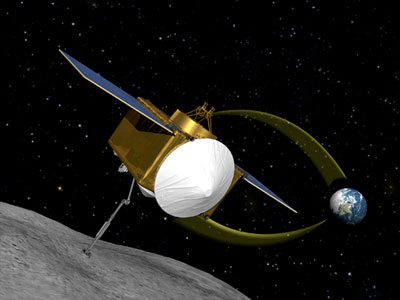
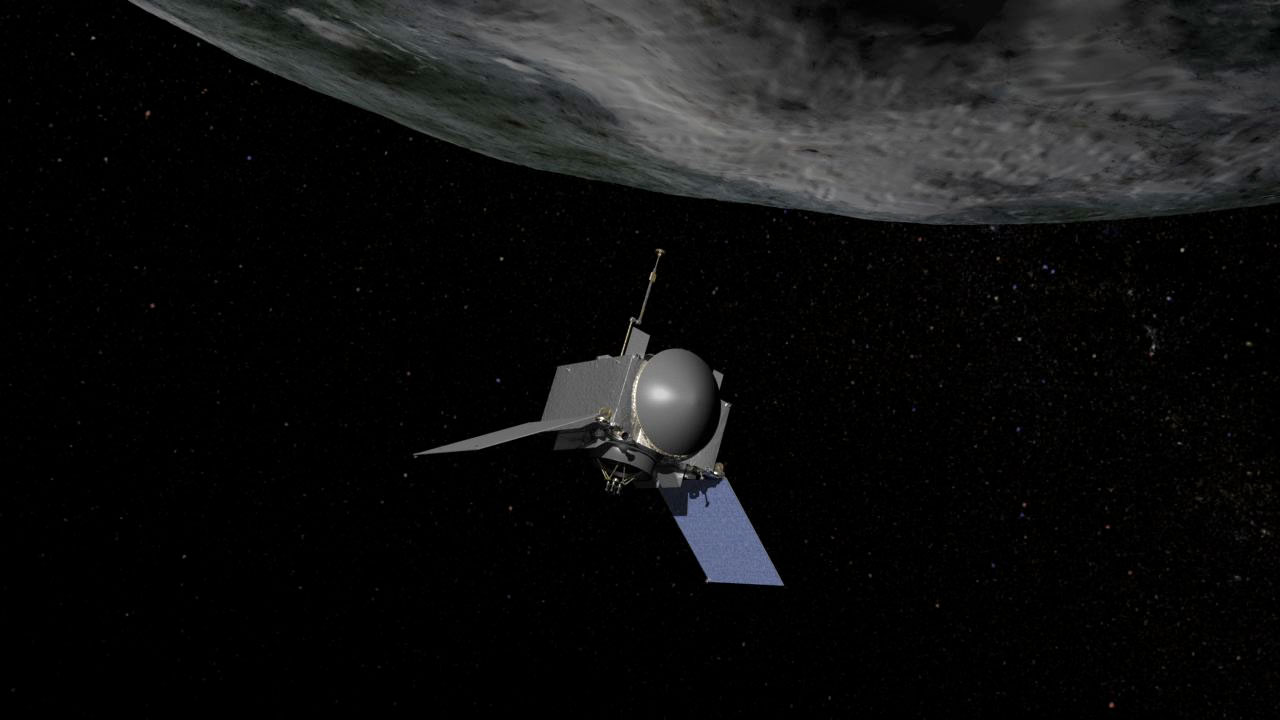
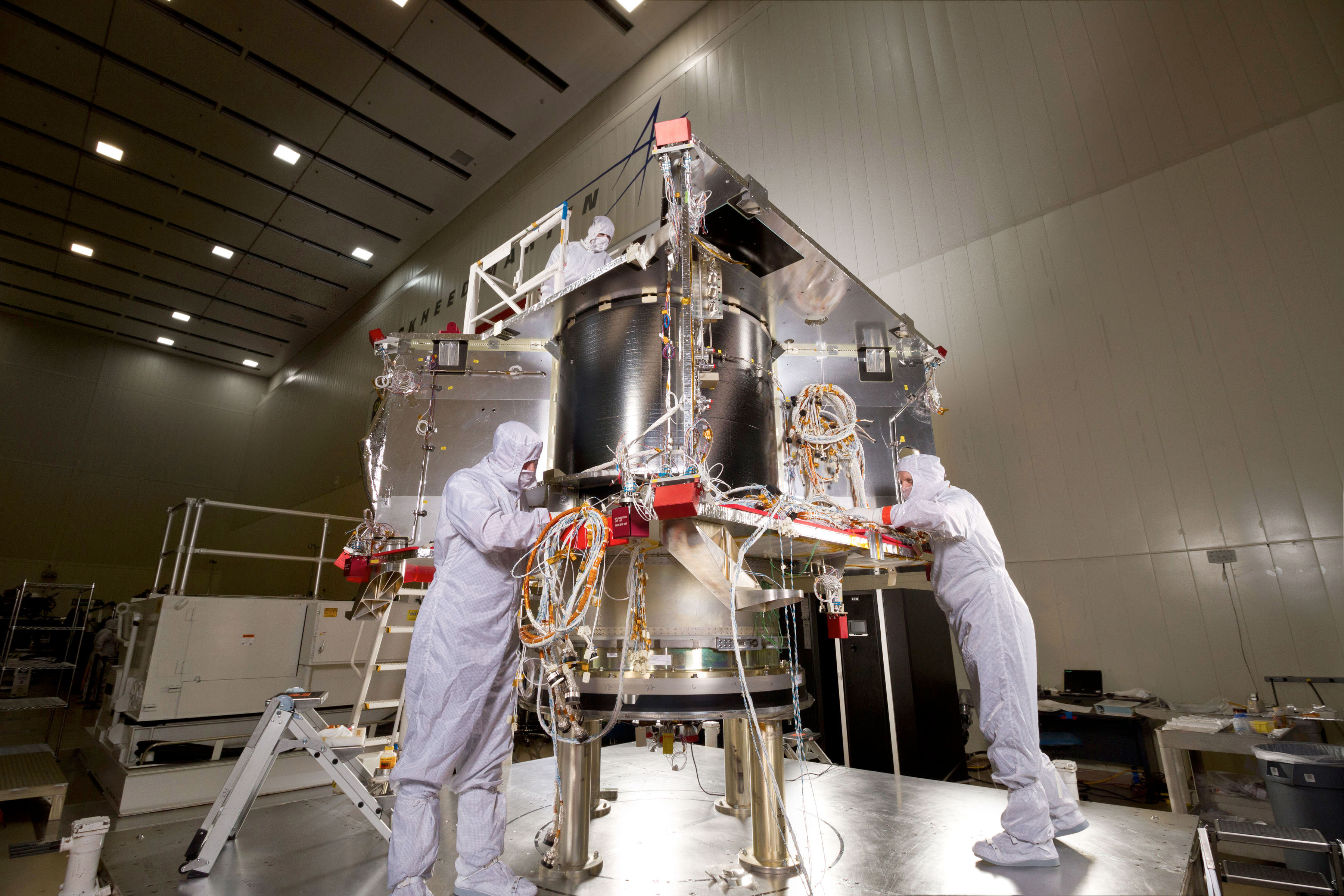
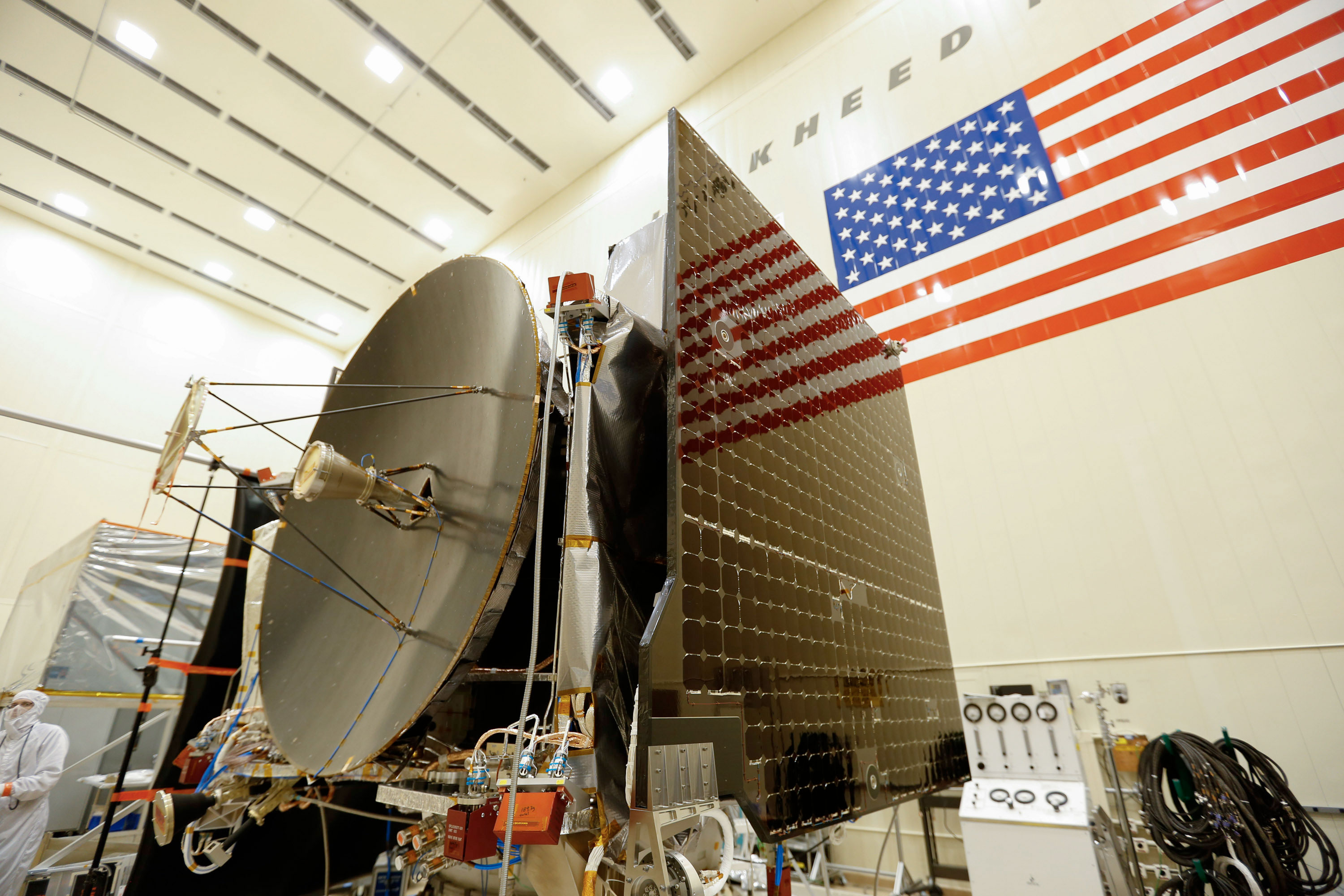
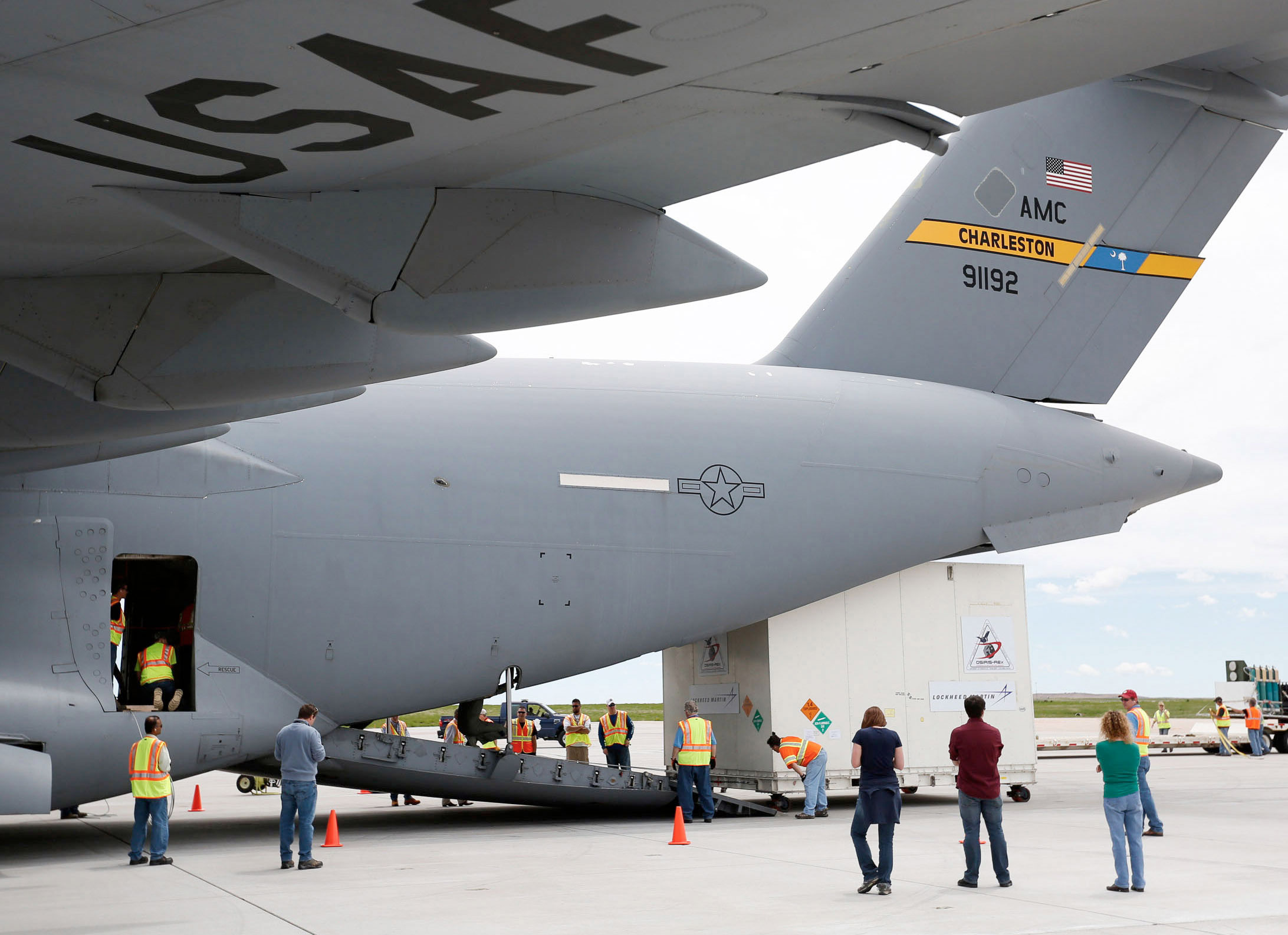
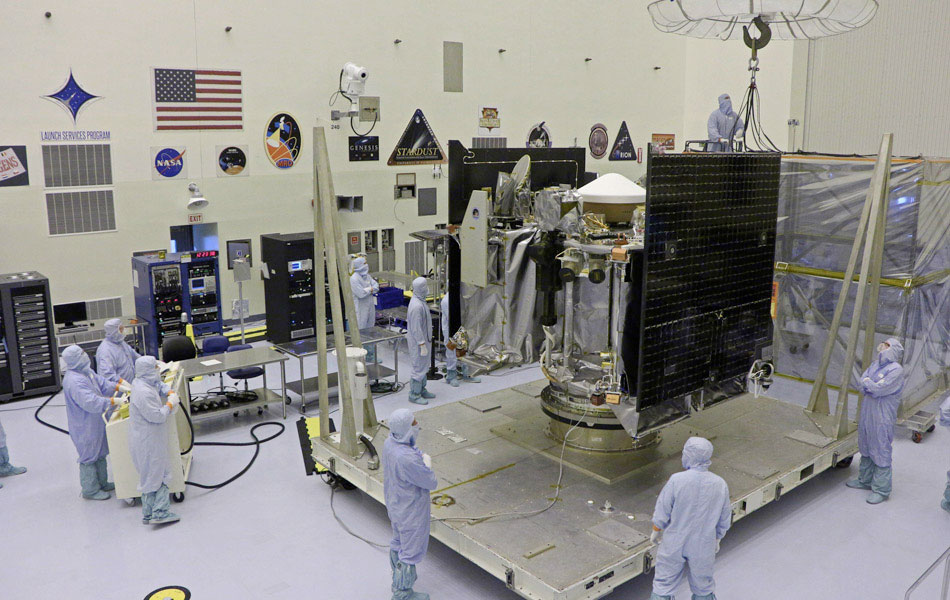
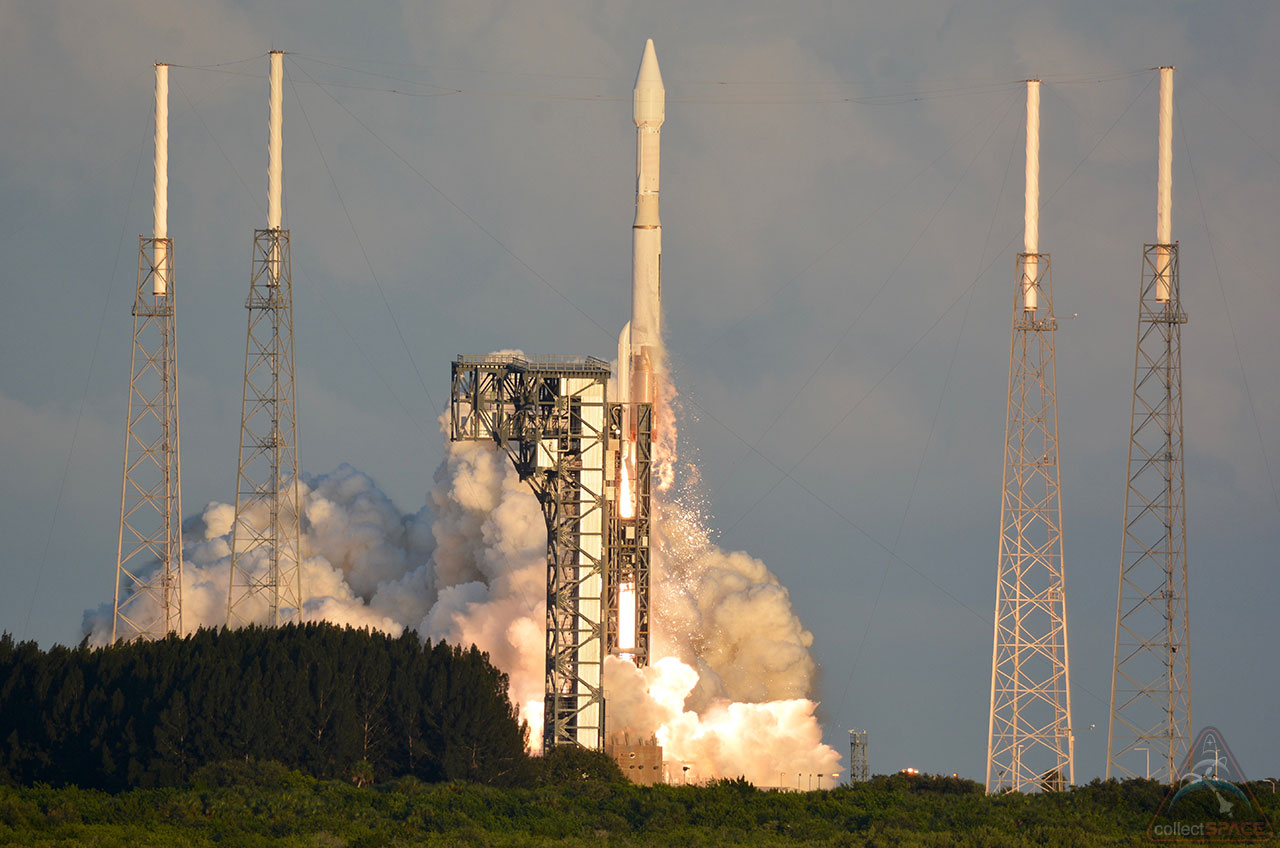
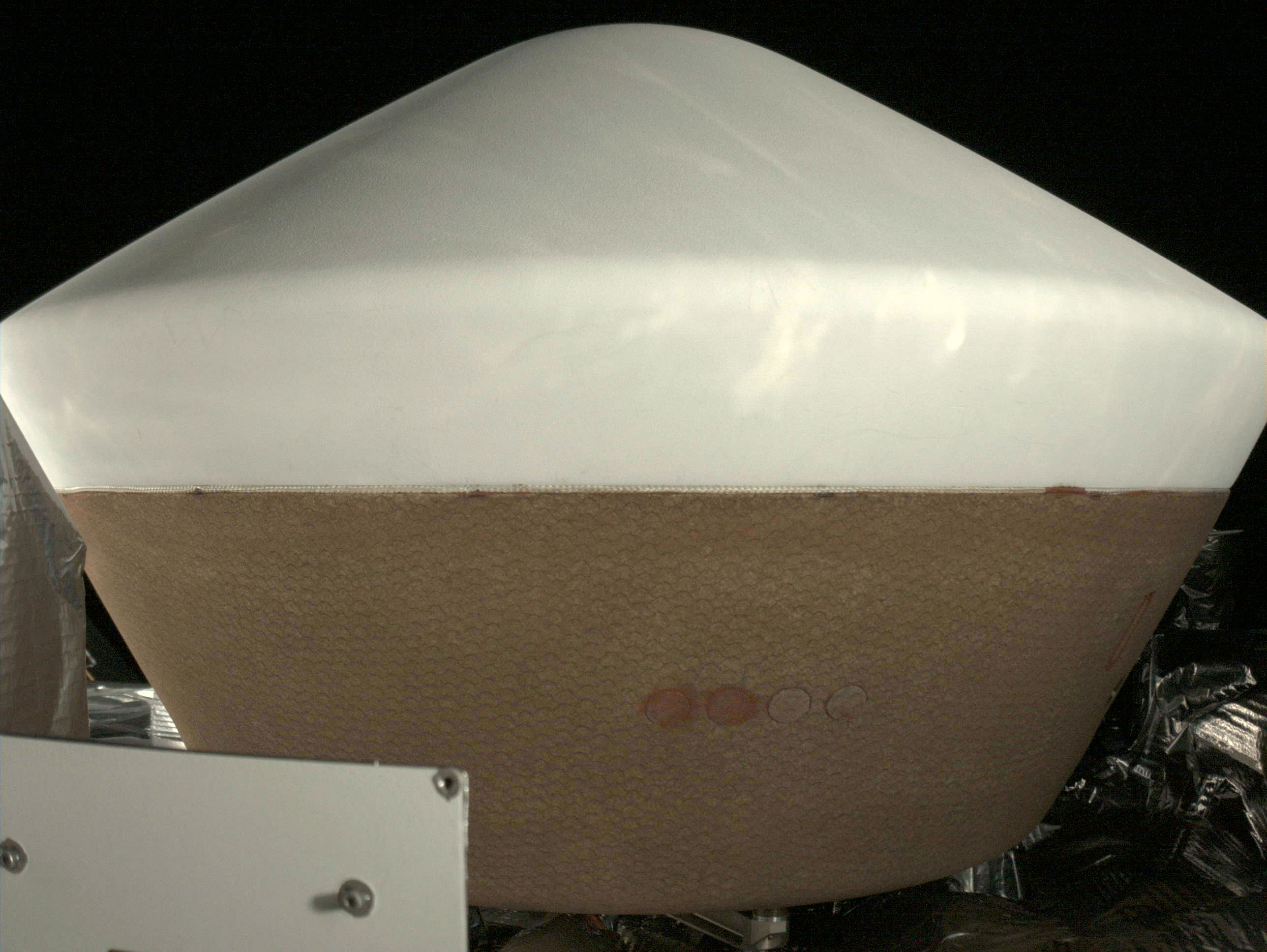
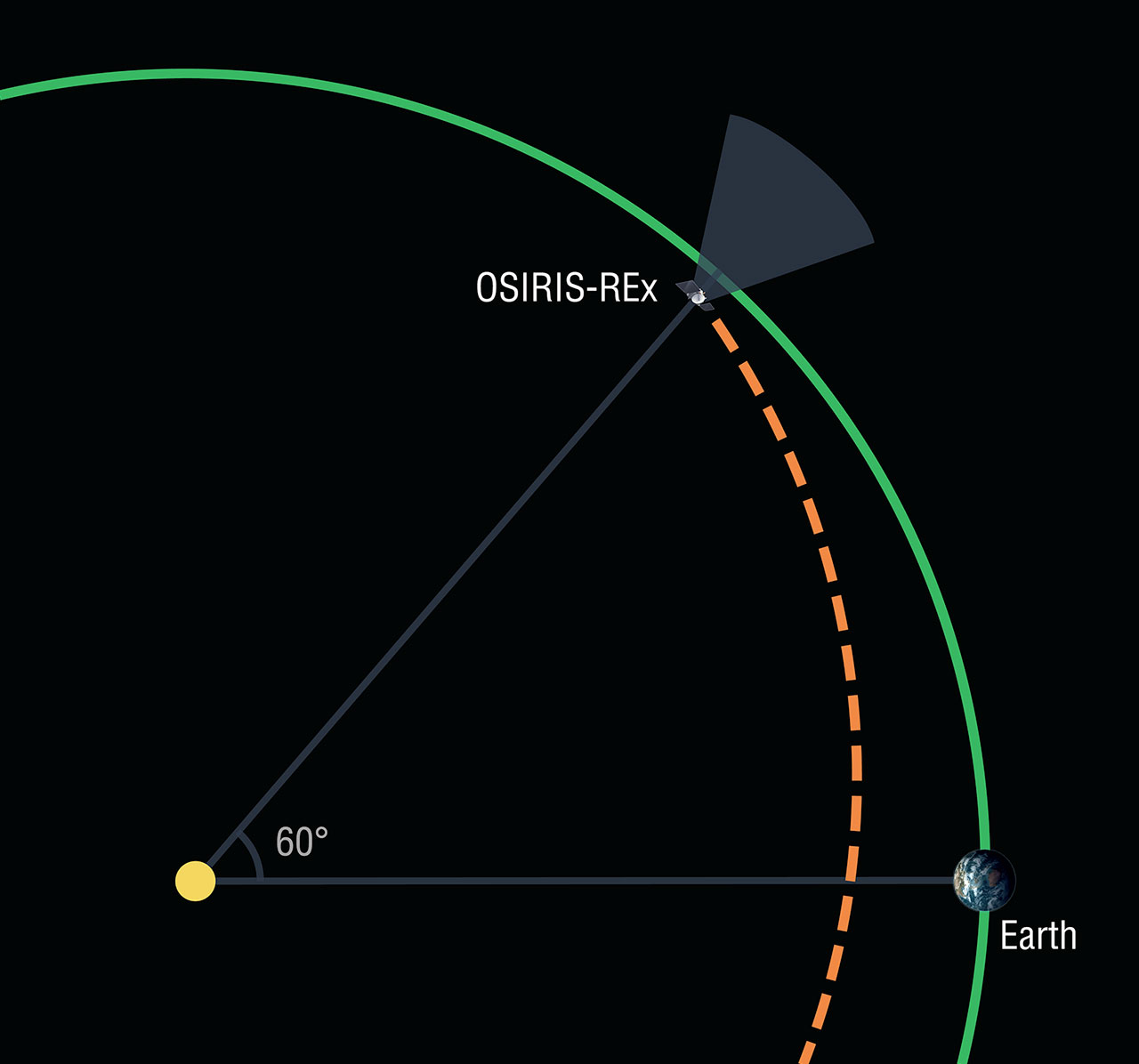
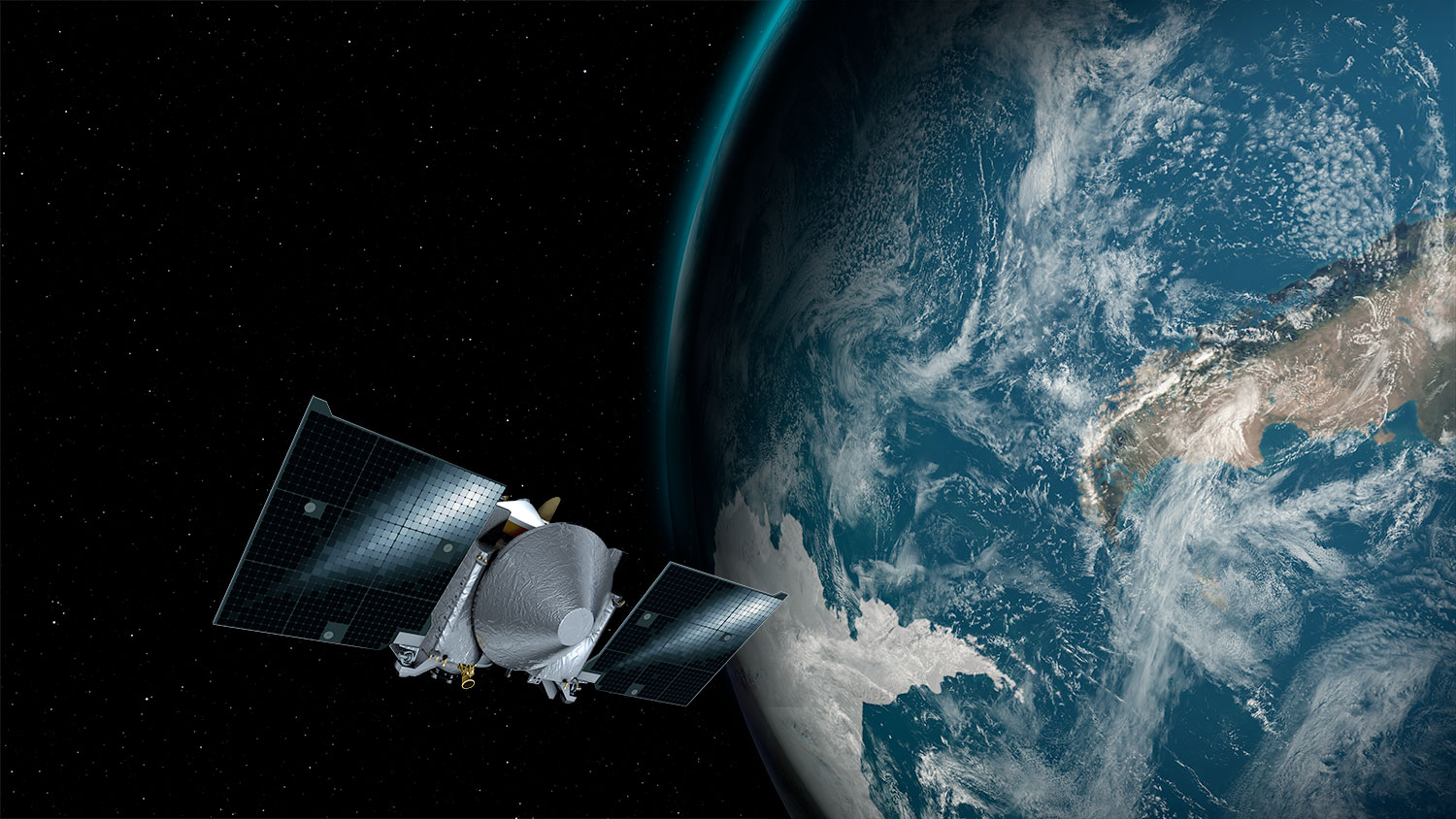

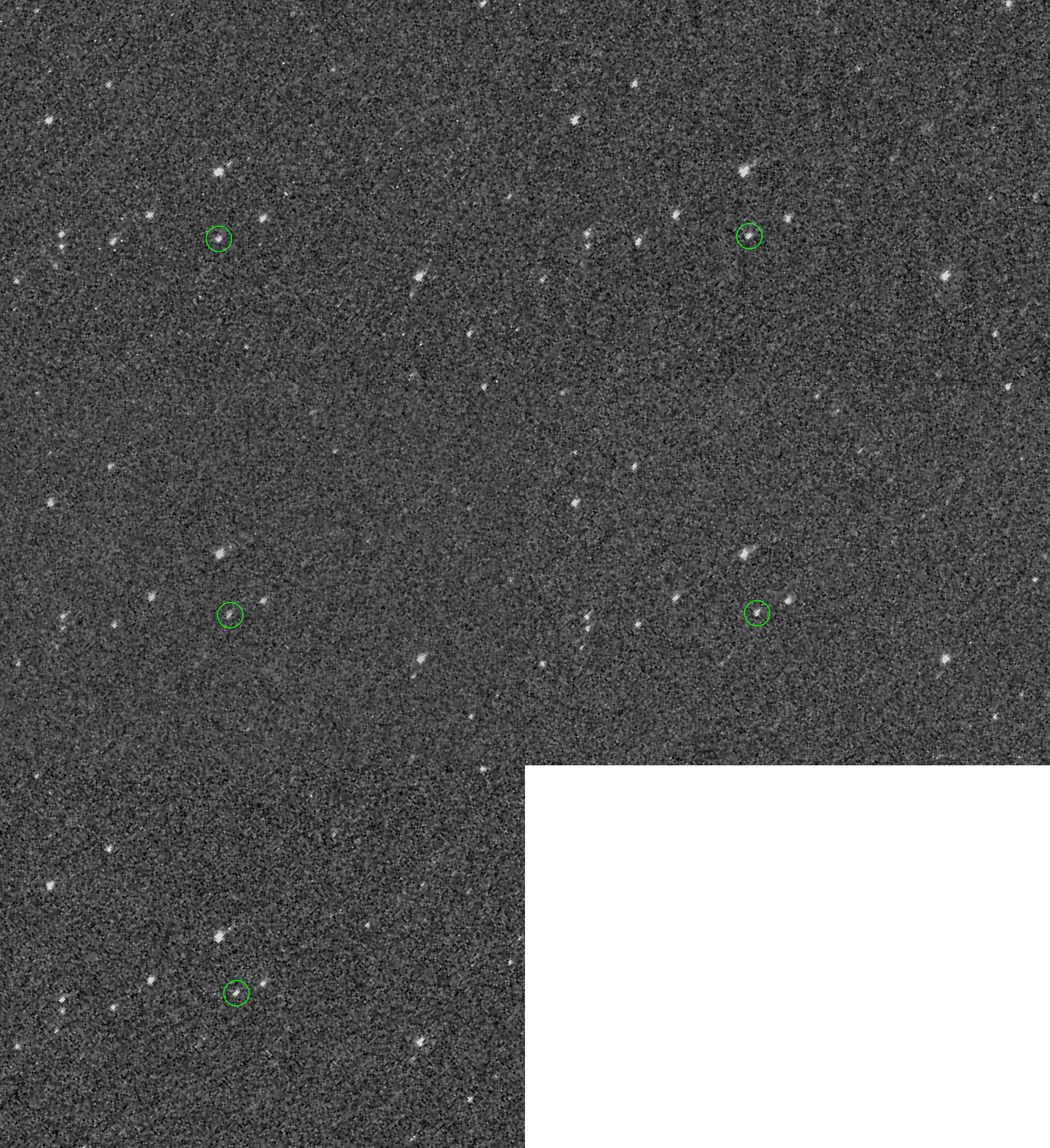
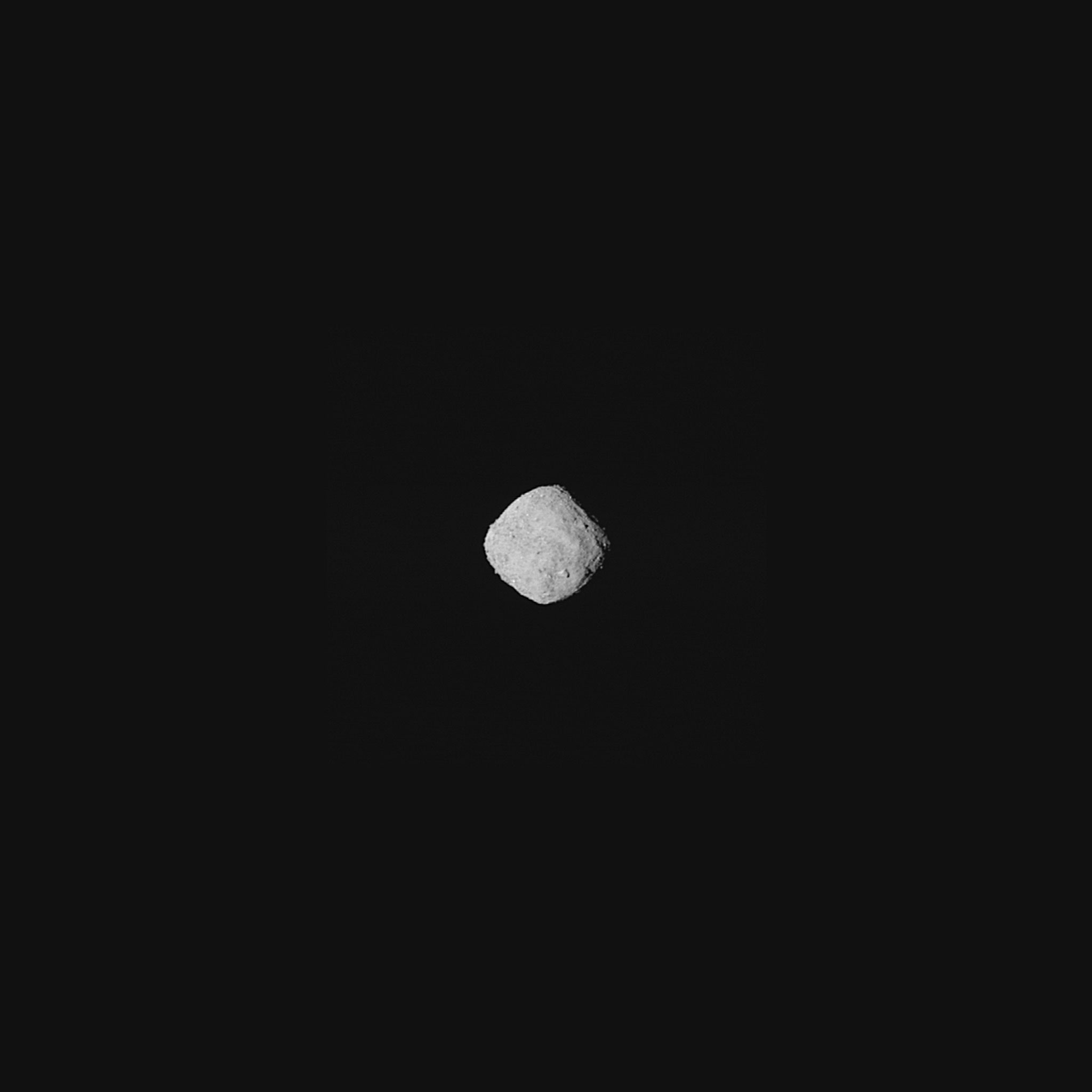
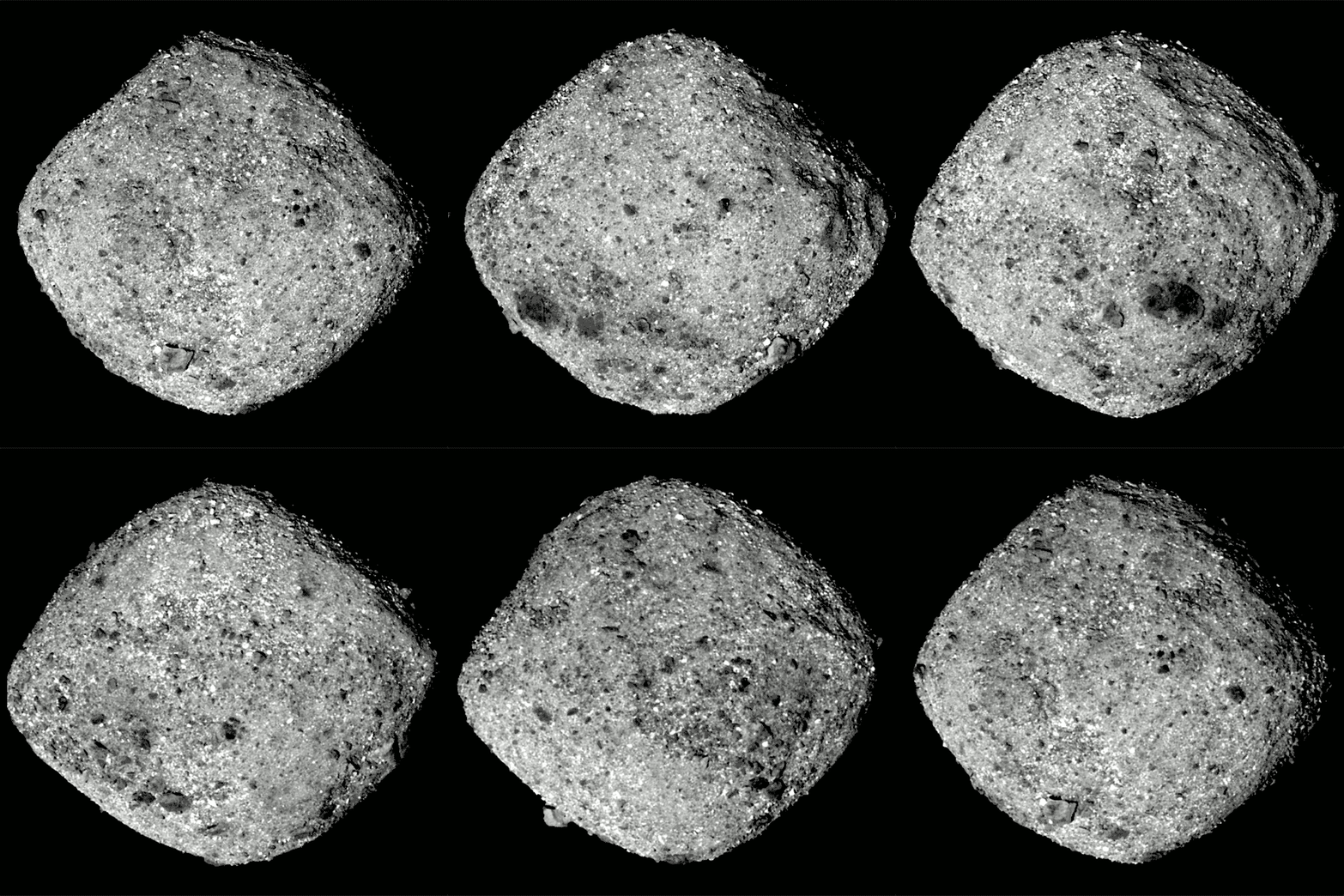
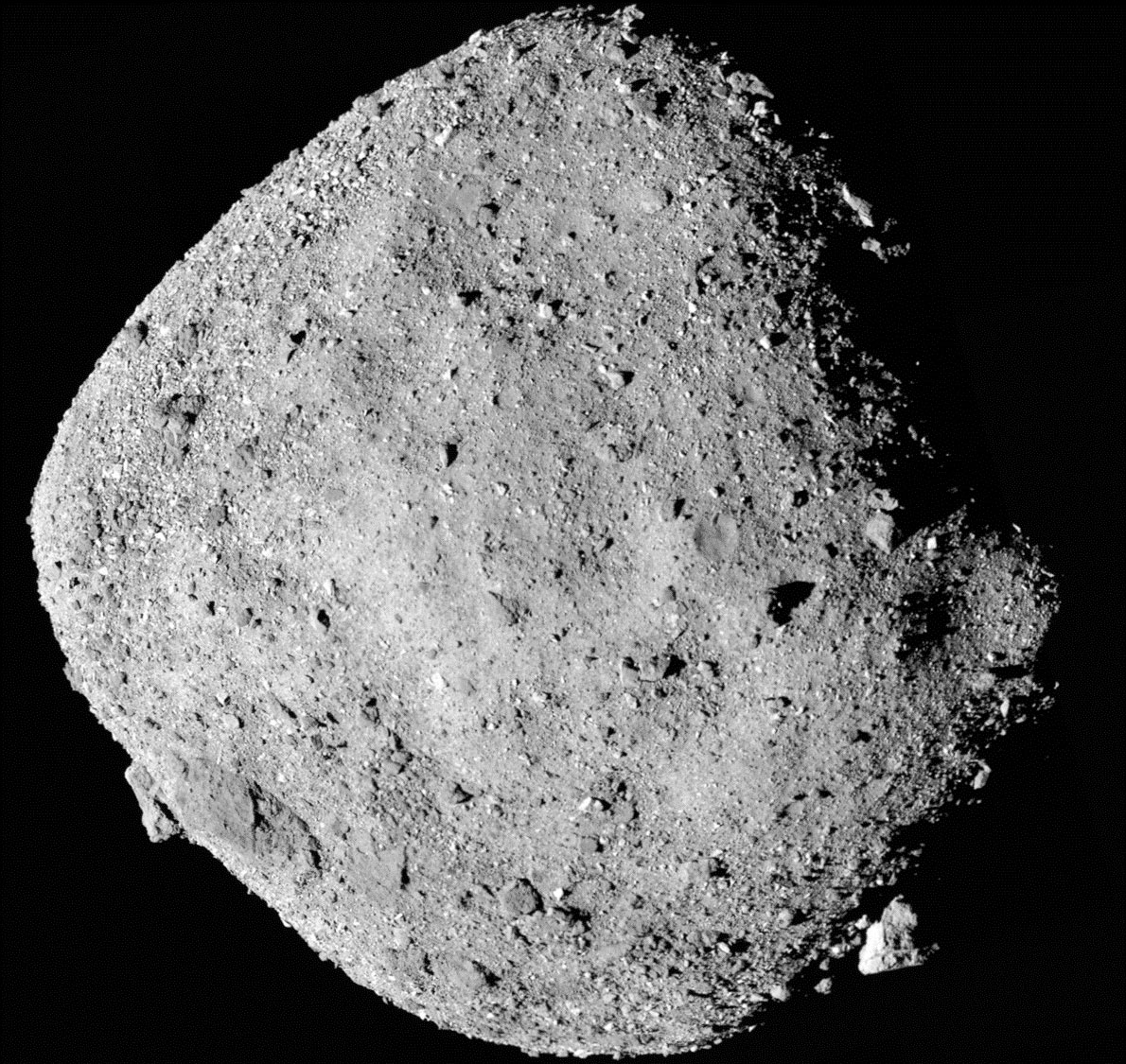
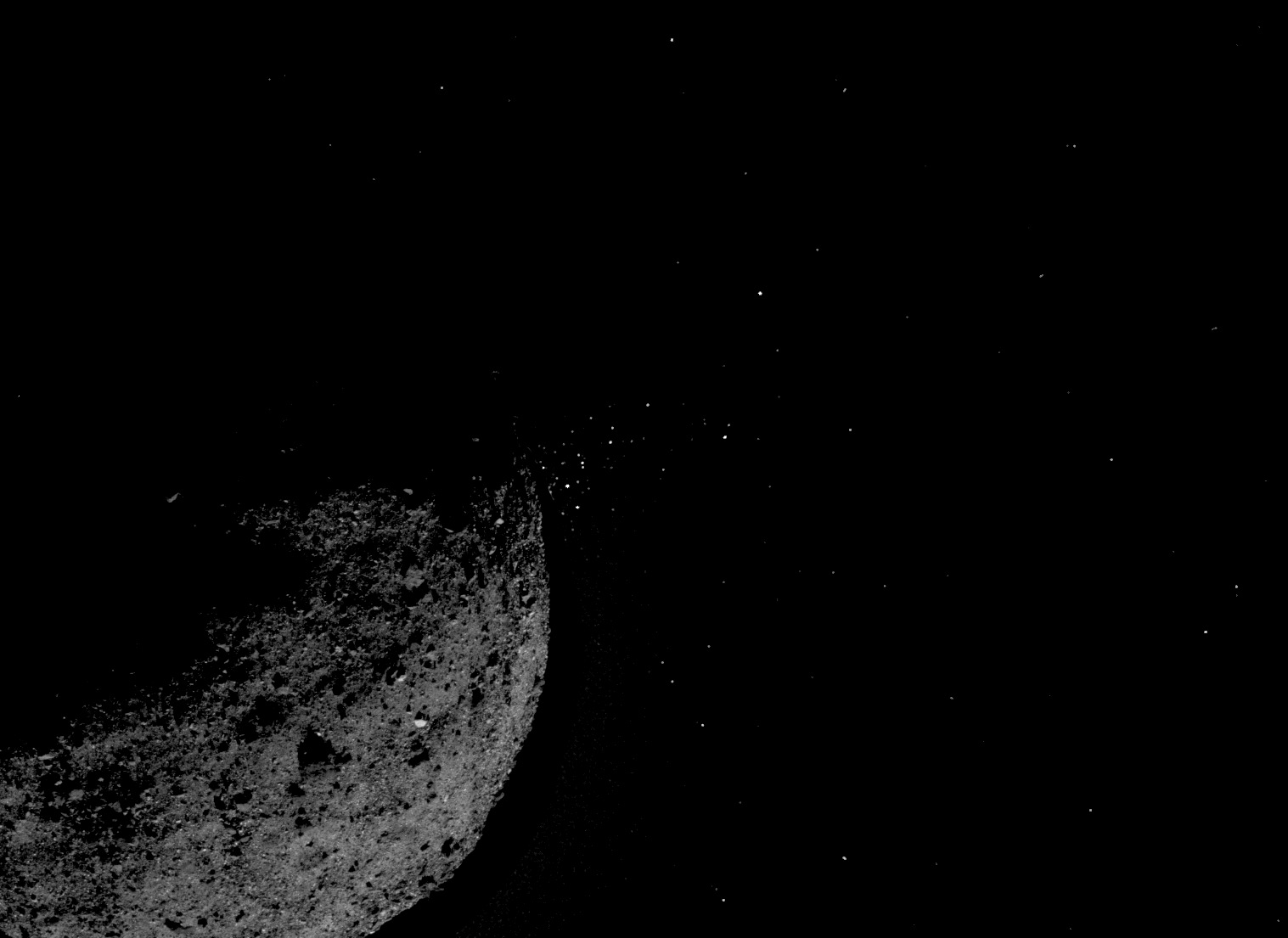

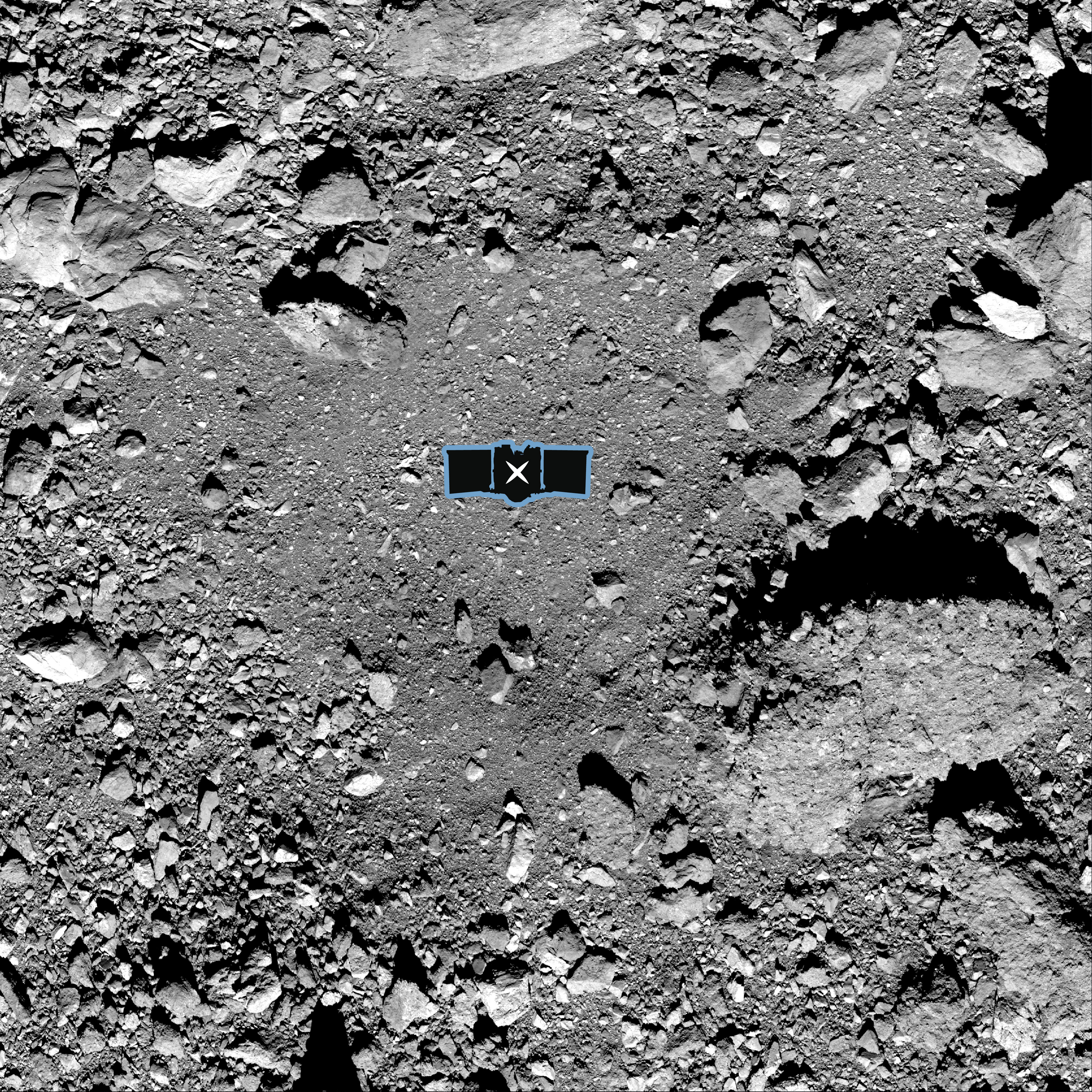
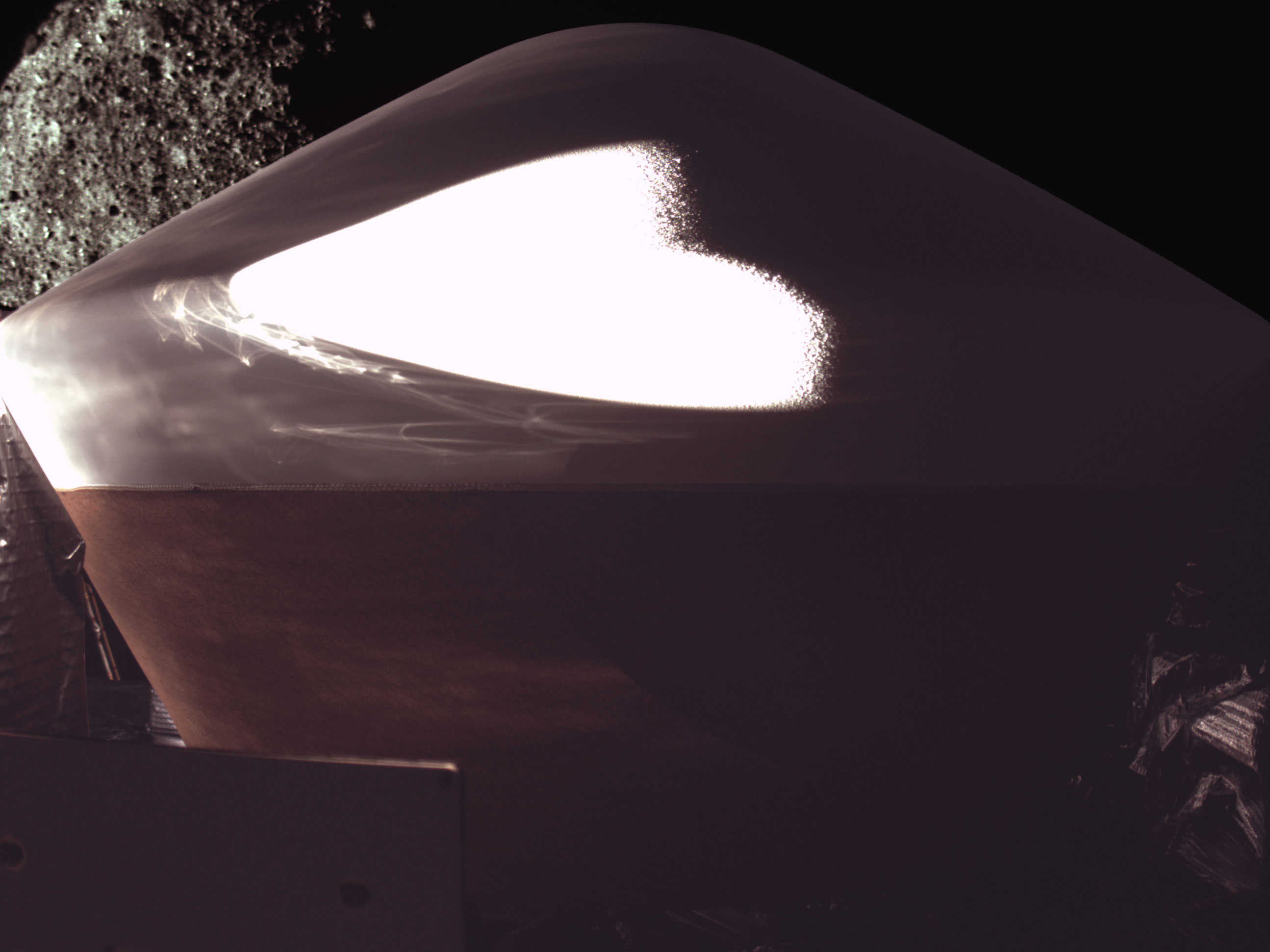
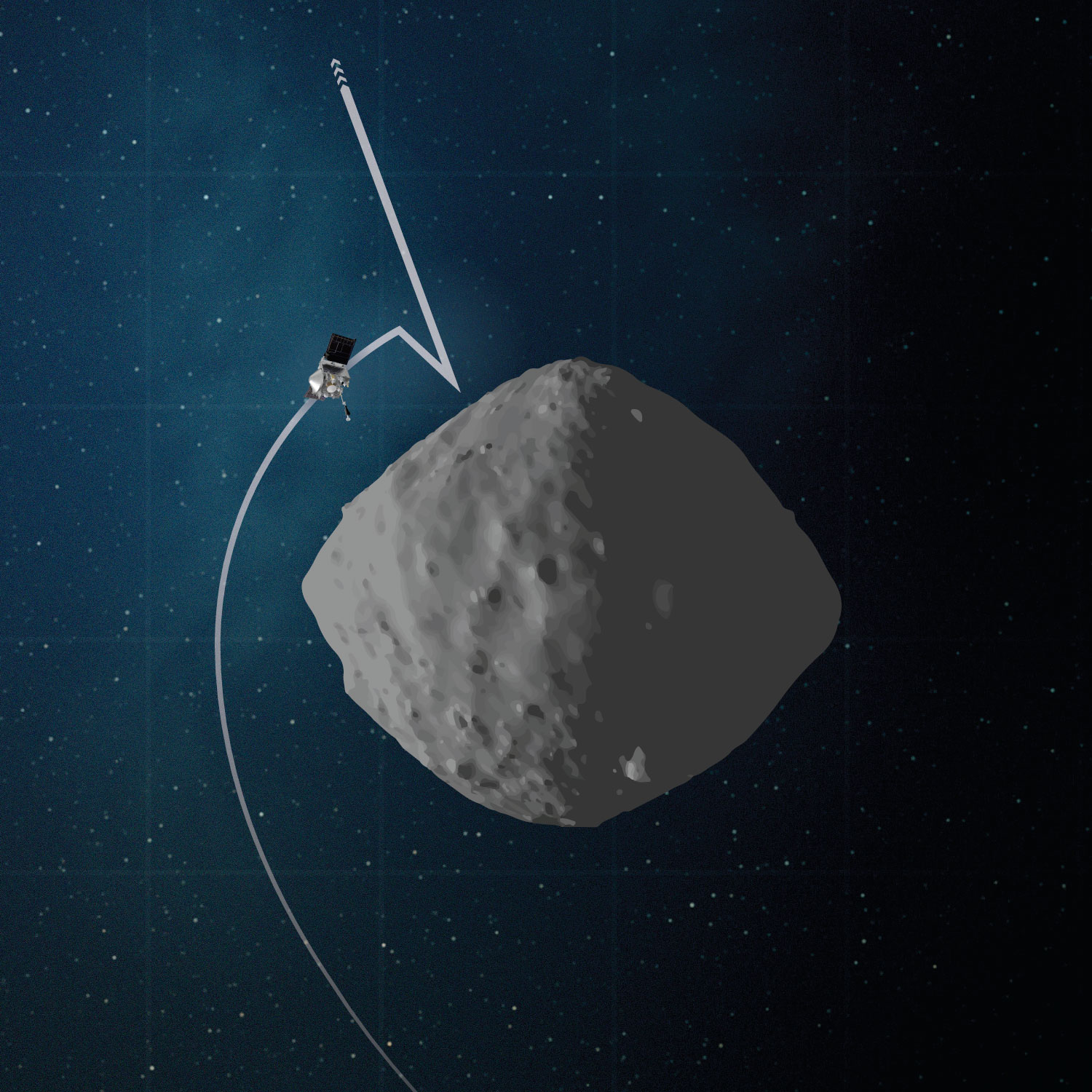
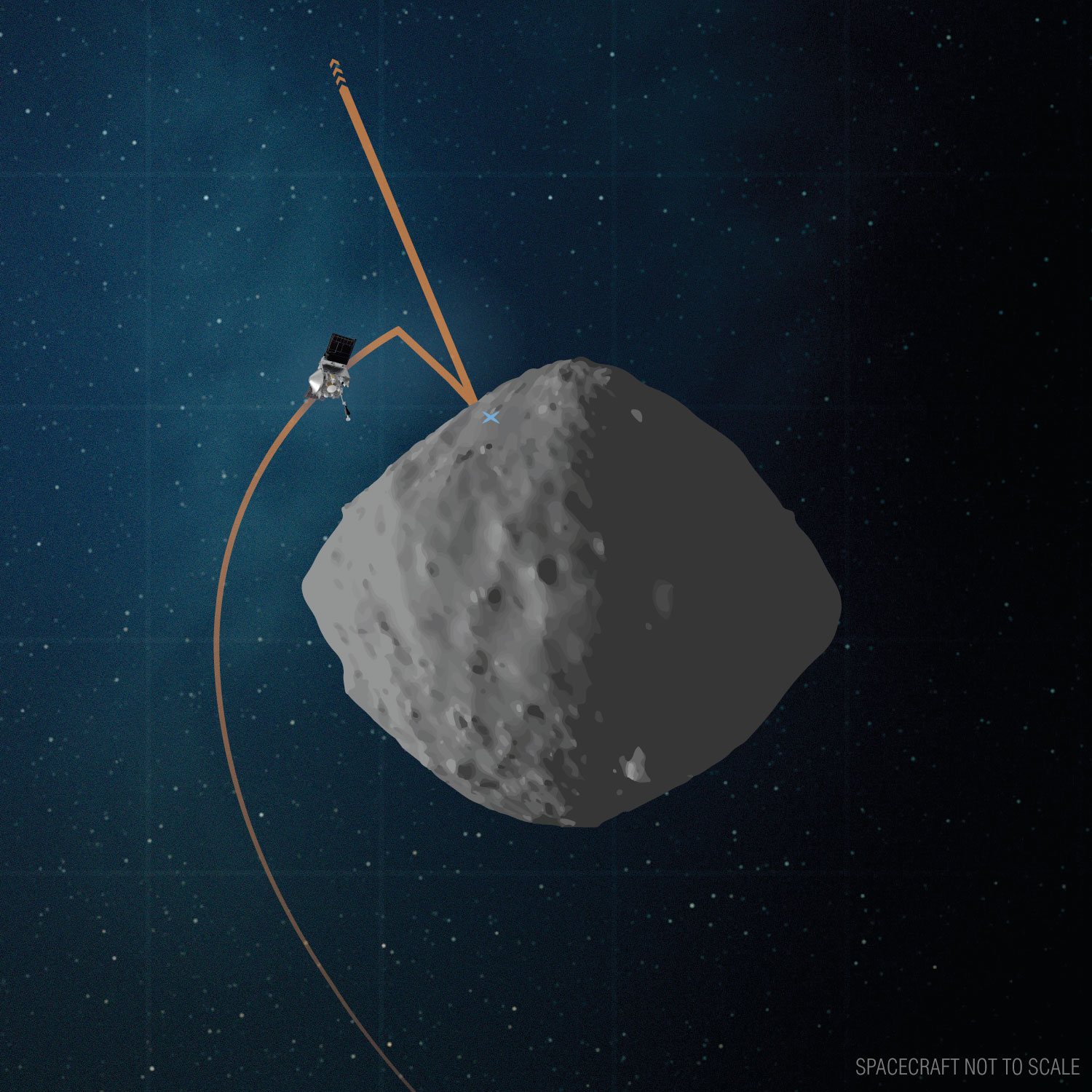
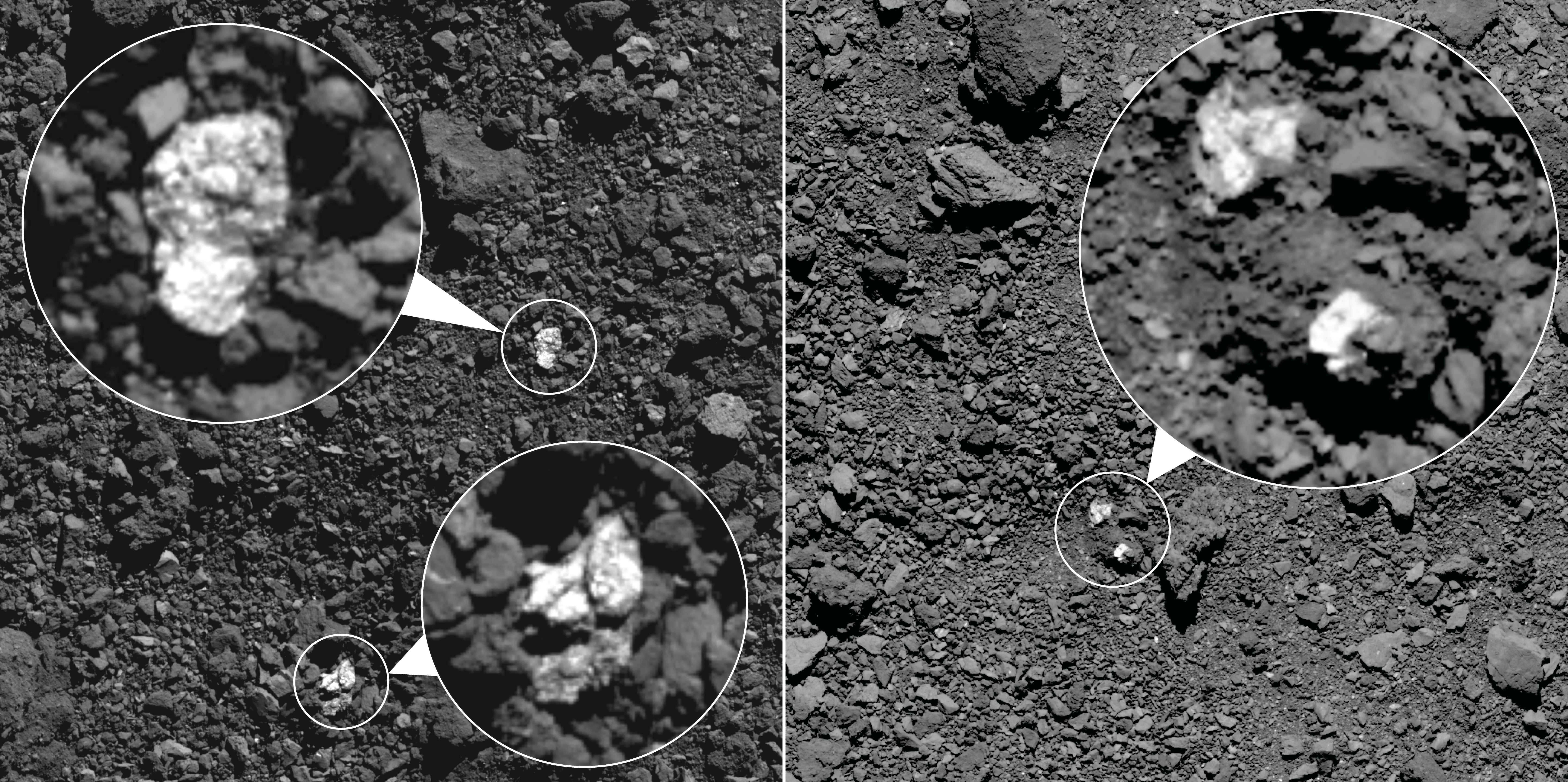
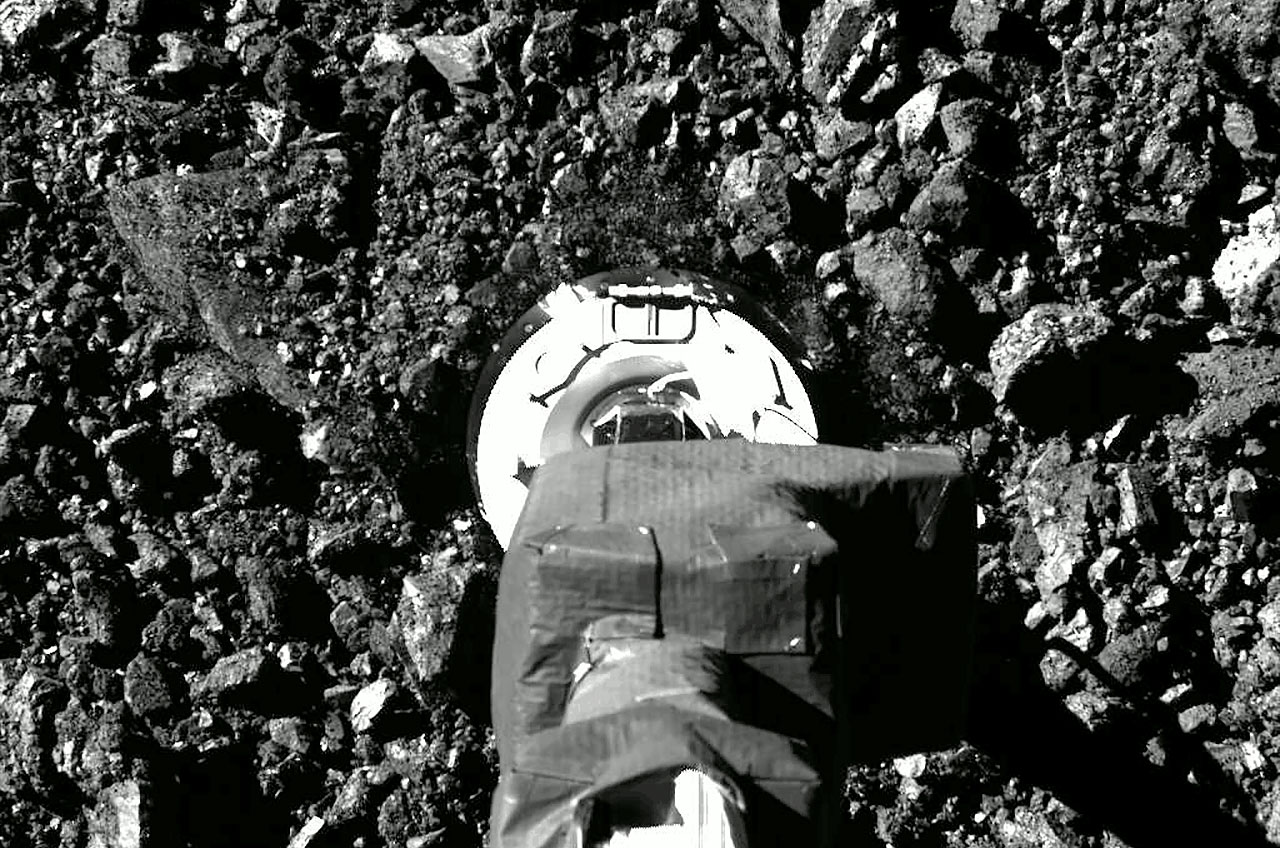

 advertisement