Echoing words first heard in 1968 and perhaps more poignantly, not spoken for the past 53 years, NASA's Mission Control on Thursday (April 2) committed to "trans-lunar injection," sending humans once again on a path to fly to the moon.
Robert Pearlman Editor
Posts: 57235 From: Houston, TX Registered: Nov 1999
posted 04-03-2026 01:14 PM
NASA release
Lunar Science Team Prepares for Flyby
After the TLI burn that sent Orion on its path to the Moon, the lunar science team began building a Lunar Targeting Plan, a guide to what the crew will look at on the Moon's surface during its approximately six-hour observation on Monday, April 6.
The targeting plan will include documenting features that can help scientists understand how the Moon and solar system formed, such as craters, ancient lava flows, and cracks and ridges created as the Moon's outer layer slowly shifted over time.
One feature that will be added to the plan is a solar eclipse, which will last for nearly an hour toward the end of the flyby window. During the eclipse, the Sun will be hidden from view as it moves behind the Moon from the perspective of Orion. The crew will see a mostly dark Moon at this time — an opportunity for them to look for flashes of light from meteoroids striking the Moon's surface, dust lofting above the edge of the Moon, and deep space targets, including planets. While the Sun slides behind the Moon, the crew will observe the solar corona, the Sun's outermost atmosphere, while it's visible.
Robert Pearlman Editor
Posts: 57235 From: Houston, TX Registered: Nov 1999
posted 04-04-2026 09:47 AM
NASA release
First trajectory correction burn unneeded, crew prepares for lunar flyby
Integrity continues on a precise trajectory to fly by the moon on Monday (April 6). Flight controllers elected to cancel the first outbound trajectory correction burn, as the spacecraft's trajectory is on the right path. Any adjustments needed may be incorporated into a subsequent correction burn.
The crew began preparing Integrity's cabin for the lunar observation period on Monday, that is expected to begin around 2:30 p.m. EDT. Additionally, the astronauts exercised, practiced medical response procedures (CPR) and tested the spacecraft’s emergency communications system in deep space.
The crew began their sleep period around 4 a.m. EDT. The ground team will wake them up to begin Flight Day 4 at 11:35 a.m. on Saturday (April 4).
Robert Pearlman Editor
Posts: 57235 From: Houston, TX Registered: Nov 1999
posted 04-04-2026 05:38 PM
NASA release
Deep-Space Flying, Lunar Flyby Prep
The crew are spending their fourth flight day preparing for their lunar flyby on Monday (April 6). Their day began to the tune of Chappell Roan's "Pink Pony Club," before transitioning into their daily activities.
At wakeup, the spacecraft and its crew were approximately 169,000 miles from Earth and approaching the Moon at 110,700 miles.
Later on Saturday, Glover will take manual control of the spacecraft to test its performance in deep space to provide more data about the spacecraft's handling qualities across different movements. A 24-hour acoustics test also will occur to help engineers characterize the sound environment in the spacecraft.
After the piloting demonstration, the crew will review a list of the surface features the NASA science team has asked them to analyze and photograph during their six-hour flyby on Monday.
Flight controllers again cancelled a planned outbound trajectory correction burn, as Integrity's trajectory remains on track. The team instead adjusted the spacecraft's attitude to point a vent toward the Sun to help clear a wastewater line.
Overnight, controllers vented wastewater overboard to free up space in Orion's waste management system tank, but the activity ended earlier than expected. Engineers have been using the vent heaters to melt any potential ice that may be clogging the line and orienting the vent toward the Sun to help mitigate the issue.
Teams also are reviewing other potential causes. The wastewater tank is not full and the toilet is operational; however, the crew was instructed to use backup collection devices overnight if needed.
Just after 12 p.m. EDT, the Orion Artemis II Optical Communications System surpassed 100 gigabytes of data downlinked during the mission, including high resolution images. The terminal, mounted on the outside of the Orion capsule, uses laser communications — infrared light — to transmit more data than traditional radiofrequency systems.
Robert Pearlman Editor
Posts: 57235 From: Houston, TX Registered: Nov 1999
posted 04-05-2026 09:22 AM
NASA release
Crew Completes Manual Piloting Demo
The crew completed a manual piloting demonstration and reviewed their lunar flyby plan to wrap up their third full day in space.
Christina Koch and Jeremy Hansen took turns controlling the spacecraft to test its performance in deep space starting at 9:09 p.m. EDT on Saturday (April 4). For 41 minutes, the pair tested two different thruster modes, six degrees of freedom and three degrees of freedom, to provide engineers with more data about the spacecraft's piloting capabilities.
Commander Reid Wiseman and Pilot Victor Glover are scheduled to repeat the demo on flight day 8 – Wednesday, April 9 – to give the teams on the ground as many perspectives on the spacecraft as possible.
Over the course of the day, the crew also reviewed a list sent by the lunar science team of surface features on the moon that they will photograph and analyze during their six-hour flyby on Monday (April 6). The flyby period begins at 2:45 p.m. EDT, when Integrity's main cabin windows will be pointed toward the moon.
Earlier in the day, the astronauts took some crew selfies using one of the solar array wing cameras. The images should be sent to the ground in the coming days.
The crew went to sleep for the night at 3:15 a.m.; Mission Control will wake them to begin flight day 5 at noon on Sunday.
Robert Pearlman Editor
Posts: 57235 From: Houston, TX Registered: Nov 1999
posted 04-06-2026 12:24 AM
NASA release
Crew readies for lunar flyby
The crew members completed a plan test of their Orion Crew Survival System suits, performing leak checks, simulating seat entry and assessing their ability to eat and drink.
They then turned their attention to the outbound trajectory correction (OTC) burn, which began at 11:03 p.m. EDT. The maneuver refined Integrity's path toward the moon.
Earlier in the day, mission control sent the crew the final list of lunar surface features the science team has assigned for observation and photography during the lunar flyby on Monday. Ahead of the flyby, the crew worked through final preparations and held a conference with mission controllers to finalize lunar targets and techniques.
The 30 targets include the Orientale basin, a nearly 600-mile-wide crater that straddles the moon's near and far sides. Orientale will be fully illuminated and visible as Orion approaches the moon.
This 3.8-billion-year-old crater formed when a large object struck the lunar surface and retains clear evidence of that collision, including dramatic topography in its rings. The crew will study Orientale's features up close and from multiple angles as they pass by.
Hertzsprung basin is also on the crew's list of targets. Northwest of Orientale is a nearly 400-mile crater on the moon's far side. An older ringed basin, Hertzsprung offers a unique contrast to Orientale because its features have been degraded by subsequent impacts. The crew will compare the topography of the two craters to gain insight into how features evolve over geologic timescales.
Key moments for the lunar flyby include the following. All times are Eastern and may change based on real-time operations:
Monday, April 6
12:41 a.m.: Orion enters lunar sphere of influence at 41,072 miles from the Moon.
1:30 p.m.: The science officer in mission control will brief the crew on their science goals for the upcoming flyby.
1:56 p.m.: The Artemis II crew is expected surpass the record previously set by the Apollo 13 crew in 1970 for the farthest humans have ever traveled from Earth.
2:45 p.m.: Lunar observations begin.
6:44 p.m.: Mission control expects to temporarily lose communication with the crew as the Orion spacecraft passes behind the Moon.
6:45 p.m.: During "Earthset," Earth will glide behind the Moon from Orion's perspective.
7:02 p.m.: Orion reaches its closest approach to the Moon at 4,070 miles above the surface.
7:07 p.m.: Crew reach their maximum distance from Earth during the mission.
7:25 p.m.: "Earthrise" marks Earth coming back into view on the opposite edge of the Moon.
7:25 p.m.: NASA's Mission Control Center should re -acquire communication with the astronauts.
8:35-9:32 p.m.: During a solar eclipse, the Sun will pass behind the Moon from the crew's perspective.
9:20 p.m.: Lunar observations conclude.
Tuesday, April 7
1:25 p.m.: Orion exits the lunar sphere of influence at 41,072 miles from the Moon.
When Orion passes behind the moon, the mission will enter a planned communications blackout of about 40 minutes as the lunar surface blocks the radio signals needed for the Deep Space Network to connect with the spacecraft. Similar blackouts occurred during the Artemis I and Apollo missions and are expected with an Earth-based communications infrastructure. Once Orion reemerges, the network will quickly reacquire its signal and restore contact with mission control.
Robert Pearlman Editor
Posts: 57235 From: Houston, TX Registered: Nov 1999
Humanity is about to get its first in-person, up-close look at the moon in more than half a century.
Four astronauts will spend about seven hours on Monday (April 6) observing the far side of the moon, the half that constantly points away from Earth. At their closest approach on board their Orion spacecraft "Integrity," Reid Wiseman, Victor Glover and Christina Koch of NASA and Jeremy Hansen with the Canadian Space Agency will be about 4,000 miles (6,400 km) above the surface. The last time any person came that close was during the Apollo 17 mission in 1972.
Robert Pearlman Editor
Posts: 57235 From: Houston, TX Registered: Nov 1999
NASA's Apollo and Artemis programs crossed historic paths on Monday (April 6), as the latter broke a record set by the earlier, and the legacy of earlier lived on with latter's promise for the future.
The first four astronauts to fly to the moon since the Apollo lunar missions ended, the Artemis II crew of Reid Wiseman, Victor Glover, Christina Koch of NASA and Jeremy Hansen with the Canadian Space Agency, flew past the farthest distance that humans have traveled beyond Earth — 248,655 miles (400,171 kilometers) — at 1:56 p.m. EDT (1756 GMT), or 4 days, 19 hours and 21 minutes into their flight.
Robert Pearlman Editor
Posts: 57235 From: Houston, TX Registered: Nov 1999
posted 04-07-2026 09:06 AM
NASA release
Crew Wraps Historic Lunar Flyby
After the lunar observation period concluded, the Artemis II crew was congratulated by President Donald Trump, in a live conversation. They also spoke with NASA Administrator Jared Isaacman and answered questions from social media.
Scientists already are looking forward to the crew's images, along with the many others taken during the flyby. After the lunar data is downlinked from the spacecraft overnight, scientists will look at images, audio, and other data to determine better times and locations of the flashes and seek input from amateurs who were observing the moon at the same time.
Robert Pearlman Editor
Posts: 57235 From: Houston, TX Registered: Nov 1999
The Artemis II crew wrapped up a historic seven-hour lunar flyby, marking humanity's first return to the moon since Apollo 17 in 1972 and capturing images of the lunar far side.
Flying aboard their Orion spacecraft "Integrity," NASA astronauts Reid Wiseman, Victor Glover and Christina Koch, together with Jeremy Hansen with the Canadian Space Agency, reached 252,756 miles (406,771 km) away from Earth — 4,101 miles (6,600 km) farther than the record set by the Apollo 13 crew in 1970 — and came within 4,067 miles (6,545 km) of the lunar surface.
Robert Pearlman Editor
Posts: 57235 From: Houston, TX Registered: Nov 1999
posted 04-08-2026 09:15 AM
NASA release
Long Distance Call, First Return Correction Burn
Four International Space Station (ISS) Expedition 74 astronauts had a ship-to-ship call with the four Artemis II astronauts on Tuesday (April 7) after the latter flew around the moon.
The station crewmates called Reid Wiseman, Victor Glover, Christina Koch and Jeremy Hansen, who are returning to Earth aboard the spacecraft Integrity, for a short conversation. The station crew expressed their curiosity about the difference between the two spacecraft, while the Artemis II crewmates shared their experience seeing the moon up close.
Koch, who performed a pair of station spacewalks with Jessica Meir in January 2020 and who is now back on the station now, remarked, "Every single thing that we learned on ISS is up here."
At 8:03 p.m. EDT, Integrity ignited its thrusters for 15 seconds, producing a change in velocity of 1.6 feet-per-second and guiding the Artemis II crew toward Earth. NASA astronaut Christina Koch and CSA (Canadian Space Agency) astronaut Jeremy Hansen reviewed procedures and monitored the spacecraft's configuration and navigation data.
Wiseman, Glover, Koch and Hansen also tested an orthostatic intolerance garment — specialized equipment designed to help astronauts maintain blood pressure and circulation during the transition back to Earth's gravity.
The crew also took manual control of Integrity, using the spacecraft's field of view to center a designated target before guiding Orion to a tail to Sun attitude and comparing its control modes. The manual piloting demonstration began at 10:00 p.m. EDT.
Robert Pearlman Editor
Posts: 57235 From: Houston, TX Registered: Nov 1999
posted 04-09-2026 07:54 AM
NASA release
Crew Conducts Key Tests on Return to Earth
Aboard the Orion spacecraft Integrity, the Artemis II crew kicked off Flight Day 8 on Wednesday (April 8) with the wakeup song “Under Pressure,” by Queen and David Bowie. As they awoke, they were 200,278 miles from Earth and 83,549 miles from the Moon. The crew also received a celebratory message from the Canadian Space Agency.
All four crew members then took turns testing and evaluating the orthostatic intolerance garment worn under their Orion Crew Survival System (OCCS) suits. The garment helps maintain blood pressure and circulation during the transition back to Earth’s gravity. After extended time in microgravity, some astronauts experience orthostatic intolerance, a condition that can make it difficult to stand upright without dizziness or fainting. The garment applies lower‑body compression to counteract this effect and support a safe return.
The crew took control of Orion around 10:55 p.m. EDT for another manual piloting demonstration. Using Integrity's field of view window, the crew centered a designated target and then guided the spacecraft to a tail‑to‑Sun attitude. The test gathered more data about the handling qualities and guidance, navigation, and control systems. By manually piloting the capsule to a tail-to-Sun attitude, the crew was able to manage thermal conditions and power generation.
The crew completed a similar piloting demonstration earlier in the mission and also during the proximity operations demonstration.
Looking ahead, the crew and flight control teams will begin preparing the cabin and studying entry procedures ahead of splashdown. The crew will start stowing equipment and installing their seats to ensure all items are secured for re-entry.
To prepare the cabin, the teams opted to forego the originally planned shielding deployment demonstration.
NASA is targeting splashdown at 8:07 p.m. (5:07 p.m. PDT) Friday, April 10, off the coast of San Diego.
Robert Pearlman Editor
Posts: 57235 From: Houston, TX Registered: Nov 1999
posted 04-09-2026 01:41 PM
NASA release
Crew Prepares to Come Home
On their last full day in space, the Artemis II crew began the morning with "Lonesome Drifter" by Charley Crockett as they approached Earth at 147,337 miles.
Koch and Hansen began the day by stowing equipment they have had out during the mission, removing cargo and locker netting, installing and adjusting crew seats to ensure all items are secured before their return to Earth. As part of the day's activities, the crew will review the latest weather briefing, recovery force status, and entry timeline. Throughout the day, they also will work through post‑landing operations.
Orion's thrusters are scheduled to ignite for the second return trajectory correction burn at 9:53 p.m. EDT to fine‑tune the spacecraft's path toward Earth. The maneuver will further refine Orion's trajectory and ensure the spacecraft remains aligned for atmospheric re-entry. During the burn, Hansen will review the procedure steps and monitor Orion's guidance, navigation, and propulsion systems.
Preparing for splashdown
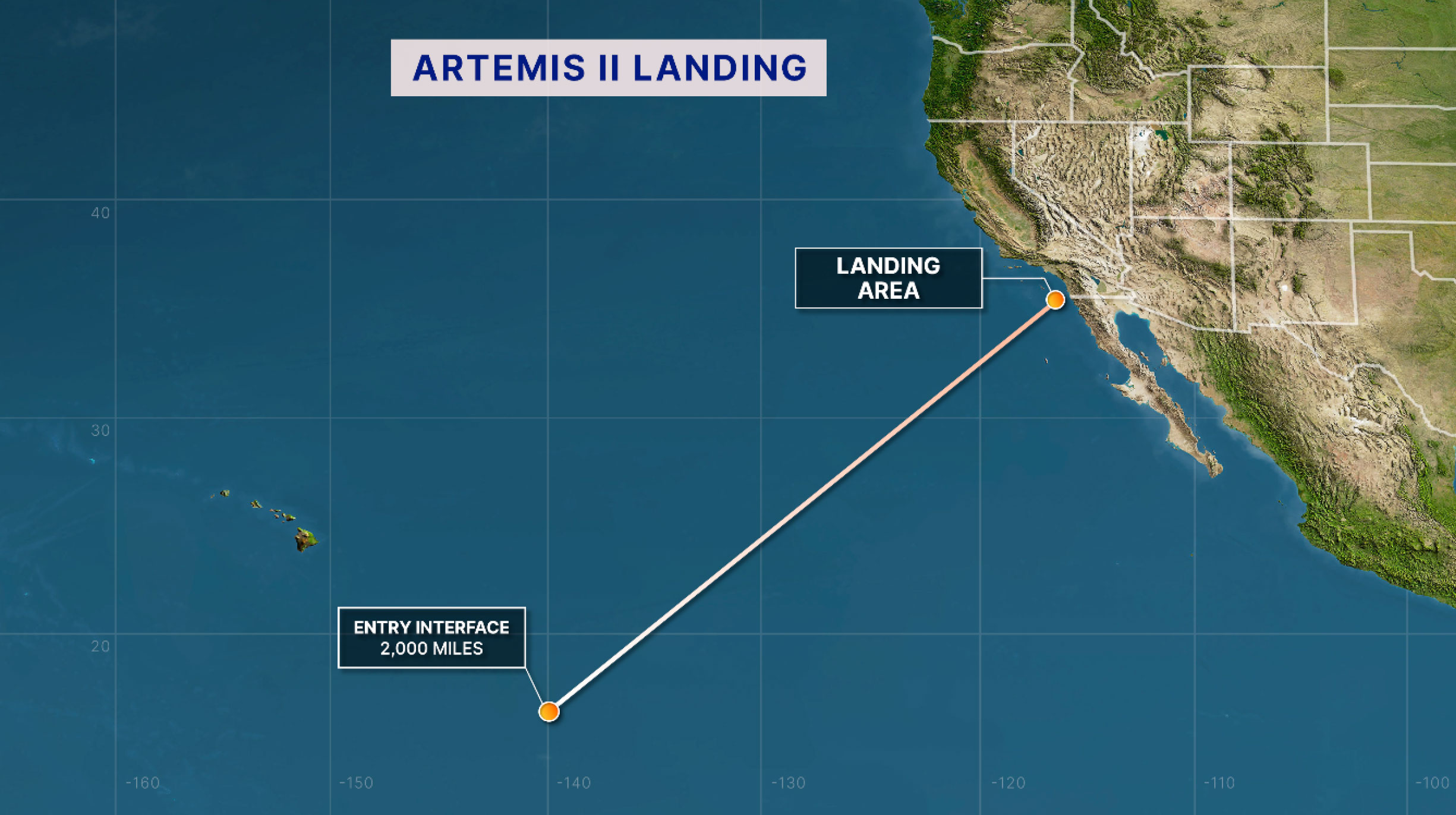
As Artemis II nears its return to Earth, NASA teams on the ground are completing final preparations for Orion's re-entry and splashdown around 8:07 p.m. (5:07 p.m. PDT) Friday, April 10, off the coast of San Diego.
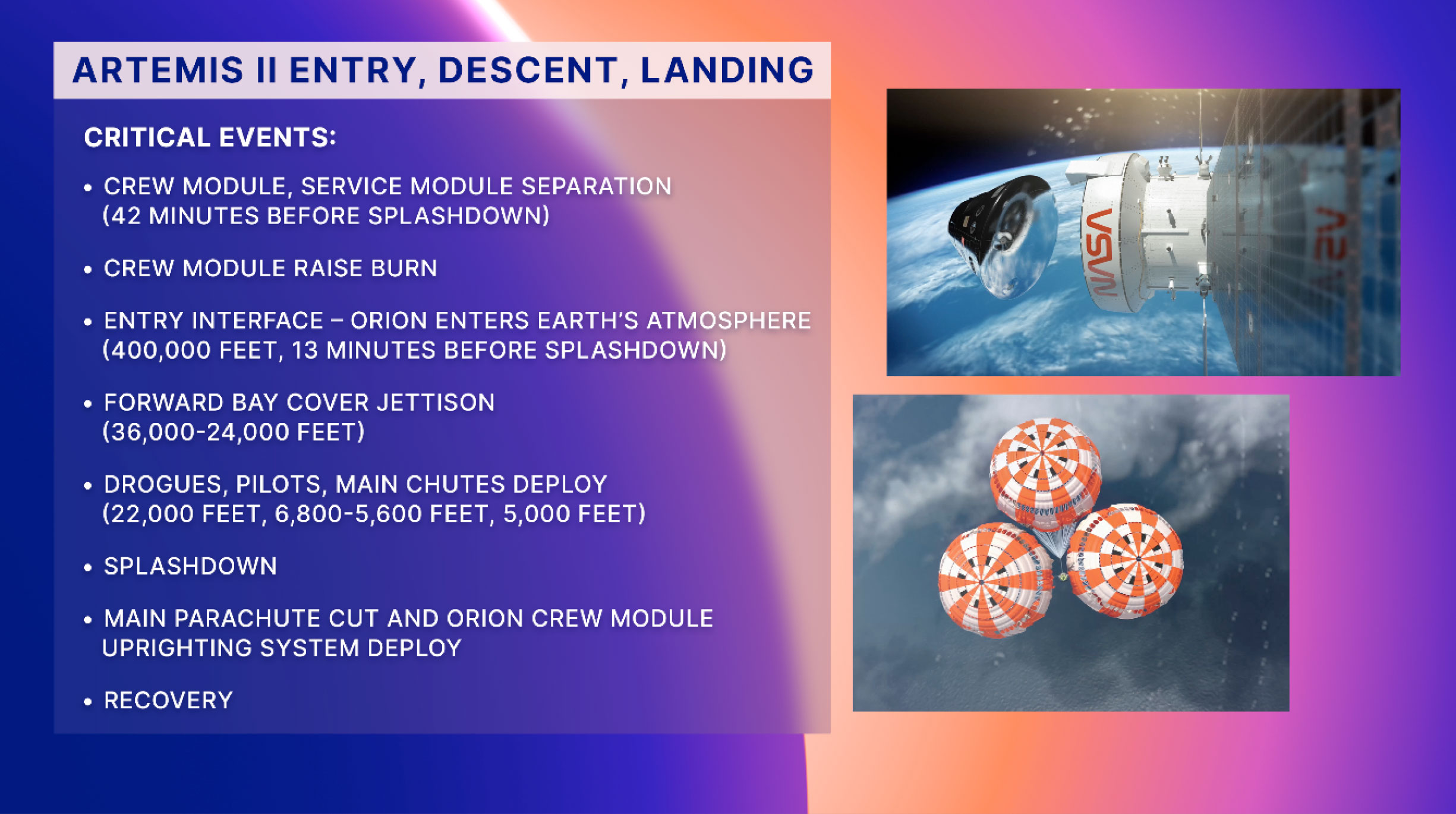
Above: Artemis II infographic showcasing the missions entry, descent, and landing milestones. This graphic was presented by Artemis II Flight Director Rick Henfling during the mission status briefing to the media and public on April 8, 2026 at NASA's Johnson Space Center in Houston.
During re-entry, the service module will separate about 20 minutes before Orion reaches the upper atmosphere southeast of Hawaii. If needed, a final trajectory‑adjustment burn will fine‑tune the flight path before the spacecraft begins a series of roll maneuvers to safely distance itself from departing hardware. Orion will reach its maximum velocity — approximately 23,864 mph — just before entry interface.
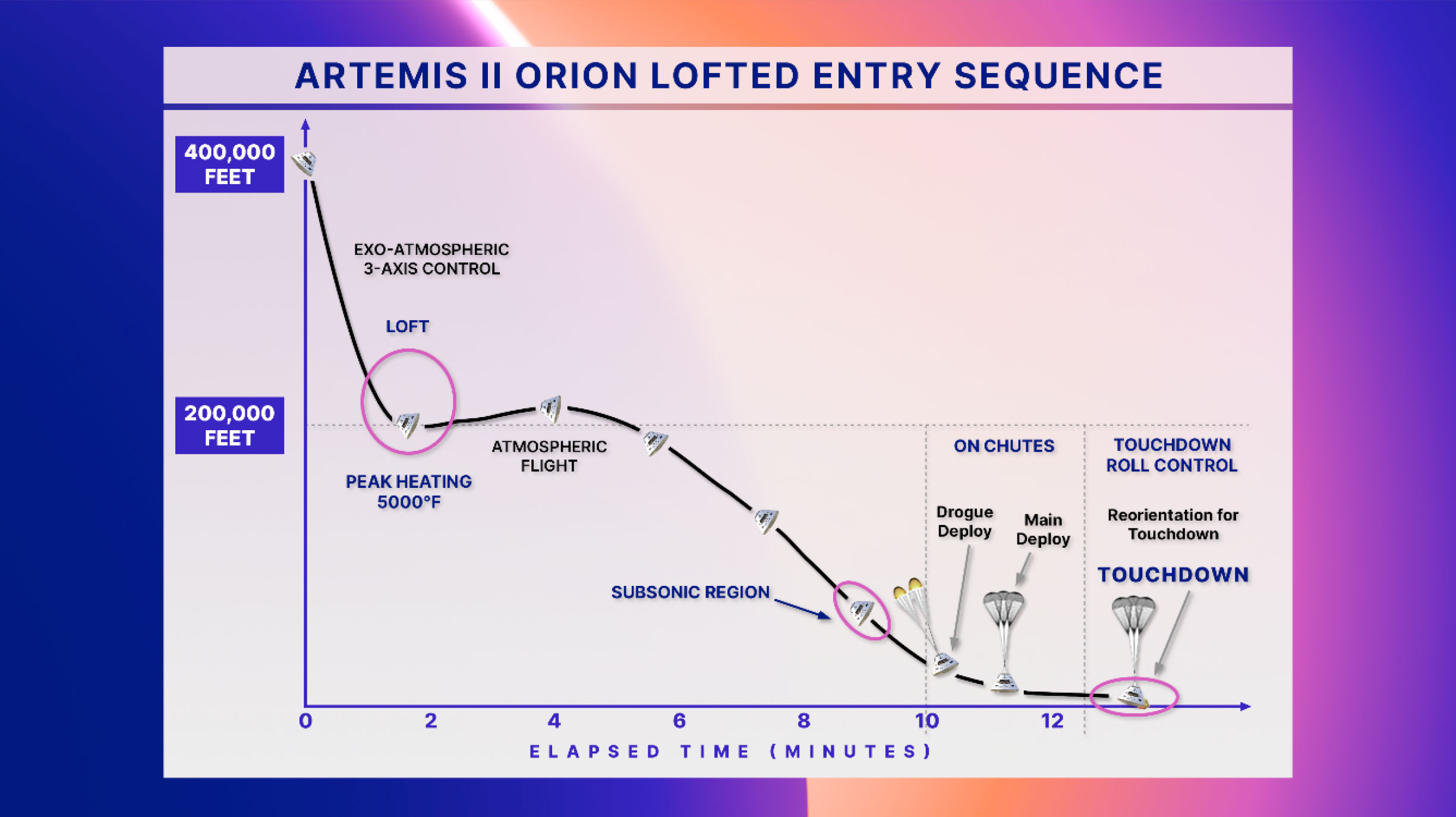
Above: Infographic featuring the Artemis II Orion lofted entry sequence.
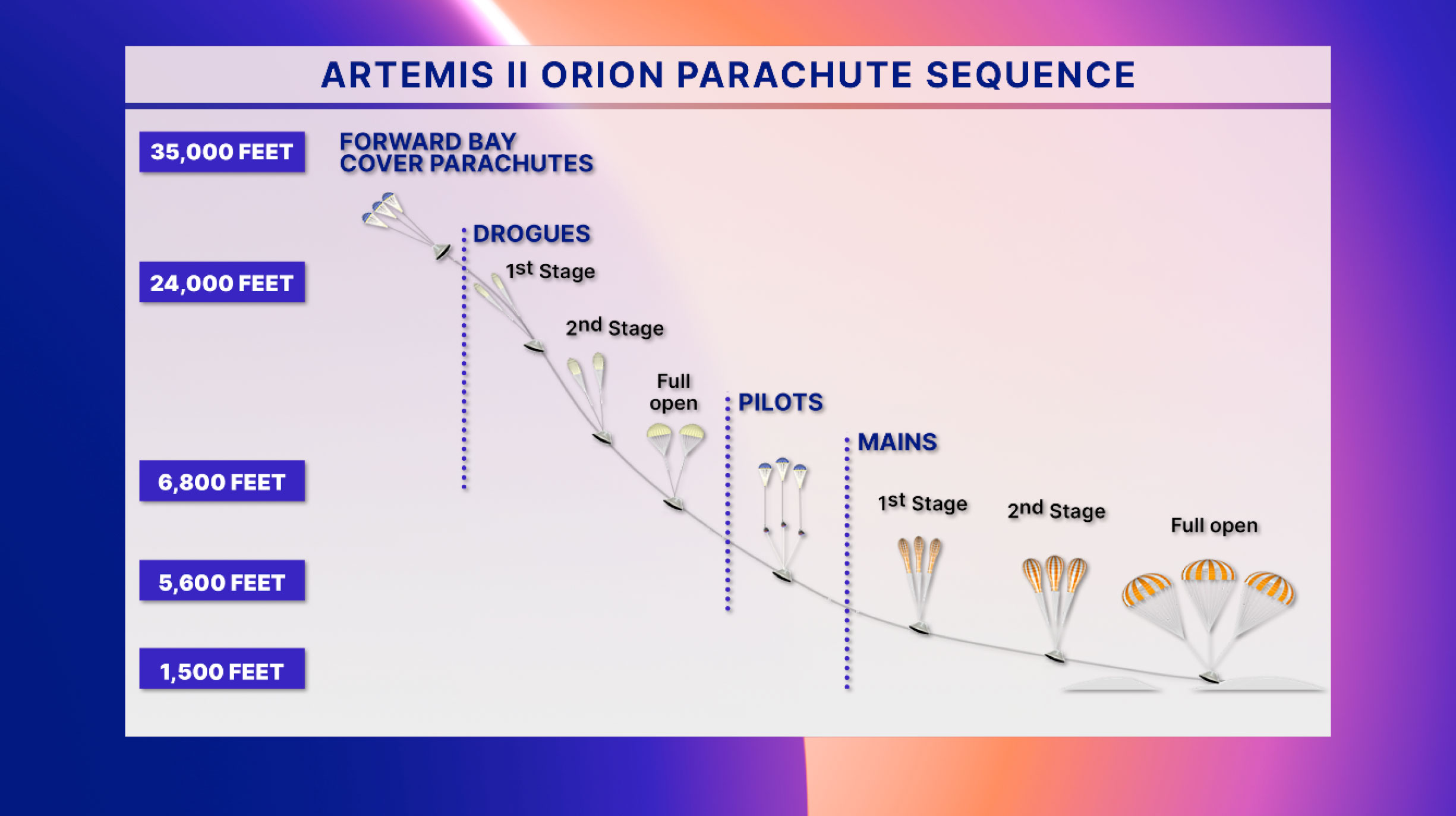
Above: Infographic displaying the Artemis II Orion parachute sequence.
As Orion descends through about 400,000 feet, the spacecraft will enter a planned six‑minute communications blackout as plasma forms around the capsule during peak heating. The crew is expected to experience up to 3.9 Gs in a nominal landing profile.
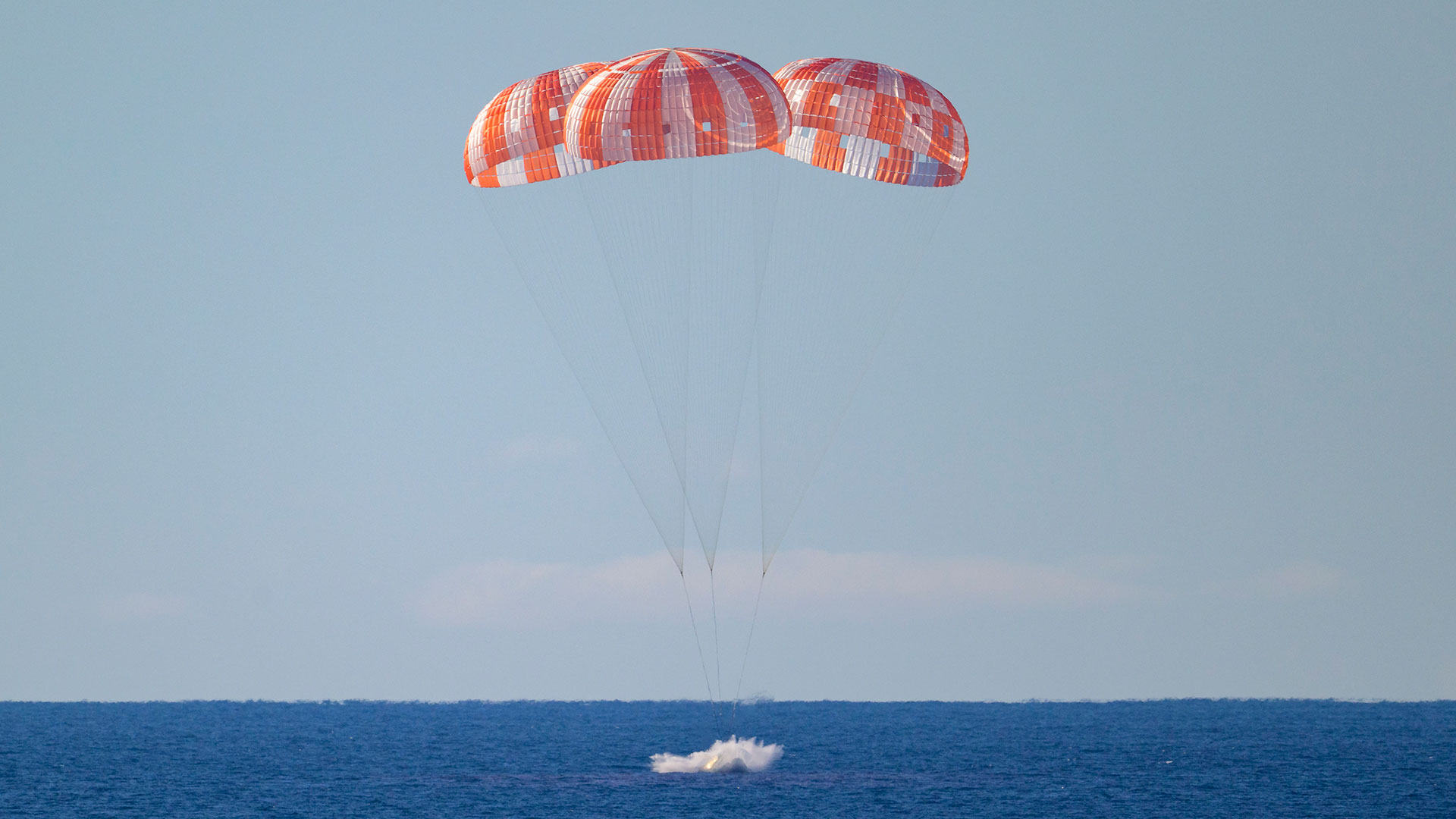
After emerging from blackout, Orion will jettison its forward bay cover, deploy its drogue parachutes near 22,000 feet, and then unfurl its three main parachutes around 6,000 feet to slow the capsule for splashdown off the coast of San Diego.
Above: Ground track map displaying the Artemis II Orion parachute sequence.
Within two hours after splashdown, the crew will be extracted from Orion and flown to the USS John P. Murtha. Recovery teams will retrieve the crew using helicopters, and once aboard the ship, the astronauts will undergo post‑mission medical evaluations before returning to shore to board an aircraft bound for NASA's Johnson Space Center in Houston.
Robert Pearlman Editor
Posts: 57235 From: Houston, TX Registered: Nov 1999
posted 04-10-2026 08:13 AM
NASA release
Second Return Correction Burn Complete
At 10:53 p.m. EDT on April 9, Integrity ignited its thrusters for 9 seconds, producing an acceleration in velocity of 5.3 feet-per-second and pushing the Artemis II crew toward Earth. The astronauts were at the time more than halfway home.
About two hours before the burn, there was an unexpected return link loss of signal during a data rate change affecting the transmission of communications and telemetry from the spacecraft to the ground. Two-way communications were reestablished, and flight controllers resumed preparing for the upcoming burn with the crew shortly after.
The third return trajectory correction burn is scheduled for April 10 at about 1:53 p.m. ahead of re-entry procedures. NASA is targeting splashdown at 8:07 p.m. (5:07 p.m. PDT) Friday, April 10, off the coast of San Diego.
Robert Pearlman Editor
Posts: 57235 From: Houston, TX Registered: Nov 1999
posted 04-10-2026 04:08 PM
NASA release
Crew Completes Final Burn Before Splashdown
At 2:53 p.m. EDT on Friday (April 10), Integrity ignited its thrusters for 8 seconds, producing a change in velocity of 4.2 feet-per-second and pushing Artemis II toward Earth.
The crew continues to wrap up cabin configuration for re-entry and move into their entry checklist.
Splashdown is targeted for 8:07 p.m. EDT (5:07 p.m. PDT) off the coast of San Diego, where NASA's recovery team will be standing by to welcome the Artemis II crew home.
A carefully timed sequence will guide Orion through the final stages of descent (times in EDT):
7:33 p.m.: Orion's crew module will separate from the service module, exposing its heat shield for the spacecraft's return through Earth's atmosphere, where it will encounter temperatures of about 3,000 degrees Fahrenheit.
7:37 p.m.: Following separation, Orion will perform an 18 second crew module raise burn beginning to set the proper entry angle and align the heat shield for atmospheric interface.
7:53 p.m.: When Orion reaches 400,000 feet above Earth's surface while traveling nearly 35 times the speed of sound. The crew is expected to experience up to 3.9 Gs in the planned entry profile. This moment marks the spacecraft's first contact with the upper atmosphere and the start of a planned six-minute communications blackout as plasma builds around the capsule.
8:03 p.m.: Around 22,000 feet in altitude, the drogue parachutes will deploy, slowing and stabilizing the capsule as Orion nears splashdown.
8:04 p.m.: At around 6,000 feet, the drogues will release, and the three main parachutes will deploy, reducing Orion's speed to less than 136 mph.
8:07 p.m.: Slowing to 20 mph, Orion will splash down in the Pacific Ocean off the coast of San Diego, completing the Artemis II crew's return to Earth and a 694,481-mile journey.
From there, teams from NASA and the U.S. military will extract the crew from Orion and fly them via helicopter to the USS John P. Murtha.
Within two hours after splashdown, the crew will be extracted from Orion and flown to the USS Murtha. Recovery teams will retrieve the crew, assist them onto an inflatable raft, and then use helicopters to deliver them to the ship. Once aboard, the astronauts will undergo post‑mission medical evaluations before returning to shore where awaiting aircraft will take them to NASA's Johnson Space Center in Houston.
Robert Pearlman Editor
Posts: 57235 From: Houston, TX Registered: Nov 1999
The first astronauts to fly by the moon in more than 50 years are back on Earth.
Artemis II mission commander Reid Wiseman, pilot Victor Glover and mission specialist Christina Koch, all with NASA, and Canadian Space Agency mission specialist Jeremy Hansen splashed down aboard their Orion spacecraft "Integrity" in the Pacific Ocean, off the coast of San Diego, on Friday (April 10).
The 8:07 p.m. EDT (5:07 p.m. PDT local time or 0007 GMT on April 11) landing brought to an end a history-making 10 days that for the majority of people alive was the first time humans traveled beyond low Earth orbit in their lifetime. The last time was during the Apollo 17 mission in 1972.
Robert Pearlman Editor
Posts: 57235 From: Houston, TX Registered: Nov 1999
posted 10-15-2026 12:31 PM
NASA release
Rigorous Analysis Confirms NASA's Artemis II Heat Shield Performance
NASA's Artemis II mission sent four astronauts around the Moon and brought them safely back to Earth, laying a foundation for crewed flights to the Moon's surface.
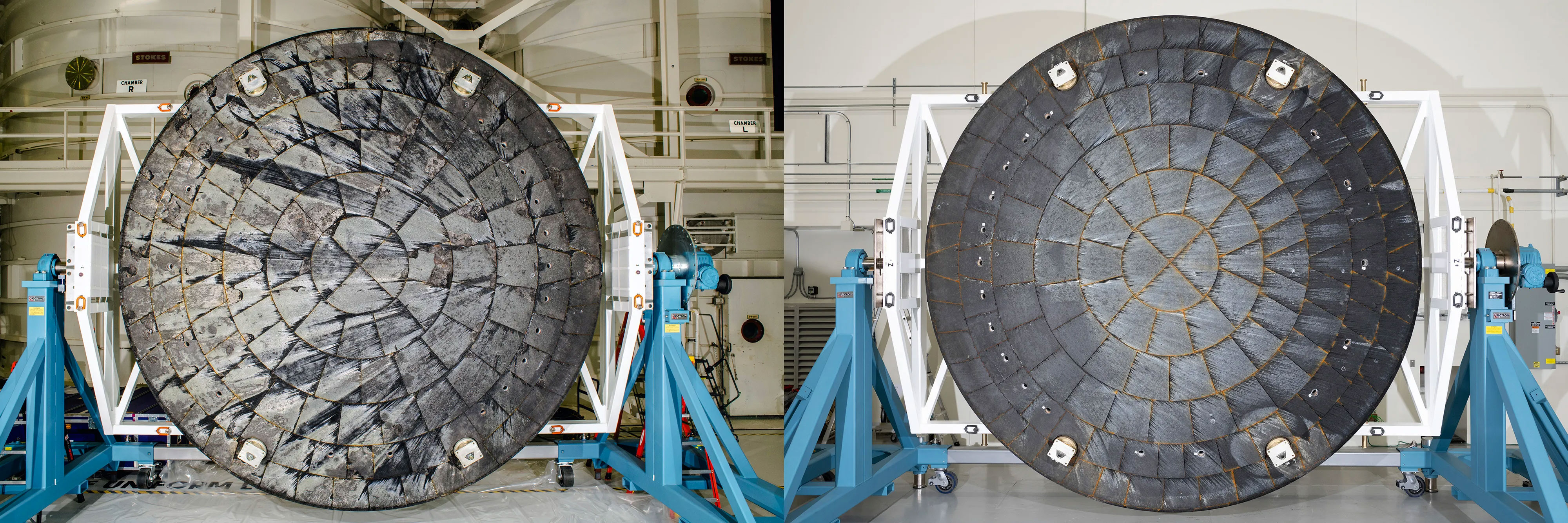
A post‑mission comparison of the Orion spacecraft heat shields from Artemis I (left) and Artemis II (right) are shown after removal from their crew modules. Both heat shields are seen rotated for inspection inside the Operations and Checkout Building at NASA's Kennedy Space Center in Florida. (NASA)
Additional engineering data analysis of the Orion spacecraft's heat shield confirmed initial data showing the heat shield performed as expected.
In particular, NASA measured whether the thermal protection system effectively safeguarded the crew and Orion systems as the spacecraft reentered Earth's atmosphere. This test flight was the first time astronauts flew aboard Orion.
Orion reached a maximum velocity of 39 times the speed of sound and experienced external temperatures exceeding 4,000 degrees Fahrenheit at its peak, all while the four astronauts inside Orion stayed relatively cool with a cabin temperature in the mid-70 degree Fahrenheit range during their return to Earth from the Moon.
After NASA's thorough analysis of Artemis I heat shield findings, informed by extensive arc jet material testing at NASA's Ames Research Center in California's Silicon Valley, the agency modified Orion's reentry trajectory for Artemis II by shortening the maximum downrange distance the spacecraft could fly between when it entered Earth's atmosphere and splashed down in the Pacific Ocean. Analysis prior to the mission showed that limiting downrange distance would limit how long the spacecraft's heat shield spent in the temperature range at which the Artemis I heat shield phenomenon occurred.
Shortly after Artemis II splashdown on April 10, 2026, U.S. Navy divers captured underwater imagery of the Orion spacecraft's heat shield. (US Navy)
The spacecraft reentered with precision, entering within only 192 feet of its targeted entry interface, and successfully splashed down only 0.59 miles from the predicted landing site off the coast of San Diego. Initial inspections of the thermal protection system, including diver imagery of the spacecraft's heat shield taken just after splashdown and further inspections on the recovery ship, found it performed as expected, with a significant reduction in the amount of cracks and char loss as compared to Artemis I.
Upon the spacecraft's return to NASA's Kennedy Space Center in Florida after the Moon mission, thermal protection system experts began additional examination of the heat shield, made of 186 unique blocks of an ablative material called Avcoat. The heat shield was then transported to NASA's Marshall Space Flight Center in Huntsville, Alabama, where work on sample extraction and internal x-ray scans began in August to provide further engineering insight into the system and behavior of the material.
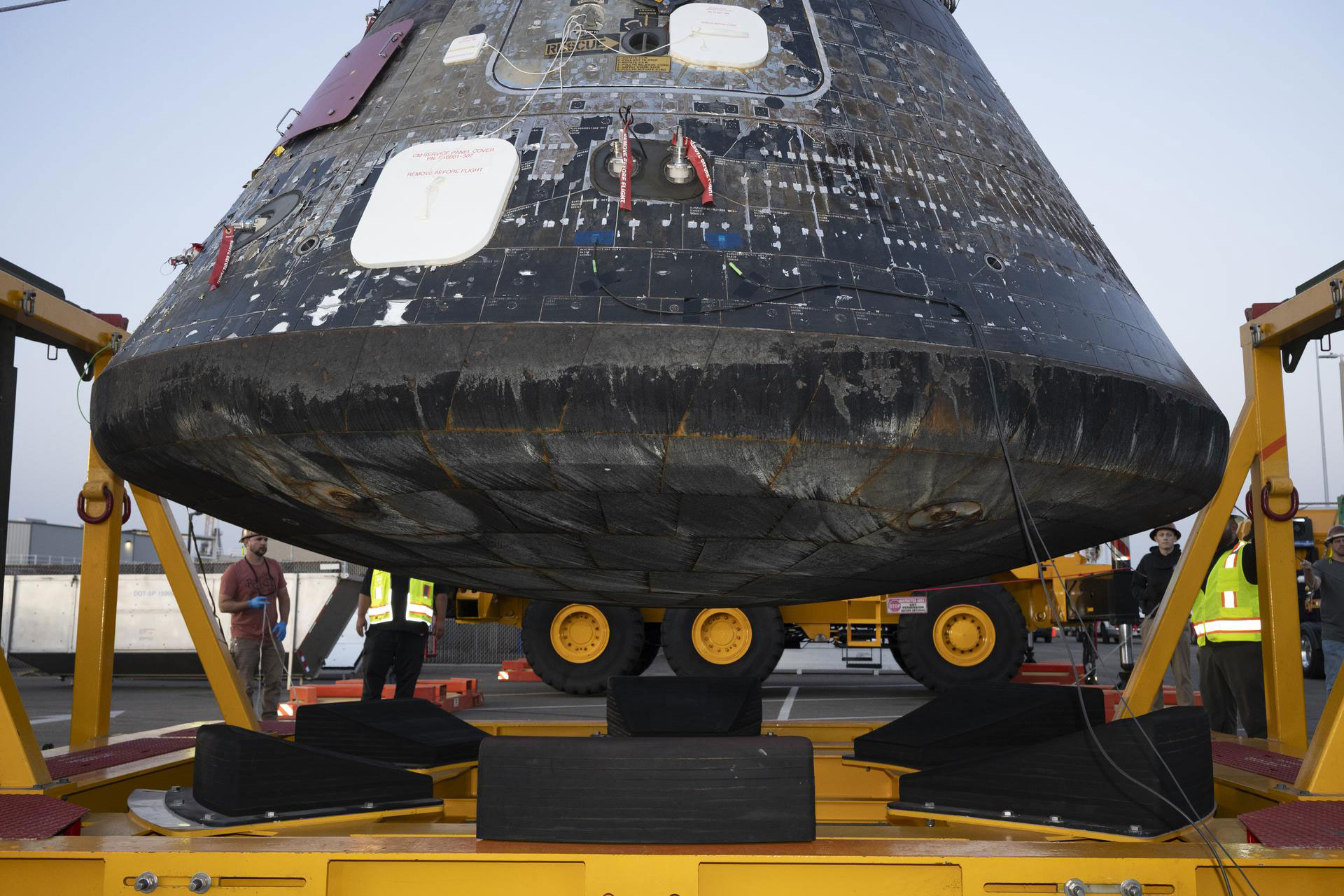
The Artemis II Orion crew module after being offloaded from the well deck of USS John P. Murtha at Naval Base San Diego and lifted from the Orion Recovery Cradle Assembly on April 18, 2026. The gray area, as seen on the edge where the spacecraft's heat shield and the backshell meet, is from recovery operations. (NASA/Kevin Davis)
A thorough post-flight assessment review found that Orion's aerodynamic and aerothermal performance, including the heat shield and backshell thermal protection system, was in line with engineering predictions based on pre-flight analyses and ground testing. The shorter allowable down range during entry reduced the cracking and char loss experienced on the Artemis II heat shield relative to the Artemis I heat shield by a factor of ten, proving the effectiveness of the trajectory modification. Engineers found only nine spots of char loss of varying sizes on the Artemis II heat shield dish, compared to 103 during Artemis I.
The analysis also showed that Orion's robust heat shield design showed consistency from Artemis I to Artemis II, evident by the performance of system features such as the seams between the heat shield Avcoat blocks and the Avcoat surrounding the heat shield compression pad separation bolts.
Post-flight inspection of Orion's backshell, the protective cover on the sloped sides of the crew module made up of 1,300 ceramic tiles, showed expected performance across the crew module surface. Visual inspections indicated backshell features designed to seal and protect penetrations such as windows, vents, thrusters, and the side hatch also met expectations, with no signs of overheating observed.
The team also performed post-flight laser scans of the heat shield surface and is comparing this data to pre-flight measurements to determine material recession, which will then be compared to analysis predictions. Engineers are continuing with heat shield sample extraction at NASA Marshall and subsequent material test and assessment and thermal analysis, to support long-term heat shield development, manufacturing efforts, and data capture.
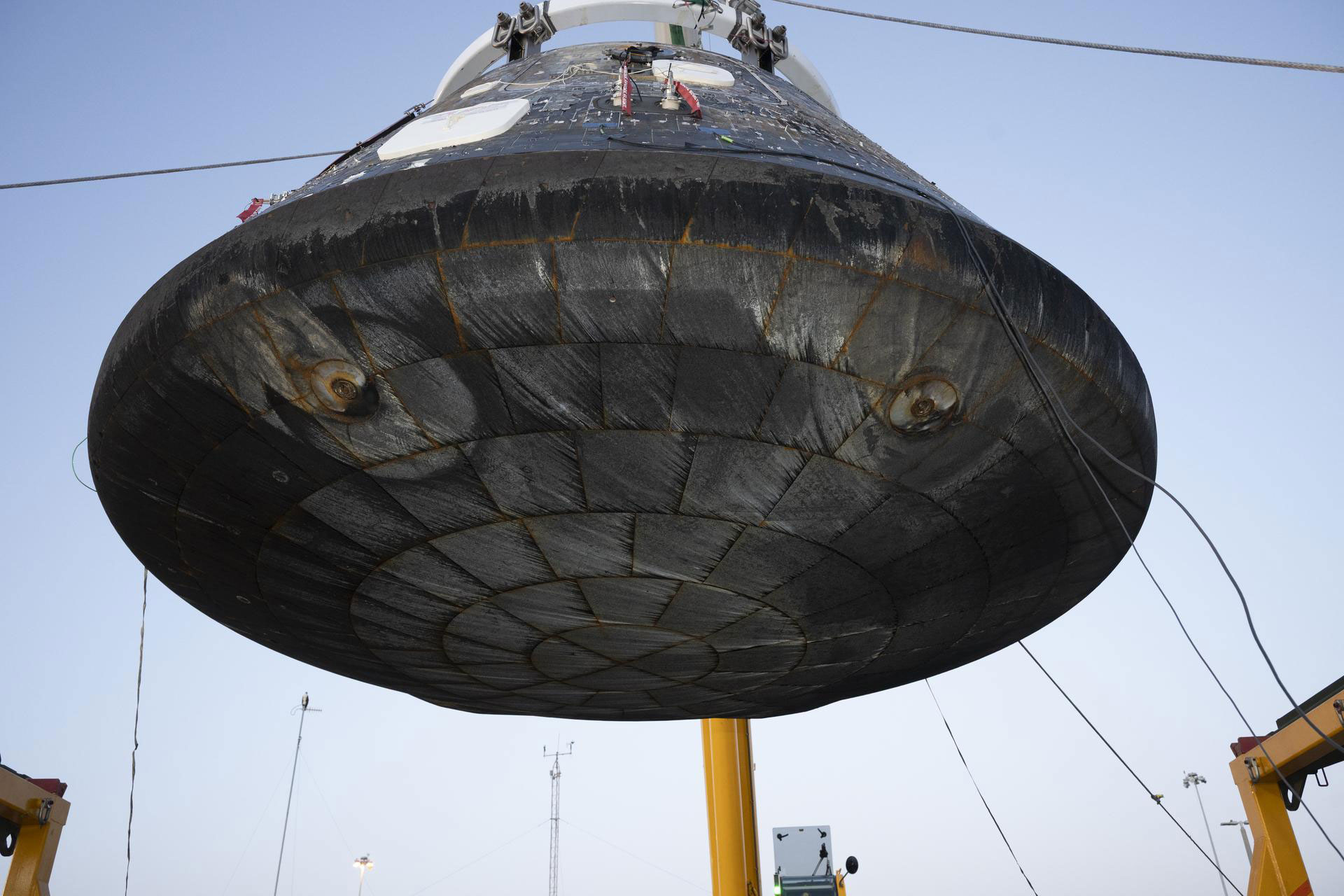
The Artemis II Orion crew module is lifted from its recovery fixture for inspection and engineering imagery after being offloaded from the USS John P. Murtha at Naval Base San Diego on April 18, 2026. The recessed areas, or smaller concentric circles, seen on the heat shield are associated with the separation bolts that connect the crew module with the service module. The larger circular patterns are formed due to compression pad material used within this location of the spacecraft, creating flow disturbances caused by extreme aerodynamic and thermal airflow during reentry. This causes increased heating locally and therefore Avcoat ablator thickness is increased in these areas by design. (NASA/Kevin Davis)
Orion's performance and the team's analysis on Artemis II reflect system robustness, capability to support crew, and critical insights gathered that will enhance the Artemis III mission and beyond. Following the extensive Artemis I heat shield investigation, upgrades were made to the heat shield design for Artemis III to achieve uniformity and consistent permeability of the Avcoat blocks. Technicians attached the heat shield for the Artemis III Orion crew module at NASA Kennedy in early July, and the Orion crew and service modules were joined at the end of July. The spacecraft has since been successfully powered up for the first time, enabling engineers to check all connection lines between the two modules are working as planned.
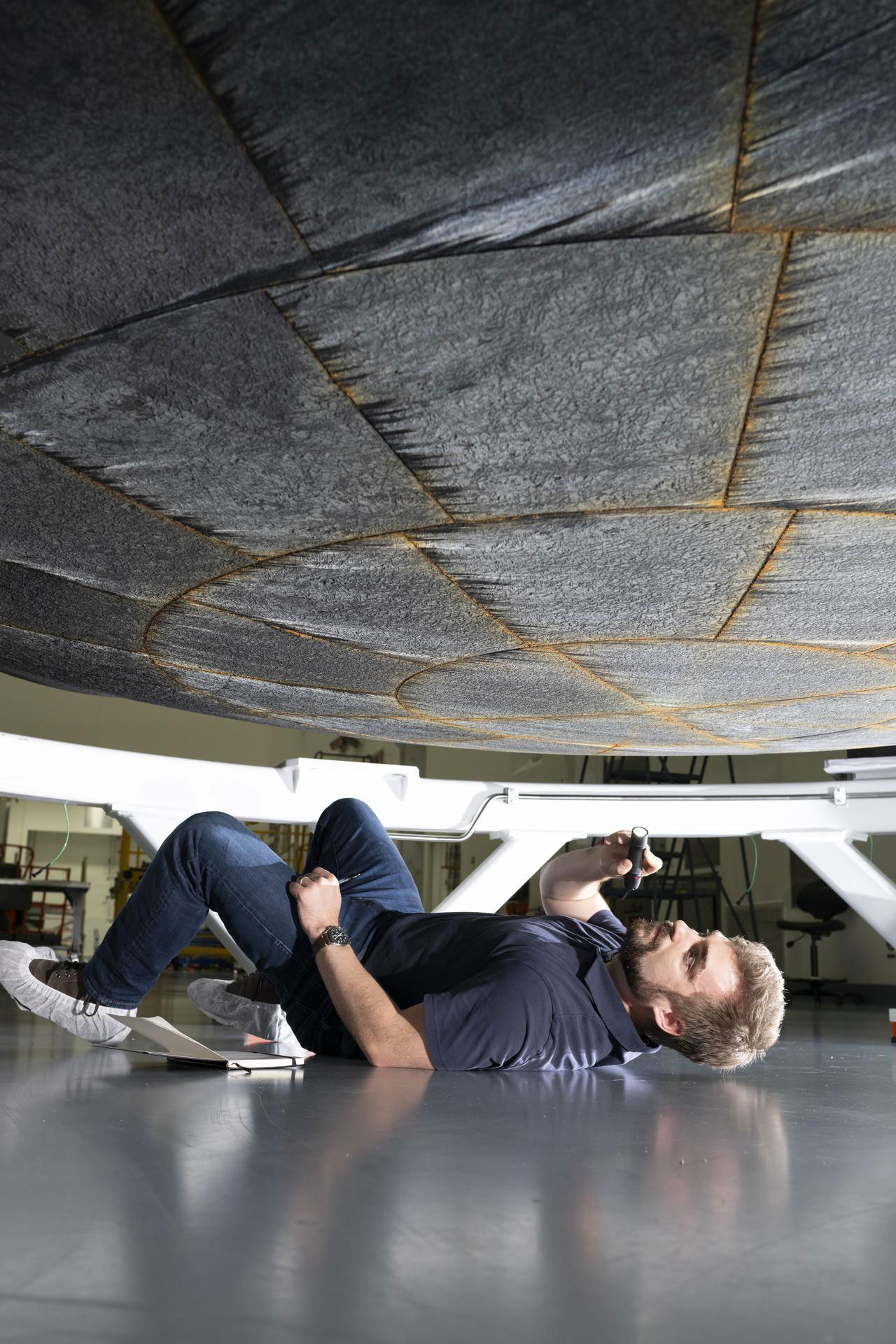
An engineer from NASA's Ames Research Center inspects the Artemis II Orion heat shield at NASA Kennedy's Multi-Purpose Payload Facility on April 30, 2026, prior to its removal from the crew module. The orange tint seen between Avcoat tiles is an expected effect of the silicone used to fill the gaps between the blocks. The silicone gap filler contains iron oxide, which gives it a red appearance after enduring reentry. (NASA/Kevin Davis)
NASA continues to advance toward Artemis III as teams ready the Orion spacecraft for next year's mission in low Earth orbit. NASA will launch the SLS (Space Launch System) rocket and Orion spacecraft with NASA astronauts Randy Bresnik, Frank Rubio, Andre Douglas, and ESA (European Space Agency) Luca Parmitano, to rendezvous with human lander test articles from Blue Origin and SpaceX to demonstrate critical systems and operations needed for future lunar landings, beginning with Artemis IV in 2028.







 posted 04-03-2026 03:41 AM






 advertisement