Posts: 57235 From: Houston, TX Registered: Nov 1999
posted 02-19-2026 11:36 AM
NASA release
Upper stage propellant loading begins
As teams continue to fuel the SLS rocket's core stage with liquid oxygen and liquid hydrogen, teams began loading liquid hydrogen into the rocket's interim cryogenic propulsion stage or upper stage.
Robert Pearlman Editor
Posts: 57235 From: Houston, TX Registered: Nov 1999
posted 02-19-2026 12:14 PM
NASA release
SLS core stage hydrogen in replenish mode; thus far no leaks reported
NASA teams have transitioned the SLS rocket's core stage liquid hydrogen tank to replenish mode. This marks an important milestone in the test, as teams reached this step without exceeding the ground safety limit of the hydrogen leak concentration, as was observed during the first Artemis II wet dress rehearsal.
After completing fast fill and topping, replenish keeps the tank at flight-ready levels by replacing any LH2 lost to boil-off. Replenish is essential for maintaining stable pressure and temperature in the tank as the countdown continues. Cryogenic propellants like liquid hydrogen naturally warm and evaporate over time, even in insulated tanks. Replenishing the tanks counteracts this by continuously adding small amounts of liquid propellant to maintain the correct volume and pressure.
This phase ensures the core stage remains fully fueled and ready to power its four RS-25 engines at liftoff, providing the thrust needed to send Orion and its crew on their journey around the Moon.
Robert Pearlman Editor
Posts: 57235 From: Houston, TX Registered: Nov 1999
posted 02-19-2026 01:50 PM
NASA release
All SLS cryogenic tanks in replenish mode
NASA teams have transitioned all cryogenic tanks on the SLS (Space Launch System) rocket to replenish mode. This includes both liquid hydrogen and liquid oxygen tanks for the core stage and the interim cryogenic propulsion stage.
Cryogenic propellants naturally warm and evaporate over time, even in insulated tanks. Replenish counteracts this by continuously adding small amounts of liquid hydrogen and liquid oxygen to maintain proper levels and pressure. This ensures the rocket remains fully fueled and stable as the countdown progresses toward terminal count.
Following all stages replenish, teams will perform final system checks and verify valve and sensor performance before transitioning to the terminal countdown sequence, which includes simulated launch operations and final readiness verifications.
With all stages in replenish, the Artemis II wet dress rehearsal is now in its final fueling configuration, bringing this test wet dress rehearsal operations closer to terminal count.
Robert Pearlman Editor
Posts: 57235 From: Houston, TX Registered: Nov 1999
posted 02-19-2026 03:02 PM
NASA release
Closeout crew en route to White Room
NASA's Artemis II closeout crew is en route to the White Room inside the crew access arm at Launch Pad 39B. This specialized team is responsible for securing the Orion spacecraft and ensuring all access points are properly configured before simulated crew ingress operations.
The White Room is the environmentally controlled area at the end of the crew access arm, providing a clean and safe space for astronauts to enter Orion on launch day. During the wet dress rehearsal, the closeout crew will close the spacecraft's hatches, verify hatch seals, check environmental conditions, and confirm all systems are ready for the next steps in the countdown.
In addition, the pad rescue team will be positioned to respond immediately in the unlikely event of an emergency, ensuring safe evacuation procedures for pad personnel. Their presence ensures that all operations meet stringent safety standards as the SLS (Space Launch System) rocket and Orion spacecraft move closer to flight readiness. These teams are essential for mitigating risk and supporting the complex choreography of Artemis II's prelaunch activities.
Robert Pearlman Editor
Posts: 57235 From: Houston, TX Registered: Nov 1999
posted 02-19-2026 03:50 PM
NASA release
Closeout crew closes Orion hatch
As part of the Artemis II wet dress rehearsal, NASA teams have closed the Orion crew module hatch inside the White Room at Launch Pad 39B. This step simulates launch day procedures, ensuring the spacecraft is sealed and ready for launch. The Artemis II astronauts are not participating in today's rehearsal, but the close out crew simulated strapping them into their seats.
The closeout crew inspects and cleans the hatch seals to maintain airtight integrity, verifies environmental controls inside the crew module, and confirms all mechanical and electrical connections are secure before closure.
Closing the hatch is a critical milestone that demonstrates Orion's readiness for flight and validates procedures for the first crewed Artemis mission around the Moon. The closeout crew will next close the launch abort system hatch.
Robert Pearlman Editor
Posts: 57235 From: Houston, TX Registered: Nov 1999
posted 02-19-2026 05:40 PM
NASA release
Launch abort system hatch closed
NASA teams have closed the launch abort system hatch during the Artemis II wet dress rehearsal, simulating final launch day procedures. The launch abort system hatch provides access to the Orion crew module through the abort tower and must be securely sealed to ensure crew safety during ascent.
Closing the launch abort system hatch is a critical milestone that confirms the spacecraft is fully configured for flight. The hatch is designed to protect astronauts in the event of an emergency during launch, and proper hatch integrity ensures the system can perform as intended.
With the hatch secured, the closeout crew validates mechanical seals, verifies environmental conditions, perform leak checks, and confirms readiness for the next steps in the countdown sequence.
Next up, the closeout crew will depart the launch pad once its work is completed.
Robert Pearlman Editor
Posts: 57235 From: Houston, TX Registered: Nov 1999
posted 02-19-2026 06:09 PM
NASA release
Closeout crew departs the launch pad
NASA’s Artemis II closeout crew has completed its critical tasks and departed NASA Kennedy's Launch Complex 39B during the Artemis II wet dress rehearsal.
The departure of the closeout crew marks the transition to the final countdown phase of the test, ensuring the launch pad is clear and safe for simulated liftoff procedures. Their work validates launch day protocols and confirms Orion and the SLS (Space Launch System) rocket are configured for flight readiness.
With the pad secured, teams will continue monitoring fueling operations and prepare for wet dress rehearsal terminal count: the final ten minutes of the countdown.
Robert Pearlman Editor
Posts: 57235 From: Houston, TX Registered: Nov 1999
posted 02-19-2026 07:37 PM
NASA release
T-10 minutes and holding
The launch director has extended the T-10 minute hold to allow for time to complete final preparations for the terminal countdown of today's wet dress rehearsal, including bringing the core stage engine section temperature into the necessary range for launch. It is currently just shy of the temperature that would be required if SLS were planning to launch, but engineers expect it to rise shortly.
A new simulated T-0 time will be set once the temperature has risen into the correct range.
Robert Pearlman Editor
Posts: 57235 From: Houston, TX Registered: Nov 1999
posted 02-19-2026 07:45 PM
NASA release
Entering terminal count
NASA teams have now officially entered the final ten minutes of today's Artemis II wet dress rehearsal countdown known as terminal count after Charlie Blackwell-Thompson, NASA's Artemis launch director, gave the "go" to proceed toward the simulated T-0 time of 8:42 p.m.
During terminal count, automated systems take control of countdown operations, final checks of flight computers, engine bleed systems, and ground support equipment occur, and the rocket transitions to internal power, and the countdown proceeds toward simulated engine start.
Terminal count is designed to confirm that all systems can perform flawlessly under launch conditions, ensuring readiness for Artemis II – the first crewed mission of the Artemis program.
During this first terminal count run, the team will pause at T-1 minute and 30 seconds for up to three minutes, then resume until T-33 seconds before launch and pause again. After that, they will recycle the clock back to T-10 minutes and conduct a second terminal countdown to approximately T-33 seconds before ending the sequence. This process simulates real-world conditions, including scenarios where a launch might be scrubbed due to technical or weather issues.
Update at 8:39 p.m. EST: The crew access arm has been retracted. The launch abort system would be available to pull the crew to safety in the event of an emergency on the launch pad beginning 5 minutes 25 seconds before launch.
Robert Pearlman Editor
Posts: 57235 From: Houston, TX Registered: Nov 1999
posted 02-19-2026 07:50 PM
NASA release
First terminal count complete after glitch
The terminal countdown was paused due to a booster avionics system voltage anomaly, but resumed and continued to planned recycle point. The team is now resetting the countdown as planned.
Robert Pearlman Editor
Posts: 57235 From: Houston, TX Registered: Nov 1999
posted 02-19-2026 09:32 PM
NASA release
Second terminal count conducted; wet dress rehearsal complete
NASA teams officially entered the second round of terminal countdown, or the final ten minutes of today's Artemis II wet dress rehearsal countdown after successfully recycling the clock back to T-10 minutes. The new T-0 was set for 10:17 p.m. EST.
The WDR ended at 10:16 p.m., concluding as planned at T-29 seconds in the countdown.
Robert Pearlman Editor
Posts: 57235 From: Houston, TX Registered: Nov 1999
posted 02-20-2026 10:47 AM
NASA release
NASA Begins Artemis II Launch Pad Ops After Successful Fuel Test
NASA successfully fueled its SLS (Space Launch System) rocket and demonstrated the launch countdown for Artemis II on Thursday (Feb. 19) during a wet dress rehearsal at the agency's Kennedy Space Center in Florida.
Engineers loaded more than 700,000 gallons of liquid propellant into the rocket, sent a closeout crew to the launch pad to demonstrate closing the Orion spacecraft's hatches, and completed two runs of terminal count — the final phase of the launch countdown. The Artemis II crew also observed part of the test from the Launch Control Center at NASA Kennedy.
During the test, teams closely monitored liquid hydrogen fueling operations, which proved challenging during previous tests. Hydrogen gas concentrations remained under allowable limits, giving engineers confidence in new seals installed in an interface used to route fuel to the rocket.
Early in fueling operations, teams experienced a loss of ground communications in the Launch Control Center. Operators temporarily moved to backup communication methods to maintain safe propellant loading activities before normal communications channels were restored. Engineers isolated the equipment that caused the issue.
While engineers review data from the test, the Artemis II crew is preparing to enter quarantine late Friday, Feb. 20, in Houston. Although NASA has not set a formal launch date, beginning the roughly 14-day quarantine to limit the crew's exposure to illness before launch preserves flexibility in the March launch window.
Over the next several days, technicians will use cranes to set up temporary access platforms on the mobile launcher. The platforms will allow them to reach the upper left and right segments of the SLS solid rocket boosters and core stage intertank to service the flight termination system and retest it to meet Eastern Range safety requirements. The platforms were developed based on lessons learned during Artemis I and enable NASA to complete end-to-end testing of the safety system while at the launch pad rather than rolling back to the Vehicle Assembly Building at NASA Kennedy for retesting.
The closeout crew also will practice closeout operations once more, adding to the team's proficiency.
Robert Pearlman Editor
Posts: 57235 From: Houston, TX Registered: Nov 1999
posted 02-21-2026 09:47 AM
NASA release
NASA Troubleshooting Artemis II Rocket Upper Stage Issue, Preparing to Roll Back
NASA is taking steps to potentially roll back the Artemis II rocket and Orion spacecraft to the Vehicle Assembly Building (VAB) at the agency’s Kennedy Space Center in Florida after overnight Feb. 21 observing interrupted flow of helium in the SLS (Space Launch System) rocket’s interim cryogenic propulsion stage. Helium flow is required for launch.
Teams are actively reviewing data, and taking steps to enable rollback positions for NASA to address the issue as soon as possible while engineers determine the best path forward.
In order to protect for troubleshooting options at both Pad B and the VAB, teams are making preparations to remove the pad access platforms installed yesterday, which have wind-driven constraints and cannot be removed during high winds, which are forecasted for tomorrow. This will almost assuredly impact the March launch window.
Robert Pearlman Editor
Posts: 57235 From: Houston, TX Registered: Nov 1999
posted 02-22-2026 12:47 PM
NASA release
NASA to Rollback Artemis II Rocket, Spacecraft
Weather pending, NASA will roll the SLS (Space Launch System) rocket and Orion spacecraft for Artemis II off the launch pad at the agency’s Kennedy Space Center in Florida as soon as Tuesday, Feb. 24.
Engineers are continuing to prepare for the move after encountering an issue with the flow of helium to the rocket's upper stage.
On Feb. 21, managers decided to remove recently installed platforms before high winds descend on the Space Coast, which poised teams for rollback while discussions about the issue were ongoing. Returning to the Vehicle Assembly Building at Kennedy is required to determine the cause of the issue and fix it.
Teams are reviewing the exact time to begin the approximately 4 mile, multi-hour trek.
The quick work to begin preparations for rolling the rocket and spacecraft back to the VAB potentially preserves the April launch window, pending the outcome of data findings, repair efforts, and how the schedule comes to fruition in the coming days and weeks.
The Artemis II crew members were released from quarantine the evening of Feb. 21 and remain in Houston.
Robert Pearlman Editor
Posts: 57235 From: Houston, TX Registered: Nov 1999
NASA's march to the moon has been delayed to April.
The space agency's plans to launch the Artemis II crew as soon as the first week of March have been postponed by at least a month due to their rocket needing to return to its assembly building. The decision to roll back the Space Launch System (SLS) came after a problem emerged with its upper stage.
Robert Pearlman Editor
Posts: 57235 From: Houston, TX Registered: Nov 1999
posted 02-23-2026 08:20 PM
NASA release
NASA Targets Artemis II Rollback on Wednesday
Due to weather, NASA now is targeting early Wednesday, Feb. 25, to roll the SLS (Space Launch System) rocket and Orion spacecraft for Artemis II off the launch pad and back to the Vehicle Assembly Building (VAB) at the agency's Kennedy Space Center in Florida. Cold temperatures and high winds are expected Tuesday, and rolling on Feb. 25, gives teams enough time to complete preparations at the launch pad that were limited today by high winds in the area.
The approximately 4-mile trek is expected to take up to 12 hours. Once back in the VAB, teams will immediately begin work to install platforms to access the area of the helium flow issue.
Robert Pearlman Editor
Posts: 57235 From: Houston, TX Registered: Nov 1999
posted 02-24-2026 04:27 PM
NASA release
First Motion Set for Artemis II Rollback
NASA is targeting approximately 9 a.m. EST, Wednesday, Feb. 25, to begin rolling the SLS (Space Launch System) rocket and Orion spacecraft for Artemis II off the launch pad and back to the Vehicle Assembly Building (VAB) at the agency's Kennedy Space Center in Florida. Teams will continue to monitor winds and temperatures in advance of the roll.
The approximately 4-mile trek is expected to take up to 12 hours. Once back in the VAB, teams will immediately begin work to install platforms to access the area of the helium flow issue. Teams also will take advantage of the time in the VAB to replace batteries in the flight termination system and retest it, and replace additional batteries in the upper stage.
Robert Pearlman Editor
Posts: 57235 From: Houston, TX Registered: Nov 1999
posted 02-25-2026 09:24 AM
NASA release
SLS rolls back to assembly building
NASA's SLS (Space Launch System) rocket and Orion spacecraft for the Artemis II mission began rolling off the launch pad at 9:38 a.m. EST, Feb. 25, at NASA's Kennedy Space Center in Florida.
Rolling from Launch Pad 39B to the Vehicle Assembly Building at NASA Kennedy is expected to take up to 12 hours.
Robert Pearlman Editor
Posts: 57235 From: Houston, TX Registered: Nov 1999
posted 02-26-2026 07:34 AM
NASA release
SLS rolled into VAB for repairs
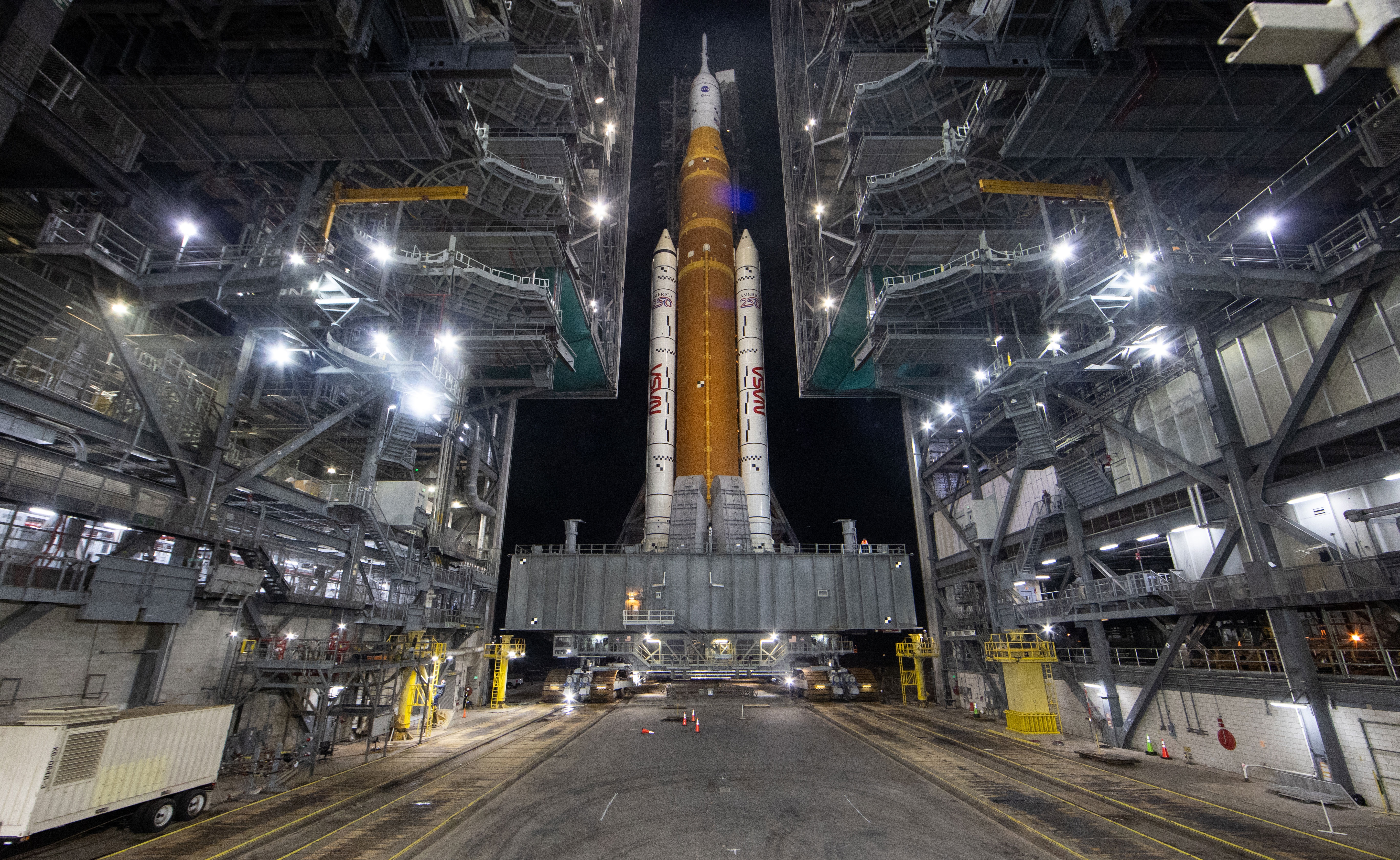
The SLS (Space Launch System) rocket and Orion spacecraft for NASA's Artemis II mission arrived at the Vehicle Assembly Building from Launch Pad 39B at approximately 8 p.m. EST Feb. 25, at NASA's Kennedy Space Center in Florida.
While in the assembly building, technicians will troubleshoot the helium flow issue to the rocket's upper stage, replace batteries on the rocket's upper stage, core stage, and solid rocket boosters as well as service its flight termination system.
Robert Pearlman Editor
Posts: 57235 From: Houston, TX Registered: Nov 1999
posted 02-27-2026 12:13 AM
NASA release
Repairs begin in Vehicle Assembly Building
Once NASA's Artemis II SLS (Space Launch System) rocket and Orion spacecraft arrived at the Vehicle Assembly Building (VAB) Feb. 25, technicians immediately began addressing why the flow of helium to the SLS upper stage was interrupted as engineers were reconfiguring the rocket following a successful wet dress rehearsal on Feb. 21.
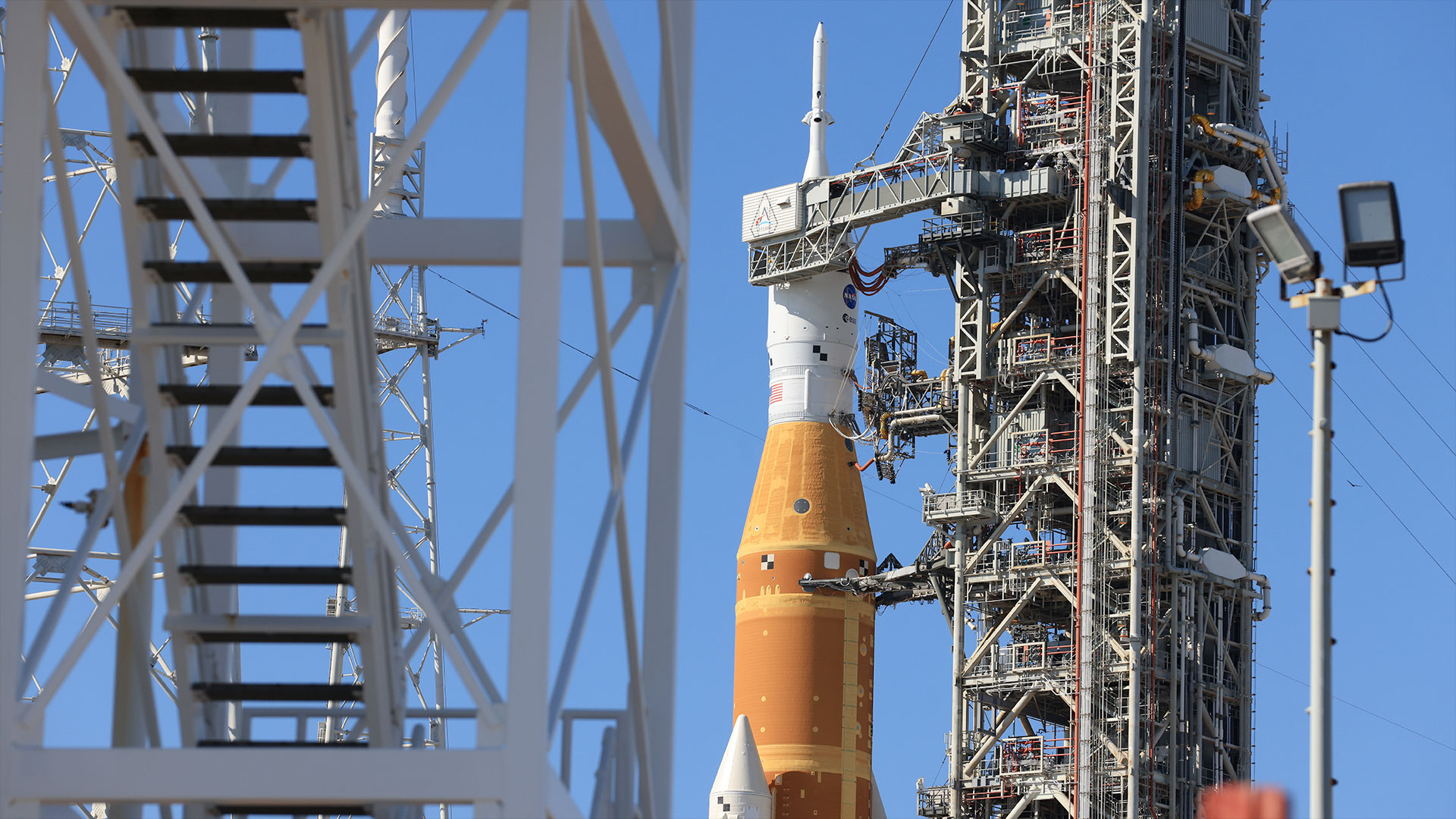
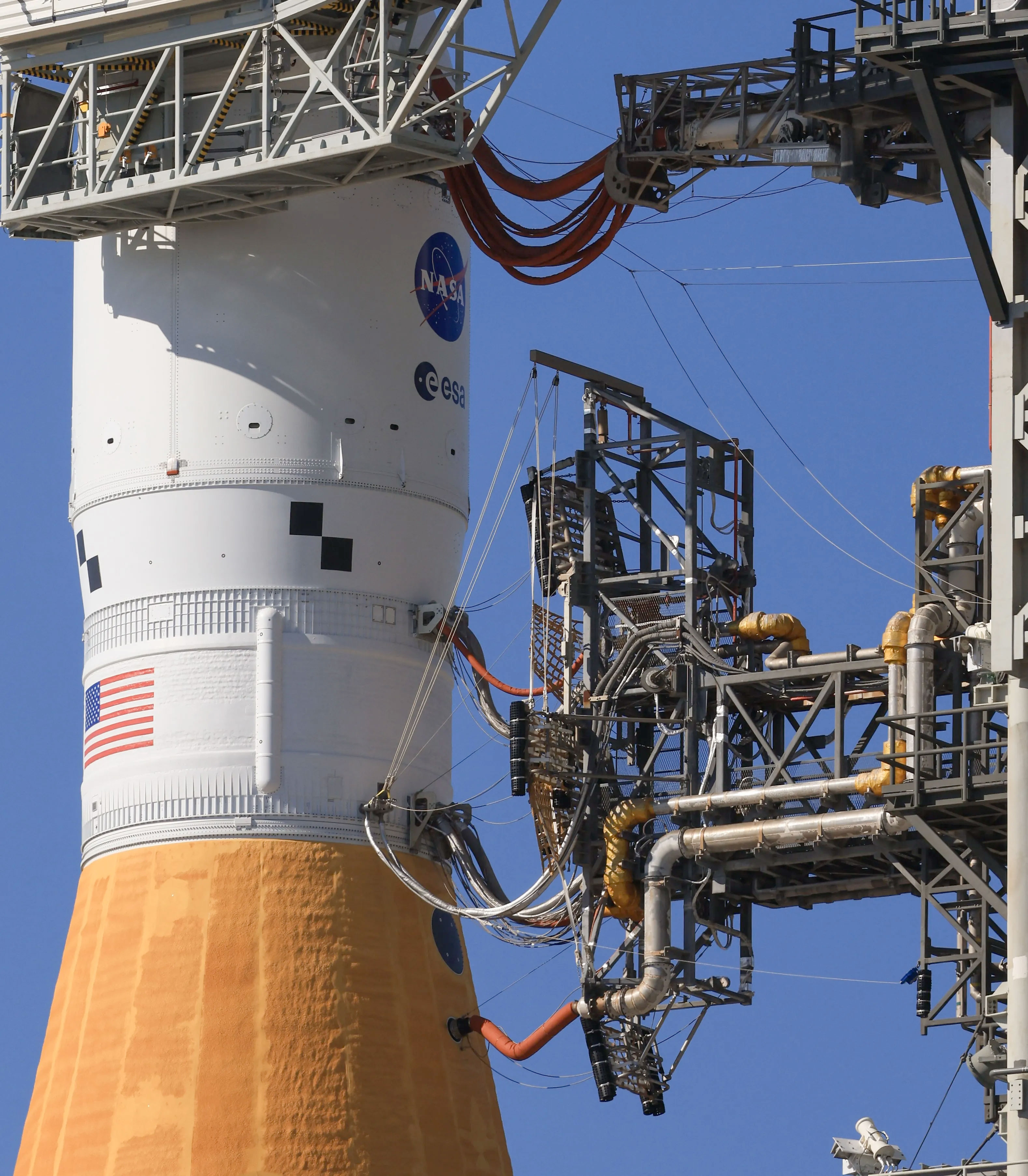
To make the repairs, teams are installing two sets of internal access platforms inside the launch vehicle stage adapter and must remove thermal blankets that cover the area they are interested in – a point on the rocket's interim cryogenic propulsion system, or upper stage. The area provides connections for multiple umbilicals, including tubing used to fill the upper stage with helium. Helium is used to maintain proper environmental conditions, and to pressurize the stage for flight.
Above: The interim cryogenic propulsion stage has two umbilicals. The highest, smaller ICPS forward plate includes a liquid hydrogen vent and environmental control system air line. The lower, larger aft plate supplies liquid hydrogen, liquid oxygen, and includes a helium quick disconnect and hazardous gas sensing. (NASA)
Engineers have narrowed the issue preventing the helium flow to two potential components: a seal on the tubing's quick disconnect and a check valve on the other end of that tubing.
While the rocket and spacecraft are in the VAB, teams also will install new batteries for the SLS's upper stage, core stage, and solid rocket boosters, as well as retest its flight termination system and avionics and control systems.
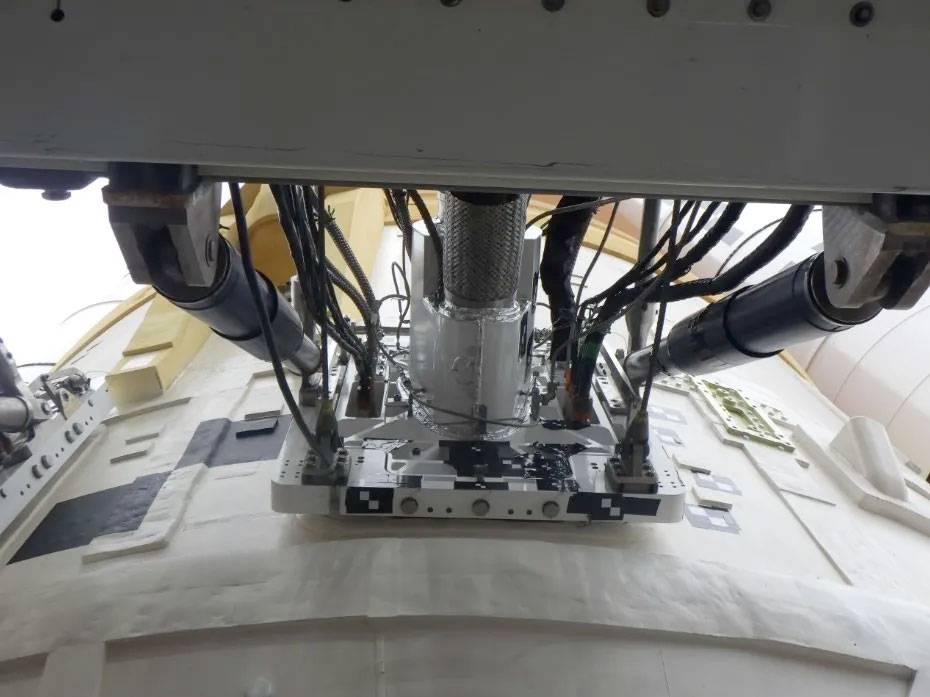
Above: Shown is a mated flight and ground plate for the SLS (Space Launch System) core stage's liquid hydrogen tail service mast umbilical. The quick disconnect device sits between these interface plates once the umbilicals are connected and provide access for flowing propellant into the core stage's fuel tank. The tail service mast umbilical connects from the zero-level deck on the mobile launcher to the SLS (Space Launch System) rocket core stage aft section and provide liquid oxygen and liquid hydrogen fluid lines and electrical cable connections to the SLS core stage engine section to support propellant handling during prelaunch operations. (NASA)
The Orion spacecraft's launch abort system batteries will be recharged, and engineers may refresh some of the stowed items inside the crew module.
Engineers have optimized planned work in the VAB, and much of the work to come can be done in parallel. Pending the outcome of data reviews, repair efforts, and how the schedule comes to fruition in the coming days and weeks, the Artemis II Moon rocket will roll back to Launch Pad 39B in time for April launch opportunities.
Robert Pearlman Editor
Posts: 57235 From: Houston, TX Registered: Nov 1999
posted 03-03-2026 02:20 PM
NASA release
NASA Repairs Upper Stage Helium Flow, Preps Continue Ahead of Rollout
With NASA's Artemis II SLS (Space Launch System) rocket and Orion spacecraft in the Vehicle Assembly Building at the agency's Kennedy Space Center in Florida, technicians have accessed the launch vehicle stage adapter to inspect components that prevented helium from flowing to the upper stage after a Feb. 21 wet dress rehearsal.
Engineers determined a seal in the quick disconnect, through which helium flows from the ground systems to the rocket, was obstructing the pathway. The team removed the quick disconnect, reassembled the system, and began validating the repairs to the upper stage by running a reduced flow rate of helium through the mechanism to ensure the issue was resolved. Engineers are assessing what allowed the seal to become dislodged to prevent the issue from recurring.
While the upper stage repair has been underway, technicians also have been working to refresh other systems on the rocket. They are activating a new set of flight termination system batteries ahead of end-to-end retesting of the system and also are replacing the flight batteries on the upper stage, core stage, and solid rocket boosters, and charging the Orion launch abort system batteries.
Work to replace a seal on the core stage liquid oxygen line feed system began March 2. Once complete, teams will reassemble the oxygen tail service mast umbilical plate and perform various integrity tests to ensure the seal interface is tight.
Work on the rocket and spacecraft will continue in the coming weeks as NASA prepares for rolling the rocket out to the launch pad again later this month ahead of a potential launch in April.
Robert Pearlman Editor
Posts: 57235 From: Houston, TX Registered: Nov 1999
posted 03-13-2026 11:01 AM
NASA release
Artemis II Flight Readiness Polls Go to Proceed Toward April Launch
NASA completed the agency's Artemis II Flight Readiness Review on Thursday, March 12, and polled "go" to proceed toward launch.
NASA is targeting Thursday, March 19, to roll the SLS (Space Launch System) rocket and Orion spacecraft to launch pad 39B in advance of a launch attempt Wednesday, April 1, pending close out of remaining open work.
Robert Pearlman Editor
Posts: 57235 From: Houston, TX Registered: Nov 1999
posted 03-13-2026 11:01 AM
NASA release
NASA's Artemis II Moon Mission Daily Agenda
About eight minutes after Artemis II lifts off, the Orion spacecraft and its crew, NASA astronauts Reid Wiseman, Victor Glover, and Christina Koch, along with CSA (Canadian Space Agency) astronaut Jeremy Hansen, will be in space. The approximately 10-day test flight will be packed with activity as the astronauts venture around the Moon and back, with teams checking out Orion's systems along the way. While teams in mission control could refine the crew's schedule each day based on operational activities during the test flight, ground teams and the crew have a general plan for each day of the mission.
Launch Day/Flight Day 1:
Once the SLS (Space Launch System) rocket's main engines cutoff, Orion and the interim cryogenic propulsion stage (ICPS) separate from the rest of rocket. The ICPS still has work to do – about 49 minutes after launch, its engine will fire to raise the perigee, or lowest point of a spacecraft's orbit, to a safe altitude of 100 miles above Earth. About an hour later, when Orion reaches that perigee, the ICPS will fire again to continue raising the spacecraft into a high-Earth orbit. The crew will then have about 23 hours to do a thorough checkout of Orion's systems while still relatively close to home.
The crew will start testing systems like the potable water dispenser that will provide drinking water and rehydrate the food they brought along, the toilet, and the system that removes carbon dioxide from the air. The crewmates also can take off the orange spacesuits worn for launch and work in regular clothing. They'll spend time rearranging Orion's interior to function as a living and workspace for four floating people over the next 10 days.
About three hours into the mission, NASA will test how Orion handles.
On future missions, Orion will dock with other spacecraft. To verify Orion will do so safely, the ICPS will be repurposed as a docking target. It will separate from Orion, and the crew will practice flying their spacecraft toward and around it in a proximity operations demonstration. Afterward, the ICPS will fire its engines again for a disposal burn that will send it into the Pacific Ocean, and Orion will continue its high Earth orbit.
After about eight-and-a-half hours in space, the astronauts will sleep for a short period. The four astronauts will be awakened after about four hours to perform an additional engine firing that will put Orion into the correct orbital geometry for its translunar injection (TLI) burn on flight day 2. They'll also take the opportunity to perform a brief check out their emergency communications on the Deep Space Network, at the most-distant point of their high Earth orbit, which is necessary before the TLI.
After this, they'll be able to go back to sleep for another four-and-a-half hours, wrapping up flight day 1.
Flight Day 2
Wiseman and Glover will begin their day setting up and checking out Orion's flywheel exercise device before getting in their first workouts of the mission. Koch and Hansen have exercise scheduled for the second half of the day. The morning workouts will provide another test of Orion's life support systems before leaving Earth orbit.
Koch will spend her morning preparing for the main event of the day – the translunar injection burn. The TLI is the last major engine firing of the Artemis II mission and will set Orion on the path to the Moon. And since Orion is using a free-return trajectory to swing around the far side of the Moon, the TLI engine firing also puts Orion on the path to return to Earth on flight day 10.
Koch will set up Orion's system to perform the burn, done by Orion's main engine on the spacecraft's European Service Module. Also called the orbital maneuvering system engine, it provides up to 6,000 pounds of thrust – enough to accelerate a car from 0 to 60 mph in about 2.7 seconds.
Following TLI, the crew has a lighter day of activity, with time set aside to acclimate to the space environment. They'll have an opportunity to participate in a space to ground video communication – the first of several that will take place throughout the mission. With the exception of flight day 7 – the crew's off-duty day – and landing day, they are expected to have one or two of these opportunities each day of the mission.
Flight Day 3
The first of three smaller engine firings, called the outbound trajectory correction, will ensure Orion is staying on target for its path around the Moon and will take place on flight day 3. Hansen will prepare for the burn in the morning, which is scheduled to happen shortly after the crew's midday meal.
The rest of the day will include a variety of checkouts and demonstrations. Glover, Koch, and Hansen will demonstrate CPR procedures in space; Wiseman and Glover will checkout some of Orion's medical kit, including the thermometer, blood pressure monitor, stethoscope, and otoscope.
Koch has time set aside in the second half of the day to test Orion's emergency communications system on the Deep Space Network. The entire crew will come together to rehearse the choreography for the scientific observation work they'll do on flight day 6, when Orion comes the closest to the Moon.
Flight Day 4
A second outbound trajectory correction burn on flight day 4 will continue to refine Orion's path to the Moon as the crew perfects some of their own preparations. They'll each have an hour devoted to reviewing the geography targets they'll be asked to get imagery of on flight day 6. Since those will vary depending on the crew's final launch time and day, this serves as an opportunity to study exactly what they'll be looking for as they draw close to the lunar surface. Although they will likely take photos and video out of Orion's windows often, flight day 4 has 20 minutes on the schedule specifically dedicated to taking photos of celestial bodies from Orion's windows.
Flight Day 5
Orion will enter the lunar sphere of influence on flight day 5, marking the point at which the pull of the Moon's gravity will become stronger than the pull of the Earth's gravity.
As they enter the Moon's neighborhood, the crew will have a full day, with the morning almost entirely devoted to tests of their spacesuits. Officially called the Orion crew survival system, the orange suits protect the crew during launch and reentry, but also could be used in an emergency to provide the crew member wearing it with a breathable atmosphere for up to six days if Orion depressurized. As the first astronauts to wear the new suits in space, the Artemis II crew will be testing their ability to quickly put the suits on and pressurize them; install their seats and get into them while wearing the suits; eat and drink through a port on the spacesuits' helmet; and other functions.
During the crew's afternoon, the final outbound trajectory correction burn will take place before Orion's lunar flyby on flight day 6.
Flight Day 6
The Artemis II crew will come their closest to the Moon on flight day 6, while traveling the farthest from Earth. Artemis II could set a record for the farthest anyone has traveled from Earth depending on launch day, breaking the current record – 248,655 miles away – set in 1970 by the Apollo 13 crew. The distance the Artemis II crew will travel depends on their exact launch day and time.
Over the course of the day, the crew will come within 4,000 to 6,000 miles of the lunar surface as they swing around the far side of the Moon – it should look to them about the size of a basketball held at arm's length. They will devote the majority of their day to taking photos and videos of the Moon, and recording their observations as they become the first to see some parts of the Moon with their own eyes.
Because the Sun's angle on the Moon changes by about one degree every two hours, the crew won't be sure what lighting conditions to expect on the lunar surface until they launch. If the Sun is high in the lunar sky during the flyby, there will be few shadows, and the crew will be looking for subtle variations in surface color and rightness. If the Sun is lower on the horizon, long shadows will stretch across the surface, enhancing relief and revealing depth, ridges, slopes, and crater rims that are often difficult to detect under full illumination. If the Sun is overhead from Orion's perspective – like noon on Earth – shadows will be few to nonexistent, creating ideal lighting conditions for close-up imaging of specific lunar features.
The crew will record their observations in real time, as they take photos and videos – including when they lose communication with Earth for 30-50 minutes as they pass behind the Moon. That way, their observations can later be linked with the exact images they took.
Flight Day 7
Orion will exit the lunar sphere of influence the morning of flight day 7. Before the Artemis II crew gets too far away from the Moon, scientists on the ground, eager to hear from them while the experience is still fresh in their minds, will have time to speak with the crew.
In the second half of the crew's day, the Orion engine will fire again for the first of three return trajectory correction burns that will adjust Orion's path home.
The rest of the day will be largely off-duty for the crew, giving them a chance to rest before jumping back into their final tasks before their return to Earth.
Flight Day 8
The primary activities for flight day 8 include two Orion demonstrations.
First, the crew will assess their ability to protect themselves from high radiation events like solar flares. They'll use Orion's supplies and equipment to build a shelter for cover if needed. Radiation will be an ongoing concern as humans venture into deep space, and multiple experiments will be aimed at collecting data on the radiation levels inside Orion.
At the end of the day, the crew will try out Orion's manual piloting capability by steering the spacecraft through a variety of tasks. They'll center a chosen target in Orion's windows, move into a tail-to-Sun attitude, and perform attitude maneuvers comparing the craft's six-degree-of-freedom and three-degree-of-freedom attitude control modes.
Flight Day 9
Artemis II's last full day in space will kick off with prep for their return to Earth. The crew has time set aside to study their procedures for reentry and splashdown, and talk with the flight control team. Another return trajectory correction burn will ensure the spacecraft remains on target for that return.
The crew will complete more demonstrations to check off their to-do list: waste collection systems in case the Orion toilet doesn't function properly and orthostatic intolerance garment fit checks. Orthostatic intolerance – which can cause symptoms such as dizziness and lightheadedness while standing – is a possibility for astronauts when they return to Earth and their bodies must readapt to the pull of gravity on their blood supply. Compression garments, worn under spacesuits, can help.
The crew members will try their garments on, take body circumference measurements, and complete a questionnaire on how it fits, and how easy it is to put on and take off.
Flight Day 10
The last day of the Artemis II mission is focused on getting the crew safely home. A final return trajectory correction burn will ensure Orion is on the right path for splashdown, and the crew will return their cabin to its original set up – with equipment stowed and seats in place – and get back into their spacesuits.
The crew module will separate from the service module, whose engines have steered them around the Moon and back to Earth. This will expose the crew module's heat shield, which will protect the spacecraft and crew as they make their way back through Earth's atmosphere and temperatures of up about 3,000 degrees Fahrenheit. Once safely through the heat of reentry, the cover that protected the spacecraft's forward bay will be jettisoned to make way for a series of parachutes to deploy – two drogue parachutes that will slow the capsule down to about 307 miles per hour, followed by three pilot parachutes that will pull out the final three main parachutes. These will slow Orion down to approximately 17 mph for a splashdown in the Pacific Ocean, where NASA and U.S. Navy personnel will be waiting for them, concluding the Artemis II mission.
Robert Pearlman Editor
Posts: 57235 From: Houston, TX Registered: Nov 1999
posted 03-17-2026 10:07 AM
NASA release
NASA delays Artemis II rollout by one day
Teams are now targeting no earlier than Friday, March 20, to roll NASA's Artemis II rocket from the Vehicle Assembly Building out to Launch Pad 39B, maintaining the opportunity for a Wednesday, April 1, launch attempt.
Over the weekend at the agency's Kennedy Space Center in Florida, engineers were completing closeout activities ahead of rollout, previously slated for Thursday, March 19. Teams identified an electrical harness for the flight termination system on the core stage needed replacement. They have since addressed the issue and continue to complete preparations to roll out later this week.
The trek to the launch pad takes up to 12 hours aboard the crawler-transporter. The agency will provide a live stream of the rocket's journey to the pad.
A rollout on March 20 would still preserve the possibility of launching at the beginning of the April launch window, though teams also are keeping a close eye on the weather in the coming days.
Robert Pearlman Editor
Posts: 57235 From: Houston, TX Registered: Nov 1999
posted 03-19-2026 06:37 PM
NASA release
NASA Finalizes Artemis II Rollout, Crew Begins Quarantine
NASA's Artemis II rocket and its four-person crew are all making progress toward a launch pad meet up in April.
Engineers are targeting 8 p.m. EDT on Thursday, March 19, to start rolling the Artemis II SLS (Space Launch System) rocket and Orion spacecraft to Launch Pad 39B at the agency's Kennedy Space Center in Florida.
NASA's crawler-transporter 2 will carry the 11-million-pound stack, including the mobile launcher, at about 1 mph along the four-mile route from Kennedy's Vehicle Assembly Building to the launch pad. The journey can take up to 12 hours.
The time of rollout is subject to change if additional time is needed for technical preparations or weather accommodations.
Meanwhile, the Artemis II crew entered quarantine at 5 p.m. CDT Wednesday in Houston, to ensure they stay healthy leading up to launch. NASA astronauts Reid Wiseman, Victor Glover, and Christina Koch, along with CSA (Canadian Space Agency) astronaut Jeremy Hansen, will limit their exposure to others for the next week in Houston, before flying to Kennedy approximately five days before launch, to continue their quarantine from the astronaut crew quarters there.
Both activities are key milestones on the way to a launch as early as Wednesday, April 1. The early April launch window includes opportunities through Monday, April 6.
Robert Pearlman Editor
Posts: 57235 From: Houston, TX Registered: Nov 1999
posted 03-20-2026 09:25 AM
NASA release
SLS Heading Back to Launch Pad
NASA's Artemis II SLS (Space Launch System) rocket and Orion spacecraft slated to send four astronauts around the moon began rolling to Launch Pad 39B at 12:20 a.m. EDT (0420 GMT) on Friday, March 20. Rollout operations were delayed due to high winds in the area.
The trek to the pad is expected to take up to 12 hours, as NASA's crawler-transporter 2 carefully carries the rocket on top of the mobile launcher approximately 4 miles along the crawlerway.
Robert Pearlman Editor
Posts: 57235 From: Houston, TX Registered: Nov 1999
posted 03-20-2026 12:43 PM
NASA release
SLS Arrives at Launch Pad 39B
At 11:21 a.m. EDT (1521 GMT) on Friday (March 20), NASA's Artemis II SLS (Space Launch System) rocket and Orion spacecraft arrived at Launch Pad 39B after an 11-hour journey from the Vehicle Assembly Building at the agency's Kennedy Space Center in Florida.
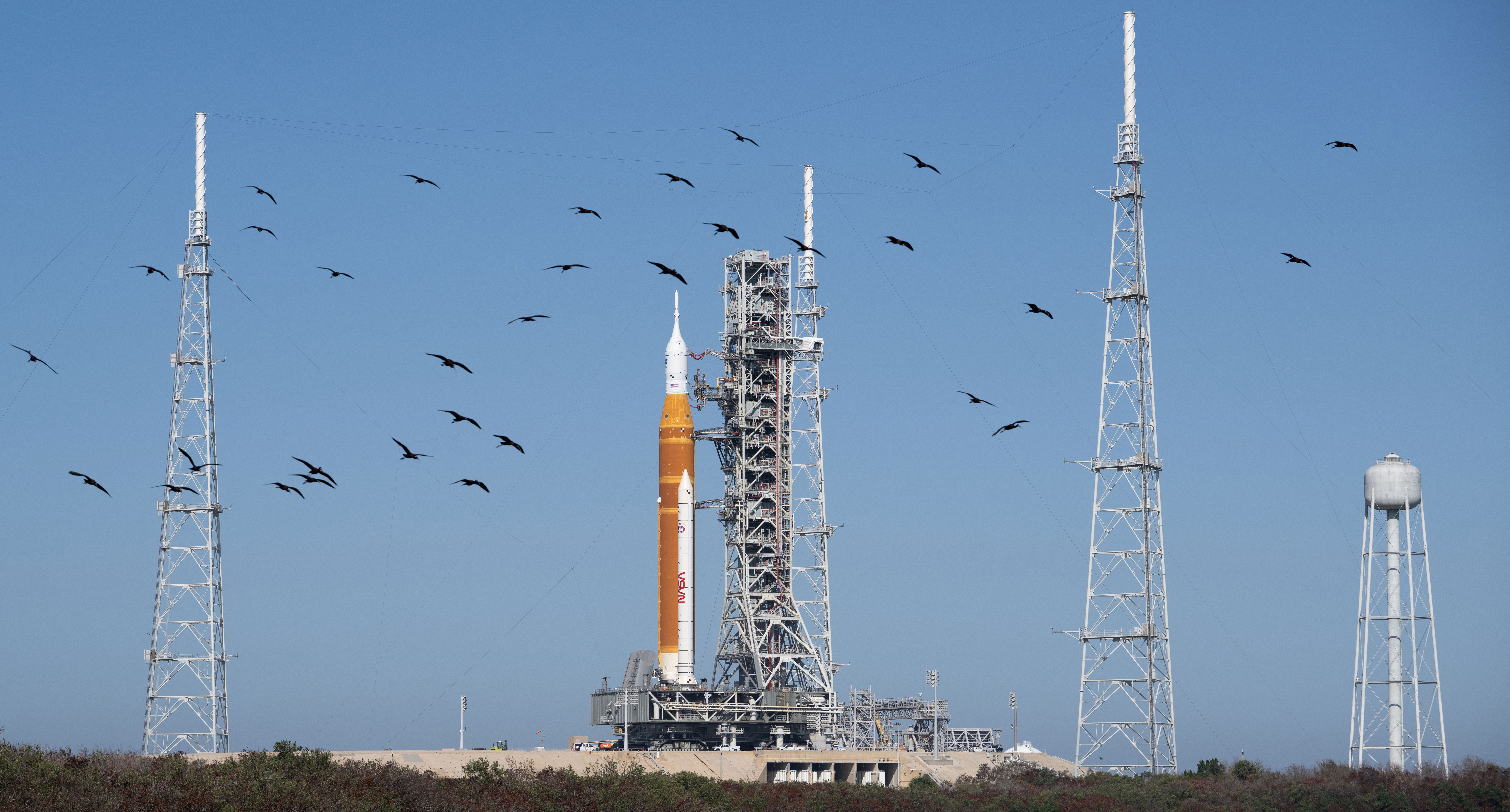
NASA's crawler-transporter 2 began its 4-mile trek with the integrated SLS and Orion stacked on top of the mobile launcher at 12:20 a.m. EDT. Moving at a maximum speed of just 0.82 mph, the crawler carried the 322-foot-tall Moon rocket and spacecraft slowly and steadily toward the pad.
Now that the rocket is at Pad 39B, NASA teams are gearing up for the final stretch of prelaunch preparations ahead of launch as soon as Wednesday, April 1.
Robert Pearlman Editor
Posts: 57235 From: Houston, TX Registered: Nov 1999
posted 03-30-2026 06:44 PM
NASA release
Artemis II Launch Countdown Begins
The countdown for NASA's Artemis II test flight is underway at the agency's Kennedy Space Center in Florida, with members of the launch team arriving at their consoles inside the Rocco Petrone Launch Control Center. The onsite countdown clock started ticking down at 4:44 p.m. EDT to a targeted launch time of 6:24 p.m. on Wednesday, April 1.
With countdown officially underway, engineers are powering up flight hardware, checking communication links, and preparing the rocket's cryogenic systems for the precise fueling sequence required to load hundreds of thousands of gallons of super-cooled liquid hydrogen and liquid oxygen. At Launch Pad 39B, teams will begin filling the sound suppression system's massive tank with water, which will unleash a protective deluge at liftoff to shield the vehicle from the roar of its own engines.
The Artemis II crew remain in Astronaut Crew Quarters inside NASA Kennedy's Neil A. Armstrong Operations and Checkout Building. The crewmates have spent the final countdown phase focused on readiness and technical verification, remaining in quarantine under strict health monitoring and completing medical checks to ensure fitness for launch. They have been following a controlled sleep schedule and nutrition plan to maintain energy and hydration for launch, while continuing to receive regular updates on the rocket's configuration and weather conditions from crew quarters.
NASA and weather officers with the U.S. Space Force's Space Launch Delta 45 continue to pay close attention to weather conditions ahead of tanking operations. The weather forecast for launch day shows an 80 percent chance of favorable weather conditions with primary concerns being cloud coverage and the potential for high winds in the area. Teams will continue to monitor the weather in the coming days.
Robert Pearlman Editor
Posts: 57235 From: Houston, TX Registered: Nov 1999
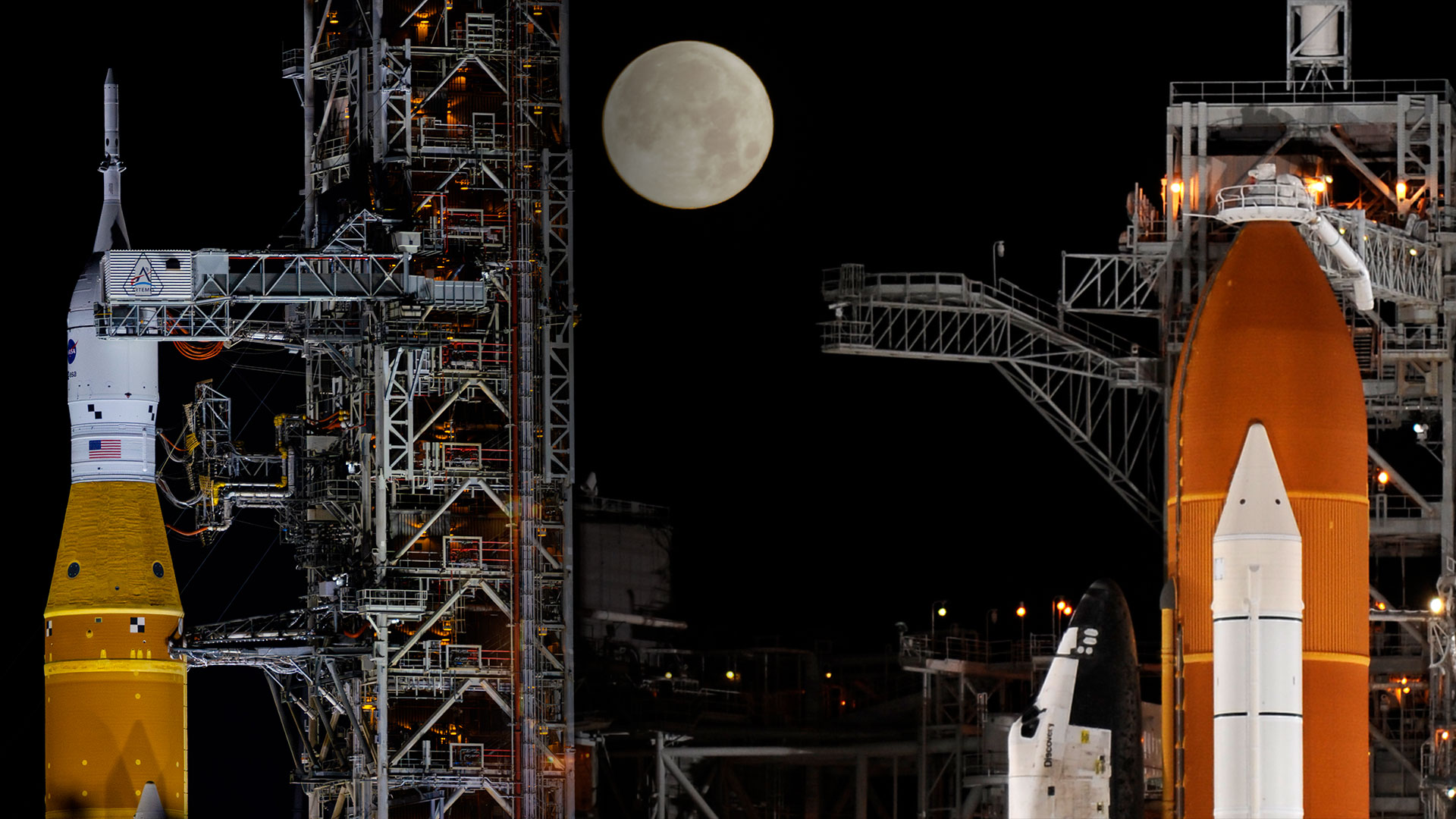
The first astronauts to fly to the moon since the end of the Apollo program are launching on a vehicle built out of space shuttle history.
Artemis II commander Reid Wiseman, pilot Victor Glover and mission specialists Christina Koch and Jeremy Hansen did not launch on any of the winged orbiters. The three who flew before — Wiseman, Glover and Koch — all logged time on the International Space Station after flying on either Russia Soyuz or SpaceX Dragon spacecraft.
The Artemis II Space Launch System (SLS) and Orion spacecraft, by comparison, have components flown on 86 space shuttle missions. The heavy-lift rocket and space capsule (specifically, its service module) have heritage dating back 44 years and as recent as the final mission of the program.
Robert Pearlman Editor
Posts: 57235 From: Houston, TX Registered: Nov 1999
posted 03-31-2026 04:17 PM
NASA release
Teams Readying SLS for Launch
As the Artemis II countdown moves steadily toward liftoff no earlier than 6:24 p.m. EDT, Wednesday, April 1, launch teams at NASA's Kennedy Space Center in Florida continue completing a sequence of highly choreographed steps to ready the SLS (Space Launch System) rocket and Orion spacecraft for the crew's journey around the Moon.
The weather forecast for launch day shows an 80% chance of favorable weather conditions with primary concerns being cumulus clouds, ground winds, and solar weather. NASA and weather officers with the U.S. Space Force's Space Launch Delta 45 will continue to monitor the weather leading up to liftoff.
Engineers began the day by finishing critical health checks on the rocket's four RS‑25 engines, confirming that sensors, connections, and diagnostics were all performing as expected. Their readiness marks an important milestone as cryogenic operations approach.
Meanwhile, the SLS upper stage – the interim cryogenic propulsion stage – having completed its earlier power‑up and verification activities, was powered down into a safe, stable configuration.
Teams also brought the Orion spacecraft's flight batteries to full charge, ensuring dependable power for avionics, life support, and communications throughout launch and early flight. Soon after, engineers began charging the rocket's core stage flight batteries, which is another essential step to support sensors and control systems during launch and ascent.
As launch approaches, preparations increasingly focus on operations to support the crew. Engineers performed regulator leak checks on the astronauts' pressure suits inside Orion, verifying airtight seals and pressure control systems. These checks ensure the suits are ready to protect the crew in the unlikely event of cabin depressurization.
Tonight at Launch Complex 39B, engineers will shift the pad environment toward its final configuration. All non-essential personnel will depart the area, leaving only the specialists required for the remaining prelaunch tasks. Clearing the pad minimizes risk as cryogenic loading draws closer.
In the early morning hours of launch day, teams will activate another critical component of the countdown: the ground launch sequencer. This automated system will orchestrate thousands of commands in the final minutes before liftoff, managing valve movements, system transitions, and timing cues that prepare the rocket for the terminal count.
Finally, engineers will initiate the air‑to‑gaseous nitrogen changeover inside the rocket's cavities, which is an important safety step that replaces atmospheric air with inert nitrogen gas. By displacing oxygen and moisture, technicians create a stable, non-reactive environment ahead of fueling operations.
Robert Pearlman Editor
Posts: 57235 From: Houston, TX Registered: Nov 1999
posted 04-01-2026 07:31 AM
NASA release
Tanking operations underway for launch
Artemis Launch Director Charlie Blackwell-Thompson gave the official "go" for tanking, and NASA teams are ready to start loading propellants into the SLS (Space Launch System) rocket. This essential step kicks off with the chilldown of the core stage liquid oxygen and liquid hydrogen transfer lines, preparing the rocket for its historic mission.
Once chilldown is complete, teams will initiate slow fill followed by fast fill tanking operations as they load 700,000 gallons of super-cold liquid oxygen and liquid hydrogen in the SLS core stage.
Below are the as scheduled times for core stage slow and fast fill operations:
L-9H55M – L-9H25M: Core stage LH2 slow fill start
L-9H40M – L-9H30M: Core stage LOX slow fill
L-9H30M – L-6H40M: Core stage LOX fast fill
L-9H25M – L-8H: Core stage LH2 fast fill
Earlier this morning, engineers at NASA's Kennedy Space Center in Florida performed the air-to-gaseous nitrogen changeover and cavity inerting, a critical step to ensure crew safety and vehicle integrity. During this phase, atmospheric air inside the rocket's cavities is replaced with gaseous nitrogen, an inert gas that reduces the risk of combustion and contamination, creating a safe environment for subsequent fueling operations. By displacing oxygen and moisture, engineers maintain the purity and stability of the rocket's internal systems before cryogenic propellant loading begins.
The launch countdown, which started Monday at 4:44 p.m. EDT, is currently in a built-in hold. This planned pause is a critical checkpoint in the countdown sequence, allowing teams to complete essential tasks and verify system readiness before moving forward.
During this hold, engineers perform final configuration checks, review system health, and ensure all launch criteria are met. It's also a window for resolving any minor issues without impacting the overall timeline. These holds are standard in complex missions like Artemis II, providing flexibility and confidence as we prepare to send astronauts on a journey around the Moon.
Below are the countdown milestones as planned for tanking: [LIST[]]
L-10H50M: Launch team decides “go” or “no-go” to begin tanking the rocket
L-10H40M – L-10H35M: Core stage LOX transfer line chilldown
L-10H40M – L-9H55M: Core stage LH2 chilldown
L-10H25M – L-9H40M: Core stage LOX main propulsion system chilldown
T-33S: GLS sends “go for automated launch sequencer” command
T-30S: Core stage flight computer to automated launching sequencer
T-12S: Hydrogen burn off igniters initiated
T-10S: GLS sends the command for core stage engine start
T-6.36S: RS-25 engines startup
T-0: Booster ignition, umbilical separation, and liftoff[/LIST]
Robert Pearlman Editor
Posts: 57235 From: Houston, TX Registered: Nov 1999
posted 04-01-2026 12:07 PM
NASA release
All SLS cryogenic tanks in replenish mode
NASA teams have transitioned all cryogenic tanks on the SLS (Space Launch System) rocket to replenish mode. This includes both liquid hydrogen and liquid oxygen tanks for the core stage and the interim cryogenic propulsion stage.
Cryogenic propellants naturally warm and evaporate over time, even in insulated tanks. Replenish counteracts this by continuously adding small amounts of liquid hydrogen and liquid oxygen to maintain proper levels and pressure. This ensures the rocket remains fully fueled and stable as the countdown progresses toward terminal count.
Following all stages replenish, teams will perform final system checks and verify valve and sensor performance before transitioning to the terminal countdown sequence, which includes simulated launch operations and final readiness verifications.
Robert Pearlman Editor
Posts: 57235 From: Houston, TX Registered: Nov 1999
posted 04-01-2026 01:15 PM
NASA release
Astronauts depart for the launch pad
After getting suited up, the Artemis II astronauts left their crew quarters at the Neil Armstrong Operations & Checkout Building and boarded the Astrovan II for the 20-minute ride to Launch Pad 39B and their awaiting spacecraft.
Before they left, the crew completed one last bit of unfinished business — a card game. A long-held tradition, NASA crews play cards with the chief astronaut (in this case, Scott Tingle), before leaving the crew quarters ahead of launch until the commander loses. It is hoped that by losing, the commander burns off all his or her bad luck, thereby clearing the mission for only good luck.
The crew will take the elevator up the mobile launcher's tower and walk down the climate-controlled crew access arm to the White Room, their final stop before climbing aboard their Orion spacecraft. In this controlled environment, the closeout crew will assist the astronauts with hatch operations and verify that all safety systems are ready for launch.
Robert Pearlman Editor
Posts: 57235 From: Houston, TX Registered: Nov 1999
posted 04-01-2026 04:15 PM
NASA release
Orion crew hatch sealed for launch
The closeout crew has completed closing the crew module hatch to the Orion spacecraft. Inside the White Room at Launch Complex 39B, the closeout crew worked to inspect seals, secure fasteners and verify that the hatch was airtight.
The technicians also closed the launch abort system hatch. The hatch provides a protective barrier for the crew module, designed to safeguard the astronauts during the Artemis II flight path and, if necessary, enable a rapid escape in the event of an emergency.
Robert Pearlman Editor
Posts: 57235 From: Houston, TX Registered: Nov 1999
posted 04-01-2026 05:25 PM
NASA release
Countdown enters terminal count
T-10 minutes and counting
T-10M – GLS initiates terminal count
T-8M – Crew Access Arm retract
T-6M – GLS go for core stage tank pressurization
T-6M – Orion ascent pyros are armed
T-6M – Orion set to internal power
T-5M57S – Core stage LH2 terminate replenish
T-5M20S – LAS capability is available
T-5M20S – NTD lets commander knows LAS capability is available
T-4M40S – GLS go for LH2 high flow bleed check
T-4M30S – Flight termination system armed
T-4M – GLS is go for core stage auxiliary power unit (APU) start
T-4M – Core Stage APU starts
T-4M – Core stage LOX terminate replenish
T-3M30S – ICPS LOX terminate replenish
T-3M10S – GLS go for purge sequence 4
T-2M02S – ICPS switches to internal battery power
T-2M – Booster switches to internal batter power
T-1M30S – Core stage switches to internal power
T-1M20S – ICPS enters terminal countdown mode
T-50S – ICPS LH2 terminate replenish
T-33S – GLS sends “go for automated launch sequencer” command
T-30S – Core stage flight computer to automated launching sequencer
T-12S – Hydrogen burn off igniters initiated
T-10S – GLS sends the command for core stage engine start
T-6.36S– RS-25 engines startup
T-0
Booster ignition, umbilical separation, and liftoff
Robert Pearlman Editor
Posts: 57235 From: Houston, TX Registered: Nov 1999
Four astronauts have left Earth to fly by the moon for the first time in more than half a century.
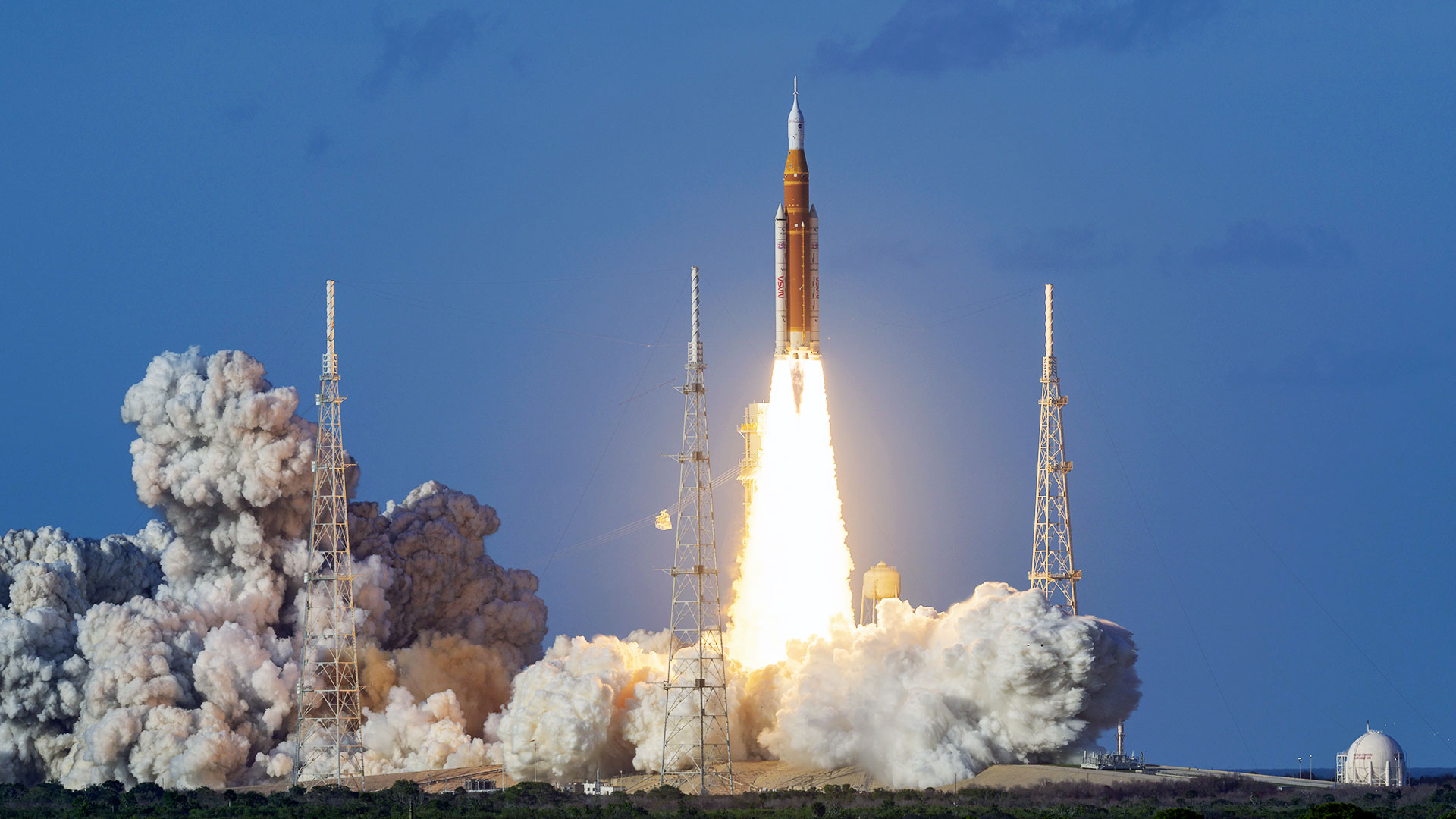
Making immediate history as the first crew to lift off atop NASA's Space Launch System (SLS) rocket, Reid Wiseman, Victor Glover, Christina Koch and Jeremy Hansen embarked on the 10-day Artemis II mission on Wednesday (April 1). The three Americans and one Canadian were strapped into "Integrity," their Orion spacecraft, when they launched at 6:35 p.m. EDT (2235 GMT) from Complex 39B at the Kennedy Space Center in Florida.
Robert Pearlman Editor
Posts: 57235 From: Houston, TX Registered: Nov 1999
posted 04-01-2026 10:31 PM
NASA release
Perigee and Apogee Raise Burns Complete, Crew Looks Ahead to Proximity Operations
A planned perigee raise maneuver was successfully completed, refining the Orion spacecraft's orbit around Earth. The interim cryogenic propulsion stage (ICPS) ignited its RL-10 engine for a precisely timed burn that increased the lowest point of the spacecraft's orbit.
Shortly after the burn, the spacecraft experienced a loss of communications, when the ground was not able to receive data from the crew or spacecraft. It was shortly resolved, and the crew confirmed that they were able to hear communications from the ground throughout. The ground teams are looking into what might have caused the drop out.
The apogee raise burn was then successfully completed, continuing to fine tune the Orion spacecraft's orbit around Earth. The ICPS ignited its RL-10 engine for another precisely timed burn that increased the highest point of the spacecraft's orbit.
Ahead of the burn, the Artemis II crew began setting their spacecraft up for life in space. Among the tasks was a checkout of the toilet. During this operation, the crew called down to report a blinking fault light. The team on the ground is looking into what might be causing that issue and will be working with the crew to resolve it.
Update: The crew, working closely with mission control, were able to restore the Orion spacecraft's toilet to normal operations following the proximity operations demonstration.
Proximity Operations Demonstration
The crew is now beginning preparations for the proximity operations demonstration that will test the Orion's ability to maneuver relative to another spacecraft, the ICPS, after separation, using its onboard navigation sensors and reaction control thrusters. Before the demo, Orion will have planned communications handover from NASA's Near Space Network to the Deep Space Network. These two networks work in tandem to support Orion from the launch pad, around the moon and back to Earth.
During the approximately 70-minute proximity operations demo, the crew will command the Orion, named Integrity, through a series of moves using the detached upper stage of the SLS (Space Launch System) rocket as a target. The ICPS includes an approximately two-foot target that will be used to evaluate how Orion flies with astronauts at the controls.
As the spacecraft and its crew move away, the spacecraft will perform an automated backflip to turn around and face the stage. At approximately 300 feet away, Orion will stop its relative motion. The crew will take control and use the translational and rotational hand controllers and display system to make very small movements to ensure the spacecraft is responding as expected.
About 30 feet from the stage, Orion will stop, and the crew will check out the spacecraft's fine handling qualities to evaluate how it performs near another spacecraft. Small maneuvers performed very close to the ICPS will be done using the reaction control system thrusters on the European Service Module.
At the end of the demo, Integrity will perform an automated departure burn to move away from the ICPS before the stage then fires to re-enter Earth's atmosphere over a remote location in the Pacific Ocean. During Orion's departure burn, engineers will use the spacecraft's docking camera to gather precise positioning measurements, which will help inform navigation during rendezvous activities on future missions in the lunar environment, where there is no GPS system.
Integrity's solar array wings are generating power, thermal conditions remain within predicted ranges and flight controllers have verified that the crew is safely configured for the next phase of the mission.
Robert Pearlman Editor
Posts: 57235 From: Houston, TX Registered: Nov 1999
posted 04-01-2026 10:57 PM
NASA release
Prox Ops Complete, Perigee Raise Up Next
The crew completed the proximity operations demonstration.
Over the course of the approximately 70‑minute activity, the crew guided Integrity through a series of controlled approach and retreat maneuvers using the detached ICPS (interim cryogenic propulsion stage) as a reference target.
At the conclusion of the demo, Integrity executed a departure burn to safely back away from the ICPS.
CubeSats to Deploy
Four small satellites, or CubeSats, also launched to high Earth orbit in the Orion stage adapter of the SLS (Space Launch System). CubeSats are shoebox-sized payloads that have the potential to expand knowledge of the space environment. These experiments will be deployed after the adapter has separated from the spacecraft. The four CubeSats are:
ATENEA, developed by the Argentina National Space Activities Commission, will investigate radiation shielding, orbital design optimization, and long-range communications.
Space Weather CubeSat-1, developed by the Saudi Space Agency, will measure various aspects of space weather, such as radiation, solar X-rays, solar energy particles, and magnetic fields.
TACHELES, developed by the German Aerospace Center, will demonstrate key in-space technologies, including electrical components for future lunar logistics vehicles and operations.
K-Rad Cube, developed by KASA (Korea AeroSpace Administration) will measure space radiation and its biological effect across the Van Allen radiation belts.
Perigee Raise Burn
After a four-hour nap, the crew will be awakened at 7 a.m. EDT on Thursday (April 2) to prepare for a perigee raise burn. This burn will lift the lowest point of Orion's orbit around Earth. Together with the apogee raise burn completed earlier, these maneuvers shape Orion's initial orbit and prepare it for later trans-lunar operations.
The crew will resume their sleep period around 9:40 a.m. EDT.
Robert Pearlman Editor
Posts: 57235 From: Houston, TX Registered: Nov 1999
posted 04-02-2026 10:30 AM
NASA release
Perigee Raise Burn Complete
The perigee raise burn is complete, marking another planned orbital adjustment in the early hours of the Artemis II mission.
After a brief rest period, the crew was awakened to monitor the Orion spacecraft's systems through the burn. The ground team woke them at 7:06 a.m. EDT with the song "Sleepyhead" by Young and Sick.
The spacecraft ignited its service module's main engine for 43 seconds, raising the lowest point of its orbit and refining the trajectory as it continues to circle Earth. This critical burn placed Orion, named Integrity by the Artemis II crew, into a stable high Earth orbit that aligns with its path to the Moon. The crew members will now move back into their rest period for another four and a half hours before they are again awakened to start their first full day in space.
Later today, the mission management team will gather for its first meeting of the mission to assess the spacecraft's systems and will give their approval for the upcoming translunar injection burn that will send astronauts out of Earth orbit and toward the Moon for the first time since 1972.
During the translunar injection burn, Orion will ignite its engines for just over six minutes, accelerating the spacecraft to escape Earth's gravitational pull. Flight controllers will closely monitor engine performance, guidance, and navigation data throughout the maneuver to ensure Orion remains precisely aligned for the outbound journey.
Robert Pearlman Editor
Posts: 57235 From: Houston, TX Registered: Nov 1999
posted 04-02-2026 04:43 PM
NASA release
'Go' for Translunar Injection Burn
NASA's Artemis II mission management team polled "Go" for the translunar injection burn to send the crew in the Orion spacecraft toward the moon and send humans around Earth's closest celestial neighbor for the first time since Apollo 17 in 1972.
The spacecraft will ignite its main engine on the service module for five minutes and 49 seconds beginning at 7:49 p.m. EDT.
Orion's main engine, a modified space shuttle-flown OMS engine mounted to the European Service Module, provides up to 6,000 pounds of thrust, enough to accelerate a car from 0 to 60 mph in about 2.7 seconds.
NASA astronauts Reid Wiseman, Victor Glover, Christina Koch and CSA (Canadian Space Agency) astronaut Jeremy Hansen began their day at 2:35 p.m. EDT with the playing of "Green Light," by John Legend and Andre 3000 by the mission control team. The crew members are preparing for the burn and will conduct their first exercise sessions on the spacecraft's flywheel device, a tool devised for maintaining fitness during long‑duration missions.







 posted 02-19-2026 11:36 AM



 advertisement