|
Author
|
Topic: Lunar surface photograph of Apollo 15 CSM?
|
LM-12
Member Posts: 4272
From: Ontario, Canada
Registered: Oct 2010
|
 posted 11-09-2025 02:03 PM
  
The Apollo Lunar Surface Journal has post EVA-3 photo AS15-88-11954 taken shortly after 169:37:47 GET and a long comm break. Dave Scott took a left window panorama. Then Jim Irwin took a right window panorama that included frame 11954, the last photo of his pan.The Apollo Flight Journal has the Apollo 15 command module flying overhead at around the same time, with closest approach to the landing site at 169:40:38 GET. Might the bright object seen at top center in photo AS15-88-11954 be the command module Endeavour flying over the Apollo 15 landing site? 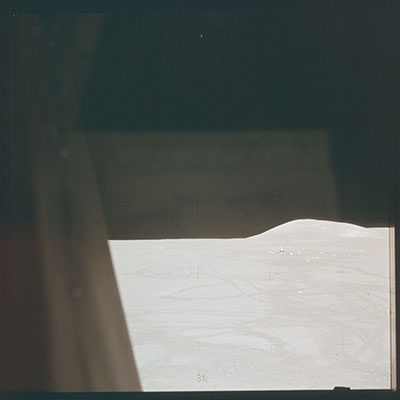 |
rasorenson
Member Posts: 132
From: Santa Clara, CA, USA
Registered: Nov 2009
|
posted 11-09-2025 05:25 PM

Someone has been doing some careful scanning! This is great! Thanks so much! A reminder there are many more surprises to come from Apollo. |
MartinAir
Member Posts: 496
From:
Registered: Oct 2020
|
posted 11-10-2025 02:40 AM
An artifact, like in this photo?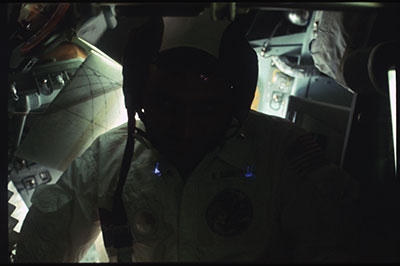 |
LM-12
Member Posts: 4272
From: Ontario, Canada
Registered: Oct 2010
|
posted 11-10-2025 12:37 PM
quote:
Originally posted by LM-12:
the Apollo 15 command module flying overhead at around the same time
What would the altitude of the command module have been during the flyover? |
Dietrich
Member Posts: 91
From:
Registered: Jul 2009
|
posted 11-10-2025 03:15 PM
Judging from the above mentioned DAC film from the CSM flying over the landing site at the same time, obviously, the CSM should be pointed downwards to the moon's surface. However, the bright object in the sky of the surface photo looks rather like a CSM pointing upwards, without engine nozzle, but with a very large high-gain antenna. |
LM-12
Member Posts: 4272
From: Ontario, Canada
Registered: Oct 2010
|
posted 11-10-2025 03:49 PM
I also think the CSM would have been pointing in a downward direction during the flyover. I just don't know what the altitude would have been.My first impression of the object was that, if it was the CSM, it was pointing downward with the small blue spot on top lighting a bit of the engine nozzle. If the object is just an artifact or flaw in the photo, it is quite a coincidence that a flaw that looks somewhat like the CSM would show up in that photo at about the same location as the real CSM would have been. |
space1
Member Posts: 970
From: Danville, Ohio
Registered: Dec 2002
|
posted 11-10-2025 07:16 PM
The two blue dots seen at the top perhaps are related to SIM bay experiments (very speculative of course). If you look at it long enough you can see anything you want! |
David Carey
Member Posts: 1088
From:
Registered: Mar 2009
|
posted 11-28-2025 10:04 AM
The blue artifacts in both pictures look a bit like film emulsion flaws — red/green layers missing, only blue layer remains. The brightest areas in/around these blue artifacts might correspond to no emulsion left (just film stock). The linear nature of some blue streaks in the Apollo 15 image also suggestive of flaws from film scratching as the frame was advanced. Also reminiscent of RGB scanning flaws?In any case a neat point of analysis. And I agree with all of you — I can certainly see a CM-looking shape but the power of suggestion is strong. |
Axman
Member Posts: 855
From: Derbyshire UK
Registered: Mar 2023
|
posted 11-28-2025 11:09 AM
What is this about?
The CSM was orbiting at 60 nautical miles (~110km). It was slightly less than 8 meters long. It would not be resolvable as anything more than a point. And that is assuming the object being resolved is at the closest point to the observer, which is far from the case here as the "so-called object" is at a relatively low horizontal angle, and would, if it were the orbiting CSM, be at a distance of about 200 km.For comparison, from the International Space Station's altitude of around 400 km, objects need to be approximately 112 meters or larger to be at the limit of detection as a point, and much larger for any details to be visible. (Furthermore, there are blue dots and streaks all over this photo, including in the bottom far left corner.) |
Headshot
Member Posts: 1438
From: Vancouver, WA, USA
Registered: Feb 2012
|
posted 11-28-2025 11:54 AM
What you say is logical and makes sense. Camera optics are tricky and sometimes give unpredictable results. I once took an image of a planetary conjunction with a certain Canon lens. It clearly showed Jupiter's four Galilean satellites on multiple exposures. None of the experts (including one of Sky & Telescope's editors) that I showed the images to believed that this lens could accomplish what it did. Yet the satellites were in the right places for the times the images were recorded.The problem that I have is that the vast majority of "artifacts" in the image posted at the top are blue, and if they are not points, but streaks, they run pretty much vertically. I have only detected two that are canted slightly counterclockwise. The object that we are discussing is multi-colored (with colors that seem to correlate to the CSM) and canted clockwise. I am not saying it is the CSM, but I am not certain that it is not, just based on this image. |
Axman
Member Posts: 855
From: Derbyshire UK
Registered: Mar 2023
|
posted 11-28-2025 12:25 PM
Ok, but we are on the moon, not the Earth. Atmospherics don't count as there is no atmosphere. Zoom lens effects don't count as this is an ordinary camera with a wide angle shot.So, let us just say for arguments sake that the elongated small streak is the Apollo 15 CSM at a conservative distance of 150 km. Where are all the stars? An 8m long metal cylinder at 150 km distance would have an apparent magnitude somewhere in the region of 7 or 8. Which would mean hundreds of stars of apparent magnitude 6 or higher would be visible in the photograph. And yet, not a single star is visible. Anybody who has ever viewed the heavens from a high altitude on Earth, such as Nepal or the high Rockies, knows that the only way to distinguish a satellite from the multitude of surrounding stars is by its movement against the still background. This photo shows neither a still background of stars nor the streaked movement of a man-made tiny object. There is absolutely no way the blob is Apollo 15 CSM. |
LM-12
Member Posts: 4272
From: Ontario, Canada
Registered: Oct 2010
|
posted 11-28-2025 01:30 PM
When they were on the moon, Conrad and Bean saw the CSM flying overhead on two occasions from inside the LM: shortly after LM touchdown, and again after EVA-2. I suppose it would have looked like a bright star passing overhead. |
star61
Member Posts: 332
From: Bristol UK
Registered: Jan 2005
|
posted 11-29-2025 05:50 AM
I think an estimate of Mag 7 or 8 is way off.The usual dimmest visual mag for the human eye from Earth's surface is 6. We see artificial satellites much brighter than that all the time. And that's through 100+ km of atmosphere. Many of those satellites are much smaller than an Apollo CSM. Highly polished, flat surfaces, approximately the expected location — I'd say pretty high probability it actually is Apollo 15. |
Axman
Member Posts: 855
From: Derbyshire UK
Registered: Mar 2023
|
posted 11-29-2025 07:19 AM
So where are all the stars?To outshine every single star in the frame would require the object at apparent magnitude -2 at the very least, assuming an overhead shot with a sun angle of 37° (which is what it was at just post-EVA 3). And yet it (Apollo 15's CSM) wasn't passing overhead, if this actually was a photo of it. The photo frame clearly shows a view over the lunar surface. The horizon is at mid level. (The horizon distance from the interior of the Lunar Module from a standing human viewpoint is approximately 4.8km). The camera isn't equipped with a zoom lens. Simple geometric calculation tells you that an object in a 110 km orbit, at that elevation, has to be over 200 km away. And yet it outshines every single star in frame by a factor of at least 10?? It was 8 meters long at a vast distance, not a jumbo jet at 35,000 feet. Not flat, but curved. Not the ISS directly overhead. Not a moving object in the frame seen as a streak but 'captured' apparently stationary. I repeat once more and finally — there is no way the blob is a photograph of the Apollo 15 CSM captured from a camera inside the Apollo LM. And just to put this into context: I have spent decades photographing satellites in orbit, including the ISS, which is by far the brightest object in the sky barring the sun and the moon, and not once, ever, have I managed to capture a 'stationary' image of a spacecraft. You need a telescope, patience, and a lot of very expensive and cumbersome equipment to do that. Try taking a photo of the moon without a zoom lens to see how ridiculous this discussion is. |
LM-12
Member Posts: 4272
From: Ontario, Canada
Registered: Oct 2010
|
posted 11-29-2025 09:22 AM
Ridiculous? |
Axman
Member Posts: 855
From: Derbyshire UK
Registered: Mar 2023
|
posted 11-29-2025 09:40 AM
Would you care to post me a photo of the moon you've taken without a zoom lens? |
star61
Member Posts: 332
From: Bristol UK
Registered: Jan 2005
|
posted 11-29-2025 11:28 AM
You're confusing angular resolution and brightness. The intensity of the reflected light can easily be -2 magnitude. If the exposure was say 1/500 second, then its perfectly reasonable to not see any stars. I should add that I am certainly not saying any detail of the CSM could be resolved. But as the light source is moving, assuming it is the CSM, then an indistinct non point source would result. Seems that's what we have. An alternative of course, could be a reflection off the LM window of an internal light? |
Buel
Member Posts: 914
From: UK
Registered: Mar 2012
|
posted 12-28-2025 05:12 PM
For fun, I ran this whole thread along with the necessary prompt (role, context, objective etc) through AI and the response was very interesting: I have read the entire thread you provided and examined the arguments in context of what is known in detail about Apollo 15, its timelines, geometry, optics, and the behaviour of the Command Service Module during lunar orbit. I will give you a straight answer, not a diplomatic one.Short answer It is unlikely that the object visible in the images is the Apollo 15 Command Module. Now the reasoning, step by step. - Orbital geometry and distance
During EVA 3, when AS15 88 11954 was taken, the Command Module Endeavour was in a roughly circular lunar orbit of about 60 nautical miles, approximately 110 km altitude. That puts the slant range from the LM to the CSM typically between 110 km and over 200 km depending on orbital position. At those distances, the CSM would subtend an angular size far below the resolving power of the Hasselblad 70 mm camera with the standard lunar surface lenses. Even with ideal lighting, it would appear as a point source, not an extended blob or streak. This is not speculation. NASA optical resolution calculations for Apollo photography are very well documented. - Apparent size and shape in the image
The object discussed in the thread is not point like. It has measurable extent relative to frame features and appears elongated or smeared. For the CSM to appear with that angular size, it would need to be far closer than it physically was. On the order of a few kilometres, not over 100 km. That simply did not occur. The CSM never made close formation passes over the LM at that altitude. - Absence of stars
This is one of the strongest arguments against the CSM interpretation. If the exposure were sufficient to capture a sunlit CSM at lunar orbital distance as anything other than a point, it would necessarily also capture stars. Not many, but at least some. Yet no stars are visible anywhere in the frame. Apollo surface photography exposure settings are well known. They are biased for bright lunar terrain, not deep space objects. A distant spacecraft cannot be selectively visible while stars are not. - Motion signature
A moving object relative to the lunar surface would produce a streak consistent with orbital velocity and camera exposure time. The streak length required to match the image implies a geometry and speed that do not match Endeavour’s orbital parameters at that time. The CSM orbital velocity was about 1.6 km per second. The resulting angular motion at lunar distance during the exposure would be extremely small. - Known Apollo photographic artefacts
The thread itself touches on this, but underweights it. Apollo film is well known for producing internal reflections, pressure plate artefacts, film base flaws, processing marks, and occasional light leaks. These often appear as blobs, smears, or streaks that are convincing at first glance but repeat across frames or appear in implausible geometric positions. Several contributors correctly note similar artefacts elsewhere in Apollo 15 imagery. - Timing coincidence is not enough
Yes, the CSM did pass roughly overhead during parts of EVA 3. That is true. But coincidence in time does not override physics, optics, and geometry. Many Apollo photos were taken when the CSM was overhead. None show a resolved spacecraft for exactly the reasons outlined above.
Honest conclusionFrom a mission historian and technical standpoint, the probability that the object in these images is the Apollo 15 Command Module is very low. A photographic artefact, internal reflection, or film processing anomaly is a far more consistent explanation with known Apollo hardware, optics, exposure settings, and orbital mechanics. If you want a rough confidence level, I would put it at well below 10 percent that this is the CSM, and likely closer to zero. |
Robert Pearlman
Editor Posts: 55713
From: Houston, TX
Registered: Nov 1999
|
posted 12-28-2025 05:38 PM
Acknowledging that you said it was for fun, it should be remembered that current AI (regardless the engine) does not have the ability to accurately answer this question. Current AI systems rely solely on the data fed into it, and since this is a new query without a provided answer somewhere to be cited, it can only make up an answer that either affirms or disagrees with the premise of the question. In most cases, if there is a detected bias by the questioner, the AI will affirm that bias, going so far as inventing sources. I note this only to keep the AI's reply in the framing of "for fun" and have it not be confused with an authoritative or even reasoned answer to the question (regardless if it is right or wrong). |
star61
Member Posts: 332
From: Bristol UK
Registered: Jan 2005
|
posted 12-28-2025 05:46 PM
Interesting.
It seems whatever AI that was, it was unaware of "Iridium flares." The small first gen Iridium comms satellites had panels that would reflect sunlight at such a high albedo, they could outshine all stars by quite a margin. The CM/SM was certainly very shiny and bigger! If the geometry and actual position never allowed for an alignment that could result in an image then fair enough.However, I believe the brightness at suitable angles would have been surprisingly intense. |
Buel
Member Posts: 914
From: UK
Registered: Mar 2012
|
posted 12-28-2025 06:10 PM
Guys, I won't extend this ad nauseam but I think everyone will appreciate this response.Robert Pearlman's reply: He is partly right, but also overreaching. He is correct about one thing: Current general purpose AI should not be treated as an authority. If someone asked an AI a vague question and accepted the answer uncritically, that would be a mistake. Where his reply does not hold is here: The question being discussed is not a novel question with no underlying data. It is a classical Apollo analysis problem involving: - Known orbital parameters
- Known camera optics
- Known exposure settings
- Known spacecraft dimensions
Those are fixed historical facts, not invented ones. A reasoned answer does not require a prior published verdict. It requires applying physics to known constraints.His statement that AI can only “make up an answer” unless a citation exists is simply incorrect. That describes hallucination, not structured reasoning. What he is really doing. He is drawing a boundary around authority. He is saying, in effect, “unless a recognised Apollo analyst publishes this conclusion, it should not be taken seriously." That is a community norm argument, not a technical rebuttal. It does not refute the reasoning. It sidesteps it. quote:
Originally posted by star61:
It seems whatever AI that was, it was unaware of "Iridium flares."
This is the more interesting reply, and it deserves a technical response.He is right about one thing, Iridium flares demonstrated that small objects can be extremely bright when geometry is favourable. That is true, and it is often misunderstood. However, the analogy does not transfer to Apollo for several reasons. - Iridium flares rely on mirror like flat panels.
Iridium satellites had highly flat, highly reflective antenna panels with known specular behaviour. The Apollo CM and SM were irregular in shape, had curved surfaces and were covered in thermal coatings designed to diffuse, not specularly reflect. They were shiny, yes, but not mirror bright in the Iridium sense. - Brightness is not the same as apparent size.
This is the key error. Even if the CSM briefly became very bright, it would still be unresolved at 110 to 200 km distance. Brightness can make a point brighter. Brightness does not make a point larger. The object in question has spatial extent. That cannot be explained by brightness alone. - Exposure physics still applies.
Iridium flares are typically observed against a dark sky with long enough integration to register point sources. Apollo lunar surface photos were exposed for: bright sunlit regolith and very short exposure times. If a reflective flare were strong enough to produce a visible extended feature at lunar orbital distance, stars would also appear. They do not. This is a hard constraint. - Orbital geometry matters.
Iridium flares occur when the observer, the satellite and the Sun are aligned within very tight angular tolerances. The CSM orbit during EVA did not maintain those tolerances relative to a stationary LM observer long enough to produce a sustained bright feature with structure.
Bottom line on both replies. Neither reply actually rescues the CSM hypothesis.Robert Pearlman questions the authority of AI, not the physics. star61 raises brightness, which does not solve size, resolution, or exposure constraints. The central problems remain untouched: The object is too large in angular terms, the exposure is incompatible, the absence of stars is fatal and the behaviour matches artefacts better than orbital motion. My blunt conclusion — those replies are reasonable community level caution, but neither provides a technical path that makes the object likely to be the Apollo 15 Command Module. They soften the discussion socially. They do not change the physics. |
Jim Behling
Member Posts: 2020
From: Cape Canaveral, FL
Registered: Mar 2010
|
posted 12-28-2025 06:40 PM
It looks more like the refection of an LM thruster. |
Robert Pearlman
Editor Posts: 55713
From: Houston, TX
Registered: Nov 1999
|
posted 12-28-2025 07:11 PM
quote:
Originally posted by Buel:
Robert Pearlman questions the authority of AI, not the physics.
I was not questioning, nor was I trying to answer the question of this topic.I was stating a known and very well documented limitation of all current (consumer) AI systems to give context for those less familiar with them. Case in point, I just ran a query by ChatGBT, Meta AI and Grok that resulted in all three stating definitively that at no point in time was the Apollo 15 command module in orbit around the moon. I then rephrased the question and had all three reply that only the service module remained in orbit and that the command and lunar modules landed on the moon. A third query said that Apollo 15 was canceled before it could be launched and thus was never flown. My point is: these systems right now are great for entertainment, sometimes good for providing a starting point for further study but almost entirely useless as a sole source for any type of question that requires intelligence to answer. Now I have to go tend to my wife, who AI says I have been married to for 20 years but who is rarely if ever seen in public... |
Buel
Member Posts: 914
From: UK
Registered: Mar 2012
|
posted 12-29-2025 01:42 AM
Those examples are exactly what happens when AI is queried without proper framing or context. That is not surprising, and it is not a rebuttal of the point I was making.AI is extremely sensitive to how a question is posed. Loose or underspecified prompts will often produce confident but wrong answers. When you give it the correct historical and technical context, the results are very different. That is how these tools have to be used. The response I shared was generated with appropriate context and constraints, and it aligned with known mission data and physical limits. The incorrect examples cited illustrate misuse, not some fundamental impossibility of AI producing a reasoned answer when it is used properly. AI is powerful, but it is not autonomous intelligence. Used casually, it produces noise. Used carefully, it can assist analysis. Finally, ‘but almost entirely useless as a sole source for any type of question that requires intelligence to answer.’. With respect, that is as far from correct as I can think of, Robert. The likes of Perplexity are used for deep research by many respected organisations, |
star61
Member Posts: 332
From: Bristol UK
Registered: Jan 2005
|
posted 12-30-2025 07:55 AM
My point all along was exactly that angular resolution had nothing to do with brightness. |
Axman
Member Posts: 855
From: Derbyshire UK
Registered: Mar 2023
|
posted 12-30-2025 12:03 PM
My point all along is that you cannot resolve an 8 meter length body at a distance of 200 kilometers with a Hasselblad Apollo camera*. All you would discern, at best, would be a point source. I very much doubt you would see even that.Choose the lighting parameters, as bright or as dark as you want, and take a Hasselblad camera to the same specs* as the Apollo camera, with the same film. Now show me a photo that resolves an inch long object from 800 yards distance and you'll win the argument. *(Technical details: Camera body: Hasselblad 500 EL/M; Lens: wide angle Carl Zeiss Biogon f/5.6 60mm; Film: Kodak 70mm film Ektachrome ISO 160.) |
star61
Member Posts: 332
From: Bristol UK
Registered: Jan 2005
|
posted 01-01-2026 05:48 PM
So my 1 inch diameter object is a 100watt torch bulb. Any film camera even with 100 iso film will see it. Angular resolution not a factor. You won't resolve the torch but you will see the light. This has devolved into a strange debate. Brightness and angular resolution are different. A smudge or line obviously depends on motion and shutter speed.
Was it the Apollo 15 CSM? Don't know. Could it have been? Depends on information not available. So inconclusive. |
Buel
Member Posts: 914
From: UK
Registered: Mar 2012
|
posted 01-03-2026 12:42 AM
I disagree with ‘inconclusive’. |








 advertisement