Posts: 56330 From: Houston, TX Registered: Nov 1999
posted 05-01-2025 04:36 PM
Lockheed Martin release
Lockheed Martin Completes Orion Development for Artemis II Mission to the Moon
Upgraded Spacecraft Delivered, Preparations for 2026 Launch Underway
Lockheed Martin has completed assembly and testing of NASA's Orion Artemis II spacecraft, transferring possession to NASA's Exploration Ground Systems (EGS) team today.
This milestone is a significant step for NASA and the Artemis industry team, as they prepare to launch a crew of four astronauts to further the agency's mission in establishing a human presence on the Moon for exploration and scientific discovery. It will also help build the foundation for the first crewed missions to Mars.
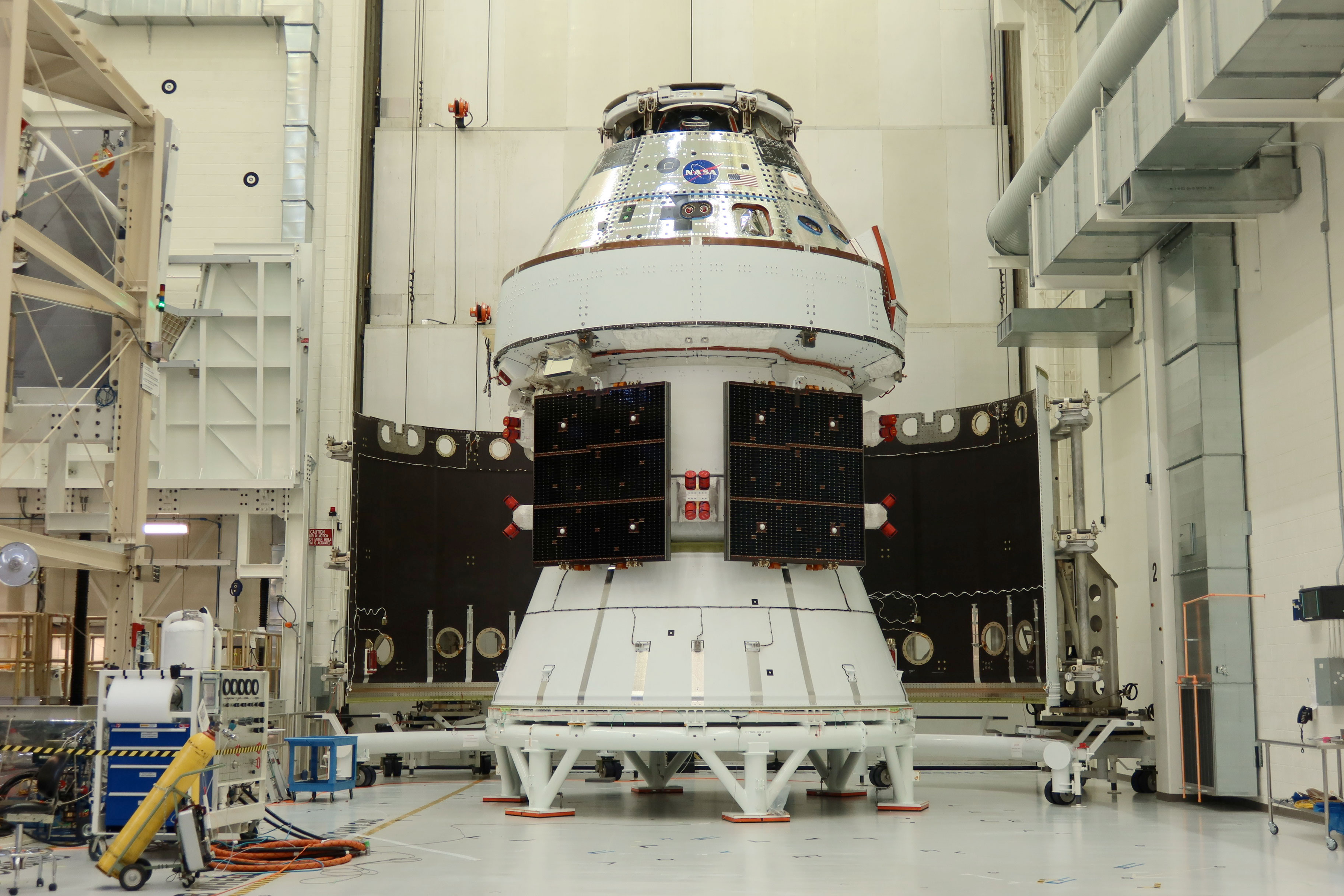
Above: The finished Orion spacecraft for the Artemis II mission was officially handed over to NASA for launch processing for crewed mission to the Moon early next year.
Orion is the most advanced, human-rated, deep space spacecraft ever developed. Lockheed Martin is the prime contractor to NASA for Orion and built the crew module, crew module adaptor and launch abort system.
"This achievement is a testament to our employees and suppliers who have worked tirelessly to get us to this important milestone," said Kirk Shireman, vice president of Human Space Exploration and Orion program manager at Lockheed Martin. "The Orion spacecraft completion for Artemis II is a major step forward in our nation's efforts to develop a long-term lunar presence. It's exciting to think that soon, humans will see the Earth rise over the lunar horizon from our vehicle, while also traveling farther from Earth than ever before."
Upgraded for Crew Onboard
The uncrewed EFT-1 and Artemis I test flights were the first steps in validating the spacecraft's core systems. Artemis II will put Orion through its final tests in deep space with a crew on board and will include learnings and significant enhancements gleaned from the Artemis I mission.
To support the health and safety of the crew, new systems have been added, which include life support – air, water, thermal control, waste management – displays and controls, audio communications, an exercise machine and a fully functional Launch Abort System. Additionally, the vehicle is outfitted with a subset of docking sensors and an experimental laser communication system, enabling high data-rate communications and paving the way for future missions.
Path to Launch
With the completion of Orion, the EGS team will perform final preparations on the spacecraft, readying it for launch. Orion will soon be moved from the Neil Armstrong Operations and Checkout Building at NASA's Kennedy Space Center to various processing facilities. This is where EGS will load propellants and other consumables, such as water and oxygen, and install the launch abort system and its protective fairings. Upon completion, it will then be transported to the Vehicle Assembly Building, lifted onto the Space Launch System (SLS) rocket and undergo final preparations for launch.
Historic Artemis Flight
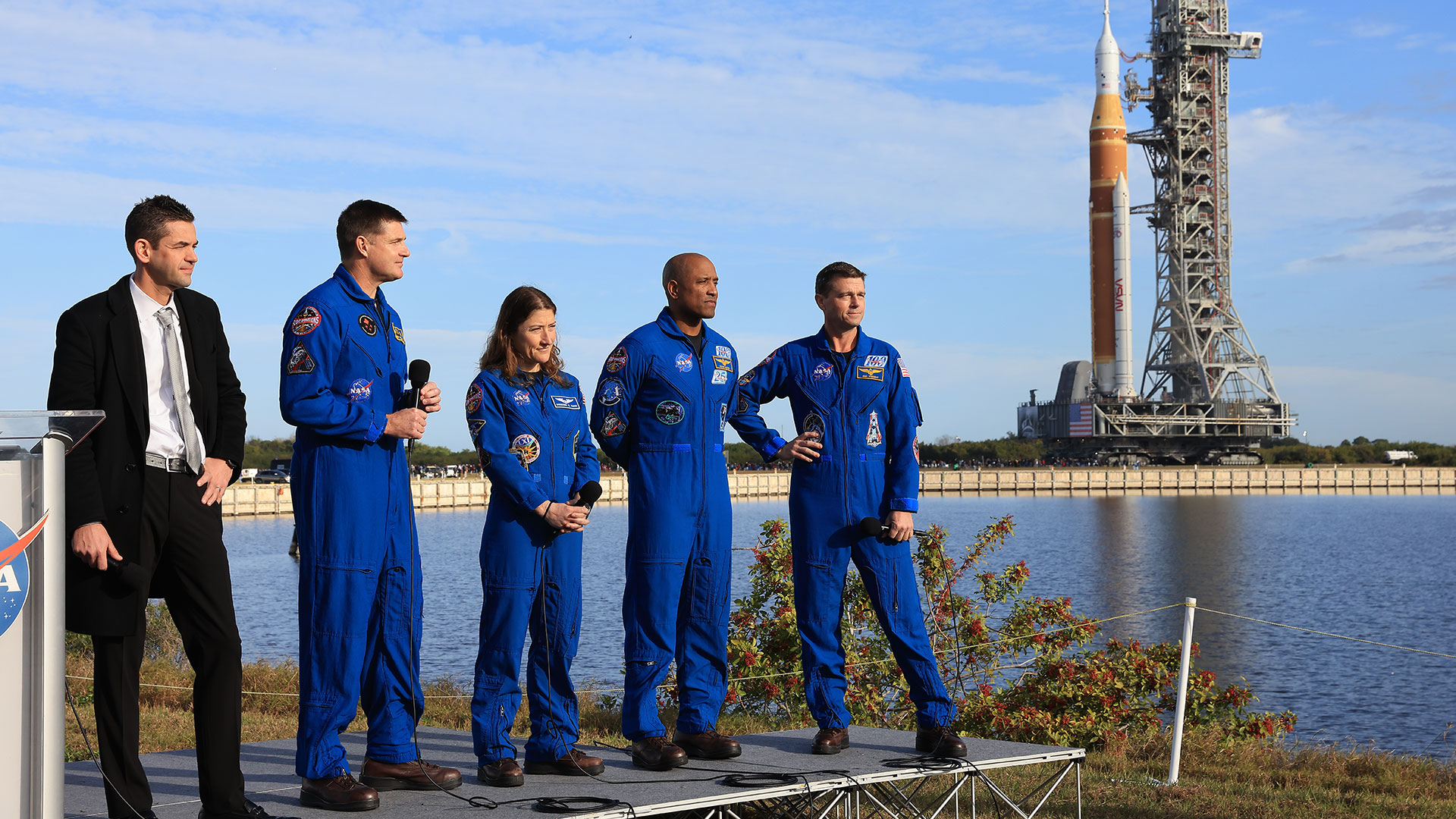
Scheduled to launch in early 2026, Artemis II and the Orion spacecraft will host NASA astronauts Reid Wiseman, Victor Glover, Christina Koch and Canadian astronaut Jeremy Hansen. Their 10-day journey will include flying 4,600 miles beyond the Moon and back to Earth.
During the mission, the crew will evaluate the spacecraft's performance, test its navigation and communication systems, and conduct a series of scientific experiments. They will perform a rendezvous operation with the SLS upper stage, practicing docking activities needed for future missions including Artemis III – which will mark the first human lunar landing since Apollo 17 in 1972.
With work on Orion for Artemis II completed, Lockheed Martin continues to develop and assemble Orion spacecraft for future Artemis missions. Artemis III and IV vehicles are in the Operations and Checkout Building, while the pressure vessel is being welded at NASA's Michoud Facility in New Orleans. Lockheed Martin is on contract to develop Orion spacecraft up to Artemis VIII and has decreased cost with each vehicle.
Robert Pearlman Editor
Posts: 56330 From: Houston, TX Registered: Nov 1999
posted 08-04-2025 04:02 PM
NASA release
NASA’s Artemis Crew Trains in Moonbound Orion Ahead of Mission
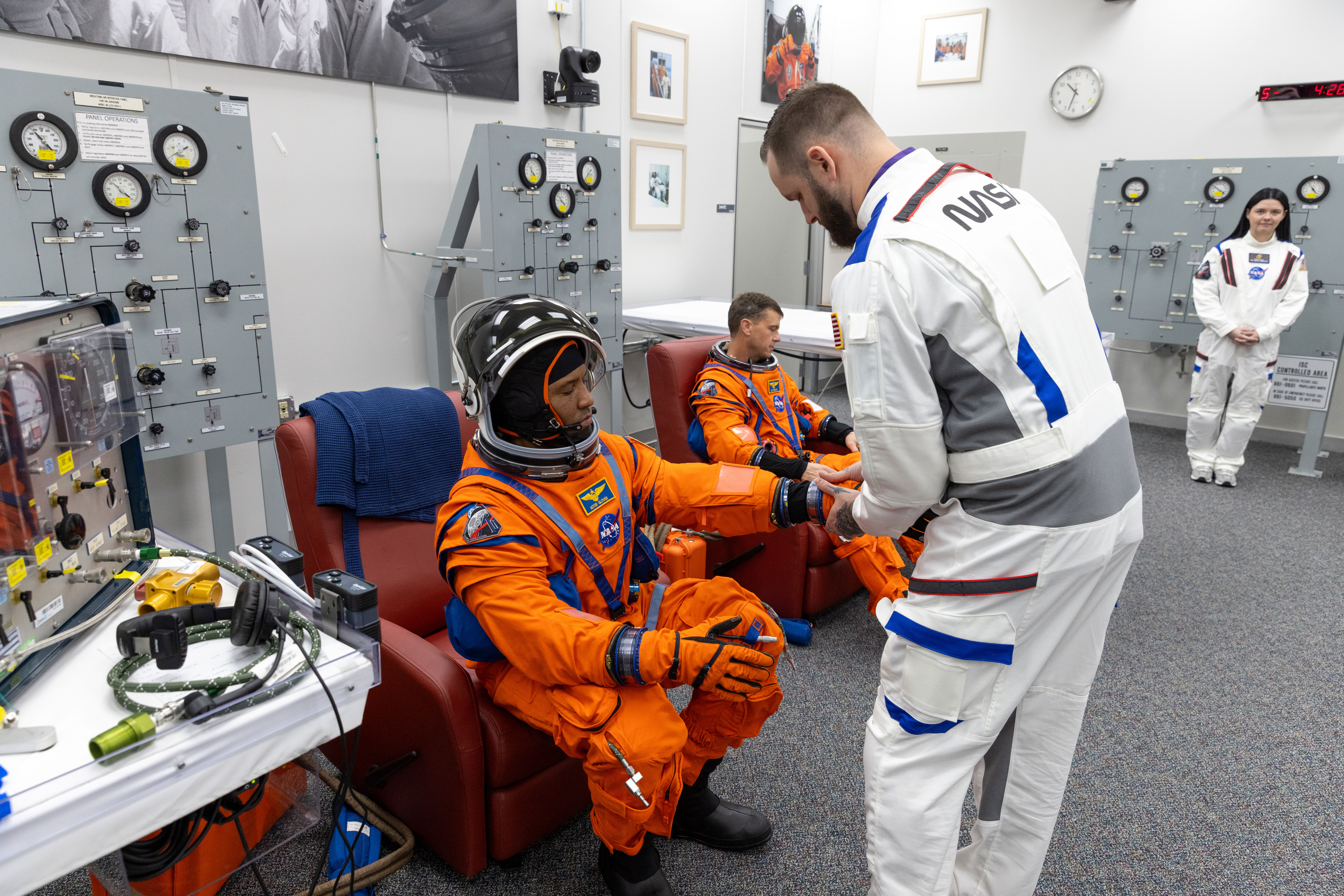
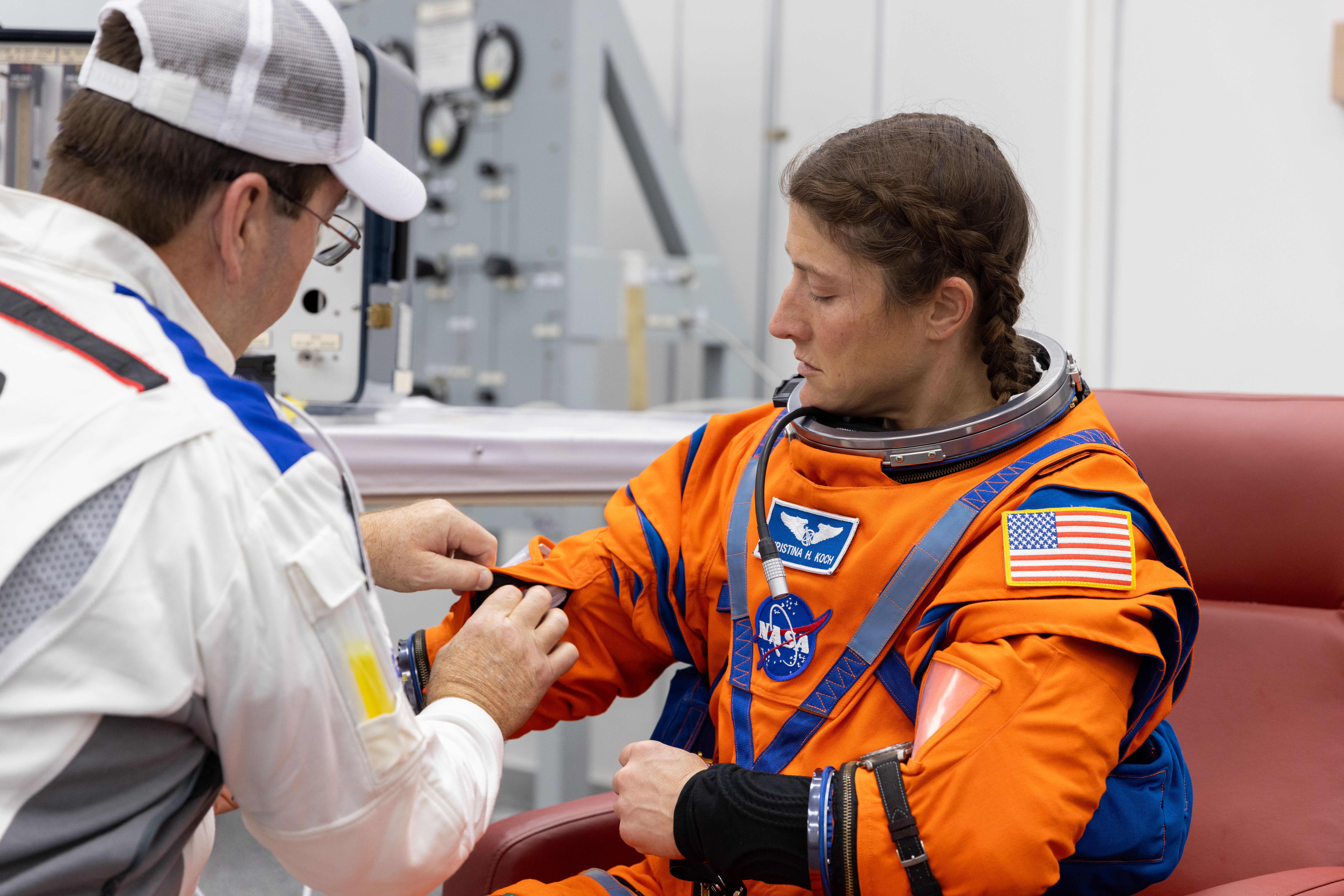
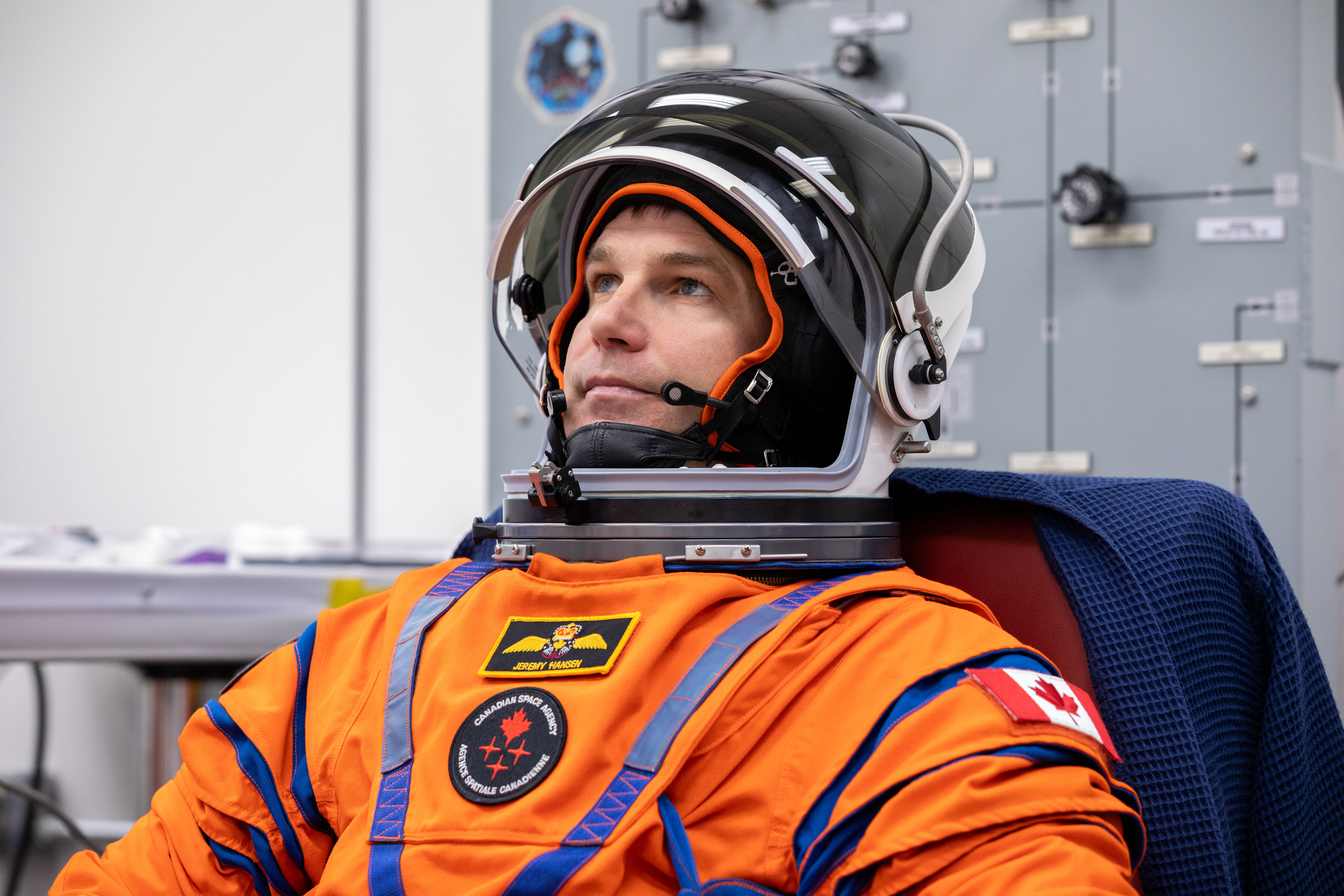
The first crew slated to fly in NASA’s Orion spacecraft during the Artemis II mission around the Moon early next year entered their spacecraft for a multi-day training at the agency’s Kennedy Space Center in Florida. Crew donned their spacesuits July 31 and boarded Orion to train and experience some of the conditions they can expect on their mission.
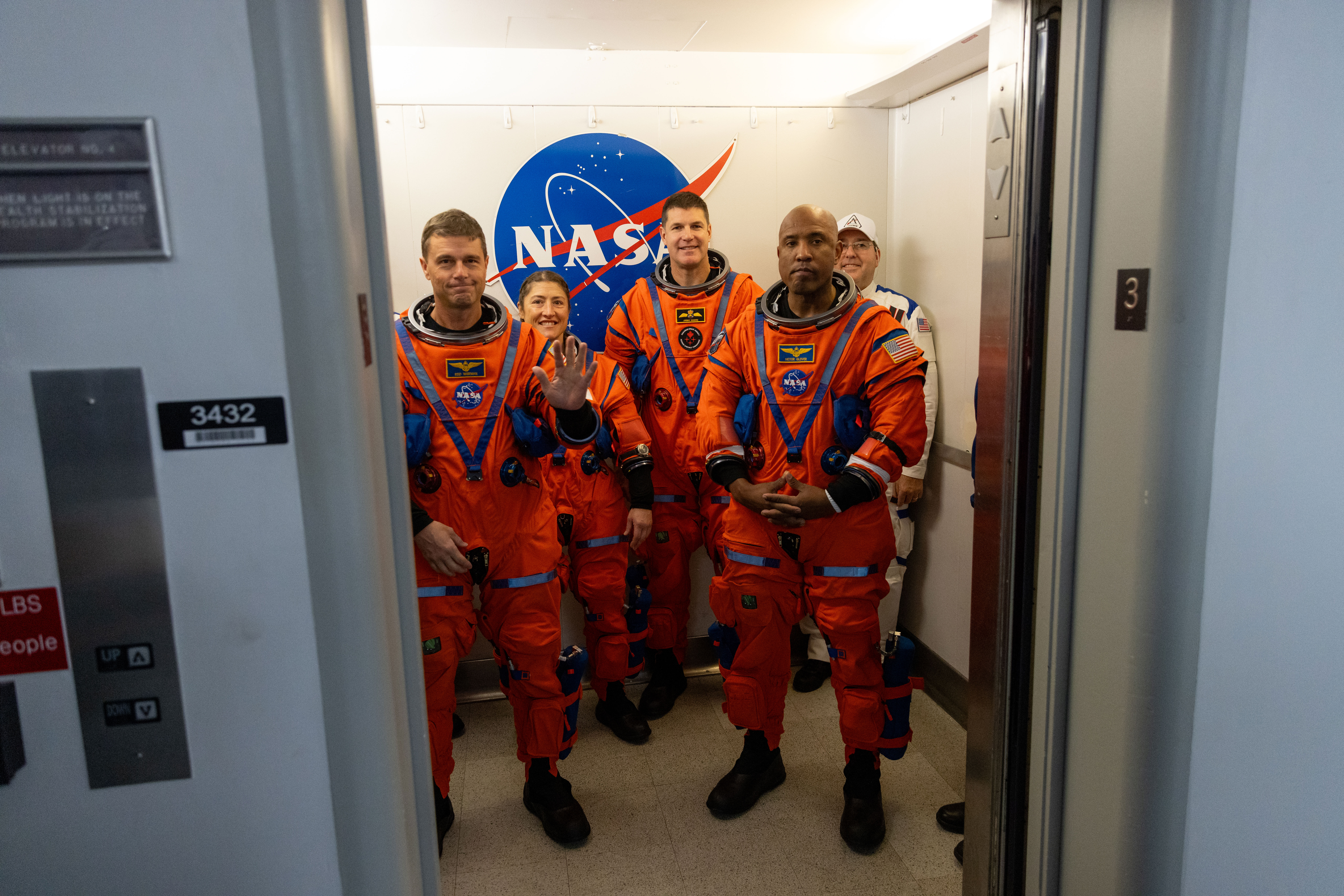
Above: The Artemis II crew (from left to right) CSA (Canadian Space Agency) Jeremy Hansen, mission specialist; Christina Koch, mission specialist; Victor Glover, pilot; and Reid Wiseman, commander, don their Orion Crew Survival System Suits for a multi-day crew module training beginning Thursday, July 31, 2025 at the agency’s Kennedy Space Center in Florida. Behind the crew, wearing clean room apparel, are members of the Artemis II closeout crew. (NASA/Rad Sinyak)
NASA astronauts Reid Wiseman, Victor Glover, and Christina Koch, and CSA (Canadian Space Agency) astronaut Jeremy Hansen participated in a suited crew test and crew equipment interface test, performing launch day and simulated orbital activities inside Orion.
“In about six months, Artemis II astronauts will journey around the Moon for the first time in 53 years,” Duffy said. “America rallied behind Apollo because it represented the best of us – now it’s Artemis’ turn. They’re not just carrying a flag – they’re carrying the pride, power, and promise of the United States of America.”
With Orion powered on, the suited crew test was a close representation of what the crew can expect on launch day. The crew began the day by suiting up inside the spaceport’s Multi-Operation Support Building, donning their Orion crew survival system spacesuits, boarding the zero-emission crew transportation vehicles, and entering Orion, which is currently inside the Multi-Payload Processing Facility, where engineers have loaded its propellants over the course of several weeks.
Once in Orion, the crew performed several launch day activities, including communications checkouts and suit leak checks. For the first time, the crew was connected to the spacecraft and its communications and life control systems, and all umbilicals were connected while the spacecraft operated on full power.
Teams simulated several different ground and flight conditions to give the crew more experience managing them in real time. Some of the activities simulated scenarios where the crew was challenged to address potential issues while in space such as leaks and failure of the air revitalization system fan, which is needed to provide oxygen and remove carbon dioxide from the cabin. Getting this hands-on experience and learning how to act fast to overcome potential challenges during flight helps ensure the crew is ready for any scenario.
The test provides astronauts the ability to train on the actual hardware they will use during flight, allowing them and support teams the opportunity to familiarize themselves with the equipment in configurations very close to what will be experienced during flight. It also allows teams to verify compatibility between the equipment and systems with flight controller procedures, so they can make any final adjustments ahead of launch.
“It signifies the immense amount of work that our operations and development teams put into making sure we are ready for launch.” Quinn said. “They have meticulously planned each operation, timing them to perfection – and now we put it to the test.”
Exchanging their spacesuits for cleanroom garments for the crew equipment interface test, and with the spacecraft powered off, the crew also performed many of the activities they are likely to do in flight and conducted additional equipment checks. The crew practiced removing and stowing the foot pans on the pilot and commander seats, which will allow them to have more open space in the cabin after launch. They also accessed the stowage lockers and familiarized themselves with cameras, associated cables and mounts, and the environmental control and life support system hardware.
In addition to getting practical experience with the actual hardware they’ll use in space, they also prepared for life in deep space, reviewing cabin labels, sleep arrangements and checklists, and the hygiene bay.
Robert Pearlman Editor
Posts: 56330 From: Houston, TX Registered: Nov 1999
posted 08-11-2025 06:37 PM
NASA release
NASA's Artemis II Orion Spacecraft Moves Closer to Launch
NASA's Artemis II Orion spacecraft completed a short but important journey Aug. 10, at the agency's Kennedy Space Center in Florida. With spacecraft fueling complete, technicians moved Orion to the next facility on its path to the launch pad.
Above: NASA’s Artemis II Orion spacecraft arrives at the Launch Abort System Facility at the agency’s Kennedy Space Center in Florida on Sunday, Aug. 10, 2025, to prepare for integration with its 44-foot-tall launch abort system. (NASA/Kim Shiflett)
Teams transported Orion from Kennedy's Multi-Payload Processing Facility (MPPF) where it has been loaded with propellants for flight, to the Launch Abort System Facility (LASF). There, engineers with NASA's Exploration Ground Systems Program will integrate the escape system atop the crew module.
Orion arrived to the MPPF in May, where technicians fueled and processed Orion, loading propellants, high pressure gases, coolant, and other fluids necessary for the spacecraft and crew to carry out their 10-day journey around the Moon and back. The Artemis II crew also took part in multiple days of tests inside Orion in the MPPF, donning their Orion Crew Survival System spacesuits and entering their spacecraft to test all the equipment interfaces they will operate during the mission.
Now inside the LASF, Orion will be integrated with its 44-foot-tall launch abort system, made up of two segments: the launch abort tower, including the abort, jettison, and attitude control motors; and the fairing assembly, including the ogive panels that protect the crew module and provide aerodynamic support during launch. The system is designed to carry the crew to safety in the event of an emergency atop the SLS (Space Launch System) rocket. Once integration is completed, the entire Orion stack will be transported to High Bay 3 in NASA Kennedy's Vehicle Assembly Building where it will be connected to its Moon rocket.
Robert Pearlman Editor
Posts: 56330 From: Houston, TX Registered: Nov 1999
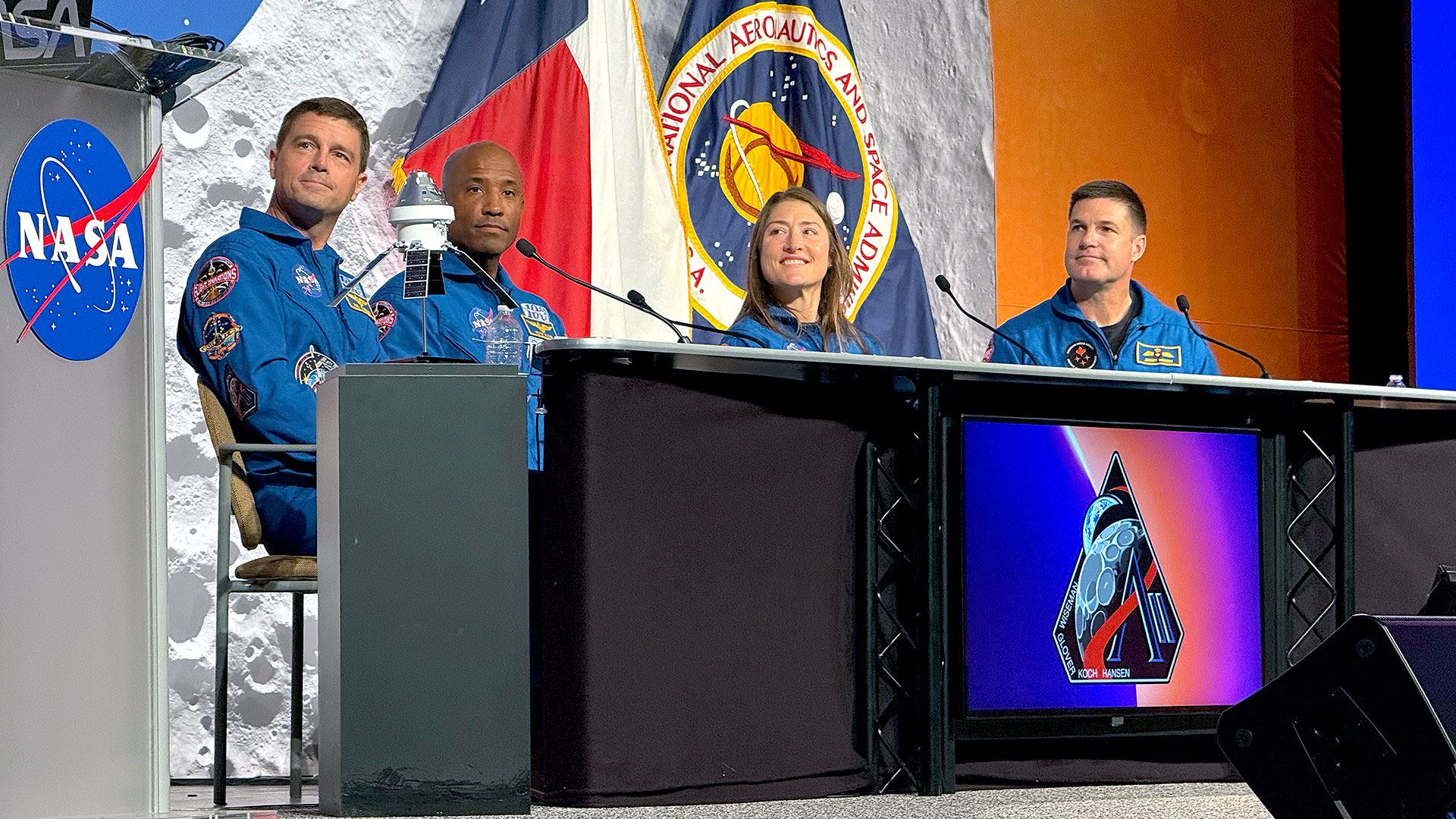
The first astronauts set to fly to the moon in more than 50 years will do so in Integrity.
NASA's Artemis II crew revealed "Integrity" as the name of their Orion spacecraft during a news conference on Wednesday (Sept. 24) at the Johnson Space Center in Houston.
Robert Pearlman Editor
Posts: 56330 From: Houston, TX Registered: Nov 1999
posted 09-30-2025 06:20 PM
NASA release
NASA Draws Closer to Artemis II Rocket Completion with Newest Addition
NASA integrated the Artemis II Orion stage adapter with the rest of the SLS (Space Launch System) rocket on Sept. 24 in the Vehicle Assembly Building at the agency’s Kennedy Space Center in Florida.
The Orion stage adapter connects the upper stage to the Orion spacecraft, isolates the spacecraft from hazardous gases, deploys small science satellites, and will be used in a maneuvering test during the Artemis II mission. (NASA)
Built by NASA engineers at the agency’s Marshall Space Flight Center in Huntsville, Alabama, the adapter connects the rocket’s interim cryogenic propulsion stage to the Orion spacecraft. A composite diaphragm within the ring protects the Orion spacecraft from hazardous gases generated during launch.
Four CubeSats containing science and technology experiments will be deployed from the adapter into high Earth orbit after Orion is a safe distance away . The 12U CubeSats aboard Artemis II were developed by international partners South Korea, Germany, Argentina, and Saudi Arabia. One “U”, or unit, is defined as 10 centimeters by 10 centimeters by 10 centimeters.
NASA will integrate the Orion spacecraft with the rocket in the coming weeks ahead of the mission, scheduled for no later than April 2026. Testing and simulations in preparation for the upcoming launch taking place no later than April 2026.
As the Artemis II rocket is nearing completion at NASA Kennedy, work continues on flight hardware for Artemis III. NASA Marshall engineers have flipped the Artemis III Orion stage adapter to begin bracket, avionics, and cable instillation. Later this fall, its diaphragm will be installed.
Robert Pearlman Editor
Posts: 56330 From: Houston, TX Registered: Nov 1999
posted 10-19-2025 10:33 AM
Last stop before launch pad: Orion arrives at VAB
The Artemis II Orion ("Integrity") on Thursday (Oct. 16) was rolled over to the Vehicle Assembly Building (VAB) at the Kennedy Space Center in preparation for its stacking atop the Space Launch System (SLS) rocket.
"This step brings Artemis II closer to its historic launch in 2026, paving the way for America's return to the Moon!" said acting NASA Administrator Sean Duffy.
The spacecraft had previously been in the Launch Abort System Facility, where it was fitted with its escape tower and ogive panels.
Once mated with the SLS, the launch vehicle will be complete. The next milestone will be a countdown rehearsal in the VAB with the Artemis II crew.
Robert Pearlman Editor
Posts: 56330 From: Houston, TX Registered: Nov 1999
posted 10-21-2025 12:28 PM
'Integrity' integrated atop SLS rocket
The Artemis II Orion "Integrity" has been mounted atop its launch vehicle, the Space Launch System (SLS) rocket.
"The last major hardware component before Artemis II launches early next year has been installed," said acting NASA Administrator Sean Duffy. "'Integrity' is our Orion spacecraft that will hold the Artemis II astronauts on their trip around the Moon. It's now fully attached to the Space Launch System and we are one step closer to mission launch!
The next major milestone will be a countdown rehearsal in the VAB with the Artemis II crew.
Robert Pearlman Editor
Posts: 56330 From: Houston, TX Registered: Nov 1999
posted 12-20-2025 07:37 PM
NASA release
Artemis II crew rehearse launch day
The four astronauts set to fly around the Moon during NASA's Artemis II test flight depart the Neil A. Armstrong Operations and Checkout Building at the agency's Kennedy Space Center in Florida, during a dress rehearsal for launch day on Dec. 20, 2025. From left are CSA (Canadian Space Agency) astronaut Jeremy Hansen, NASA astronauts Victor Glover, Reid Wiseman, and Christina Koch.
The launch day rehearsal, called a countdown demonstration test, simulated the launch day timeline, including the crew suiting up in their spacesuits and climbing in and out of their Orion spacecraft. Because the SLS (Space Launch System) rocket upon which they will launch is not yet at the launch pad, the crew boarded Orion inside Kennedy's Vehicle Assembly Building, where engineers are conducting final preparations on the spacecraft, rocket, and ground systems.
Through Artemis, NASA will send astronauts to explore the Moon for scientific discovery, economic benefits, and build the foundation for the first crewed missions to Mars.
Robert Pearlman Editor
Posts: 56330 From: Houston, TX Registered: Nov 1999
posted 01-09-2026 10:08 PM
NASA release
Final Steps Underway for NASA's First Crewed Artemis Moon Mission
As NASA moves closer to launch of the Artemis II test flight, the agency soon will roll its SLS (Space Launch System) rocket and Orion spacecraft to the launch pad for the first time at the agency's Kennedy Space Center in Florida to begin final integration, testing, and launch rehearsals.
NASA is targeting no earlier than Saturday, Jan. 17, to begin the multi-hour trek from the Vehicle Assembly Building to Launch Pad 39B. The four-mile journey on the crawler-transporter-2 will take up to 12 hours. Teams are working around the clock to close out all tasks ahead of rollout. However, this target date is subject to change if additional time is needed for technical preparations or weather.
"We are moving closer to Artemis II, with rollout just around the corner," said Lori Glaze, acting associate administrator for NASA's Exploration Systems Development Mission Directorate. "We have important steps remaining on our path to launch and crew safety will remain our top priority at every turn, as we near humanity's return to the Moon."
As with all new developments of complex systems, engineers have been troubleshooting several items in recent days and weeks. During final checkouts before rollout, technicians found a cable involved in the flight termination system was bent out of specifications. Teams are replacing it and will test the new cable over the weekend. Additionally, a valve associated with Orion's hatch pressurization exhibited issues leading up to a Dec. 20 countdown demonstration test. On Jan. 5, the team successfully replaced and tested it. Engineers also worked to resolve leaky ground support hardware required to load gaseous oxygen into Orion for breathing air.
Rollout
Once the integrated rocket and spacecraft reach the launch pad, NASA will immediately begin a long checklist of launch pad preparations, including connecting ground support equipment such as electrical lines, fuel environmental control system ducts, and cryogenic propellant feeds. Teams will power up all integrated systems at the pad for the first time to ensure flight hardware components are functioning properly with each other, the mobile launcher, and ground infrastructure systems.
Once complete, the Artemis II astronauts, NASA's Reid Wiseman, Victor Glover, and Christina Koch, and CSA (Canadian Space Agency) astronaut Jeremy Hansen, will conduct a final walkdown at the pad.
Wet dress rehearsal, tanking
At the end of January, NASA will conduct a wet dress rehearsal, which is a prelaunch test to fuel the rocket. During wet dress, teams demonstrate the ability to load more than 700,000 gallons of cryogenic propellants into the rocket, conduct a launch countdown, and practice safely removing propellant from the rocket without astronauts onsite.
During launch, a closeout crew will be responsible for securing astronauts in Orion and closing its hatches. The closeout crew also will use this rehearsal to practice their procedures safely without astronauts aboard the spacecraft.
The wet dress rehearsal will include several "runs" to demonstrate the launch team's ability to hold, resume, and recycle to several different times in the final 10 minutes of the countdown, known as terminal count.
The first run will begin approximately 49 hours before launch when launch teams are called to their stations, to 1 minute 30 seconds before launch, followed by a planned three-minute hold and then countdown resumption to 33 seconds before launch – the point at which the rocket's automatic launch sequencer will control the final seconds of the countdown. Teams then will recycle back to T-10 minutes and hold, then resume down to 30 seconds before launch as part of a second run.
While NASA has integrated lessons learned from Artemis I into the launch countdown procedures, the agency will pause to address any issues during the test or at any other point should technical challenges arise. Engineers will have a close eye on propellant loading of liquid hydrogen and liquid oxygen into the rocket, after challenges encountered with liquid hydrogen loading during Artemis I wet dress rehearsals. Teams also will pay close attention to the effectiveness of recently updated procedures to limit how much gaseous nitrogen accumulates in the space between Orion's crew module and launch abort system hatches, which could pose an issue for the closeout crew.
Additional wet dress rehearsals may be required to ensure the vehicle is completely checked out and ready for flight.
If needed, NASA may rollback SLS and Orion to the Vehicle Assembly Building for additional work ahead of launch after the wet dress rehearsal.
Next steps toward launch
Following a successful wet dress rehearsal, NASA will convene a flight readiness review where the mission management team will assess the readiness of all systems, including flight hardware, infrastructure, and launch, flight, and recovery teams before committing to a launch date.
While the Artemis II launch window opens as early as Friday, Feb. 6, the mission management team will assess flight readiness after the wet dress rehearsal across the spacecraft, launch infrastructure, and the crew and operations teams before selecting a launch date.
To determine potential launch dates, engineers identified key constraints required to accomplish the mission and keep the crew inside Orion safe. The resulting launch periods are the days or weeks where the spacecraft and rocket can meet mission objectives. These launch periods account for the complex orbital mechanics involved in launching on a precise trajectory toward the Moon while the Earth is rotating on its axis and the Moon is orbiting Earth each month in its lunar cycle. This results in a pattern of approximately one week of launch opportunities, followed by three weeks without launch opportunities.
There are several primary parameters that dictate launch availability within these periods. Because of its unique trajectory relative to subsequent lunar landing missions, these key constraints are unique to the Artemis II test flight.
The launch day and time must allow SLS to be able to deliver Orion into a high Earth orbit where the crew and ground teams will evaluate the spacecraft's life support systems before the crew ventures to the Moon.
Orion also must be in the proper alignment with the Earth and Moon at the time of the trans-lunar injection burn. The Artemis II trans-lunar injection burn places Orion on course to flyby the Moon, and also sets it on a free return trajectory, in which the spacecraft uses the Moon's gravity to send the spacecraft back to Earth without additional major propulsive maneuvers.
The trajectory for a given day must ensure Orion is not in darkness for more than 90 minutes at a time so that the solar array wings can receive and convert sunlight to electricity, and the spacecraft can maintain an optimal temperature range. Mission planners eliminate potential launch dates that would send Orion into extended eclipses during the flight.
The launch date must support a trajectory that allows for the proper entry profile planned during Orion's return to Earth.
The periods below show launch availability through April 2026. Mission planners refine the periods based on updated analysis approximately two months before they begin and are subject to change.
Launch Period Jan. 31 – Feb. 14 Launch opportunities February 6, 7, 8, 10, and 11
Launch Period Feb. 28 – March 13 Launch opportunities March 6, 7, 8, 9, 11
Launch Period March 27 – April 10 Launch opportunities April 1, 3, 4, 5, 6
In addition to the launch opportunities based on orbital mechanics and performance requirements, there are also limitations on which days within a launch period can be viable based on commodity replenishment, weather, and other users on the Eastern Range schedule. As a general rule, up to four launch attempts may be attempted within the approximate week of opportunities that exist within a launch period.
As the agency prepares for its first crewed mission beyond Earth orbit in more than 50 years, NASA expects to learn along the way, both on the ground and in flight, and will let the readiness and performance of its systems dictate when the agency is ready to launch.
Robert Pearlman Editor
Posts: 56330 From: Houston, TX Registered: Nov 1999
NASA is now 4.2 miles (6.8 kilometers) closer to returning astronauts to the moon.
The agency on Saturday (Jan. 17) rolled out its Space Launch System (SLS) rocket and Orion spacecraft to Launch Pad 39B at the Kennedy Space Center in Florida in preparation for the Artemis II mission to fly astronauts by the moon for the first time in more than 50 years. The journey atop a slow-moving, Apollo-era crawler transporter took about 8 hours to complete.
Robert Pearlman Editor
Posts: 56330 From: Houston, TX Registered: Nov 1999
posted 01-21-2026 04:10 PM
NASA release
Launch Pad Preparations Progress Ahead of Artemis II Wet Dress Rehearsal
Shortly after NASA's Artemis II SLS (Space Launch System) rocket and Orion spacecraft arrived to Launch Pad 39B at the agency's Kennedy Space Center in Florida on Jan. 17, engineers began preparations for an upcoming wet dress rehearsal, a fueling test of the rocket set to occur before launch.
Technicians hooked up purge lines meant to keep cavities of the rocket and spacecraft in the right conditions, enabled communications with the Launch Control Center, and performed swing tests of the crew access arm — the bridge that allows the crew and other personnel to access Orion. The emergency egress system, a slide-wire and basket systems that allows for a quick exit in the case of an emergency, also was connected, allowing teams to practice releasing the baskets. Orion and elements of the rocket, including the core stage, interim cryogenic propulsion stage, and boosters, have been powered on.
Teams are in the midst of multi-day testing of radio frequency communications between the rocket and the Eastern Range.
Technicians are scheduled to begin servicing the SLS twin solid rocket boosters with hydrazine over the weekend. They also will load several final items into Orion, including tablets for the crew, medical kits, and several scientific payloads such as the AVATAR investigation.
During the upcoming wet dress rehearsal, teams demonstrate the ability to load more than 700,000 gallons of cryogenic propellants into the rocket, conduct a launch countdown, and practice safely removing propellant from the rocket without astronauts onsite.
If needed, engineers can rollback SLS and Orion to the Vehicle Assembly Building for additional work. While the Artemis II launch window opens as early as Friday, Feb. 6, the mission management team will assess flight readiness after the wet dress rehearsal across the spacecraft, launch infrastructure, and the crew and operations teams before selecting a launch date.
Robert Pearlman Editor
Posts: 56330 From: Houston, TX Registered: Nov 1999
posted 01-23-2026 08:39 PM
NASA release
Artemis II Crew Enters Quarantine Ahead of Journey Around Moon
The next astronauts to fly around the Moon went into quarantine late Friday.
NASA astronauts Reid Wiseman, Victor Glover, and Christina Koch, along with CSA (Canadian Space Agency) astronaut Jeremy Hansen, will ensure that they don't pick up any illness that could delay their mission by limiting their exposure to others in the days before they lift off. This period, called the health stabilization program, typically starts about 14 days before launch. Beginning quarantine now preserves flexibility as teams work toward potential opportunities in the February launch period. At this time, the agency still has not set an official launch date as testing continues for the rocket and spacecraft. Pending the outcome of the wet dress rehearsal or other operations considerations, the crew can come out of quarantine, and re-enter 14 days before any launch date.
The crew will begin quarantine in Houston, and if testing continues to go well and activities progress toward a possible launch next month, they will fly to NASA's Kennedy Space Center in Florida about six days ahead of launch. There, the Artemis II crew will live in the astronaut crew quarters inside the Neil A. Armstrong Operations and Checkout Building, before launch day. During quarantine, the crew can continue regular contact with friends, family, and colleagues who are able to observe quarantine guidelines, and will avoid public places, wear masks, and maintain distance from others they come into contact with as they continue their final training activities. Those training activities will continue in the days ahead with mission simulations and medical checkouts.
Meanwhile, teams at Kennedy continue to prepare the SLS (Space Launch System) rocket and Orion spacecraft, along with associated ground systems, ahead of launch. Teams have completed all checkouts of mechanical power systems, cryogenic propellant lines, and engines at Launch Pad 39B. On Saturday, Jan. 24, the pad perimeter will be cleared of all non-essential personnel for SLS booster servicing planned to begin over the weekend.
On the other side of the country, the NASA and Department of War teams that will work together to retrieve the crew and spacecraft following their return to Earth and splashdown in the Pacific Ocean are performing a final simulation of their activities, called a just-in-time training, at sea. Those teams will begin making their way to Orion's splashdown location in the days after launch.
Robert Pearlman Editor
Posts: 56330 From: Houston, TX Registered: Nov 1999
posted 01-26-2026 08:13 PM
NASA release
NASA Moves Steps Closer to Artemis II Fueling Test Ahead of Launch
Teams at NASA's Kennedy Space Center in Florida continue to prepare the SLS (Space Launch System) rocket, Orion spacecraft, and ground infrastructure in advance of the Artemis II test flight. Engineers have remained on track or ahead of schedule as they work through planned activities at the launch pad and are getting ready to conduct a wet dress rehearsal, leading up to a simulated "launch" as early as Saturday, Jan. 31.
The upcoming wet dress rehearsal is a prelaunch test to fuel the rocket. During the rehearsal, teams demonstrate the ability to load more than 700,000 gallons of cryogenic propellants into the rocket, conduct a launch countdown, and practice safely removing propellant from the rocket without astronauts inside the spacecraft.
During several "runs," the wet dress rehearsal will test the launch team's ability to hold, resume, and recycle to several different times in the final 10 minutes of the countdown, known as terminal count. The rehearsal will count down to a simulated launch at 9 p.m. EST, but could run to approximately 1 a.m. if needed.
The first run will begin approximately 49 hours before launch when launch teams are called to their stations, to 1 minute 30 seconds before launch, followed by a planned three-minute hold and then countdown resumption to 33 seconds before launch – the point at which the rocket's automatic launch sequencer will control the final seconds of the countdown. Teams then will recycle back to T-10 minutes and hold, then resume down to 30 seconds before launch as part of a second run.
If needed, NASA may rollback SLS and Orion to the Vehicle Assembly Building for additional work ahead of launch after the wet dress rehearsal.
Over the weekend, teams successfully serviced the SLS rocket boosters, which involved loading hydrazine into the booster aft skirts. The team continues operations to prepare Orion for flight, including stowing items inside the spacecraft and performing planned pyrotechnic work on the launch abort system. Technicians performed checkouts of core stage's four RS-25 engines and pressurized a tank in the spacecraft propulsion system used for fueling, called the composite overwrapped pressure vessel.
With cold weather sweeping the country and lower than normal temperatures expected in Florida Tuesday, Jan. 27, technicians are taking steps to ensure environmental control systems keeping Orion and SLS elements at the proper conditions are prepared for the cold.
Engineers and scientists also are addressing issues that cropped up during operations in preparation for crewed flight. During an evaluation of the emergency egress system, the baskets used to transport the crew and other pad personnel from the mobile launcher in an emergency stopped short of the terminus area located inside the pad perimeter. Since then, the brakes of the system have been adjusted to ensure the baskets fully descend. In the coming days, technicians also will take additional samples of Orion's potable water system to ensure the crew's water is drinkable. Initial samples showed higher levels of total organic carbon than expected.
Crew also remain in quarantine in Houston, which they entered on Jan. 23.
Robert Pearlman Editor
Posts: 56330 From: Houston, TX Registered: Nov 1999
posted 01-30-2026 09:18 AM
NASA release
NASA updates Artemis II wet dress rehearsal, launch opportunities
NASA is targeting Monday, Feb. 2, as the tanking day for the upcoming Artemis II wet dress rehearsal at the agency's Kennedy Space Center in Florida, as a result of weather. With this change, the first potential opportunity to launch is no earlier than Sunday, Feb. 8.
Over the past several days, engineers have been closely monitoring conditions as cold weather and winds move through Florida. Managers have assessed hardware capabilities against the projected forecast given the rare arctic outbreak affecting the state and decided to change the timeline. Teams and preparations at the launch pad remain ready for the wet dress rehearsal. However, adjusting the timeline for the test will position NASA for success during the rehearsal, as the expected weather this weekend would violate launch conditions.
While NASA will wait to set a launch date until teams have reviewed the outcome of the wet dress rehearsal, Friday, Feb. 6, and Saturday, Feb. 7, are no longer viable opportunities. Any additional delays would result in a day for day change.
The Artemis II crew remains in quarantine in Houston. Managers are assessing the timeline for crew arrival.
The opening of a simulated launch window during the wet dress rehearsal begins at 9 p.m. EST, Feb. 2, with the countdown beginning approximately 49 hours prior. NASA will continue to assess weather conditions ahead of the test.
During the current cold weather, engineers have kept Orion powered and have configured its heaters for the colder temperatures. Purges, used to maintain proper environmental conditions for elements of the spacecraft and rocket, including the booster aft skirts, are also configured for the weather.
Robert Pearlman Editor
Posts: 56330 From: Houston, TX Registered: Nov 1999
posted 01-31-2026 07:33 PM
NASA release
Countdown Begins for Artemis II Wet Dress Rehearsal
The countdown for the Artemis II wet dress rehearsal is underway at NASA's Kennedy Space Center in Florida.
The countdown clock began at 8:13 p.m. EST, or L-48 hours, 40 minutes before the opening of a simulated launch window at 9 pm. Mon, Feb. 2. The test is expected to go until approximately 1 a.m. Feb. 3.
This test will run the launch team, as well as supporting teams in the Mission Control Center at NASA's Johnson Space Center in Houston and other supporting NASA centers, through a full range of operations, including loading cryogenic liquid propellant into the SLS (Space Launch System) rocket's tanks, conducting a launch countdown, demonstrating the ability to recycle the countdown clock, and draining the tanks to practice scrub procedures. These steps ensure the team is fully prepared for launch day.
Countdown Milestones
The countdown contains "L minus" and "T minus" times. "L minus" indicates how far away we are from liftoff in hours and minutes. "T minus" time is a sequence of events that are built into the countdown. Pauses in the countdown, or "holds," are built into the countdown to allow the launch team to target a precise launch window, and to provide a cushion of time for certain tasks and procedures without impacting the overall schedule. During planned holds in the countdown process, the countdown clock is intentionally stopped and the T- time also stops. The L- time, however, continues to advance.
During the rehearsal, the team will execute a detailed countdown sequence. They will pause at T-1 minute and 30 seconds for up to three minutes, then resume until T-33 seconds before launch and pause again. After that, they will recycle the clock back to T-10 minutes and conduct a second terminal countdown to approximately T-33 seconds before ending the sequence. This process simulates real-world conditions, including scenarios where a launch might be scrubbed due to technical or weather issues. At the end of the test, the team will drain the propellant and review all data before setting an official target launch date.
While the Artemis II crew members are not participating in the wet dress rehearsal, crew milestones occurring during launch day will be incorporated into the test timeline and the Artemis closeout crew will practice their closeout operations, which include closing the Orion crew module and launch abort system hatches.
Below are some of the key events that take place at each milestone after the countdown begins. All times are approximate for when these milestones are expected to occur.
L-49 hours 15 minutes and counting
L-49H, 15M: The launch team arrives on their stations and the countdown begins
L-48H40M: The countdown clock begins
L-47H30M – L-38H30M: Fill the water tank for the sound suppression system
L-48H45M – L-39H45M: Liquid Oxygen (LOX)/Liquid Hydrogen (LH2) system preparations for vehicle loading
L-39H30M – L-38H45M: The core stage is powered up
L-40H30M – L-39H: The interim cryogenic propulsion stage (ICPS) is powered up
L-38H45M – L-34H30M: Final preparations of the four RS-25 engines
L-34 hours 30 minutes and counting
L-33H45M – L-33H10M: The ICPS is powered down
L-32H30M – L-28H30M: Charge Orion flight batteries to 100%
T-4M: GLS is go for core stage auxiliary power unit (APU) start
T-4M: Core Stage APU starts
T-4M: Core stage LOX terminate replenish
T-3M30S: ICPS LOX terminate replenish
T-3M10S: GLS is go for purge sequence 4
T-2M02S: ICPS switches to internal battery power
T-2M: Booster switches to internal batter power
T-1M30S: Hold for three minutes to verify core stage certification hold time
T-1M30S: Core stage switches to internal power
T-1M20S: ICPS enters terminal countdown mode
T-50S: ICPS LH2 terminate replenish
T-33S: GLS sends "go for automated launch sequencer" command
T-33S: GLS Cutoff/Recycle
Inside the terminal countdown, teams have a few options to hold the count if needed.
The launch team can hold at 6 minutes for the duration of the launch window, less the 6 minutes needed to launch, without having to recycle back to 10 minutes.
If teams need to stop the clock between T-6 minutes and T-1 minute, 30 seconds, they can hold for up to 3 minutes and resume the clock to launch. If they require more than 3 minutes of hold time, the countdown recycles back to T-10.
If the clock stops after T-1 minute and 30 seconds, but before the automated launch sequencer takes over, then teams can recycle back to T-10 to try again, provided there is adequate launch window remaining.
On launch day, after handover to the automated launch sequencer, any issue that would stop the countdown would lead to concluding the launch attempt for that day.
Robert Pearlman Editor
Posts: 56330 From: Houston, TX Registered: Nov 1999
posted 02-02-2026 08:06 AM
NASA release
Wet Dress Rehearsal Countdown Progressing for Artemis II
NASA continued to press ahead through the countdown for the Artemis II wet dress rehearsal on Sunday (Feb. 1). Teams monitored all systems throughout the overnight hours during cold temperatures and high winds at the agency's Kennedy Space Center in Florida.
Early Sunday morning, at approximately L-39 hours and 30 minutes, teams powered up the rocket's core stage, which soon will be loaded with more than 700,000 gallons of liquid oxygen and liquid hydrogen during the tanking phase of the countdown. This will occur over a series of different propellant loading milestones to fill, top off, and replenish the tanks.
The interim cryogenic propulsion stage was powered up overnight from Saturday to Sunday. Orion has remained powered over the last several days due to cold temperatures in Florida. Engineers are preparing to charge Orion's flight batteries and soon will begin core stage battery charge.
Later on Sunday, engineers conducted final preparations of the umbilical arms and performed a walkdown at the launch pad.
Robert Pearlman Editor
Posts: 56330 From: Houston, TX Registered: Nov 1999
posted 02-02-2026 09:33 AM
NASA release
Artemis II Wet Dress Rehearsal Update
The Artemis II wet dress rehearsal countdown continues on Monday (Feb. 2) as teams at NASA's Kennedy Space Center in Florida began configuring the SLS (Space Launch System) rocket and Orion spacecraft with gaseous nitrogen, an important step to mitigate fire hazards, protect spacecraft systems, and ensure mission safety.
Technicians are currently replacing the ambient air in the SLS and Orion crew module with gaseous nitrogen, which is an inert gas that does not support combustion. By replacing air – which contains highly-combustible oxygen – with nitrogen, engineers can remove the oxidizer needed to sustain fire and dramatically reduce flammability risks in a launch environment filled with high-energy systems and propellants.
The step also includes an inerting purge that removes oxygen and prevents contaminants like moisture or particulates from entering sensitive systems on SLS and Orion. This keeps propulsion and life-support hardware clean and stable and creates a non-reactive environment that protects hardware and minimizes chemical reactions during countdown and ascent.
While gaseous nitrogen is excellent for fire prevention, it is hazardous for humans to breathe because it displaces oxygen, so all personnel have cleared the area during operations.
Up next, NASA's Artemis launch director, Charlie Blackwell-Thompson and mission management team will poll whether to give a "go" for tanking operations around 10:45 a.m. EST, following a briefing from weather officers in the U.S. Space Force Space Launch Delta 45. While there won't be a launch today, teams are targeting 9 p.m. EST as the opening of a simulated launch window. Following a first run, teams will recycle the clock to T-10 minutes and will resume until stopping at approximately T-30 seconds.
Robert Pearlman Editor
Posts: 56330 From: Houston, TX Registered: Nov 1999
posted 02-02-2026 10:45 AM
NASA release
Artemis II Wet Dress Rehearsal: 'Go' for Tanking
On Monday (Feb. 2) at approximately 11:25 a.m. EST, the Artemis launch director, in coordination with the mission management team chair, gave the "go" to begin loading cryogenic liquid propellant into the SLS (Space Launch System) rocket for wet dress rehearsal. While teams continue to monitor cold weather that would impact launch day, they are not tracking weather constraints to Monday's tanking operations.
NASA teams have completed final preparations and closeouts of the umbilicals connecting the mobile launcher to the SLS rocket and Orion spacecraft. The umbilicals provide power, communications, and fuel to different parts of the rocket and spacecraft, while additional accessories provide stabilization. During launch, each umbilical releases from its connection point, allowing the rocket and spacecraft to lift off safely.
Teams will begin slowly filling cryogenic propellant into the rocket beginning at L-9 hours 25 minutes in the countdown. Liquid hydrogen and liquid oxygen will flow into the rocket's core stage and interim cryogenic propulsion stage tanks, topped off and replenished as some cryogenic propellant boils off. The team will also conduct leak checks to ensure loading proceeds as expected.
Robert Pearlman Editor
Posts: 56330 From: Houston, TX Registered: Nov 1999
posted 02-02-2026 12:53 PM
NASA release
Teams Stop Flow of Core Stage Liquid Hydrogen for Troubleshooting
Teams have stopped the flow of liquid hydrogen through the tail service mast umbilical interface into the core stage after leak concentrations exceeded allowable limits. Stopping the flow allows engineers to perform troubleshooting procedures that were developed after Artemis I.
Liquid oxygen continues to flow into the core stage, and liquid hydrogen continues to flow into the upper stage.
Robert Pearlman Editor
Posts: 56330 From: Houston, TX Registered: Nov 1999
posted 02-02-2026 02:27 PM
NASA release
Troubleshooting Continues for Core Stage Liquid Hydrogen Loading
After teams temporarily resumed fast fill of liquid hydrogen operations into the core stage, initial steps to correct the leak proved unsuccessful. The leak rate at the interface of the tail service mast umbilical continues to exceed the allowable limits.
Liquid hydrogen filling operations on both the core stage and upper stage are paused as the team meets to determines next steps.
Robert Pearlman Editor
Posts: 56330 From: Houston, TX Registered: Nov 1999
posted 02-02-2026 03:09 PM
NASA release
Core Stage Liquid Hydrogen Loading Resumes
Ground teams have resumed the fast fill of liquid hydrogen operations into the core stage of the SLS (Space Launch System) rocket. Operations were stopped twice after leak rates at the interface of the tail service mast umbilical exceeded allowable limits.
Engineers will attempt to complete fast fill and begin topping off the tank. Should that be successful, they will attempt to manage the hydrogen concentration, keeping it within acceptable limits during core stage hydrogen loading.
Once the tank is full, the rocket will go into a replenish phase in which the flow rates are reduced; this is expected to help control the liquid hydrogen concentration level in the umbilical.
Teams are reinitiating liquid oxygen flow into the upper stage.
Robert Pearlman Editor
Posts: 56330 From: Houston, TX Registered: Nov 1999
posted 02-02-2026 03:51 PM
NASA release
Core Stage Liquid Hydrogen in Topping Mode
NASA teams have completed filling the core stage of the SLS (Space Launch System) rocket with liquid hydrogen and transitioned to topping mode. Topping ensures the tank reaches its full capacity with super-cold liquid hydrogen chilled to minus 423 degrees Fahrenheit.
Engineers continue to watch the leak at the interface of the tail service mast umbilical, but the liquid hydrogen concentration in the umbilical remains within acceptable limits.
Robert Pearlman Editor
Posts: 56330 From: Houston, TX Registered: Nov 1999
posted 02-02-2026 04:22 PM
NASA release
Tanking Operations Progressing
Fueling of the SLS (Space Launch System) rocket is proceeding on all fronts, following earlier pauses on liquid hydrogen flows.
Liquid hydrogen and liquid oxygen in the core stage are in the replenish phase. Liquid oxygen has also reached the replenish stage on the upper stage. Replenish mode keeps the tank at flight-ready levels by replacing any cryogenic propellant lost to boil-off.
On the upper stage, the liquid hydrogen fill has moved into fast fill.
Following both stages of the rocket being in replenish mode, the launch director will assess readiness to send the Artemis closeout crew out to Launch Pad 39B to proceed with Orion closeout operations, including hatch closures.
Robert Pearlman Editor
Posts: 56330 From: Houston, TX Registered: Nov 1999
posted 02-02-2026 04:48 PM
NASA release
Upper Stage Liquid Hydrogen Topping Underway
Following the vent and relief test on the interim cryogenic propulsion stage (ICPS) liquid hydrogen tank, NASA teams have entered the topping phase of fueling liquid hydrogen. The vent and relief test verifies that the vent and relief valves operate correctly to maintain safe pressure levels inside the upper stage liquid hydrogen tank, while topping ensures the upper stage tank reaches full capacity.
Following topping, teams will move to replenish mode, keeping the ICPS tank at flight-ready levels into terminal count. Meanwhile, all other propellant tanks on SLS are in replenish mode.
Robert Pearlman Editor
Posts: 56330 From: Houston, TX Registered: Nov 1999
posted 02-02-2026 05:45 PM
NASA release
All SLS Stages in Replenish Mode
NASA teams have transitioned all cryogenic tanks on the SLS (Space Launch System) rocket to replenish mode during the Artemis II wet dress rehearsal. This includes both liquid hydrogen and liquid oxygen tanks for the core stage and the interim cryogenic propulsion stage. Engineers continue to monitor liquid hydrogen concentration levels in the tail service mast umbilical, where a leak was previously detected. Levels are currently stable.
Teams enter replenish mode because cryogenic propellants naturally warm and evaporate over time, even in insulated tanks. Replenish counteracts this by continuously adding small amounts of liquid hydrogen and liquid oxygen to maintain proper levels and pressure. This ensures the rocket remains fully fueled and stable as the countdown progresses toward terminal count.
Following all stages replenish, teams will perform final system checks and verify valve and sensor performance before transitioning to the terminal countdown sequence, which includes simulated launch operations and final readiness verifications. The countdown clock has also entered a 40-minute hold, a new addition from Artemis I.
With all stages in replenish, the Artemis II wet dress rehearsal is now in its final fueling configuration, bringing operations closer to terminal count. NASA's closeout crew is preparing to head to Launch Complex 39B to ensure safety and readiness during the critical fueling operations.
Robert Pearlman Editor
Posts: 56330 From: Houston, TX Registered: Nov 1999
posted 02-02-2026 06:02 PM
NASA release
Closeout Crew Departs to White Room
As part of the Artemis II wet dress rehearsal, NASA's Artemis II closeout crew and pad rescue team are en route to Launch Pad 39B. The closeout crew will head to the White Room inside the crew access arm on the mobile launcher and are responsible for securing the Orion spacecraft and ensuring all access points are properly configured before simulated crew ingress operations.
The White Room is the environmentally controlled area at the end of the crew access arm, providing a clean and safe space for astronauts to enter Orion on launch day. During the wet dress rehearsal, the closeout crew will close the spacecrafts' hatches, verify hatch seals, check environmental conditions, and confirm all systems are ready for the next steps in the countdown.
Their work is critical for maintaining safety and readiness as Artemis II moves closer to its first crewed mission around the Moon.
Though the rehearsal has been counting down to the opening of a simulated launch window at 9 p.m. Mon, Feb. 2, the test could go until approximately 1 a.m. Feb. 3.
Robert Pearlman Editor
Posts: 56330 From: Houston, TX Registered: Nov 1999
posted 02-02-2026 06:37 PM
NASA release
Crew Module Hatch Preparations and Closure
As part of the Artemis II wet dress rehearsal, NASA teams are performing final preparations and closure of the Orion crew module hatch inside the White Room at Launch Pad 39B. This step simulates launch day procedures, ensuring the spacecraft is sealed and ready for crew to enter Orion for launch. The Artemis II astronauts are not participating in the rehearsal.
The closeout crew will inspect and clean the hatch seals to maintain airtight integrity, verify environmental controls inside the crew module, confirm all mechanical and electrical connections are secure before closure.
Closing the hatch is a critical milestone that demonstrates Orion's readiness for flight and validates procedures for the first crewed Artemis mission around the Moon.
Coming up next, teams will configure the launch abort system hatch for closure.
Robert Pearlman Editor
Posts: 56330 From: Houston, TX Registered: Nov 1999
posted 02-02-2026 08:55 PM
NASA release
Closeout Work in White Room Continues
The Artemis II wet dress rehearsal entered the T-10 minute hold in the simulated countdown at 8:50 p.m. EST. Though it had been counting down to the opening of a simulated launch window at 9 p.m. EST Monday, Feb. 2, the test will proceed as teams continue to work through countdown milestones.
The closeout crew remains in the White Room and has closed the Orion spacecraft's crew module hatch. While performing seal pressurization checks on the counterbalance assembly, which could be used to help open the hatch, a valve associated with Orion's hatch pressurization was inadvertently vented. The counterbalance assembly then needed to be repressurized to allow work to continue.
Approximately an hour of work remains in the White Room, with the launch abort system hatch remaining to be closed.
Robert Pearlman Editor
Posts: 56330 From: Houston, TX Registered: Nov 1999
posted 02-02-2026 09:52 PM
NASA release
Launch Abort System Hatch Closed
NASA teams completed closing the launch abort system hatch during the Artemis II wet dress rehearsal, simulating final launch day procedures. The launch abort system hatch provides access to the Orion crew module through the outer aeroshell of the launch abort system and must be securely sealed to ensure crew safety during ascent.
Closing the launch abort system hatch is a critical milestone that confirms the spacecraft is fully configured for flight. The launch abort system is designed to protect astronauts in the event of an emergency during launch, and proper hatch integrity ensures the system can perform as intended.
With the hatch secured, the closeout crew validates mechanical seals, verifies environmental conditions, performs leak checks, and confirms readiness for the next steps in the countdown sequence.
Next up, the closeout crew will depart the launch pad once its work is completed.
The rehearsal entered the T-10 minute hold at 8:50 p.m. EST, and the team continues to work through countdown milestones in the hold. Though the test had been counting down to the opening of a simulated launch window at 9 p.m. EST, the test has continued into the window. While the launch control team initially planned to pause when the countdown reached 33 seconds to launch and recycle the countdown clock back to T-10 minutes to conduct a second terminal countdown, Artemis Launch Director Charlie Blackwell-Thompson has made the decision to limit the rehearsal to one terminal count.
Robert Pearlman Editor
Posts: 56330 From: Houston, TX Registered: Nov 1999
posted 02-02-2026 10:22 PM
NASA release
Closeout Crew Departs Launch Complex 39B
NASA's Artemis II closeout crew has completed its critical tasks and departed NASA Kennedy's Launch Complex 39B during the Artemis II wet dress rehearsal.
The departure of the closeout crew marks the transition to the final countdown phase, ensuring the launch pad is clear and safe for simulated liftoff procedures. Although the Artemis II astronauts did not participate in today's rehearsal, the closeout crew's work validates launch day protocols and confirms Orion and the SLS (Space Launch System) rocket are configured for flight readiness.
With the pad secured, teams will continue monitoring fueling operations and prepare for wet dress rehearsal terminal count, the final ten minutes of the countdown. The team will be conducting a single terminal countdown for this test.
Robert Pearlman Editor
Posts: 56330 From: Houston, TX Registered: Nov 1999
posted 02-02-2026 11:14 PM
NASA release
Entering Terminal Count at T-10 Minutes
NASA teams officially entered the final 10 minutes of today's Artemis II wet dress rehearsal countdown known as terminal count after Charlie Blackwell-Thompson, NASA's Artemis launch director, gave the "go" to proceed.
During terminal count, automated systems take control of countdown operations, final checks of flight computers, engine bleed systems, and ground support equipment occur, and the rocket transitions to internal power, and the countdown proceeds toward simulated engine start.
Terminal count is designed to confirm that all systems can perform flawlessly under launch conditions, ensuring readiness for Artemis II – the first crewed mission of the Artemis campaign.
Teams will be conducting a single run of terminal count for this test.
Robert Pearlman Editor
Posts: 56330 From: Houston, TX Registered: Nov 1999
posted 02-02-2026 11:32 PM
NASA release
Test Terminated at T-5:15
The Artemis II wet dress rehearsal countdown was terminated at the T-5:15 minute mark due to a liquid hydrogen leak at the interface of the tail service mast umbilical, which had experienced high concentrations of liquid hydrogen earlier in the countdown, as well.
The launch control team is working to ensure the SLS (Space Launch System) rocket is in a safe configuration and begin draining its tanks.
Robert Pearlman Editor
Posts: 56330 From: Houston, TX Registered: Nov 1999
NASA has delayed the launch of its first astronauts to fly to the moon in more than 50 years.
The Artemis II crew, including U.S. astronauts Reid Wiseman, Victor Glover and Christina Koch, along with Jeremy Hansen of the Canadian Space Agency, now has at least a month before they lift off on a 10-day mission to fly by and beyond the moon before returning to Earth. Artemis II will mark only the second time that NASA's Space Launch System (SLS) rocket has flown — and its first time with a crew on board.
Robert Pearlman Editor
Posts: 56330 From: Houston, TX Registered: Nov 1999
posted 02-09-2026 07:27 AM
NASA release
NASA Conducts Repairs, Analysis Ahead of Next Fueling Test
Since concluding a wet dress rehearsal Feb. 3 ahead of Artemis II, technicians have replaced two seals in an area where operators saw higher than allowable hydrogen gas concentrations during the test. Engineers are analyzing the removed seals and developing plans to address all issues ahead of the next rehearsal.
Once the SLS (Space Launch System) rocket's tanks were drained of cryogenic propellant following the previous test, technicians immediately began work to access the tail service mast umbilical on the mobile launcher and detach rocket and ground-side interface plates to inspect the area of the elevated gas levels, and replace seals around two fueling lines.
Two tail service masts, each about three stories tall, provide cryogenic propellant lines and electrical cable connections to the SLS core stage. The tail service masts tilt back before launch and include "quick disconnects," mechanisms that instantaneously disconnect at liftoff to ensure a safe and reliable retraction at launch.
While teams continue evaluating the cause of the leak, reconnecting the interfaces is expected to be complete on Monday, Feb. 9. Testing is planned to occur at NASA's Stennis Space Center in Bay St. Louis, Mississippi, to evaluate additional dynamics of the plates. Engineers are reviewing options to test the repair work prior to the next wet dress rehearsal to ensure the seals are performing as expected.
NASA also will update several operations for the next wet dress rehearsal to focus on fueling activities. The Orion crew module hatch will be closed prior to the test, and the closeout crew responsible on launch day for assisting the Artemis II crew into their seats and closing Orion's two hatches will not be deployed to the launch pad. The crew access arm will not be retracted during the next rehearsal, after engineers successfully demonstrated the ground launch sequencer can retract it during the final phase of the countdown.
Additionally, NASA has added 30 minutes of extra time during each of two planned holds in the countdown before and after tanking operations to allow more time for troubleshooting, increasing the total time of the countdown by one hour. The additional time will not affect the crew's timeline on launch day.
Since emerging from quarantine, NASA astronauts Reid Wiseman, Victor Glover, and Christina Koch, and CSA (Canadian Space Agency) astronaut Jeremy Hansen, have continued training activities, ensuring their familiarity with Orion spacecraft systems is second nature. The astronauts also have been reviewing the details of each flight day for the mission, bolstering their knowledge of test objectives planned during the flight.
While NASA continues to eye March as the next potential launch opportunity, the agency will not set a targeted launch date until after completing a successful wet dress rehearsal and reviewing the data.
Robert Pearlman Editor
Posts: 56330 From: Houston, TX Registered: Nov 1999
posted 02-13-2026 07:23 PM
NASA release
Following Confidence Test, NASA Continues Artemis II Data Review
As part of robustly testing the vehicle prior to flight, NASA engineers are reviewing data after a confidence test Feb. 12, in which operators partially filled the SLS (Space Launch System) core stage liquid hydrogen tank to assess newly replaced seals in an area used to fill the rocket with propellant.
During the test, teams encountered an issue with ground support equipment that reduced the flow of liquid hydrogen into the rocket. Teams were able to gain confidence in several key objectives of the test, and data was obtained at the core stage interfaces, taken at the same time in the test where they encountered a leak during the previous wet dress rehearsal.
Engineers will purge the line over the weekend to ensure proper environmental conditions and inspect the ground support equipment before replacing a filter suspected to be the cause of the reduced flow.
Engineers will examine findings before setting a timeline for the next test, a second wet dress rehearsal this month. March remains the earliest potential launch window for Artemis II.
Robert Pearlman Editor
Posts: 56330 From: Houston, TX Registered: Nov 1999
posted 02-16-2026 02:50 PM
NASA release
NASA Eyes Next Wet Dress Rehearsal for Artemis II
NASA is targeting Thursday, Feb. 19, as the tanking day for the second wet dress rehearsal ahead of the agency's Artemis II test flight.
Over the weekend, teams replaced a filter in ground support equipment that was suspected of reducing the flow of liquid hydrogen during a Feb. 12 partial fueling test. The test provided enough data to allow engineers to plan toward a second wet dress rehearsal this week. Engineers have reconnected the line with the new filter and are reestablishing proper environmental conditions.
The wet dress rehearsal will run the launch team as well as supporting teams through a full range of operations, including loading cryogenic liquid propellant into the SLS (Space Launch System) rocket's tanks, conducting a launch countdown, demonstrating the ability to recycle the countdown clock, and draining the tanks to practice scrub procedures.
Launch controllers will arrive to their consoles in the Launch Control Center at NASA's Kennedy Space Center in Florida at 6:40 p.m. EST on Feb. 17 to begin the nearly 50-hour countdown. The simulated launch time is 8:30 p.m., Feb. 19, with a four-hour window for the test. While the Artemis II crew is not participating in the test, a team of personnel will go to the launch pad to practice Orion closeout operations, including closing the spacecraft's hatches.
During the rehearsal, the team will execute a detailed countdown sequence. Operators will conduct two runs of the last ten minutes of the countdown, known as terminal count. They will pause at T-1 minute and 30 seconds for up to three minutes, then resume until T-33 seconds before launch and pause again. After that, they will recycle the clock back to T-10 minutes and conduct a second terminal countdown to just inside of T-30 seconds before ending the sequence. This process simulates real-world conditions, including scenarios where a launch might be scrubbed due to technical or weather issues.
While NASA will not set a formal launch date until after a successful rehearsal and data reviews, the agency has been evaluating in recent weeks if the there are additional days that would be suitable for launch and found an extra opportunity the first week of March. However, managers have determined March 6 is the earliest opportunity for launch that allows for a second wet dress rehearsal, sufficient time for data review, and time to transition the launch pad, rocket, and spacecraft to launch operations.
Robert Pearlman Editor
Posts: 56330 From: Houston, TX Registered: Nov 1999
posted 02-17-2026 09:17 PM
NASA release
Artemis II Wet Dress Rehearsal: Countdown Begins
The countdown for the Artemis II wet dress rehearsal is underway at NASA's Kennedy Space Center in Florida.
The countdown clock began at 6:50 p.m. EST Tuesday, or L-49 hours, 40 minutes before the opening of a simulated launch window at 8:30 p.m., Thursday, Feb. 19. The test is expected to go until approximately 12:30 a.m., Friday, Feb. 20.
The test will run the launch team, as well as supporting teams in the Mission Control Center at NASA's Johnson Space Center in Houston and other supporting NASA centers, through a full range of operations, including loading cryogenic liquid propellant into the SLS (Space Launch System) rocket's tanks, conducting a launch countdown, demonstrating the ability to recycle the countdown clock, and draining the tanks to practice scrub procedures. These steps ensure the team is fully prepared for launch day.
In parallel, teams are preparing to install temporary platforms onto the mobile launcher after a successful wet dress rehearsal and are staging associated equipment near the launch pad. The platforms will allow technicians to service flight termination system elements in the upper left and right segments of the solid rocket boosters and core stage intertank for required testing of the system to meet Eastern Range safety requirements ahead of a potential March launch opportunity.
Countdown Milestones
The countdown contains "L minus" and "T minus" times. "L minus" indicates how far away we are from liftoff in hours and minutes. "T minus" time is a sequence of events that are built into the countdown. Pauses in the countdown, or "holds," are built into the countdown to allow the launch team to target a precise launch window, and to provide a cushion of time for certain tasks and procedures without impacting the overall schedule. During planned holds in the countdown process, the countdown clock is intentionally stopped and the T- time also stops. The L- time, however, continues to advance.
During the rehearsal, the team will execute a detailed countdown sequence. They will pause at T-1 minute and 30 seconds for up to three minutes, then resume until T-33 seconds before launch and pause again. After that, they will recycle the clock back to T-10 minutes and conduct a second terminal countdown to approximately T-33 seconds before ending the sequence. This process simulates real-world conditions, including scenarios where a launch might be scrubbed due to technical or weather issues. At the end of the test, the team will drain the propellant and review all data before setting an official target launch date.
While the Artemis II crew members are not participating in the wet dress rehearsal, crew milestones occurring during launch day will be incorporated into the test timeline and the Artemis closeout crew will practice their closeout operations, which include closing the Orion crew module and launch abort system hatches.
Below are some of the key events that take place at each milestone after the countdown begins. All times are approximate for when these milestones are expected to occur.
L-49 hours 50 minutes and counting
L-49H50M: The launch team arrives on their stations and the countdown begins
L-49H40M: The countdown clock begins
L-48H45M – L-39H45M: Liquid Oxygen (LOX)/Liquid Hydrogen (LH2) system preparations for vehicle loading
L-45H30M – L-44H: The Orion spacecraft is powered up
L-42H20M – L-41H: The core stage is powered up
L-42H10M – L-40H30M: The interim cryogenic propulsion stage (ICPS) is powered up
L-39H45M – L-35H30M: Final preparations of the four RS-25 engines
L-35 hours and counting
L-34H45M – L-34H10M: The ICPS is powered down
L-33H30M – L-29H30M: Charge Orion flight batteries to 100%
T-4M: GLS is go for core stage auxiliary power unit (APU) start
T-4M: Core Stage APU starts
T-4M: Core stage LOX terminate replenish
T-3M30S: ICPS LOX terminate replenish
T-3M10S: GLS is go for purge sequence 4
T-2M02S: ICPS switches to internal battery power
T-2M: Booster switches to internal batter power
T-1M30S: Hold for three minutes to verify core stage certification hold time
T-1M30S: Core stage switches to internal power
T-1M20S: ICPS enters terminal countdown mode
T-50S: ICPS LH2 terminate replenish
T-33S: GLS sends "go for automated launch sequencer" command
T-33S: GLS Cutoff/Recycle
Inside the terminal countdown, teams have a few options to hold the count if needed.
The launch team can hold at 6 minutes for the duration of the launch window, less the 6 minutes needed to launch, without having to recycle back to 10 minutes.
If teams need to stop the clock between T-6 minutes and T-1 minute, 30 seconds, they can hold for up to 3 minutes and resume the clock to launch. If they require more than 3 minutes of hold time, the countdown recycles back to T-10.
If the clock stops after T-1 minute and 30 seconds, but before the automated launch sequencer takes over, then teams can recycle back to T-10 to try again, provided there is adequate launch window remaining.
On launch day, after handover to the automated launch sequencer, any issue that would stop the countdown would lead to concluding the launch attempt for that day.
Robert Pearlman Editor
Posts: 56330 From: Houston, TX Registered: Nov 1999
posted 02-18-2026 11:29 AM
NASA release
Wet Dress Rehearsal Countdown Progressing
NASA continues to press ahead through the Artemis II wet dress rehearsal countdown – a fueling test of the SLS (Space Launch System) rocket.
Early this morning, at approximately 3 a.m. EST, teams powered up the rocket's core stage, which will be loaded with more than 700,000 gallons of liquid oxygen and liquid hydrogen during the tanking phase of the countdown. This will occur over a series of different propellant loading milestones to fill, top off, and replenish the tanks. The interim cryogenic propulsion stage also was powered up overnight.
Around 11 a.m., or L-33 hours, 30 minutes in the countdown, operators began charging Orion's flight batteries. Core stage battery charging is scheduled to begin this afternoon. Later today, engineers will conduct final preparations of the umbilical arms and perform a walkdown at the launch pad.
Robert Pearlman Editor
Posts: 56330 From: Houston, TX Registered: Nov 1999
posted 02-19-2026 09:40 AM
NASA release
Propellant loading underway for wet dress rehearsal
Following a "go" to begin tanking operations at 9:27 a.m. EST on Thursday (Feb. 19) and the successful chilldown of the liquid hydrogen and liquid oxygen lines, teams have started slowly filling the Space Launch System's core stage with super-cold liquid hydrogen, chilled to minus 423 degrees Fahrenheit, then with liquid oxygen chilled to minus 297 degrees.
This marks the official start of propellant loading for the Artemis II wet dress rehearsal.
Slow fill is a deliberate process that allows the tanks and associated hardware to thermally condition before transitioning to fast fill. This step minimizes thermal stress and ensures the integrity of the system as hundreds of thousands of gallons of cryogenic propellant flow into the core stage.
Update for 10:43 a.m. EST: Teams have transitioned from slow fill to fast fill for liquid oxygen on the core stage of the SLS rocket. Liquid hydrogen remains in slow fill for the core stage.
Robert Pearlman Editor
Posts: 56330 From: Houston, TX Registered: Nov 1999
posted 02-19-2026 10:15 AM
NASA release
Firing room communications problem
Teams in the firing room at NASA's Kennedy Space Center Launch Control Center are experiencing an issue with ground communications and have moved to backup communication methods to maintain safe audio command and control.
The launch director has decided to maintain the current vehicle state, continuing the liquid oxygen fast fill, but delaying moving into liquid hydrogen fast fill, while engineers troubleshoot the issue.
Update for 11:45 a.m. EST: Normal communications have been restored, and NASA teams have made the decision to transition to fast fill of the SLS rocket's core stage with super-cold liquid hydrogen. Core stage liquid oxygen remains in fast fill.
Fast fill rapidly loads hundreds of thousands of gallons of liquid hydrogen and liquid oxygen into their core stage tanks. During this process, teams also monitor for leaks and conduct engine bleed procedures to thermally condition the RS-25 engines for launch. Once fast fill is complete, operations will move to topping and replenish phases.
Up next, teams will start chilling down the liquid hydrogen tank on the interim cryogenic propulsion stage – or the upper stage – of SLS.







 posted 05-01-2025 04:36 PM








 advertisement