Posts: 42988 From: Houston, TX Registered: Nov 1999
posted 12-12-2007 04:58 PM
New NASA Mission to Reveal Moon's Internal Structure and Evolution
At a Monday meeting of the American Geophysical Union, NASA's Associate Administrator for Science Alan Stern announced the selection of a new mission that will peer deep inside the moon to reveal its anatomy and history.
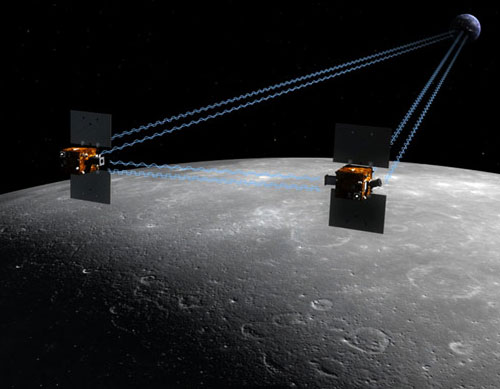
The Gravity Recovery and Interior Laboratory, or GRAIL, mission is a part of NASA's Discovery Program. It will cost $375 million and is scheduled to launch in 2011. GRAIL will fly twin spacecraft in tandem orbits around the moon for several months to measure its gravity field in unprecedented detail. The mission also will answer longstanding questions about Earth's moon and provide scientists a better understanding of how Earth and other rocky planets in the solar system formed.
"GRAIL's revolutionary capabilities stood out in this Discovery mission competition owing to its unsurpassed combination of high scientific value and low technical and programmatic risk," Stern said. "GRAIL also offers to bring innovative Earth studies techniques to the moon as a precursor to their possible later use at Mars and other planets."
Scientists will use the gravity field information from the two satellites to X-ray the moon from crust to core to reveal the moon's subsurface structures and, indirectly, its thermal history.
The study technique GRAIL will use was pioneered by the joint U.S.-German Earth observing Gravity Recovery and Climate Experiment, or GRACE, mission launched in 2002. The GRACE satellites measure gravity changes related to the movement of mass within the Earth, such as the melting of ice at the poles and changes in ocean circulation. As with GRACE, both GRAIL spacecraft will be launched on a single launch vehicle.
GRAIL's principal investigator is Maria Zuber of the Massachusetts Institute of Technology. Zuber's team of expert scientists and engineers includes former NASA astronaut Sally Ride, who will lead the mission's public outreach efforts. A camera aboard each spacecraft will allow students and the public to interact with observations from the satellites. Each GRAIL spacecraft will carry the cameras to documents their views from lunar orbits.
GRAIL will support NASA's exploration goals as the agency returns humans to the moon by 2020. In 2008, the agency will launch the Lunar Reconnaissance Orbiter, or LRO, to circle the moon for at least a year and take measurements to identify future robotic and human landing sites. The orbiter also will look for potential lunar resources and document aspects of the lunar radiation environment. After a 30-year hiatus, LRO represents NASA's first step toward returning humans to the moon. The orbiter will be accompanied by another spacecraft, called the Lunar Crater Observation and Sensing Satellite mission, which will impact the lunar south pole to search for evidence of polar water frost.
"As NASA moves forward with exploration endeavors, our lunar science missions will be the light buoy leading the path for future human activities," said Jim Green, director of the Planetary Division, Science Mission Directorate, Washington.
Created in 1992, NASA's Discovery Program sponsors a series of scientist-led, cost-capped solar system exploration missions with highly focused scientific goals. The GRAIL proposal was selected from 24 submissions in response to a 2006 Announcement of Opportunity for the program. Proposals were evaluated for scientific merit, science implementation merit, and technical, management and cost feasibility.
NASA's Jet Propulsion Laboratory, Pasadena, Calif., will manage the GRAIL mission. The spacecraft will be built by Lockheed Martin Space Systems, Denver.
Of possible special interest to collectSPACE readers, as noted in the preceding NASA release, Sally Ride will lead this mission's public outreach efforts.
Robert Pearlman Editor
Posts: 42988 From: Houston, TX Registered: Nov 1999
Sally Ride Science to Lead Education Efforts for Grail Mission around the Moon
Sally Ride Science is part of a new NASA mission that will peer deep inside the moon to reveal its anatomy and history — and share its findings with students. The Gravity Recovery and Interior Laboratory, or Grail, mission is a part of NASA's Discovery Program. Sally Ride Science, founded by Dr. Sally Ride, America's first woman in space, will lead the mission's education efforts.
Grail will fly twin spacecraft in tandem orbits around the moon for several months to measure its gravity field in unprecedented detail. Scientists will use the information from the two satellites to study the moon from crust to core to reveal its subsurface structures and, indirectly, its thermal history. The mission will answer longstanding questions about Earth's moon and provide scientists a better understanding of how Earth and other rocky planets in the solar system formed.
Cameras aboard each spacecraft will be dedicated to education — allowing students to photograph the moon from lunar orbit.
According to Ride, Grail will leverage the EarthKAM control center at the University of California, San Diego, where undergraduates will develop the software and procedures to run cameras on the Grail spacecraft. The cameras will be used by middle school students to study the moon from their classrooms.
In addition, as part of the education program, Sally Ride Science will develop workshops about the moon to feature at its science festivals for fifth through eighth grade students. Sally Ride Science will also develop Educator Institutes to train teachers in science activities related to the moon and gravity.
On the Grail mission, Ride will be part of a team of expert scientists and engineers led by Dr. Maria Zuber, of the Massachusetts Institute of Technology, who will serve as Grail's principal investigator. The Grail proposal was selected from 24 submissions in response to a 2006 Announcement of Opportunity for NASA's Discovery Program. The Grail mission will cost $375 million and is scheduled to launch in 2011.
Robert Pearlman Editor
Posts: 42988 From: Houston, TX Registered: Nov 1999
posted 05-24-2011 11:18 AM
NASA Kennedy Space Center release
NASA's Twin Craft Arrive In Florida For Moon Mission
NASA's twin lunar probes have arrived in Florida to begin final preparations for a launch in late summer. The two Gravity Recovery And Interior Laboratory spacecraft (GRAIL) were shipped from Lockheed Martin Space Systems, Denver, to the Astrotech payload processing facility in Titusville, Fla., Friday, May 20. NASA's dynamic duo will orbit the moon to determine the structure of the lunar interior from crust to core and to advance understanding of the thermal evolution of the moon.
"NASA's lunar twins have arrived at Cape Canaveral," said Maria Zuber, GRAIL's principal investigator, based at the Massachusetts Institute of Technology, in Cambridge. "We're only a few full moons away from a mission that will reveal clues not only into the history of the moon and Earth, but will provide important data for future lunar exploration."
The GRAIL twins, known as GRAIL-A and GRAIL-B, were removed from their shipping containers Monday, May 23. Later this week, they will begin functional testing to verify their state of health after their ride on an Air Force transport jet from Colorado. Over the next four months at the Astrotech facility, the spacecraft will undergo final testing, fueling and packaging in the shroud that will protect them as the Delta II launch vehicle lifts them into space. The spacecraft will then be transported to the Cape Canaveral Air Force Station for installation atop the rocket that will carry them toward the moon.
GRAIL will be carried into space aboard a United Launch Alliance Delta II Heavy rocket lifting off from Launch Complex-19 at the Cape Canaveral Air Force Station in Florida. The launch period opens Sept. 8, 2011, and extends through Oct. 19. For a Sept. 8 liftoff, the launch window opens at 8:37 a.m. EDT (5:37 a.m. PDT) and remains open through 9:16 a.m. EDT (6:16 a.m. PDT).
GRAIL-A and GRAIL-B will fly in tandem orbits around the moon for several months to measure its gravity field in unprecedented detail. The mission will also answer longstanding questions about Earth's moon, and provide scientists a better understanding of how Earth and other rocky planets in the solar system formed.
NASA's Jet Propulsion Laboratory, Pasadena, Calif., manages the GRAIL mission. The Massachusetts Institute of Technology, Cambridge, is home to the mission's principal investigator, Maria Zuber. The GRAIL mission is part of the Discovery Program managed at NASA's Marshall Space Flight Center in Huntsville, Ala. Lockheed Martin Space Systems, Denver, built the spacecraft. Launch management for the mission is the responsibility of NASA's Launch Services Program at the Kennedy Space Center in Florida. JPL is a division of the California Institute of Technology in Pasadena.
Robert Pearlman Editor
Posts: 42988 From: Houston, TX Registered: Nov 1999
posted 08-11-2011 07:57 AM
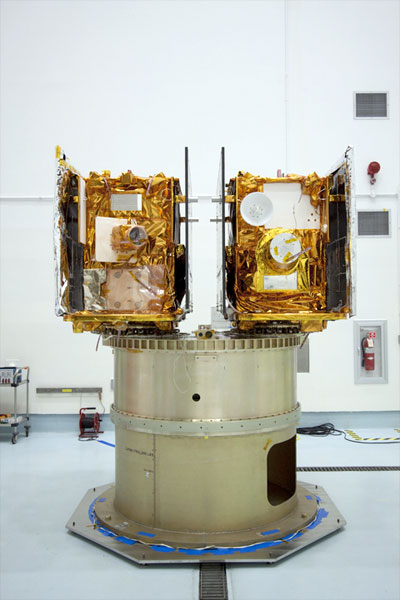
NASA's twin Gravity Recovery and Interior Laboratory (GRAIL) lunar spacecraft were attached on Aug. 10, 2011, to the spacecraft adapter ring in their launch configuration in Astrotech Space Operation's payload processing facility in Titusville, Fla. Preparations are under way to transport the lunar probes to the launch pad.
GRAIL will fly in tandem orbits around the moon for several months to measure its gravity field. GRAIL's primary science objectives are to determine the structure of the lunar interior, from crust to core, and to advance understanding of the thermal evolution of the moon.
Launch aboard a United Launch Alliance Delta II rocket from Space Launch Complex 17B at the Cape Canaveral Air Force Station is scheduled for Sept. 8.
Credit: NASA/Jim Grossmann
Robert Pearlman Editor
Posts: 42988 From: Houston, TX Registered: Nov 1999
posted 08-18-2011 03:51 PM
NASA Jet Propulsion Laboratory release
NASA's GRAIL Moon Twins are Joined to Their Booster
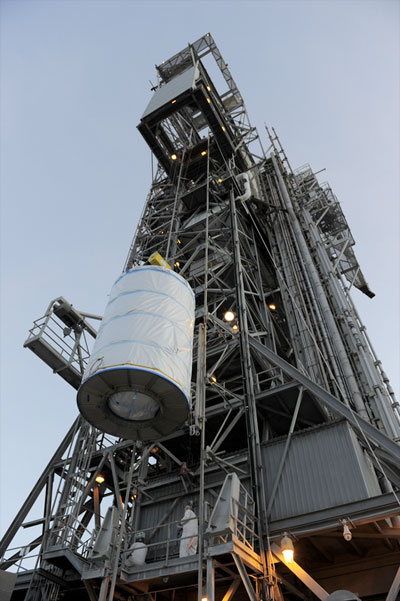
NASA's lunar-bound GRAIL twins were mated to their Delta II launch vehicle at the Cape Canaveral Air Force Station's Launch Complex 17 at 8:45 a.m. EDT (5:45 a.m. PDT) today.
The 15-mile (25-kilometer) trip from Astrotech Space Operations in Titusville, Fla., is the last move for GRAIL before it begins its journey to the moon. NASA's dynamic duo will orbit the moon to determine the structure of the lunar interior from crust to core and to advance understanding of the thermal evolution of the moon.
Credit: NASA/Kim Shiflett
"We are about to finish one chapter in the GRAIL story and open another," said Maria Zuber, GRAIL's principal investigator, based at the Massachusetts Institute of Technology in Cambridge. "Let me assure you this one is a real page-turner. GRAIL will rewrite the book on the formation of the moon and the beginning of us."
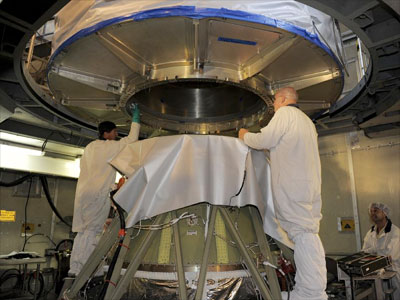
Now that the GRAIL spacecraft are atop their rocket, a final flurry of checks and tests can begin to confirm that all is go for launch. The final series of checks begins tomorrow, Aug. 19, with an on-pad functional test. The test is designed to confirm that the spacecraft is healthy after the fueling and transport operations. Next week, among all the upcoming final tests, reviews and closeout operations leading up to liftoff, the GRAIL team will install the launch vehicle fairing around the spacecraft.
Credit: NASA/Kim Shiflett
GRAIL's launch period opens Sept. 8 and extends through Oct. 19. On each day, there are two separate instantaneous launch opportunities separated in time by approximately 39 minutes. On Sept. 8, the first launch opportunity is at 8:37 a.m. EDT (5:37 a.m. PDT). The second launch opportunity is 9:16 a.m. EDT (6:16 a.m. PDT).
Robert Pearlman Editor
Posts: 42988 From: Houston, TX Registered: Nov 1999
posted 08-25-2011 10:29 AM
NASA Jet Propulsion Laboratory release
NASA Moon Mission In Final Preparations For September Launch
NASA's Gravity Recovery And Interior Laboratory (GRAIL), mission to study the moon is in final launch preparations for a scheduled Sept. 8 launch onboard a Delta II rocket from Cape Canaveral Air Force Station in Florida.
GRAIL's twin spacecraft are tasked for a nine-month mission to explore Earth's nearest neighbor in unprecedented detail. They will determine the structure of the lunar interior from crust to core and advance our understanding of the thermal evolution of the moon.
"Yesterday's final encapsulation of the spacecraft is an important mission milestone," said David Lehman, GRAIL project manager for NASA's Jet Propulsion Laboratory in Pasadena, Calif. "Our two spacecraft are now sitting comfortably inside the payload fairing which will protect them during ascent. Next time the GRAIL twins will see the light of day they will be about 95 miles up and accelerating."
The spacecraft twins, GRAIL A and B, will fly a circuitous route to lunar orbit taking 3.5 months and covering approximately 2.6 million miles (4.2 million kilometers) for GRAIL-A, and 2.7 million miles (4.3 million kilometers) for GRAIL-B.
In lunar orbit, the spacecraft will transmit radio signals precisely defining the distance between them. Regional gravitational differences on the moon are expected to expand and contract that distance. GRAIL scientists will use these accurate measurements to define the moon's gravity field. The data will allow mission scientists to understand what goes on below the surface of our natural satellite.
"GRAIL will unlock lunar mysteries and help us understand how the moon, Earth and other rocky planets evolved as well," said Maria Zuber, GRAIL principal investigator from the Massachusetts Institute of Technology in Cambridge.
GRAIL's launch period opens Sept. 8 and extends through Oct. 19. On each day, there are two separate launch opportunities separated by approximately 39 minutes. On Sept. 8, the first launch opportunity is 8:37 a.m. EDT; the second is 9:16 a.m.
Robert Pearlman Editor
Posts: 42988 From: Houston, TX Registered: Nov 1999
posted 09-08-2011 05:59 AM
GRAIL poised for launch
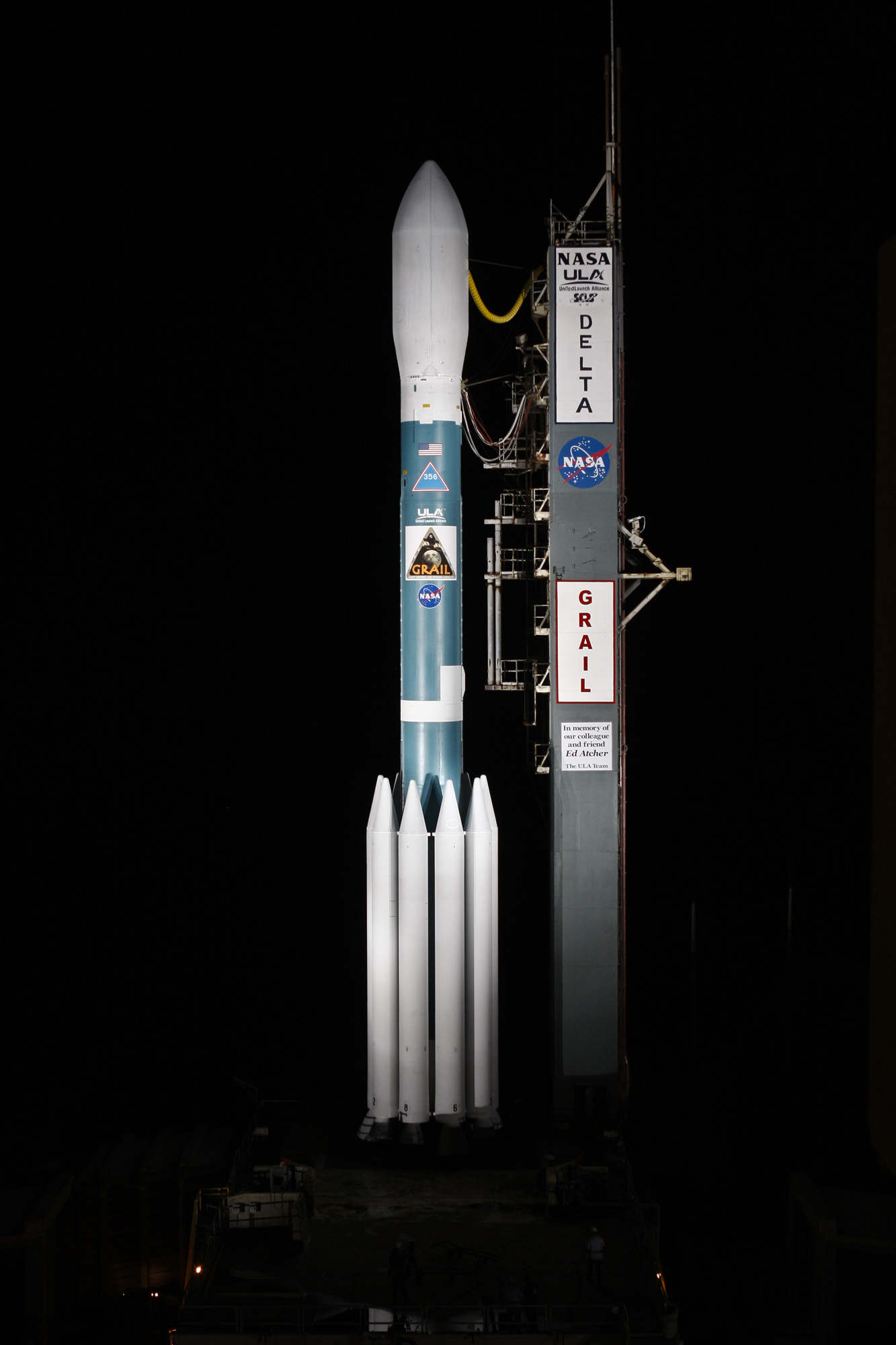
The mobile service tower on Space Launch Complex 17B at the Cape Canaveral Air Force Station in Florida was rolled away from the United Launch Alliance Delta II heavy rocket starting at about 11:20 p.m. EDT Wednesday in preparation for Thursday's scheduled launch of NASA's GRAIL lunar mapping mission.
GRAIL remains on track for two instantaneous (one-second) launch windows at 8:37:06 a.m. (12:37:36 GMT) or if needed, 9:16:12 a.m. (13:16:12 GMT).
The Delta II's first stage has been loaded with almost 10,000 gallons of refined kerosene, known as RP-1. Liquid oxygen is now being loaded.
Forecasts call for a 40 percent chance of acceptable weather at liftoff time. The concern is the possibility of thick clouds and rain near Launch Complex 17B.
During the 6:30 a.m. weather briefing to the launch team, clouds had not thickened so far, so there is some optimism that conditions will allow a launch.
If not, the same conditions will persist on Friday, with an improving weather picture for the weekend.
Credit: United Launch Alliance/Thom Baur
Above: Delta II-GRAIL rocket as seen just after the Mobile Service Tower was moved back from the vehicle.
Robert Pearlman Editor
Posts: 42988 From: Houston, TX Registered: Nov 1999
posted 09-08-2011 08:13 AM
Winds postpone GRAIL launch to Friday
Upper level winds above Launch Complex 17B at Cape Canaveral Air Force Station exceeded acceptable limits to launch NASA's GRAIL mission to the moon during the first of two launch opportunities on Thursday.
Liftoff has been re-targeted for Friday, Sept. 9.
GRAIL's launch period opened today (Sept. 8) and extends through Oct. 19. On each day, there are two separate instantaneous launch opportunities separated in time by approximately 39 minutes.
On Friday, Sept. 9, the first launch opportunity is at 8:33:25 a.m. EDT (12:33:25 GMT). The second launch opportunity is 9:12:31 a.m. EDT (13:12:31 a.m. PDT).
Robert Pearlman Editor
Posts: 42988 From: Houston, TX Registered: Nov 1999
posted 09-08-2011 10:22 PM
GRAIL launch further delayed to Saturday
The launch of a Delta II rocket carrying NASA's Gravity Recovery and Interior Laboratory (GRAIL) has been postponed one day to allow additional time to review propulsion system data from Thursday's detanking operation after the launch attempt was scrubbed due to upper level winds. The postponement will allow the launch team additional time to review the data.
The launch now is planned for Saturday, Sept. 10 from Space Launch Complex-17B at the Cape Canaveral Air Force Station, Fla. There are two instantaneous launch opportunities at 8:29:45 a.m. EDT (12:29:45 GMT) and 9:08:52 a.m. EDT (13:08:52 GMT).
The forecast for Sept. 10 shows a 60 percent chance of favorable weather conditions for a Saturday morning launch.
Robert Pearlman Editor
Posts: 42988 From: Houston, TX Registered: Nov 1999
posted 09-10-2011 05:24 AM
GRAIL set for Saturday moonshot
NASA's twin GRAIL spacecraft are scheduled to begin their mission to the moon by lifting off today (Sept. 10) from Cape Canaveral Air Force Station's Launch Complex 17B atop a United Launch Alliance Delta II heavy rocket.
There are two instantaneous launch opportunities at 8:29:45 a.m. EDT (12:29:45 GMT) and 9:08:52 a.m. EDT (13:08:52 GMT). The forecast shows a 60 percent chance of favorable weather conditions at liftoff time, with the primary concern being thick clouds and a chance for isolated showers.
Friday the launch team concluded its review of propulsion system data from Thursday's Delta II detanking operations and confirmed there are no issues with the rocket. Unacceptably high upper level winds on Thursday morning scrubbed the first launch attempt for the mission.
Robert Pearlman Editor
Posts: 42988 From: Houston, TX Registered: Nov 1999
posted 09-10-2011 07:26 AM
Winds delay GRAIL launch to second window
High upper level winds at Complex 17B at Cape Canaveral Air Force Station have again delayed the launch of NASA's GRAIL mission to the moon.
Liftoff has been re-targeted for the second instantaneous window of the day, at 9:08:52 a.m. EDT (13:08:52 GMT).
Robert Pearlman Editor
Posts: 42988 From: Houston, TX Registered: Nov 1999
posted 09-10-2011 08:09 AM
GRAIL launches on journey to center of the moon
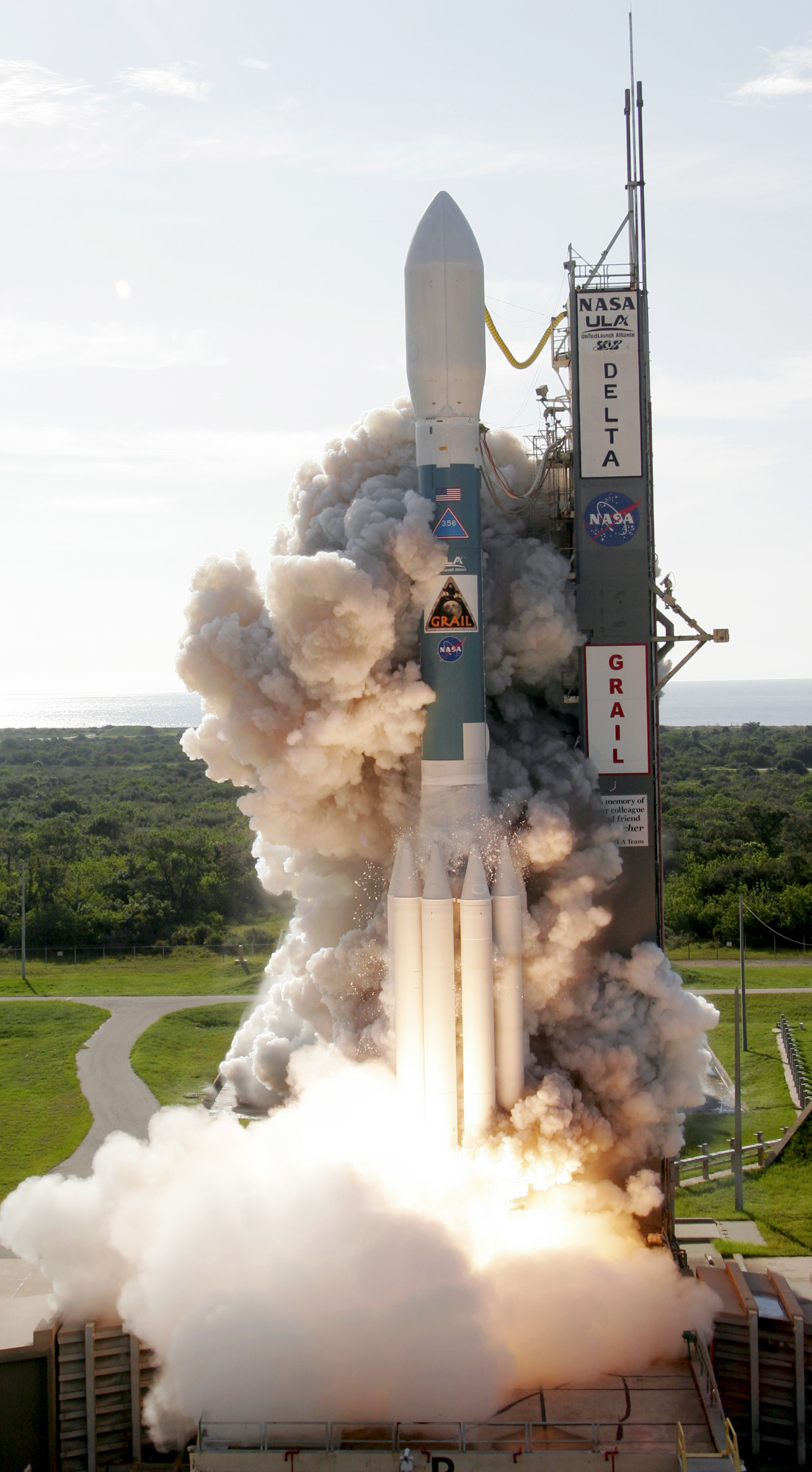
NASA's Gravity Recovery And Interior Laboratory, or GRAIL, mission to study the moon launched on board a Delta II heavy rocket from the Cape Canaveral Air Force Station's Launch Complex 17B in Florida at 9:08:52 a.m. EDT (13:08:52 GMT) on Saturday, Sept. 10, 2011.
"We are on our way, and early indications show everything is looking good," said David Lehman, GRAIL project manager at NASA's Jet Propulsion Laboratory (JPL) in Pasadena, Calif. "We will know more about GRAIL's status in a few hours, after an opportunity to analyze telemetry and poll our mission controllers."
GRAIL's twin spacecraft have embarked on a nine-month mission to explore Earth's nearest neighbor in unprecedented detail. They will determine the structure of the lunar interior from crust to core and advance our understanding of the thermal evolution of the moon.
The spacecraft twins, GRAIL A and B, will fly a circuitous route to lunar orbit taking 3.5 months and covering approximately 2.6 million miles (4.2 million kilometers) for GRAIL-A, and 2.7 million miles (4.3 million kilometers) for GRAIL-B. GRAIL-A is scheduled to arrive at the moon on New Year's Eve. GRAIL-B will follow its twin a day later on New Year's Day.
In lunar orbit, the two spacecraft will transmit radio signals precisely defining the distance between them. Gravitational differences on the moon are expected to expand and contract that distance. GRAIL team members will use these accurate measurements to define the moon's gravity field. The data will allow scientists to understand what goes on below the surface of our natural satellite.
GRAIL's launch marked the last scheduled liftoff of a United Launch Alliance (ULA) Delta II from Cape Canaveral after 22 years and 110 launches.
Robert Pearlman Editor
Posts: 42988 From: Houston, TX Registered: Nov 1999
posted 09-10-2011 10:17 AM
United Launch Alliance release
United Launch Alliance Successfully Launches GRAIL Moon Mission for NASA on Final Flight from Space Launch Complex 17
A United Launch Alliance (ULA) Delta II rocket carrying the Gravity Recovery and Interior Laboratory (GRAIL) spacecraft for NASA lifted off from Space Launch Complex (SLC)-17B here at 9:08 a.m. EDT today. This launch marks the 9th flight for ULA in 2011, the 49th Delta II mission for NASA and the last currently-planned flight from this launch complex.
"With the final launch from SLC-17, we reflect on the tremendous historical significance of this complex and the impact of the military and scientific payloads that began their missions from this site," said Michael Gass, ULA president and CEO. "From the Global Positioning System satellites launched for the U.S. Air Force, to NASA's Mars rovers Spirit and Opportunity, in total this complex has been the origin for 259 critical Delta missions to protect our country and explore our universe."
The GRAIL mission was launched aboard a Delta II Heavy 7920H-10 configuration vehicle featuring a ULA first stage booster powered by a Pratt & Whitney Rocketdyne RS-27A main engine and nine Alliant Techsystems (ATK) strap-on solid rocket motors. An Aerojet AJ10-118K engine powered the second stage. The payload was encased by a 10-foot-diameter composite payload fairing.
"ULA is extremely proud to be a part of NASA's team for the GRAIL mission and we sincerely congratulate all of our mission partners," said Jim Sponnick, ULA vice president, Mission Operations. "Today's successful launch is the third NASA mission ULA has launched in just three months with two more to come in October and November. The timing and precision of this campaign along with a one-launch-at-a-time focus are testaments to our commitment to providing reliable and cost-effective space launch services to our customers."
Credit: United Launch Alliance/Thom Baur
Robert Pearlman Editor
Posts: 42988 From: Houston, TX Registered: Nov 1999
posted 09-10-2011 10:56 AM
GRAIL spacecraft on their way to the moon
Both GRAIL spacecraft, A and B — to be named through a contest to start soon — separated on schedule from the second stage of their Delta II rocket and are now flying to the moon.
All systems are working as expected. It will take the two spacecraft until New Year's Eve and New Year's Day to reach the moon.
The naming contest, which will be open to all U.S. schools, will begin accepting essay submissions Oct. 14 through Nov. 11.
Robert Pearlman Editor
Posts: 42988 From: Houston, TX Registered: Nov 1999
posted 10-03-2011 05:06 PM
NASA release
NASA Invites Students To Name Moon-Bound Spacecraft
NASA has a class assignment for U.S. students: help the agency give the twin spacecraft headed to orbit around the moon new names.
The naming contest is open to students in kindergarten through 12th grade at schools in the United States. Entries must be submitted by teachers using an online entry form. Length of submissions can range from a short paragraph to a 500-word essay. The entry deadline is Nov. 11.
NASA's solar-powered Gravity Recovery And Interior Laboratory (GRAIL)-A and GRAIL-B spacecraft lifted off from Cape Canaveral Air Force Station, Fla. on Sept. 10 to begin a three-and-a-half-month journey to the moon. GRAIL will create a gravity map of the moon using two spacecraft that orbit at very precise distances. The mission will enable scientists to learn about the moon's internal structure and composition, and give scientists a better understanding of its origin. Accurate knowledge of the moon's gravity also could be used to help choose future landing sites.
"A NASA mission to the moon is one of the reasons why I am a scientist today," said GRAIL Principal Investigator Maria Zuber from the Massachusetts Institute of Technology (MIT) in Cambridge. "My hope is that GRAIL motivates young people today towards careers in science, math and technology. Getting involved with naming our two GRAIL spacecraft could inspire their interest not only in space exploration but in the sciences, and that's a good thing."
Zuber and former astronaut Sally Ride of Sally Ride Science in San Diego will chair the final round of judging. Sally Ride Science is the lead for GRAIL's MoonKAM program, which enables students to task cameras aboard the two GRAIL spacecraft to take close-up views of the lunar surface.
Robert Pearlman Editor
Posts: 42988 From: Houston, TX Registered: Nov 1999
posted 10-06-2011 06:04 PM
NASA release
NASA's Moon Twins Going Their Own Way
NASA's Gravity Recovery And Interior Laboratory (GRAIL)-B spacecraft successfully executed its first flight path correction maneuver Wednesday, Oct. 5. The rocket burn helped refine the spacecraft's trajectory as it travels from Earth to the moon and provides separation between itself and its mirror twin, GRAIL-A. The first burn for GRAIL-A occurred on Sept. 30.
"Both spacecraft are alive and with these burns, prove that they're kicking too, as expected," said David Lehman, GRAIL project manager at NASA's Jet Propulsion Laboratory in Pasadena, Calif. "There is a lot of time and space between now and lunar orbit insertion, but everything is looking good."
GRAIL-B's rocket burn took place on Oct. 5 at 11 a.m. PDT (2 p.m. EDT). The spacecraft's main engine burned for 234 seconds and imparted a velocity change of 56.1 mph (25.1 meters per second) while expending 8.2 pounds (3.7 kilograms) of propellant. GRAIL-A's burn on Sept. 30 also took place at 11 a.m. PDT. It lasted 127 seconds and imparted a 31.3 mph (14 meters per second) velocity change on the spacecraft while expending 4 pounds (1.87 kilograms) of propellant.
These burns are designed to begin distancing GRAIL-A and GRAIL-B's arrival times at the moon by approximately one day and to insert them onto the desired lunar approach paths.
The straight-line distance from Earth to the moon is about 250,000 miles (402,336 kilometers). It took NASA's Apollo moon crews about three days to cover that distance. Each of the GRAIL twins is taking about 30 times that long and covering more than 2.5 million miles (4 million kilometers) to get there. This low-energy, high-cruise time trajectory is beneficial for mission planners and controllers, as it allows more time for spacecraft checkout. The path also provides a vital component of the spacecraft's single science instrument, the Ultra Stable Oscillator, to be continuously powered for several months, allowing it to reach a stable operating temperature long before beginning the collection of science measurements in lunar orbit.
GRAIL-A will enter lunar orbit on New Year's Eve, and GRAIL-B will follow the next day. When science collection begins, the spacecraft will transmit radio signals precisely defining the distance between them as they orbit the moon. Regional gravitational differences on the moon are expected to expand and contract that distance. GRAIL scientists will use these accurate measurements to define the moon's gravity field. The data will allow mission scientists to understand what goes on below the surface of our natural satellite.
Robert Pearlman Editor
Posts: 42988 From: Houston, TX Registered: Nov 1999
posted 12-28-2011 01:50 PM
NASA release
NASA twin spacecraft on final approach for moon orbit
NASA's twin spacecraft to study the moon from crust to core are nearing their New Year's Eve and New Year's Day main-engine burns to place the duo in lunar orbit.
Named Gravity Recovery And Interior Laboratory (GRAIL), the spacecraft are scheduled to be placed in orbit beginning at 1:21 p.m. PST (4:21 p.m. EST) for GRAIL-A on Dec. 31, and 2:05 p.m. PST (5:05 p.m. EST) on Jan. 1 for GRAIL-B.
"Our team may not get to partake in a traditional New Year's celebration, but I expect seeing our two spacecraft safely in lunar orbit should give us all the excitement and feeling of euphoria anyone in this line of work would ever need," said David Lehman, project manager for GRAIL at NASA's Jet Propulsion Laboratory (JPL) in Pasadena, Calif.
The distance from Earth to the moon is approximately 250,000 miles (402,336 kilometers). NASA's Apollo crews took about three days to travel to the moon. Launched from Cape Canaveral Air Force Station Sept. 10, 2011, the GRAIL spacecraft are taking about 30 times that long and covering more than 2.5 million miles (4 million kilometers) to get there.
This low-energy, long-duration trajectory has given mission planners and controllers more time to assess the spacecraft's health. The path also allowed a vital component of the spacecraft's single science instrument, the Ultra Stable Oscillator, to be continuously powered for several months. This will allow it to reach a stable operating temperature long before it begins making science measurements in lunar orbit.
"This mission will rewrite the textbooks on the evolution of the moon," Maria Zuber, GRAIL principal investigator from the Massachusetts Institute of Technology (MIT) in Cambridge, said. "Our two spacecraft are operating so well during their journey that we have performed a full test of our science instrument and confirmed the performance required to meet our science objectives."
As of Dec. 28, GRAIL-A is 65,860 miles (106,000 kilometers) from the moon and closing at a speed of 745 mph (1,200 kph). GRAIL-B is 79,540 miles (128,000 kilometers) from the moon and closing at a speed of 763 mph (1,228 kph).
During their final approaches to the moon, both orbiters move toward it from the south, flying nearly over the lunar south pole. The lunar orbit insertion burn for GRAIL-A will take approximately 40 minutes and change the spacecraft's velocity by about 427 mph (688 kph). GRAIL-B's insertion burn 25 hours later will last about 39 minutes and is expected to change the probe's velocity by 430 mph (691 kph).
The insertion maneuvers will place each orbiter into a near-polar, elliptical orbit with a period of 11.5 hours. Over the following weeks, the GRAIL team will execute a series of burns with each spacecraft to reduce their orbital period from 11.5 hours down to just under two hours. At the start of the science phase in March 2012, the two GRAILs will be in a near-polar, near-circular orbit with an altitude of about 34 miles (55 kilometers).
When science collection begins, the spacecraft will transmit radio signals precisely defining the distance between them as they orbit the moon. As they fly over areas of greater and lesser gravity, caused both by visible features such as mountains and craters and by masses hidden beneath the lunar surface. they will move slightly toward and away from each other. An instrument aboard each spacecraft will measure the changes in their relative velocity very precisely, and scientists will translate this information into a high-resolution map of the Moon's gravitational field. The data will allow mission scientists to understand what goes on below the surface. This information will increase our knowledge of how Earth and its rocky neighbors in the inner solar system developed into the diverse worlds we see today.
JPL manages the GRAIL mission. MIT is home to the mission's principal investigator, Maria Zuber. The GRAIL mission is part of the Discovery Program managed at NASA's Marshall Space Flight Center in Huntsville, Ala. Lockheed Martin Space Systems in Denver built the spacecraft.
Robert Pearlman Editor
Posts: 42988 From: Houston, TX Registered: Nov 1999
posted 12-31-2011 04:51 PM
NASA's GRAIL-A in orbit around the moon
The first of NASA's two Gravity Recovery And Interior Laboratory (GRAIL) spacecraft, GRAIL-A, entered lunar orbit on New Year's Eve (Dec. 31, 2011), a day ahead of its twin.
"Pop the bubbly and toast the moon! NASA's GRAIL-A spacecraft is in lunar orbit," the agency's Jet Propulsion Laboratory (JPL) wrote on Twitter.
GRAIL-A fired its main thruster at 3:21 p.m. CST (2121 GMT) for 40 minutes, slowing its approach by 427 miles per hour (687 kilometers per hour). Engine cutoff and lunar orbit insertion was confirmed at 4:01 p.m. CST (2201 GMT).
"Burn complete! GRAIL-A is now orbiting the moon and awaiting the arrival of its twin GRAIL-B on New Year's Day," wrote JPL.
Launched aboard the same rocket on Sept. 10, 2011, GRAIL-A's mirror twin, GRAIL-B, is also closing the gap between itself and the moon. GRAIL-B is scheduled to perform its lunar orbit insertion burn on New Year's Day (Jan. 1, 2012) at 4:05 p.m. CST (2205 GMT).
As it will for GRAIL-B, GRAIL-A's insertion maneuver placed it into a near-polar, elliptical orbit with an orbital period of 11.5 hours. Over the following weeks, flight controllers will execute a series of burns with each spacecraft to reduce their period down to just under two hours.
At the start of the science phase in March 2012, the two GRAILs will be in a near-polar, near-circular orbit with an altitude of about 34 miles (55 kilometers).
When science collection begins, the spacecraft will transmit radio signals precisely defining the distance between them as they orbit the moon in formation. Regional gravitational differences on the moon are expected to expand and contract that distance. Scientists will use these accurate measurements to define the moon's gravity field.
The data will allow mission scientists to understand what goes on below the surface of the moon, providing more information about how it, the Earth and other terrestrial planets formed.
Robert Pearlman Editor
Posts: 42988 From: Houston, TX Registered: Nov 1999
posted 01-01-2012 05:47 PM
NASA's twin GRAIL spacecraft reunite in lunar orbit
The second of NASA's two Gravity Recovery And Interior Laboratory (GRAIL) spacecraft has successfully completed its planned main engine burn and is now in lunar orbit. Working together, GRAIL-A and GRAIL-B will study the moon as never before.
"NASA greets the new year with a new mission of exploration," said NASA Administrator Charles Bolden. "The twin GRAIL spacecraft will vastly expand our knowledge of our moon and the evolution of our own planet. We begin this year reminding people around the world that NASA does big, bold things in order to reach for new heights and reveal the unknown."
GRAIL-B achieved lunar orbit at 4:44 p.m. CST (2244 GMT) on New Year's Day (Jan. 1, 2012). GRAIL-A successfully completed its burn the day before, Dec. 31, 2011, at 4:01 p.m. CST (2201 GMT). The insertion maneuvers placed the spacecraft into a near-polar, elliptical orbit with an orbital period of approximately 11.5 hours.
Over the coming weeks, the GRAIL team will execute a series of burns with each spacecraft to reduce their orbital period to just under two hours. At the start of the science phase in March 2012, the two GRAILs will be in a near-polar, near-circular orbit with an altitude of about 34 miles (55 kilometers).
During GRAIL's science mission, the two spacecraft will transmit radio signals precisely defining the distance between them. As they fly over areas of greater and lesser gravity caused by visible features such as mountains and craters, and masses hidden beneath the lunar surface, the distance between the two spacecraft will change slightly.
Scientists will translate this information into a high-resolution map of the moon's gravitational field. The data will allow them to understand what goes on below the lunar surface. This information will increase knowledge of how Earth and its rocky neighbors in the inner solar system developed into the diverse worlds we see today.
Each spacecraft carries a small camera called GRAIL MoonKAM (Moon Knowledge Acquired by Middle school students) with the sole purpose of education and public outreach. The MoonKAM program is led by Sally Ride, America's first woman in space, and her team at Sally Ride Science in collaboration with undergraduate students at the University of California in San Diego.
GRAIL MoonKAM will engage middle schools across the country in the GRAIL mission and lunar exploration. Thousands of fifth- to eighth-grade students will select target areas on the lunar surface and send requests to the GRAIL MoonKAM Mission Operations Center in San Diego. Photos of the target areas will be sent back by the GRAIL satellites for students to study.
A student contest that began in October 2011 chose new names for the spacecraft, which are scheduled to be announced this month. Ride and Maria Zuber, the mission's principal investigator at the Massachusetts Institute of Technology (MIT), chaired the final round of judging.
Robert Pearlman Editor
Posts: 42988 From: Houston, TX Registered: Nov 1999
posted 02-01-2012 04:36 PM
NASA Mission Returns First Video From Moon's Far Side
A camera aboard one of NASA's twin Gravity Recovery And Interior Laboratory (GRAIL) lunar spacecraft has returned its first unique view of the far side of the moon. MoonKAM, or Moon Knowledge Acquired by Middle school students, will be used by students nationwide to select lunar images for study.
GRAIL consists of two identical spacecraft, recently named Ebb and Flow, each of which is equipped with a MoonKAM. The images were taken as part of a test of Ebb's MoonKAM on Jan. 19. The GRAIL project plans to test the MoonKAM aboard Flow at a later date.
In the video, the north pole of the moon is visible at the top of the screen as the spacecraft flies toward the lunar south pole. One of the first prominent geological features seen on the lower third of the moon is the Mare Orientale, a 560-mile-wide (900 kilometer) impact basin that straddles both the moon's near and far side.
The clip ends with rugged terrain just short of the lunar south pole. To the left of center, near the bottom of the screen, is the 93-mile-wide (149 kilometer) Drygalski crater with a distinctive star-shaped formation in the middle. The formation is a central peak, created many billions of years ago by a comet or asteroid impact.
"The quality of the video is excellent and should energize our MoonKAM students as they prepare to explore the moon," said Maria Zuber, GRAIL principal investigator from the Massachusetts Institute of Technology in Cambridge.
The twin spacecraft successfully achieved lunar orbit this past New Year's Eve and New Year's Day. Previously named GRAIL-A and GRAIL-B, the washing machine-sized spacecraft received their new names from fourth graders at the Emily Dickinson Elementary School in Bozeman, Mont., following a nationwide student naming contest.
Thousands of fourth- to eighth-grade students will select target areas on the lunar surface and send requests to the GRAIL MoonKAM Mission Operations Center in San Diego. Photos of the target areas will be sent back by the satellites for students to study. The MoonKAM program is led by Sally Ride, America's first woman in space. Her team at Sally Ride Science and undergraduate students at the University of California in San Diego will engage middle schools across the country in the GRAIL mission and lunar exploration. GRAIL is NASA's first planetary mission carrying instruments fully dedicated to education and public outreach.
"We have had great response from schools around the country; more than 2,500 signed up to participate so far," Ride said. "In mid-March, the first pictures of the moon will be taken by students using MoonKAM. I expect this will excite many students about possible careers in science and engineering."
Launched in September 2011, Ebb and Flow periodically perform trajectory correction maneuvers that, over time, will lower their orbits to near-circular ones with an altitude of about 34 miles (55 kilometers). During their science mission, the duo will answer longstanding questions about the moon and give scientists a better understanding of how Earth and other rocky planets in the solar system formed.
Robert Pearlman Editor
Posts: 42988 From: Houston, TX Registered: Nov 1999
posted 03-08-2012 07:50 AM
NASA's Twin Grail Spacecraft Begin Collecting Lunar Science Data
NASA's Gravity Recovery And Interior Laboratory (GRAIL) spacecraft orbiting the moon officially have begun their science collection phase. During the next 84 days, scientists will obtain a high-resolution map of the lunar gravitational field to learn about the moon's internal structure and composition in unprecedented detail. The data also will provide a better understanding of how Earth and other rocky planets in the solar system formed and evolved.
"The initiation of science data collection is a time when the team lets out a collective sigh of relief because we are finally doing what we came to do," said Maria Zuber, principal investigator for the GRAIL mission at the Massachusetts Institute of Technology in Cambridge. "But it is also a time where we have to put the coffee pot on, roll up our sleeves and get to work."
The GRAIL mission's twin, washing-machine-sized spacecraft, named Ebb and Flow, entered lunar orbit on New Year's Eve and New Years Day. GRAIL's science phase began yesterday at 8:15 p.m. EST (5:15 p.m. PST). During this mission phase, the spacecraft will transmit radio signals precisely defining the distance between them. As they fly over areas of greater and lesser gravity caused by visible features such as mountains, craters and masses hidden beneath the lunar surface, the distance between the two spacecraft will change slightly. Science activities are expected to conclude on May 29, after GRAIL maps the gravity field of the moon three times.
"We are in a near-polar, near-circular orbit with an average altitude of about 34 miles (55 kilometers) right now," said David Lehman, GRAIL project manager from NASA's Jet Propulsion Laboratory (JPL) in Pasadena, Calif. "During the science phase, our spacecraft will orbit the moon as high as 31 miles (51 kilometers) and as low as 10 miles (16 kilometers). They will get as close to each other as 40 miles (65 kilometers) and as far apart as 140 miles (225 kilometers)."
Robert Pearlman Editor
Posts: 42988 From: Houston, TX Registered: Nov 1999
posted 03-22-2012 03:22 PM
NASA'S Grail MoonKam Returns First Student-Selected Lunar Images
One of two NASA spacecraft orbiting the moon has beamed back the first student-requested pictures of the lunar surface from its onboard camera. Fourth grade students from the Emily Dickinson Elementary School in Bozeman, Mont., received the honor of making the first image selections by winning a nationwide competition to rename the two spacecraft.
The image was taken by the MoonKam, or Moon Knowledge Acquired by Middle school students. Previously named Gravity Recovery And Interior Laboratory A and B, the twin spacecraft are now called Ebb and Flow. Both washing-machine-sized orbiters carry a small MoonKAM camera. Over 60 student-requested images were taken aboard the Ebb spacecraft from March 15-17 and downlinked to Earth on March 20.
"MoonKAM is based on the premise that if your average picture is worth a thousand words, then a picture from lunar orbit may be worth a classroom full of engineering and science degrees," said Maria Zuber, GRAIL mission principal investigator from the Massachusetts Institute of Technology in Cambridge, Mass. "Through MoonKAM, we have an opportunity to reach out to the next generation of scientists and engineers. It is great to see things off to such a positive start."
GRAIL is NASA's first planetary mission to carry instruments fully dedicated to education and public outreach. Students will select target areas on the lunar surface and request images to study from the GRAIL MoonKAM Mission Operations Center in San Diego.
The MoonKAM program is led by Sally Ride, America's first woman in space, and her team at Sally Ride Science in collaboration with undergraduate students at the University of California in San Diego. More than 2,700 schools spanning 52 countries are using the MoonKAM cameras.
"What might seem like just a cool activity for these kids may very well have a profound impact on their futures," Ride said. "The students really are excited about MoonKAM, and that translates into an excitement about science and engineering."
Launched in September 2011, Ebb and Flow will answer longstanding questions about the moon and give scientists a better understanding of how Earth and other rocky planets in the solar system formed.
Robert Pearlman Editor
Posts: 42988 From: Houston, TX Registered: Nov 1999
posted 05-29-2012 07:43 PM
NASA Lunar Spacecraft Complete Prime Mission Ahead of Schedule
A NASA mission to study the moon from crust to core has completed its prime mission earlier than expected. The team of NASA's Gravity Recovery and Interior Laboratory (GRAIL) mission, with twin probes named Ebb and Flow, is preparing for extended science operations starting Aug. 30 and continuing through Dec. 3, 2012.
The GRAIL mission has gathered unprecedented detail about the internal structure and evolution of the moon. This information will increase our knowledge of how Earth and its rocky neighbors in the inner solar system developed into the diverse worlds we see today.
Since March 8, the spacecraft have operated around the clock for 89 days. From an orbit that passes over the lunar poles, they have collected data covering the entire surface three times. An instrument called the Lunar Gravity Ranging System onboard each spacecraft transmits radio signals that allow scientists to translate the data into a high-resolution map of the moon's gravitational field. The spacecraft returned their last data set of the prime mission today. The instruments were turned off at 10 a.m. PDT (1 p.m. EDT) when the spacecraft were 37 miles (60 kilometers) above the Sea of Nectar.
"Many of the measurement objectives were achieved from analysis of only half the primary mission data, which speaks volumes about the skill and dedication of our science and engineering teams," said Maria Zuber, principal investigator of GRAIL at the Massachusetts Institute of Technology in Cambridge. "While there is a great deal of work yet to be done to achieve the mission's science, it's energizing to realize that what we traveled from Earth to the moon for is right here in our hands."
"GRAIL delivered to Earth over 99.99 percent of the data that could have been collected, which underscores the flawless performance of the spacecraft, instrument and the Deep Space Network," said Zuber.
Both spacecraft instruments will be powered off until Aug. 30. The spacecraft will have to endure a lunar eclipse on June 4. The eclipse and the associated sudden changes in temperature and the energy-sapping darkness that accompanies the phenomena were expected and do not concern engineers about the spacecraft's health.
"Before launch, we planned for all of GRAIL's primary mission science to occur between lunar eclipses," said David Lehman, project manager of GRAIL from NASA's Jet Propulsion Laboratory in Pasadena, Calif. "But now that we have flown Ebb and Flow for a while, we understand them and are confident they can survive these eclipses in good shape."
The extended mission goal is to take an even closer look at the moon's gravity field. To achieve this, GRAIL mission planners will halve their current operating altitude to the lowest altitude that can be safely maintained.
"Orbiting at an average altitude of 14 miles (23 kilometers) during the extended mission, the GRAIL twins will be clearing some of the moon's higher surface features by about 5 miles (8 kilometers)," said Joe Beerer of JPL, GRAIL's mission manager. "If Ebb and Flow had feet, I think by reflex they'd want to pull them up every time they fly over a mountain."
Along with mission science, GRAIL's MoonKAM (Moon Knowledge Acquired by Middle school students) education and public outreach program is also extended. To date over 70,000 student images of the moon have been obtained. The MoonKAM program is led by Sally Ride, America's first woman in space, and her team at Sally Ride Science in collaboration with undergraduate students at the University of California in San Diego.
Robert Pearlman Editor
Posts: 42988 From: Houston, TX Registered: Nov 1999
posted 12-13-2012 04:24 AM
NASA's GRAIL Creates Most Accurate Moon Gravity Map
Twin NASA probes orbiting Earth's moon have generated the highest resolution gravity field map of any celestial body.
The new map, created by the Gravity Recovery and Interior Laboratory (GRAIL) mission, is allowing scientists to learn about the moon's internal structure and composition in unprecedented detail. Data from the two washing machine-sized spacecraft also will provide a better understanding of how Earth and other rocky planets in the solar system formed and evolved.
The gravity field map reveals an abundance of features never before seen in detail, such as tectonic structures, volcanic landforms, basin rings, crater central peaks and numerous simple, bowl-shaped craters. Data also show the moon's gravity field is unlike that of any terrestrial planet in our solar system.
These are the first scientific results from the prime phase of the mission, and they are published in three papers in the journal Science.
"What this map tells us is that more than any other celestial body we know of, the moon wears its gravity field on its sleeve," said GRAIL Principal Investigator Maria Zuber of the Massachusetts Institute of Technology in Cambridge. "When we see a notable change in the gravity field, we can sync up this change with surface topography features such as craters, rilles or mountains."
According to Zuber, the moon's gravity field preserves the record of impact bombardment that characterized all terrestrial planetary bodies and reveals evidence for fracturing of the interior extending to the deep crust and possibly the mantle. This impact record is preserved, and now precisely measured, on the moon.
The probes revealed the bulk density of the moon's highland crust is substantially lower than generally assumed. This low-bulk crustal density agrees well with data obtained during the final Apollo lunar missions in the early 1970s, indicating that local samples returned by astronauts are indicative of global processes.
"With our new crustal bulk density determination, we find that the average thickness of the moon's crust is between 21 and 27 miles (34 and 43 kilometers), which is about 6 to 12 miles (10 to 20 kilometers) thinner than previously thought," said Mark Wieczorek, GRAIL co-investigator at the Institut de Physique du Globe de Paris. "With this crustal thickness, the bulk composition of the moon is similar to that of Earth. This supports models where the moon is derived from Earth materials that were ejected during a giant impact event early in solar system history."
The map was created by the spacecraft transmitting radio signals to define precisely the distance between them as they orbit the moon in formation. As they fly over areas of greater and lesser gravity caused by visible features, such as mountains and craters, and masses hidden beneath the lunar surface, the distance between the two spacecraft will change slightly.
"We used gradients of the gravity field in order to highlight smaller and narrower structures than could be seen in previous datasets," said Jeff Andrews-Hanna, a GRAIL guest scientist with the Colorado School of Mines in Golden. "This data revealed a population of long, linear gravity anomalies, with lengths of hundreds of kilometers, crisscrossing the surface. These linear gravity anomalies indicate the presence of dikes, or long, thin, vertical bodies of solidified magma in the subsurface. The dikes are among the oldest features on the moon, and understanding them will tell us about its early history."
While results from the primary science mission are just beginning to be released, the collection of gravity science by the lunar twins continues. GRAIL's extended mission science phase began Aug. 30 and will conclude Dec. 17. As the end of mission nears, the spacecraft will operate at lower orbital altitudes above the moon.
When launched in September 2011, the probes were named GRAIL A and B. They were renamed Ebb and Flow in January by elementary students in Bozeman, Mont., in a nationwide contest. Ebb and Flow were placed in a near-polar, near-circular orbit at an altitude of approximately 34 miles (55 kilometers) on Dec. 31, 2011, and Jan. 1, 2012, respectively.
Robert Pearlman Editor
Posts: 42988 From: Houston, TX Registered: Nov 1999
posted 12-13-2012 04:27 AM
Twin NASA Probes Prepare for Dec. 17 Mission-Ending Moon Impact
Twin lunar-orbiting NASA spacecraft that have allowed scientists to learn more about the internal structure and composition of the moon are being prepared for their controlled descent and impact on a mountain near the moon's north pole at about 2:28 p.m. PST (5:28 p.m. EST) Monday, Dec. 17.
Ebb and Flow, the Gravity Recovery and Interior Laboratory (GRAIL) mission probes, are being sent purposely into the lunar surface because their low orbit and low fuel levels preclude further scientific operations. The duo's successful prime and extended science missions generated the highest resolution gravity field map of any celestial body. The map will provide a better understanding of how Earth and other rocky planets in the solar system formed and evolved.
"It is going to be difficult to say goodbye," said GRAIL principal investigator Maria Zuber of the Massachusetts Institute of Technology in Cambridge. "Our little robotic twins have been exemplary members of the GRAIL family, and planetary science has advanced in a major way because of their contributions."
The mountain where the two spacecraft will make contact is located near a crater named Goldschmidt. Both spacecraft have been flying in formation around the moon since Jan. 1, 2012. They were named by elementary school students in Bozeman, Mont., who won a contest. The first probe to reach the moon, Ebb, also will be the first to go down, at 2:28:40 p.m. Flow will follow Ebb about 20 seconds later.
Both spacecraft will hit the surface at 3,760 mph (1.7 kilometers per second). No imagery of the impact is expected because the region will be in shadow at the time.
Ebb and Flow will conduct one final experiment before their mission ends. They will fire their main engines until their propellant tanks are empty to determine precisely the amount of fuel remaining in their tanks. This will help NASA engineers validate fuel consumption computer models to improve predictions of fuel needs for future missions.
"Our lunar twins may be in the twilight of their operational lives, but one thing is for sure, they are going down swinging," said GRAIL project manager David Lehman of NASA's Jet Propulsion Laboratory in Pasadena, Calif. "Even during the last half of their last orbit, we are going to do an engineering experiment that could help future missions operate more efficiently."
Because the exact amount of fuel remaining aboard each spacecraft is unknown, mission navigators and engineers designed the depletion burn to allow the probes to descend gradually for several hours and skim the surface of the moon until the elevated terrain of the target mountain gets in their way.
The burn that will change the spacecrafts' orbit and ensure the impact is scheduled to take place Friday morning.
"Such a unique end-of-mission scenario requires extensive and detailed mission planning and navigation," said Lehman. "We've had our share of challenges during this mission and always come through in flying colors, but nobody I know around here has ever flown into a moon mountain before. It'll be a first for us, that's for sure."
During their prime mission, from March through May, Ebb and Flow collected data while orbiting at an average altitude of 34 miles (55 kilometers). Their altitude was lowered to 14 miles (23 kilometers) for their extended mission, which began Aug. 30 and sometimes placed them within a few miles of the moon's tallest surface features.
Robert Pearlman Editor
Posts: 42988 From: Houston, TX Registered: Nov 1999
A pair of twin gravity-mapping moon probes ended their science mission on Monday (Dec. 17) by becoming intimately familiar with the pull of the natural satellite.
The washer-and-dryer-size Gravity Recovery and Interior Laboratory (GRAIL) spacecraft slammed into an unnamed mountain near the moon's north pole at 5:28 p.m. EST (2228 GMT). The pair was crashed intentionally because their low orbit and remaining fuel levels precluded further scientific operations.
The impacts, which were directed by earlier rocket burns, were designed to keep the two probes from colliding with historic sites on the surface of the moon.
...NASA announced Monday that the final resting place for Ebb and Flow on the moon was being named after Ride in recognition of her contributions to the GRAIL mission and the space program.
Robert Pearlman Editor
Posts: 42988 From: Houston, TX Registered: Nov 1999
posted 03-20-2013 09:09 AM
NASA release
Lunar Reconnaissance Orbiter sees GRAIL's explosive farewell
Many spacecraft just fade away, drifting silently through space after their mission is over, but not GRAIL. NASA's twin GRAIL (Gravity Recovery and Interior Laboratory) spacecraft went out in a blaze of glory on Dec. 17, 2012, when they were intentionally crashed into a mountain near the moon's north pole.
The successful mission to study the moon's interior took the plunge to get one last bit of science: with the spacecraft kicking up a cloud of dust and gas with each impact, researchers hoped to discover more about the moon's composition. However, with the moon about 380,000 kilometers (over 236,000 miles) away from Earth, the impact plumes would be difficult to observe from here. Fortunately, GRAIL had company. NASA's Lunar Reconnaissance Orbiter (LRO) is orbiting the moon as well, busily making high-resolution maps of the lunar surface. With just three weeks notice, the LRO team scrambled to get their orbiter in the right place at the right time to witness GRAIL's fiery finale.
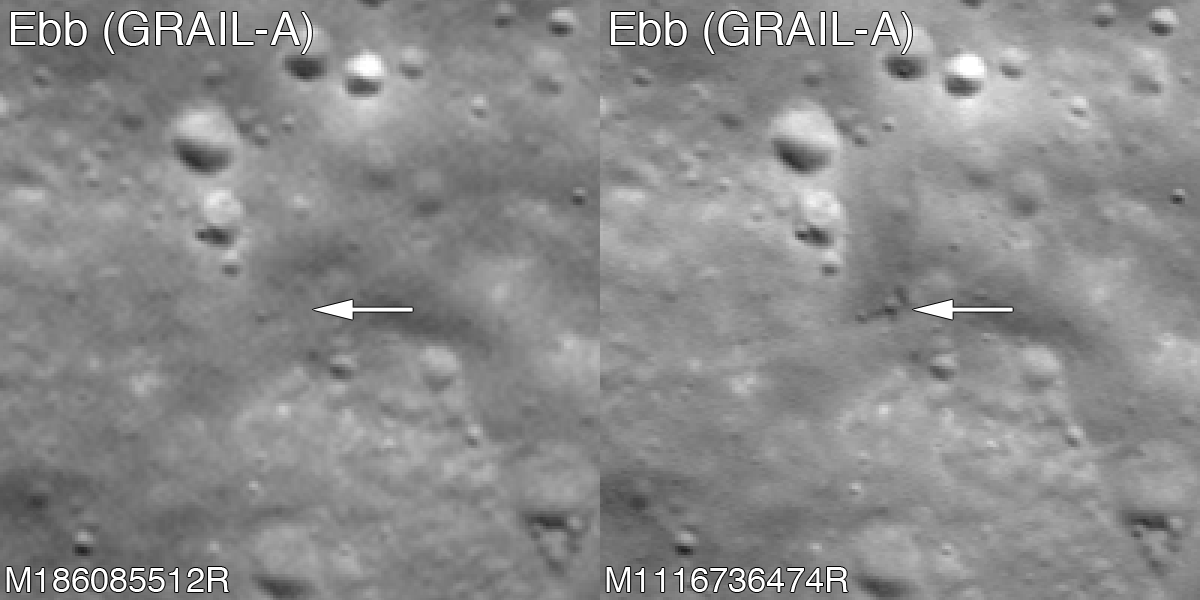
Above: Lunar Reconnaissance Orbiter Camera image shows the impact site of GRAIL A (Ebb spacecraft) before and after the spacecraft's descent to the lunar surface. (Credit: NASA/GSFC/ASU)
"We were informed by the GRAIL team about three weeks prior to the impact exactly where the impact site would be," said LRO Project Scientist John Keller of NASA's Goddard Space Flight Center in Greenbelt, Md. "The GRAIL team's focus was on obtaining the highest-resolution gravity measurements possible from the last few orbits of the GRAIL spacecraft, which led to uncertainty in the ultimate impact site until relatively late."
LRO was only about 100 miles (160 kilometers) from the lunar surface at the time of the impact, and variations in gravity from massive features like lunar mountains tugged on the spacecraft, altering its orbit.
The site was in shadow at the time of the impact, so the LRO team had to wait until the plumes rose high enough to be in sunlight before making the observation. The Lyman Alpha Mapping Project (LAMP), an ultraviolet imaging spectrograph on board the spacecraft, saw mercury and enhancements of atomic hydrogen in the plume.
"The mercury observation is consistent with what the LRO team saw from the LCROSS impact in October 2009," said Keller. "LCROSS (Lunar CRater Observation and Sensing Satellite) saw significant amounts of mercury, but the LCROSS site was at the bottom of the moon's Cabeus crater, which hasn't seen sunlight for more than a billion years and is therefore extremely cold."
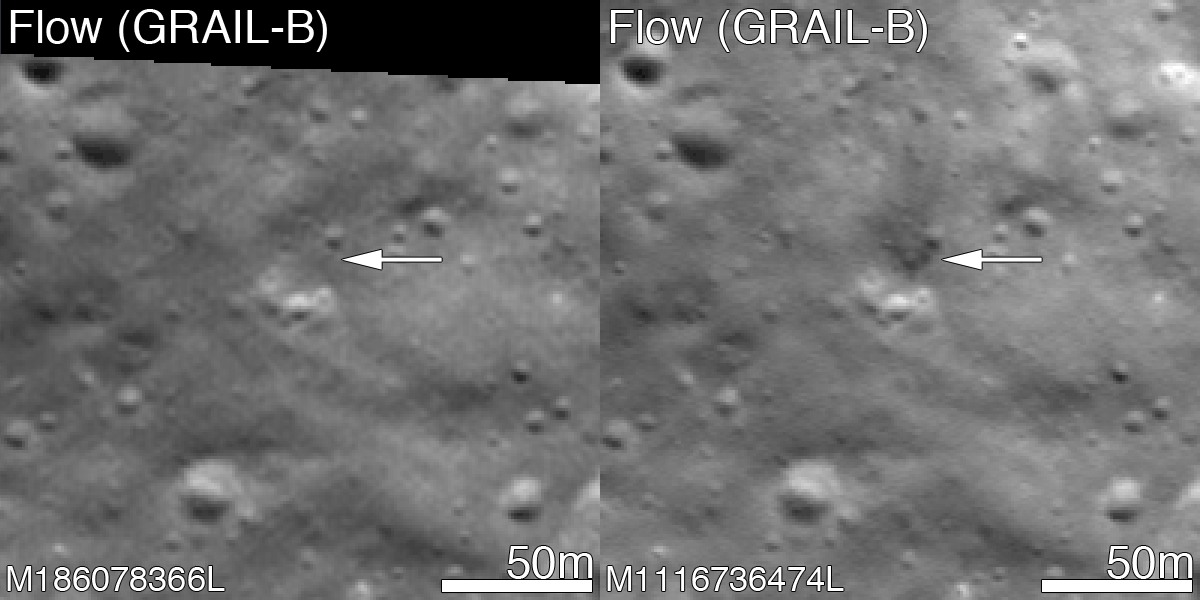
LRO's Lunar Reconnaissance Orbiter Camera was able to make an image of the craters from the GRAIL impacts despite their relatively small size.
Above: Lunar Reconnaissance Orbiter Camera image shows the impact site of GRAIL B (Flow spacecraft) before and after the spacecraft's descent to the lunar surface. (Credit: NASA/GSFC/ASU)
The two spacecraft were relatively small -- cubes about the size of a washing machine with a mass of about 200 kilograms (440 pounds) each at the time of impact. The spacecraft were traveling about 3,800 mph (6,100 kilometers per hour) when they hit the surface.
"Both craters are relatively small, perhaps 4 to 6 meters (about 13 to 20 feet) in diameter and both have faint, dark, ejecta patterns, which is unusual," said Mark Robinson, LROC principal investigator at Arizona State University's School of Earth and Space Sciences, Tempe, Ariz. "Fresh impact craters on the moon are typically bright, but these may be dark due to spacecraft material being mixed with the ejecta."
"Both impact sites lie on the southern slope of an unnamed massif [mountain] that lies south of the crater Mouchez and northeast of the crater Philolaus," said Robinson. "The massif stands as much as 2,500 meters [about 8,202 feet] above the surrounding plains. The impact sites are at an elevation of about 700 meters [around 2,296 feet] and 1,000 meters [3,281 feet], respectively, about 500 to 800 meters [approximately 1,640 to 2,625 feet] below the summit. The two impact craters are about 2,200 meters [roughly 7,218 feet] apart. GRAIL B [renamed Flow] impacted about 30 seconds after GRAIL A [Ebb] at a site to the west and north of GRAIL A."
Lunar Reconnaissance Orbiter complemented the GRAIL mission in other ways as well. LRO's Diviner lunar radiometer observed the impact site and confirmed that the amount of heating of the surface there by the relatively small GRAIL spacecraft was within expectations. LRO's Lunar Orbiter Laser Altimeter (LOLA) instrument bounced laser pulses off the surface to build up a precise map of the lunar terrain, including the three-dimensional structure of features like mountains and craters.
"Combining the LRO LOLA topography map with GRAIL's gravity map yields some very interesting results," said Keller. "You expect that areas with mountains will have a little stronger gravity, while features like craters will have a little less. However, when you subtract out the topography, you get another map that reveals gravity differences that are not tied to the surface. It gives insight into structures deeper in the moon's interior."
Robert Pearlman Editor
Posts: 42988 From: Houston, TX Registered: Nov 1999
posted 05-31-2013 07:28 AM
NASA release
NASA's GRAIL Mission Solves Mystery of Moon's Surface Gravity
NASA's Gravity Recovery and Interior Laboratory (GRAIL) mission has uncovered the origin of massive invisible regions that make the moon's gravity uneven, a phenomenon that affects the operations of lunar-orbiting spacecraft.
Because of GRAIL's findings, spacecraft on missions to other celestial bodies can navigate with greater precision in the future. GRAIL's twin spacecraft studied the internal structure and composition of the moon in unprecedented detail for nine months. They pinpointed the locations of large, dense regions called mass concentrations, or mascons, which are characterized by strong gravitational pull. Mascons lurk beneath the lunar surface and cannot be seen by normal optical cameras.
GRAIL scientists found the mascons by combining the gravity data from GRAIL with sophisticated computer models of large asteroid impacts and known detail about the geologic evolution of the impact craters. The findings are published in the May 30 edition of the journal Science.
"GRAIL data confirm that lunar mascons were generated when large asteroids or comets impacted the ancient moon, when its interior was much hotter than it is now," said Jay Melosh, a GRAIL co-investigator at Purdue University in West Lafayette, Ind., and lead author of the paper. "We believe the data from GRAIL show how the moon's light crust and dense mantle combined with the shock of a large impact to create the distinctive pattern of density anomalies that we recognize as mascons."
The origin of lunar mascons has been a mystery in planetary science since their discovery in 1968 by a team at NASA's Jet Propulsion Laboratory (JPL) in Pasadena, Calif. Researchers generally agree mascons resulted from ancient impacts billions of years ago. It was not clear until now how much of the unseen excess mass resulted from lava filling the crater or iron-rich mantle upwelling to the crust.
On a map of the moon's gravity field, a mascon appears in a target pattern. The bulls-eye has a gravity surplus. It is surrounded by a ring with a gravity deficit. A ring with a gravity surplus surrounds the bulls-eye and the inner ring. This pattern arises as a natural consequence of crater excavation, collapse and cooling following an impact. The increase in density and gravitational pull at a mascon's bulls-eye is caused by lunar material melted from the heat of a long-ago asteroid impact.
"Knowing about mascons means we finally are beginning to understand the geologic consequences of large impacts," Melosh said. "Our planet suffered similar impacts in its distant past, and understanding mascons may teach us more about the ancient Earth, perhaps about how plate tectonics got started and what created the first ore deposits."
This new understanding of lunar mascons also is expected to influence planetary geology well beyond that of Earth and our nearest celestial neighbor.
"Mascons also have been identified in association with impact basins on Mars and Mercury," said GRAIL principal investigator Maria Zuber of the Massachusetts Institute of Technology in Cambridge. "Understanding them on the moon tells us how the largest impacts modified early planetary crusts."
See here for discussion of GRAIL and its journey to the "center of the moon".







 posted 12-12-2007 04:58 PM



 advertisement