
Space History News
space history and collectibles feature articles
Messages
discussion forums about space history and collecting
Sightings
calendar of worldwide astronaut appearances
buySPACE
marketplace for space artifacts, toys and memorabilia
Resources
collecting guides and selected space history documents
Websites
related space memorabilia and history websites
|

The editor's collection.
Autographs
who's who in space: the first 25 years of space exploration
Books
galleys, drafts, and advanced reading copies
Hardware
space flown fragments and complete artifacts
Medallions
flown coins and those minted with flown metal
Philatelics
first day ceremony programs and flown stamps
|
|

|
|
collectSPACE Recommendation:
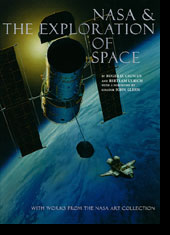
NASA and the Exploration of Space
by Dr. Roger Launius and Bertram Ulrich
Review by Matt Scherzi <[email protected]>
 When prehistoric man wanted to record his accomplishments, he did so by painting on cave walls. Among the events he depicted there often would be a man hoisting a spear upwards. Aimed at what was once considered an unreachable target, usually a mastodon or other large animal, the spear with its fire hardened tip enabled man to kill the beast.
Modern man continues to record his accomplishments, though today our spears have become rockets. Like our ancestors, our targets were once thought unreachable, however our flames are used to boost the tips towards the heavens.
Instead of cave walls, our record is contained within the NASA Art Program.
Order "NASA and the Exploration of Space"
In NASA And The Exploration Of Space, Historian Dr. Roger Launius and Art Curator Bertram Ulrich have collaborated to tell the story of mankind's exploration of space through the agency's art program, from it's 1963 origins to the present day. Illustrated with over 170 drawings and full color paintings, including pieces by reknowned artists Paul Calle, Robert McCall, Norman Rockwell and James Wyeth, Launius and Ulrich have created what may be the definitive Space Art compilation.
Divided into sections paralleling the progress of the developing space program, the authors first focus on the pre-agency years beginning with Robert Goddard's liquid-fuel rockets to the German V-2 program, and from the origins of the Jet Propulsion Laboratory to Sputnik and our first response.
The first formal chapter, "Building a Space Program," opens with Paul Hudson's "In the Beginning Nothing Became Everything" which at first glance could easily be mistaken for a photograph from the Hubble Telescope. Illustrations and text describe the development of the X-15 (employing Stan Stoke's painting), Max Faget's work on the Mercury Spacecraft, and the evolution of the Firing Room to what became the Apollo Mission Control.
Artwork in this chapter includes Norman Rockwell's painting of John Young and Gus Grissom preparing for their Gemini flight and Mitchell Jamieson's capture of a pensive Gordo Cooper reflecting on his twenty-two orbit mission.
In "Quest for the Moon," Launius and Ulrich span the Gemini and Apollo eras. Opening with a two page Gemini montage of Paul Calle pencil drawings, the chapter continues the focus set on the program's infrastructure. The lunar module simulator, launch pads and the Vehicle Assembly Building (VAB) are the focus of several pieces.
Robert McCall contributes two paintings depicting the return of Apollo 7 and Apollo 8's SPS engine burn. Also included are two of Norman Rockwell's most famous space-themed paintings, "Astronaut on the Moon" and "Behind Apollo 11."
The third chapter, "From Competition to Cooperation" illustrates the movement toward international ventures in space. The artists' choice of varied mediums, from the abstract to photo-realistic techniques, nicely illustrates the progress from the Apollo-Soyuz Test Project through the International Space Station.
The artwork in chapter four, "Toward Future Exploration" tends more toward the abstract and imaginative due to it's more speculative nature. Ludek Pesek's "Mars from Deimos" is reminiscent of Chelsey Bonestell's work, while "Earth and Moon" by Greg Mort symbolizes the union between these two celestial neighbors.
NASA and the Exploration of Space is recommended for every space and/or art collectors library, fitting nicely next to Bonestell's "Conquest of Space" and McCall's "Our World in Space."
|

© 1999-2009 collectSPACE.com All rights reserved.
Questions? E-mail [email protected]
|
|
|
|