advertisements advertisements
|

|
Trans-lunar Integrity: Artemis II astronauts moon-bound after TLI burn
Artemis II mission coverage presented with the support of

April 3, 2026 — "Houston is go for TLI."
Echoing words first heard in 1968 and perhaps more poignantly, not spoken for the past 53 years, NASA's Mission Control on Thursday (April 2) committed to "trans-lunar injection," sending humans once again on a path to fly to the moon.
"When the engine ignites, you embark on humanity's lunar homecoming arc and set the course to return Integrity and her crew safely home," said Chris Birch, a NASA astronaut serving as capcom (capsule communicator), the flight controllers' voice for the four Artemis II crew members on the Orion spacecraft "Integrity."
"Your Integrity crew is go for TLI," replied Christina Koch, Artemis II mission specialist and the first woman to depart our home planet for deep space. "With this burn for the moon, we do not leave Earth. We choose it."
And then it happened. Just over 24 hours after launching from Florida at 7:49 p.m. EDT (2349 GMT) on Thursday, Koch and her fellow NASA astronauts, commander Reid Wiseman and pilot Victor Glover, together with mission specialist Jeremy Hansen with the Canadian Space Agency, left the safety of Earth orbit for a figure-eight trip out beyond the moon and back home again.
"Integrity, good engine, good control," came the call from Birch as the five-minute, 50-second burn of a reused space shuttle orbital maneuvering system engine got underway.
"We show the same. It feels great up here," said Wiseman.
When the TLI burn began, Integrity was 115 statute miles (185 km) above Earth and 247,600 miles (398,474 km) away from the lunar surface. When the engine cut off, the Artemis II crew was 405 miles (652 km) away and speeding away at 24,527 miles per hour (39,472 km/h).
They are expected to fly by the moon at a closest approach of 4,112 miles (6,618 km) on flight day 6 (Monday, April 6).
"Having just experienced incredible views of planet Earth and seeing the entire planet out the window in one pane, knowing that we're about to have some similar views of the moon in that same way is definitely getting me more excited for it," said Koch in an inflight media interview a couple of hours after the TLI burn. "I knew that that is what we would see. But there's nothing that prepares you for the breathtaking aspect of seeing your home planet both lit up bright as day and also the moon glow on it at night with the beautiful beam of the sunset."
"Knowing that we're going to get similar views of the moon, I'm just really excited for that," she said.
As they fly by, the moon will appear about the same size as a basketball held at arm's length. The crew will see parts of the far side of the moon never before directly seen with human eyes and will witness an eclipse as the Sun passes behind the moon.
Before then, the astronauts will continue to monitor their spacecraft's system, exercise using a compact flywheel device and photo document their journey. They have already had to troubleshoot a few relatively minor issues, including re-priming their toilet, resetting their offline access to Microsoft Outlook and bagging water as a backup to their tank supply, should their tank supply close off.
During the TLI burn, they were alerted by some caution lights, but were advised no crew action was needed.
"There were some reaction control system manifold messages that we had been seeing previously. Essentially, whenever we're using that system, there's a pressure sensor divergence. We've seen that before, so we knew exactly what that those signatures were," said Howard Hu, NASA's Orion program manager, during a post-burn press conference.
The late astronaut Michael Collins, who gave the first "go for TLI" call before NASA's Apollo 8 astronauts left for the moon, later said he should have chosen something more momentous. Wiseman seemed to agree.
"There were pretty tense moments there for a second," said Wiseman in a media in-flight interview. "When we got through that burn, we just kind of looked at each other as a crew. We [humans] had been to the moon before in 1968 through 1972, it's been a long time since we've been back, and I got to tell you, there is nothing normal about this."
"Sending four humans 250,000 miles away is a Herculean effort, and we are now just realizing the gravity of that," he said.
Hansen, who is the only first-time flier on the crew and first non-American to fly to the moon, gave similar credit to all who worked to make the mission possible.
"We firmly felt the power of your perseverance during every second of that burn," said Hansen. "Humanity has once again shown what we are capable of, and it is your hopes for the future that carry us now on this journey around the moon." |
|
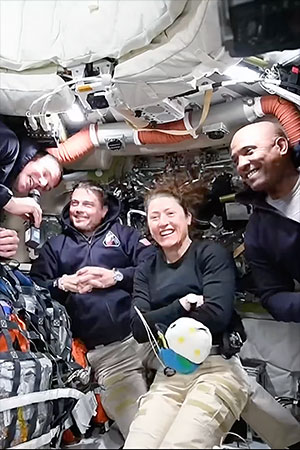
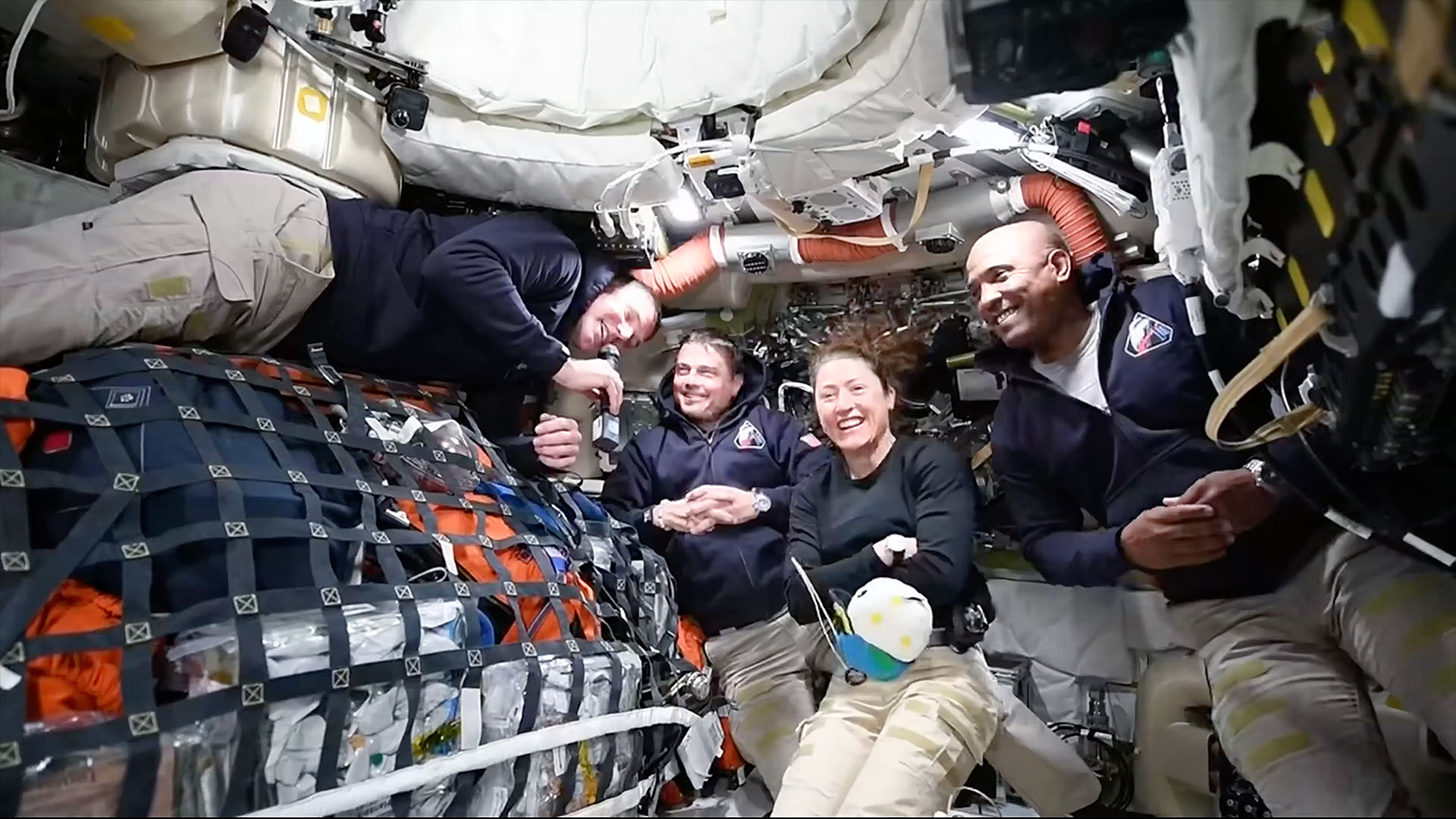
Artemis II crew members (from left to right) Jeremy Hansen, Reid Wiseman, Christina Koch and Victor Glover speak with the media after their trans-lunar injection (TLI) burn, sending "Integrity," their Orion spacecraft, on a path to fly by the moon. (NASA)
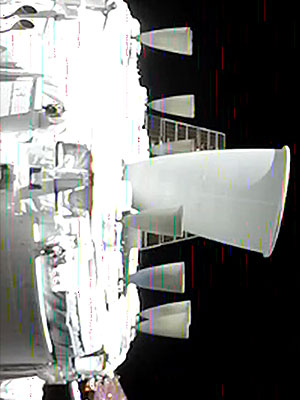
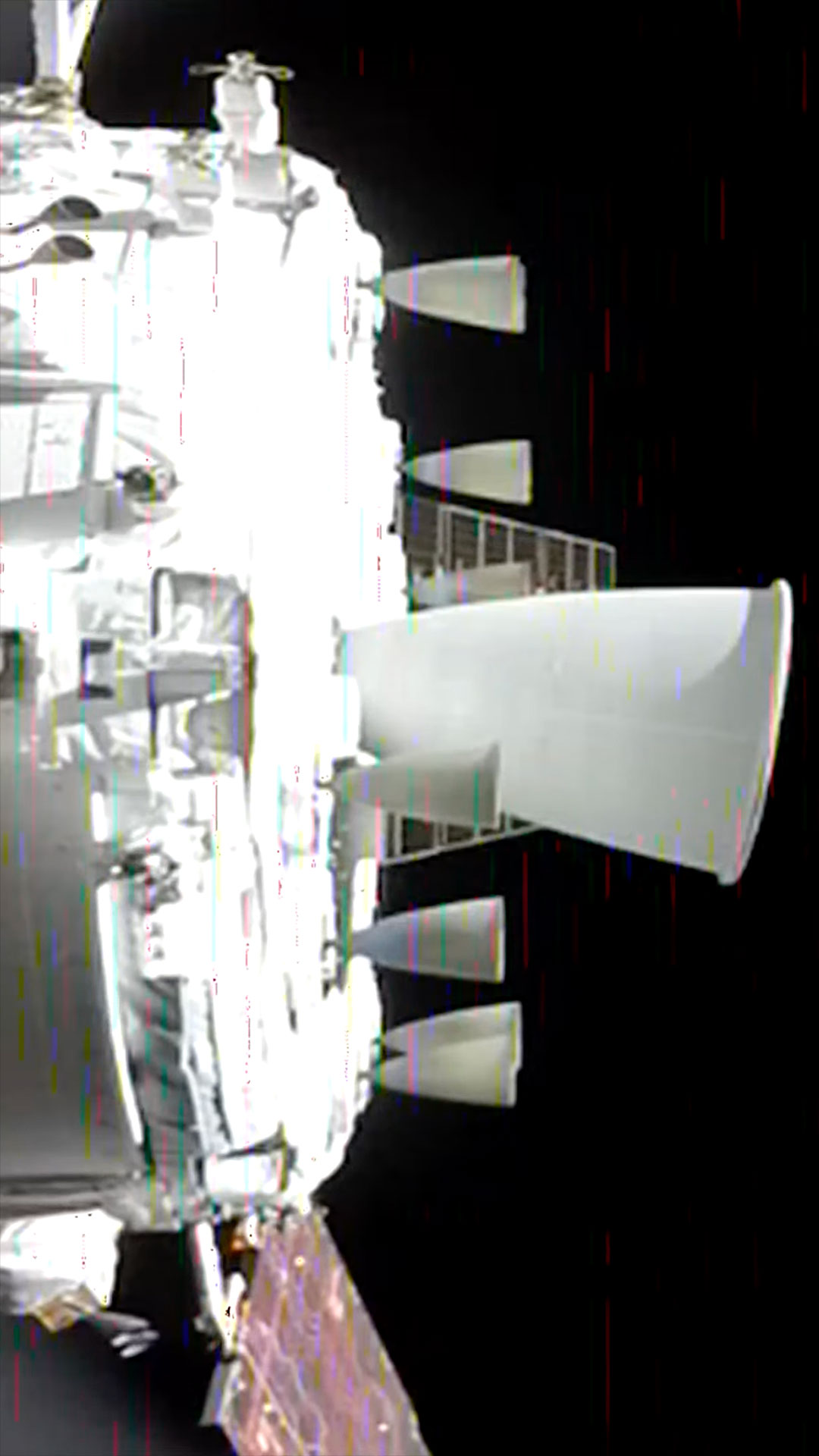
In-flight view of the Orion main engine, a reused space shuttle orbital maneuvering system (OMS) engine, mounted on the base of Integrity's European Service Module. (NASA)
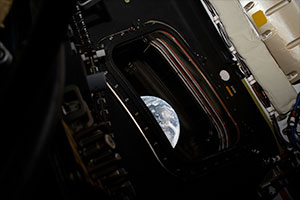
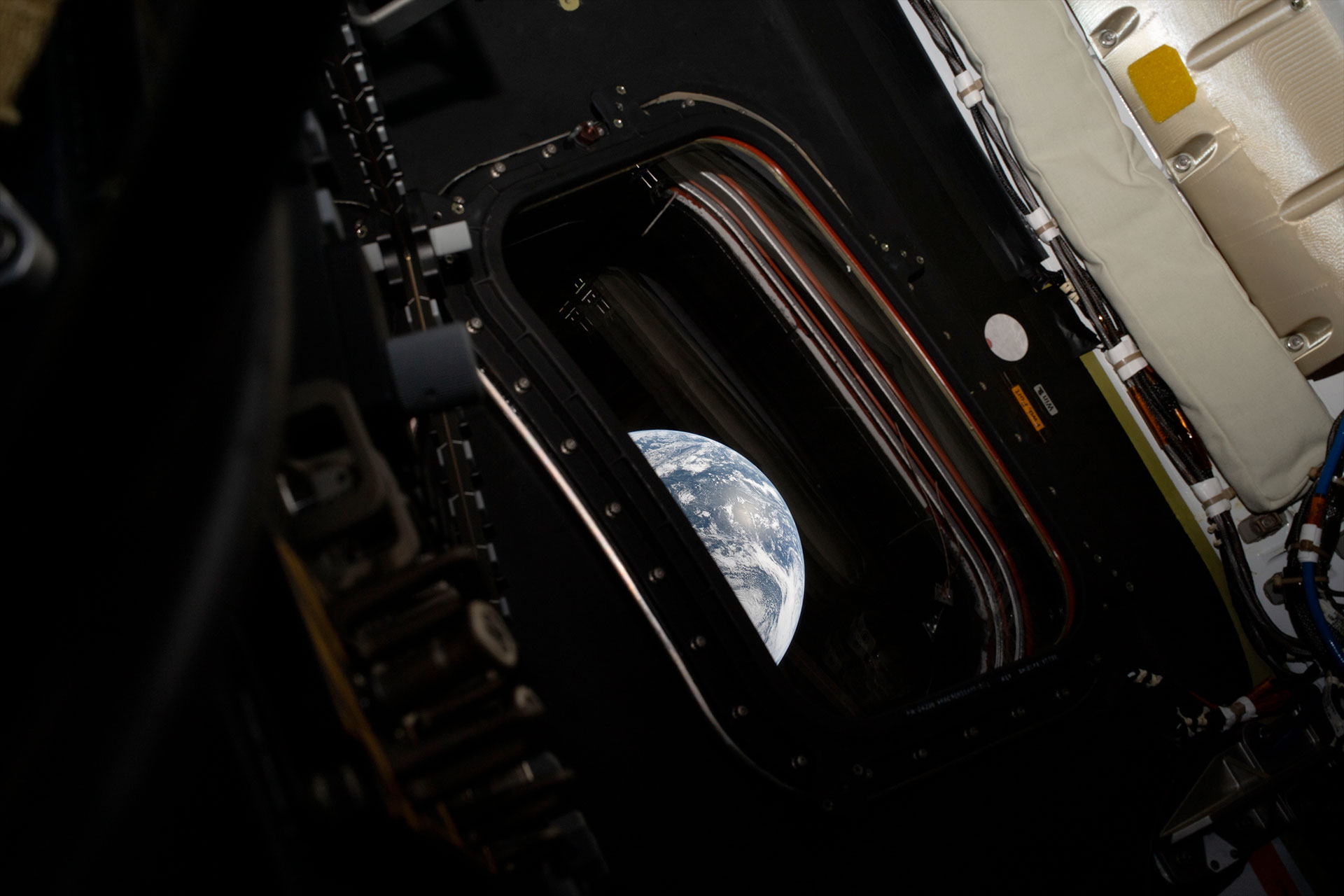
A view of Earth taken by Artemis II commander Reid Wiseman from one of the four main windows on the Orion spacecraft after completing the translunar injection burn on April 2, 2026. (NASA) |

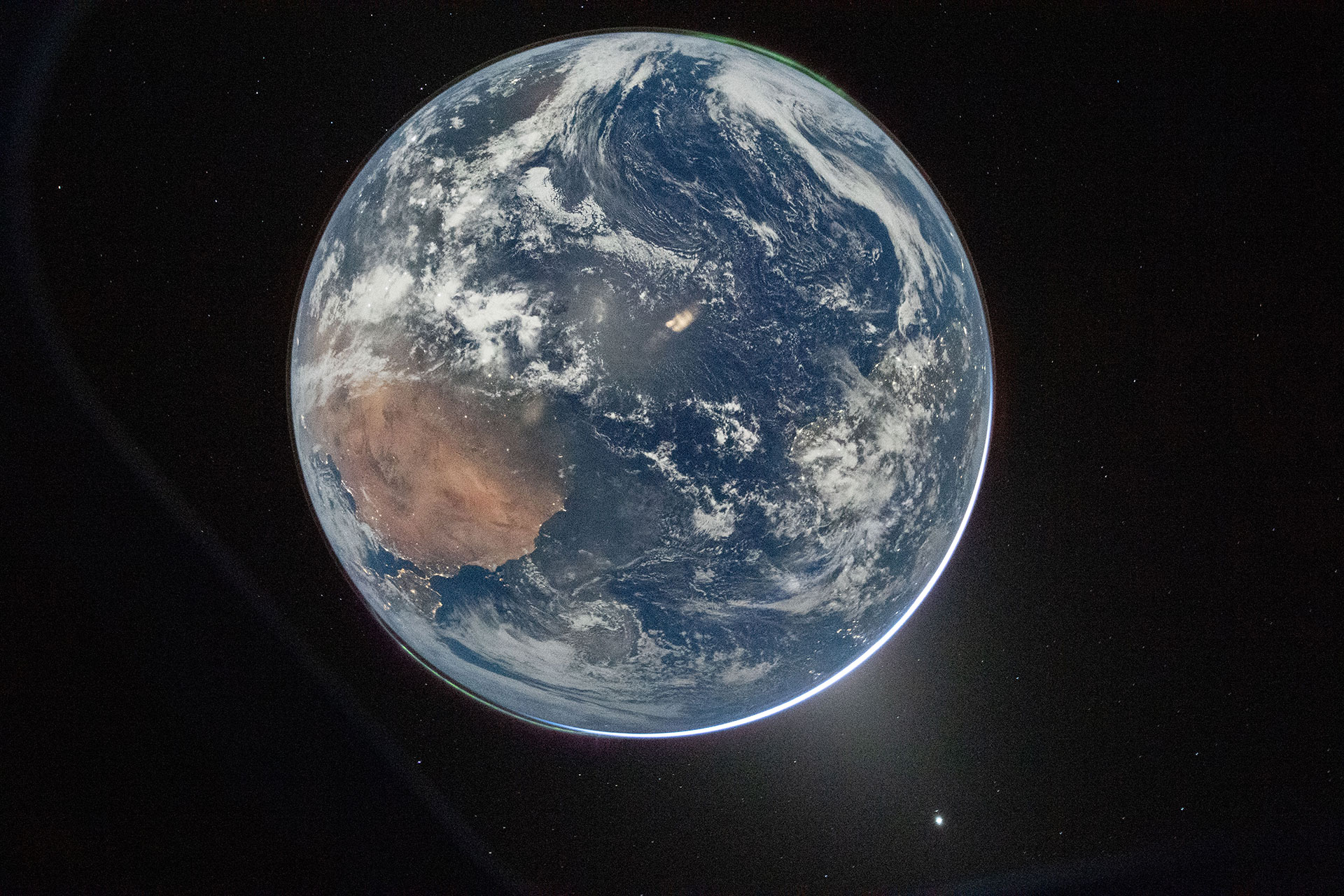
Earth as taken by Artemis II Commander Reid Wiseman from one of the Orion spacecraft's window after completing the translunar injection burn on April 2, 2026. The image features two auroras (top right and bottom left) and zodiacal light (bottom right) is visible as Earth eclipses the Sun. (NASA) |
collectSPACE is grateful to Intuitive Machines for supporting our Artemis II mission coverage. Intuitive Machines successfully soft-landed its Nova-C class lunar lander on the moon, returning the United States to the lunar surface for the first time since 1972. In 2025, Intuitive Machines returned to the lunar south pole with a second lander. The company is focused on delivery services, data transmission services and infrastructure as a service. |
|

© collectSPACE. All rights reserved.
|
|
|
|