March 31, 2026 — The first astronauts to fly to the moon since the end of the Apollo program are launching on a vehicle built out of space shuttle history.
Artemis II commander Reid Wiseman, pilot Victor Glover and mission specialists Christina Koch and Jeremy Hansen did not launch on any of the winged orbiters. The three who flew before — Wiseman, Glover and Koch — all logged time on the International Space Station after flying on either Russia Soyuz or SpaceX Dragon spacecraft.
The Artemis II Space Launch System (SLS) and Orion spacecraft, by comparison, have components flown on 86 space shuttle missions. The heavy-lift rocket and space capsule (specifically, its service module) have heritage dating back 44 years and as recent as the final mission of the program.
The Artemis II launch will mark the last use of this historic hardware, with each either being dropped into the ocean to sink or be destroyed later when reentering Earth's atmosphere.
T-minus 6 seconds
The first shuttle-legacy hardware to fire up again on Artemis II are three of the four RS-25 engines mounted at the base of the SLS core stage. Previously known as a space shuttle main engine, the RS-25 was modified for use with the SLS, gaining a new engine controller and software, as well as added nozzle insulation to protect from booster exhaust.
Engines 2047, 2059 and 2061 were used on space shuttle orbiters, according to L3 Harris (previously Aerojet Rocketdyne), NASA's contractor for the RS-25. The fourth engine flying on Artemis II, 2062, was assembled from spare parts left over from the shuttle program.
Engine 2047 has the longest flight history, having been launched on 15 missions, as compared to five by 2059 and two by 2061. It first flew in 1998, helping send Discovery and the STS-91 crew on the final mission to dock with Russia's space station Mir.
The engine's other flights include STS-96, the first docking to the International Space Station in 1999; STS-98, the delivery of the U.S. Destiny laboratory to the ISS in 2001; STS-109, servicing the Hubble Space Telescope in 2002; STS-123, the delivery of the Japanese Kibo logistics module and Canadian Dextre robotic manipular in 2008; and STS-135, the final launch of the program in 2011.
Engine 2047 is flying for the first with its two other shuttle-flown engines, whereas 2061 flew both of its previous flights with 2059: STS-130, Endeavour's launch of the Node 3 "Tranquility" and Cupola to the ISS in 2010 and STS-134, the final flight of Endeavour in 2011. Engine 2059 first flew in 2007, launching on Atlantis with the STS-117 crew to deploy a new pair of solar arrays for the space station.
Engine 2061 was first assigned to launch on Artemis III, but was brought forward when hydraulic leaks were found on the engine it replaced (2063).
T-minus 0 seconds
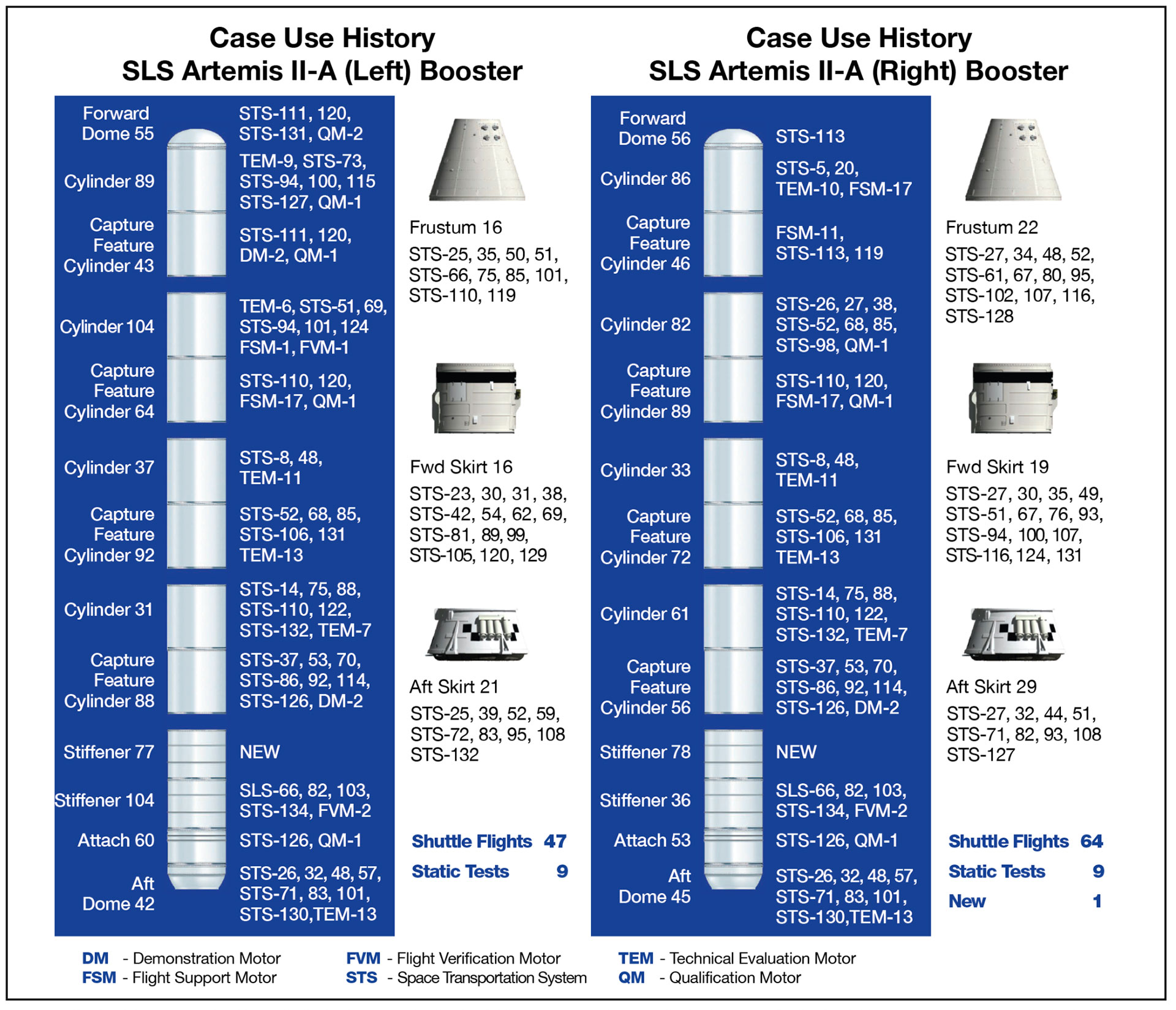
At liftoff of Artemis II, the power generated by the four RS-25 engines will be joined by the thrust of two side-mounted, five-segment solid rocket boosters that are almost entirely comprised of shuttle-used, four-segment motor parts. Northrop Grumman, the booster's prime contractor, identified only the second stiffener on each booster as being new.
"The cylinders, domes, capture features, aft domes, frustums, forward skirts and other shuttle-era booster components used to build the Artemis II boosters have supported 84 different space shuttle missions. Left booster hardware flew on 47 shuttle missions and was used in nine tests. Right booster hardware flew on 64 missions and was used in nine ground tests," according to NASA's SLS reference guide for the Artemis II mission.
The left and right-side forward skirts have the most flight history, each having been used on 14 launches, including STS-61B, the 23rd flight of the shuttle program, in 1985 (on the left skirt) and STS-49, the first flight of Endeavour, in 1992. The right skirt also helped launch Columbia on its ill-fated final flight, STS-107, in 2003.
The frustum on the right-side also lifted off with Columbia for its tragic last launch.
The component with the earliest flight history of any part of the Artemis II SLS is the cylinder at the top of the right-side booster, which began use on STS-5 in 1982. The same cylinder also flew on STS-51I in 1985.
The most recently used solid rocket booster components are the first stiffeners on each side. They were both used on STS-134 (along with RS-25 engines 2059 and 2061) on the last launch of Endeavour.
L+plus 4 hours and 52 minutes
When it comes time for the Orion spacecraft "Integrity" to depart for the moon, another key piece of space shuttle hardware will be responsible for that boost.
Orion's power and propulsion is provided by the European Service Module, the European Space Agency's (ESA) contribution to the Artemis program. The service module uses a OMS-E engine, a shuttle-heritage orbital maneuvering system engine that has been modified to be expendable.
The first time the OMS-E engine will fire will be at about five hours into the flight to distance Integrity from the SLS upper stage, or ICPS (Interim Cryogenic Propulsion System), which on Artemis II is being used as a target for rendezvous and (simulated) docking operations. The service module engine will then be used for the trans-lunar injection (TLI) burn at one day, one hour and 42 minutes.
"For the Artemis II mission, the engine chosen comes from space shuttle Atlantis," ESA posted on its website. "The engine was stored for 20 years before being moved to Bremen, Germany, where it was installed on the second European Service Module and tested to satisfaction. It flew back across the Atlantic Ocean to return to the Kennedy Space Center from where it was launched six times."
The Artemis II OMS engine was in service to the shuttle program between 2000 and 2002. All six of its missions (STS-101, 106, 98, 104, 110 and 112) flew to the International Space Station. The engine logged more than 69 days in space prior to its launch to the moon.
"When the Orion spacecraft embarks on that journey, it will be comforting to know that such a legendary piece of hardware will be there to assist it," ESA officials wrote.
L+plus two years and counting
Artemis II is the second mission to use an SLS rocket built up from shuttle-flown components. The uncrewed Artemis I mission did the same when it launched in 2022 on a 26-day mission orbiting the moon.
L3 Harris has enough shuttle-used RS-25 engines for two more SLS launches, including, as now planned, the Artemis IV lunar landing mission targeted for 2028. Northrop Grumman has shuttle-heritage solid rocket booster segments to support the next six SLS launches. ESA will use shuttle-flown OMS-E engines for its Orion service module for four more missions.
After that supply is launched, NASA and its partners plan to use newly-built hardware, some of which has been completed. The agency recently announced that it has standardized the SLS's design under its current configuration and plans to continue using the heavy-lift rocket until commercial alternatives are available.
Flown examples of the space shuttle main engine, solid rocket boosters and reusable orbital maneuvering system engines are preserved in museums, including the Smithsonian National Air and Space Museum in Washington, D.C. and the California Science Center in Los Angeles. |
|
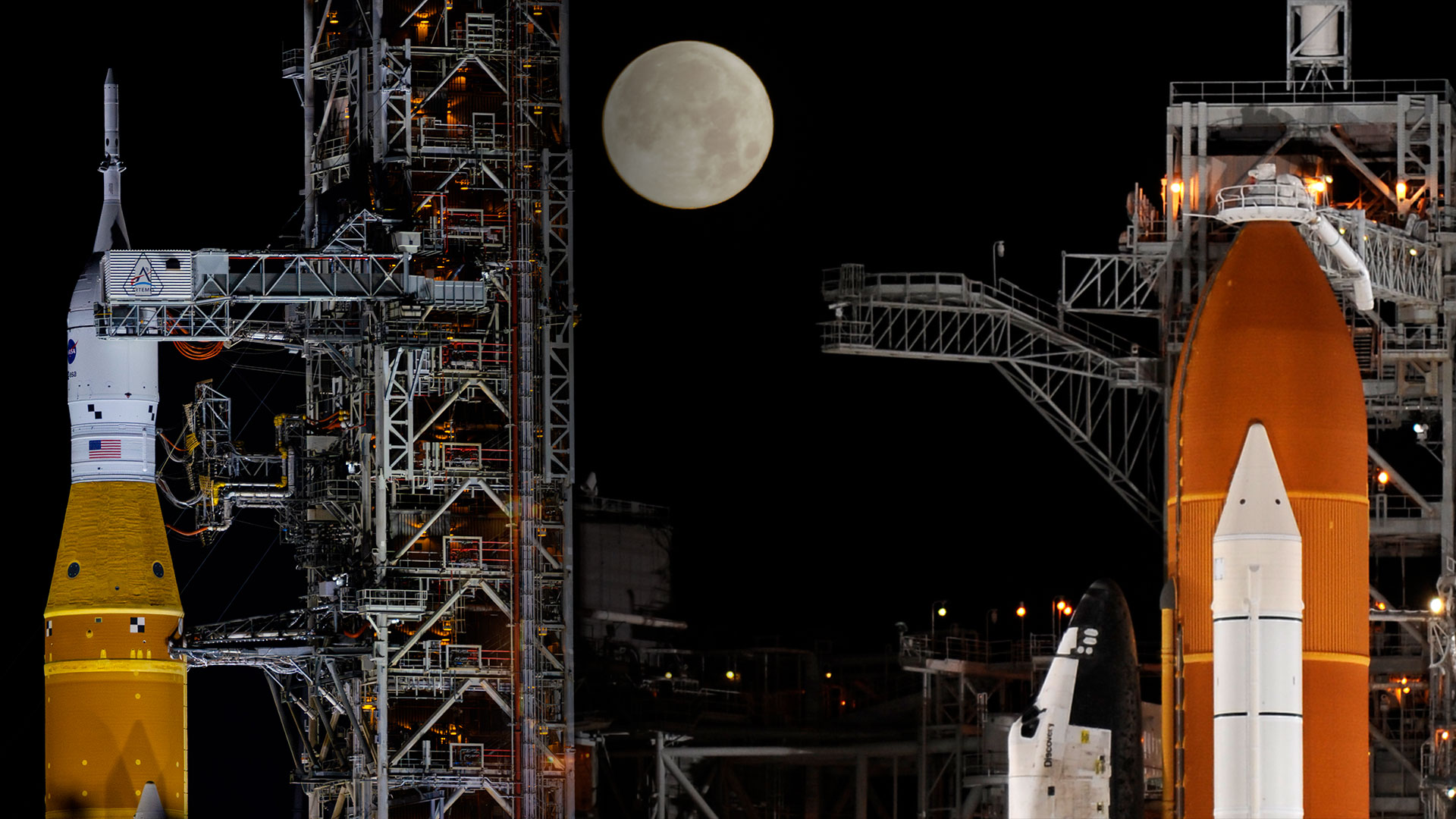
The Artemis II Space Launch System (SLS) rocket (at left) will lift off with four astronauts on a mission to the moon using parts from 86 space shuttle flights. (NASA/collectSPACE)
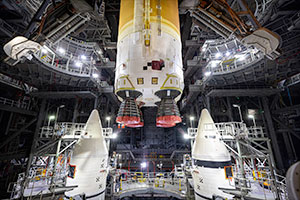
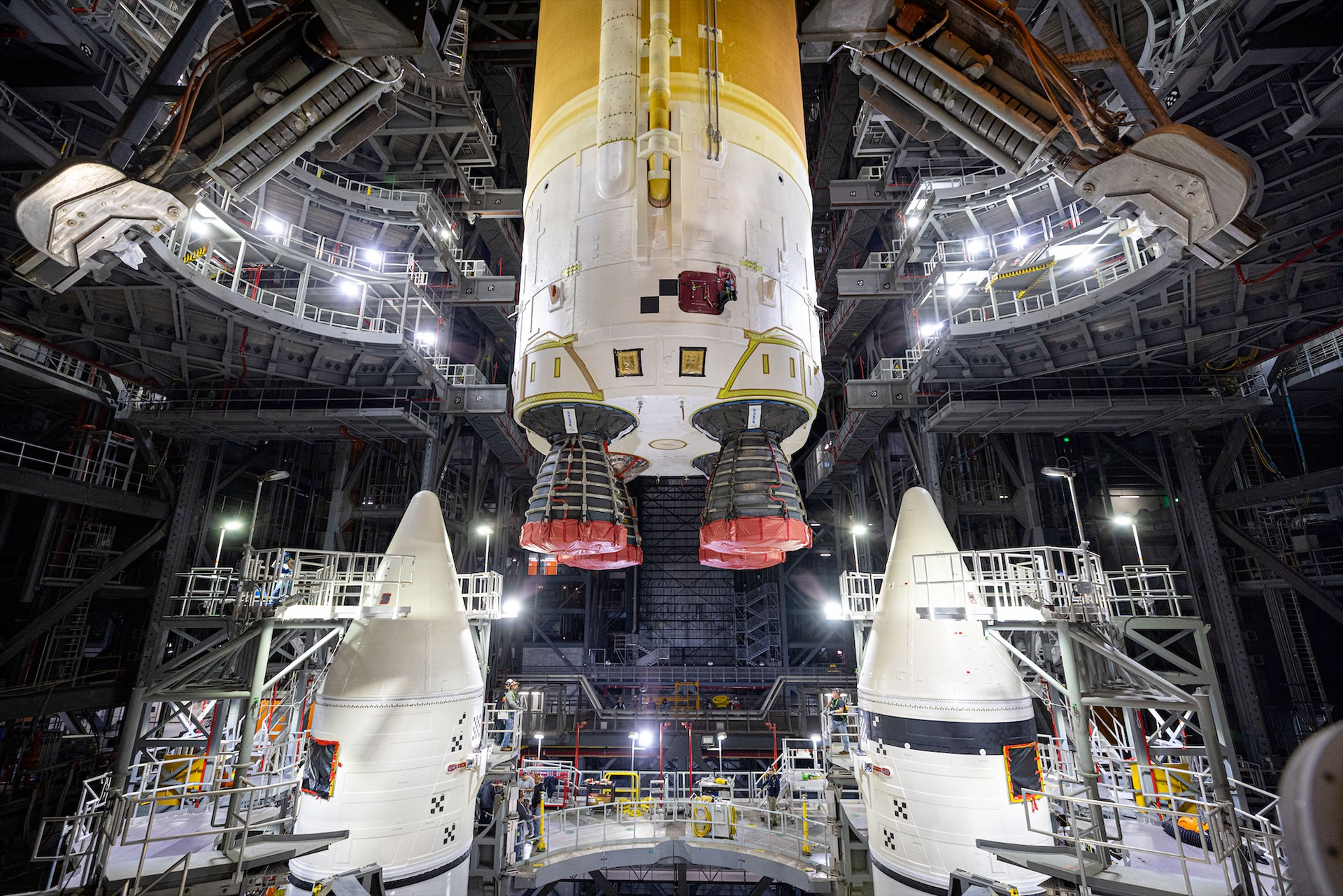
The Artemis Space Launch System (SLS) core stage with four RS-25 engines at its base is lowered between its solid rocket boosters inside the Vehicle Assembly Building at NASA's Kennedy Space Center in Florida. This photograph was taken about a month before engine 2063 was replaced by engine 2061. (NASA)
Artemis II RS-25 engine flight history
|
STS-91
STS-96
STS-98
STS-99
STS-106
STS-104
STS-109
STS-112
STS-115
STS-118
STS-123
STS-126
STS-128
STS-132
STS-135 |
|
Discovery
Discovery
Atlantis
Endeavour
Atlantis
Atlantis
Columbia
Atlantis
Atlantis
Endeavour
Endeavour
Endeavour
Discovery
Atlantis
Atlantis |
|
June 2, 1998
May 27, 1999
Feb. 7, 2001
Feb. 11, 2000
Sept. 8, 2000
July 12, 2001
March 1, 2002
Oct. 7, 2002
Sept. 9, 2006
August 8, 2007
Mrch 11, 2008
Nov. 30, 2008
Aug. 28, 2009
May 14, 2010
July 8, 2011 |
|
STS-117
STS-122
STS-125
STS-130
STS-134 |
|
Atlantis
Atlantis
Atlantis
Endeavour
Endeavour |
|
June 22, 2007
Feb. 7, 2008
May 11, 2009
Feb. 8, 2010
May 16, 2011 |
|
|
|
|
|
Feb. 8, 2010
May, 16, 2011 |
|
New, assembled from STS heritage flight spares |

|
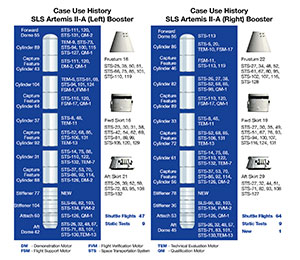
The left (II-A) and right (II-B) side solid rocket boosters flying on Artemis II include hardware that was previously used in the launch of 84 space shuttle missions. (NASA/Northrop Grumman)
Artemis II Orion ESM engine history
Serial no. A70-0671-04-020 |
STS-101
STS-106
STS-98
STS-104
STS-110
STS-112 |
|
Atlantis
Atlantis
Atlantis
Atlantis
Atlantis
Atlantis |
|
May 19, 2000
Sept. 8, 2000
Feb. 7, 2001
July 12, 2001
April 8, 2002
Oct. 7, 2002 |
|
|