|
Author
|
Topic: [Discuss] Orion crew exploration vehicle
|
Robert Pearlman
Editor Posts: 50516
From: Houston, TX
Registered: Nov 1999
|
 posted 05-24-2011 12:09 PM
   
Please use this topic for general questions about the Orion spacecraft to discuss NASA's and Lockheed Martin's development of the crewed exploration vehicle. |
ilbasso
Member Posts: 1527
From: Greensboro, NC USA
Registered: Feb 2006
|
posted 05-25-2011 12:28 PM
The spacecraft will carry four astronauts for 21-day missions... What kind of meaningful deep space missions could you do in the 21-day design life of the vehicle? |
Jay Chladek
Member Posts: 2272
From: Bellevue, NE, USA
Registered: Aug 2007
|
posted 05-25-2011 03:37 PM
I imagine 21 days would be the maximum time the spacecraft could be activated. If shut down (such as docked somewhere) it could be kept in hibernation much longer. The biggest limiting factor in any spacecraft design is how many consumables it can carry for its size of crew. Oxygen tanks lose pressure overtime and if fuel cells are used, their consumables get used up as well. That was one of the reasons why NASA went with more storage batteries and less fuel cells in the Skylab versions of the Apollo command and service modules. |
Tykeanaut
Member Posts: 2235
From: Worcestershire, England, UK.
Registered: Apr 2008
|
posted 06-14-2011 10:17 AM
I gather that each Orion vehicle will only be used once each time, like Apollo.Why couldn't it be re-coated with heat shield material, etc. and put back into service for another launch? |
Robert Pearlman
Editor Posts: 50516
From: Houston, TX
Registered: Nov 1999
|
posted 06-14-2011 10:21 AM
The Orion was originally proposed as reusable, in large part because it would land on land. For weight and other considerations, it is now being designed to splashdown.Still NASA and Lockheed plan to reuse about 40 percent of the individual capsules' components between flights. |
Robert Pearlman
Editor Posts: 50516
From: Houston, TX
Registered: Nov 1999
|
posted 07-08-2011 10:17 AM
NASA has said they will focus on the name after the budget questions and remaining technical details are worked out. For now, it is known as MPCV Orion.(The introduction of MPCV as a title was the result of congressional action, not something that NASA initiated.) |
Fra Mauro
Member Posts: 1739
From: Bethpage, N.Y.
Registered: Jul 2002
|
posted 07-27-2011 07:28 AM
Testing began this month at NASA's Langley Research Center in Hampton, Va., in the new Hydro Impact Basin to certify the Orion Multi-Purpose Crew Vehicle (MPCV) for water landings. This is nice to see! A little bit reminiscent of the Apollo tests. |
LM-12
Member Posts: 3782
From: Ontario, Canada
Registered: Oct 2010
|
posted 08-16-2011 11:04 AM
How does the Orion compare in size to the Apollo command module? Has anyone seen a side-by-side diagram of both vehicles for comparison? |
Robert Pearlman
Editor Posts: 50516
From: Houston, TX
Registered: Nov 1999
|
posted 09-09-2011 05:22 PM
Construction began today on the first Orion to be used for an orbital flight test (OFT). |
LM-12
Member Posts: 3782
From: Ontario, Canada
Registered: Oct 2010
|
posted 07-11-2012 10:54 AM
quote:
Originally posted by LM-12:
How does the MPCV Orion compare in size to the Apollo Command Module?
This NASASpaceflight.com article has a diagram comparing both capsules.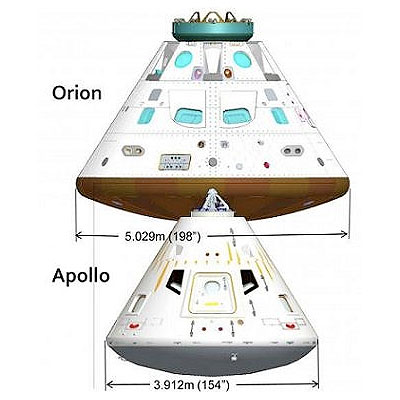 |
SkyMan1958
Member Posts: 1293
From: CA.
Registered: Jan 2011
|
posted 04-06-2021 03:47 PM
I was intrigued by a comment during today's Orion water drop test. The manager said that Orion was capable of supporting missions of 21 days. I thought the Moon missions were going to last on the order of 28 to 30 days. Clearly there is a mismatch between these two numbers. Will Orion be able to draw power, oxygen etc. from the Gateway and extend it's "lifespan" thereby? Or are the missions indeed planned to last at most 21 days? The latter Apollo missions lasted 12ish days, so 21 days doesn't sound like a major improvement, not to mention all the hoopla about Orion going to Mars, which would clearly be a no go in that short a lifespan. |
Robert Pearlman
Editor Posts: 50516
From: Houston, TX
Registered: Nov 1999
|
posted 04-06-2021 03:51 PM
As noted by NASA here, the 21 days is amount of time Orion can support a crew based on the available on board consumables. Orion, itself, can operate in space for up to six months. |
Blackarrow
Member Posts: 3604
From: Belfast, United Kingdom
Registered: Feb 2002
|
posted 04-06-2021 05:48 PM
That source says that Orion can orbit an object in space (say, the Moon or Mars) for up to 6 months without a crew. That's not the same as saying it has a lifetime in space of 6 months. Putting the two pieces of information together, that source suggests a maximum mission of 29 weeks: 3 weeks with crew on board and 26 weeks without crew. As SkyMan1958 points out, that rules out Mars. Of course, we are probably talking here about "Orion Mk. 1" with a later vehicle ("Mk. 6"?) capable of supporting a long-duration Mars mission. |








 advertisement