|
|

|
|
Author
|
Topic: Boeing's CST-100 Starliner-1 mission
|
Robert Pearlman
Editor Posts: 57126
From: Houston, TX
Registered: Nov 1999
|
 posted 08-25-2020 10:38 AM
   
NASA release NASA Astronaut Jeanette Epps Joins First Operational Boeing Crew Mission to Space StationNASA has assigned astronaut Jeanette Epps to NASA's Boeing Starliner-1 mission, the first operational crewed flight of Boeing's CST-100 Starliner spacecraft on a mission to the International Space Station. Epps will join NASA astronauts Sunita Williams and Josh Cassada for a six-month expedition planned for a launch in 2021 to the orbiting space laboratory. The flight will follow NASA certification after a successful uncrewed Orbital Flight Test-2 and Crew Flight Test with astronauts. The spaceflight will be the first for Epps, who earned a bachelor's degree in physics in 1992 from LeMoyne College in her hometown of Syracuse, New York. She completed a master's degree in science in 1994 and a doctorate in aerospace engineering in 2000, both from the University of Maryland, College Park. While earning her doctorate, Epps was a NASA Graduate Student Researchers Project fellow, authoring several journal and conference articles on her research. After completing graduate school, she worked in a research laboratory for more than two years, co-authoring several patents, before the Central Intelligence Agency (CIA) recruited her. She spent seven years as a CIA technical intelligence officer before her selection as a member of the 2009 astronaut class. NASA assigned Williams and Cassada to the Starliner-1 mission in August 2018. The spaceflight will be the first for Cassada and third for Williams, who spent long-duration stays aboard the space station on Expeditions 14/15 and 32/33. |
Robert Pearlman
Editor Posts: 57126
From: Houston, TX
Registered: Nov 1999
|
posted 10-06-2021 10:32 AM
Cassada reassigned from Starliner-1 crewNASA has reassigned astronaut Josh Cassada to the agency's SpaceX Crew-5 mission to the International Space Station as part of the Commercial Crew Program. Cassada was previously assigned to Boeing's Starliner-1 crew. NASA decided it was important to make this reassignment to allow Boeing time to complete the development of Starliner while continuing plans for astronauts (like Cassada) to gain spaceflight experience for the future needs of the agency's missions. NASA astronaut Suni Williams will continue to provide experience for Boeing as the agency prepares for NASA's Boeing Starliner-1 flight. Additional Boeing flight assignments will be made in the future. Cassada grew up in White Bear Lake, Minnesota, and is a physicist and U.S. Navy test pilot. He attended college in Michigan and then completed his Ph.D. research at Fermi National Accelerator Laboratory before becoming a naval aviator. Cassada has accumulated more than 4,000 flight hours in over 45 different aircraft. NASA selected him as an astronaut in 2013. This will be his first spaceflight. "It has been great to spend the last few years training with the joint Boeing and NASA team, and I am really looking forward to now have a chance to also train with SpaceX on a new spacecraft. Cross training on both programs is a unique opportunity to learn, but also to provide valuable insight to future astronauts flying these spacecraft," Cassada said. "And, of course, Nicole and I are incredibly excited to get to work aboard the International Space Station, executing current operations and also contributing to future exploration beyond low-earth orbit." |
Robert Pearlman
Editor Posts: 57126
From: Houston, TX
Registered: Nov 1999
|
posted 09-30-2022 10:32 AM
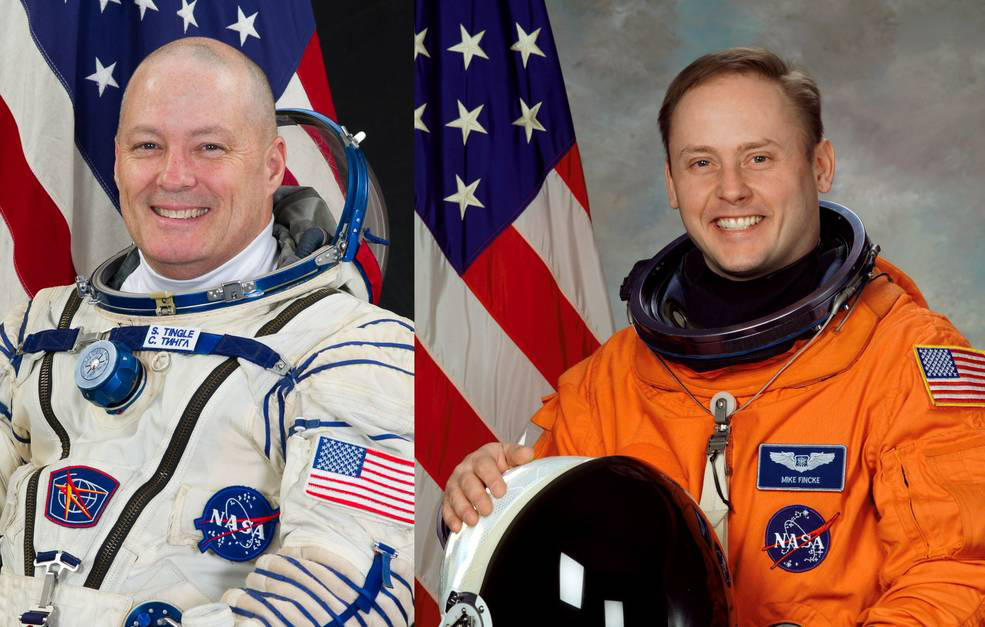
NASA release NASA Updates Crew Assignments for First Starliner Crew Rotation FlightNASA has added two astronauts to the agency's Boeing Starliner-1 launch to the International Space Station, the spacecraft's first mission following completion of its flight tests and certification.  Above: Portraits of NASA astronauts Scott Tingle and Edward Michael (Mike) Fincke. (NASA) Astronauts Scott Tingle and Mike Fincke of NASA will serve as the CST-100 Starliner spacecraft commander and pilot, respectively, for the mission. Both astronauts have previously flown as crew members aboard the space station. NASA astronaut Jeanette Epps remains assigned as a mission specialist on Starliner-1. Epps also continues cross-training on the Dragon spacecraft to protect for other flight opportunities. The agency's Starliner crew rotation missions to the space station will carry four crew members at a time. Future crew assignments for Starliner-1 will be made following review and approval by the agency and its international partners. Starliner-1 will launch following the successful completion of NASA's Boeing Crew Flight Test (CFT), which aims to demonstrate Starliner's ability to achieve NASA certification and safely fly regular crewed missions to space station. Boeing is targeting launch of its first test flight with astronauts in early February 2023, pending space station program approval, rocket manifest, and confirmation by the Eastern Range. Starliner will launch aboard a United Launch Alliance Atlas V rocket from Space Launch Complex-41 at Cape Canaveral Space Force Station in Florida. After a successful CFT mission, NASA will begin the final process of certifying the Starliner spacecraft and systems for future crewed missions to the space station as part of the agency's Commercial Crew Program. |
Robert Pearlman
Editor Posts: 57126
From: Houston, TX
Registered: Nov 1999
|
posted 11-22-2023 09:13 AM
Canadian Space Agency release Canadian Space Agency astronaut Joshua Kutryk to contribute to future mission to the International Space StationToday (Nov. 22), the Honourable François-Philippe Champagne, Minister responsible for the Canadian Space Agency (CSA), announced a significant assignment for a CSA astronaut. Joshua Kutryk has been assigned to a six-month mission on the International Space Station (ISS) launching aboard Starliner-1. Recruited as a CSA astronaut in 2017, Joshua completed his basic training in 2020. Since then, he has continued to serve Canada's space program and worked in different positions, including guiding spacewalks from Mission Control and overseeing commercial vehicle procedures and daily ISS operations. Joshua Kutryk is scheduled to launch aboard the Boeing CST-100 Starliner no earlier than the beginning of 2025, on what is planned to be the Starliner's first operational mission. This will be Joshua's first mission, making him the fourth CSA astronaut to take part in a long-duration mission aboard the ISS and the first one to fly under NASA's Commercial Crew Program. As we prepare to send humans to the Moon, we still need to deepen our understanding of what is required to allow humanity to live, learn and work in the harsh environment of space. Sustainable until 2030 and beyond, the ISS remains a laboratory where ground-breaking scientific research can unfold under conditions similar to deep-space human spaceflight. Over the last four decades, Canada's astronauts have earned a world-class reputation. Josh's assignment contributes to preparing CSA astronauts for increasingly challenging roles in space missions and cements Canada's reputation as a sought-after partner for space exploration. In doing so, he will inspire Canadians across the country and spark interest in STEM-related careers for countless young people. "I am grateful to represent Canada on this mission," said Kutryk. "Space, for me, is about curiosity, adventure, innovation and science. But it's also about collaboration. Collaboration towards future opportunities. Space is about collaborating for a better future. It's about our future; it's about Canadian prosperity. Our country decided decades ago to invest in space because it helps us solve challenges for Canadians, and we are still driven by this purpose today. I'm committed to making the most out of this incredible opportunity for our country." |
Robert Pearlman
Editor Posts: 57126
From: Houston, TX
Registered: Nov 1999
|
posted 09-28-2026 02:46 PM
NASA release NASA, Boeing update on uncrewed Starliner-1On Monday (Sept. 28), NASA and Boeing provided an update on the company’s Starliner spacecraft. In February, NASA released findings from the agency's Program Investigation Team outlining the programmatic and technical issues resulting in an uncrewed return of the Starliner during its first crewed flight in 2024. In total, the investigation identified 61 recommendations to NASA to ensure that future missions meet the high standards required for human spaceflight.
The report specifically identified issues with Starliner's service module reaction control thrusters operating outside of their engineering qualification, which resulted in the loss of control experienced during its Crew Flight Test. Through significant ground testing and analysis, NASA and Boeing learned the service module thruster performance issues resulted from a combination of factors, including the thermal environment and features inherent in its design.
Based on the findings, Boeing has made thermal modifications to the Starliner's service module which NASA will evaluate for improved performance on Starliner-1. NASA and Boeing also have jointly decided to implement an additional thruster valve design modification in support of spacecraft certification and future crewed flights. "We are starting with an uncrewed Starliner-1 mission to the International Space Station to validate the improvements made to the spacecraft and gather the flight data we need," said NASA Administrator Jared Isaacman.
The uncrewed Starliner-1 has the potential to fly in December of this year or January 2027. It will serve as an engineering evaluation mission to verify improved thermal environments, obtain necessary performance data for system qualification, and identify residual risk ahead of crewed missions.
"Starliner's next flight is a critical step on the path to achieving full system certification and ensuring a sustained human presence in low Earth orbit," said Dana Weigel, manager of NASA's Low Earth Orbit Program. "With the safety of our space station crew and the public as our highest priority, we will test Starliner's propulsion system through targeted demonstration objectives and disciplined operational controls. These steps are essential to validating Starliner's thermal performance which is a key element for the certification."
Following the flight, NASA and Boeing will complete the service module thruster valve design modification, which is focused on addressing poppet seal extrusion and its adverse effects on thruster performance. Boeing also will implement other improvements across the spacecraft including installation of new crew module thrusters, batteries, and minor modifications to the parachute system for increased performance and reliability in support of system certification. | |
Contact Us | The Source for Space History & Artifacts
Copyright collectSPACE. All rights reserved.

Ultimate Bulletin Board 5.47a
|
|

|
 advertisement advertisement
|