Topic: Orbital Sciences' Cygnus-Antares spacecraft
Robert Pearlman Editor
Posts: 42988 From: Houston, TX Registered: Nov 1999
posted 12-23-2008 06:25 PM
Orbital Sciences release
Orbital Selected by NASA For $1.9 Billion Space Station Cargo Delivery Contract
Orbital Sciences Corporation, one of the world's leading space technology companies, today announced that it has been selected for a long-term contract by the National Aeronautics and Space Administration (NASA) to provide cargo transportation services to and from the International Space Station (ISS). Orbital stated that the contract, awarded under NASA's Commercial Resupply Services (CRS) program, has an expected value of approximately $1.9 billion for cargo transportation missions to be conducted between 2011 and 2015. This contract amount covers ISS cargo transportation services for about 20 metric tons of cargo, which would be accommodated by 8 missions of Orbital's CRS system. The operational missions would follow Orbital's flight demonstration of its CRS system in late 2010 under the Commercial Orbital Transportation Services (COTS) program, which Orbital and the space agency initiated in early 2008.
"We are very appreciative of the trust NASA has placed with us to provide commercial cargo transportation services to and from the International Space Station, beginning with our demonstration flight scheduled in late 2010," said Mr. David W. Thompson, Orbital's Chairman and Chief Executive Officer. "The CRS program will serve as a showcase for the types of commercial services U.S. space companies can offer NASA, allowing the space agency to devote a greater proportion of its resources for the challenges of human spaceflight, deep space exploration and scientific investigations of our planet and the universe in which we live."
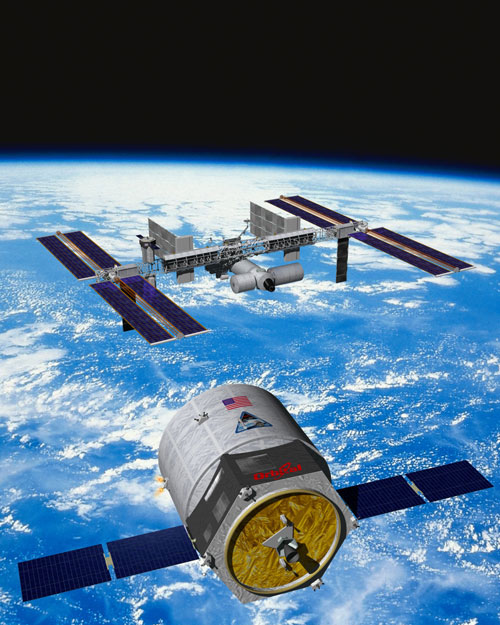
To carry out the cargo services missions, Orbital will use the integrated system it is currently developing under the COTS cooperative research and development program with NASA. The company's COTS system is based on Orbital's new Cygnus(TM) maneuvering space vehicle and will be the anchor customer for the new Taurus IITM medium-lift launch vehicle, now under development. Cygnus is made up of a service module, containing the vehicle's propulsion, power systems and avionics, and one of three types of specialized cargo modules. Orbital's design accommodates pressurized, unpressurized and return cargo modules, offering NASA flexibility in its cargo planning.
"CRS represents a dramatic departure from NASA's traditional contracting practices that will be greatly beneficial to both the space agency and the nation's industrial base," said Dr. Antonio L. Elias, Executive Vice President and General Manager of Orbital's Advanced Programs Group, which oversees both the COTS and CRS projects.
Leading up to the first flight of Orbital's system, the company has begun preparations for its CRS-related production and testing activities over the next 18 months at its Dulles, Virginia headquarters and space vehicle engineering center; its Chandler, Arizona launch vehicle operations; and its Wallops Island, Virginia payload processing facility and launch base. Orbital recently determined that it would conduct the testing of the first stage engines of the Taurus II rocket at NASA's Stennis Space Center facility in Mississippi. The company has also begun its on-site preparations for the launch site infrastructure at the Mid-Atlantic Regional Spaceport located at Wallops Island that will support Taurus II launches.
About Orbital
Orbital develops and manufactures small- and medium-class rockets and space systems for commercial, military and civil government customers. The company's primary products are satellites and launch vehicles, including low-Earth orbit, geosynchronous-Earth orbit and planetary spacecraft for communications, remote sensing, scientific and defense missions; human-rated space systems for Earth-orbit, lunar and other missions; ground- and air-launched rockets that deliver satellites into orbit; and missile defense systems that are used as interceptor and target vehicles. Orbital also provides satellite subsystems and space-related technical services to government agencies and laboratories.
Robert Pearlman Editor
Posts: 42988 From: Houston, TX Registered: Nov 1999
posted 04-28-2010 12:00 PM
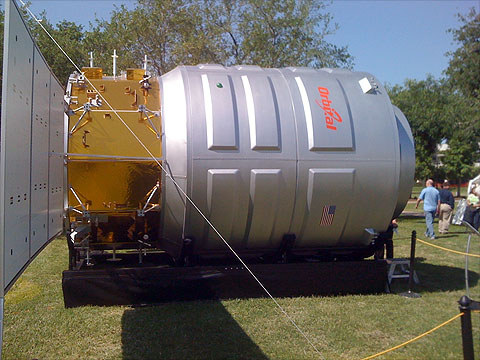
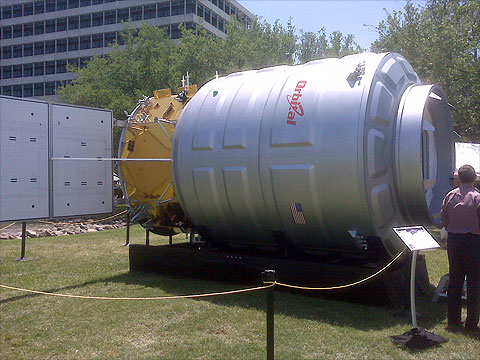
Orbital Cygnus mock-up at Johnson Space Center:
Credit: Taichi Yamazaki
Credit: Cindy Mahler
Robert Pearlman Editor
Posts: 42988 From: Houston, TX Registered: Nov 1999
posted 11-10-2010 05:54 PM
NASA release
NASA Test Fires New Rocket Engine For Commercial Space Vehicle
NASA's John C. Stennis Space Center in Mississippi conducted a successful test firing Wednesday of the liquid-fuel AJ26 engine that will power the first stage of Orbital Sciences Corp.'s Taurus II space launch vehicle. Orbital and its engine supplier, Aerojet, test-fired the engine on Stennis' E-1 test stand. The test directly supports NASA's partnerships to enable commercial cargo flights to the International Space Station.
The initial test, the first in a series of three firings, lasted 10 seconds and served as a short-duration readiness firing to verify AJ26 engine start and shutdown sequences, E-1 test stand operations, and ground-test engine controls.
The test was conducted by a joint operations team comprised of Orbital, Aerojet and Stennis engineers, with Stennis employees serving as test conductors. The joint operations team and other NASA engineers will conduct an in-depth data review of all subsystems in preparation for a 50-second hot-fire acceptance test scheduled several weeks from now. A third hot-fire test at Stennis also is planned to verify tuning of engine control valves.
"Congratulations to Orbital and Aerojet for successfully completing another major milestone," said Doug Cooke, associate administrator for the Exploration Systems Mission Directorate at NASA Headquarters in Washington. "This brings us one step closer to realizing NASA's goals for accessing low Earth orbit via commercial spacecraft."
The AJ26 engine is designed to power the Taurus II space vehicle on flights to low Earth orbit. The NASA-Orbital partnership was formed under the agency's Commercial Orbital Transportation Services joint research and development project. The company is under contract with NASA to provide eight cargo missions to the space station through 2015.
"With this first test, Stennis not only demonstrates its versatility and status as the nation's premiere rocket engine test facility, it also opens an exciting new chapter in the nation's space program," said Patrick Scheuermann, Stennis' center director. "We're proud to be partnering with Orbital to enable the wave of the future -- commercial flights to space and eventual resupply of cargo to the International Space Station."
In addition to the Orbital partnership, Stennis also conducts testing on Pratt & Whitney Rocketdyne's RS-68 rocket engine. The AJ26 is the first new engine in years to be tested at Stennis. Operators spent more than two years modifying the E-1 test stand in preparation. Work included construction of a 27-foot-deep flame deflector trench, major structural modifications and new fluid and gas delivery systems.
Robert Pearlman Editor
Posts: 42988 From: Houston, TX Registered: Nov 1999
posted 12-18-2010 05:52 PM
NASA release
NASA Moves Forward In Commercial Rocket Engine Testing
NASA conducted a test fire Friday of the liquid-fuel AJ26 engine that will power the first stage of Orbital Sciences Corp.'s Taurus II space launch vehicle. The test at the agency's Stennis Space Center in Mississippi supports NASA's Commercial Transportation Services partnerships to enable commercial cargo flights to the International Space Station.
Orbital's Taurus II uses a pair AJ26 rocket engines built by Aerojet to provide first stage propulsion. Friday's test on the Stennis' E-1 test stand involved a team of Orbital, Aerojet, and Stennis engineers, with Stennis employees serving as test conductors.
"Once again, the Orbital and Aerojet team have achieved a major milestone with the AJ26 engine," said Doug Cooke, associate administrator for the Exploration Systems Mission Directorate at NASA Headquarters in Washington. "This success moves Orbital closer to its goal of providing NASA with commercial space transportation services to the space station."
The 55-second firing was the second in a series of verification tests being conducted at the south Mississippi facility. A third hot-fire test also is planned to verify tuning of engine control valves.
"This second test of the AJ26 engine not only moves Orbital's commercial space transport plans a step ahead, but also demonstrates again the quality and versatility of Stennis facilities and the expertise of our test and support team," Stennis Director Patrick Scheuermann said.
The AJ26 engine is designed to power the Taurus II space vehicle on flights to low Earth orbit. NASA's partnership with Orbital was formed under the agency's Commercial Orbital Transportation Services joint research and development project. The company is under contract with NASA to provide eight cargo missions to the space station through 2015.
Robert Pearlman Editor
Posts: 42988 From: Houston, TX Registered: Nov 1999
posted 12-18-2010 05:58 PM
Orbital Sciences update
Orbital Completes Cargo Integration Demonstration
A team of Orbital and Thales Alenia Space (TAS) engineers and technicians recently completed a COTS program milestone when it successfully performed a Cargo Integration Demonstration in Turin, Italy, where the Cygnus Pressurized Cargo Modules (PCMs) are being built and tested. The demonstration was one of the milestones in Orbital’s Space Act Agreement with NASA and marked another significant achievement for the program.
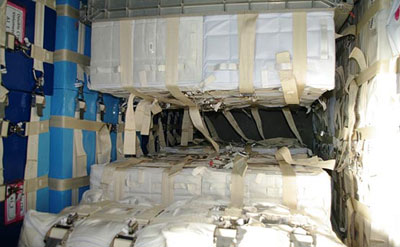
TAS technicians performed the demonstration, which was witnessed by Orbital and NASA engineers, managers, astronauts and flight controllers. The demonstration was performed using a PCM flight unit, production Ground Support Equipment (GSE) and simulated pre-packed cargo bags and cargo volume mock-ups.
The process included a complete volumetric loading of a standard PCM to demonstrate access to every cargo stowage location using a variety of different sized cargo transfer bags. The demonstration milestone called for the installation of at least one cargo bag of the maximum allowable mass in the least-accessible-location in the cargo module to validate the most extreme cargo capabilities anticipated, as well as a “virtual reality” demonstration of cargo module unloading during operations on orbit, an activity that cannot be adequately simulated in the Earth-gravity environment. In addition, the assembly of an internal stowage structure was performed using tools typically found on the ISS.
The demonstration was a 100% success, with all bags and simulators installed, strapped and tensioned. This demonstration gave the Orbital-NASA team confidence that the cargo accommodation system developed for ground and space operations will meet the strict operational requirements of human spaceflight.
The photos below show the Cygnus PCM packed with simulated cargo in the types of bags actually used in ISS operations.
Posts: 42988 From: Houston, TX Registered: Nov 1999
posted 01-06-2011 04:16 PM
Aviation Weekreports that a date has been set for Orbital's first COTS demo.
NASA has set Dec. 14 as the target launch date for Orbital Sciences Corp.'s Commercial Orbital Transportation System (COTS) cargo demonstration mission. Meanwhile, the company says it continues to make progress with NASA toward attaining safety clearance for the mission, in which its Cygnus spacecraft will dock with the International Space Station (ISS).
The flight is scheduled to include delivery of a token cargo load using Orbital's first Cygnus visiting vehicle, a service module combined with a pressurized cargo module (PCM). It is expected to be preceded by a Taurus II "risk-reduction" mission, which is still awaiting funding approval from Congress.
The first cargo module is expected to reach Orbital's manufacturing facilities in Dulles, Va., from Thales Alenia Space in Turin, Italy, "around April," according to Carl Walz, Orbital's vice president of human spaceflight operations.
The first service module structure -- supplied from AASC of Stockton, Calif. -- which will provide power and propulsion for the PCM, is at Orbital's Dulles site undergoing fit-out.
Robert Pearlman Editor
Posts: 42988 From: Houston, TX Registered: Nov 1999
posted 08-21-2011 11:46 AM
Thales Alenia Space release (May 30, 2011)
Thales Alenia Space delivers first Cygnus PCM to Orbital Sciences Corporation
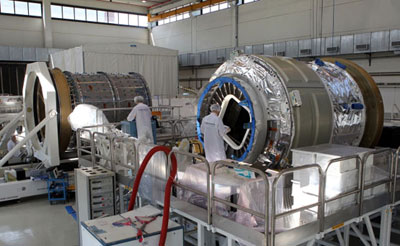
Thales Alenia Space announced that it has delivered to Orbital Sciences Corporation its first Pressurized Cargo Module (PCM) developed to transport cargo to the International Space Station.
This first PCM will be used for the Cygnus demonstration mission, under NASA's Commercial Orbital Transportation Services (COTS) research and development initiative with Orbital.
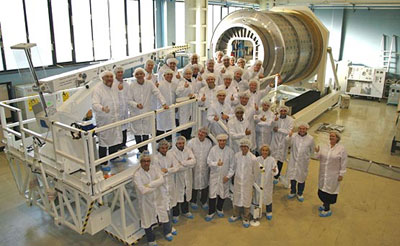
PCM production in Turin, Italy. Credit: Thales/Alenia
The module was shipped from the Thales Alenia Space plant in Turin, Italy to NASA's Wallops Flight Facility in Virginia, where Orbital will integrate it with the Cygnus service module to produce the complete Cygnus spacecraft. The first mission is currently scheduled for December 2011, using Orbital's Taurus II launcher.
Following the demonstration flight, Thales Alenia Space will provide Orbital with eight more PCM units to be used for ISS cargo transport, in order to deliver crew supplies, spare parts and scientific experiments to the Station under Orbital's Commercial Resupply Service (CRS) contract with NASA.
The first PCM will be followed by three more units in "standard" configuration, capable of transporting up to 2,000 kg of cargo each, along with five "enhanced" configuration units, boosting payload capacity to 2,700 kg.
"The delivery of the first Pressurized Cargo Module for commercial space transportation is a major event for Thales Alenia Space," said Luigi Maria Quaglino, Senior Vice President and General Manager of the Space Infrastructures & Transportation Business Unit at Thales Alenia Space. "This program is a strong sign of continuity for our long-standing position as a leader in the space infrastructure and transportation sector. In addition, we want to highlight that the PCM delivery also clearly reflects a new trend in the space business, namely the private sector's engagement to fulfill critical services on a commercial basis — a segment in which our company is playing a major role."
Robert Pearlman Editor
Posts: 42988 From: Houston, TX Registered: Nov 1999
posted 08-21-2011 11:49 AM
NASA release (August 19, 2011)
Space Station Commercial Cargo Carrier Arriving At NASA Wallops
NASA's partnership with industry to develop transportation to the International Space Station (ISS) reaches another milestone on Aug. 24.
The cargo module for Orbital Sciences Corp.'s Cygnus spacecraft, which will carry supplies to the space station, is scheduled to arrive at NASA's Wallops Flight Facility in Virginia.
During the next several months, Orbital's engineering team will integrate the PCM with the Cygnus service module that includes the spacecraft's avionics, propulsion and power systems.
The Cygnus spacecraft is scheduled for a demonstration flight early next year on an Orbital Taurus II launch vehicle under NASA's Commercial Orbital Transportation Services (COTS) agreement with the company.
Cygnus will launch from the Mid-Atlantic Regional Spaceport's pad 0A at Wallops.
Robert Pearlman Editor
Posts: 42988 From: Houston, TX Registered: Nov 1999
posted 08-25-2011 10:26 AM
NASA release
Cygnus Space Station Cargo Carrier Arrives At NASA Wallops
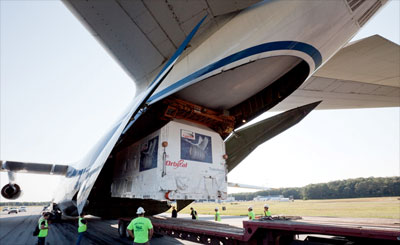
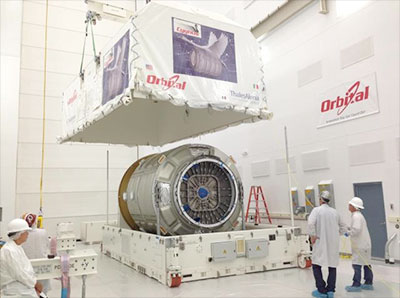
NASA's work to help develop commercial space transportation systems reached a significant achievement yesterday with the arrival at Wallops Flight Facility in Virginia of the Cygnus Pressurized Cargo Module, Orbital Science Corp.'s spacecraft to carry supplies to the International Space Station.
Credit: NASA/Wallops Flight Facility
"This is one more important step in our partnership with U.S. private industry to build safe, reliable and cost effective cargo transportation systems," said Philip McAlister, acting director of commercial space flight development at NASA Headquarters in Washington. "We are pleased that Orbital has made this accomplishment and look forward to the company flying the Cygnus spacecraft in 2012."
During the next several months, Orbital's engineering team will integrate the pressurized module with the Cygnus service module that includes the spacecraft's avionics, propulsion and power systems.
The Cygnus spacecraft is scheduled for a demonstration flight from Wallops early next year on an Orbital Taurus II launch vehicle under NASA's Commercial Orbital Transportation Services agreement with the company.
Robert Pearlman Editor
Posts: 42988 From: Houston, TX Registered: Nov 1999
posted 02-22-2012 05:09 PM
Orbital status update
Updated 2012 COTS and CRS Schedules
Orbital updated its 2012 Commercial Orbital Transportation Services (COTS) and Commercial Resupply Services (CRS) operational schedules now that they are in the homestretch to their four major milestones for the year, which are as follows:
May - Antares First-Stage Static Fire Test at Wallops
June - Antares Test Flight for COTS
Third quarter - COTS Demonstration Mission*
Fourth quarter - CRS Mission #1*
*Orbital's operational dates are subject to coordination with NASA's ISS cargo delivery schedule.
Robert Pearlman Editor
Posts: 42988 From: Houston, TX Registered: Nov 1999
posted 10-02-2012 06:28 AM
Orbital Sciences release
Orbital Begins Antares Rocket Operations at Mid-Atlantic Regional Spaceport
Rockets First Stage Transported to New Launch Pad to Commence Full-Scale Operations
Orbital Sciences Corporation, one of the world's leading space technology companies, today (Oct. 1, 2012) announced that it has commenced Antares launch vehicle operations at the liquid-fuel launch complex at the Mid-Atlantic Regional Spaceport (MARS).
Following a four-year design, development, construction, test and inspection process, the Virginia Commercial Space Flight Authority (VCSFA), which oversees MARS, has authorized Orbital to begin on-pad operations leading up to flight demonstrations of its Antares medium-class launch vehicle and Cygnus cargo logistics spacecraft, the vehicles Orbital will use to fulfill a $1.9 billion NASA contract to deliver essential cargo to the International Space Station (ISS).
The MARS launch complex is located at NASA's Wallops Flight Facility in eastern Virginia and is owned and operated by MARS, under the auspices of the VCSFA, which receives its funding from the Commonwealth of Virginia.
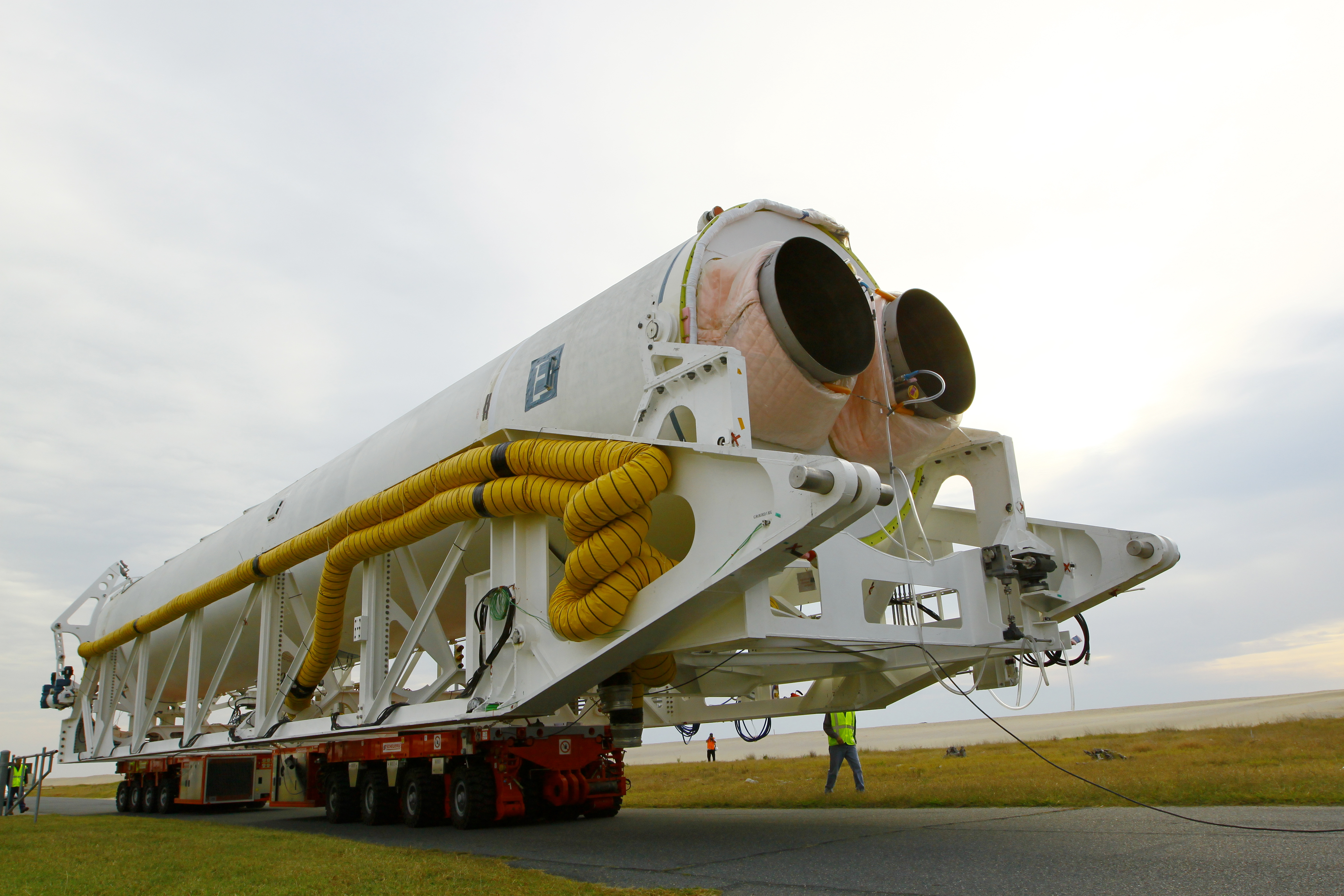
"MARS has completed construction and testing operations on its launch complex at Wallops Island, the first all-new large-scale liquid-fuel launch site to be built in the U.S. in decades," said David W. Thompson, Orbital's President and Chief Executive Officer. "Accordingly, our pad operations are commencing immediately in preparation for an important series of ground and flight tests of our Antares medium-class launch vehicle over the next few months. In fact, earlier today, an Antares first stage test article was transported to the pad from its final assembly building about a mile away, marking the beginning of full pad operations."
Credit: NASA
Above: Orbital Sciences Corporation's Antares rocket rolls out to the launch pad at NASA's Wallops Flight Facility on the morning of Oct. 1, 2012.
Over the next several months, the company plans to complete three major program milestones, including an on-pad hot-fire test of the Antares first stage, the maiden flight of a fully operational Antares rocket, and a demonstration mission to the ISS of Orbital's cargo delivery system, prior to commencing operational cargo delivery missions under NASA's Commercial Resupply Services (CRS) agreement in 2013.
This system, developed under the Commercial Orbital Transportation Services (COTS) joint research and development agreement with NASA, is made up of an Antares rocket, a Cygnus advanced maneuvering cargo logistics spacecraft, and ground-based mission operations command and control facilities.
The first of the three milestones, the Antares hot-fire test operation, will demonstrate the readiness of the rocket's first stage and launch pad fueling systems to support the upcoming flights. The hot-fire test involves firing Antares' dual AJ26 rocket engines that will generate a combined total thrust of 680,000 lbs. for approximately 30 seconds while the first stage is held down on the pad.
The hot-fire operation is expected to be conducted in four to five weeks following integration and check-out of the Antares first stage test unit with the launch complex's fueling systems.
The hot-fire test will be followed about one month later by the maiden flight of the Antares rocket, which will carry a Cygnus mass simulator payload that will be heavily instrumented to gather data on the launch environment aboard Antares. In addition, four small "pico satellites" will be deployed from two dispensers that will be integrated with the mass simulator.
The last of the three COTS test milestones will be the COTS demonstration mission to the ISS. For this mission, a fully operational Cygnus spacecraft will be launched into orbit by Antares and, following an extensive series of in-orbit tests, will autonomously rendezvous and berth with the ISS.
The first Cygnus will deliver approximately 550 kg of cargo upon its arrival and will remove about 1,000 kg of disposal cargo upon its departure from the orbiting laboratory.
Robert Pearlman Editor
Posts: 42988 From: Houston, TX Registered: Nov 1999
posted 10-20-2012 08:47 AM
Orbital Sciences, in announcing its third quarter financial results, confirmed its first flight to the International Space Station has been postponed to 2013.
...Orbital also achieved several milestones in its Antares rocket and Cygnus spacecraft development programs over the last three months. The company's activities on these programs were highlighted by the testing and activation of the new launch complex at Wallops Island and the roll-out to the pad of an Antares first stage rocket to be used in the final ground tests prior to the inaugural flight of the rocket.
In addition, Orbital's first two Cygnus cargo logistics spacecraft have completed their major functional and environmental testing. These Cygnus spacecraft are expected to be delivered to Wallops Island in early 2013 for integration with Antares rockets and launches to the International Space Station on COTS and CRS missions.
Orbital's Chief Executive David W. Thompson further told Space News that the company's demonstration flight to the space station would occur late in the first quarter of 2013 or early in the second quarter, depending on the station's traffic schedule and on Antares' status.
An engine-firing test with the Antares first stage currently on the launch pad is planned for early November, and if successful, it will lead to a full Antares rocket test flight, without the Cygnus cargo vehicle, in December.
Robert Pearlman Editor
Posts: 42988 From: Houston, TX Registered: Nov 1999
posted 07-15-2013 04:33 PM
Orbital Sciences Corporation release
COTS Demonstration Mission - Schedule Update (as of July 10, 2013)
Orbital's Antares launch vehicle and Cygnus cargo logistics spacecraft engineering and operations teams are busy preparing for the upcoming Demonstration Mission to the International Space Station (ISS). This mission is the final milestone in the Commercial Orbital Transportation Services (COTS) joint development effort with NASA.
The Demonstration Mission will verify the overall capabilities of the cargo delivery system developed under the COTS effort. A successful demonstration will enable Orbital to carry out the first of eight regularly scheduled, fully operational cargo resupply missions under the Commercial Resupply Services (CRS) program before the end of the year.
Orbital's teams are now working on a schedule that would enable the company to support a launch in late August. However, the Wallops Flight Facility (WFF) range has also been tasked with supporting another high-profile NASA mission, necessitating NASA to shift the COTS Demonstration Mission schedule to mid-September.
Currently, priority on the WFF range has been given to NASA's Lunar Atmosphere and Dust Experiment Explorer (LADEE) mission, which is being launched aboard a Minotaur V rocket (which is designed, built and operated by Orbital). The LADEE mission has a launch window of September 6-10, with the target launch date being the 6th.
Following the launch of the Minotaur V from Pad 0B at Wallops, Orbital is scheduled to conduct the launch of the COTS Demonstration Mission from Pad 0A during a window of September 14-19, with the target date being the 14th. Should preparations and processing for the LADEE mission encounter an unexpected delay, Orbital will continue to integrate the Antares rocket and Cygnus spacecraft to be in a position to conduct the COTS Demonstration Mission as early as the end of August, giving NASA additional options to maximize the launch manifest from Wallops.
Orbital's teams are well along in preparations for the COTS Demonstration Mission. The two stages of the Antares rocket have been mated and the launch vehicle is in final integration and testing. Likewise, the Cygnus spacecraft is already fueled and loaded with about 1,300 lbs. of cargo (with an additional 250 lbs. of late load cargo expected).
Soon, integration of the Cygnus spacecraft with the Antares rocket will begin, leading to launch readiness in late August.
The Cygnus spacecraft is currently scheduled to berth with the ISS on September 22.
Linda Voss New Member
Posts: From: Registered:
posted 08-06-2013 03:10 AM
Orbital Sciences release (July 2013)
Cargo Module for Cargo Delivery Mission Shipped from Italy
The Cygnus Pressurized Cargo Module (PCM) that will be used to transport supplies to the International Space Station under Orbital's Commercial Resupply Services (CRS) contract with NASA later this year was shipped from the Thales Alenia Space production facility in Turin, Italy on July 17, 2013. This is the second PCM transported to the Wallops Island, VA launch site.
At the NASA Wallops Flight Facility, the PCM will be loaded with cargo and mated to the Cygnus Service Module (SM).
The first PCM, to be utilized in the Commercial Orbital Transportation System (COTS) demonstration mission was loaded mated to its Cygnus Service Module earlier this year.







 posted 12-23-2008 06:25 PM



 advertisement