Topic: NASA's Juno to look into Jupiter's atmosphere
SpaceAholic Member
Posts: 5449 From: Sierra Vista, Arizona Registered: Nov 1999
posted 11-29-2008 12:25 AM
NASA release
NASA Prepares for New Juno Mission to Jupiter
Called Juno, the mission will be the first in which a spacecraft is placed in a highly elliptical polar orbit around the giant planet to understand its formation, evolution and structure. Underneath its dense cloud cover, Jupiter safeguards secrets to the fundamental processes and conditions that governed our early solar system.
"Jupiter is the archetype of giant planets in our solar system and formed very early, capturing most of the material left after the sun formed," said Scott Bolton, Juno principal investigator from the Southwest Research Institute in San Antonio. "Unlike Earth, Jupiter's giant mass allowed it to hold onto its original composition, providing us with a way of tracing our solar system's history."
The spacecraft is scheduled to launch aboard an Atlas rocket from Cape Canaveral, Fla., in August 2011, reaching Jupiter in 2016. The spacecraft will orbit Jupiter 32 times, skimming about 4,800 kilometers (3,000 miles) over the planet's cloud tops for approximately one year. The mission will be the first solar powered spacecraft designed to operate despite the great distance from the sun.
"Jupiter is more than 644 million kilometers (400 million miles) from the sun or five times further than Earth," Bolton said. "Juno is engineered to be extremely energy efficient."
The spacecraft will use a camera and nine science instruments to study the hidden world beneath Jupiter's colorful clouds. The suite of science instruments will investigate the existence of an ice-rock core, Jupiter's intense magnetic field, water and ammonia clouds in the deep atmosphere, and explore the planet's aurora borealis.
"In Greek and Roman mythology, Jupiter's wife Juno peered through Jupiter's veil of clouds to watch over her husband's mischief," said Professor Toby Owen, co-investigator at the University of Hawaii in Honolulu. "Our Juno looks through Jupiter's clouds to see what the planet is up to, not seeking signs of misbehavior, but searching for whispers of water, the ultimate essence of life."
Understanding the formation of Jupiter is essential to understanding the processes that led to the development of the rest of our solar system and what the conditions were that led to Earth and humankind. Similar to the sun, Jupiter is composed mostly of hydrogen and helium. A small percentage of the planet is composed of heavier elements. However, Jupiter has a larger percentage of these heavier elements than the sun.
"Juno's extraordinarily accurate determination of the gravity and magnetic fields of Jupiter will enable us to understand what is going on deep down in the planet," said Professor Dave Stevenson, co-investigator at the California Institute of Technology in Pasadena. "These and other measurements will inform us about how Jupiter's constituents are distributed, how Jupiter formed and how it evolved, which is a central part of our growing understanding of the nature of our solar system."
Deep in Jupiter's atmosphere, under great pressure, hydrogen gas is squeezed into a fluid known as metallic hydrogen. At these great depths, the hydrogen acts like an electrically conducting metal which is believed to be the source of the planet's intense magnetic field. Jupiter also may have a rocky solid core at the center.
"Juno gives us a fantastic opportunity to get a picture of the structure of Jupiter in a way never before possible," said James Green, director of NASA's Planetary Division at NASA Headquarters in Washington. "It will allow us to take a giant step forward in our understanding on how giant planets form and the role that plays in putting the rest of the solar system together. "
The Juno mission is the second spacecraft designed under NASA's New Frontiers Program. The first was the Pluto New Horizons mission, launched in January 2006 and scheduled to reach Pluto's moon Charon in 2015. The program provides opportunities to carry out several medium-class missions identified as top priority objectives in the Decadal Solar System Exploration Survey, conducted by the Space Studies Board of the National Research Council in Washington.
NASA's Jet Propulsion Laboratory in Pasadena, Calif., manages the Juno mission. Lockheed Martin of Denver is building the spacecraft. The Italian Space Agency is contributing an infrared spectrometer instrument and a portion of the radio science experiment.
Robert Pearlman Editor
Posts: 54408 From: Houston, TX Registered: Nov 1999
posted 04-09-2011 09:04 PM
NASA release
NASA's Jupiter-Bound Spacecraft Arrives in Florida
NASA's Juno spacecraft has arrived in Florida to begin final preparations for a launch this summer. The spacecraft was shipped from Lockheed Martin Space Systems, Denver, to the Astrotech payload processing facility in Titusville, Fla., today. The solar-powered Juno spacecraft will orbit Jupiter's poles 33 times to find out more about the gas giant's origins, structure, atmosphere and magnetosphere.
"The Juno spacecraft and the team have come a long way since this project was first conceived in 2003," said Scott Bolton, Juno's principal investigator, based at Southwest Research Institute in San Antonio. "We're only a few months away from a mission of discovery that could very well rewrite the books on not only how Jupiter was born, but how our solar system came into being."
Next Monday, Juno will be removed from its shipping container, the first of the numerous milestones to prepare it for launch. Later that week, the spacecraft will begin functional testing to verify its state of health after the road trip from Colorado. After this, the team will load updated flight software and perform a series of mission readiness tests. These tests involve the entire spacecraft flight system, as well as the associated science instruments and the ground data system.
Juno will be carried into space aboard a United Launch Alliance Atlas V rocket lifting off from Launch Complex-41 at the Cape Canaveral Air Force Station in Florida. The launch period opens Aug. 5, 2011, and extends through Aug. 26. For an Aug. 5 liftoff, the launch window opens at 8:39 a.m. PDT (11:39 am EDT) and remains open through 9:39 a.m. PDT (12:39 p.m. EDT).
NASA's Jet Propulsion Laboratory, Pasadena, Calif., manages the Juno mission for the principal investigator, Scott Bolton, of Southwest Research Institute at San Antonio. The Juno mission is part of the New Frontiers Program managed at NASA's Marshall Space Flight Center in Huntsville, Ala. Lockheed Martin Space Systems, Denver, is building the spacecraft. The Italian Space Agency in Rome is contributing an infrared spectrometer instrument and a portion of the radio science experiment. Launch management for the mission is the responsibility of NASA's Launch Services Program at the Kennedy Space Center in Florida. JPL is a division of the California Institute of Technology in Pasadena.
Robert Pearlman Editor
Posts: 54408 From: Houston, TX Registered: Nov 1999
posted 07-27-2011 10:00 AM
Juno spacecraft encased for launch
In the Astrotech payload processing facility near the Kennedy Space Center in Florida, an Atlas payload fairing was closed around NASA's Juno spacecraft on July 18, 2011.
The fairing was then moved on July 25 onto a transporter for its trip to Space Launch Complex 41 at the Cape Canaveral Air Force Station.
The fairing will protect the spacecraft from the impact of aerodynamic pressure and heating during ascent and will be jettisoned once the spacecraft is outside the Earth's atmosphere. Juno is scheduled to launch aboard a United Launch Alliance (ULA) Atlas V on August 5.
Credit: NASA/Kim Shiflett/Frank Michaux
Robert Pearlman Editor
Posts: 54408 From: Houston, TX Registered: Nov 1999
posted 07-27-2011 01:38 PM
NASA release
NASA's Jupiter-Bound Juno Mated to Its Rocket
NASA's Juno spacecraft completed its last significant terrestrial journey on Wednesday, with a 15-mile (25-kilometer) trip from Astrotech Space Operations in Titusville, Fla., to its launch pad at the Cape Canaveral Air Force Station. The solar-powered, Jupiter-bound spacecraft was secured into place on top of its rocket at 10:42 a.m. EDT (7:42 a.m. PDT).
Juno will arrive at Jupiter in July 2016 and orbit its poles 33 times to learn more about the gas giant's interior, atmosphere and aurora.
"We're about to start our journey to Jupiter to unlock the secrets of the early solar system," said Scott Bolton, the mission's principal investigator from the Southwest Research Institute in San Antonio. "After eight years of development, the spacecraft is ready for its important mission."
Now that the Juno payload is atop the most powerful Atlas rocket ever made -- the United Launch Alliance Atlas V 551 -- a final flurry of checks and tests can begin and confirm that all is go for launch. The final series of checks begins Wednesday with an on-pad functional test. The test is designed to confirm that the spacecraft is healthy after the fueling, encapsulation and transport operations.
"The on-pad functional test is the first of seven tests and reviews that Juno and its flight team will undergo during the spacecraft's last 10 days on Earth," said Jan Chodas, Juno's project manager at NASA's Jet Propulsion Laboratory (JPL) in Pasadena, Calif. "There are a number of remaining prelaunch activities that we still need to focus on, but the team is really excited that the final days of preparation, which we've been anticipating for years, are finally here. We are ready to go."
The launch period for Juno opens Aug. 5, 2011, and extends through Aug. 26. For an Aug. 5 liftoff, the launch window opens at 11:34 a.m. EDT and remains open through 12:43 EDT.
JPL manages the Juno mission for principal investigator Scott Bolton. The Juno mission is part of the New Frontiers Program managed at NASA's Marshall Space Flight Center in Huntsville, Ala. Lockheed Martin Space Systems of Denver built the spacecraft. Launch management for the mission is the responsibility of NASA's Launch Services Program at the agency's Kennedy Space Center in Florida. JPL is a division of the California Institute of Technology in Pasadena.
Robert Pearlman Editor
Posts: 54408 From: Houston, TX Registered: Nov 1999
posted 08-04-2011 01:32 PM
Atlas V rolled out for Juno launch
A United Launch Alliance Atlas V rocket with the Juno spacecraft rolled out to the Space Launch Complex (SLC)-41 launch pad at 9 a.m. EDT Thursday (Aug. 4). The launch of the Juno mission is set for Friday, Aug. 5 with the launch period opening at 11:34 a.m. EDT.
Credit: ULA/Pat Corkery
Robert Pearlman Editor
Posts: 54408 From: Houston, TX Registered: Nov 1999
posted 08-05-2011 07:35 AM
Launch Day for Juno
The countdown is moving ahead this morning toward a liftoff at 11:34 a.m. EDT (1534 GMT) to begin the Juno mission to Jupiter.
The United Launch Alliance (ULA) Atlas V rocket carrying the four-ton spacecraft is poised at Space Launch Complex 41 at Cape Canaveral Air Force Station in Florida within sight of the space shuttle launch pads to the north.
The last probe to fly to Jupiter, Galileo, was sent aloft aboard a space shuttle in 1989. Juno's mission was inspired in part to search for answers to questions raised by Galileo's findings.
The weather forecast is positive this morning and there are no indications of technical issues.
Robert Pearlman Editor
Posts: 54408 From: Houston, TX Registered: Nov 1999
posted 08-05-2011 09:03 AM
Atlas V tanks fueling
The fuel and oxygen tanks in the Atlas V and Centaur upper stage are being loaded with propellants this morning as the countdown for the launch of the Juno spacecraft to Jupiter proceeds on pace for a 11:34 a.m. EDT (1534 GMT) liftoff.
The Atlas V first stage operates on high-grade kerosene and liquid oxygen, while the Centaur uses liquid hydrogen for fuel along with liquid oxygen to power its engine.
There are no technical issues and the weather forecast calls for a 70 percent chance of acceptable conditions.
Robert Pearlman Editor
Posts: 54408 From: Houston, TX Registered: Nov 1999
posted 08-05-2011 10:39 AM
Launch on hold at T-4 minutes for technical issue
The launch of NASA's Juno spacecraft has been delayed as the Atlas V launch team works an issue with higher than expected cycles of the Centaur upper stage's helium charge system.
The launch team is reviewing the cycle rate as compared to a launch countdown rehearsal held a couple of weeks ago, and is performing a leak check.
UPDATE: The leak check has been called off as the Centaur helium problem appears to be isolated to the ground-side of the system (as opposed to an issue with the launch vehicle). The team switched to a secondary helium system to clear the issue.
The launch team is now attempting to clear the range of any boats that may have strayed into the hazard area off the coast of Cape Canaveral.
The launch window extends today until 12:43 p.m. EDT (1643 GMT). The countdown is being held at the T-minus 4 minute mark.
Robert Pearlman Editor
Posts: 54408 From: Houston, TX Registered: Nov 1999
posted 08-05-2011 10:59 AM
Helium issue cleared, launch time reset
Having cleared an issue with the Atlas V's Centaur upper stage and cleared the range of wayward boats, the launch team has re-targeted today's launch of NASA's Juno spacecraft for 12:25 p.m. EDT (1625 GMT).
UPDATE (12:21 p.m. EDT): Launch team gave their "GO!" to launch Juno. T-minus 4 minutes and counting...
Robert Pearlman Editor
Posts: 54408 From: Houston, TX Registered: Nov 1999
posted 08-05-2011 11:25 AM
Juno's journey to Jupiter begins
"Liftoff of the Atlas V with Juno on a trek to Jupiter. A planetary piece of the puzzle on the beginning of our solar system."
— NASA launch commentator George Diller
NASA's Juno spacecraft lifted off from the Cape Canaveral Air Force Station at 12:25 p.m. EDT Friday (Aug. 5) to begin a five-year journey to Jupiter.
Juno's detailed study of the largest planet in our solar system will help reveal Jupiter's origin and evolution. As the archetype of giant gas planets, Jupiter can help scientists understand the origin of our solar system and learn more about planetary systems around other stars.
"Today, with the launch of the Juno spacecraft, NASA began a journey to yet another new frontier," NASA's Administrator Charles Bolden said. "The future of exploration includes cutting-edge science like this to help us better understand our solar system and an ever increasing array of challenging destinations."
After Juno's launch aboard an Atlas V rocket, mission controllers now await telemetry from the spacecraft indicating it has achieved its proper orientation, and that its massive solar arrays, the biggest on any NASA deep-space probe, have deployed and are generating power.
"We are on our way, and early indications show we are on our planned trajectory," said Jan Chodas, Juno project manager at NASA's Jet Propulsion Laboratory (JPL) in Pasadena, Calif. "We will know more about Juno's status in a couple hours after its radios are energized and the signal is acquired by the Deep Space Network antennas at Canberra."
Credit: NASA/Bill Ingalls
Juno will cover the distance from Earth to the moon (about 250,000 miles or 402,236 kilometers) in less than one day's time. It will take another five years and 1,740 million miles (2,800 million kilometers) to complete the journey to Jupiter.
Juno will orbit the planet's poles 33 times and use its collection of eight science instruments to probe beneath the gas giant's obscuring cloud cover to learn more about its origins, structure, atmosphere, and magnetosphere, and look for a potential solid planetary core.
With four large moons and many smaller moons, Jupiter forms its own miniature solar system. Its composition resembles a star's, and if it had been about 80 times more massive, the planet could have become a star instead.
Credit: ULA/Pat Corkery
"Jupiter is the Rosetta Stone of our solar system," said Scott Bolton, Juno's principal investigator from the Southwest Research Institute in San Antonio. "It is by far the oldest planet, contains more material than all the other planets, asteroids and comets combined and carries deep inside it the story of not only the solar system but of us. Juno is going there as our emissary — to interpret what Jupiter has to say."
Juno's name comes from Greek and Roman mythology. The god Jupiter drew a veil of clouds around himself to hide his mischief, and his wife, the goddess Juno, was able to peer through the clouds and reveal Jupiter's true nature.
Robert Pearlman Editor
Posts: 54408 From: Houston, TX Registered: Nov 1999
posted 08-05-2011 12:30 PM
Juno flying on its own to Jupiter
At 53 minutes and 14 seconds into its flight (1:18 p.m. EDT), the Juno spacecraft successfully separated from the Centaur upper stage and is now on its own on a path to Jupiter.
"Flight so far looks fantastic," NASA launch manager Omar Baez said, adding that Juno is in the right orbit to start its journey to Jupiter. "We're right on track for that, and everything looked good."
Juno has deployed its three tractor-trailer-size solar arrays. Each array is 29.5 feet long and 8.7 feet wide. There are 18,698 solar cells on the panels to generate approximately 400 watts of electricity once at Jupiter.
Robert Pearlman Editor
Posts: 54408 From: Houston, TX Registered: Nov 1999
posted 08-30-2011 08:52 PM
Jupiter-bound Juno captures Earth and moon
On its way to the biggest planet in the solar system — Jupiter, NASA's Juno spacecraft took time to capture its home planet and its natural satellite — the moon.
"This is a remarkable sight people get to see all too rarely," said Scott Bolton, Juno principal investigator from the Southwest Research Institute in San Antonio. "This view of our planet shows how Earth looks from the outside, illustrating a special perspective of our role and place in the universe. We see a humbling yet beautiful view of ourselves."
The image was taken by the spacecraft's camera, JunoCam, on Aug. 26 when the spacecraft was about 6 million miles (9.66 million kilometers) away. The image was taken as part of the mission team's checkout of the Juno spacecraft. The team is conducting its initial detailed checks on the spacecraft's instruments and subsystems after its launch on Aug. 5.
Juno covered the distance from Earth to the moon (about 250,000 miles or 402,000 kilometers) in less than one day's time. It will take the spacecraft another five years and 1,740 million miles (2,800 million kilometers) to complete the journey to Jupiter.
The spacecraft will orbit the planet's poles 33 times and use its eight science instruments to probe beneath the gas giant's obscuring cloud cover to learn more about its origins, structure, atmosphere and magnetosphere, and look for a potential solid planetary core.
The solar-powered Juno spacecraft lifted off from Cape Canaveral Air Force Station in Florida at 9:25 a.m. PDT (12:25 p.m. EDT) on Aug. 5 to begin its five-year journey to Jupiter.
Robert Pearlman Editor
Posts: 54408 From: Houston, TX Registered: Nov 1999
posted 09-05-2012 08:02 PM
Juno maneuvering for Earth flyby
Navigators and mission controllers for NASA's Juno mission to Jupiter have decided to reschedule the mission's second deep space maneuver for Sept. 14. The maneuver will set the stage for a gravity assist from a flyby of Earth on Oct. 9, 2013. Juno will arrive at Jupiter on July 4, 2016.
Juno's first deep space maneuver took place Aug. 30. The maneuver, as planned, changed the spacecraft's velocity by about 770 mph (344 meters a second) and lasted 29 minutes 39 seconds. Upon review of mission data following the burn, the team determined that although the first maneuver was completely successful, one of the propellant pressures within the spacecraft's propulsion system was higher than expected. The team has decided to take an extra 10 days to analyze this increase and consider mitigation options, placing the second deep space maneuver on Sept. 14. There will be no impact to the mission's timeline or science.
The two deep space maneuvers place Juno on course for its Earth flyby, which will occur as the spacecraft is completing one elliptical orbit around the sun. The Earth flyby will boost Juno's velocity by 16,330 mph (about 7.3 kilometers per second), placing the spacecraft on its final flight path for Jupiter. The closest approach to Earth on Oct. 9, 2013, will occur when Juno is at an altitude of about 310 miles (500 kilometers).
Robert Pearlman Editor
Posts: 54408 From: Houston, TX Registered: Nov 1999
posted 08-14-2013 04:16 AM
NASA release
NASA's Juno is Halfway to Jupiter
NASA's Juno spacecraft is halfway to Jupiter.
The Jovian-system-bound spacecraft reached the milestone Monday (Aug. 12) at 7:25 a.m. CDT (1225 GMT).
"Juno's odometer just clicked over to 9.464 astronomical units," said Juno Principal Investigator Scott Bolton, of the Southwest Research Institute in San Antonio. "The team is looking forward, preparing for the day we enter orbit around the most massive planet in our solar system."
For those astronomical-unitly challenged, an astronomical unit (AU) is a unit of measure used by space engineers and scientists when discussing the massive distances involved in the exploration of our solar system – and beyond. An AU is based on the distance between Earth and the sun and is 92,955,807.273 miles (149,597,870.7 kilometers) long. The 9.464 astronomical units Juno has already traveled (or still has left to go) is equivalent to 879,733,760 miles (or 1,415,794,248 kilometers). Juno was 34.46 million miles (55.46 million kilometers) from Earth when the milestone was reached.
The next milestone in the nearly five-year journey to Jupiter will occur this October, when the spacecraft flies past Earth in search of a little extra speed.
"On Oct. 9, Juno will come within 347 miles (559 kilometers) of Earth," said the mission's Project Manager Rick Nybakken of NASA's Jet Propulsion Laboratory in Pasadena, Calif. "The Earth flyby will give Juno a kick in the pants, boosting its velocity by 16,330 mph (about 7.3 kilometers per second). From there, it's next stop Jupiter."
Juno will arrive at Jupiter on July 4, 2016, at 9:29 p.m. CDT (0229 GMT July 5).
Juno was launched on Aug. 5, 2011. Once in orbit around Jupiter, the spacecraft will circle the planet 33 times, from pole to pole, and use its collection of eight science instruments to probe beneath the gas giant's obscuring cloud cover. Juno's science team will learn about Jupiter's origins, structure, atmosphere and magnetosphere, and look for a potential solid planetary core.
Juno's name comes from Greek and Roman mythology. The god Jupiter drew a veil of clouds around himself to hide his mischief, and his wife, the goddess Juno, was able to peer through the clouds and reveal Jupiter's true nature.
Robert Pearlman Editor
Posts: 54408 From: Houston, TX Registered: Nov 1999
posted 10-09-2013 01:58 PM
Lockheed Martin release
Earth flyby to slingshot Juno to Jupiter
NASA's Juno spacecraft launched aboard an Atlas V rocket from Cape Canaveral Air Force Station, Fla., Aug. 5, 2011, beginning a five-year journey to Jupiter.
But it wasn't charted on a direct path.
Before it reaches its destination, Juno will greet the Earth one last time. The spacecraft will perform a flyby Oct. 9, passing within 347 miles of Earth.
The flyby will function as a gravity assist for Juno, with Earth's gravity accelerating the solar-powered spacecraft's velocity by 16,330 miles per hour. NASA launched Juno to an area just past Mars, then two main engine burns executed a year ago maneuvered it back around toward Earth.
The purpose of using a gravity assist to get Juno on its way to Jupiter is one of cost.
"A direct mission to Jupiter would have required about 50 percent more fuel than we loaded," said Tim Gasparrini, Juno program manager for Lockheed Martin Space Systems. "Had we not chosen to do the flyby, the mission would have required a bigger launch vehicle, a larger spacecraft and would have been more expensive."
Lockheed Martin's Juno team is playing an active and varied role in the mission and is preparing for the flyby.
"While flying Juno is a team effort, the core operations are in Denver," said Gasparrini. "We are responsible for systems engineering, subsystem performance and execution of the commanding that goes to the Juno spacecraft. During the flyby, the team will be monitoring the spacecraft because gravity is doing all the work."
NASA's Jet Propulsion Laboratory is providing the critical navigation for the mission and the flyby.
In the lead up to the flyby, Gasparrini's team has been active monitoring Juno.
"We've been doing final reviews on sequences necessary to conduct the flyby," said Jeff Lewis, spacecraft engineer and Lockheed Martin Space Systems operations lead for Juno. "Most of the commanding is folded into our 28-day background sequence, and most of the sequences started on Sept. 27."
For Lewis and others on the team, a big part of positioning Juno for a successful gravity assist is to ensure the spacecraft steers clear of other objects in its vicinity.
"The day of the Earth flyby, the team will be on hand to monitor things," said Lewis. "We have a couple of possible collision avoidance maneuvers to select from, looking at all the satellites around the Earth. We are passing inside the orbits of geostationary spacecraft."
Catching a velocity boost isn't the only value in the effort. The operation also will permit officials to test Juno's instruments and observe the spacecraft's flight handling.
"We'll exercise the science instruments, since Juno's instruments will be operating in a magnetospheric environment for the first time," said Lewis. "The Earth's magnetic field will allow a number of the instruments to be tested. We're also using the flyby of the moon as an opportunity to gauge how the spacecraft operates. Since Juno is a spinning spacecraft, we need to sense the right time to take data as the Moon, or Jupiter, passes through the instruments' fields of view."
On Aug. 12, Juno achieved a milestone by reaching the halfway point on its trek to Jupiter as it had traveled 9.46 astronomical units, equivalent to 879,733,760 miles, at that point. Demonstrating fortuitous timing, the spacecraft is scheduled to reach Jupiter July 4, 2016.
Juno's primary mission is to study Jupiter's atmosphere as a means of better understanding how the planet, and by extension, the solar system originated and evolved. Juno will employ its suite of scientific instruments to peer beneath the planet's dense cloud cover to study the existence of a solid planetary core, map Jupiter's magnetic field, measure water content in the atmosphere and study the planet's auroras.
The spacecraft will orbit Jupiter for about one year, or 33 orbits, operating at times as close as 3,100 miles above the planet's clouds.
According to Gasparrini, the Lockheed Martin Juno team is working collaboratively with other members of the overall Juno program team to ensure mission success. Other team members include NASA, the Jet Propulsion Laboratory, the Southwest Research Institute – including Scott Bolton, Juno's principal investigator – and a number of scientists throughout the world.
As the flyby approaches, Gasparrini and team are locked in and ready.
"The team is 100 percent focused on executing the Earth flyby successfully," said Gasparrini. "We've spent a lot of time looking at possible off-nominal conditions. In the presence of a fault, the spacecraft will stay healthy and will perform as planned."
Robert Pearlman Editor
Posts: 54408 From: Houston, TX Registered: Nov 1999
posted 10-10-2013 08:06 AM
Juno enters 'safe mode' after Earth flyby
NASA's Juno probe detected an anomalous condition and went into safe mode Wednesday (Oct. 9) after slingshotting around Earth to gain momentum for the long trip to Jupiter, SPACE.com reported.
While Juno's mission managers are still attempting to discern what happened, they are hopeful that the problem won't threaten the $1.1 billion mission.
"We believe we are on track as planned to Jupiter," Juno project manager Rick Nybakken, with NASA's Jet Propulsion Laboratory, told the Associated Press, describing his level of concern as "moderate."
Data indicates the spacecraft obtained the predicted gravity boost from the flyby, Spaceflight Now reported, citing Scott Bolton, Juno's principal investigator from the Southwest Research Institute in San Antonio.
Bolton said Juno is designed to downlink data at a slower rate than normal during a safe mode, but telemetry from the spacecraft shows all its systems and instruments are fine.
Robert Pearlman Editor
Posts: 54408 From: Houston, TX Registered: Nov 1999
posted 10-12-2013 10:53 AM
Southwest Research Institute release
Juno Spacecraft Resumes Full Flight Operations on Way to Jupiter
NASA's Juno spacecraft, which is on its way to Jupiter, resumed full flight operations Friday (Oct. 11). The spacecraft had entered safe mode during its flyby of Earth on Wednesday. The safe mode did not impact the spacecraft's trajectory one smidgeon. This flyby provided the necessary gravity boost to accurately slingshot the probe towards Jupiter, where it will arrive on July 4, 2016.
The spacecraft exited safe mode at 4:12 p.m. CDT (2112 GMT) on Friday.
The spacecraft is currently operating nominally and all systems are fully functional.
On Oct. 9, Juno past within 350 miles of the ocean just off the tip of South Africa at 2:21 p.m. CDT (1921 GMT). Soon after the closest approach, a signal was received by the European Space Agency's (ESA) 15-meter antenna just north of Perth, Australia, indicating the spacecraft initiated an automated fault-protection action called "safe mode."
Safe mode is a state that the spacecraft may enter if its on-board computer perceives conditions on the spacecraft are not as expected. Aboard Juno, the safe mode turned off instruments and a few non-critical spacecraft components, and pointed the spacecraft toward the Sun to ensure the solar arrays received power. The spacecraft acted as expected during the transition into and while in safe mode.
The Juno science team is continuing to analyze data acquired by the spacecraft's science instruments during the flyby. Most data and images were downlinked prior to the safe mode event.
Robert Pearlman Editor
Posts: 54408 From: Houston, TX Registered: Nov 1999
posted 12-10-2013 05:48 PM
NASA release
NASA's Juno Gives Starship-Like View of Earth Flyby
When NASA's Juno spacecraft flew past Earth on Oct. 9, 2013, it received a boost in speed of more than 8,800 mph (about 7.3 kilometer per second), which set it on course for a July 4, 2016, rendezvous with Jupiter, the largest planet in our solar system. One of Juno's sensors, a special kind of camera optimized to track faint stars, also had a unique view of the Earth-moon system. The result was an intriguing, low-resolution glimpse of what our world would look like to a visitor from afar.
"If Captain Kirk of the USS Enterprise said, 'Take us home, Scotty,' this is what the crew would see," said Scott Bolton, Juno principal investigator at the Southwest Research Institute, San Antonio. "In the movie, you ride aboard Juno as it approaches Earth and then soars off into the blackness of space. No previous view of our world has ever captured the heavenly waltz of Earth and moon."
The cameras that took the images for the movie are located near the pointed tip of one of the spacecraft's three solar-array arms. They are part of Juno's Magnetic Field Investigation (MAG) and are normally used to determine the orientation of the magnetic sensors. These cameras look away from the sunlit side of the solar array, so as the spacecraft approached, the system's four cameras pointed toward Earth. Earth and the moon came into view when Juno was about 600,000 miles (966,000 kilometers) away -- about three times the Earth-moon separation.
During the flyby, timing was everything. Juno was traveling about twice as fast as a typical satellite, and the spacecraft itself was spinning at 2 rpm. To assemble a movie that wouldn't make viewers dizzy, the star tracker had to capture a frame each time the camera was facing Earth at exactly the right instant. The frames were sent to Earth, where they were processed into video format.
"Everything we humans are and everything we do is represented in that view," said the star tracker's designer, John Jørgensen of the Danish Technical University, near Copenhagen.
Also during the flyby, Juno's Waves instrument, which is tasked with measuring radio and plasma waves in Jupiter's magnetosphere, recorded amateur radio signals. This was part of a public outreach effort involving ham radio operators from around the world. They were invited to say "HI" to Juno by coordinating radio transmissions that carried the same Morse-coded message. Operators from every continent, including Antarctica, participated.
"With the Earth flyby completed, Juno is now on course for arrival at Jupiter on July 4, 2016," said Rick Nybakken, Juno project manager at NASA's Jet Propulsion Laboratory in Pasadena, Calif.
The Juno spacecraft was launched from Kennedy Space Center in Florida on August 5, 2011. Juno's launch vehicle was capable of giving the spacecraft only enough energy to reach the asteroid belt, at which point the sun's gravity pulled it back toward the inner solar system. Mission planners designed the swing by Earth as a gravity assist to increase the spacecraft's speed relative to the sun, so that it could reach Jupiter. (The spacecraft's speed relative to Earth before and after the flyby is unchanged.)
After Juno arrives and enters into orbit around Jupiter in 2016, the spacecraft will circle the planet 33 times, from pole to pole, and use its collection of science instruments to probe beneath the gas giant's obscuring cloud cover. Scientists will learn about Jupiter's origins, internal structure, atmosphere and magnetosphere.
Juno's name comes from Greek and Roman mythology. The god Jupiter drew a veil of clouds around himself to hide his mischief from his wife, but the goddess Juno used her special powers to peer through the clouds and reveal Jupiter's true nature.
Robert Pearlman Editor
Posts: 54408 From: Houston, TX Registered: Nov 1999
posted 07-07-2015 09:19 PM
NASA release
With One Year to Jupiter, NASA's Juno Team Prepares
Juno is on track for arrival on July 4, 2016
NASA recently approved updates to Juno's flight plan at Jupiter that help streamline the mission
Scientists are monitoring Jupiter with Earth — and space-based telescopes to provide context for Juno's observations
With just one year remaining in a five-year trek to Jupiter, the team of NASA's Juno mission is hard at work preparing for the spacecraft's expedition to the solar system's largest planet. The mission aims to reveal the story of Jupiter's formation and details of its interior structure. Data from Juno will provide insights about our solar system's beginnings, and what we learn from the mission will also enrich scientists' understanding of giant planets around other stars.
Juno is scheduled to arrive at Jupiter on July 4, 2016 (Pacific Daylight Time). Once it settles into orbit, the spacecraft will brave the hazards of Jupiter's intense radiation when it repeatedly approaches within a few thousand miles, or kilometers, of the cloud tops to collect its data.
Juno is the first mission dedicated to the study of a giant planet's interior, which it will do by mapping the planet's magnetic and gravity fields. The mission will also map the abundance of water vapor in the planet's atmosphere, providing the key to understanding which of several theories about the planet's formation is likely the correct one. In addition, Juno will travel through the previously unexplored region above the planet's poles, collecting the first images from there, along with data about electromagnetic forces and high-energy particles in the environment.
Although other spacecraft have previously visited Jupiter, the space around the planet is full of unknowns, especially the regions above the poles. With these challenges in mind, the Juno team has been busy fine-tuning their flight plan.
"We're already more than 90 percent of the way to Jupiter, in terms of total distance traveled," said Scott Bolton, Juno principal investigator at Southwest Research Institute, San Antonio. "With a year to go, we're looking carefully at our plans to make sure we're ready to make the most of our time once we arrive."
Following a detailed analysis by the Juno team, NASA recently approved changes to the mission's flight plan at Jupiter. Instead of taking 11 days to orbit the planet, Juno will now complete one revolution every 14 days. The difference in orbit period will be accomplished by having Juno make a slightly shorter engine burn than originally planned.
The revised cadence will allow Juno to build maps of the planet's magnetic and gravity fields in a way that will provide a global look at the planet earlier in the mission than the original plan. Over successive orbits, Juno will build a virtual web around Jupiter, making its gravity and magnetic field maps as it passes over different longitudes from north to south. The original plan would have required 15 orbits to map these forces globally, with 15 more orbits filling in gaps to make the map complete. In the revised plan, Juno will get very basic mapping coverage in just eight orbits. A new level of detail will be added with each successive doubling of the number, at 16 and 32 orbits.
The slightly longer orbit also will provide a few extra days between close approaches to the planet for the team to react to unexpected conditions the spacecraft might experience in the complex environment very close to Jupiter.
"We have models that tell us what to expect, but the fact is that Juno is going to be immersed in a strong and variable magnetic field and hazardous radiation, and it will get closer to the planet than any previous orbiting spacecraft," said Bolton. "Juno's experience could be different than what our models predict — that's part of what makes space exploration so exciting."
The revised plan lengthens Juno's mission at Jupiter to 20 months instead of the original 15, and the spacecraft will now complete 32 orbits instead of 30. But the extra time doesn't represent bonus science for the mission — rather, it's an effect of the longer orbital period and the change in the way Juno builds its web around Jupiter. Basically, it will take Juno a bit longer to collect the full data set the mission is after, but it will get a low-resolution version of its final products earlier in the mission than originally planned.
NASA also recently approved a change to the spacecraft's initial orbit after Jupiter arrival, called the capture orbit. The revised plan splits the originally planned, 107-day-long capture orbit into two. The new approach will provide the Juno team a sneak preview of their science activities, affording them an opportunity to test the spacecraft's science instruments during a close approach to Jupiter before beginning the actual science phase of the mission. The original scenario called for an engine burn to ease Juno into Jupiter orbit, followed by a second burn 107 days later, putting the spacecraft into an 11-day science orbit. In the updated mission design, the orbit insertion burn is followed 53.5 days later by a practice run at Jupiter with science instruments turned on, followed by another 53.5-day orbit before the final engine burn that places Juno into its new, 14-day science orbit.
In addition to myriad preparations being made on the engineering side, Juno's science team is also busy preparing to collect valuable data about the giant planet's inner workings. One piece of this science groundwork is a collection of images and spectra being obtained by powerful ground-based telescopes and NASA's Hubble Space Telescope (spectra are like chemical fingerprints of gases in the atmosphere). These data are intended to provide big-picture context for Juno's up-close observations of Jupiter, which is important for interpreting what the spacecraft's instruments will see.
With the countdown clock ticking — this time, not toward launch, but toward arrival at their destination — the Juno team is acutely aware of how quickly they're sneaking up on the giant planet. And their excitement is building.
"It's been a busy cruise, but the journey has provided our team with valuable experience flying the spacecraft and enhanced our confidence in Juno's design," said Rick Nybakken, Juno project manager at NASA's Jet Propulsion Laboratory, Pasadena, California. "Now it's time to gear up for Jupiter."
Robert Pearlman Editor
Posts: 54408 From: Houston, TX Registered: Nov 1999
posted 01-13-2016 04:10 PM
NASA release
NASA's Juno Spacecraft Breaks Solar Power Distance Record
NASA's Juno mission to Jupiter has broken the record to become humanity's most distant solar-powered emissary. The milestone occurred at 11 a.m. PST (2 p.m. EST, 19:00 UTC) on Wednesday, Jan. 13, when Juno was about 493 million miles (793 million kilometers) from the sun.
The previous record-holder was the European Space Agency's Rosetta spacecraft, whose orbit peaked out at the 492-million-mile (792-million-kilometer) mark in October 2012, during its approach to comet 67P/Churyumov-Gerasimenko.
Above: This graphic shows how NASA's Juno mission to Jupiter became the most distant solar-powered explorer and influenced the future of space exploration powered by the sun.
"Juno is all about pushing the edge of technology to help us learn about our origins," said Scott Bolton, Juno principal investigator at the Southwest Research Institute in San Antonio. "We use every known technique to see through Jupiter's clouds and reveal the secrets Jupiter holds of our solar system's early history. It just seems right that the sun is helping us learn about the origin of Jupiter and the other planets that orbit it."
Launched in 2011, Juno is the first solar-powered spacecraft designed to operate at such a great distance from the sun. That's why the surface area of solar panels required to generate adequate power is quite large. The four-ton Juno spacecraft carries three 30-foot-long (9-meter) solar arrays festooned with 18,698 individual solar cells. At Earth distance from the sun, the cells have the potential to generate approximately 14 kilowatts of electricity. But transport those same rectangles of silicon and gallium arsenide to a fifth rock from the sun distance, and it's a powerfully different story.
"Jupiter is five times farther from the sun than Earth, and the sunlight that reaches that far out packs 25 times less punch," said Rick Nybakken, Juno's project manager from NASA's Jet Propulsion Laboratory in Pasadena, Calif. "While our massive solar arrays will be generating only 500 watts when we are at Jupiter, Juno is very efficiently designed, and it will be more than enough to get the job done."
Prior to Juno, eight spacecraft have navigated the cold, harsh underlit realities of deep space as far out as Jupiter. All have used nuclear power sources to get their job done. Solar power is possible on Juno due to improved solar-cell performance, energy-efficient instruments and spacecraft, a mission design that can avoid Jupiter's shadow, and a polar orbit that minimizes the total radiation. Juno's maximum distance from the sun during its 16-month science mission will be about 517 million miles (832 million kilometers), an almost five percent increase in the record for solar-powered space vehicles.
"It is cool we got the record and that our dedicated team of engineers and scientists can chalk up another first in space exploration," said Bolton. "But the best is yet to come. We are achieving these records and venturing so far out for a reason -- to better understand the biggest world in our solar system and thereby better understand where we came from."
Juno will arrive at Jupiter on July 4 of this year. Over the next year the spacecraft will orbit the Jovian world 33 times, skimming to within 3,100 miles (5,000 kilometers) above the planet's cloud tops every 14 days. During the flybys, Juno will probe beneath the obscuring cloud cover of Jupiter and study Jupiter's aurorae to learn more about the planet's origins, structure, atmosphere and magnetosphere.
Robert Pearlman Editor
Posts: 54408 From: Houston, TX Registered: Nov 1999
posted 02-04-2016 08:48 AM
NASA release
NASA's Juno Spacecraft Burns for Jupiter
NASA's solar-powered Juno spacecraft successfully executed a maneuver to adjust its flight path today, Feb. 3. The maneuver refined the spacecraft's trajectory, helping set the stage for Juno's arrival at the solar system's largest planetary inhabitant five months and a day from now.
"This is the first of two trajectory adjustments that fine tune Juno's orbit around the sun, perfecting our rendezvous with Jupiter on July 4th at 8:18 p.m. PDT [11:18 p.m. EDT]," said Scott Bolton, Juno principal investigator at the Southwest Research Institute in San Antonio.
The maneuver began at 10:38 a.m. PST (1:38 p.m. EST). ). The Juno spacecraft's thrusters consumed about 1.3 pounds (0.6 kilograms) of fuel during the burn, and changed the spacecraft's speed by 1 foot (0.31 meters), per second. At the time of the maneuver, Juno was about 51 million miles (82 million kilometers) from Jupiter and approximately 425 million miles (684 million kilometers) from Earth. The next trajectory correction maneuver is scheduled for May 31.
Robert Pearlman Editor
Posts: 54408 From: Houston, TX Registered: Nov 1999
Since its launch five years ago, there have been three forces tugging at NASA's Juno spacecraft as it speeds through the solar system. The Sun, Earth and Jupiter have all been influential — a gravitational trifecta of sorts. At times, Earth was close enough to be the frontrunner. More recently, the Sun has had the most clout when it comes to Juno's trajectory. Today, it can be reported that Jupiter is now in the gravitational driver's seat, and the basketball court-sized spacecraft is not looking back.
"Today the gravitational influence of Jupiter is neck and neck with that of the Sun," said Rick Nybakken, Juno project manager at NASA's Jet Propulsion Laboratory in Pasadena, California. "As of tomorrow, and for the rest of the mission, we project Jupiter's gravity will dominate as the trajectory-perturbing effects by other celestial bodies are reduced to insignificant roles."
Juno was launched on Aug. 5, 2011. On July 4 of this year, it will perform a Jupiter orbit insertion maneuver — a 35-minute burn of its main engine, which will impart a mean change in velocity of 1,212 mph (542 meters per second) on the spacecraft. Once in orbit, the spacecraft will circle the Jovian world 37 times, skimming to within 3,100 miles (5,000 kilometers) above the planet's cloud tops. During the flybys, Juno will probe beneath the obscuring cloud cover of Jupiter and study its auroras to learn more about the planet's origins, structure, atmosphere and magnetosphere.
Juno's name comes from Greek and Roman mythology. The mythical god Jupiter drew a veil of clouds around himself to hide his mischief, and his wife — the goddess Juno — was able to peer through the clouds and reveal Jupiter's true nature.
Robert Pearlman Editor
Posts: 54408 From: Houston, TX Registered: Nov 1999
posted 06-16-2016 02:07 PM
NASA release
NASA's Juno Spacecraft to Risk Jupiter's Fireworks for Science
On July 4, NASA will fly a solar-powered spacecraft the size of a basketball court within 2,900 miles (4,667 kilometers) of the cloud tops of our solar system's largest planet.
As of Thursday, Juno is 18 days and 8.6 million miles (13.8 million kilometers) from Jupiter. On the evening of July 4, Juno will fire its main engine for 35 minutes, placing it into a polar orbit around the gas giant. During the flybys, Juno will probe beneath the obscuring cloud cover of Jupiter and study its auroras to learn more about the planet's origins, structure, atmosphere and magnetosphere.
"At this time last year our New Horizons spacecraft was closing in for humanity's first close views of Pluto," said Diane Brown, Juno program executive at NASA Headquarters in Washington. "Now, Juno is poised to go closer to Jupiter than any spacecraft ever before to unlock the mysteries of what lies within."
A series of 37 planned close approaches during the mission will eclipse the previous record for Jupiter set in 1974 by NASA's Pioneer 11 spacecraft of 27,000 miles (43,000 kilometers). Getting this close to Jupiter does not come without a price -- one that will be paid each time Juno's orbit carries it toward the swirling tumult of orange, white, red and brown clouds that cover the gas giant.
"We are not looking for trouble, we are looking for data," said Scott Bolton, principal investigator of Juno from the Southwest Research Institute in San Antonio. "Problem is, at Jupiter, looking for the kind of data Juno is looking for, you have to go in the kind of neighborhoods where you could find trouble pretty quick."
The source of potential trouble can be found inside Jupiter itself. Well below the Jovian cloud tops is a layer of hydrogen under such incredible pressure it acts as an electrical conductor. Scientists believe that the combination of this metallic hydrogen along with Jupiter's fast rotation -- one day on Jupiter is only 10 hours long -- generates a powerful magnetic field that surrounds the planet with electrons, protons and ions traveling at nearly the speed of light. The endgame for any spacecraft that enters this doughnut-shaped field of high-energy particles is an encounter with the harshest radiation environment in the solar system.
"Over the life of the mission, Juno will be exposed to the equivalent of over 100 million dental X-rays," said Rick Nybakken, Juno's project manager from NASA's Jet Propulsion Laboratory (JPL) in Pasadena, California. "But, we are ready. We designed an orbit around Jupiter that minimizes exposure to Jupiter's harsh radiation environment. This orbit allows us to survive long enough to obtain the tantalizing science data that we have traveled so far to get."
Juno's orbit resembles a flattened oval. Its design is courtesy of the mission's navigators, who came up with a trajectory that approaches Jupiter over its north pole and quickly drops to an altitude below the planet's radiation belts as Juno races toward Jupiter's south pole. Each close flyby of the planet is about one Earth day in duration. Then Juno's orbit will carry the spacecraft below its south pole and away from Jupiter, well beyond the reach of harmful radiation.
While Juno is replete with special radiation-hardened electrical wiring and shielding surrounding its myriad of sensors, the highest profile piece of armor Juno carries is a first-of-its-kind titanium vault, which contains the spacecraft's flight computer and the electronic hearts of many of its science instruments. Weighing in at almost 400 pounds (172 kilograms), the vault will reduce the exposure to radiation by 800 times of that outside of its titanium walls.
Without the vault, Juno's electronic brain would more than likely fry before the end of the very first flyby of the planet. But, while 400 pounds of titanium can do magical things, it can't do it forever in an extreme radiation environment like that on Jupiter. The quantity and energy of the high-energy particles is just too much. However, Juno's special orbit allows the radiation dose and the degradation to accumulate slowly, allowing Juno to do a remarkable amount of science for 20 months.
"Over the course of the mission, the highest energy electrons will penetrate the vault, creating a spray of secondary photons and particles," said Heidi Becker, Juno's Radiation Monitoring Investigation lead. "The constant bombardment will break the atomic bonds in Juno's electronics."
Robert Pearlman Editor
Posts: 54408 From: Houston, TX Registered: Nov 1999
posted 06-24-2016 05:48 PM
NASA release
NASA's Juno Spacecraft Closing in on Jupiter
Today (6/24), at exactly 9:57 and 48 seconds a.m. PDT, NASA's Juno spacecraft was 5.5 million miles (8.9 million kilometers) from its July 4th appointment with Jupiter. Over the past two weeks, several milestones occurred that were key to a successful 35-minute burn of its rocket motor, which will place the robotic explorer into a polar orbit around the gas giant.
"We have over five years of spaceflight experience and only 10 days to Jupiter orbit insertion," said Rick Nybakken, Juno project manager from NASA's Jet Propulsion Laboratory in Pasadena, California. "It is a great feeling to put all the interplanetary space in the rearview mirror and have the biggest planet in the solar system in our windshield."
On June 11, Juno began transmitting to and receiving data from Earth around the clock. This constant contact will keep the mission team informed on any developments with their spacecraft within tens of minutes of it occurring. On June 20, the protective cover that shields Juno's main engine from micrometeorites and interstellar dust was opened, and the software program that will command the spacecraft through the all-important rocket burn was uplinked.
Above: NASA's Juno spacecraft obtained this color view on June 21, 2016, at a distance of 6.8 million miles (10.9 million kilometers) from Jupiter. As Juno makes its initial approach, the giant planet's four largest moons — Io, Europa, Ganymede and Callisto — are visible, and the alternating light and dark bands of the planet's clouds are just beginning to come into view.
One of the important near-term events remaining on Juno's pre-burn itinerary is the pressurization of its propulsion system on June 28. The following day, all instrumentation not geared toward the successful insertion of Juno into orbit around Jupiter on July 4 will be turned off.
"If it doesn't help us get into orbit, it is shut down," said Scott Bolton, Juno's principal investigator from the Southwest Research Institute in San Antonio. "That is how critical this rocket burn is. And while we will not be getting images as we make our final approach to the planet, we have some interesting pictures of what Jupiter and its moons look like from five-plus million miles away."
The mission optical camera, JunoCam, imaged Jupiter on June 21, 2016, at a distance of 6.8 million miles (10.9 million kilometers) from the gas giant. In the image, just to the right of center is Jupiter, with its distinctive swirling bands of orange, brown and white. To the left of Jupiter (from right to left) are the planet's four largest moons — Europa, Io, Callisto and Ganymede. Juno is approaching over Jupiter's north pole, affording the spacecraft a unique perspective on the Jovian system. Previous missions that imaged Jupiter on approach saw the system from much lower latitudes, closer to the planet's equator.
JunoCam is an outreach instrument — its inclusion in this mission of exploration was to allow the public to come along for the ride with Juno. JunoCam's optics were designed to acquire high-resolution views of Jupiter's poles while the spacecraft is flying much closer to the planet. Juno will be getting closer to the cloud tops of the planet than any mission before it, and the image resolution of the massive gas giant will be the best ever taken by a spacecraft.
All of Juno's instruments, including JunoCam, are scheduled to be turned back on approximately two days after achieving orbit. JunoCam images are expected to be returned from the spacecraft for processing and release to the public starting in late August or early September.
"This image is the start of something great," said Bolton. "In the future we will see Jupiter's polar auroras from a new perspective. We will see details in rolling bands of orange and white clouds like never before, and even the Great Red Spot.
Robert Pearlman Editor
Posts: 54408 From: Houston, TX Registered: Nov 1999
posted 06-30-2016 03:30 PM
NASA release
NASA's Juno Spacecraft Enters Jupiter's Magnetic Field
NASA's Jupiter-bound Juno spacecraft has entered the planet's magnetosphere, where the movement of particles in space is controlled by what's going on inside Jupiter.
"We've just crossed the boundary into Jupiter's home turf," said Juno Principal Investigator Scott Bolton of Southwest Research Institute, San Antonio. "We're closing in fast on the planet itself and already gaining valuable data."
Juno is on course to swing into orbit around Jupiter on July 4. Science instruments on board detected changes in the particles and fields around the spacecraft as it passed from an environment dominated by the interplanetary solar wind into Jupiter's magnetosphere. Data from Juno's Waves investigation, presented as audio stream and color animation, indicate the spacecraft's crossing of the bow shock just outside the magnetosphere on June 24 and the transit into the lower density of the Jovian magnetosphere on July 25.
"The bow shock is analogous to a sonic boom," said William Kurth of the University of Iowa in Iowa City, lead co-investigator for the Waves investigation. "The solar wind blows past all the planets at a speed of about a million miles per hour, and where it hits an obstacle, there's all this turbulence."
The obstacle is Jupiter's magnetosphere, which is the largest structure in the solar system.
"If Jupiter's magnetosphere glowed in visible light, it would be twice the size of the full moon as seen from Earth," Kurth said. And that's the shorter dimension of the teardrop-shaped structure; the dimension extending outward behind Jupiter has a length about five times the distance between Earth and the sun.
Out in the solar wind a few days ago, Juno was speeding through an environment that has about 16 particles per cubic inch (one per cubic centimeter). Once it crossed into the magnetosphere, the density was about a hundredfold less. The density is expected to climb again, inside the magnetosphere, as the spacecraft gets closer to Jupiter itself. The motions of these particles traveling under the control of Jupiter's magnetic field will be one type of evidence Juno examines for clues about Jupiter's deep interior.
While this transition from the solar wind into the magnetosphere was predicted to occur at some point in time, the structure of the boundary between those two regions proved to be unexpectedly complex, with different instruments reporting unusual signatures both before and after the nominal crossing.
"This unusual boundary structure will itself be the subject of scientific investigation," said Barry Mauk of the Johns Hopkins University Applied Physics Laboratory, Laurel, Maryland, who is the instrument lead for the Jupiter Energetic-Particle Detector Instrument (JEDI) on Juno.
Robert Pearlman Editor
Posts: 54408 From: Houston, TX Registered: Nov 1999
posted 07-01-2016 06:45 PM
NASA release
NASA's Juno Spacecraft Getting Close to Jupiter
NASA's Juno mission, launched nearly five years ago, will soon reach its final destination: the most massive planet in our solar system, Jupiter. On the evening of July 4, at roughly 9 p.m. PDT (12 a.m. EDT, July 5), the spacecraft will complete a burn of its main engine, placing it in orbit around the king of planets.
During Juno's orbit-insertion phase, or JOI, the spacecraft will perform a series of steps in preparation for a main engine burn that will guide it into orbit. At 6:16 p.m. PDT (9:16 p.m. EDT), Juno will begin to turn slowly away from the sun and toward its orbit-insertion attitude. Then 72 minutes later, it will make a faster turn into the orbit-insertion attitude.
At 7:41 p.m. PDT (10:41 p.m. EDT), Juno switches to its low-gain antenna. Fine-tune adjustments are then made to the spacecraft's attitude. Twenty-two minutes before the main engine burn, at 7:56 p.m. PDT (10:56 p.m. EDT), the spacecraft spins up from 2 to 5 revolutions per minute (RPM) to help stabilize it for the orbit insertion burn.
At 8:18 p.m. PDT (11:18 p.m. EDT), Juno's 35-minute main-engine burn will begin. This will slow it enough to be captured by the giant planet's gravity. The burn will impart a mean change in velocity of 1,212 mph (542 meters a second) on the spacecraft. It is performed in view of Earth, allowing its progress to be monitored by the mission teams at NASA's Jet Propulsion Laboratory in Pasadena, California, and Lockheed Martin Space Systems in Denver, via signal reception by Deep Space Network antennas in Goldstone, California, and Canberra, Australia.
After the main engine burn, Juno will be in orbit around Jupiter. The spacecraft will spin down from 5 to 2 RPM, turn back toward the sun, and ultimately transmit telemetry via its high-gain antenna.
Juno starts its tour of Jupiter in a 53.5-day orbit. The spacecraft saves fuel by executing a burn that places it in a capture orbit with a 53.5-day orbit instead of going directly for the 14-day orbit that will occur during the mission's primary science collection period. The 14-day science orbit phase will begin after the final burn of the mission for Juno's main engine on October 19.
Robert Pearlman Editor
Posts: 54408 From: Houston, TX Registered: Nov 1999
For only the second time in space history, a probe is now orbiting Jupiter, looping from pole to pole to improve our understanding of the formation and evolution of the largest planet in the solar system.
NASA's Juno spacecraft, a solar-powered probe about the size of a basketball court, survived a 5-year, 1,740-million-mile (2,800-million-km) journey from Earth to arrive in polar orbit around the Jovian world on Monday night (July 4).
Robert Pearlman Editor
Posts: 54408 From: Houston, TX Registered: Nov 1999
posted 07-08-2016 02:49 PM
NASA release
Team Begins Powering up Science Instruments
The engineers and scientists working on NASA's Juno mission have been busying themselves, getting their newly arrived Jupiter orbiter ready for operations around the largest planetary inhabitant in the solar system. Juno successfully entered Jupiter's orbit during a 35-minute engine burn on Monday, July 4. Confirmation that the burn had completed was received on Earth at 8:53 pm. PDT (11:53 p.m. EDT) that evening.
As planned, the spacecraft returned to high-rate communications on July 5 and powered up five of its science instruments on July 6. Per the mission plan, the remaining science instruments will be powered up before the end of the month. Juno's science instruments had been turned off in the days leading up to Jupiter orbit insertion.
The Juno team has scheduled a short trajectory correction maneuver on July 13 to refine the orbit around Jupiter.
"Prior to launch five years ago we planned a date and time for the Jupiter orbit insertion burn and the team nailed it," said Rick Nybakken, project manager for Juno from NASA's Jet Propulsion Laboratory in Pasadena, California. "We are in our planned 53.4 day orbit. Now we are focusing on preparing for our fourth and final main engine burn, which will put us in our 14-day science orbit on October 19."
The next time Juno's orbit carries it close by the planet will be on Aug. 27. The flyby is expected to provide some preliminary science data.
"We had to turn all our beautiful instruments off to help ensure a successful Jupiter orbit insertion on July 4," said Scott Bolton, Juno principal investigator from the Southwest Research Institute in San Antonio. "But next time around we will have our eyes and ears open. You can expect us to release some information about our findings around September 1."
Robert Pearlman Editor
Posts: 54408 From: Houston, TX Registered: Nov 1999
posted 07-12-2016 07:34 PM
NASA release
NASA's Juno Spacecraft Sends First In-orbit View
The JunoCam camera aboard NASA's Juno mission is operational and sending down data after the spacecraft's July 4 arrival at Jupiter. Juno's visible-light camera was turned on six days after Juno fired its main engine and placed itself into orbit around the largest planetary inhabitant of our solar system. The first high-resolution images of the gas giant Jupiter are still a few weeks away.
"This scene from JunoCam indicates it survived its first pass through Jupiter's extreme radiation environment without any degradation and is ready to take on Jupiter," said Scott Bolton, principal investigator from the Southwest Research Institute in San Antonio. "We can't wait to see the first view of Jupiter's poles."
The new view was obtained on July 10, 2016, at 10:30 a.m. PDT (1:30 p.m. EDT, 5:30 UTC), when the spacecraft was 2.7 million miles (4.3 million kilometers) from Jupiter on the outbound leg of its initial 53.5-day capture orbit. The color image shows atmospheric features on Jupiter, including the famous Great Red Spot, and three of the massive planet's four largest moons -- Io, Europa and Ganymede, from left to right in the image.
"JunoCam will continue to take images as we go around in this first orbit," said Candy Hansen, Juno co-investigator from the Planetary Science Institute, Tucson, Arizona. "The first high-resolution images of the planet will be taken on August 27 when Juno makes its next close pass to Jupiter."
JunoCam is a color, visible-light camera designed to capture remarkable pictures of Jupiter's poles and cloud tops. As Juno's eyes, it will provide a wide view, helping to provide context for the spacecraft's other instruments. JunoCam was included on the spacecraft specifically for purposes of public engagement; although its images will be helpful to the science team, it is not considered one of the mission's science instruments.
The Juno team is currently working to place all images taken by JunoCam on the mission's website, where the public can access them.
During its mission of exploration, Juno will circle the Jovian world 37 times, soaring low over the planet's cloud tops -- as close as about 2,600 miles (4,100 kilometers). During these flybys, Juno will probe beneath the obscuring cloud cover of Jupiter and study its auroras to learn more about the planet's origins, structure, atmosphere and magnetosphere.
Robert Pearlman Editor
Posts: 54408 From: Houston, TX Registered: Nov 1999
posted 08-25-2016 05:29 PM
NASA release
NASA's Juno to Soar Closest to Jupiter
This Saturday (Aug. 27) at 5:51 a.m. PDT, (8:51 a.m. EDT, 12:51 UTC) NASA's Juno spacecraft will get closer to the cloud tops of Jupiter than at any other time during its prime mission. At the moment of closest approach, Juno will be about 2,500 miles (4,200 kilometers) above Jupiter's swirling clouds and traveling at 130,000 mph (208,000 kilometers per hour) with respect to the planet. There are 35 more close flybys of Jupiter scheduled during its prime mission (scheduled to end in February of 2018). The Aug. 27 flyby will be the first time Juno will have its entire suite of science instruments activated and looking at the giant planet as the spacecraft zooms past.
Above: This dual view of Jupiter was taken on August 23, when NASA's Juno spacecraft was 2.8 million miles (4.4 million kilometers) from the gas giant planet on the inbound leg of its initial 53.5-day capture orbit.
"This is the first time we will be close to Jupiter since we entered orbit on July 4," said Scott Bolton, principal investigator of Juno from the Southwest Research Institute in San Antonio. "Back then we turned all our instruments off to focus on the rocket burn to get Juno into orbit around Jupiter. Since then, we have checked Juno from stem to stern and back again. We still have more testing to do, but we are confident that everything is working great, so for this upcoming flyby Juno's eyes and ears, our science instruments, will all be open."
"This is our first opportunity to really take a close-up look at the king of our solar system and begin to figure out how he works," Bolton said.
While the science data from the pass should be downlinked to Earth within days, interpretation and first results are not expected for some time.
"No other spacecraft has ever orbited Jupiter this closely, or over the poles in this fashion," said Steve Levin, Juno project scientist from NASA's Jet Propulsion Laboratory in Pasadena, California. "This is our first opportunity and there are bound to be surprises. We need to take our time to make sure our conclusions are correct."
Not only will Juno's suite of eight science instruments be on, the spacecraft's visible light imager — JunoCam will also be snapping some closeups. A handful of JunoCam images, including the highest resolution imagery of the Jovian atmosphere and the first glimpse of Jupiter's north and south poles, are expected to be released during the later part of next week.
Robert Pearlman Editor
Posts: 54408 From: Houston, TX Registered: Nov 1999
posted 08-27-2016 06:37 PM
NASA release
NASA's Juno Successfully Completes Jupiter Flyby
NASA's Juno mission successfully executed its first of 36 orbital flybys of Jupiter today. The time of closest approach with the gas-giant world was 6:44 a.m. PDT (9:44 a.m. EDT, 13:44 UTC) when Juno passed about 2,600 miles (4,200 kilometers) above Jupiter's swirling clouds. At the time, Juno was traveling at 130,000 mph (208,000 kilometers per hour) with respect to the planet. This flyby was the closest Juno will get to Jupiter during its prime mission.
Above: Jupiter's north polar region is coming into view as NASA's Juno spacecraft approaches the giant planet. This view of Jupiter was taken on August 27, when Juno was 437,000 miles (703,000 kilometers) away.
"Early post-flyby telemetry indicates that everything worked as planned and Juno is firing on all cylinders," said Rick Nybakken, Juno project manager at NASA's Jet Propulsion Laboratory in Pasadena, California.
There are 35 more close flybys of Jupiter planned during Juno's mission (scheduled to end in February 2018). The August 27 flyby was the first time Juno had its entire suite of science instruments activated and looking at the giant planet as the spacecraft zoomed past.
"We are getting some intriguing early data returns as we speak," said Scott Bolton, principal investigator of Juno from the Southwest Research Institute in San Antonio. "It will take days for all the science data collected during the flyby to be downlinked and even more to begin to comprehend what Juno and Jupiter are trying to tell us."
While results from the spacecraft's suite of instruments will be released down the road, a handful of images from Juno's visible light imager -- JunoCam -- are expected to be released the next couple of weeks. Those images will include the highest-resolution views of the Jovian atmosphere and the first glimpse of Jupiter's north and south poles.
"We are in an orbit nobody has ever been in before, and these images give us a whole new perspective on this gas-giant world," said Bolton.
SpaceAholic Member
Posts: 5449 From: Sierra Vista, Arizona Registered: Nov 1999
posted 09-03-2016 08:05 AM
NASA release
Jupiter's North Pole Unlike Anything Encountered in Solar System
NASA's Juno spacecraft has sent back the first-ever images of Jupiter's north pole, taken during the spacecraft's first flyby of the planet with its instruments switched on. The images show storm systems and weather activity unlike anything previously seen on any of our solar system's gas-giant planets.
Above: NASA's Juno spacecraft captured this view as it closed in on Jupiter's north pole, about two hours before closest approach on Aug. 27, 2016.
Juno successfully executed the first of 36 orbital flybys on Aug. 27 when the spacecraft came about 2,500 miles (4,200 kilometers) above Jupiter's swirling clouds. The download of six megabytes of data collected during the six-hour transit, from above Jupiter's north pole to below its south pole, took one-and-a-half days. While analysis of this first data collection is ongoing, some unique discoveries have already made themselves visible.
"First glimpse of Jupiter's north pole, and it looks like nothing we have seen or imagined before," said Scott Bolton, principal investigator of Juno from the Southwest Research Institute in San Antonio. "It's bluer in color up there than other parts of the planet, and there are a lot of storms. There is no sign of the latitudinal bands or zone and belts that we are used to -- this image is hardly recognizable as Jupiter. We're seeing signs that the clouds have shadows, possibly indicating that the clouds are at a higher altitude than other features."
One of the most notable findings of these first-ever pictures of Jupiter's north and south poles is something that the JunoCam imager did not see.
Above: Juno was about 48,000 miles (78,000 kilometers) above Jupiter's polar cloud tops when it captured this view, showing storms and weather unlike anywhere else in the solar system.
"Saturn has a hexagon at the north pole," said Bolton. "There is nothing on Jupiter that anywhere near resembles that. The largest planet in our solar system is truly unique. We have 36 more flybys to study just how unique it really is."
Along with JunoCam snapping pictures during the flyby, all eight of Juno's science instruments were energized and collecting data. The Jovian Infrared Auroral Mapper (JIRAM), supplied by the Italian Space Agency, acquired some remarkable images of Jupiter at its north and south polar regions in infrared wavelengths.
"JIRAM is getting under Jupiter's skin, giving us our first infrared close-ups of the planet," said Alberto Adriani, JIRAM co-investigator from Istituto di Astrofisica e Planetologia Spaziali, Rome. "These first infrared views of Jupiter's north and south poles are revealing warm and hot spots that have never been seen before. And while we knew that the first-ever infrared views of Jupiter's south pole could reveal the planet's southern aurora, we were amazed to see it for the first time. No other instruments, both from Earth or space, have been able to see the southern aurora. Now, with JIRAM, we see that it appears to be very bright and well-structured. The high level of detail in the images will tell us more about the aurora's morphology and dynamics."
Above: This infrared image from Juno provides an unprecedented view of Jupiter's southern aurora. Such views are not possible from Earth.
Among the more unique data sets collected by Juno during its first scientific sweep by Jupiter was that acquired by the mission's Radio/Plasma Wave Experiment (Waves), which recorded ghostly-sounding transmissions emanating from above the planet. These radio emissions from Jupiter have been known about since the 1950s but had never been analyzed from such a close vantage point.
"Jupiter is talking to us in a way only gas-giant worlds can," said Bill Kurth, co-investigator for the Waves instrument from the University of Iowa, Iowa City. "Waves detected the signature emissions of the energetic particles that generate the massive auroras which encircle Jupiter's north pole. These emissions are the strongest in the solar system. Now we are going to try to figure out where the electrons come from that are generating them."
Robert Pearlman Editor
Posts: 54408 From: Houston, TX Registered: Nov 1999
posted 10-14-2016 09:36 PM
NASA release
Mission Prepares for Next Jupiter Pass
Mission managers for NASA's Juno mission to Jupiter have decided to postpone the upcoming burn of its main rocket motor originally scheduled for Oct. 19. This burn, called the period reduction maneuver (PRM), was to reduce Juno's orbital period around Jupiter from 53.4 to 14 days. The decision was made in order to further study the performance of a set of valves that are part of the spacecraft's fuel pressurization system. The period reduction maneuver was the final scheduled burn of Juno's main engine.
"Telemetry indicates that two helium check valves that play an important role in the firing of the spacecraft's main engine did not operate as expected during a command sequence that was initiated yesterday," said Rick Nybakken, Juno project manager at NASA's Jet Propulsion Laboratory in Pasadena, California. "The valves should have opened in a few seconds, but it took several minutes. We need to better understand this issue before moving forward with a burn of the main engine."
After consulting with Lockheed Martin Space Systems of Denver and NASA Headquarters, Washington, the project decided to delay the PRM maneuver at least one orbit. The most efficient time to perform such a burn is when the spacecraft is at the part of its orbit which is closest to the planet. The next opportunity for the burn would be during its close flyby of Jupiter on Dec. 11.
Mission designers had originally planned to limit the number of science instruments on during Juno's Oct. 19 close flyby of Jupiter. Now, with the period reduction maneuver postponed, all of the spacecraft's science instruments will be gathering data during the upcoming flyby.
"It is important to note that the orbital period does not affect the quality of the science that takes place during one of Juno's close flybys of Jupiter," said Scott Bolton, principal investigator of Juno from the Southwest Research Institute in San Antonio. "The mission is very flexible that way. The data we collected during our first flyby on August 27th was a revelation, and I fully anticipate a similar result from Juno's October 19th flyby."
Robert Pearlman Editor
Posts: 54408 From: Houston, TX Registered: Nov 1999
posted 10-19-2016 03:15 PM
NASA release
Juno Spacecraft in Safe Mode for Latest Jupiter Flyby
NASA's Juno spacecraft entered safe mode Tuesday, Oct. 18 at about 10:47 p.m. PDT (Oct. 19 at 1:47 a.m. EDT). Early indications are a software performance monitor induced a reboot of the spacecraft's onboard computer. The spacecraft acted as expected during the transition into safe mode, restarted successfully and is healthy. High-rate data has been restored, and the spacecraft is conducting flight software diagnostics. All instruments are off, and the planned science data collection for today's close flyby of Jupiter (perijove 2), did not occur.
"At the time safe mode was entered, the spacecraft was more than 13 hours from its closest approach to Jupiter," said Rick Nybakken, Juno project manager from NASA's Jet Propulsion Laboratory in Pasadena, Calif. "We were still quite a ways from the planet's more intense radiation belts and magnetic fields. The spacecraft is healthy and we are working our standard recovery procedure."
The spacecraft is designed to enter safe mode if its onboard computer perceives conditions are not as expected. In this case, the safe mode turned off instruments and a few non-critical spacecraft components, and it confirmed the spacecraft was pointed toward the sun to ensure the solar arrays received power.
Mission managers are continuing to study an unrelated issue with the performance of a pair of valves that are part of the spacecraft's propulsion system. Last week the decision was made to postpone a burn of the spacecraft's main engine that would have reduced Juno's orbital period from 53.4 to 14 days.
The next close flyby is scheduled on Dec. 11, with all science instruments on.
The Juno science team continues to analyze returns from the first close flyby on Aug. 27. Revelations from that flyby include that Jupiter's magnetic fields and aurora are bigger and more powerful than originally thought. Juno's Microwave Radiometer instrument (MWR) also provided data that give mission scientists their first glimpse below the planet's swirling cloud deck. The radiometer instrument can peer about 215 to 250 miles (350 to 400 kilometers) below Juno's clouds.
Above: This composite image depicts Jupiter’s cloud formations as seen through the eyes of Juno’s Microwave Radiometer (MWR) instrument as compared to the top layer, a Cassini Imaging Science Subsystem image of the planet. The MWR can see a couple of hundred miles (kilometers) into Jupiter’s atmosphere with its largest antenna. The belts and bands visible on the surface are also visible in modified form in each layer below.
"With the MWR data, it is as if we took an onion and began to peel the layers off to see the structure and processes going on below," said Bolton. "We are seeing that those beautiful belts and bands of orange and white we see at Jupiter's cloud tops extend in some version as far down as our instruments can see, but seem to change with each layer."
The JunoCam public outreach camera also was operating during the Aug. 27 flyby. The raw images from that flyby (and all future flybys) were made available on the JunoCam website for the public to not only peruse but to process into final image products. JunoCam is the first outreach camera to venture beyond the asteroid belt.
Above: A smiley face can be seen in this image of Jupiter created by a citizen scientist (Randy Ahn) using data from Juno’s JunoCam instrument. In JunoCam’s view, Jupiter is only half-lit, so Ahn copied and flipped the half-smile to make a full smile out of Jupiter’s swirling atmosphere.
"JunoCam has a small operations team and no image processing team, so we took a leap of faith that the public would step up and help us generate images of Jupiter from the raw data," said Candy Hansen, JunoCam imaging scientist from the Planetary Science Institute in Tucson, Arizona. "All sorts of people are coming to the JunoCam site and providing their own aesthetic. We have volunteers from all over the world, and they are doing beautiful work. So far all our expectations for JunoCam have not only been met but are being exceeded, and we're just getting started."
The final image products include straightforward images of the solar system's largest world, but also some with a certain artistic license, including a variation on Vincent Van Gogh's Starry Night painting and even a "smiley face" made from an image of Jupiter's south pole. These amateur-generated JunoCam images are not only being used to help interest the media and public in this mission to the most massive planet in the solar system, but are engaging Juno's science team as well.
Above: This image of the sunlit part of Jupiter and its swirling atmosphere was created by a citizen scientist (Alex Mai) using data from Juno’s JunoCam instrument.
"The amateurs are giving us a different perspective on how to process images," said Hansen. "They are experimenting with different color enhancements, different highlights or annotations than we would normally expect. They are identifying storms tracked from Earth to connect our images to the historical record. This is citizen science at its best."
Robert Pearlman Editor
Posts: 54408 From: Houston, TX Registered: Nov 1999
posted 10-25-2016 10:10 PM
NASA release
NASA's Juno Mission Exits Safe Mode, Performs Trim Maneuver
NASA’s Juno spacecraft at Jupiter has left safe mode and has successfully completed a minor burn of its thruster engines in preparation for its next close flyby of Jupiter.
Mission controllers commanded Juno to exit safe mode Monday, Oct. 24, with confirmation of safe mode exit received on the ground at 10:05 a.m. PDT (1:05 p.m. EDT). The spacecraft entered safe mode on Oct. 18 when a software performance monitor induced a reboot of the spacecraft's onboard computer. The team is still investigating the cause of the reboot and assessing two main engine check valves.
"Juno exited safe mode as expected, is healthy and is responding to all our commands,” said Rick Nybakken, Juno project manager from NASA's Jet Propulsion Laboratory in Pasadena, California. "We anticipate we will be turning on the instruments in early November to get ready for our December flyby."
In preparation for that close flyby of Jupiter, Juno executed an orbital trim maneuver Tuesday at 11:51 a.m. PDT (2:51 p.m. EDT) using its smaller thrusters. The burn, which lasted just over 31 minutes, changed Juno’s orbital velocity by about 5.8 mph (2.6 meters per second) and consumed about 8 pounds (3.6 kilograms) of propellant. Juno will perform its next science flyby of Jupiter on Dec. 11, with time of closest approach to the gas giant occurring at 9:03 a.m. PDT (12:03 p.m. EDT). The complete suite of Juno’s science instruments, as well as the JunoCam imager, will be collecting data during the upcoming flyby.
“We are all excited and eagerly anticipating this next pass close to Jupiter,” said Scott Bolton, principal investigator of Juno from the Southwest Research Institute in San Antonio. “The science collected so far has been truly amazing."
Robert Pearlman Editor
Posts: 54408 From: Houston, TX Registered: Nov 1999
posted 12-13-2016 08:47 AM
NASA release
NASA Juno Mission Completes Latest Jupiter Flyby
NASA's Juno mission completed a close flyby of Jupiter on Sunday, Dec. 11, its latest science orbit of the mission.
Seven instruments and the spacecraft's JunoCam were operating during the flyby to collect data that is now being returned to Earth. Juno is currently in a 53-day orbit, and its next close flyby of Jupiter will occur on Feb. 2, 2017.
At the time of closest approach (called perijove), Juno was about 2,580 miles (4,150 kilometers) above the gas giant's roiling cloud tops and traveling at a speed of about 129,000 mph (57.8 kilometers per second) relative to the planet.
"This will be the first time we are planning to operate the full Juno capability to investigate Jupiter's interior structure via its gravity field," said Scott Bolton, principal investigator of Juno from the Southwest Research Institute in San Antonio, before the perijove. "We are looking forward to what Jupiter's gravity may reveal about the gas giant's past and its future."
Mission managers decided not to collect data with the Jovian Infrared Auroral Mapper (JIRAM) instrument during this flyby, to allow the team to complete an update to the spacecraft software that processes JIRAM's science data. A software patch allowing JIRAM's operation is expected to be available prior to the next perijove pass in February.
The spacecraft team continues to weigh its options regarding modifications of Juno's orbital period — how long it takes for the spacecraft to complete one orbit around Jupiter. At present, Juno's orbital period is 53.4 days. There had been plans to perform a period reduction maneuver with the spacecraft's main engine on Oct. 19 to reduce the orbital period to 14 days. The team made the decision to forgo the maneuver in order to further study the performance of a set of valves that are part of the spacecraft's fuel pressurization system.
"We have a healthy spacecraft that is performing its mission admirably, and we are able to obtain great science every time we fly by," said Rick Nybakken, project manager for Juno from NASA's Jet Propulsion Laboratory in Pasadena, California. "What we do not want to do is add any unnecessary risk, so we are moving forward carefully."
Robert Pearlman Editor
Posts: 54408 From: Houston, TX Registered: Nov 1999
posted 02-17-2017 11:35 AM
NASA release
NASA's Juno to Remain in Current Orbit at Jupiter
NASA's Juno mission to Jupiter, which has been in orbit around the gas giant since July 4, 2016, will remain in its current 53-day orbit for the remainder of the mission. This will allow Juno to accomplish its science goals, while avoiding the risk of a previously-planned engine firing that would have reduced the spacecraft's orbital period to 14 days.
"Juno is healthy, its science instruments are fully operational, and the data and images we've received are nothing short of amazing," said Thomas Zurbuchen, associate administrator for NASA's Science Mission Directorate in Washington. "The decision to forego the burn is the right thing to do -- preserving a valuable asset so that Juno can continue its exciting journey of discovery."
Juno has successfully orbited Jupiter four times since arriving at the giant planet, with the most recent orbit completed on Feb. 2. Its next close flyby of Jupiter will be March 27.
The orbital period does not affect the quality of the science collected by Juno on each flyby, since the altitude over Jupiter will be the same at the time of closest approach. In fact, the longer orbit provides new opportunities that allow further exploration of the far reaches of space dominated by Jupiter's magnetic field, increasing the value of Juno's research.
During each orbit, Juno soars low over Jupiter's cloud tops -- as close as about 2,600 miles (4,100 kilometers). During these flybys, Juno probes beneath the obscuring cloud cover and studies Jupiter's auroras to learn more about the planet's origins, structure, atmosphere and magnetosphere.
The original Juno flight plan envisioned the spacecraft looping around Jupiter twice in 53-day orbits, then reducing its orbital period to 14 days for the remainder of the mission. However, two helium check valves that are part of the plumbing for the spacecraft's main engine did not operate as expected when the propulsion system was pressurized in October. Telemetry from the spacecraft indicated that it took several minutes for the valves to open, while it took only a few seconds during past main engine firings.
"During a thorough review, we looked at multiple scenarios that would place Juno in a shorter-period orbit, but there was concern that another main engine burn could result in a less-than-desirable orbit," said Rick Nybakken, Juno project manager at NASA's Jet Propulsion Laboratory in Pasadena, California. "The bottom line is a burn represented a risk to completion of Juno's science objectives."
Juno's larger 53-day orbit allows for "bonus science" that wasn't part of the original mission design. Juno will further explore the far reaches of the Jovian magnetosphere -- the region of space dominated by Jupiter's magnetic field -- including the far magnetotail, the southern magnetosphere, and the magnetospheric boundary region called the magnetopause. Understanding magnetospheres and how they interact with the solar wind are key science goals of NASA's Heliophysics Science Division.
"Another key advantage of the longer orbit is that Juno will spend less time within the strong radiation belts on each orbit," said Scott Bolton, Juno principal investigator from Southwest Research Institute in San Antonio. "This is significant because radiation has been the main life-limiting factor for Juno."
Juno will continue to operate within the current budget plan through July 2018, for a total of 12 science orbits. The team can then propose to extend the mission during the next science review cycle. The review process evaluates proposed mission extensions on the merit and value of previous and anticipated science returns.
The Juno science team continues to analyze returns from previous flybys. Revelations include that Jupiter's magnetic fields and aurora are bigger and more powerful than originally thought and that the belts and zones that give the gas giant's cloud top its distinctive look extend deep into the planet's interior. Peer-reviewed papers with more in-depth science results from Juno's first three flybys are expected to be published within the next few months. In addition, the mission's JunoCam -- the first interplanetary outreach camera -- is now being guided with assistance from the public. People can participate by voting on which features on Jupiter should be imaged during each flyby.
"Juno is providing spectacular results, and we are rewriting our ideas of how giant planets work," said Bolton. "The science will be just as spectacular as with our original plan."
Robert Pearlman Editor
Posts: 54408 From: Houston, TX Registered: Nov 1999
posted 03-24-2017 04:08 PM
NASA release
NASA's Juno Spacecraft Set for Fifth Jupiter Flyby
NASA's Juno spacecraft will make its fifth flyby over Jupiter's mysterious cloud tops on Monday, March 27, at 1:52 a.m. PDT (4:52 a.m. EDT, 8:52 UTC).
At the time of closest approach (called perijove), Juno will be about 2,700 miles (4,400 kilometers) above the planet's cloud tops, traveling at a speed of about 129,000 miles per hour (57.8 kilometers per second) relative to the gas-giant planet. All of Juno's eight science instruments will be on and collecting data during the flyby.
"This will be our fourth science pass — the fifth close flyby of Jupiter of the mission — and we are excited to see what new discoveries Juno will reveal," said Scott Bolton, principal investigator of Juno from the Southwest Research Institute in San Antonio. "Every time we get near Jupiter's cloud tops, we learn new insights that help us understand this amazing giant planet."
The Juno science team continues to analyze returns from previous flybys. Scientists have discovered that Jupiter's magnetic fields are more complicated than originally thought, and that the belts and zones that give the planet's cloud tops their distinctive look extend deep into the its interior. Observations of the energetic particles that create the incandescent auroras suggest a complicated current system involving charged material lofted from volcanoes on Jupiter's moon Io.
Peer-reviewed papers with more in-depth science results from Juno's first flybys are expected to be published within the next few months.
Robert Pearlman Editor
Posts: 54408 From: Houston, TX Registered: Nov 1999
posted 03-27-2017 05:49 PM
NASA release
NASA's Juno Completes Fifth Jupiter Flyby
NASA's Juno mission accomplished a close flyby of Jupiter on Monday, March 27, successfully completing its fourth science orbit.
All of Juno's science instruments and the spacecraft's JunoCam were operating during the flyby, collecting data that is now being returned to Earth. Juno's next close flyby of Jupiter will occur on May 19, 2017.
Robert Pearlman Editor
Posts: 54408 From: Houston, TX Registered: Nov 1999
posted 05-25-2017 01:23 PM
NASA release
A Whole New Jupiter: First Science Results from NASA's Juno Mission
Early science results from NASA's Juno mission to Jupiter portray the largest planet in our solar system as a complex, gigantic, turbulent world, with Earth-sized polar cyclones, plunging storm systems that travel deep into the heart of the gas giant, and a mammoth, lumpy magnetic field that may indicate it was generated closer to the planet's surface than previously thought.
"We are excited to share these early discoveries, which help us better understand what makes Jupiter so fascinating," said Diane Brown, Juno program executive at NASA Headquarters in Washington. "It was a long trip to get to Jupiter, but these first results already demonstrate it was well worth the journey."
Above: This image shows Jupiter's south pole, as seen by NASA's Juno spacecraft from an altitude of 32,000 miles (52,000 kilometers). The oval features are cyclones, up to 600 miles (1,000 kilometers) in diameter. Multiple images taken with the JunoCam instrument on three separate orbits were combined to show all areas in daylight, enhanced color, and stereographic projection. (NASA/JPL-Caltech/SwRI/MSSS/Betsy Asher Hall/Gervasio Robles)
Juno launched on Aug. 5, 2011, entering Jupiter's orbit on July 4, 2016. The findings from the first data-collection pass, which flew within about 2,600 miles (4,200 kilometers) of Jupiter's swirling cloud tops on Aug. 27, are being published this week in two papers in the journal Science, as well as 44 papers in Geophysical Research Letters.
"We knew, going in, that Jupiter would throw us some curves," said Scott Bolton, Juno principal investigator from the Southwest Research Institute in San Antonio. "But now that we are here we are finding that Jupiter can throw the heat, as well as knuckleballs and sliders. There is so much going on here that we didn't expect that we have had to take a step back and begin to rethink of this as a whole new Jupiter."
Among the findings that challenge assumptions are those provided by Juno's imager, JunoCam. The images show both of Jupiter's poles are covered in Earth-sized swirling storms that are densely clustered and rubbing together.
"We're puzzled as to how they could be formed, how stable the configuration is, and why Jupiter's north pole doesn't look like the south pole," said Bolton. "We're questioning whether this is a dynamic system, and are we seeing just one stage, and over the next year, we're going to watch it disappear, or is this a stable configuration and these storms are circulating around one another?"
Another surprise comes from Juno's Microwave Radiometer (MWR), which samples the thermal microwave radiation from Jupiter's atmosphere, from the top of the ammonia clouds to deep within its atmosphere. The MWR data indicates that Jupiter's iconic belts and zones are mysterious, with the belt near the equator penetrating all the way down, while the belts and zones at other latitudes seem to evolve to other structures. The data suggest the ammonia is quite variable and continues to increase as far down as we can see with MWR, which is a few hundred miles or kilometers.
Prior to the Juno mission, it was known that Jupiter had the most intense magnetic field in the solar system. Measurements of the massive planet's magnetosphere, from Juno's magnetometer investigation (MAG), indicate that Jupiter's magnetic field is even stronger than models expected, and more irregular in shape. MAG data indicates the magnetic field greatly exceeded expectations at 7.766 Gauss, about 10 times stronger than the strongest magnetic field found on Earth.
"Juno is giving us a view of the magnetic field close to Jupiter that we've never had before," said Jack Connerney, Juno deputy principal investigator and the lead for the mission's magnetic field investigation at NASA's Goddard Space Flight Center in Greenbelt, Maryland. "Already we see that the magnetic field looks lumpy: it is stronger in some places and weaker in others. This uneven distribution suggests that the field might be generated by dynamo action closer to the surface, above the layer of metallic hydrogen. Every flyby we execute gets us closer to determining where and how Jupiter's dynamo works."
Juno also is designed to study the polar magnetosphere and the origin of Jupiter's powerful auroras—its northern and southern lights. These auroral emissions are caused by particles that pick up energy, slamming into atmospheric molecules. Juno's initial observations indicate that the process seems to work differently at Jupiter than at Earth.
Juno is in a polar orbit around Jupiter, and the majority of each orbit is spent well away from the gas giant. But, once every 53 days, its trajectory approaches Jupiter from above its north pole, where it begins a two-hour transit (from pole to pole) flying north to south with its eight science instruments collecting data and its JunoCam public outreach camera snapping pictures. The download of six megabytes of data collected during the transit can take 1.5 days.
"Every 53 days, we go screaming by Jupiter, get doused by a fire hose of Jovian science, and there is always something new," said Bolton. "On our next flyby on July 11, we will fly directly over one of the most iconic features in the entire solar system -- one that every school kid knows -- Jupiter's Great Red Spot. If anybody is going to get to the bottom of what is going on below those mammoth swirling crimson cloud tops, it's Juno and her cloud-piercing science instruments."







 posted 11-29-2008 12:25 AM


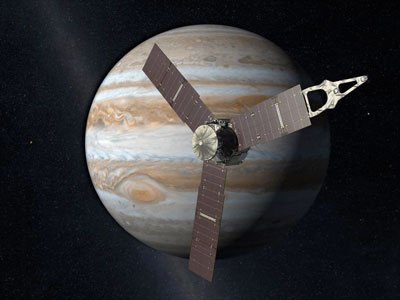
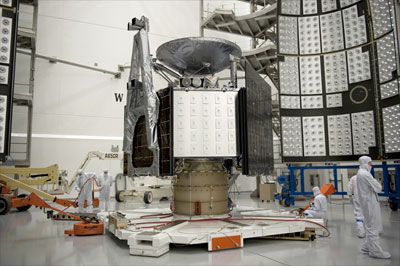
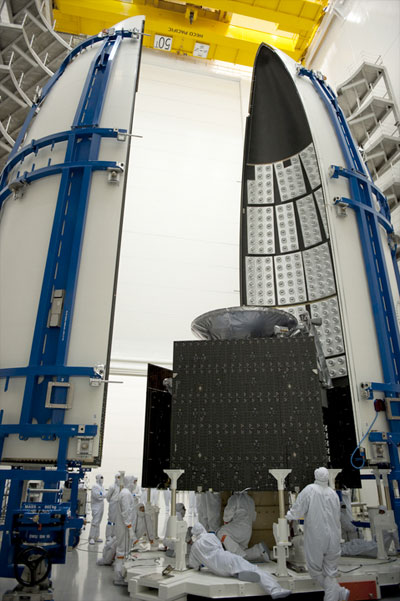
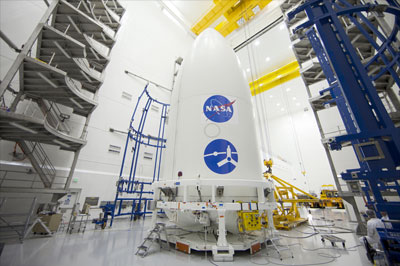
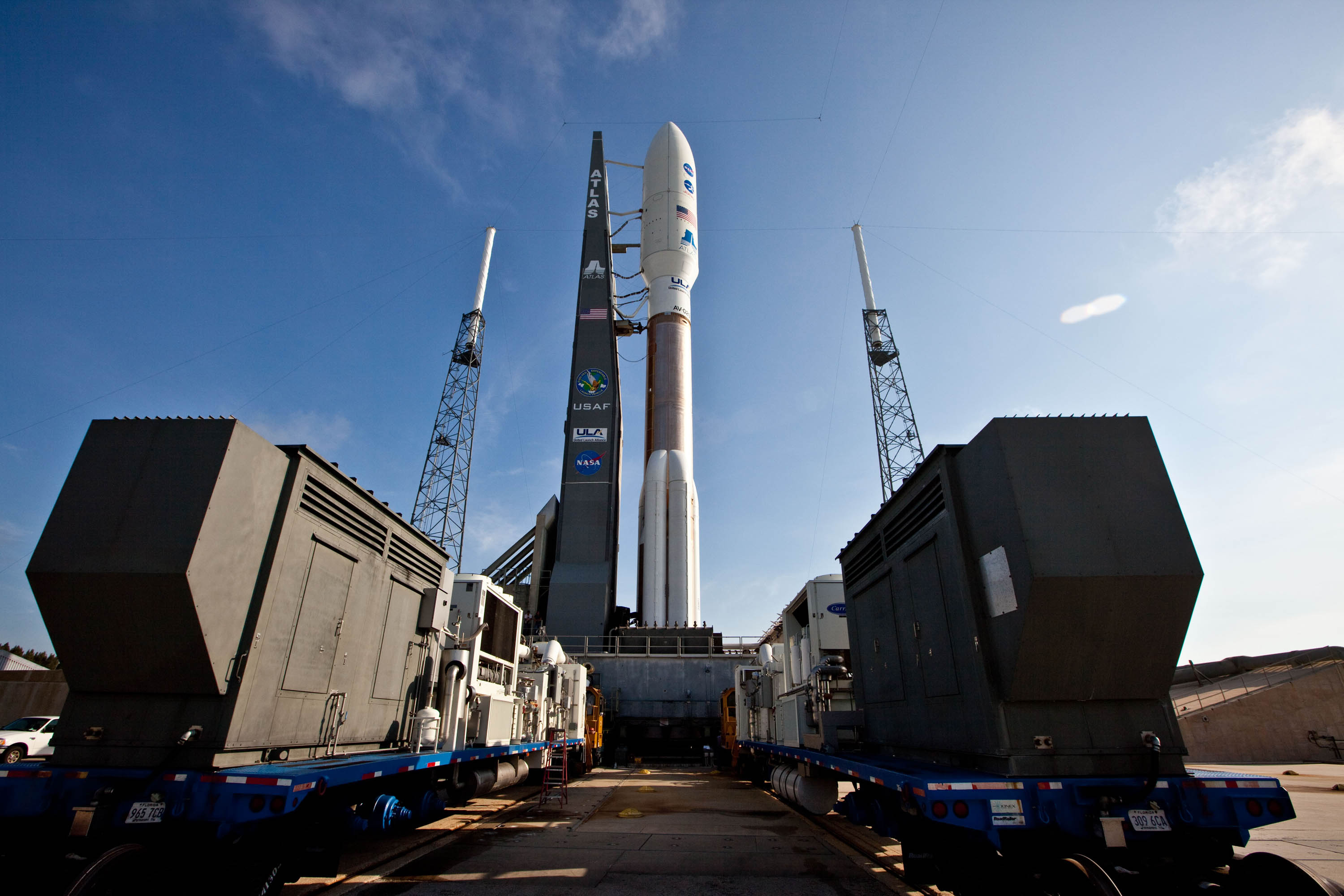
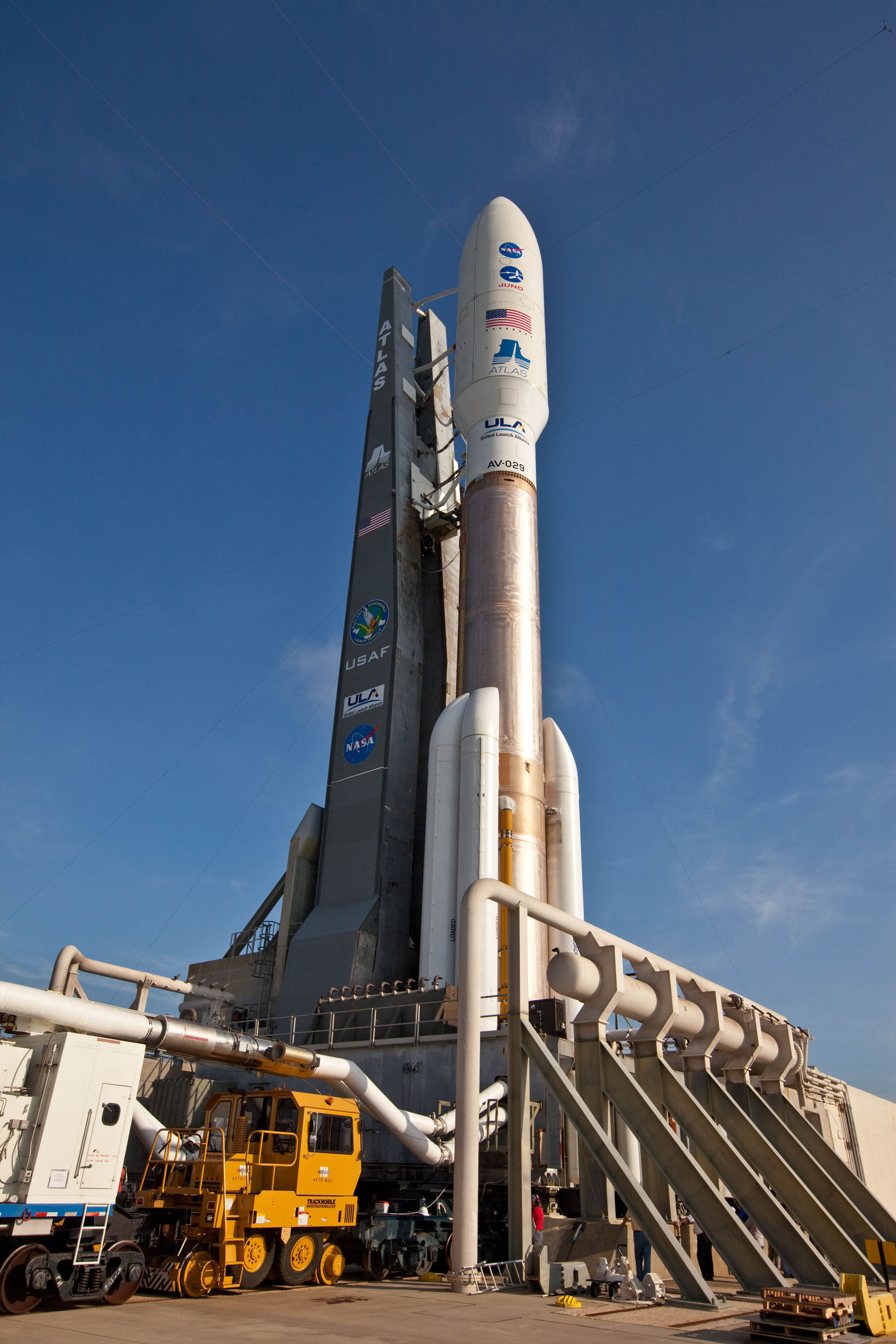
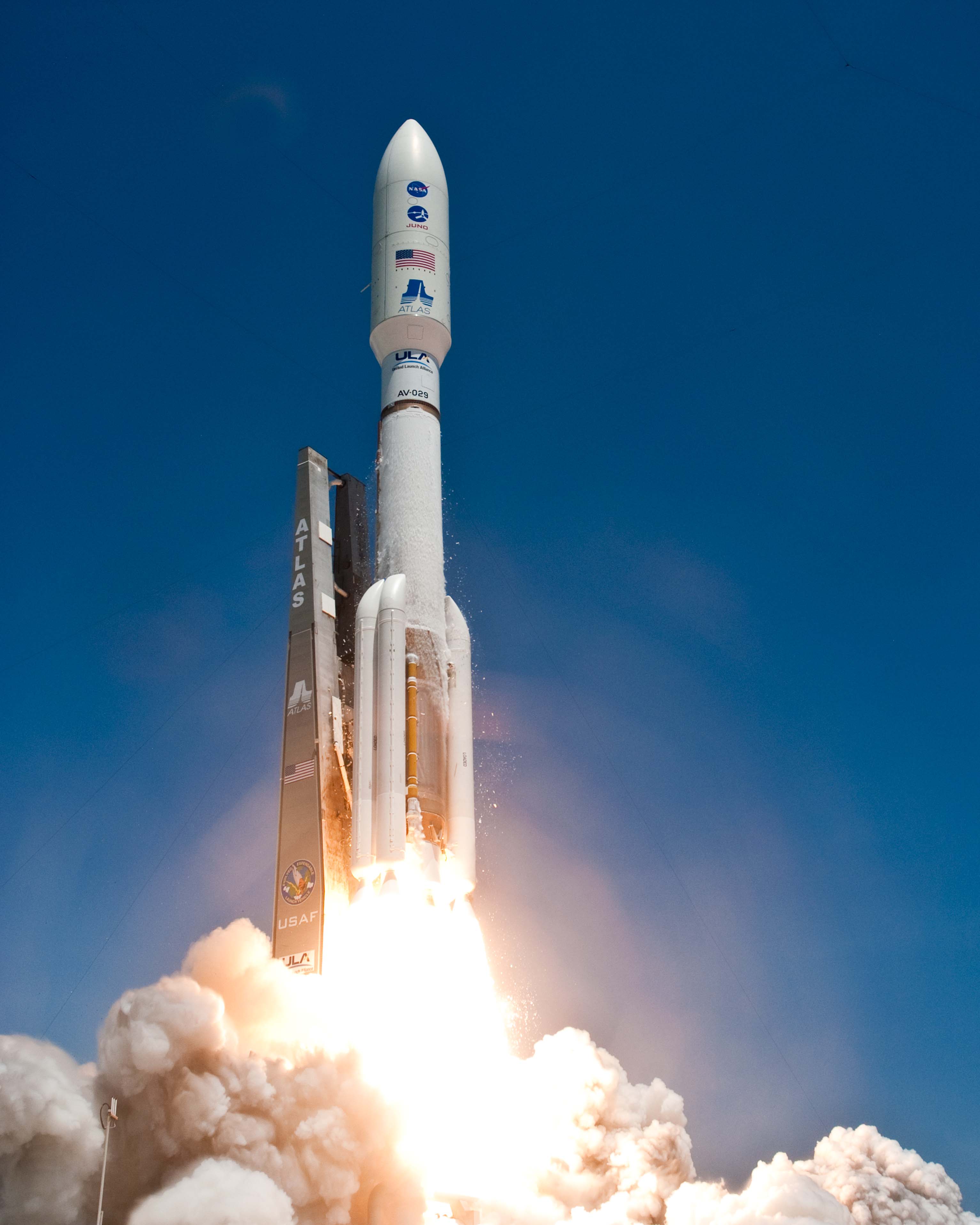

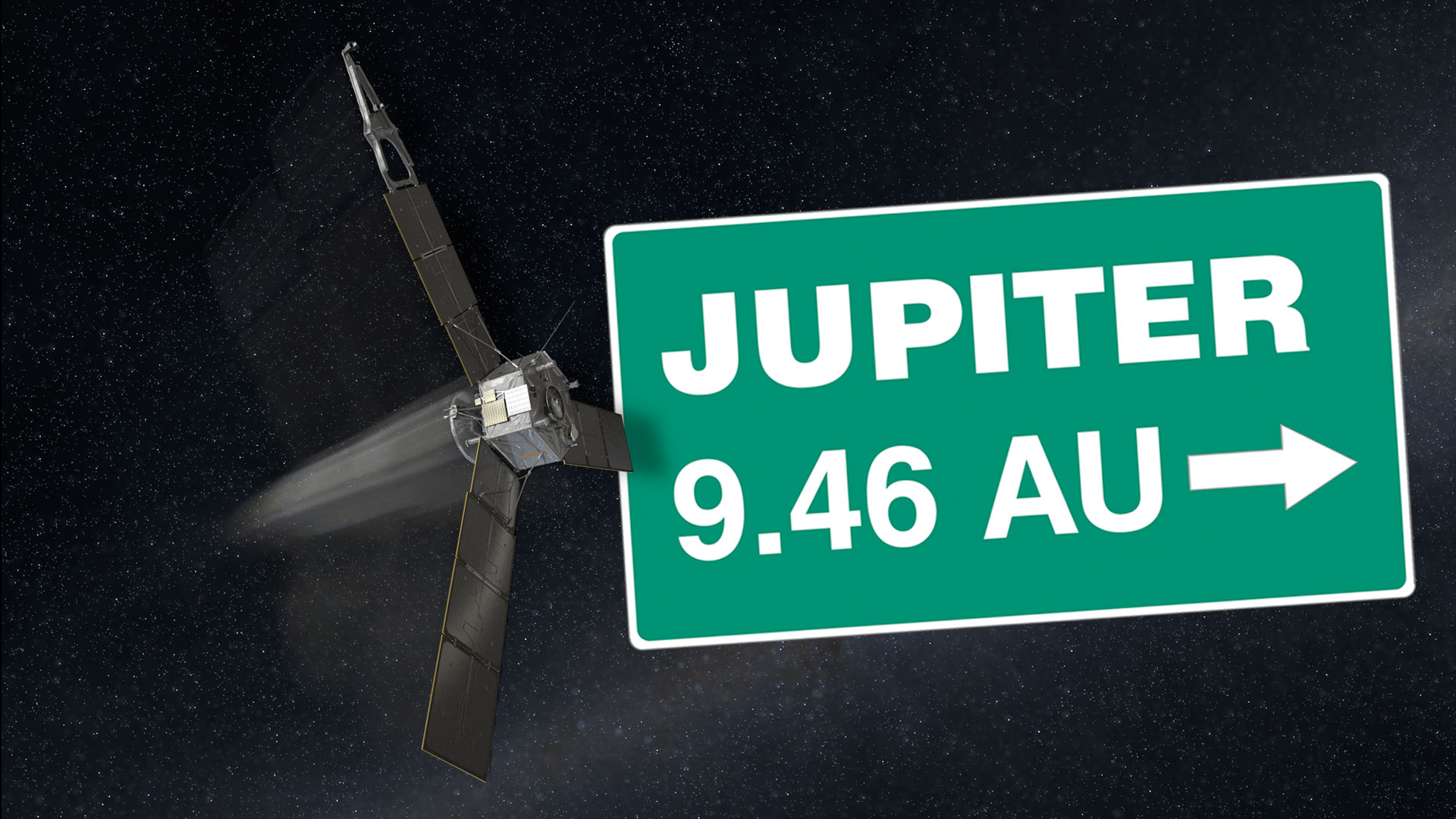
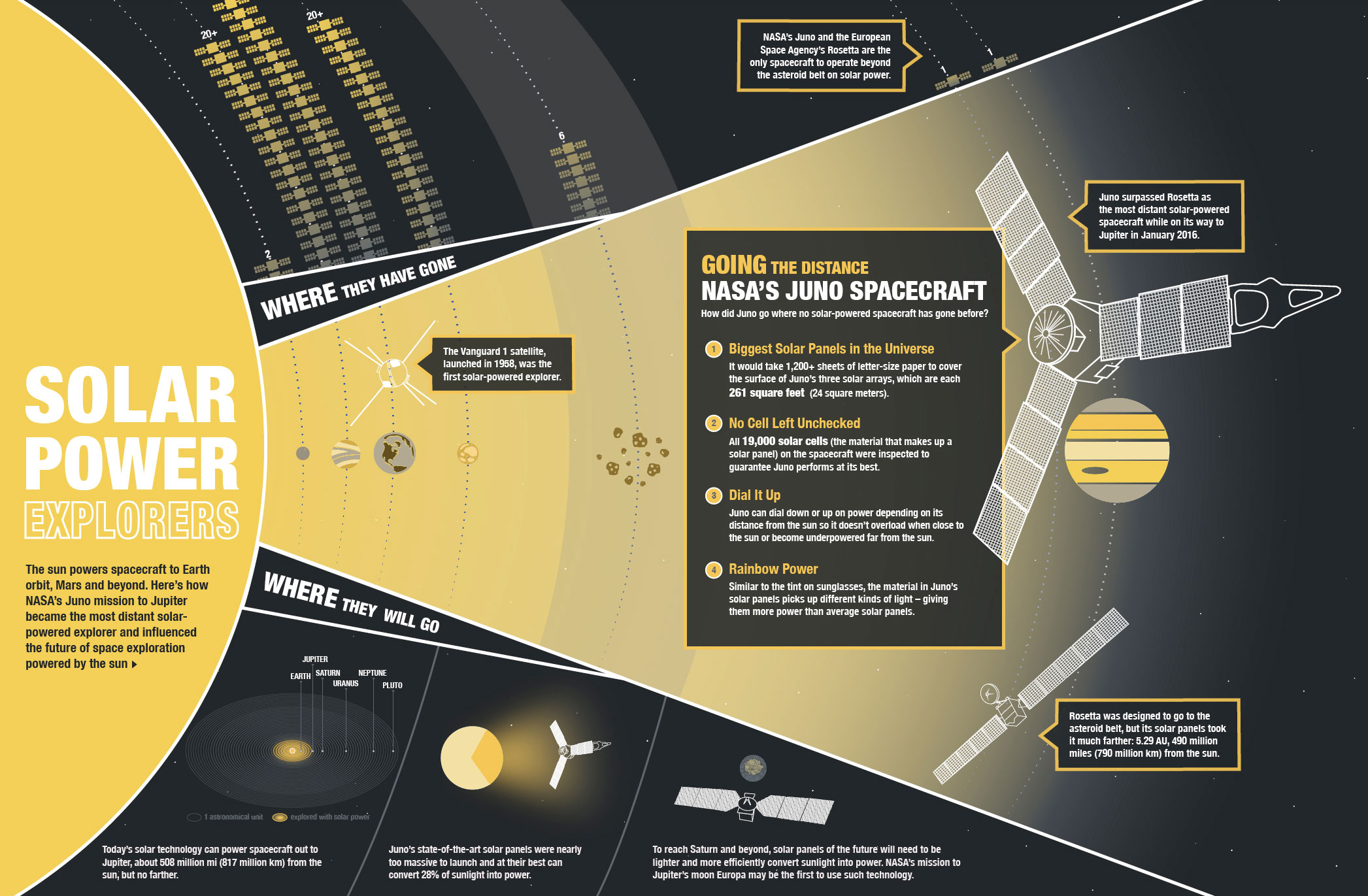
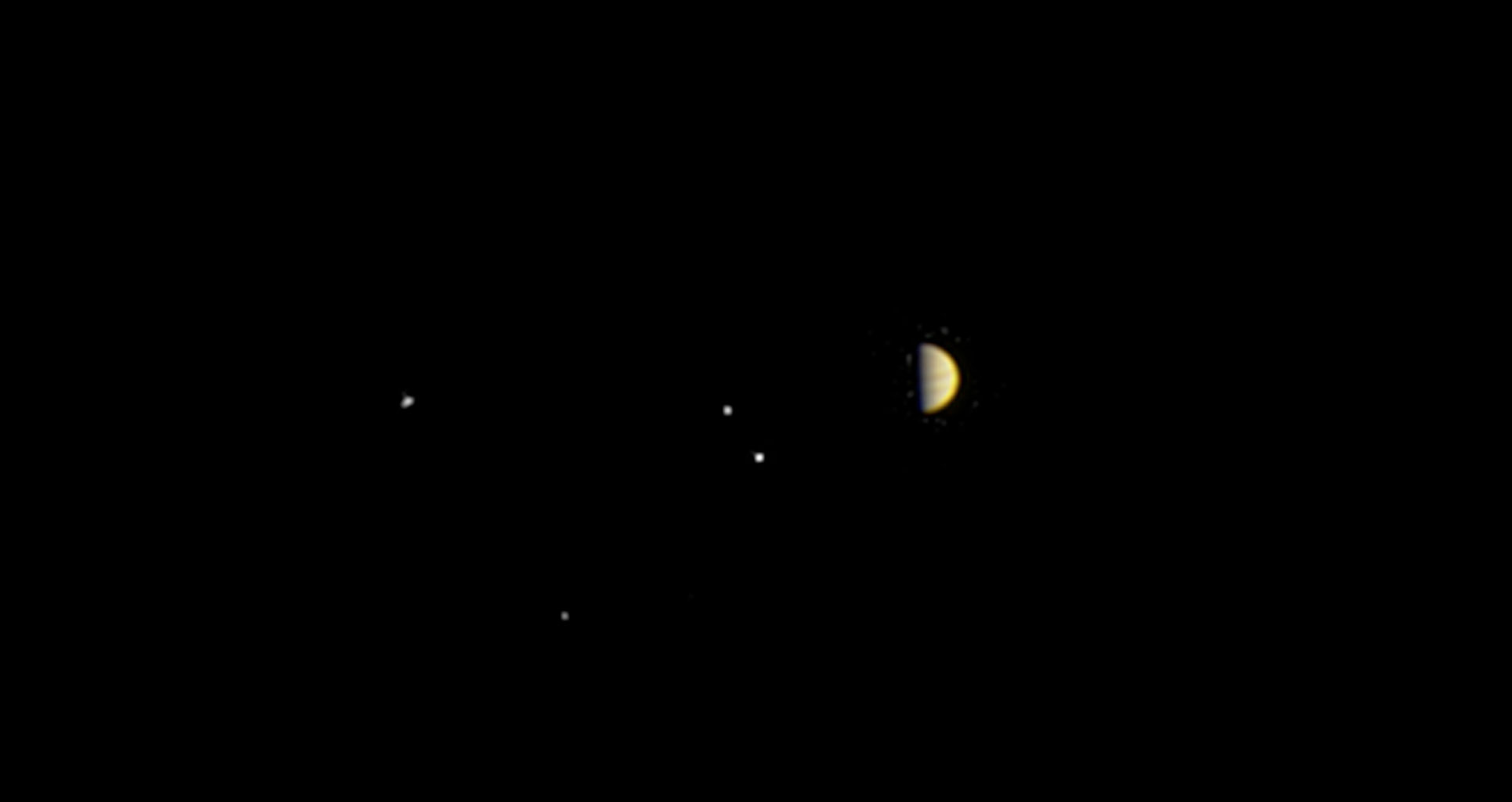
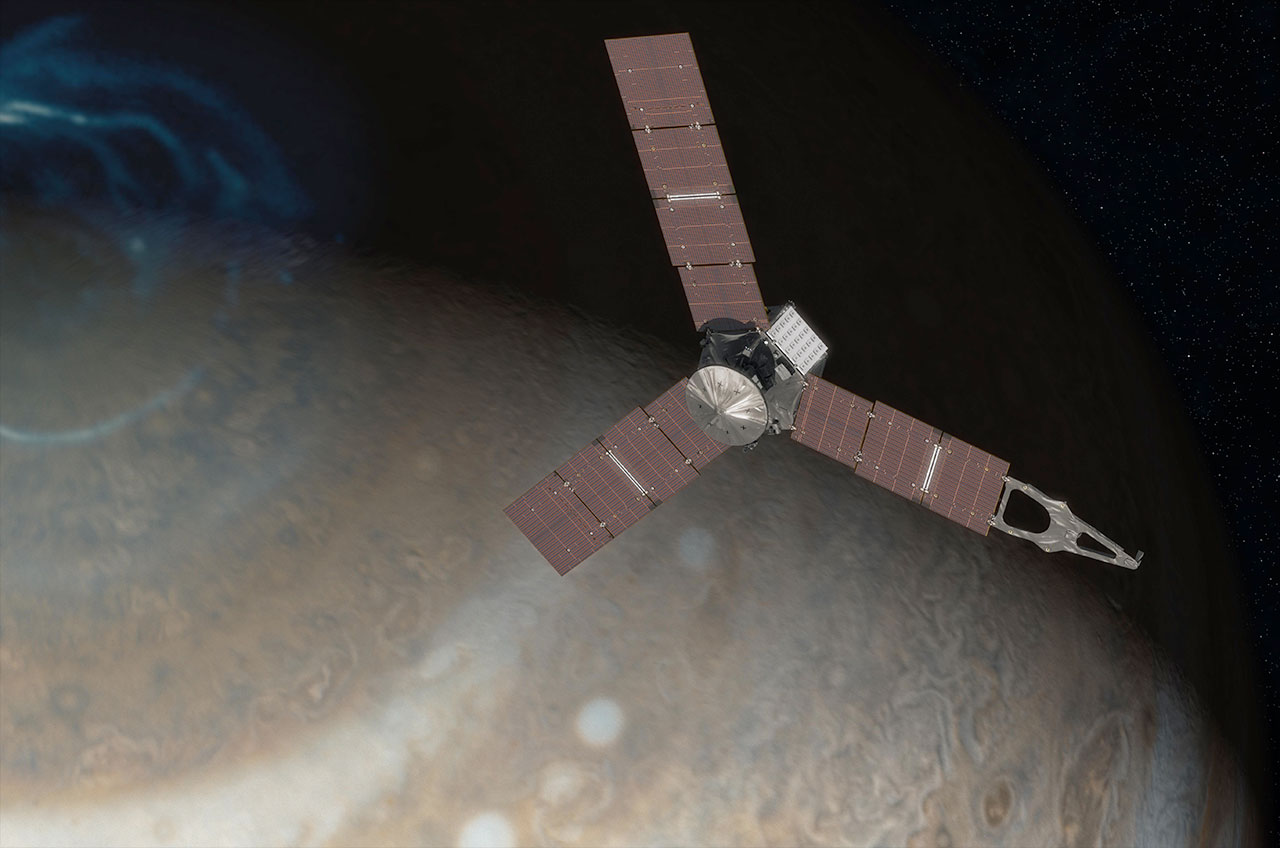
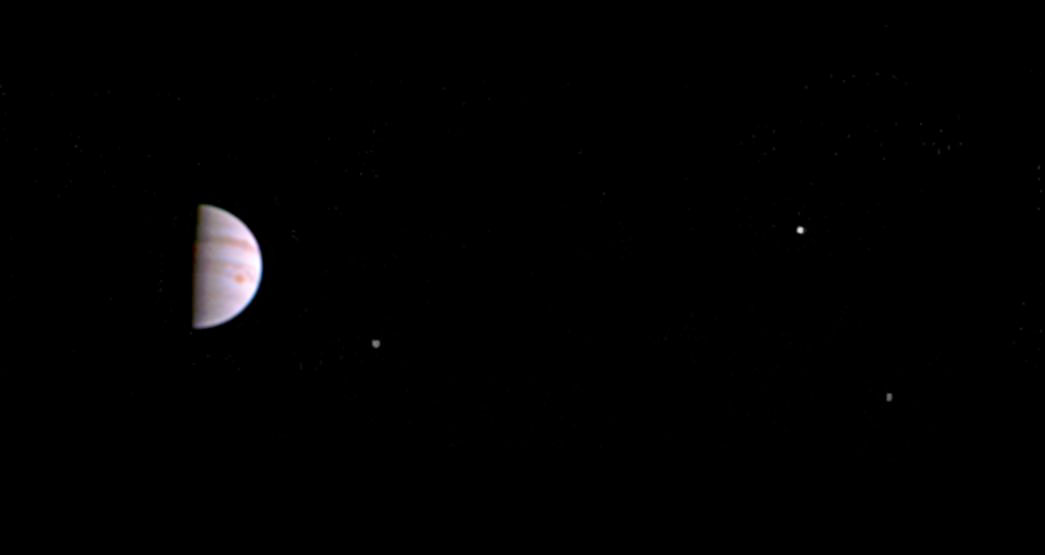
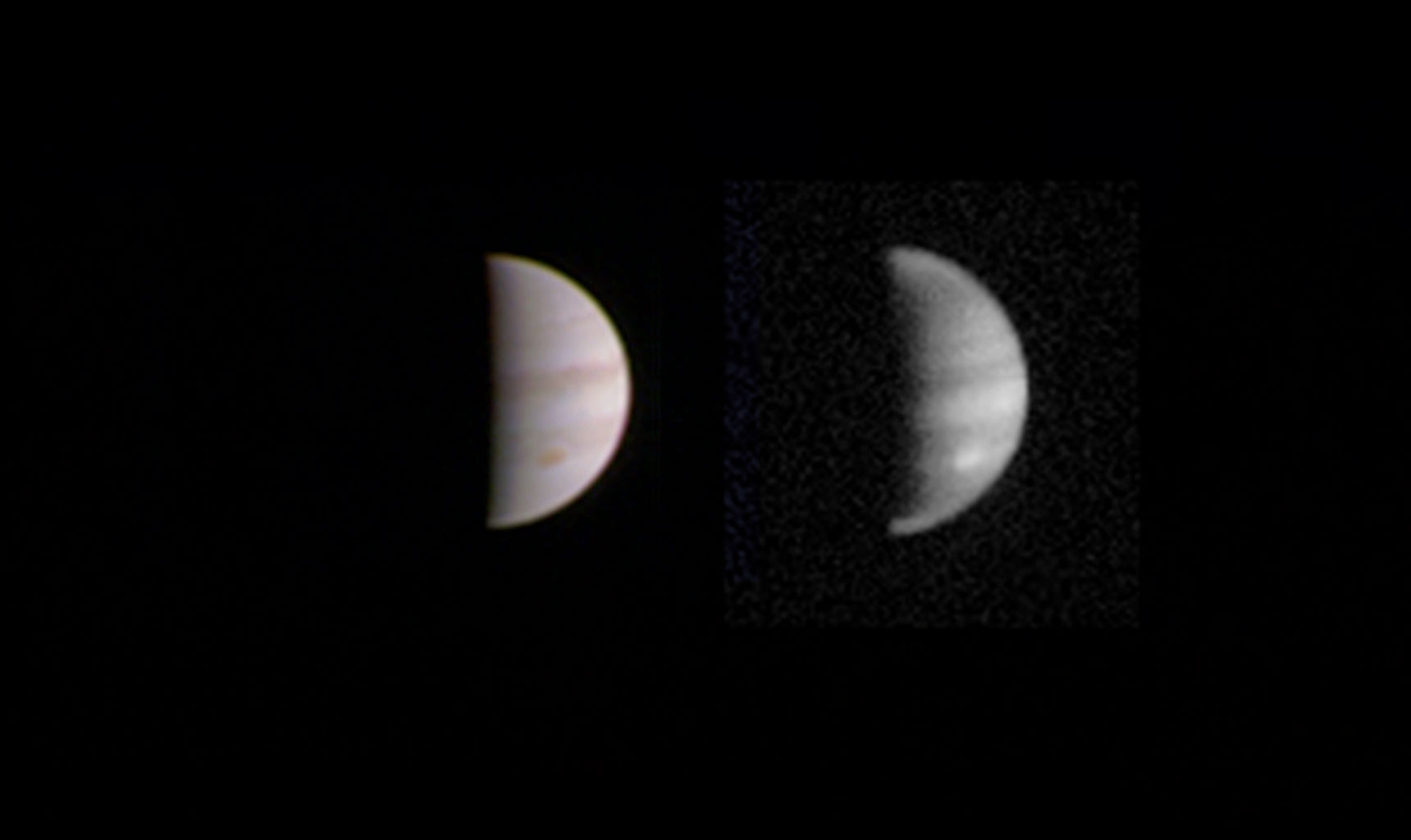
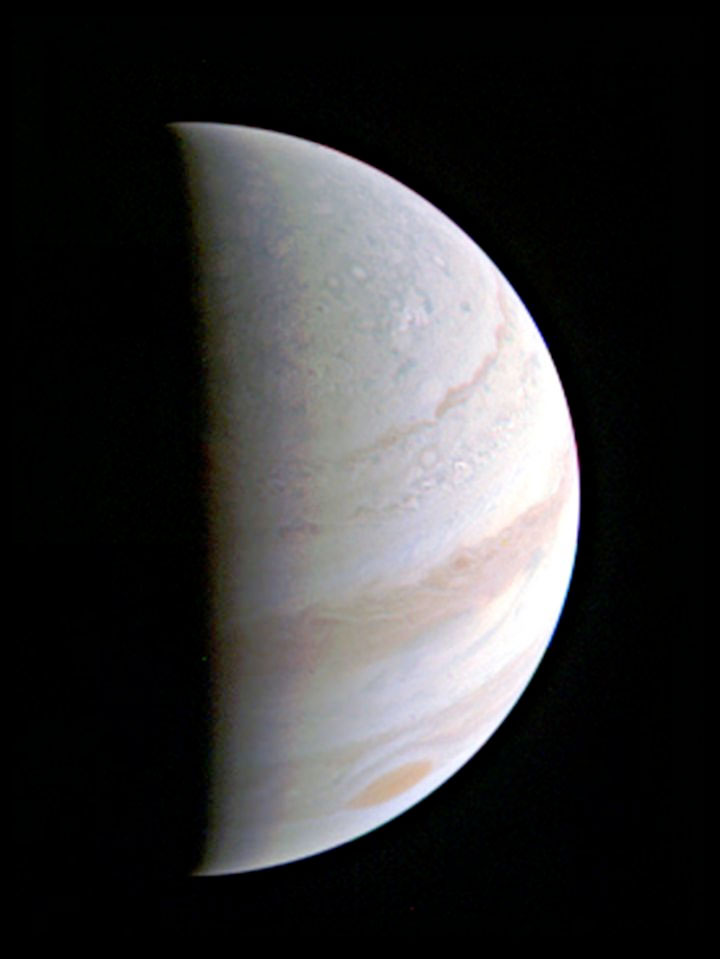
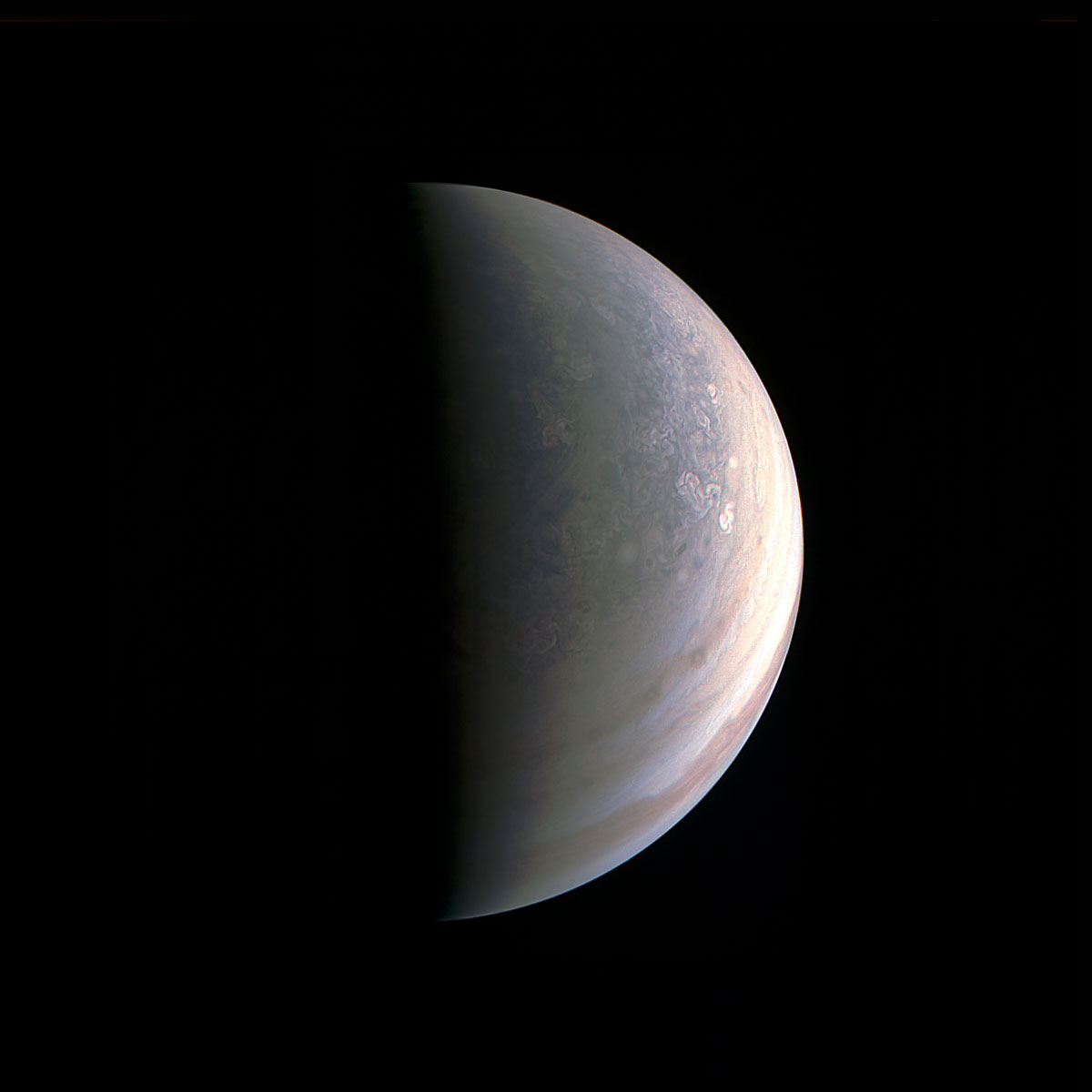
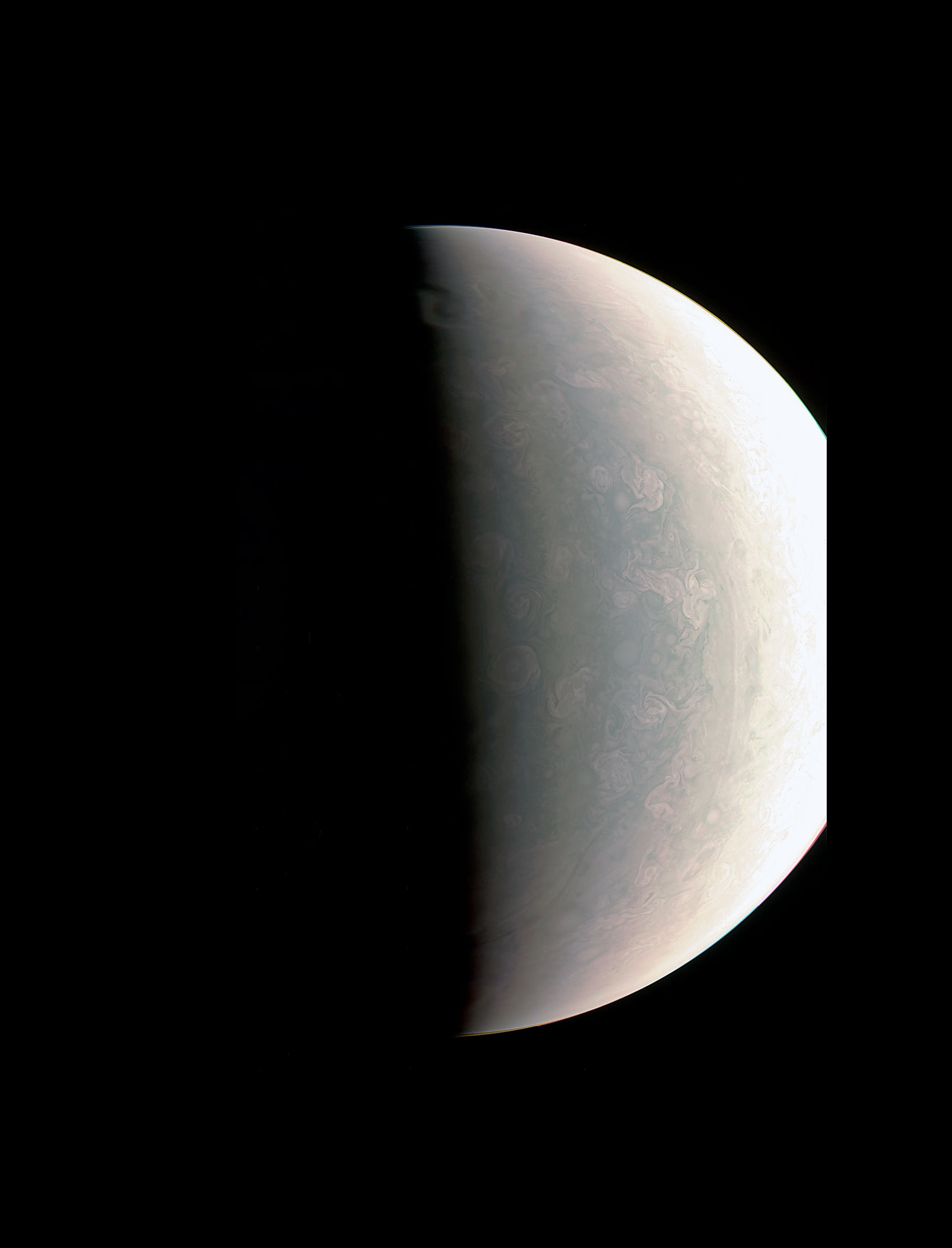
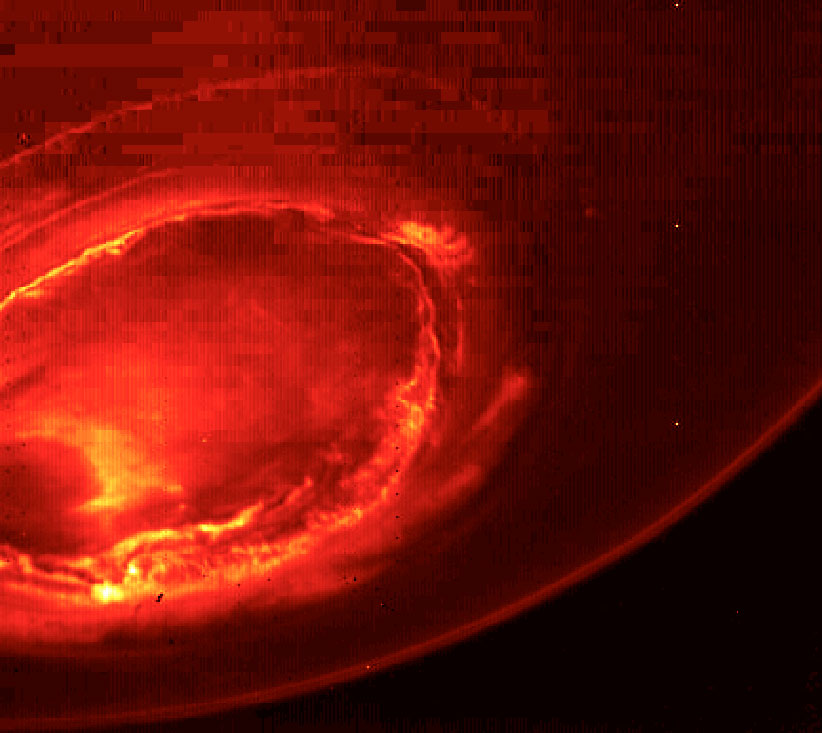
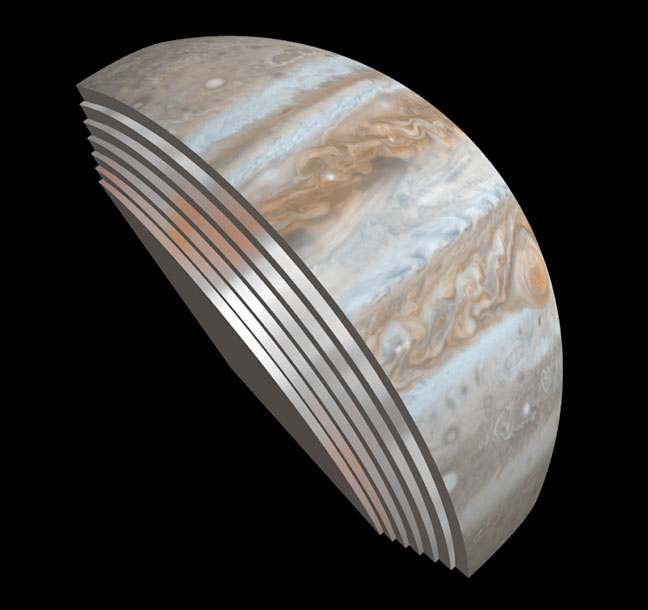
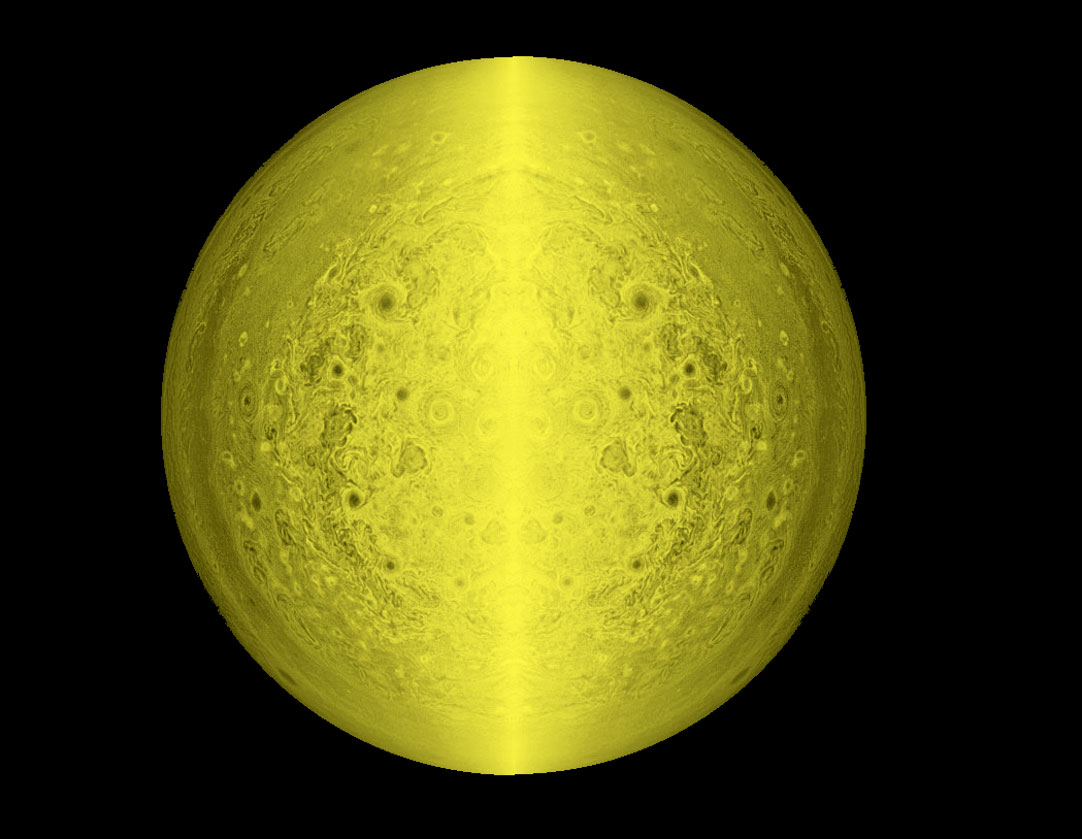
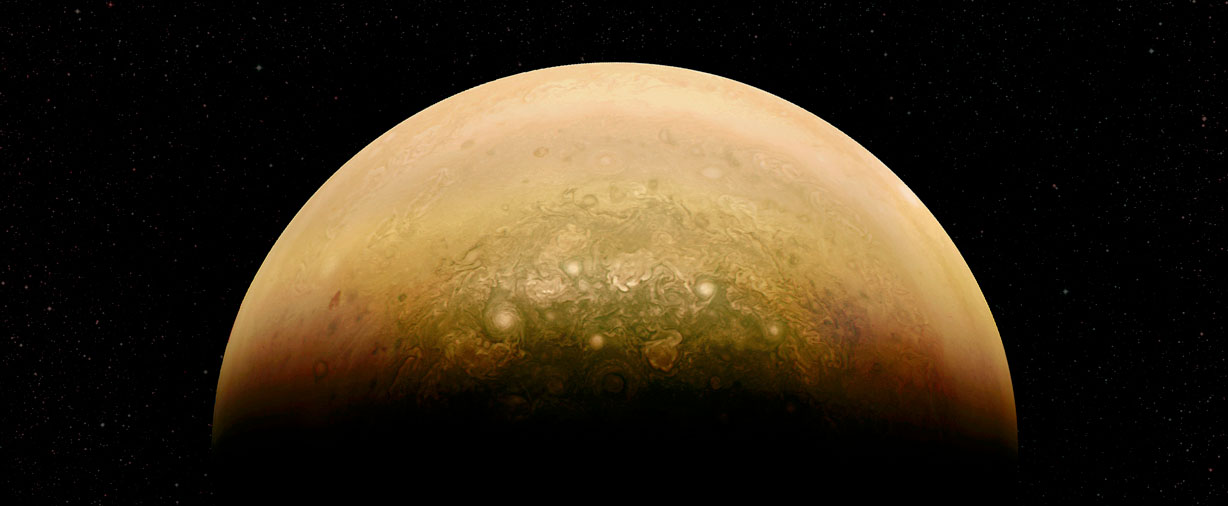
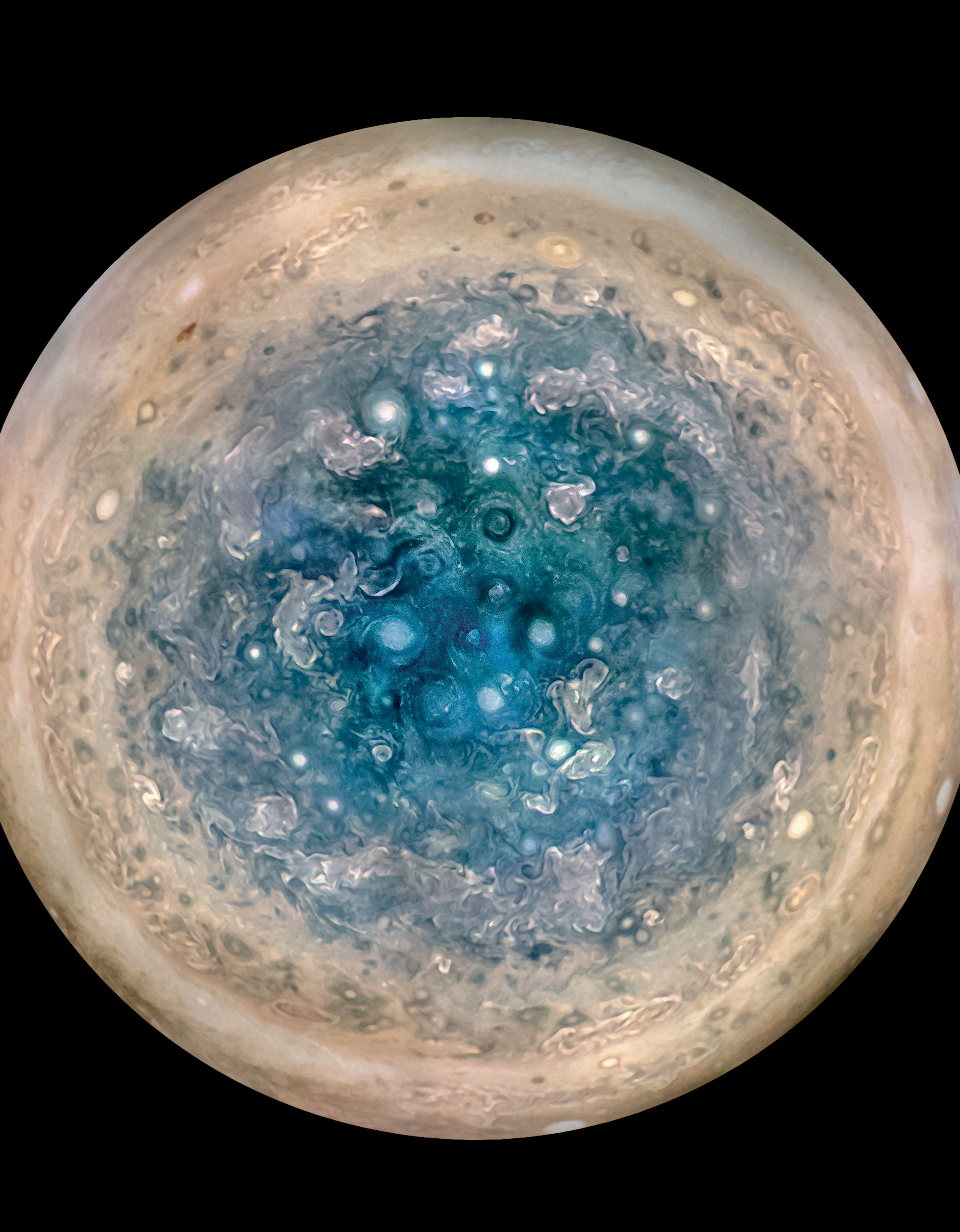

 advertisement