Posts: 57078 From: Houston, TX Registered: Nov 1999
posted 10-08-2008 10:00 AM
NASA's Mars Science Laboratory
NASA's Mars Science Laboratory (MSL) mission is preparing to set down a large, mobile laboratory using precision landing technology that makes many of Mars' most intriguing regions viable destinations for the first time. During the 23 months after landing, MSL will analyze dozens of samples drilled from rocks or scooped from the ground as it explores with greater range than any previous Mars rover.
MSL will carry the most advanced payload of scientific gear ever used on Mars' surface, a payload more than 10 times as massive as those of earlier Mars rovers. Its assignment: Investigate whether conditions have been favorable for microbial life and for preserving clues in the rocks about possible past life.
Plans for the Mars Science Laboratory call for launch from Cape Canaveral Air Force Station, Florida, between Nov. 25 and Dec. 18, 2011, and arrival at Mars in August 2012.
The spacecraft has been designed to steer itself during descent through Mars' atmosphere with a series of S-curve maneuvers similar to those used by astronauts piloting NASA space shuttles. During the three minutes before touchdown, the spacecraft slows its descent with a parachute, then uses retro rockets mounted around the rim of an upper stage. In the final seconds, the upper stage acts as a sky crane, lowering the upright rover on a tether to the surface.
MSL is about twice as long (about 3 meters or 10 feet) and five times as heavy as NASA's twin Mars Exploration Rovers, Spirit and Opportunity, launched in 2003. It inherited many design elements from them, including six-wheel drive, a rocker-bogie suspension system and cameras mounted on a mast to help the mission's team on Earth select exploration targets and driving routes. Unlike earlier rovers, MSL carries equipment to gather samples of rocks and soil, process them and distribute them to onboard test chambers inside analytical instruments.
NASA's Jet Propulsion Laboratory, Pasadena, Calif., builder of the Mars Science Laboratory, has engineered it to roll over obstacles up to 65 centimeters (25 inches) high and to travel up to about 200 meters (660 feet) per day on Martian terrain.
The rover's electrical power will be supplied by a U.S. Department of Energy radioisotope power generator. The multi-mission radioisotope thermoelectric generator produces electricity from the heat of plutonium-238's radioactive decay. This long-lived power supply gives the mission an operating lifespan on Mars' surface of a full Mars year (687 Earth days) or more. At launch, the generator will provide about 110 watts of electrical power to operate the rover's instruments, robotic arm, wheels, computers and radio. Warm fluids heated by the generator's excess heat are plumbed throughout the rover to keep electronics and other systems at acceptable operating temperatures.
The mission has been designed to use radio relays via Mars orbiters as the principal means of communication between Curiosity and the Deep Space Network of antennas on Earth.
The overarching science goal of the mission is to assess whether the landing area has ever had or still has environmental conditions favorable to microbial life, both its habitability and its preservation.
See here for discussion of NASA's Curiosity Mars Science Laboratory rover.
Robert Pearlman Editor
Posts: 57078 From: Houston, TX Registered: Nov 1999
posted 10-17-2008 05:31 AM
Lockheed Martin release
Lockheed Martin Delivers Mars Science Laboratory Backshell to NASA's Jet Propulsion Laboratory
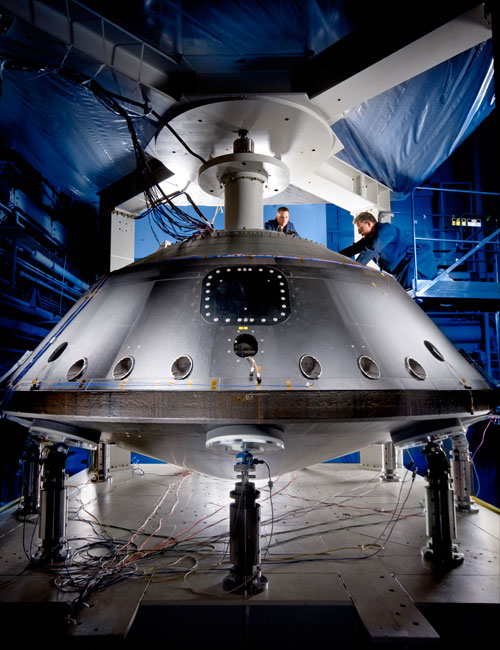
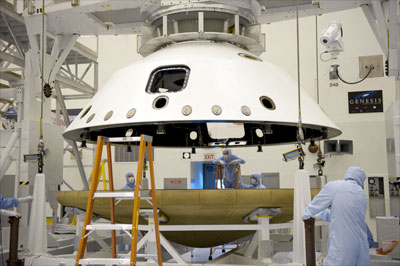
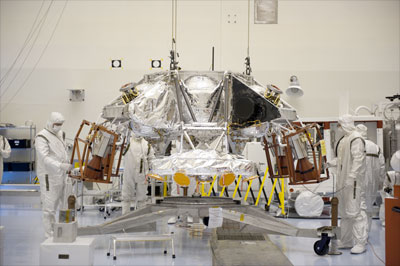
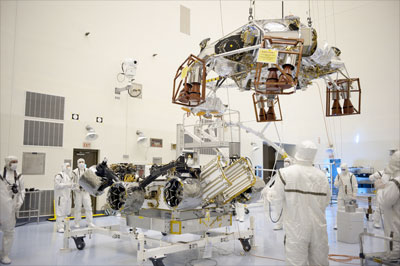
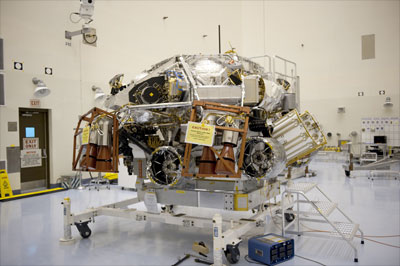
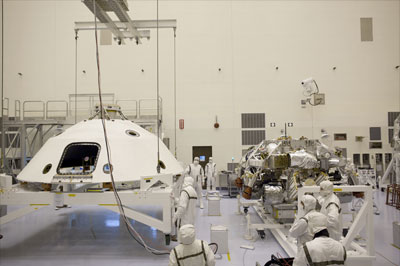
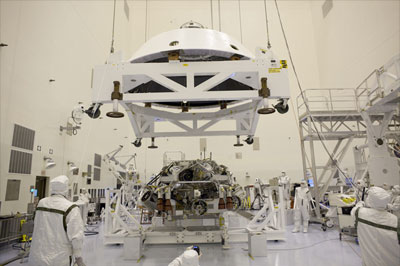
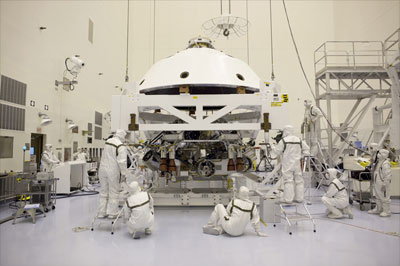
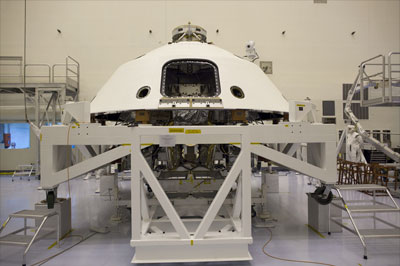
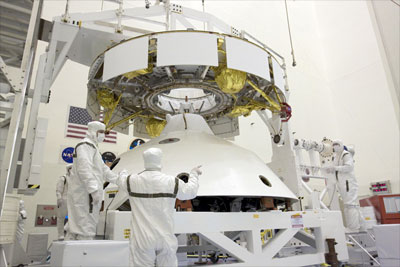
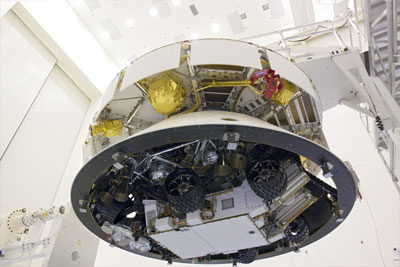
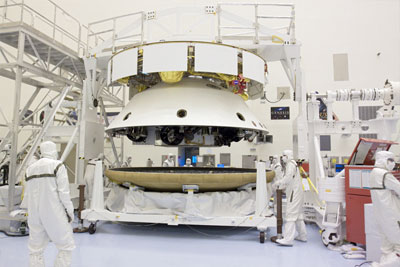
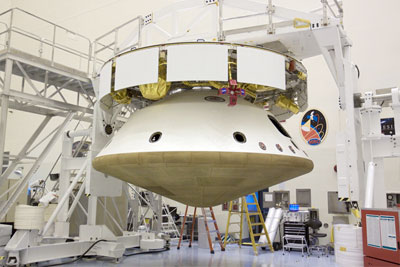
Lockheed Martin (NYSE: LMT) recently delivered the backshell for the Mars Science Laboratory (MSL) to NASA's Jet Propulsion Laboratory in Pasadena, Calif. The backshell is half of the large and sophisticated two-part aeroshell that will encapsulate and protect the MSL rover during its deep space cruise to Mars, and from the intense heat and friction that will be generated as the system descends through the Martian atmosphere.
Lockheed Martin has designed and built nearly every capsule flown by NASA for space exploration since Apollo, but none as large as the MSL aeroshell at about 15 feet in diameter. For comparison, the heatshields of the Spirit and Opportunity Mars Exploration Rovers measured 8.5 feet and Apollo capsule heatshields measured just under 13 feet.
In addition to protecting the rover, the backshell provides the structural support for the parachute and unique sky crane, a system that will lower the rover to a soft landing on the surface of Mars. The MSL biconic-shaped backshell is made of an aluminum honeycomb structure sandwiched between graphite-epoxy face sheets. It is covered with a thermal protection system composed of the cork/silicone super light ablator (SLA) 561v that originated with the Viking landers.
SLA 561v has been used on the heatshields of all Mars landers mission of past, but this is the first time it will be used on the backshell of a Mars mission. Lockheed Martin used the proprietary ablator on the backshell of the successful Genesis mission.
"The biggest challenge for the MSL aeroshell is its gigantic size," said Steve Jolly, Lockheed Martin Space Systems Company program manager for the MSL aeroshell. "It's almost double the size of our Mars Exploration Rovers' [Spirit and Opportunity] aeroshells. When you are building a structure that big, there are many considerations we had to take into account, including the fact that this is a lifting capsule that is steerable."
Designed to provide a more-precise landing than previous missions, the steering capability is produced by ejecting ballast that off-sets the center- of-mass prior to entry into the atmosphere. This off-set creates lift as it interacts with the thin Martian atmosphere and allows roll control and autonomous steering through the use of thrusters.
Scheduled for launch in the fall of 2009, the Mars Science Laboratory -- built by the Jet Propulsion Laboratory -- will support the Mars Exploration Program's strategy of "follow the water" and will have the science goals of determining whether the planet was ever habitable, characterizing the climate and geology of Mars, and preparing for human exploration.
The second half of the MSL aeroshell, the heatshield, is still in production at Lockheed Martin's Denver, Colo., facilities and is currently undergoing installation of the Phenolic Impregnated Carbon Ablator (PICA) tiles. It is scheduled to ship to Kennedy Space Center in April 2009.
The shipping of the MSL backshell comes just four months after the spectacular entry, descent, and landing of the Phoenix Mars Lander which also used an aeroshell system. Both the aeroshell and lander were designed and built by Lockheed Martin.
Lockheed Martin Space Systems Company, a major operating unit of Lockheed Martin Corporation, designs, develops, tests, manufactures and operates a full spectrum of advanced-technology systems for national security, civil and commercial customers. Chief products include human space flight systems; a full range of remote sensing, navigation, meteorological and communications satellites and instruments; space observatories and interplanetary spacecraft; laser radar; fleet ballistic missiles; and missile defense systems.
Headquartered in Bethesda, Md., Lockheed Martin is a global security company that employs about 140,000 people worldwide and is principally engaged in the research, design, development, manufacture, integration and sustainment of advanced technology systems, products and services. The corporation reported 2007 sales of $41.9 billion.
Robert Pearlman Editor
Posts: 57078 From: Houston, TX Registered: Nov 1999
posted 11-18-2008 02:26 PM
NASA release
NASA Invites Students to Name New Mars Rover
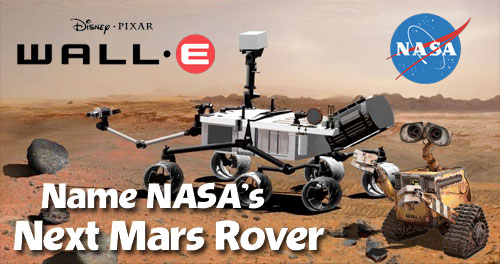
NASA is looking for the right stuff, or in this case, the right name for the next Mars rover. NASA, in cooperation with Walt Disney Studios Motion Pictures' movie WALL-E from Pixar Animation Studios, will conduct a naming contest for its car-sized Mars Science Laboratory rover that is scheduled for launch in 2009.
The contest begins Tuesday, Nov. 18, and is open to students 5 to 18 years old who attend a U.S. school and are enrolled in the current academic year. To enter the contest, students will submit essays explaining why their suggested name for the rover should be chosen. Essays must be received by Jan. 25, 2009. In March 2009, the public will have an opportunity to rank nine finalist names via the Internet as additional input for judges to consider during the selection process. NASA will announce the winning rover name in April 2009.
Disney will provide prizes to students submitting winning essays, including a trip to NASA's Jet Propulsion Laboratory in Pasadena, Calif., where the rover is under construction. The grand prize winner will have an opportunity to place a signature on the spacecraft and take part in the history of space exploration.
"Mars exploration has always captured the public imagination," said Mark Dahl, program executive for the Mars Science Laboratory at NASA Headquarters in Washington. "This contest will expand our ability to inspire students' interest in science and give the public a chance to participate in NASA's next expedition to Mars."
Walt Disney Studios Motion Pictures in Burbank, Calif., will make it possible for WALL-E, the name of its animated robotic hero and summer 2008 movie, to appear in online content inviting students to participate in the naming contest. The online WALL-E content will provide young viewers with a current connection to the human-robotic partnership that is transforming discovery and exploration. The contest coincides with Walt Disney Studios Home Entertainment's release of WALL-E on DVD and Blu-ray. The naming contest partnership is part of a Space Act Agreement between NASA and Disney designed to use the appeal of WALL-E in educational and public outreach efforts.
"All of us at Disney are delighted to be working with NASA in its educational and public outreach efforts to teach schoolchildren about space exploration, robot technology and the universe in which they live," said Mark Zoradi, president of Walt Disney Studios Motion Pictures Group. "WALL-E is one of the most lovable and entertaining characters that Pixar has ever created, and he is the perfect spokes-robot for this program."
The Mars Science Laboratory rover will be larger and more capable than any craft previously sent to land there. It will check whether the environment in a carefully selected landing region ever has been favorable for supporting microbial life. The rover will search for minerals that formed in the presence of water and look for several chemical building blocks of life.
"We are now in a phase when we're building and testing the rover before its journey to Mars," said John Klein, deputy project manager for the Mars Science Laboratory at JPL. "As the rover comes together and begins to take shape, the whole team can't wait to call it by name."
Additional assignments include imaging its surroundings in high definition, analyzing rocks with a high-powered laser beam, inspecting rocks and soil with a six-foot robotic arm, and cooking and sniffing rock powder delivered from a hammering drill to investigate what minerals are in Martian rocks.
Robert Pearlman Editor
Posts: 57078 From: Houston, TX Registered: Nov 1999
posted 12-04-2008 11:02 AM
NASA announced today it was delaying Mars Science Laboratory's launch to 2011.
NASA's Mars Science Laboratory will launch two years later than previously planned in the fall of 2011. The mission will send a next-generation rover with unprecedented research tools to study the early environmental history of Mars.
A launch date of October 2009 no longer is feasible because of testing and hardware challenges that must be addressed to ensure mission success. The window for a 2009 launch ends in late October. The relative positions of Earth and Mars are favorable for flights to Mars only a few weeks every two years. The next launch opportunity after 2009 is in 2011.
"We will not lessen our standards for testing the mission's complex flight systems, so we are choosing the more responsible option of changing the launch date," said Doug McCuistion, director of the Mars Exploration Program at NASA Headquarters in Washington. "Up to this point, efforts have focused on launching next year, both to begin the exciting science and because the delay will increase taxpayers' investment in the mission. However, we've reached the point where we can not condense the schedule further without compromising vital testing."
The Mars Science Laboratory team recently completed an assessment of the progress it has made in the past three months. As a result of the team's findings, the launch date was changed.
"Despite exhaustive work in multiple shifts by a dedicated team, the progress in recent weeks has not come fast enough on solving technical challenges and pulling hardware together," said Charles Elachi, director of NASA's Jet Propulsion Laboratory in Pasadena, Calif. "The right and smart course now for a successful mission is to launch in 2011."
The advanced rover is one of the most technologically challenging interplanetary missions ever designed. It will use new technologies to adjust its flight while descending through the Martian atmosphere, and to set the rover on the surface by lowering it on a tether from a hovering descent stage. Advanced research instruments make up a science payload 10 times the mass of instruments on NASA's Spirit and Opportunity Mars rovers. The Mars Science Laboratory is engineered to drive longer distances over rougher terrain than previous rovers. It will employ a new surface propulsion system.
Rigorous testing of components and systems is essential to develop such a complex mission and prepare it for launch. Tests during the middle phases of development resulted in decisions to re-engineer key parts of the spacecraft.
"Costs and schedules are taken very seriously on any science mission," said Ed Weiler, associate administrator for NASA's Science Mission Directorate at NASA Headquarters. "However, when it's all said and done, the passing grade is mission success."
The mission will explore a Mars site where images taken by NASA's orbiting spacecraft indicate there were wet conditions in the past. Four candidate landing sites are under consideration. The rover will check for evidence of whether ancient Mars environments had conditions favorable for supporting microbial life and preserving evidence of that life if it existed there.
NASA's Jet Propulsion Laboratory manages the Mars Science Laboratory project for the Science Mission Directorate.
Robert Pearlman Editor
Posts: 57078 From: Houston, TX Registered: Nov 1999
posted 01-22-2009 07:06 PM
Robert Pearlman Editor
Posts: 57078 From: Houston, TX Registered: Nov 1999
posted 03-19-2009 02:43 PM
NASA release
Online Poll for NASA's Mars Rover Naming Contest Opens March 23
NASA will post online nine names that are finalists for the agency's Mars Science Laboratory mission and invite the public to vote for its favorite. The non-binding poll to help NASA select a name opens online Monday, March 23, and will accept votes through March 29.
More than 9,000 students in kindergarten through 12th grades submitted essays proposing names for the rover in a nationwide contest that ended Jan. 25. Entries came from all 50 states, Puerto Rico and the families of American service personnel overseas. NASA will select the winning name, based on a student's essay and the public poll, and announce the name in April.
"The names that students proposed range from heroes to animals and bugs," said Michelle Viotti, manager of the Mars Public Engagement program at NASA's Jet Propulsion Laboratory, or JPL, in Pasadena, Calif. "No matter what name is finally chosen, this is a mission for everyone, and we can't wait to start calling this rover by name."
The student who submitted the winning name will be invited to JPL to sign the rover. Additionally, all 30 student semi-finalists in the naming contest will have an opportunity to place an individually-tailored message on the chip. For worldwide participation beyond the contest, the public has a chance to participate in "Send Your Name to Mars." The agency will collect names to be recorded on a microchip that will be carried on the car-sized robotic explorer. Names will be collected via the contest web link beginning Monday.
The naming contest is part of a Space Act Agreement between NASA and Disney. Walt Disney Studios Motion Pictures is the prize provider for the contest. This collaboration made it possible for WALL-E, the animated robotic hero from the 2008 movie of the same name, to appear in online content inviting students to participate.
Scheduled to launch in 2011 and land on Mars in 2012, the rover will use a set of advanced science instruments to check whether the environment in a selected landing region ever has been favorable for supporting microbial life and preserving evidence of such life. The rover also will search for minerals that formed in the presence of water and look for chemical building blocks of life.
JPL manages the mission for NASA's Science Mission Directorate in Washington.>
Robert Pearlman Editor
Posts: 57078 From: Houston, TX Registered: Nov 1999
posted 03-23-2009 08:08 AM
The nine finalist names have been revealed and the polls are now open for votes:
Sunrise
Pursuit
Journey
Vision
Amelia
Curiosity
Perception
Adventure
Wonder
You can also send your own name on the soon-to-be re-named Mars Science Lab.
Robert Pearlman Editor
Posts: 57078 From: Houston, TX Registered: Nov 1999
posted 04-24-2009 09:04 PM
NASA photo release
Mars Parachute Testing in World's Largest Wind Tunnel
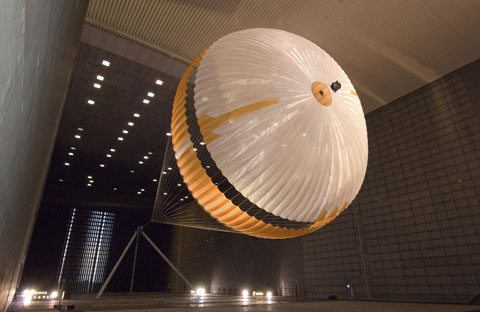
The parachute for NASA's next mission to Mars passed flight-qualification testing in March and April 2009 inside the world's largest wind tunnel, at NASA Ames Research Center, Moffett Field, Calif.
NASA's Mars Science Laboratory mission, to be launched in 2011 and land on Mars in 2012, will use the largest parachute ever built to fly on an extraterrestrial mission.
This image shows a duplicate qualification-test parachute inflated in an 80-mile-per-hour (36-meter-per-second) wind inside the test facility. The parachute uses a configuration called disk-gap-band. It has 80 suspension lines, measures more than 50 meters (165 feet) in length, and opens to a diameter of nearly 16 meters (51 feet). Most of the orange and white fabric is nylon, though a small disk of heavier polyester is used near the vent in the apex of the canopy due to higher stresses there. It is designed to survive deployment at Mach 2.2 in the Martian atmosphere, where it will generate up to 65,000 pounds of drag force.
The wind tunnel is 24 meters (80 feet) tall and 37 meters (120 feet) wide, big enough to house a Boeing 737. It is part of the National Full-Scale Aerodynamics Complex, operated by the Arnold Engineering Development Center of the U.S. Air Force.
Pioneer Aerospace, South Windsor, Conn., built the parachutes for testing and for flying on the Mars Science Laboratory. NASA's Jet Propulsion Laboratory, Pasadena, Calif., manages the Mars Science Laboratory project for the NASA Science Mission Directorate, Washington, and is building and testing the mission's spacecraft. JPL is a division of the California Institute of Technology.
Robert Pearlman Editor
Posts: 57078 From: Houston, TX Registered: Nov 1999
posted 05-27-2009 09:56 AM
NASA release
NASA Selects Student's Entry as New Mars Rover Name
NASA's Mars Science Laboratory rover, scheduled for launch in 2011, has a new name thanks to a sixth-grade student from Kansas. Twelve-year-old Clara Ma from the Sunflower Elementary school in Lenexa submitted the winning entry, "Curiosity." As her prize, Ma wins a trip to NASA's Jet Propulsion Laboratory (JPL) in Pasadena, Calif., where she will be invited to sign her name directly onto the rover as it is being assembled.
A NASA panel selected the name following a nationwide student contest that attracted more than 9,000 proposals via the Internet and mail. The panel primarily took into account the quality of submitted essays. Name suggestions from the Mars Science Laboratory project leaders and a non-binding public poll also were considered.
"Students from every state suggested names for this rover. That's testimony to the excitement Mars missions spark in our next generation of explorers," said Mark Dahl, the mission's program executive at NASA Headquarters in Washington. "Many of the nominating essays were excellent and several of the names would have fit well. I am especially pleased with the choice, which recognizes something universally human and essential to science."
Ma decided to enter the rover-naming contest after she heard about it at her school.
"I was really interested in space, but I thought space was something I could only read about in books and look at during the night from so far away," Ma said. "I thought that I would never be able to get close to it, so for me, naming the Mars rover would at least be one step closer."
"Curiosity is an everlasting flame that burns in everyone's mind. It makes me get out of bed in the morning and wonder what surprises life will throw at me that day," Ma wrote in her winning essay. "Curiosity is such a powerful force. Without it, we wouldn't be who we are today. Curiosity is the passion that drives us through our everyday lives. We have become explorers and scientists with our need to ask questions and to wonder."
The naming contest was conducted in partnership with Disney-Pixar's animated film "WALL-E." The activity invited ideas from students 5 - 18 years old enrolled in a U.S. school. The contest started in November 2008. Entries were accepted until midnight Jan. 25.
Walt Disney Studios Motion Pictures supplied the prizes for the contest, including 30 for semifinalists related to "WALL-E." Nine finalists have been invited to provide messages to be placed on a microchip mounted on Curiosity. The microchip also will contain the names of thousands of people around the world who have "signed" their names electronically via the Internet. Additional electronic signatures still are being accepted via the Internet.
"We have been eager to call the rover by name," said Pete Theisinger, who manages the JPL team building and testing Curiosity. "Giving it a name worthy of this mission's quest means a lot to the people working on it."
Curiosity will be larger and more capable than any craft previously sent to land on the Red Planet. It will check to see whether the environment in a selected landing region ever has been favorable for supporting microbial life and preserving evidence of life. The rover also will search for minerals that formed in the presence of water and look for several chemical building blocks of life.
The Mars Science Laboratory project is managed by JPL for NASA's Science Mission Directorate in Washington.
Robert Pearlman Editor
Posts: 57078 From: Houston, TX Registered: Nov 1999
An industry-wide concern over bad titanium could add more cost to the already over-budget $2.3 billion Mars Science Laboratory mission because engineers need to check the integrity of the metal used in the structure of the spacecraft, NASA officials told an agency advisory committee.
"Everybody thought we were buying a (military) standard titanium that was properly treated for use. It turns out it wasn't worked properly," said Doug McCuistion, director of NASA's Mars exploration program.
Robert Pearlman Editor
Posts: 57078 From: Houston, TX Registered: Nov 1999
posted 05-21-2010 09:53 AM
NASA Jet Propulsion Laboratory release
Geometry Drives Selection Date for 2011 Mars Launch
Planners of NASA's next Mars mission have selected a flight schedule that will use favorable positions for two currently orbiting NASA Mars orbiters to obtain maximum information during descent and landing.
Continuing analysis of the geometry and communications options for the arrival at Mars have led planners for the Mars Science Laboratory, or Curiosity, to choose an Earth-to-Mars trajectory that schedules launch between Nov. 25 and Dec. 18, 2011. Landing will take place between Aug. 6 and Aug. 20, 2012. Due to an Earth-Mars planetary alignment, this launch period actually allows for a Mars arrival in the earlier portion of the landing dates under consideration.
"The key factor was a choice between different strategies for sending communications during the critical moments before and during touchdown," said Michael Watkins, mission manager at NASA's Jet Propulsion Laboratory in Pasadena, Calif. "The shorter trajectory is optimal for keeping both orbiters in view of Curiosity all the way to touchdown on the surface of Mars. The longer trajectory allows direct communication to Earth all the way to touchdown."
The simplicity of direct-to-Earth communication from Curiosity during landing has appeal to mission planners, in comparison to relying on communications relayed via NASA's Mars Odyssey, which has been orbiting Mars since 2001, and NASA's Mars Reconnaissance Orbiter, in operation since 2006. However, the direct-to-Earth option allows a communication rate equivalent to only about 1 bit per second, while the relay option allows about 8,000 bits or more per second.
Landing on Mars is always difficult, with success uncertain. After an unsuccessful attempted Mars landing in 1999 without definitive information on the cause of the mishap, NASA put a high priority on communication during subsequent Mars landings.
"It is important to capture high-quality telemetry to allow us to learn what happens during the entry, descent and landing, which is arguably the most challenging part of the mission," said Fuk Li, manager of NASA's Mars Exploration Program at JPL. "The trajectory we have selected maximizes the amount of information we will learn to mitigate any problems."
Curiosity will use several innovations during entry into the Martian atmosphere, descent and landing in order to hit a relatively small target area on the surface and set down a rover too heavy for the cushioning air bags used in earlier Mars rover landings. In a "sky-crane" maneuver during the final minute of arrival, a rocket-powered descent stage will lower Curiosity on a tether for a wheels-down landing directly onto the surface.
Even though Curiosity won't be communicating directly with Earth at touchdown, data about the landing will reach Earth promptly. Odyssey will be in view of both Earth and Curiosity, in position to immediately forward to Earth the data stream it is receiving during the touchdown. Odyssey performed this type of "bent-pipe" relay during the May 25, 2008, arrival of NASA's Phoenix Mars Lander.
Curiosity will rove extensively on Mars, carrying an analytical laboratory and other instruments to examine a carefully selected landing area. It will investigate whether conditions there have favored development of microbial life and its preservation in the rock record. Plans call for the mission to operate on Mars for a full Martian year, which is equivalent to two Earth years.
Consideration of landing sites for the mission narrowed to four finalist candidates in November 2008. The candidate sites are still being analyzed for safety and science attributes.
Robert Pearlman Editor
Posts: 57078 From: Houston, TX Registered: Nov 1999
NASA is closing in on the end of a long process -- which began three years ago -- to poll the Mars science community for potential landing sites, then weigh the pros and cons of each.
Now, out of some 60 possible sites considered at different stages of the process, the list has been whittled down to four. They are regions of Mars known as Mawrth Vallis, Gale crater, Holden crater and Eberswalde crater.
"These are the best places you could possibly imagine you would want to go, and for the first time, you can actually land near them and get to them," said Matthew Golombek of JPL, co-chair of the Curiosity rover landing site steering committee.
Robert Pearlman Editor
Posts: 57078 From: Houston, TX Registered: Nov 1999
posted 07-01-2010 03:24 PM
NASA photo release
Next Mars Rover Sports a Set of New Wheels
NASA's next Mars rover, Curiosity, is sitting pretty on a set of spiffy new wheels that would be the envy of any car show on Earth.
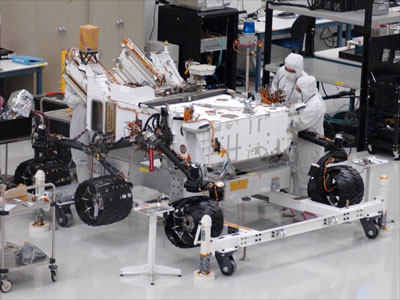
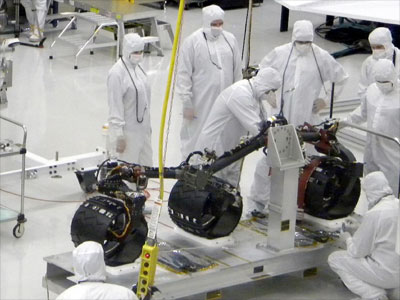
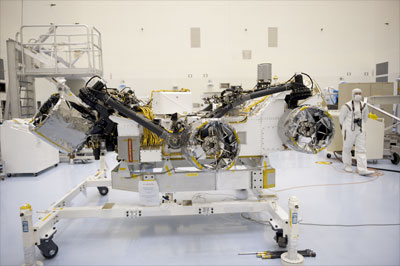
The wheels and a suspension system were added this week by spacecraft technicians and engineers. These new and important touches are a key step in assembling and testing the flight system in advance of a planned 2011 launch.
Curiosity, centerpiece of NASA's Mars Science Laboratory mission, is a six-wheeler and uses a rocker-bogie suspension system like its smaller predecessors: Spirit, Opportunity and Sojourner. Each wheel has its own drive motor, and the corner wheels also have independent steering motors. Unlike earlier Mars rovers, Curiosity will also use its mobility system as a landing gear when the mission's rocket-powered descent stage lowers the rover directly onto the Martian surface on a tether in August 2012.
In coming months at NASA's Jet Propulsion Laboratory, the mobility system will get functional testing and be part of environmental testing of the rover. The mobility system will now stay on Curiosity through launch unless testing identifies a need for rework that would require it to be disassembled.
The mission will launch from Florida during the period Nov. 25 to Dec. 18, 2011. Curiosity will examine an area of Mars for modern or ancient habitable environments, including any that may have also been favorable for preserving clues about life and environment, though this mission will not seek evidence of life. It will examine rocks, soil and atmosphere with a diverse payload of tools, including a laser to vaporize patches of rock from a distance and an instrument designed to test for organic compounds.
Robert Pearlman Editor
Posts: 57078 From: Houston, TX Registered: Nov 1999
posted 07-23-2010 07:09 PM
NASA video release
Curiosity Rover Grows by Leaps and Bounds
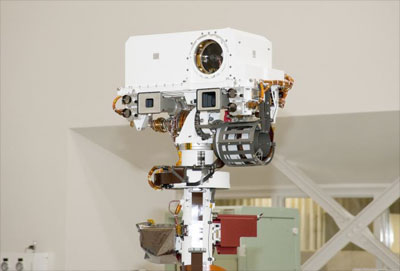
Talk about a growth-spurt. In one week, Curiosity grew by approximately 1 meter (3.5 feet) when spacecraft technicians and engineers attached the rover's neck and head (called the Remote Sensing Mast) to its body. At around 2 meters (about 7 feet) tall, the next rover to Mars now stands head and shoulders above the rest.
Mounted on Curiosity's mast are two navigation cameras (Navcams), two mast cameras (Mastcam), and the laser-carrying chemistry camera (ChemCam).
While it now has a good head on its shoulders, Curiosity's "eyes" (the Mastcam), have been blindfolded in a protective silvery material. The Mastcam, containing two digital cameras, will soon be unveiled, so engineers can test its picture-taking abilities.
Robert Pearlman Editor
Posts: 57078 From: Houston, TX Registered: Nov 1999
posted 07-27-2010 11:04 AM
NASA video release
Mars Curiosity Takes First Baby Steps
Like proud parents savoring their baby's very first steps, mission team members gathered in a gallery above a clean room at NASA's Jet Propulsion Laboratory to watch the Mars Curiosity rover roll for the first time.
Engineers and technicians wore "bunny suits" while guiding Curiosity through its first steps, or more precisely, its first roll on the clean room floor. The rover moved forward and backward about 1 meter (3.3 feet).
Robert Pearlman Editor
Posts: 57078 From: Houston, TX Registered: Nov 1999
posted 10-21-2010 02:43 PM
NASA release
Watch Construction Of NASA's New Mars Rover Live On The Web
A newly installed webcam is giving the public an opportunity to watch technicians assemble and test the next NASA Mars rover, one of the most technologically challenging interplanetary missions ever designed.
NASA's Mars Science Laboratory, also known as the Curiosity rover, is in a clean room at the agency's Jet Propulsion Laboratory in Pasadena, Calif. The webcam, affectionately called "Curiosity Cam," provides the video feed, without audio, from a viewing gallery above the clean room floor. The video will be supplemented periodically by live Web chats featuring Curiosity team members answering questions about the rover. Currently, work in the clean room begins at 8 a.m. PDT Monday through Friday.
Clean room technicians have been busy adding new avionics and instruments to the rover. Beginning Friday, viewers will see technicians carefully add the rover's suspension system and its six wheels. On Monday, Oct. 25, the rover's 7-foot-long robotic arm will be carefully lifted and attached to the front of the rover.
The camera shows a portion of the clean room that is typically active; but the rover, spacecraft components and technicians may move out of view as work shifts to other areas of the room. When activity takes place in other testing facilities around JPL, the clean room may be empty. The camera also may be turned off periodically for maintenance or due to technical issues.
Months of assembly and testing remain before the car-sized rover is ready for launch from Cape Canaveral, Fla. The rover and spacecraft components will ship to NASA's Kennedy Space Center in Florida next spring. The launch will occur between Nov. 25 and Dec. 18, 2011. Curiosity will arrive on Mars in August 2012.
Curiosity is engineered to drive longer distances over rougher terrain than previous rovers with a science payload 10 times the mass of instruments on NASA's Spirit and Opportunity.
The new, large rover will investigate whether the landing region has had environments favorable for supporting microbial life and for preserving evidence about whether life existed on the Red Planet.
Robert Pearlman Editor
Posts: 57078 From: Houston, TX Registered: Nov 1999
Work Stopped on Alternative Cameras for Mars Rover
The NASA rover to be launched to Mars this year will carry the Mast Camera (Mastcam) instrument already on the vehicle, providing the capability to meet the mission's science goals.
Credit: NASA/JPL
Above: This view of the top of the mast was taken April 4, 2011, inside the Spacecraft Assembly Facility at NASA's Jet Propulsion Laboratory, Pasadena, Calif. For scale, the width of the white box at the top is about 0.4 meter (16 inches).
Work has stopped on an alternative version of the instrument, with a pair of zoom-lens cameras, which would have provided additional capabilities for improved three-dimensional video. The installed Mastcam on the Mars Science Laboratory mission's Curiosity rover uses two fixed-focal-length cameras: a telephoto for one eye and wider angle for the other. Malin Space Science Systems, San Diego, built the Mastcam and was funded by NASA last year to see whether a zoom version could be developed in time for testing on Curiosity.
"With the Mastcam that was installed last year and the rover's other instruments, Curiosity can accomplish its ambitious research goals," said Mars Science Laboratory Project Scientist John Grotzinger, of the California Institute of Technology, Pasadena. "Malin Space Science Systems has provided excellent, unprecedented science cameras for this mission. The possibility for a zoom-camera upgrade was very much worth pursuing, but time became too short for the levels of testing that would be needed for them to confidently replace the existing cameras. We applaud Malin Space Science Systems for their tremendous effort to deliver the zooms, and also the Mars Science Laboratory Project's investment in supporting this effort."
Malin Space Science Systems has also provided the Mars Hand Lens Imager and the Mars Descent Imager instruments on Curiosity. The company will continue to pursue development of the zoom system, both to prove out the design and to make the hardware available for possible use on future missions.
"While Curiosity won't benefit from the 3D motion imaging that the zooms enable, I'm certain that this technology will play an important role in future missions," said Mastcam Co-Investigator James Cameron. "In the meantime, we're certainly going to make the most of our cameras that are working so well on Curiosity right now."
Mastcam Principal Investigator Michael Malin said, "Although we are very disappointed that the zoom cameras will not fly, we expect the fixed-focal-length cameras to achieve all of the primary science objectives of the Mastcam investigation."
The rover and other parts of the Mars Science Laboratory spacecraft are in testing at NASA's Jet Propulsion Laboratory, Pasadena, Calif., which manages the project for the NASA Science Mission Directorate, Washington. The spacecraft will be delivered to NASA Kennedy Space Center in Florida in coming months for launch late this year. In August 2012, Curiosity will land on Mars for a two-year mission to examine whether conditions in the landing area have been favorable for microbial life and for preserving evidence about whether life has existed there.
Robert Pearlman Editor
Posts: 57078 From: Houston, TX Registered: Nov 1999
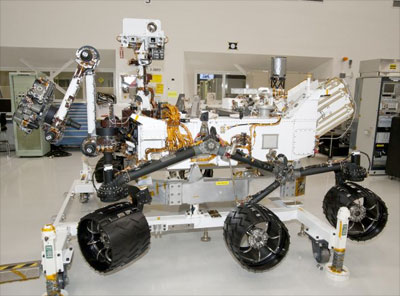
Assembly and testing of NASA's Mars Science Laboratory spacecraft is far enough along that the mission's rover, Curiosity, looks very much as it will when it is investigating Mars.
Credit: NASA/JPL
Above: This image was taken April 4, 2011, inside the Spacecraft Assembly Facility at NASA's Jet Propulsion Laboratory, Pasadena, Calif. Aside from the setting and its placement on ground support equipment, the rover appears much as it will after landing on Mars in August 2012.
Testing continues this month at NASA's Jet Propulsion Laboratory, Pasadena, Calif., on the rover and other components of the spacecraft that will deliver Curiosity to Mars. In May and June, the spacecraft will be shipped to NASA Kennedy Space Center, Fla., where preparations will continue for launch in the period between Nov. 25 and Dec. 18, 2011.
The mission will use Curiosity to study one of the most intriguing places on Mars -- still to be selected from among four finalist landing-site candidates. It will study whether a selected area of Mars has offered environmental conditions favorable for microbial life and for preserving evidence about whether Martian life has existed.
Robert Pearlman Editor
Posts: 57078 From: Houston, TX Registered: Nov 1999
posted 05-24-2011 05:13 PM
Mars Science Laboratory Mission Status Report
Hardware Lifting Incident
During processing of NASA's Mars Science Laboratory at NASA's Kennedy Space Center, Fla., an incident occurred on Friday, May 20, involving the spacecraft's back shell.
A crane lift of the hardware caused unexpected mechanical loads on interfaces between the back shell and its ground support equipment. These interfaces are used during ground operations in preparation for launch. A structural assessment of the back shell was performed in the area of these interfaces.
Inspections and analyses through Monday, May 23, have not identified any damage. Flight processing is expected to continue this week.
The back shell is used to protect the rover and descent stage during entry in Mars' upper atmosphere.
Mars Science Laboratory will launch during the period from Nov. 25 to Dec. 18, 2011, taking its rover, Curiosity, to an August 2012 landing. During a two-year mission on Mars, Curiosity will investigate whether a selected area of Mars has offered environmental conditions favorable for microbial life and for preserving evidence about life.
The spacecraft's back shell, heat shield and cruise stage were delivered to Kennedy Space Center on May 12. The rover and descent stage will be delivered in June.
Robert Pearlman Editor
Posts: 57078 From: Houston, TX Registered: Nov 1999
posted 06-09-2011 08:09 AM
NASA Office of the Inspector General (OIG)
NASA's Management of the Mars Science Laboratory Project
NASA Inspector General Paul K. Martin released June 8 a report [PDF] that examined NASA's management of a $2.5 billion science mission designed to investigate whether Mars has, or ever had, an environment capable of supporting life. The Mars Science Laboratory Project is the most technologically challenging interplanetary rover ever designed.
The audit found significant technical, schedule, and fiscal challenges that must be resolved prior to the mission's scheduled launch in November 2011.
Robert Pearlman Editor
Posts: 57078 From: Houston, TX Registered: Nov 1999
posted 06-26-2011 11:24 AM
NASA release
NASA Mars Rover Arrives In Florida After Cross-Country Flight
NASA's next Mars rover has completed the journey from its California birthplace to Florida in preparation for launch this fall.
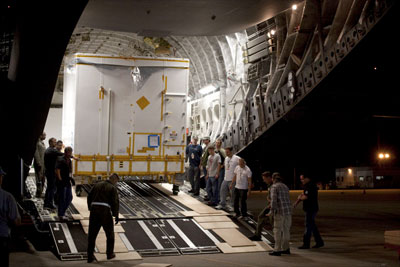
The Mars Science Laboratory (MSL) rover, also known as Curiosity, arrived Wednesday at NASA's Kennedy Space Center aboard an Air Force C-17 transport plane. It was accompanied by the rocket-powered descent stage that will fly the rover during the final moments before landing on Mars. The C-17 flight began at March Air Reserve Base in Riverside, Calif., where the boxed hardware had been trucked from NASA's Jet Propulsion Laboratory (JPL) in Pasadena, Calif.
The rover's aeroshell -- the protective covering for the trip to the Red Planet -- and the cruise stage, which will guide it to Mars, arrived at Kennedy last month. The mission is targeted to launch from Cape Canaveral Air Force Station between Nov. 25 and Dec. 18. The car-size rover will land on Mars in August 2012.
"The design and building part of the mission is nearly behind us now," said JPL's David Gruel, who has managed Mars Science Laboratory assembly, test and launch operations since 2007. "We're getting to final checkouts before sending the rover on its way to Mars."
The rover and other spacecraft components will undergo more testing before mission staff stack them and fuel the onboard propulsion systems. Curiosity should be enclosed in its aeroshell for the final time in September and delivered to Kennedy's Launch Complex 41 in early November for integration with a United Launch Alliance Atlas V rocket.
Curiosity is about twice as long and more than five times as heavy as any previous Mars rover. Its 10 science instruments include two for ingesting and analyzing samples of powdered rock delivered by the rover's robotic arm. During a prime mission lasting one Martian year -- nearly two Earth years -- researchers will use the rover's tools to study whether the landing region has had environmental conditions favorable for supporting microbial life and favorable for preserving clues about whether life existed.
JPL built the rover and descent stage and manages the mission for NASA's Science Mission Directorate in Washington. Launch management for the mission is the responsibility of NASA's Launch Services Program at Kennedy.
Robert Pearlman Editor
Posts: 57078 From: Houston, TX Registered: Nov 1999
posted 07-18-2011 02:35 PM
NASA release
NASA Announcing Landing Site For New Mars Rover
NASA and the Smithsonian's National Air and Space Museum will host a news conference at 10 a.m. EDT, Friday, July 22 to announce the selected landing site for the agency's latest Mars rover.
The event will be in the museum's Moving Beyond Earth Gallery. NASA Television and the agency's website will provide live coverage of the event.
The Mars Science Laboratory (MSL), or Curiosity, will land on the surface of Mars in August 2012. Curiosity is being assembled and readied for a November launch at NASA's Kennedy Space Center, Florida. Curiosity is about twice as long and more than five times as heavy as any previous Mars rover. The rover will study whether the landing region had environmental conditions favorable for supporting microbial life and for preserving clues about whether life existed.
July 22 is Mars Day at the museum. The annual event marks the July 1976 landing of Viking 1, the first spacecraft to operate on Mars. The day will feature displays, family activities and presentations by scientists from the museum's Center for Earth and Planetary Studies, the Museum of Natural History and NASA. Visitors will learn about the latest Mars research, missions and see a life-size model of Curiosity.
Robert Pearlman Editor
Posts: 57078 From: Houston, TX Registered: Nov 1999
posted 07-22-2011 09:50 AM
NASA release
NASA's Next Mars Rover To Land At Gale Crater
NASA's next Mars rover will land at the foot of a layered mountain inside the planet's Gale crater.
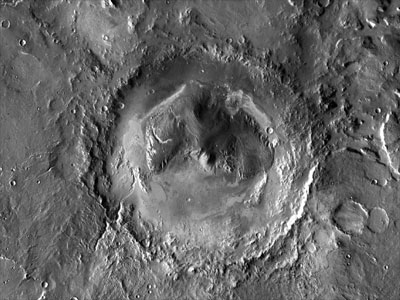
The car-sized Mars Science Laboratory, or Curiosity, is scheduled to launch late this year and land in August 2012. The target crater spans 96 miles (154 kilometers) in diameter and holds a mountain rising higher from the crater floor than Mount Rainier rises above Seattle. Gale is about the combined area of Connecticut and Rhode Island. Layering in the mound suggests it is the surviving remnant of an extensive sequence of deposits. The crater is named for Australian astronomer Walter F. Gale.
"Mars is firmly in our sights," said NASA Administrator Charles Bolden. "Curiosity not only will return a wealth of important science data, but it will serve as a precursor mission for human exploration to the Red Planet."
Credit: NASA/JPL-Caltech/ASU/UA
Above: This computer-generated view based on multiple orbital observations shows Mars' Gale crater as if seen from an aircraft northwest of the crater.
During a prime mission lasting one Martian year -- nearly two Earth years -- researchers will use the rover's tools to study whether the landing region had favorable environmental conditions for supporting microbial life and for preserving clues about whether life ever existed.
"Scientists identified Gale as their top choice to pursue the ambitious goals of this new rover mission," said Jim Green, director for the Planetary Science Division at NASA Headquarters in Washington. "The site offers a visually dramatic landscape and also great potential for significant science findings."
Credit: NASA/JPL-Caltech/ASU
Above: This view of Gale is a mosaic of observations made in the visible-light portion of the spectrum by the Thermal Emission Imaging System camera on NASA's Mars Odyssey orbiter.
In 2006, more than 100 scientists began to consider about 30 potential landing sites during worldwide workshops. Four candidates were selected in 2008.
An abundance of targeted images enabled thorough analysis of the safety concerns and scientific attractions of each site. A team of senior NASA science officials then conducted a detailed review and unanimously agreed to move forward with the MSL Science Team's recommendation. The team is comprised of a host of principal and co-investigators on the project.
Curiosity is about twice as long and more than five times as heavy as any previous Mars rover. Its 10 science instruments include two for ingesting and analyzing samples of powdered rock that the rover's robotic arm collects. A radioisotope power source will provide heat and electric power to the rover. A rocket-powered sky crane suspending Curiosity on tethers will lower the rover directly to the Martian surface.
Credit: NASA/JPL-Caltech/ESA/UA
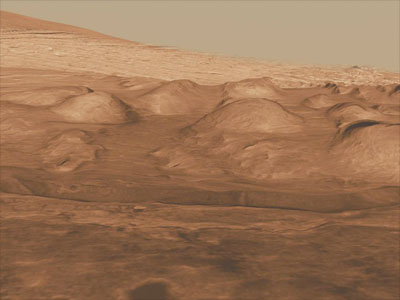
Above: This oblique view of the lower mound in Gale crater shows layers of rock that preserve a record of environments on Mars.
The portion of the crater where Curiosity will land has an alluvial fan likely formed by water-carried sediments. The layers at the base of the mountain contain clays and sulfates, both known to form in water.
"One fascination with Gale is that it's a huge crater sitting in a very low-elevation position on Mars, and we all know that water runs downhill," said John Grotzinger, the mission's project scientist at the California Institute of Technology in Pasadena, Calif. "In terms of the total vertical profile exposed and the low elevation, Gale offers attractions similar to Mars' famous Valles Marineris, the largest canyon in the solar system."
Curiosity will go beyond the "follow-the-water" strategy of recent Mars exploration. The rover's science payload can identify other ingredients of life, such as the carbon-based building blocks of biology called organic compounds. Long-term preservation of organic compounds requires special conditions. Certain minerals, including some Curiosity may find in the clay and sulfate-rich layers near the bottom of Gale's mountain, are good at latching onto organic compounds and protecting them from oxidation.
"Gale gives us attractive possibilities for finding organics, but that is still a long shot," said Michael Meyer, lead scientist for NASA's Mars Exploration Program at agency headquarters. "What adds to Gale's appeal is that, organics or not, the site holds a diversity of features and layers for investigating changing environmental conditions, some of which could inform a broader understanding of habitability on ancient Mars."
The rover and other spacecraft components are being assembled and undergoing final testing. The mission is targeted to launch from Cape Canaveral Air Force Station in Florida between Nov. 25 and Dec. 18. NASA's Jet Propulsion Laboratory in Pasadena manages the mission for the agency's Science Mission Directorate in Washington.
Robert Pearlman Editor
Posts: 57078 From: Houston, TX Registered: Nov 1999
Targeted to liftoff from Cape Canaveral on the day after Thanksgiving (Nov. 25), Curiosity was shown off to the media on Friday inside the clean room where it had been undergoing its final tests and preparations for its journey to Mars.
Robert Pearlman Editor
Posts: 57078 From: Houston, TX Registered: Nov 1999
NASA's Mars Science Laboratory Project continues to press ahead with launch preparation activities, planning to use additional time before encapsulating the rover in the launch vehicle's nose cone.
Officials want to maintain additional schedule margin for enhanced safety procedures in assembly and testing. System testing put the rover and other parts of the spacecraft through simulations of many activities from launch through operations on Mars' surface. Aspects of the test simulating the final moments before landing took longer than scheduled. Additional margin that had been built into the schedule has been consumed in recent weeks by stepped-up safety procedures in assembly and testing.
Based on this, the rover development team will turn over the spacecraft for encapsulation four days later in October than originally scheduled. The project expects to know in approximately two weeks if launch timelines may need to be adjusted. The mission's launch period begins Nov. 25 and runs through Dec. 18.
"We consumed some of the slack in our schedule during system testing in August, and we want to restore the slack to give the assembly, test and launch operations team time to do its job," said Mars Science Laboratory Project Manager Pete Theisinger of NASA's Jet Propulsion Laboratory, Pasadena, Calif.
Robert Pearlman Editor
Posts: 57078 From: Houston, TX Registered: Nov 1999
posted 09-28-2011 08:44 PM
At the Payload Hazardous Servicing Facility at the Kennedy Space Center, integration between a rocket-powered descent stage and the Mars Science Laboratory (MSL) rover Curiosity was completed on Sept. 23, 2011. The descent stage will lower Curiosity to the surface of Mars.
Credit: NASA/Ken Shiflett
Robert Pearlman Editor
Posts: 57078 From: Houston, TX Registered: Nov 1999
posted 09-28-2011 08:47 PM
In the Payload Hazardous Servicing Facility at the Kennedy Space Center, the backshell, a protective cover which carries the parachute and several components used during later stages of entry, descent and landing, was encapsulated over the Mars Science Laboratory (MSL) rover Curiosity on Sept. 23, 2011.
Credit: NASA/Dimitri Gerondidakis
Robert Pearlman Editor
Posts: 57078 From: Houston, TX Registered: Nov 1999
posted 11-09-2011 05:43 PM
In the Payload Hazardous Servicing Facility at the Kennedy Space Center, NASA's Mars Science Laboratory (MSL) aeroshell, containing the compact car-sized rover Curiosity, was mated to its cruise stage on Oct. 11, 2011. The cruise stage provides solar power, thrusters for navigation, and heat exchangers to the rover during its flight from Earth to Mars.
The integrated cruise stage and aeroshell was then mated with the MSL heat shield the same day.
Credit: NASA/Glenn Benson
Robert Pearlman Editor
Posts: 57078 From: Houston, TX Registered: Nov 1999
posted 11-09-2011 05:44 PM
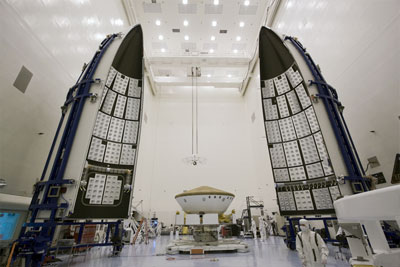
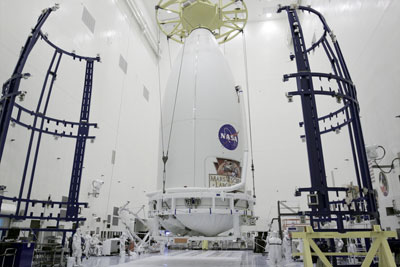
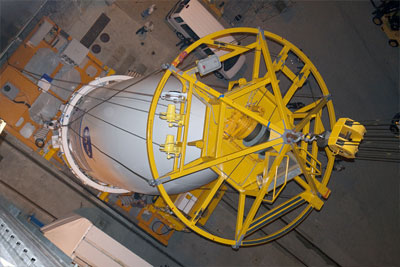
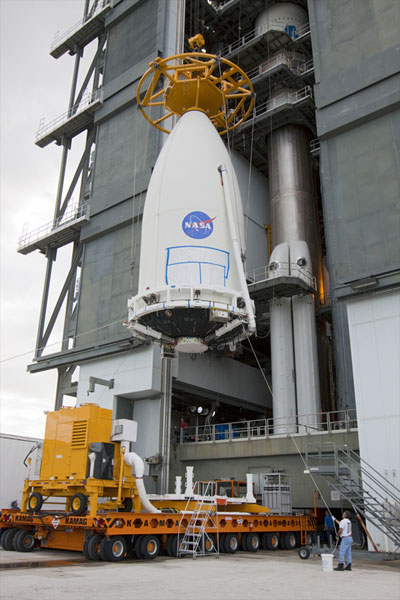
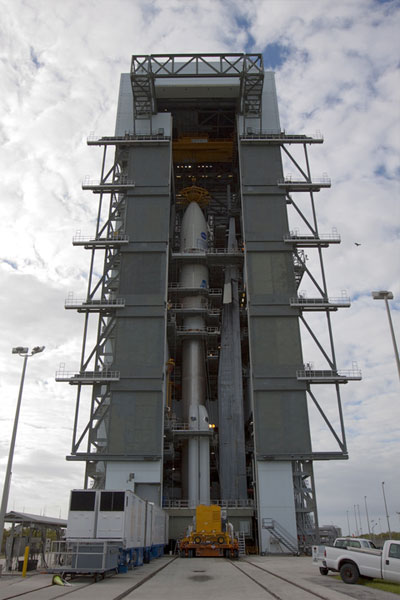
In the Payload Hazardous Servicing Facility at the Kennedy Space Center, NASA's Mars Science Laboratory (MSL) was enclosed in an Atlas V rocket payload fairing on Oct. 25, 2011. The fairing will protect the spacecraft from the impact of aerodynamic pressure and heating during ascent.
The Atlas fairing containing the MSL spacecraft was then moved by transporter to Space Launch Complex 41 at the Cape Canaveral Air Force Station, where it was raised and attached to the Atlas V rocket inside the Vertical Integration Facility on Nov. 3, 2011.
Credit: NASA/Jim Grossmann/Kim Shiflett
Robert Pearlman Editor
Posts: 57078 From: Houston, TX Registered: Nov 1999
posted 11-19-2011 03:04 PM
Mars Science Laboratory "go" for Nov. 25 launch
NASA and contractor managers for the Mars Science Laboratory (MSL) launch held their Flight Readiness Review meeting at Kennedy Space Center on Friday. After an evaluation of the MSL spacecraft and United Launch Alliance Atlas V rocket, managers gave a "go" to continue proceeding toward a liftoff at 10:25 a.m. EST (1525 GMT) next Friday, Nov. 25.
Managers will meet again Nov. 22 for the Launch Readiness Review.
The spacecraft — with its rover, Curiosity — is sealed inside the protective payload fairing atop the Atlas V rocket, which stands inside the Vertical Integration Facility at nearby Cape Canaveral Air Force Station's Launch Complex 41.
The multi-mission radioisotope thermoelectric generator (MMRTG), which will power the Curiosity rover, was installed within the Atlas fairing on Nov. 17.
Closeouts of the spacecraft and the Atlas V fairing are underway, with a countdown dress rehearsal on Sunday's schedule.
Robert Pearlman Editor
Posts: 57078 From: Houston, TX Registered: Nov 1999
posted 11-19-2011 03:54 PM
Launch delayed to Saturday, Nov. 26
The launch of a United Launch Alliance Atlas V carrying NASA's Mars Science Laboratory has been delayed one day to allow time for the team to remove and replace a flight termination system battery.
The launch is rescheduled for Saturday, Nov. 26 from Space Launch Complex 41 at Cape Canaveral Air Force Station, Florida. The one hour and 43 minute launch window opens at 10:02 a.m. EST (1502 GMT).
Robert Pearlman Editor
Posts: 57078 From: Houston, TX Registered: Nov 1999
posted 11-23-2011 11:19 PM
MSL and Curiosity 'locked and loaded' for launch
Following a Launch Readiness Review on Wednesday morning (Nov. 23), NASA and contractor managers gave the launch team the go-ahead to continue working towards the liftoff of the Mars Science Laboratory (MSL) on Saturday, Nov. 26. No significant launch vehicle or spacecraft issues are being worked on the United Launch Alliance Atlas V rocket or the MSL spacecraft, which includes the rover Curiosity.
"This rover, Curiosity rover, is really a rover on steroids. It's an order of magnitude more capable than anything we have ever launched to any planet in the solar system. It will go longer, it will discover more than we can possibly imagine," Colleen Hartman, assistant associate administrator in NASA's Science Mission Directorate, said. "The Mars Science Lab and the rover Curiosity is locked and loaded, ready for final countdown on Saturday's launch to Mars."
The next major prelaunch milestone is rollout of the Atlas V to the launch pad at the Cape Canaveral Air Force Station's Space Launch Complex 41.
"We plan on rolling the vehicle out of the Vertical Integration Facility on Friday morning," NASA Launch Director Omar Baez said. "We should be on the way to the pad by 8 a.m. [EST]."
"We've had our normal challenges and hiccups that we have in these kinds of major operations, but things have gone extremely smoothly and we're fully prepared to go on Saturday morning. We hope that the weather cooperates," Peter Theisinger, MSL project manager from the Jet Propulsion Laboratory in Pasadena, Calif., said.
Launch day weather conditions are predicted to be favorable, with a 30 percent chance of prohibiting liftoff.
Robert Pearlman Editor
Posts: 57078 From: Houston, TX Registered: Nov 1999
posted 11-25-2011 09:32 AM
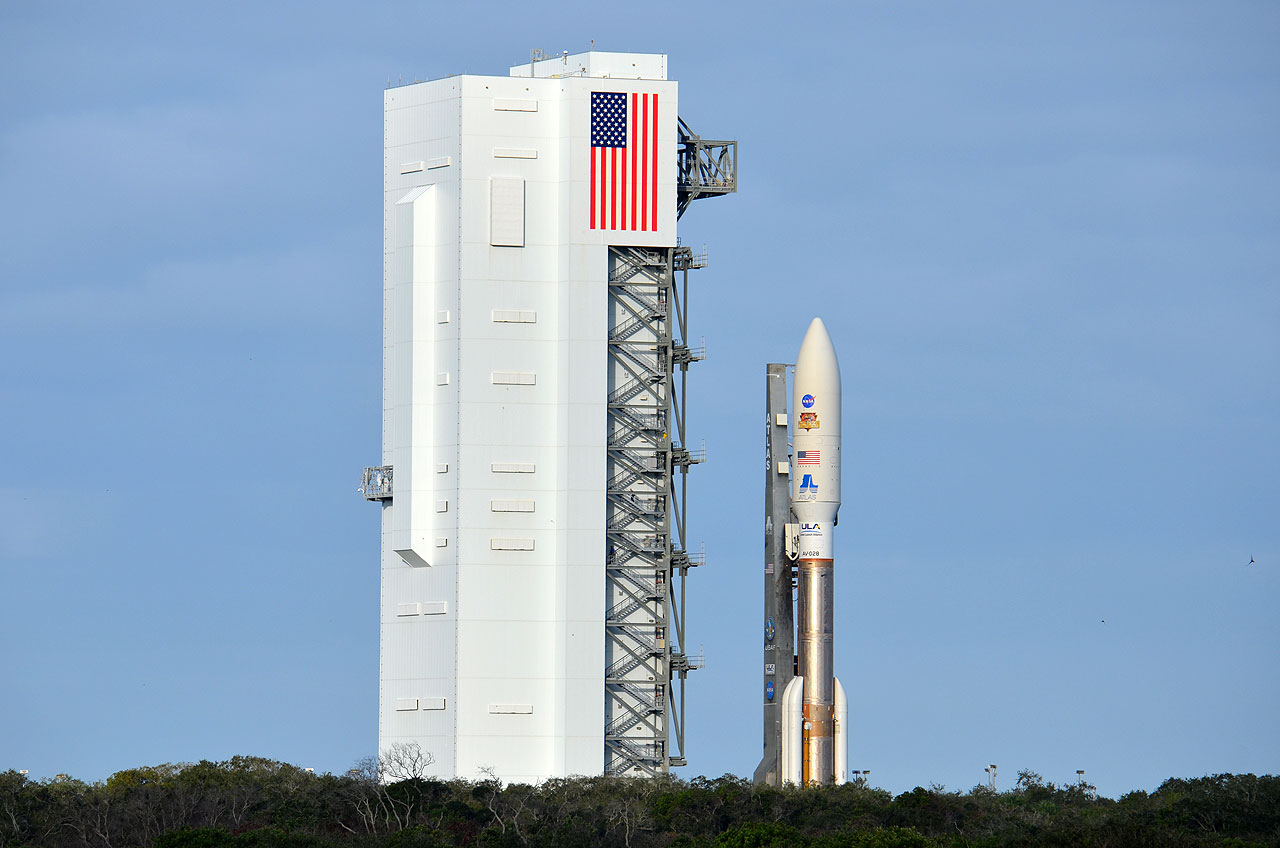
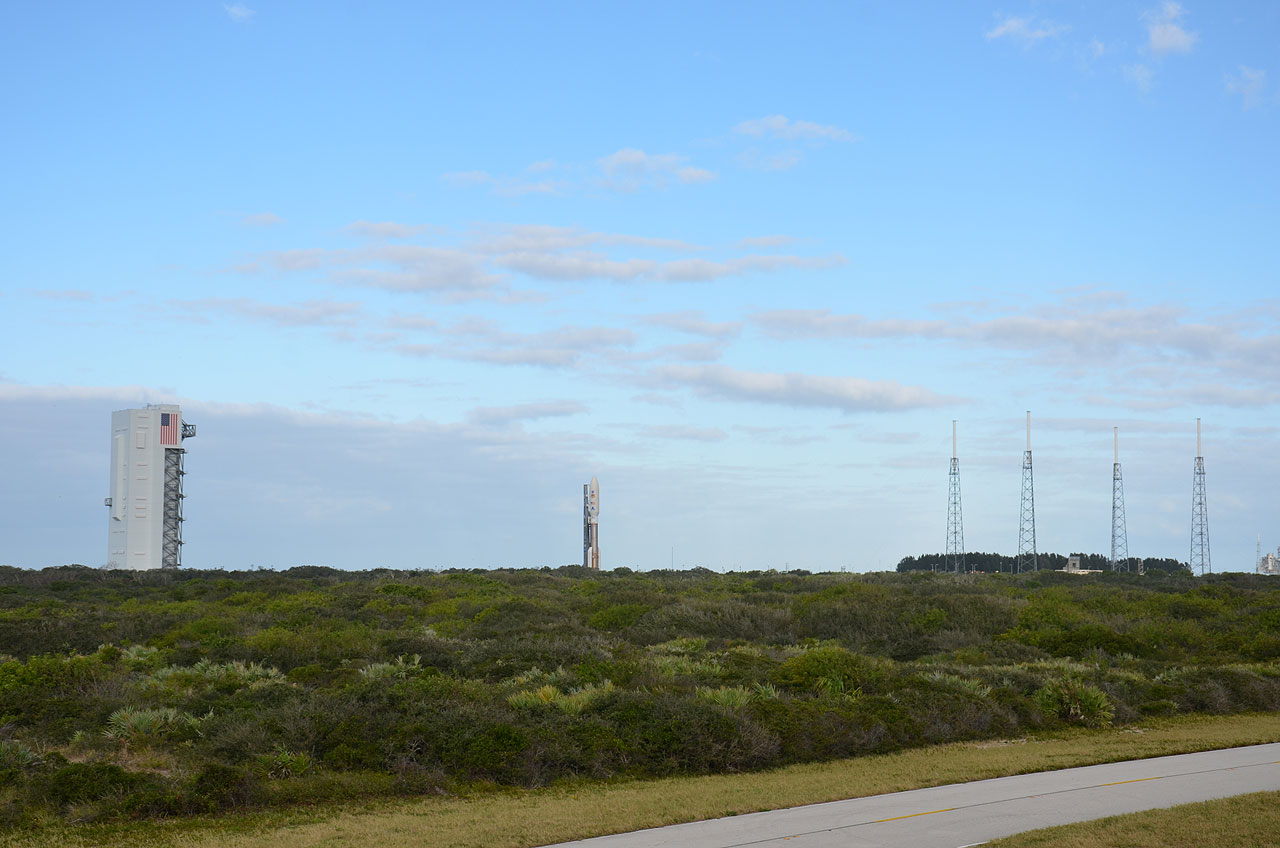
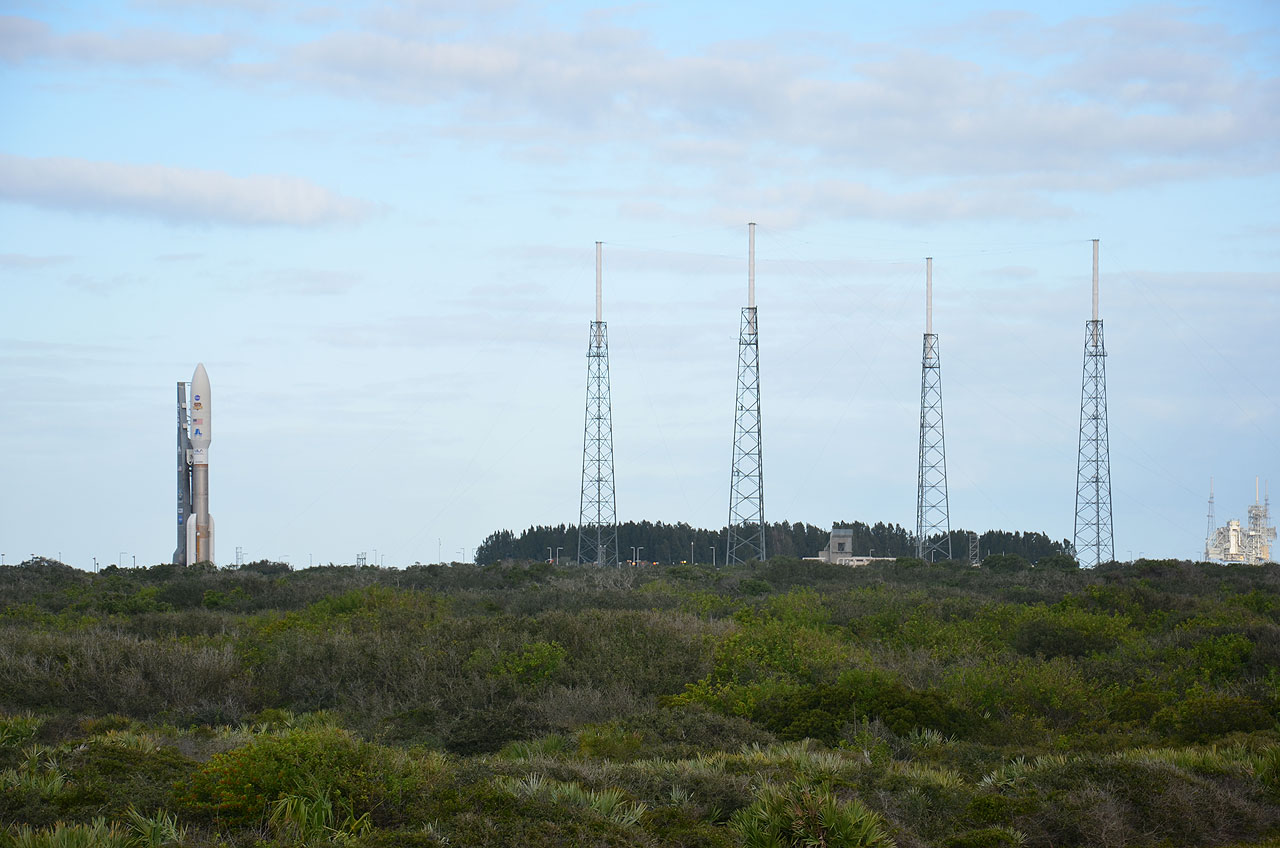
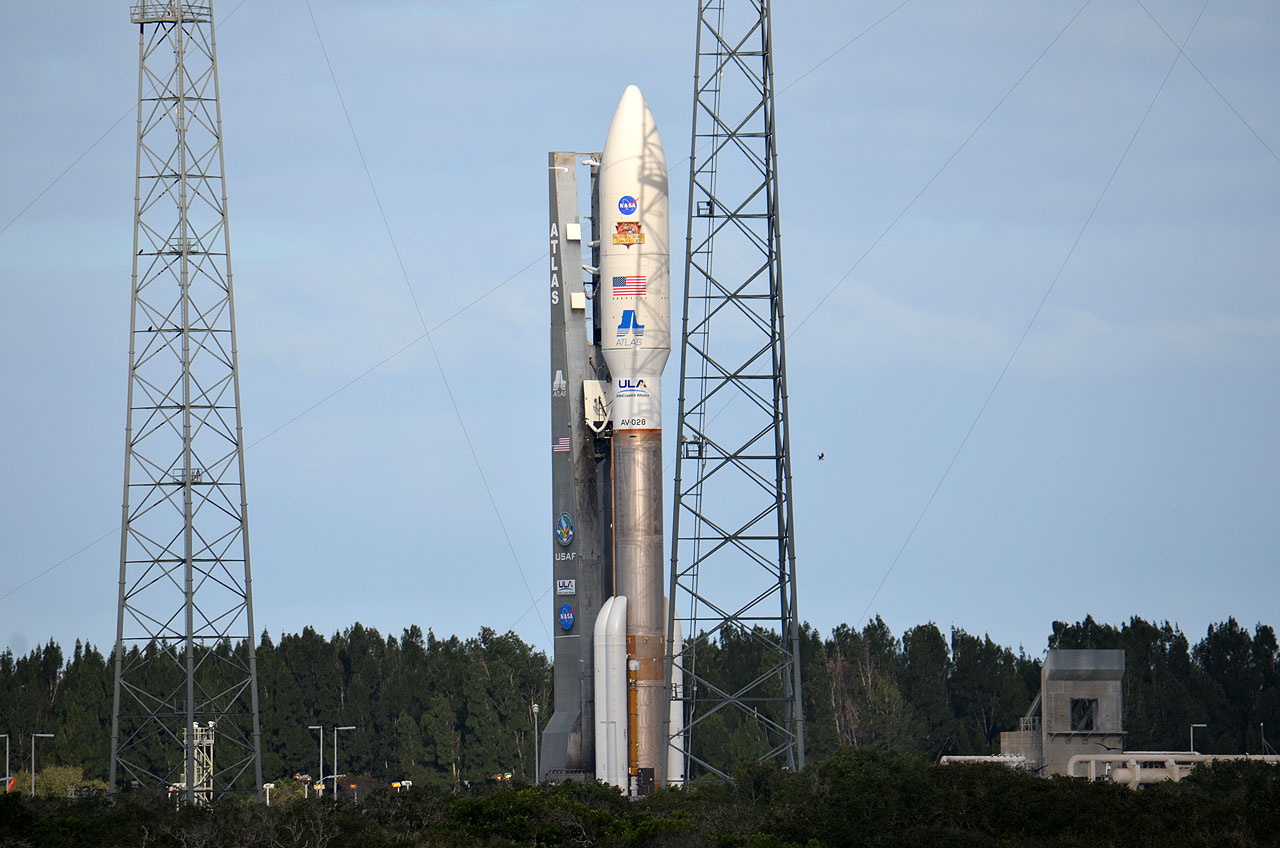
Atlas V rolls to launch pad
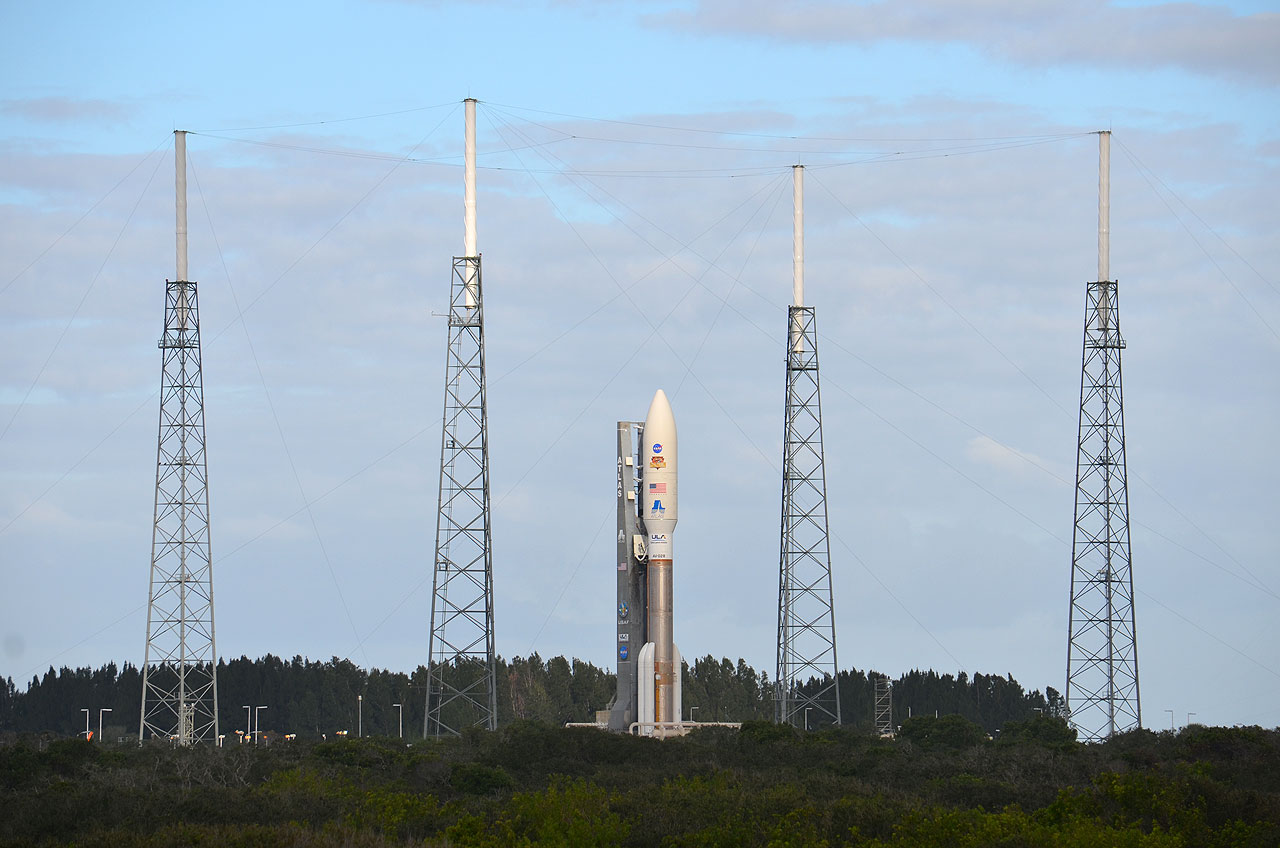
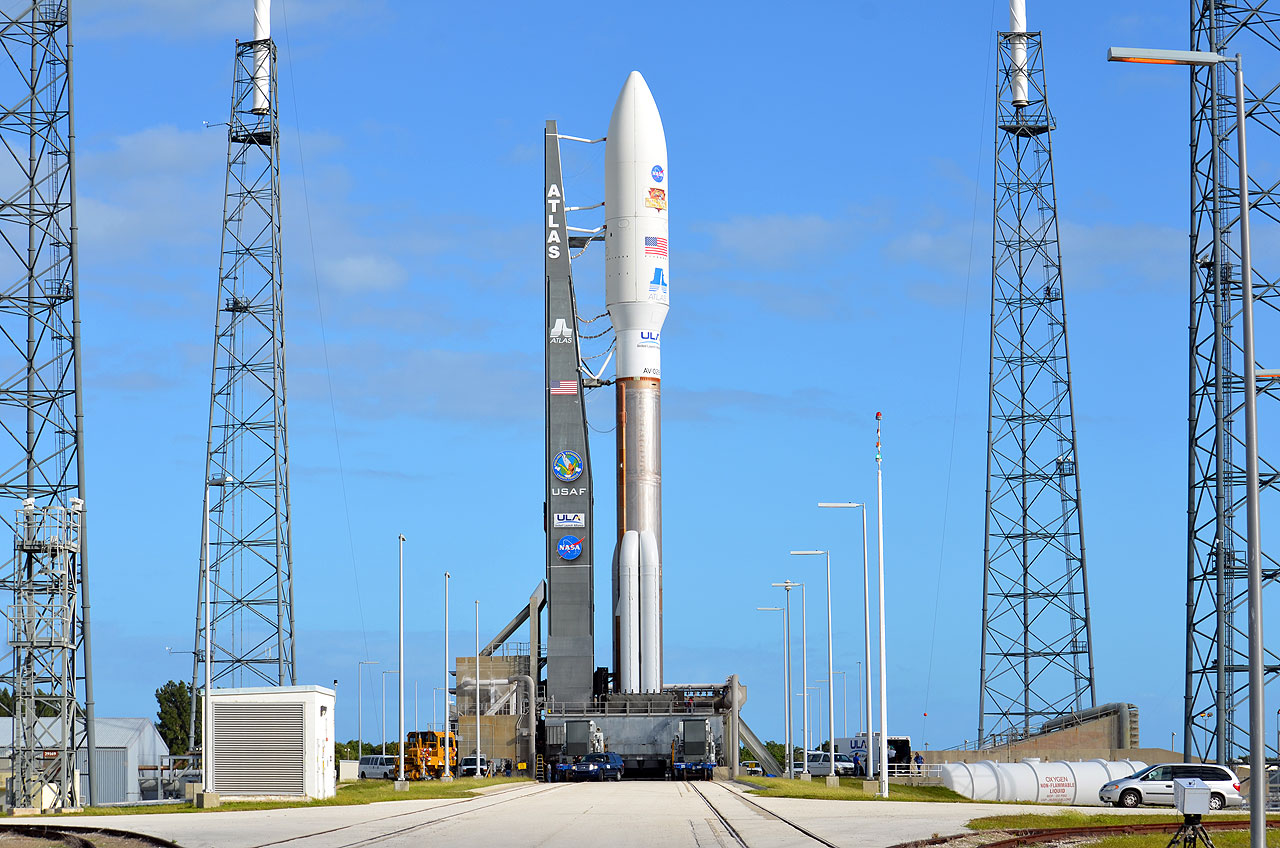
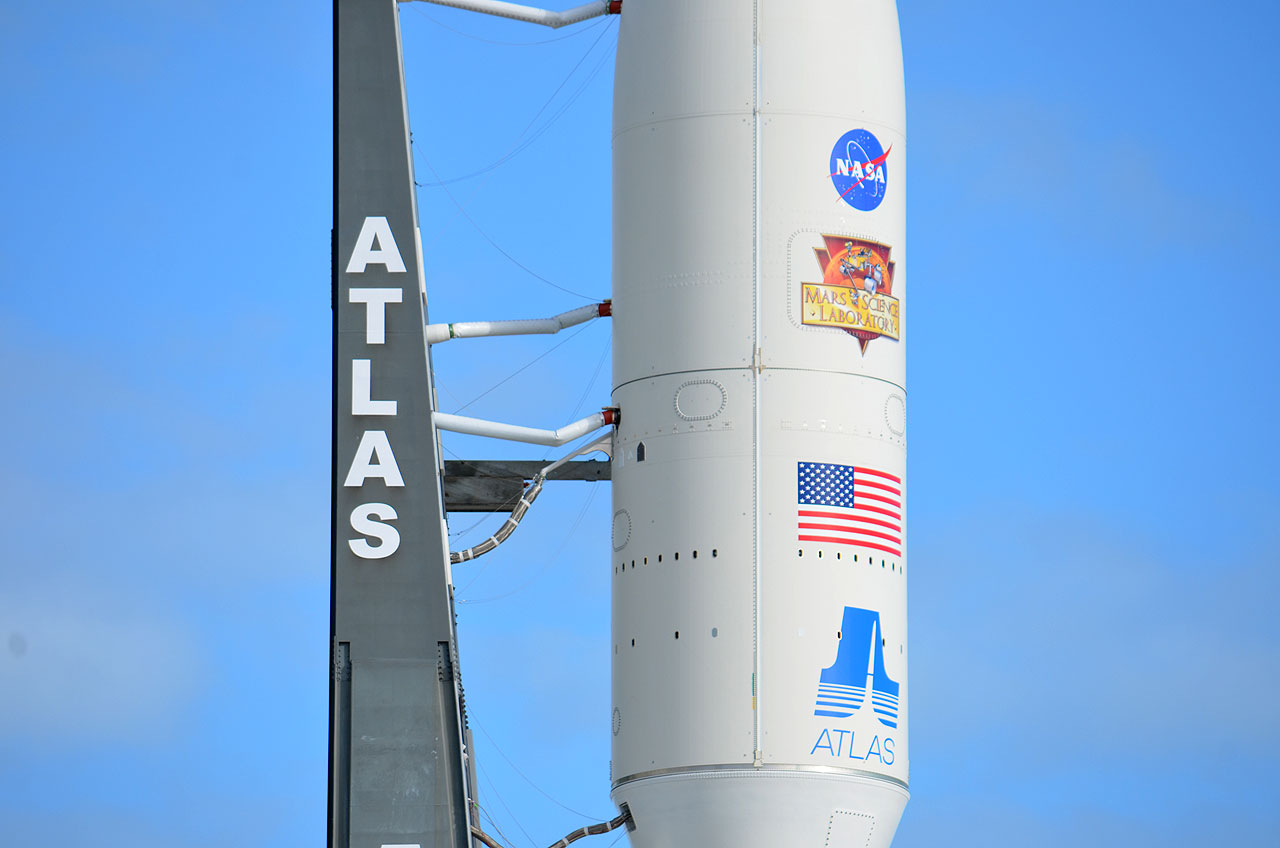
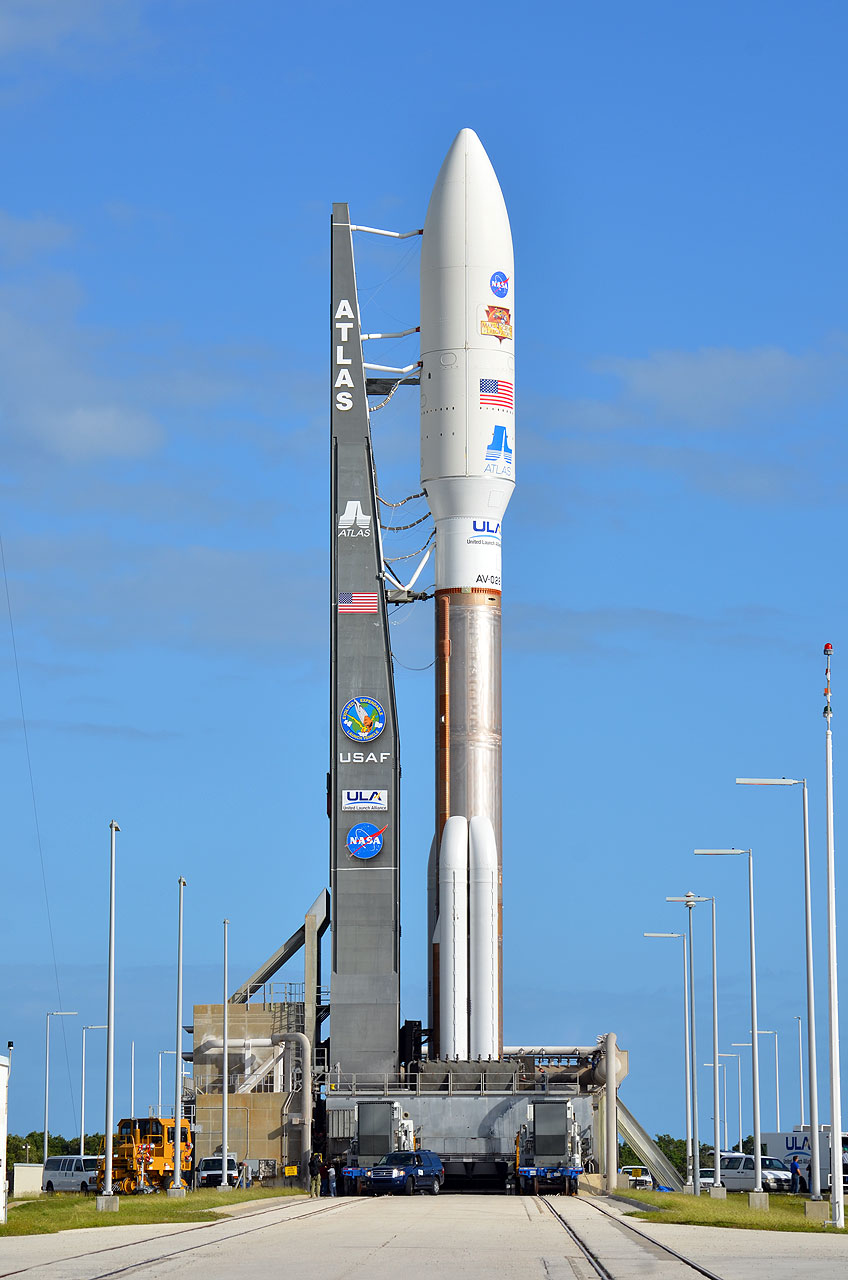
The United Launch Alliance Atlas V rocket with NASA's Mars Science Laboratory (MSL) and its Curiosity rover rolled out to Space Launch Complex-41 at Cape Canaveral Air Force Station around 8 a.m. EST Friday. Launch is set for 10:02 a.m. Saturday.
The launch team continues working towards a liftoff on Nov. 26. No significant launch vehicle or spacecraft issues are being worked.
The launch day weather forecast remains favorable, with only a 30 percent chance of conditions prohibiting liftoff.
Credit: collectSPACE/Robert Z. Pearlman
Robert Pearlman Editor
Posts: 57078 From: Houston, TX Registered: Nov 1999
posted 11-25-2011 09:34 AM
Atlas V rolls to launch pad
Credit: collectSPACE/Robert Z. Pearlman
Robert Pearlman Editor
Posts: 57078 From: Houston, TX Registered: Nov 1999
posted 11-26-2011 09:57 AM
Liftoff! Curiosity bound for Mars
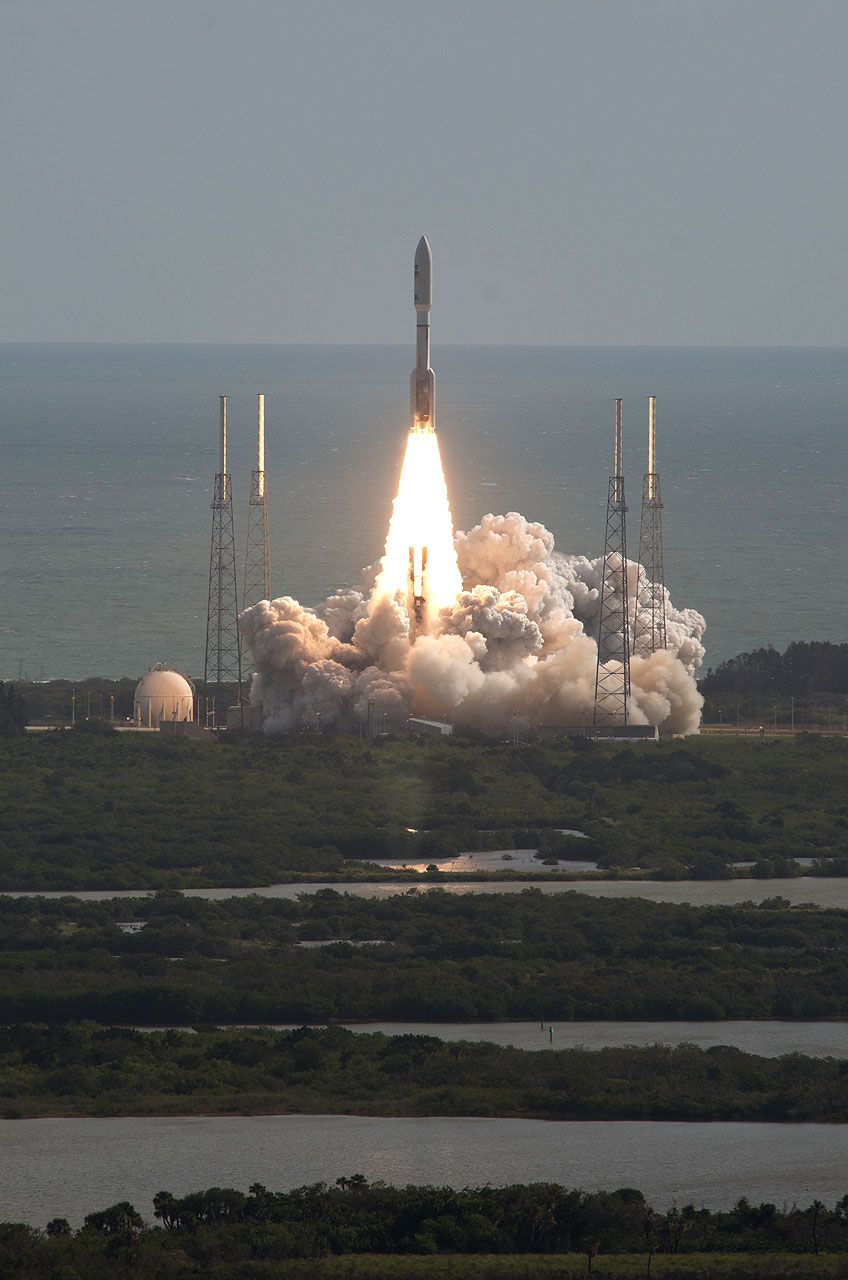
The United Launch Alliance Atlas V rocket carrying NASA's Mars Science Laboratory (MSL) spacecraft, including the rover Curiosity, lifted off at 10:02 a.m. EST (1502 GMT) on Saturday, Nov. 26, 2011 from Cape Canaveral Air Force Station's Space Launch Complex 41.
Forty-four minutes later at 10:46 a.m. EST, the spacecraft separated from rocket's Centaur upper stage, starting Mars Science Laboratory on its 354 million mile journey to the red planet.
Credit: collectSPACE/Robert Z. Pearlman
Robert Pearlman Editor
Posts: 57078 From: Houston, TX Registered: Nov 1999
posted 12-01-2011 07:44 PM
Course excellent, adjustment postponed
Excellent launch precision for the Mars Science Laboratory mission has forestalled the need for an early trajectory correction maneuver, now not required for a month or more.
That first of six planned course adjustments during the 254-day trip from Earth to Mars had originally been scheduled for 15 days after the mission's Nov. 26 launch on a United Launch Alliance Atlas V rocket. Now, the correction maneuver will not be performed until later in December or possibly January.
"This was among the most accurate interplanetary injections ever," said Louis D'Amario of NASA's Jet Propulsion Laboratory, Pasadena, Calif. He is the mission design and navigation manager for the Mars Science Laboratory.
Engineers deliberately planned MSL's initial trajectory to miss Mars by about 35,000 miles (56,400 kilometers). This precaution protects Mars from Earth's microbes, because the Centaur upper stage of the rocket, which is not thoroughly cleaned the way the spacecraft is, leaves Earth on the same trajectory as the spacecraft. The planned trajectory ensures that the Centaur will not hit Mars.
The launch put the spacecraft on an actual trajectory missing Mars by about 38,000 miles (61,200 kilometers). Planned trajectory correction maneuvers will put the spacecraft on course and on timing to land at Mars' Gale Crater on Aug. 6, 2012, Universal Time (evening of Aug. 5, Pacific Daylight Time).
The spacecraft experienced a computer reset on Tuesday apparently related to star-identifying software in the attitude control system. The reset put MSL briefly into a precautionary safe mode. Engineers were able to restore it to normal operational status for functions other than attitude control while they planned how to resume star-guided attitude control.
Also Tuesday, thrusters were used as planned to slow MSL's rotation rate from 2.5 rotations per minute to 2.05 rotations per minute.
Telecommunications are active at a downlink rate of 25 kilobits per second. The electrical output from the cruise stage solar array is 800 watts.
Thrusters warmed by catalytic bed heaters were originally warmer than expected, but use of the heaters has been reduced to keep the thrusters at intended temperatures.
As of 9 a.m. PST (noon EST) on Friday, Dec. 2, the spacecraft will have traveled 10.8 million miles (17.3 million km.) of its 352 million mile (567 million km.) flight to Mars, and will be moving at 7,500 mph (12,000 kph) relative to Earth and at 73,800 mph (118,700 kph) as relative to the sun.
Robert Pearlman Editor
Posts: 57078 From: Houston, TX Registered: Nov 1999
posted 12-14-2011 02:10 AM
Mars-bound rover begins research in space
NASA's Curiosity rover has begun monitoring space radiation during its 8-month trip from Earth to Mars. The research will aid in planning for future human missions to the Red Planet.
The Radiation Assessment Detector (RAD) aboard the rover monitors high energy atomic and subatomic particles from the sun, distant supernovas and other sources.
These particles form radiation that could be harmful to any microbes or astronauts in space or on Mars. Curiosity will also monitor the radiation on the surface of Mars after its August 2012 landing.
"RAD is serving as a proxy for an astronaut inside a spacecraft on the way to Mars," said Don Hassler, RAD's principal investigator from the Southwest Research Institute in Boulder, Colo. "The instrument is deep inside the spacecraft, the way an astronaut would be."
"Understanding the effects of the spacecraft on the radiation field will be valuable in designing craft for astronauts to travel to Mars," said Hassler.
Previous monitoring of energetic-particle radiation in space has used instruments at or near the surface of various spacecraft. The RAD instrument is on the rover inside the spacecraft and shielded by other components of MSL, including the aeroshell that will protect the rover during descent through the upper atmosphere of Mars.
Spacecraft structures, while providing shielding, also can contribute to secondary particles generated when high-energy particles strike the spacecraft. In some circumstances, secondary particles could be more hazardous than primary ones.
These first measurements mark the start of the science return from a mission that will use 10 instruments on Curiosity to assess whether Mars' Gale Crater could be or has been favorable for microbial life.
"While Curiosity will not look for signs of life on Mars, what it might find could be a game- changer about the origin and evolution of life on Earth and elsewhere in the universe," said Doug McCuistion, director of the Mars Exploration Program at NASA Headquarters in Washington. "One thing is certain: the rover's discoveries will provide critical data that will impact human and robotic planning and research for decades."
As of noon EST on Dec. 14, the spacecraft will have traveled 31.9 million miles (51.3 million km.) of its 352 million mile (567 million km.) flight to Mars. The first trajectory correction maneuver during the trip is being planned for mid-January.
Robert Pearlman Editor
Posts: 57078 From: Houston, TX Registered: Nov 1999
posted 01-11-2012 10:08 PM
Spacecraft completes biggest maneuver
NASA's Mars Science Laboratory spacecraft successfully refined its flight path Wednesday with the biggest maneuver planned for the mission's journey between Earth and Mars.
"We've completed a big step toward our encounter with Mars," said Brian Portock of NASA's Jet Propulsion Laboratory, Pasadena, Calif., deputy mission manager for the cruise phase of the mission. "The telemetry from the spacecraft and the Doppler data show that the maneuver was completed as planned."
The Mars Science Laboratory mission will use its car-size rover, Curiosity, to investigate whether the selected region on Mars inside Gale Crater has offered environmental conditions favorable for supporting microbial life and favorable for preserving clues about whether life existed.
Engineers had planned today's three-hour series of thruster-engine firings to accomplish two aims: to put the spacecraft's trajectory about 25,000 miles (about 40,000 kilometers) closer to encountering Mars and to advance the time of the encounter by about 14 hours, compared with the trajectory following the mission's Nov. 26, 2011, launch.
"The timing of the encounter is important for arriving at Mars just when the planet's rotation puts Gale Crater in the right place," said JPL's Tomas Martin-Mur, chief navigator for the mission.
The mission's second trajectory correction maneuver, expected to be about one-sixth the magnitude of this first one, is scheduled for March 26. Up to four additional opportunities for fine-tuning, as needed, are scheduled before the arrival at Mars on Aug. 5, 2012, PDT (Aug. 6, EDT and Universal Time).
The spacecraft's initial trajectory resulting from the launch included an intentional offset to prevent the upper stage of the launch vehicle from hitting Mars. That upper stage was not cleaned the way the spacecraft itself was to protect Mars from Earth's microbes.
The Mars Science Laboratory spacecraft rotates in flight at about two revolutions per minute. Today's maneuver included two different components: one that changed velocity in the direction of the axis of the spacecraft's rotation, and one that changed velocity in a direction perpendicular to that.
The maneuver used the eight thruster engines on the cruise stage of the spacecraft, grouped into two sets of four. It began with a thrust lasting about 19 minutes, using just one thruster in each set and affecting velocity along the direction of the axis of rotation. Then, to affect velocity perpendicular to that line, each set of thrusters was fired for 5 seconds when the rotation put that set facing the proper direction. These 5-second bursts were repeated more than 200 times during a period of about two hours for a total of about 40 minutes.
The maneuver was calculated to produce a net change in velocity of about 12.3 miles per hour (5.5 meters per second), combining a slight increase in speed with a small change in direction of travel.
As of 9 a.m. PST (noon EST) on Thursday, Jan. 12, the spacecraft will have traveled 81.2 million miles (130.6 million kilometers) of its 352-million-mile (567-million-kilometer) flight to Mars. It will be moving at about 10,300 mph (16,600 kilometers per hour) relative to Earth, and at about 68,700 mph (110,500 kilometers per hour) relative to the sun.
Robert Pearlman Editor
Posts: 57078 From: Houston, TX Registered: Nov 1999
posted 02-10-2012 10:13 AM
Spacecraft computer issue resolved
Engineers have identified the root cause of a computer reset that occurred two months ago on NASA's Mars Science Laboratory and have determined how to correct it.
The fix involves changing how certain unused data-holding locations, called registers, are configured in the memory management of the type of computer chip used on the spacecraft. Billions of runs on a test computer with the modified register configuration yielded no repeat of the reset behavior. The mission team made this software change on the spacecraft's computer last week and confirmed this week that the update is successful.
The reset occurred Nov. 29, 2011, three days after launch, during use of the craft's star scanner. The cause has been identified as a previously unknown design idiosyncrasy in the memory management unit of the Mars Science Laboratory computer processor. In rare sets of circumstances unique to how this mission uses the processor, cache access errors could occur, resulting in instructions not being executed properly. This is what happened on the spacecraft on Nov. 29.
"Good detective work on understanding why the reset occurred has yielded a way to prevent it from occurring again," said Mars Science Laboratory Deputy Project Manager Richard Cook of NASA's Jet Propulsion Laboratory, Pasadena, Calif. "The successful resolution of this problem was the outcome of productive teamwork by engineers at the computer manufacturer and JPL."
The Mars-bound spacecraft performed a brief alignment activity using its star scanner and sun sensor on Jan. 26. During the alignment observations, the star scanner detected Mars.
"Our target is in view," said JPL's Steve Collins, attitude control subsystem engineer for Mars Science Laboratory's cruise from Earth to Mars.
The spacecraft began normal use of its star tracker and true celestial navigation this week after its software update.
The spacecraft's cruise-stage solar array is producing 704 watts. The telecommunications rates are 1 kilobit per second for uplink and 800 bits per second for downlink. The spacecraft is spinning at 1.97 rotations per minute.
As of 9 a.m. PST (noon EST, or 1700 Universal Time) on Friday, Feb. 10, the spacecraft will have traveled 127 million miles (205 million kilometers) of its 352 million mile (567 million kilometer) flight to Mars. It will be moving at about 17,800 miles per hour (28,600 kilometers per hour) relative to Earth and at about 63,700 mph (102,500 kilometers per hour) relative to the sun.
Robert Pearlman Editor
Posts: 57078 From: Houston, TX Registered: Nov 1999
posted 05-01-2012 12:14 PM
100 Days and Counting to NASA's Curiosity Mars Rover Landing
At 12:31 p.m. CDT (1731 GMT) on April 27, NASA's Mars Science Laboratory, carrying the one-ton Curiosity rover, came within 100 days from its appointment with the Martian surface.
At that moment, the mission had about 119 million miles (191 million kilometers) to go and was closing at a speed of 13,000 mph (21,000 kilometers per hour).
"Every day is one day closer to the most challenging part of this mission," said Pete Theisinger, Mars Science Laboratory project manager at NASA's Jet Propulsion Laboratory in Pasadena, Calif. "Landing an SUV-sized vehicle next to the side of a mountain 85 million miles from home is always stimulating. Our engineering and science teams continue their preparations for that big day and the surface operations to follow."
On April 22, a week-long operational readiness test concluded at the Jet Propulsion Lab. The test simulated aspects of the mission's early surface operations.
Mission planners and engineers sent some of the same commands they will send to the real Curiosity rover on the surface of Mars to a test rover used at JPL.
"Our test rover has a central computer identical to Curiosity's currently on its way to Mars," Eric Aguilar, engineering test lead, said. "We ran all our commands through it and watched to make sure it drove, took pictures and collected samples as expected by the mission planners. It was a great test and gave us a lot of confidence moving forward."
The Mars Science Laboratory spacecraft, launched Nov. 26, 2011, will deliver Curiosity to the surface of Mars on the evening of Aug. 5, 2012, PDT (early on Aug. 6, Universal Time and EDT) to begin a two-year prime mission.
Curiosity's landing site is near the base of a mountain inside Gale Crater, near the Martian equator. Researchers plan to use Curiosity to study the layers in the mountain that contain evidence about the wet environments of early Mars.
See here for discussion of NASA's Curiosity Mars Science Laboratory rover.







 posted 10-08-2008 10:00 AM





 advertisement