Posts: 56814 From: Houston, TX Registered: Nov 1999
posted 12-22-2004 07:31 PM
NASA's Lunar Reconnaissance Orbiter
NASA's Lunar Reconnaissance Orbiter (LRO) is an unmanned mission to create a comprehensive atlas of the moon's features and resources to aid in the design of future crewed lunar missions.
LRO follows in the footsteps of Ranger, Lunar Orbiter, and Surveyor as predecessors to the Apollo missions that searched for the best possible landing sites.
LRO focuses on the selection of safe landing sites, identification of lunar resources, and studies of how the lunar radiation environment will affect humans.
Robert Pearlman Editor
Posts: 56814 From: Houston, TX Registered: Nov 1999
posted 12-22-2004 07:31 PM
NASA release:
NASA Selects Investigations For Lunar Reconnaissance Orbiter
NASA has selected six proposals to provide instrumentation and associated exploration/science measurement investigations for the Lunar Reconnaissance Orbiter (LRO), the first spacecraft to be built as part of the Vision for Space Exploration.
The LRO mission is scheduled to launch in the fall of 2008 as part of NASA's Robotic Lunar Exploration Program. The mission will deliver a powerful orbiter to the vicinity of the moon to obtain measurements necessary to characterize future robotic and human landing sites. It also will identify potential lunar resources and document aspects of the lunar radiation environment relevant to human biological responses.
Proposals were submitted to NASA in response to an Announcement of Opportunity released in June 2004. Instrumentation provided by these selected measurement investigations will be the payload of the mission scheduled to launch in October 2008.
"The payload we have selected for LRO builds on our collective experience in remote sensing of the Earth and Mars," said NASA's Deputy Associate Administrator for the Science Mission Directorate, Dr. Ghassem Asrar. "The measurements obtained by these instruments will characterize in unprecedented ways the moon's surface and environment for return of humans in the next decade," he added.
"LRO will deliver measurements that will be critical to the key decisions we must make before the end of this decade," said NASA's Associate Administrator for the Exploration Systems Mission Directorate, Craig Steidle. "We are extremely excited by this innovative payload, and we are confident it will fulfill our expectations and support the Vision for Space Exploration," Steidle added.
"The instruments selected for LRO represent an ideal example of a dual use payload in which exploration relevance and potential scientific impact are jointly maximized," NASA's Chief Scientist, Dr. Jim Garvin said. "I am confident LRO will discover a 'new moon' for us, and in doing so shape our human exploration agenda for our nearest planetary neighbor for decades to come," he said.
The selected proposals will conduct Phase A/B studies to focus on how proposed hardware can best be accommodated, completed, and delivered on a schedule consistent with the mission timeline. An Instrument Preliminary Design Review and Confirmation for Phase C Review will be held at the completion of Phase B.
Selected investigations and principal investigators:
"Lunar Orbiter Laser Altimeter (LOLA) Measurement Investigation" - principal investigator Dr. David E. Smith, NASA Goddard Space Flight Center (GSFC), Greenbelt, Md. LOLA will determine the global topography of the lunar surface at high resolution, measure landing site slopes and search for polar ices in shadowed regions.
"Lunar Reconnaissance Orbiter Camera" (LROC) - principal investigator Dr. Mark Robinson, Northwestern University, Evanston, Ill. LROC will acquire targeted images of the lunar surface capable of resolving small-scale features that could be landing site hazards, as well as wide-angle images at multiple wavelengths of the lunar poles to document changing illumination conditions and potential resources.
"Lunar Exploration Neutron Detector" (LEND) - principal investigator Dr. Igor Mitrofanov, Institute for Space Research, and Federal Space Agency, Moscow. LEND will map the flux of neutrons from the lunar surface to search for evidence of water ice and provide measurements of the space radiation environment which can be useful for future human exploration.
"Diviner Lunar Radiometer Experiment" - principal investigator Prof. David Paige, UCLA, Los Angeles. Diviner will map the temperature of the entire lunar surface at 300 meter horizontal scales to identify cold-traps and potential ice deposits.
"Lyman-Alpha Mapping Project" (LAMP) - principal investigator Dr. Alan Stern, Southwest Research Institute, Boulder, Colo. LAMP will observe the entire lunar surface in the far ultraviolet. LAMP will search for surface ices and frosts in the polar regions and provide images of permanently shadowed regions illuminated only by starlight.
"Cosmic Ray Telescope for the Effects of Radiation" (CRaTER) - principal investigator Prof. Harlan Spence, Boston University, Mass. CRaTER will investigate the effect of galactic cosmic rays on tissue-equivalent plastics as a constraint on models of biological response to background space radiation.
The LRO project is managed by GSFC. Goddard will acquire the launch system and spacecraft, provide payload accommodations, mission systems engineering, assurance, and management.
According to Dr. Robinson in response to a question collectSPACE posed to him this afternoon, "The angular resolution [of the LROC] will be about 50 cm/pixel (dependent on the final orbit of course). We will definitely be able to spot the LM descent stages and Rovers."
Robert Pearlman Editor
Posts: 56814 From: Houston, TX Registered: Nov 1999
posted 01-10-2008 02:08 PM
NASA release
NASA's Next Moon Mission Spacecraft Undergoing Critical Tests
NASA's next mission to Earth's closest astronomical body is in the midst of integration and testing at NASA's Goddard Space Flight Center in Greenbelt, Md. The Lunar Reconnaissance Orbiter, known as LRO, will spend at least a year mapping the surface of the moon. Data from the orbiter will help NASA select safe landing sites for astronauts, identify lunar resources and study how the moon's environment will affect humans.
Engineers at Goddard are building the orbiter and rigorously testing spacecraft components to ready them for the harsh environment of space. After a component or entire subsystem is qualified, it is integrated into the LRO spacecraft. The core suite of avionics for the orbiter is assembled and undergoing system tests.
"This is a major milestone for the mission," said Craig Tooley, LRO project manager at Goddard. "Our team has been working nearly around the clock to get us to this point. Reaching this milestone keeps us on the path to sending LRO to the moon later this year."
Various components of the avionics and mechanical subsystem are in the process of going through their qualification program. Six instruments and one technology demonstration aboard the spacecraft will provide important data to enable a safe and productive human return to the moon. The six instruments are scheduled to arrive at Goddard in the coming months for integration.
The spacecraft will ship to NASA's Kennedy Space Center, Fla., in August in preparation for launch. The orbiter and the Lunar Crater Observation and Sensing Satellite will launch aboard an Atlas V rocket in late 2008. The trip to the moon will take approximately four days. The Lunar Reconnaissance Orbiter initially will enter an elliptical orbit, also called the commissioning orbit. Once moved into its final orbit, a circular polar orbit approximately 31 miles above the moon, the spacecraft's instruments will map the lunar surface.
Robert Pearlman Editor
Posts: 56814 From: Houston, TX Registered: Nov 1999
posted 05-01-2008 10:05 PM
NASA release
Send Your Name to the Moon With New Lunar Mission
NASA invites people of all ages to join the lunar exploration journey with an opportunity to send their names to the moon aboard the Lunar Reconnaissance Orbiter, or LRO, spacecraft.
The Send Your Name to the Moon Web site enables everyone to participate in the lunar adventure and place their names in orbit around the moon for years to come. Participants can submit their information at this website, print a certificate and have their name entered into a database. The database will be placed on a microchip that will be integrated onto the spacecraft. The deadline for submitting names is June 27, 2008.
"Everyone who sends their name to the moon, like I'm doing, becomes part of the next wave of lunar explorers," said Cathy Peddie, deputy project manager for LRO at NASA's Goddard Space Flight Center in Greenbelt, Md. "The LRO mission is the first step in NASA's plans to return humans to the moon by 2020, and your name can reach there first. How cool is that?"
The orbiter, comprised of six instruments and one technology demonstration, will provide the most comprehensive data set ever returned from the moon. The mission will focus on the selection of safe landing sites and identification of lunar resources. It also will study how the lunar radiation environment could affect humans.
LRO will also create a comprehensive atlas of the moon's features and resources that will be needed as NASA designs and builds a planned lunar outpost. The mission will support future human exploration while providing a foundation for upcoming science missions. LRO is scheduled for launch in late 2008.
The Lunar Reconnaissance Orbiter is being built at Goddard. The mission also will be managed at the center for NASA's Explorations Systems Mission Directorate in Washington.
Send Your Name to the Moon is a collaborative effort among NASA, the Planetary Society in Pasadena, Calif., and the Johns Hopkins Applied Physics Laboratory in Laurel, Md.
Robert Pearlman Editor
Posts: 56814 From: Houston, TX Registered: Nov 1999
Did you say one million? That's how many names have been submitted to blast off on NASA's Lunar Reconnaissance Orbiter, or LRO, spacecraft.
Since May 1, NASA has invited the public to join the excitement of the first mission in NASA's exploration program to return humans to the moon by 2020. LRO, which is scheduled to launch later this year, will map the lunar surface in extraordinary detail and help future human missions to the moon locate safe landing sites and vital resources on the moon.
There is still time to be part of the adventure and send your name on a mission to the moon.
Participants can submit their names at the LRO web site and print a certificate. The names will be placed on a microchip that will be installed on the LRO spacecraft and travel to the moon. The deadline for submitting names is June 27, 2008.
This is an unprecedented number of people to take part in a send your name campaign. People from all over the world are telling NASA how excited they are to be part of the nation's journey back to the moon. Here are some of the more than 700 comments NASA received:
"We will all feel the journey to the moon when our names are there. A wonderful mission."
"I can't fly to the moon, so am thrilled my name will be there forever!"
"When I was young I always watched the moon wishing that I could go there. I never did, but my name could be there. That's better than nothing."
You may ask how LRO reached one million people so quickly. Stephanie Stockman, LRO Education and Public Outreach lead has been exploring ideas for NASA to reach as many people as possible.
"The outreach team has been using social media and web 2.0 for the past year, and when it was time to send your name to the moon, I promoted it on my personal blog and Twitter account," Stockman said. "Send your name also was set up as group on Facebook, and video was posted on YouTube.
"It was on blogs all over the world. I am amazed that we can reach thousands of people in days and millions of people in weeks," she added.
Humans continue to be fascinated by the planetary body closest to home on Earth. This sentiment is summed up in the words of one commenter, "I want to join a lunar exploration journey with this opportunity."
Robert Pearlman Editor
Posts: 56814 From: Houston, TX Registered: Nov 1999
posted 07-01-2008 10:35 PM
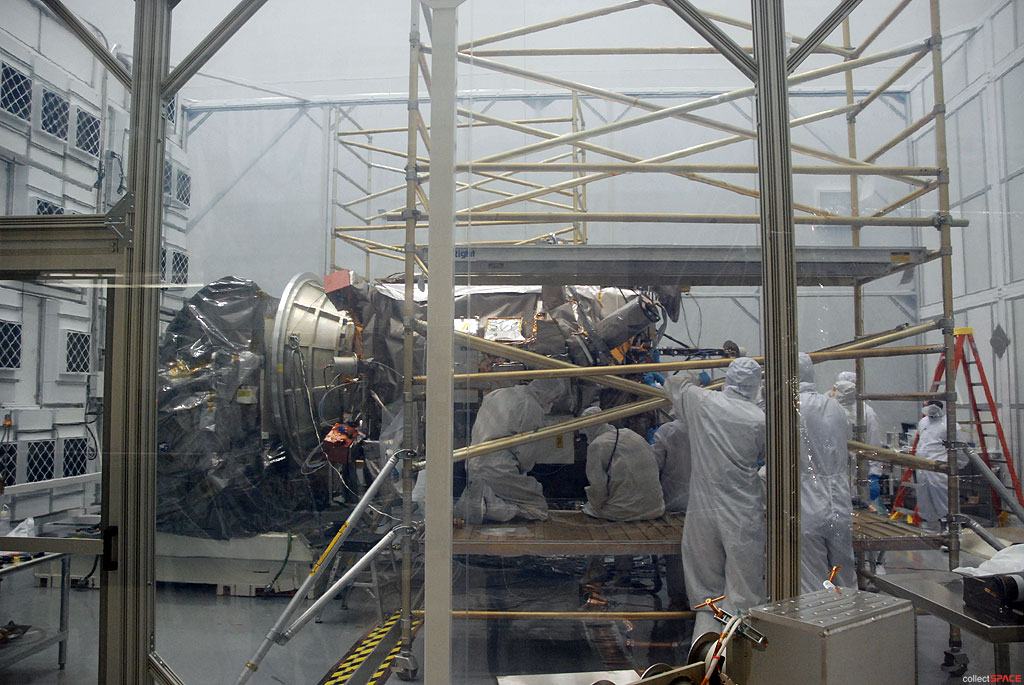
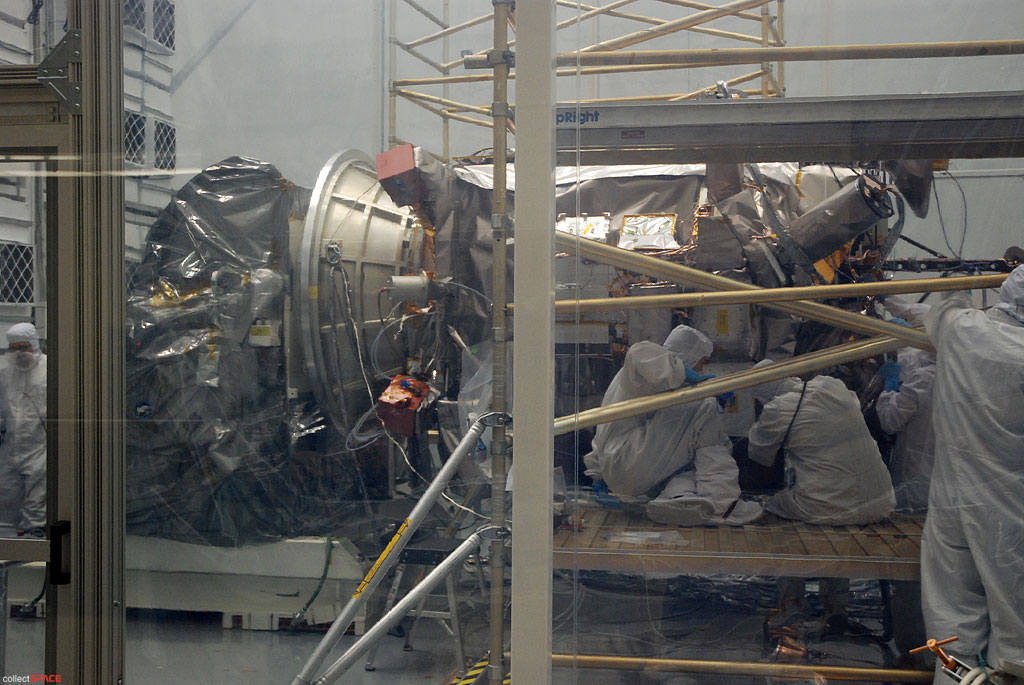
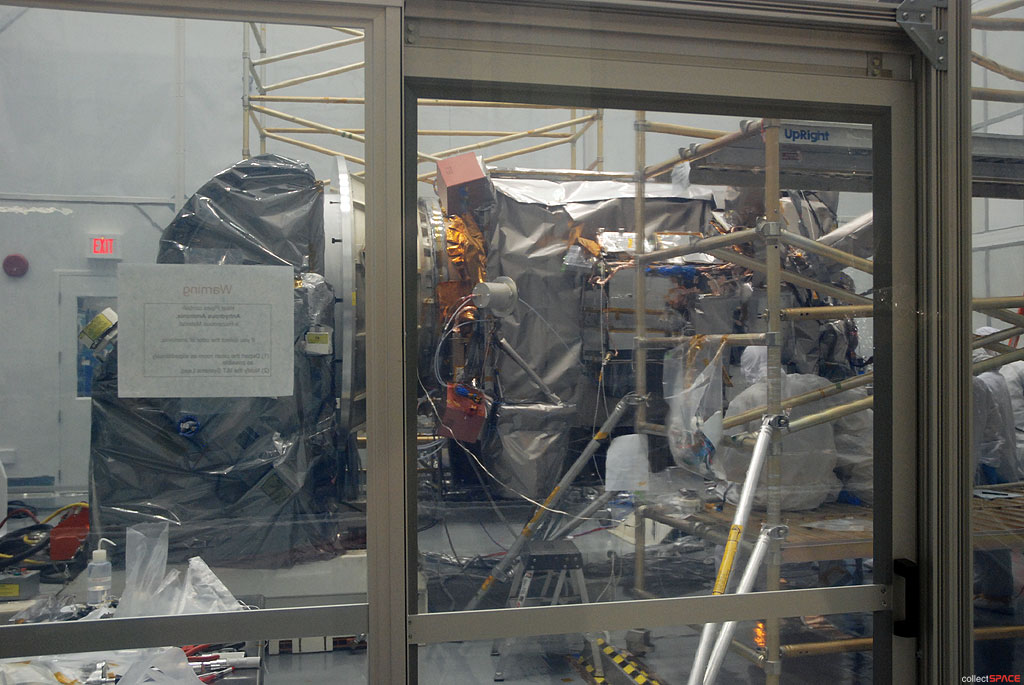
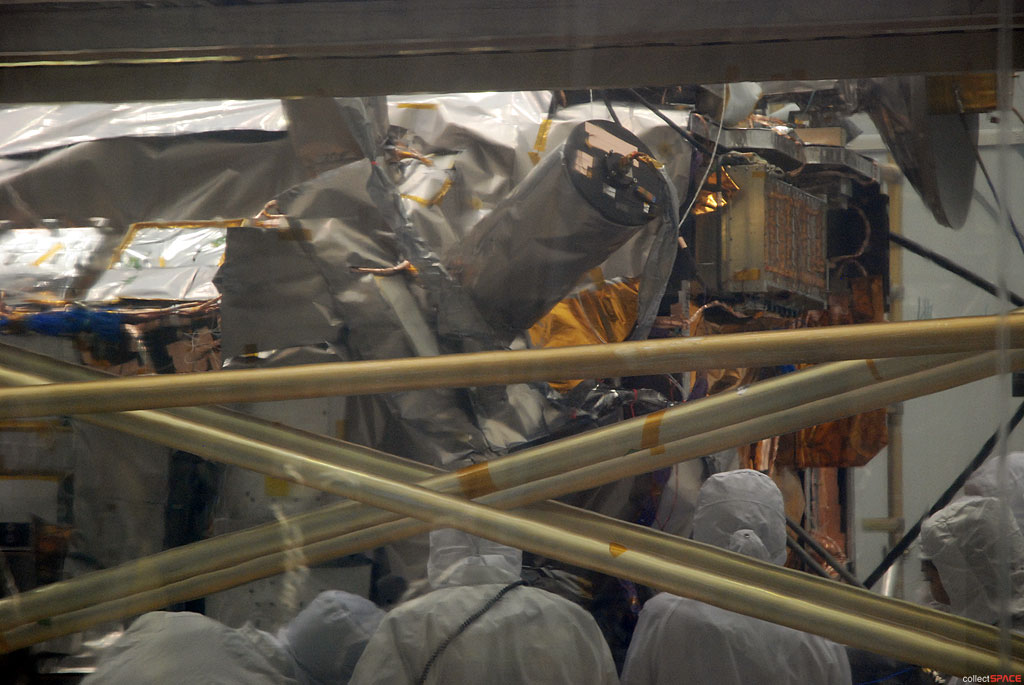
These photographs, taken today, show Lunar Reconnaissance Orbiter laying on its side as it undergoes a comprehensive performance test, its first "total checkout" at Goddard Space Flight Center in Greenbelt, Maryland.
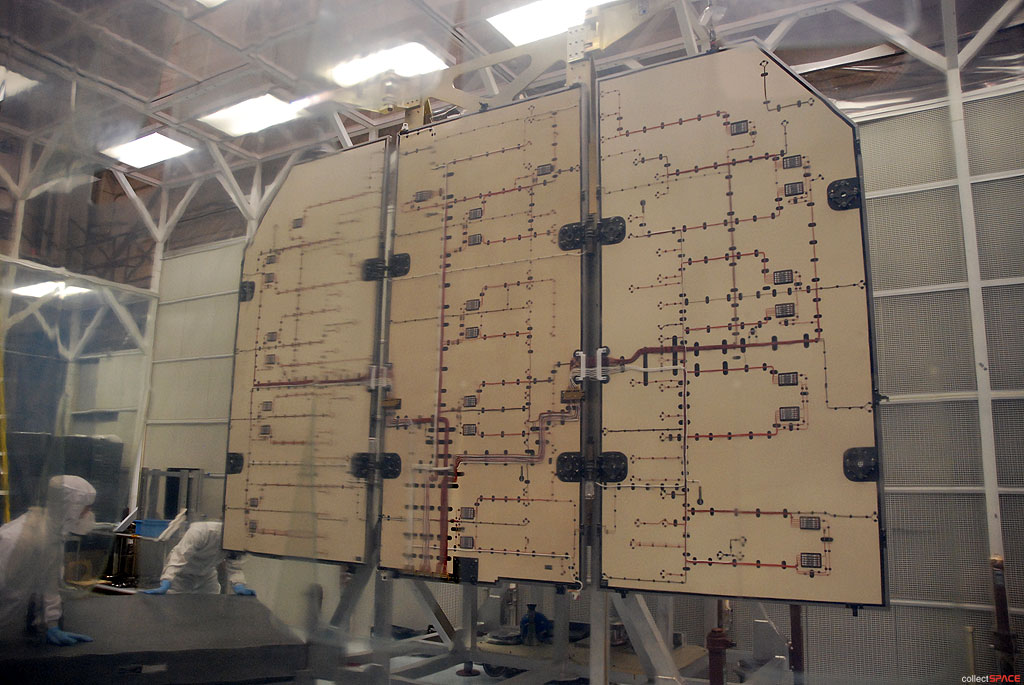
Lastly, a photo of the reverse side of LRO's solar panel.
Robert Pearlman Editor
Posts: 56814 From: Houston, TX Registered: Nov 1999
posted 07-21-2008 02:21 PM
Leonard David, blogging for LiveScience, reports that the launch of LRO/LCROSS has slipped into 2009:
NASA's Lunar Reconnaissance Orbiter (LRO) is touted as the first mission in that vision, kicking off a series of robotic treks to the Moon starting no later than 2008, as called for in the Bush push.
But the word here is that LRO is being delayed until February 2009 - kind of reaching its own escape velocity in terms of calendar date and sticking to the vision script of action items.
According to a manifest maintained by Goddard Space Flight Center, the launch is now targeted for February 27, 2009.
Robert Pearlman Editor
Posts: 56814 From: Houston, TX Registered: Nov 1999
posted 07-31-2008 12:09 PM
NASA release
NASA Tests Moon Imaging Spacecraft at Goddard
NASA's Lunar Reconnaissance Orbiter, also known as LRO, has completed the first round of environmental testing at NASA's Goddard Space Flight Center in Greenbelt, Md. These tests ensure the spacecraft is prepared for its mission to collect the highest resolution images and most comprehensive geological data set ever returned from the moon. The objective of the mission is to map the lunar surface in preparation for human missions to the moon, which are planned to occur by 2020.
The first two tests for the orbiter were the spin test and vibration test. The spin test determines the spacecraft's center of gravity and measures characteristics of its rotation. During vibration testing, engineers checked the structural integrity of the lunar probe aboard a large, shaking table that simulated the rigorous ride the orbiter will encounter during liftoff aboard an Atlas rocket.
"It is during lift-off the spacecraft will be under the most stress," said Cathy Peddie, deputy project manager for LRO at Goddard. "We want to ensure the Lunar Reconnaissance Orbiter can withstand the extreme conditions experienced during launch."
The next hurdle for the orbiter is approximately four days of acoustics testing during which the bagged spacecraft is placed near multistory, wall-sized speakers that simulate the noise-induced vibrations of launch. Following acoustics testing, the spacecraft will undergo a daylong test that simulates the orbiter's separation from the rocket during launch.
In late August, the spacecraft will begin approximately five weeks of thermal vacuum testing, which duplicates the extreme hot, cold and airless conditions of space. During the test, engineers will operate the orbiter and conduct simulated flight operations while the spacecraft is subjected to the extreme temperature cycles of the lunar environment.
By the end of 2008, the Lunar Reconnaissance Orbiter will be transported to NASA's Kennedy Space Center in Florida for final launch preparations. The orbiter and the Lunar Crater Observation and Sensing Satellite, a mission to impact the moon in search of water ice, are scheduled to launch atop an Atlas V rocket from Cape Canaveral Air Force Station in Florida. The launch window opens Feb. 27, 2009, and continues through the end of March.
The seven science instruments aboard the Lunar Reconnaissance Orbiter will develop highly detailed maps of the lunar surface that provide data about lunar topography, surface temperature, lighting conditions, mineralogical composition, and abundance of natural resources. Information from the robotic spacecraft will be used to select safe landing sites and assess potential outpost locations for future human missions to the moon. The spacecraft also will provide valuable information about the lunar radiation environment, enabling the development of effective mitigation strategies for human explorers.
The Lunar Reconnaissance Orbiter will be in a polar orbit, unlike the Apollo missions that focused on gaining science from the area around the moon's equator. The spacecraft will spend at least a year in a low, polar orbit approximately 30 miles above the lunar surface, while the instruments work together to collect detailed information about the lunar environment.
NASA's Goddard Space Flight Center is building and managing the Lunar Reconnaissance Orbiter for NASA's Exploration Systems Mission Directorate in Washington.
Robert Pearlman Editor
Posts: 56814 From: Houston, TX Registered: Nov 1999
posted 10-23-2008 03:37 PM
NASA release
NASA's Next Moon Mission Begins Thermal Vacuum Test
NASA's Lunar Reconnaissance Orbiter, or LRO, has begun environmental testing in a thermal vacuum that simulates the harsh rigors of space.
The spacecraft, built at NASA's Goddard Space Flight Center in Greenbelt, Md., has been lifted into a four-story thermal vacuum chamber there for a test that will last approximately five weeks. Once sealed in the chamber, the satellite will undergo a series of tests that simulate the space environment it will encounter when it orbits the moon.
During the tests, NASA engineers will operate the spacecraft to ensure it is performing as planned. The project also will conduct mission simulations to further train and develop the team that will operate the spacecraft.
"This is an exciting time for our project," said Cathy Peddie, LRO deputy project manager at Goddard. "Thermal vacuum testing is one of our major milestones. Not only are we checking out LRO in a test facility that most closely matches its final destination, but we are getting more 'hands-on' time operating LRO as we will see it next year at the moon."
The orbiter will carry seven instruments to provide scientists with detailed maps of the lunar surface and enhance our understanding of the moon's topography, lighting conditions, mineralogical composition and natural resources. Information gleaned from LRO will be used to select safe landing sites, determine locations for future lunar outposts and help to mitigate radiation dangers to astronauts.
The orbiter will be shipped to NASA's Kennedy Space Center in Florida early next year to be prepared for its April 24 launch aboard an Atlas V rocket. Accompanying the spacecraft will be the Lunar Crater Observation and Sensing Satellite, a mission that will impact the moon's surface in its search for water ice.
Robert Pearlman Editor
Posts: 56814 From: Houston, TX Registered: Nov 1999
posted 12-22-2008 12:51 PM
NASA release
Next NASA Moon Mission Completes Major Milestone
NASA's Lunar Reconnaissance Orbiter, or LRO, has successfully completed thermal vacuum testing, which simulates the extreme hot, cold and airless conditions of space LRO will experience after launch. This milestone concludes the orbiter's environmental test program at NASA's Goddard Space Flight Center in Greenbelt, Md.
The orbiter will carry seven instruments to provide scientists with detailed maps of the lunar surface and increase our understanding of the moon's topography, lighting conditions, mineralogical composition and natural resources. Data returned to Earth from the Lunar Reconnaissance Orbiter will be used to select safe landing sites, determine locations for future outposts and help mitigate radiation dangers to astronauts. The spacecraft will spend at least a year in a low, polar orbit approximately 30 miles above the lunar surface while the instruments work together to collect detailed information about the moon's environment.
The thermal vacuum testing on the spacecraft took about two months. The orbiter, which was built at Goddard, was subjected to the extreme temperature cycles of the lunar environment as engineers conducted simulated flight operations.
"We have cooked LRO, frozen it, shaken it, and blasted it with electromagnetic waves, and still it operates," said Dave Everett, LRO mission system engineer at Goddard. "We have performed more than 2,500 hours of powered testing since January, more than 600 of that in vacuum."
The first two checks were the spin and vibration tests. The spin test determined the spacecraft's center of gravity and measured characteristics of its rotation. During vibration testing, engineers checked the structural integrity of the spacecraft aboard a large, shaking table that simulated the rigorous ride the orbiter will encounter during liftoff aboard an Atlas rocket.
Next, the orbiter was subjected to acoustics testing. The bagged spacecraft was placed near wall-sized speakers that simulate the noise-induced vibrations of launch. Following acoustics testing, LRO underwent tests that simulated the orbiter's separation from the rocket during launch. The spacecraft also underwent electromagnetic compatibility testing to ensure internal and external electrical signals do not interfere with its critical functions.
"It was less than one year ago that LRO was a myriad collection of parts not yet delivered to our clean room," said Craig Tooley, LRO project manager at Goddard. "This truly is a significant accomplishment -- a hard earned milestone. It is a humbling and awe-inspiring experience to work with the LRO team."
LRO will be shipped to NASA's Kennedy Space Center in Florida in early 2009 to be prepared for its April 24 launch aboard an Atlas V rocket. Accompanying the spacecraft will be the Lunar Crater Observation and Sensing Satellite, a mission that will impact the moon's surface in its search for water ice.
Goddard is building and managing the Lunar Reconnaissance Orbiter for NASA's Exploration Systems Mission Directorate in Washington.
Robert Pearlman Editor
Posts: 56814 From: Houston, TX Registered: Nov 1999
posted 02-10-2009 07:21 PM
An update on Lunar Reconnaissance Orbiter, via its Twitter feed:
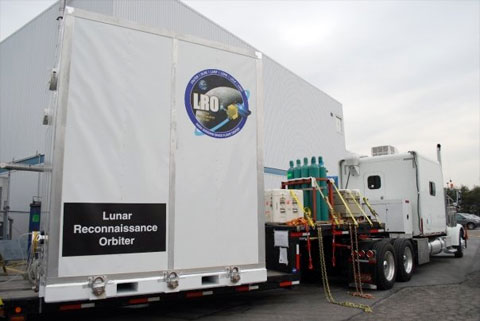
I'm in my shipping container ready to be taken to KSC tonite.
Robert Pearlman Editor
Posts: 56814 From: Houston, TX Registered: Nov 1999
posted 02-11-2009 01:15 PM
NASA release
NASA Lunar Spacecraft Ships South In Preparation For Launch
NASA's Lunar Reconnaissance Orbiter, or LRO, spacecraft was loaded on a truck Wednesday to begin its two-day journey to NASA's Kennedy Space Center in Florida. Launch is targeted for April 24.
The spacecraft was built by engineers at Goddard, where it recently completed two months of tests in a thermal vacuum chamber. During its time in the chamber, the spacecraft was subjected to hot and cold temperatures it will experience as it orbits the moon.
The satellite's mission is one of the first steps in NASA's plan to return astronauts to the moon. LRO will spend at least one year in a low polar orbit on its primary exploration mission, with the possibility of three more years to collect additional detailed scientific information about the moon and its environment.
The orbiter will carry seven instruments to provide scientists with detailed maps of the lunar surface and enhance our understanding of the moon's topography, lighting conditions, mineralogical composition and natural resources. Information gleaned from LRO will be used to select safe landing sites, determine locations for future lunar outposts and help mitigate radiation dangers to astronauts. The polar regions of the moon are the main focus of the mission because continuous access to sunlight may be possible and water ice may exist in permanently shadowed areas of the poles.
"This is the culmination of four years of hard work by everyone on the LRO Project," said Cathy Peddie, LRO deputy project manager at NASA's Goddard Space Flight Center in Greenbelt, Md. "LRO now begins its launch site processing, where it will be prepped for integration with our sister mission LCROSS, and eventually encapsulated in the Atlas V for its journey to the moon."
LRO's instruments have considerable heritage from previous planetary science missions, enabling the spacecraft to transition to a research phase under the direction of NASA's Science Mission Directorate one year after launch.
Accompanying LRO on its journey to the moon will be the Lunar Crater Observation and Sensing Satellite, or LCROSS, a mission that will impact the lunar surface in its search for water ice. The LCROSS mission is managed by NASA's Ames Research Center at Moffett Field, Calif.
Goddard manages the Lunar Reconnaissance Orbiter for NASA's Exploration Systems Mission Directorate in Washington.
Photo credit: NASA
Robert Pearlman Editor
Posts: 56814 From: Houston, TX Registered: Nov 1999
NASA has pushed back the launch of its Lunar Reconnaissance Orbiter (LRO) mission again, this time to June 2 at the earliest, due to a launch delay of the U.S. Air Force's Wideband Global Satcom-2 (WGS-2) communications satellite.
...both LRO and the military's WGS-2 satellite are slated to launch from the same pad at Cape Canaveral Air Force Station in Florida aboard Atlas 5 rockets. Denver-based United Launch Alliance, manufacturer and operator of the Atlas and Delta rockets, needs about 60 days between launches for ground processing.
The launch of WGS-2, now set for April 3, was scrubbed in March when a leak was detected in the Atlas 5 Centaur upper stage's oxidizer valve. Once the WGS-2 launch occurs, United Launch Alliance can begin preparations for the LRO liftoff.
Robert Pearlman Editor
Posts: 56814 From: Houston, TX Registered: Nov 1999
Factors of time and distance have obscured from view the winners and losers that remain across one of the great battlegrounds of the Cold War - the Moon.
Those interfering veils are about to be lifted by NASA's Lunar Reconnaissance Orbiter (LRO), set for liftoff June 17 on the most ambitious lunar mission since Apollo 17 in 1972.
LRO is a science mission with tremendous implications for future manned and unmanned missions to the Moon.
...key targets involve:
Apollo landing sites: LRO's imagery will help show detail on the condition of all six Apollo landing sites and the Apollo flight hardware left on the moon by 12 American astronauts between 1969-72.
Robert Pearlman Editor
Posts: 56814 From: Houston, TX Registered: Nov 1999
posted 05-30-2009 01:10 PM
NASA release
NASA Details Plans for Lunar Exploration Robotic Missions
NASA's return to the moon will get a boost in June with the launch of two satellites that will return a wealth of data about Earth's nearest neighbor. On Thursday, May 21, the agency outlined the upcoming missions of the Lunar Reconnaissance Orbiter, or LRO, and the Lunar Crater Observation and Sensing Satellite, or LCROSS. The spacecraft will launch together June 17 aboard an Atlas V rocket from Cape Canaveral Air Force Station in Florida.
Using a suite of seven instruments, LRO will help identify safe landing sites for future human explorers, locate potential resources, characterize the radiation environment and test new technology. LCROSS will seek a definitive answer about the presence of water ice at the lunar poles. LCROSS will use the spent second stage Atlas Centaur rocket in an unprecedented way that will culminate with two spectacular impacts on the moon's surface.
"These two missions will provide exciting new information about the moon, our nearest neighbor," said Doug Cooke, associate administrator of NASA's Exploration Systems Mission Directorate in Washington. "Imaging will show dramatic landscapes and areas of interest down to one-meter resolution. The data also will provide information about potential new uses of the moon. These teams have done a tremendous job designing and building these two spacecraft."
LRO's instruments will help scientists compile high resolution, three-dimensional maps of the lunar surface and also survey it in the far ultraviolet spectrum. The satellite's instruments will help explain how the lunar radiation environment may affect humans and measure radiation absorption with a plastic that is like human tissue.
LRO's instruments also will allow scientists to explore the moon's deepest craters, look beneath its surface for clues to the location of water ice, and identify and explore both permanently lit and permanently shadowed regions. High resolution imagery from its camera will help identify landing sites and characterize the moon's topography and composition. A miniaturized radar will image the poles and test the system's communications capabilities.
"LRO is an amazingly sophisticated spacecraft," said Craig Tooley, LRO project manager at NASA's Goddard Space Flight Center in Greenbelt, Md. "Its suite of instruments will work in concert to send us data in areas where we've been hungry for information for years."
While most Centaurs complete their work after boosting payloads out of Earth's orbit, the LCROSS Centaur will journey with the spacecraft for four months and be guided to an impact in a permanently shadowed crater at one of the moon's poles. The resulting debris plume is expected to rise more than six miles. It presents a dynamic observation target for LCROSS as well as a network of ground-based telescopes, LRO, and possibly the Hubble Space Telescope. Observers will search for evidence of water ice by examining the plume in direct sunlight. LCROSS also will increase knowledge of the mineralogical makeup of some of the remote polar craters that sunlight never reaches. The satellite represents a new generation of fast development, cost capped missions that use flight proven hardware and off the shelf software to achieve focused mission goals.
"We look forward to engaging a wide cross section of the public in LCROSS' spectacular arrival at the moon and search for water ice," said LCROSS Project Manager Dan Andrews of NASA's Ames Research Center at Moffett Field, Calif. "It's possible we'll learn the answer to what is increasingly one of planetary science's most intriguing questions."
LRO and LCROSS are the first missions launched by the Exploration Systems Mission Directorate. Their data will be used to advance goals of future human exploration of the solar system. LRO will spend at least one year in low polar orbit around the moon, collecting detailed information for exploration purposes before being transferred to NASA's Science Mission Directorate to continue collecting additional scientific data.
Goddard manages the Lunar Reconnaissance Orbiter. Ames manages the Lunar Crater Observation and Sensing Satellite. LRO is a NASA mission with international participation from the Institute for Space Research in Moscow. Russia provides the neutron detector aboard the spacecraft. Northrop Grumman in Redondo Beach, Calif., built the LCROSS spacecraft.
Robert Pearlman Editor
Posts: 56814 From: Houston, TX Registered: Nov 1999
posted 05-30-2009 01:15 PM
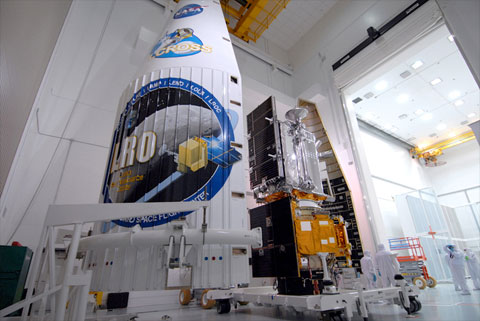
Above: On May 15 at the Astrotech Space Operations Facility, the fairing halves were joined to enclose LRO and LCROSS.
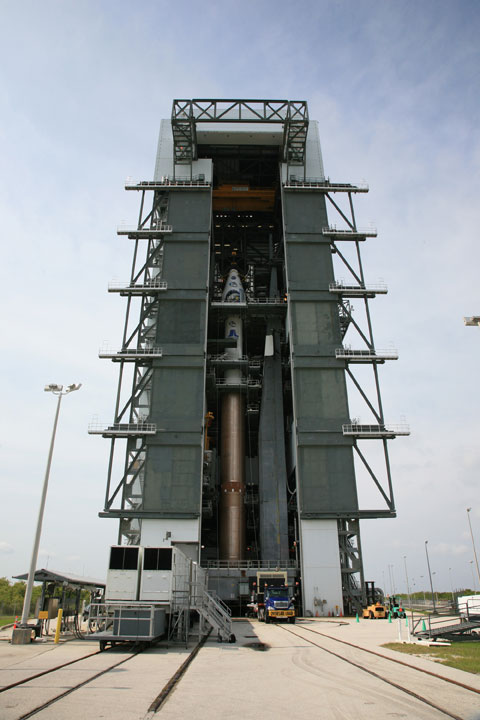
Below: On May 28 at Launch Complex 41 at the Cape Canaveral Air Force Station, LRO and LCROSS are mated with their Atlas V rocket for launch.
Photo credits: NASA
Robert Pearlman Editor
Posts: 56814 From: Houston, TX Registered: Nov 1999
posted 06-05-2009 12:14 AM
For those desiring to view the LRO/LCROSS launch:
Date: Wednesday, June 17, 2009 Time: 3:51 p.m. EDT
Special launch day activities will take place at the Kennedy Space Center Visitor Complex throughout the week of launch, beginning Saturday, June 13 through Wednesday, June 17. Activities include daily presentations in the Astronaut Encounter Theater given by key NASA personnel involved in the LRO/LCROSS robotic missions. Daily launch briefings will also be available for guests.
Launch viewing is included with general admission or an annual pass. Arrive at least an hour early to be processed through security. Viewing is from the main Visitor Complex grounds or visitors who would like to view from the Apollo/Saturn V Center (along the bus route) will need to arrive two hours earlier than launch time.
Robert Pearlman Editor
Posts: 56814 From: Houston, TX Registered: Nov 1999
posted 06-15-2009 09:02 AM
NASA update
LRO/LCROSS Closer to Launch
The Flight Readiness Review for LRO/LCROSS was held June 10, and there were no issues or concerns that would preclude a launch on June 17.
On June 11, a mission dress rehearsal was conducted. This was a high-fidelity exercise for the launch team, affirming their readiness for the countdown.
The Atlas V and LRO/LCROSS spacecraft have been undergoing prelaunch preparations in the Vertical Integration Facility adjacent to the launch pad at Cape Canaveral Air Force Station. The spacecraft closeouts for flight were completed June 10.
In preparation for launch, the Atlas V launch vehicle with LRO/LCROSS atop is scheduled to be rolled out to the pad June 16 at 10 a.m. EDT.
The countdown on launch day will start at 8:41 a.m. for a liftoff targeted for 3:51 p.m.
The launch of LRO/LCROSS hinges on NASA's decision whether or not to first launch space shuttle Endeavour on mission STS-127. For updates on that decision, see our STS-127 Flight Day Journal.
Robert Pearlman Editor
Posts: 56814 From: Houston, TX Registered: Nov 1999
posted 06-15-2009 01:00 PM
NASA update
New Launch Date Set
As a result of the rescheduling of space shuttle Endeavour's STS-127 mission for June 17, the Lunar Reconnaissance Orbiter and Lunar Crater Observation and Sensing Satellite are now set to lift off together aboard an Atlas V rocket on Thursday, June 18.
There will be three launch opportunities from Cape Canaveral Air Force Station in Florida at 5:12 p.m., 5:22 p.m. and 5:32 p.m. EDT.
If Thursday's liftoff of LRO/LCROSS is postponed 24 hours, the launch times Friday are 6:41 p.m., 6:51 p.m. and 7:01 p.m. EDT and Saturday's opportunities are 8:08 p.m., 8:18 p.m. and 8:28 p.m.
Robert Pearlman Editor
Posts: 56814 From: Houston, TX Registered: Nov 1999
posted 06-17-2009 01:36 PM
NASA release
Lunar Exploration Missions Roll to Pad for Thursday Launch
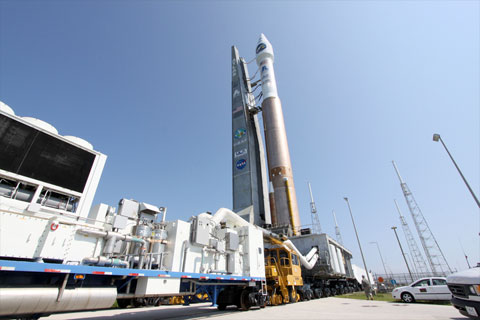
NASA's Lunar Reconnaissance Orbiter, or LRO, and the Lunar Crater Observation and Sensing Satellite, or LCROSS, rolled aboard their Atlas V rocket to the launch pad at Cape Canaveral Air Force Station in Florida Wednesday morning in preparation for launch on Thursday. The spacecraft left its processing facility at 10:02 EDT and arrived at the pad about 35 minutes later.
The spacecraft are scheduled to lift off together on Thursday, June 18, with three attempts possible at 5:12 p.m., 5:22 p.m. and 5:32 p.m. If launch slips to Friday, June 19, the launch opportunities would be 6:41 p.m., 6:51 p.m. and 7:01 p.m.
LRO is scheduled for a one-year exploration mission at a polar orbit of about 31 miles, or 50 kilometers, the closest any spacecraft has orbited the moon. Its primary objective is to conduct investigations to prepare for future explorations of the moon. LCROSS will search for water ice on the moon by sending the spent upper-stage Centaur rocket to impact part of a polar crater in permanent shadows. LCROSS will fly into the plume of dust left by the impact and measure the properties before also colliding with the lunar surface.
NASA TV coverage of the launch will begin at 2 p.m. June 18.
Photo credit: NASA/Jack Pfaller
Robert Pearlman Editor
Posts: 56814 From: Houston, TX Registered: Nov 1999
posted 06-18-2009 12:00 PM
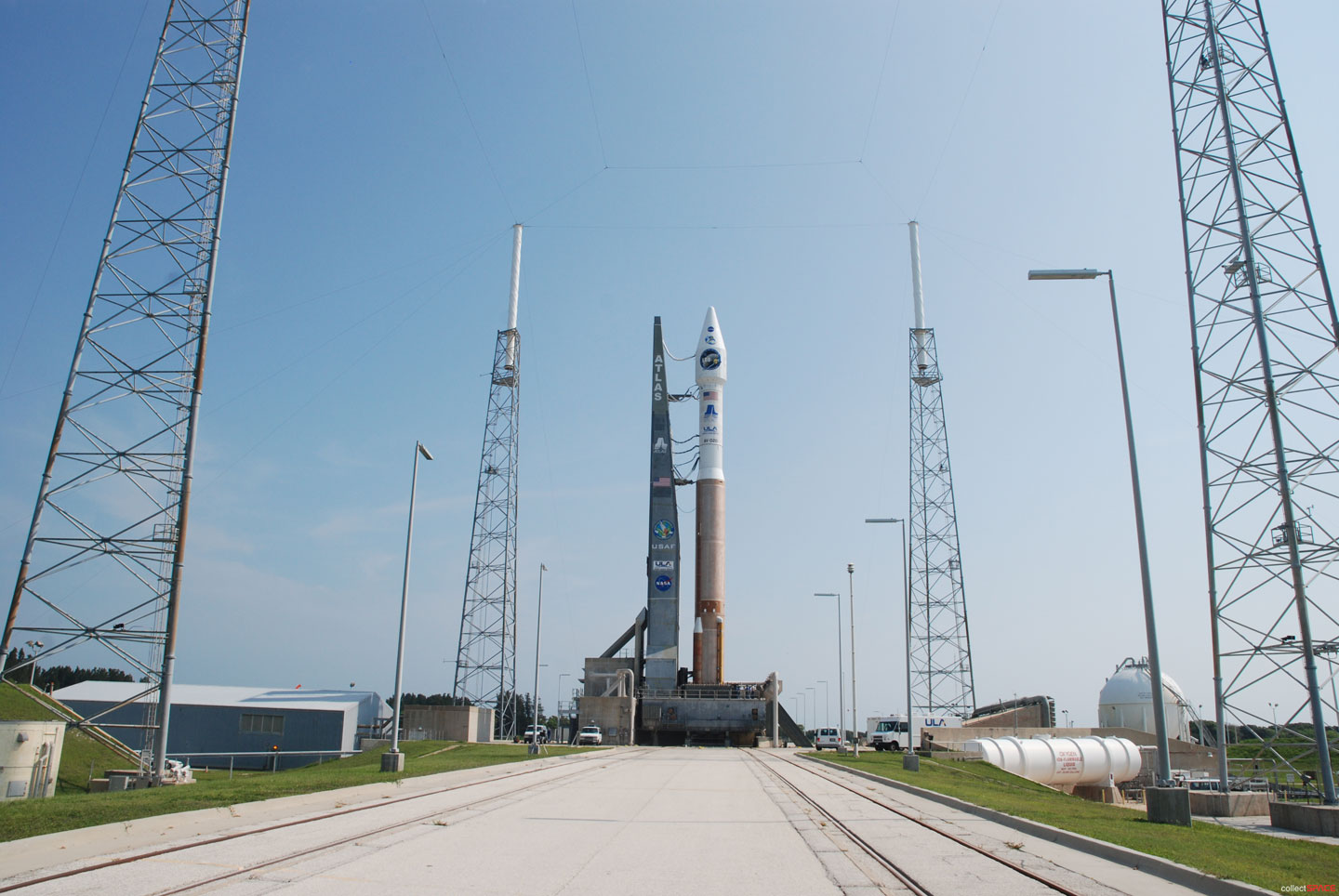
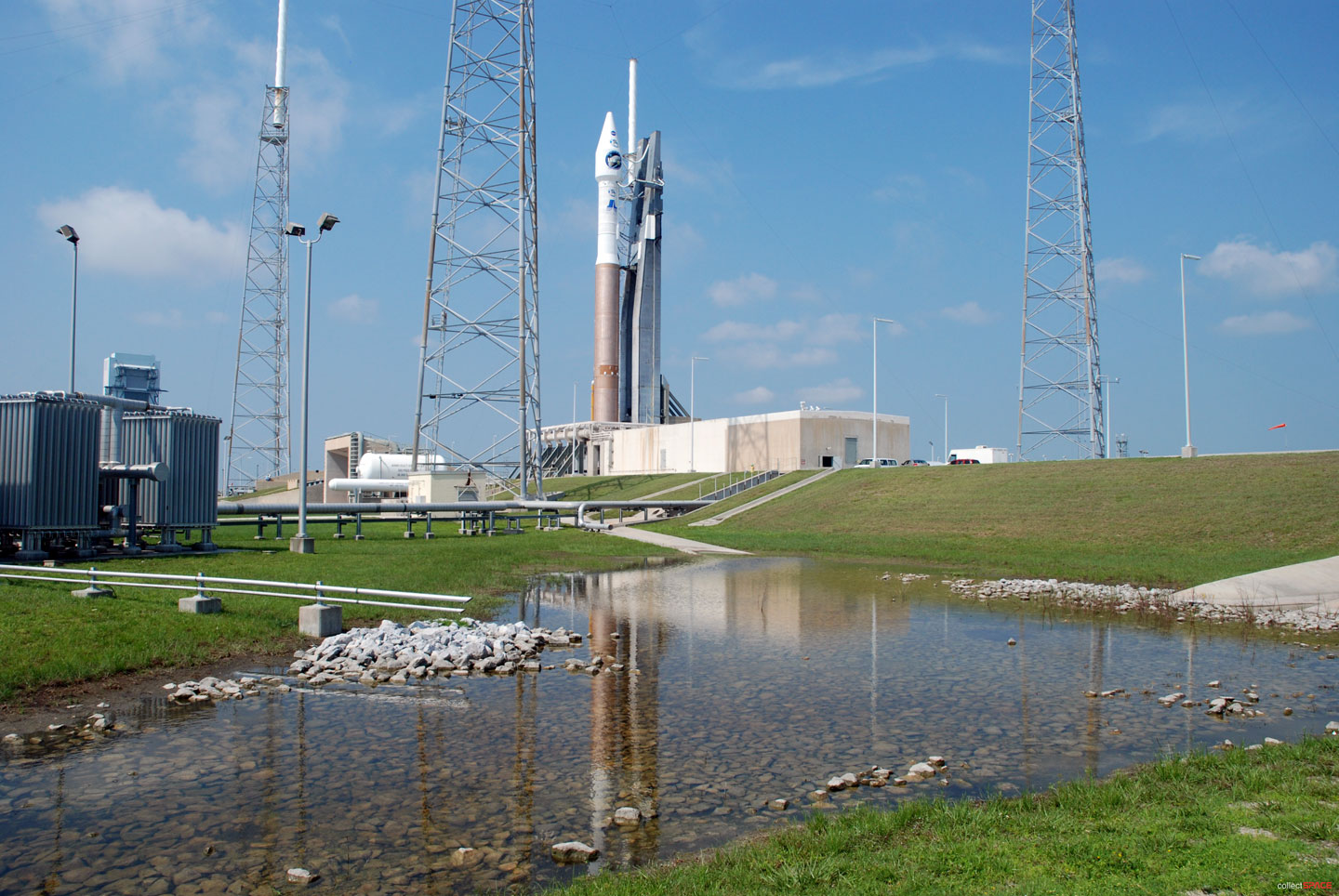
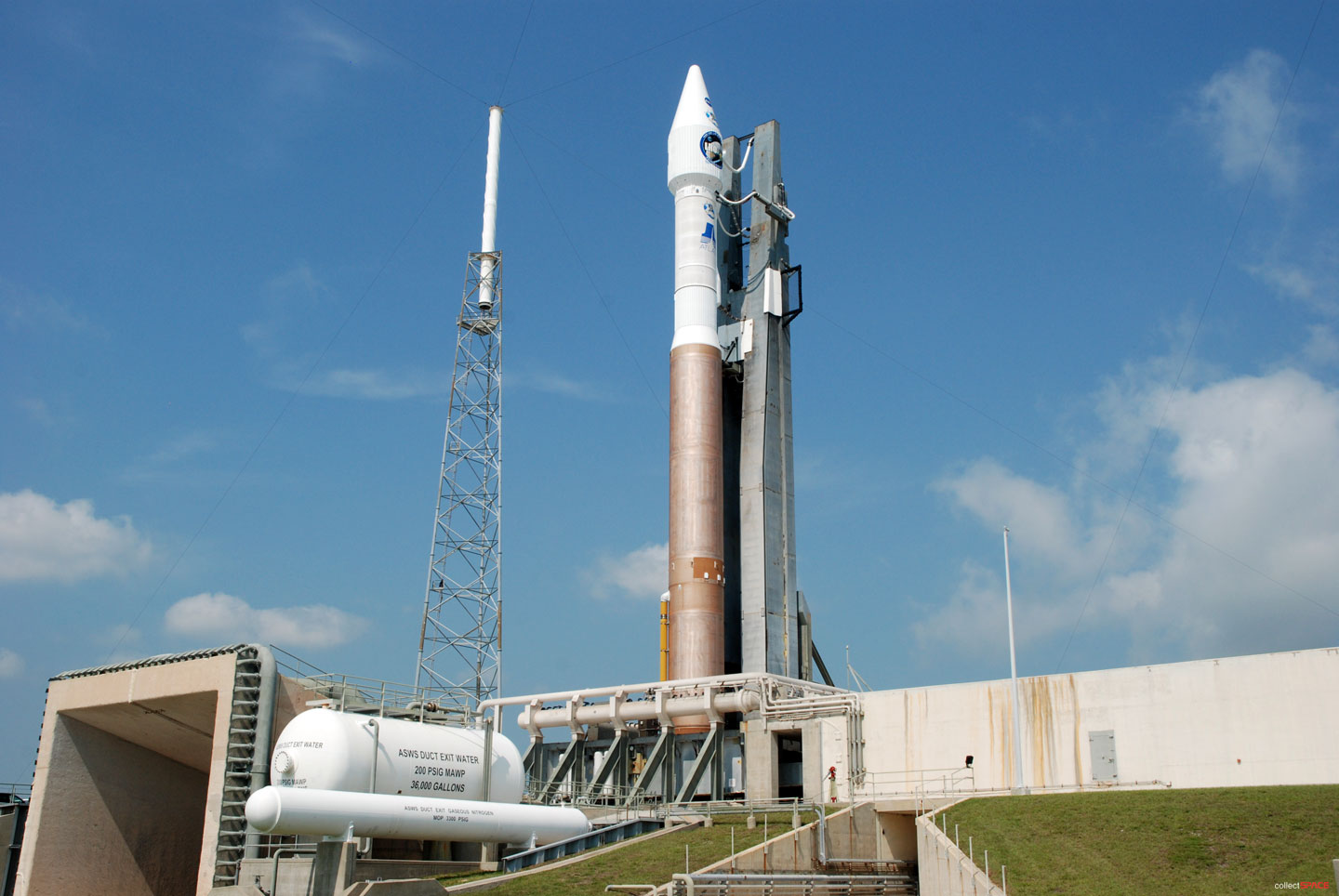
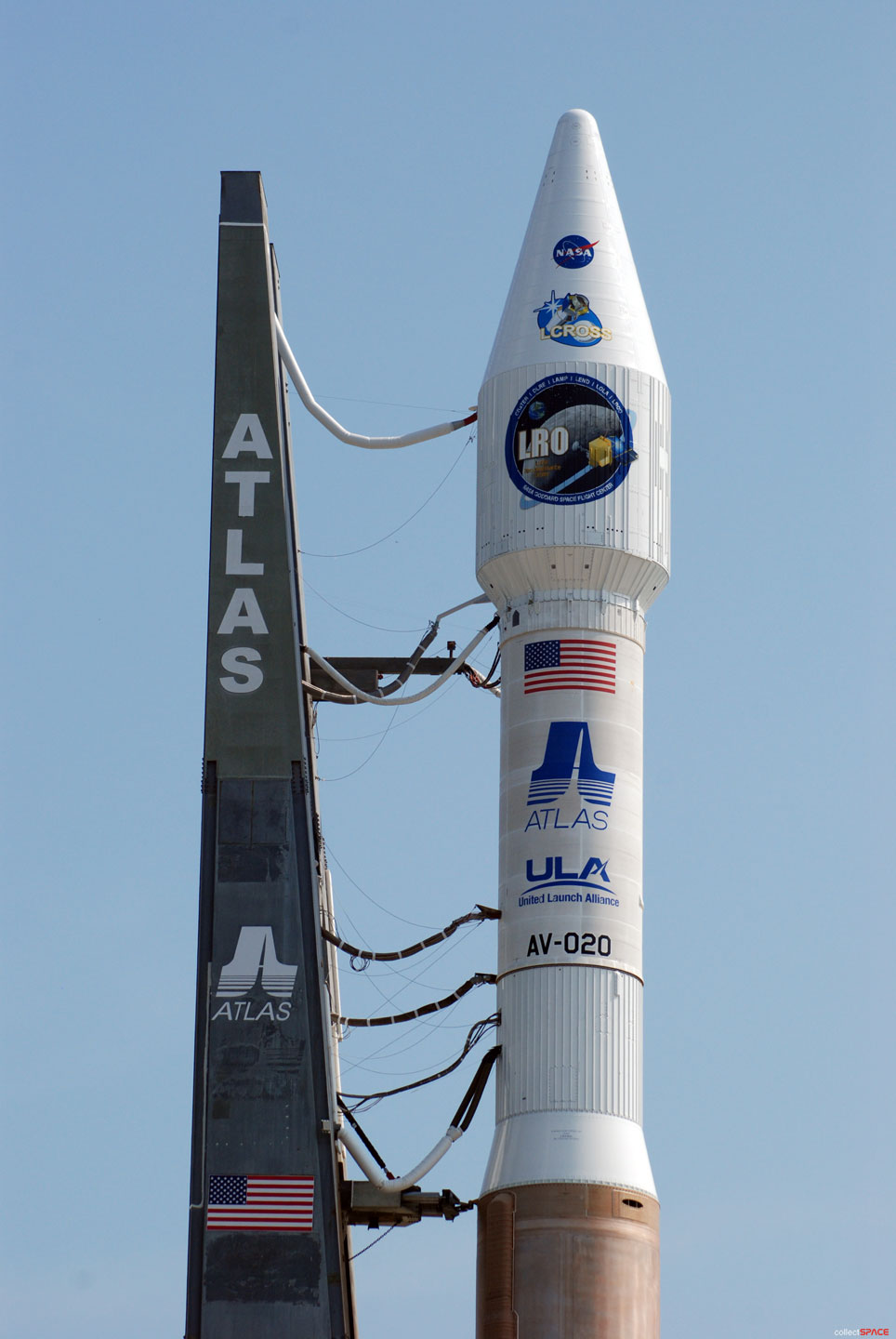
The Atlas V carrying LRO/LCROSS stands poised on the pad for launch:
Photo credit: collectSPACE.com
Robert Pearlman Editor
Posts: 56814 From: Houston, TX Registered: Nov 1999
posted 06-18-2009 04:37 PM
NASA release
NASA Returning to the Moon with First Lunar Launch in a Decade
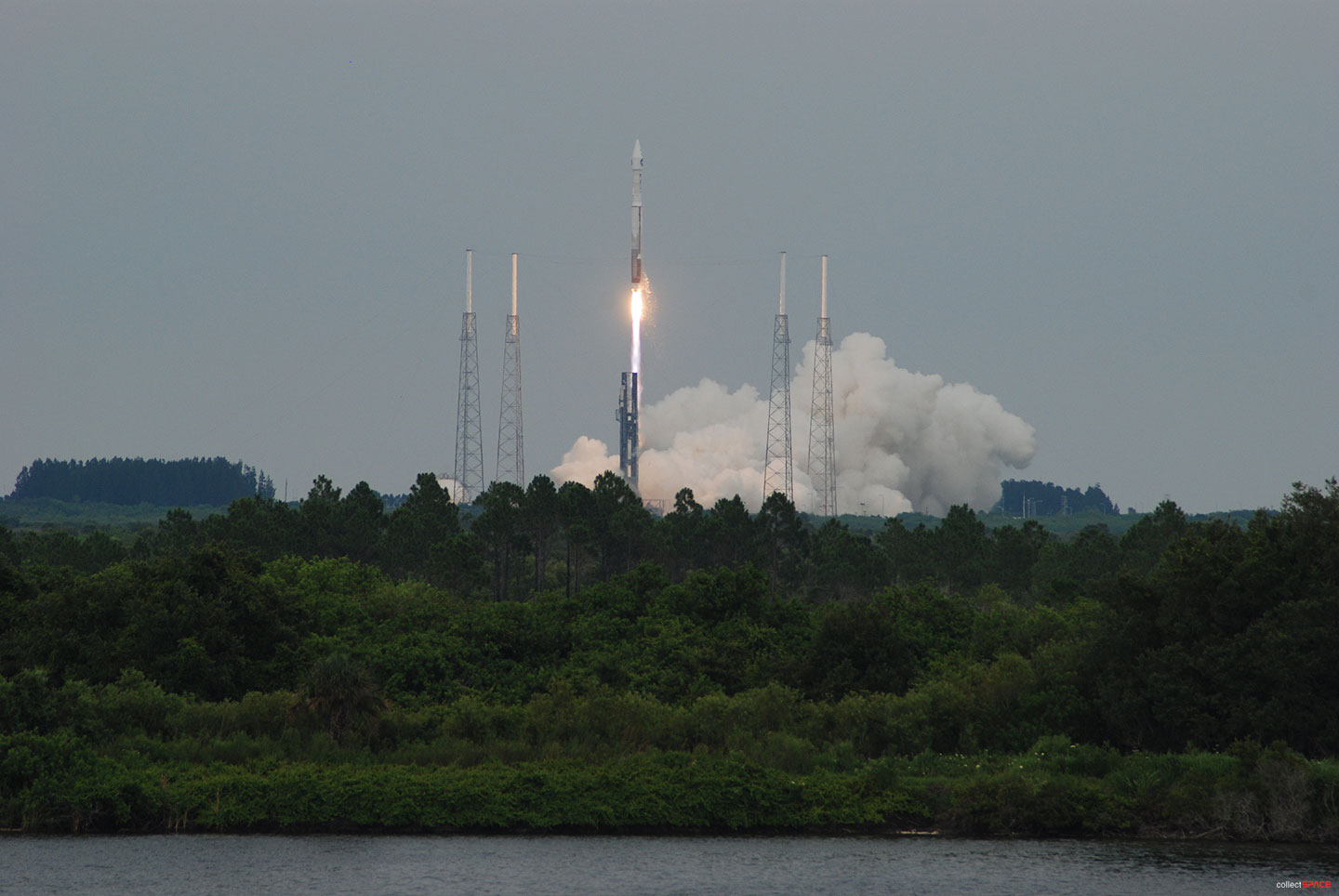
NASA's Lunar Reconnaissance Orbiter launched at 5:32 p.m. EDT Thursday aboard an Atlas V rocket from Cape Canaveral Air Force Station in Florida. The satellite will relay more information about the lunar environment than any other previous mission to the moon.
The orbiter, known as LRO, separated from the Atlas V rocket carrying it and a companion mission, the Lunar Crater Observation and Sensing Satellite, or LCROSS, and immediately began powering up the components necessary to control the spacecraft. The flight operations team established communication with LRO and commanded the successful deployment of the solar array at 7:40 p.m. The operations team continues to check out the spacecraft subsystems and prepare for the first mid-course correction maneuver. NASA scientists expect to establish communications with LCROSS about four hours after launch, at approximately 9:30 p.m.
"This is a very important day for NASA," said Doug Cooke, associate administrator for NASA's Exploration Systems Mission Directorate in Washington, which designed and developed both the LRO and LCROSS missions. "We look forward to an extraordinary period of discovery at the moon and the information LRO will give us for future exploration missions."
The spacecraft will be placed in low polar orbit about 31 miles, or 50 kilometers, above the moon for a one year primary mission. LRO's instruments will help scientists compile high resolution three-dimensional maps of the lunar surface and also survey it at many spectral wavelengths. The satellite will explore the moon's deepest craters, exploring permanently sunlit and shadowed regions, and provide understanding of the effects of lunar radiation on humans.
"Our job is to perform reconnaissance of the moon's surface using a suite of seven powerful instruments," said Craig Tooley, LRO project manager at NASA's Goddard Space Flight Center in Greenbelt, Md. "NASA will use the data LRO collects to design the vehicles and systems for returning humans to the moon and selecting the landing sites that will be their destinations."
High resolution imagery from LRO's camera will help identify landing sites for future explorers and characterize the moon's topography and composition. The hydrogen concentrations at the moon's poles will be mapped in detail, pinpointing the locations of possible water ice. A miniaturized radar system will image the poles and test communication capabilities.
"During the 60 day commissioning period, we will turn on spacecraft components and science instruments," explained Cathy Peddie, LRO deputy project manager at Goddard. "All instruments will be turned on within two weeks of launch, and we should start seeing the moon in new and greater detail within the next month."
"We learned much about the moon from the Apollo program, but now it is time to return to the moon for intensive study, and we will do just that with LRO," said Richard Vondrak, LRO project scientist at Goddard.
All LRO initial data sets will be deposited in the Planetary Data System, a publicly accessible repository of planetary science information, within six months of launch.
Goddard built and manages LRO. LRO is a NASA mission with international participation from the Institute for Space Research in Moscow. Russia provides the neutron detector aboard the spacecraft.
Photo credit: collectSPACE.com
Robert Pearlman Editor
Posts: 56814 From: Houston, TX Registered: Nov 1999
posted 06-19-2009 12:05 AM
Status updates on Twitter:
LRO will reach the moon on Tuesday at 4:43 a.m. CDT.
Robert Pearlman Editor
Posts: 56814 From: Houston, TX Registered: Nov 1999
posted 06-23-2009 12:17 AM
NASA release
New NASA Missions to Reach Moon Tuesday, Sending Back Live Video
Two NASA spacecraft will reach major mission milestones early Tuesday morning as they approach the moon -- one will send back live streaming imagery via the Internet as it swings by the moon, the other will insert itself into lunar orbit to begin mapping the moon's surface.
After a four and a half day journey to the moon, NASA's Lunar Reconnaissance Orbiter, or LRO, will be captured by the moon's gravity and prepare for the commissioning phase of its mission on June 23. NASA TV live coverage of LRO's orbit insertion begins at 5:30 a.m. EDT Tuesday, with the actual engine burn to begin orbit insertion starting at 5:47 a.m.
In addition to animation and footage of LRO, live interviews will be broadcast from NASA's Goddard Space Flight Center in Greenbelt, Md., with Cathy Peddie, LRO deputy project manager at Goddard; Jim Garvin, Goddard chief scientist; Laurie Leshin, Goddard deputy director for Science and Technology; Mike Wargo, NASA's chief lunar scientist in the Exploration Systems Mission Directorate at NASA Headquarters in Washington; Rich Vondrak, LRO project scientist at Goddard; and Craig Tooley, LRO project manager at Goddard.
At 8:20 a.m. Tuesday, the Science Operations Center at NASA's Ames Research Center in Moffett Field, Calif., will stream live telemetry-based spacecraft animation and the visible camera images from the Lunar Crater Observation and Sensing Satellite, or LCROSS, spacecraft as it swings by the moon before entering into a looping polar Earth orbit. Live video streaming via the Internet will last approximately one hour.
The LCROSS swingby starts near the lunar south pole and continues north along the far side of the moon. The maneuver will put the LCROSS spacecraft and its spent second stage Centaur rocket in the correct flight path for the October impact near the lunar south pole. The swingby also will give the mission operations team the opportunity to practice the small trajectory correction maneuvers needed to target the permanently shadowed crater that will be selected by the LCROSS science team.
During the swingby, the science team will make measurements of the moon's surface and the lunar horizon to calibrate the spacecraft's cameras and spectrometers. The LCROSS visible spectrometer will make the first near-ultraviolet survey of the selected locations on the far-side of the moon giving scientists a unique look at the concentration of minerals and elements in the lunar soil.
LCROSS and its attached Centaur upper stage rocket separately will collide with the moon the morning of Oct. 9, 2009, creating a pair of debris plumes that will be analyzed for the presence of water ice or water vapor, hydrocarbons and hydrated materials.
Robert Pearlman Editor
Posts: 56814 From: Houston, TX Registered: Nov 1999
posted 06-23-2009 07:01 AM
NASA release
NASA Lunar Mission Successfully Enters Moon Orbit
After a four and a half day journey from the Earth, the Lunar Reconnaissance Orbiter, or LRO, has successfully entered orbit around the moon. Engineers at NASA's Goddard Space Flight Center in Greenbelt, Md., confirmed the spacecraft's lunar orbit insertion at 6:27 a.m. EDT Tuesday.
During transit to the moon, engineers performed a mid-course correction to get the spacecraft in the proper position to reach its lunar destination. Since the moon is always moving, the spacecraft shot for a target point ahead of the moon. When close to the moon, LRO used its rocket motor to slow down until the gravity of the moon caught the spacecraft in lunar orbit.
"Lunar orbit insertion is a crucial milestone for the mission," said Cathy Peddie, LRO deputy project manager at Goddard. "The LRO mission cannot begin until the moon captures us. Once we enter the moon's orbit, we can begin to buildup the dataset needed to understand in greater detail the lunar topography, features and resources. We are so proud to be a part of this exciting mission and NASA's planned return to the moon."
A series of four engine burns over the next four days will put the satellite into its commissioning phase orbit. During the commissioning phase each of its seven instruments is checked out and brought online. The commissioning phase will end approximately 60 days after launch, when LRO will use its engines to transition to its primary mission orbit.
For its primary mission, LRO will orbit above the moon at about 31 miles, or 50 kilometers, for one year. The spacecraft's instruments will help scientists compile high resolution, three-dimensional maps of the lunar surface and also survey it at many spectral wavelengths.
The satellite will explore the moon's deepest craters, examining permanently sunlit and shadowed regions, and provide understanding of the effects of lunar radiation on humans. LRO will return more data about the moon than any previous mission.
DChudwin Member
Posts: 1121 From: Lincolnshire IL USA Registered: Aug 2000
posted 06-27-2009 06:24 PM
NASA status update (June 26, 2009)
LRO Executes Orbital Insertion Burn No. 4
At 8:25 a.m. EDT on June 26, the Lunar Reconnaissance Orbiter executed LOI-4. The 10-minute burn placed LRO in a 200 km circular polar orbit. Now in this low circular polar orbit, operations will begin to resemble the nominal mission with ground station passes coming and going on a regular frequency as the spacecraft passes behind the moon each orbit.
Robert Pearlman Editor
Posts: 56814 From: Houston, TX Registered: Nov 1999
posted 07-01-2009 04:19 PM
NASA status update (June 29, 2009)
LRO Reaches Commissioning Orbit
The final rocket burn that put the Lunar Reconnaissance Orbiter into its commissioning orbit around the moon was completed Saturday, June 27.
While LRO is in this temporary orbit, engineers will activate and test the spacecraft's instruments.
Robert Pearlman Editor
Posts: 56814 From: Houston, TX Registered: Nov 1999
NASA's Lunar Reconnaissance Orbiter (LRO) is now undergoing checkout as it circles the Moon. Carrying a powerful imaging system, the LRO Camera, dubbed LROC for short, is being prepared for a roster of science-gathering and sharp-shooting duties -- including the imaging of Apollo landing sites.
That's the word from LROC's Principal Investigator, Mark Robinson of Arizona State University in Tempe.
Robert Pearlman Editor
Posts: 56814 From: Houston, TX Registered: Nov 1999
posted 07-02-2009 12:44 PM
NASA release
LRO's First Moon Images
NASA's Lunar Reconnaissance Orbiter has transmitted its first images since reaching the moon on June 23. The spacecraft's two cameras, collectively known as the Lunar Reconnaissance Orbiter Camera, or LROC, were activated June 30. The cameras are working well and have returned images of a region in the lunar highlands south of Mare Nubium (Sea of Clouds).
As the moon rotates beneath LRO, LROC gradually will build up photographic maps of the lunar surface.
"Our first images were taken along the moon's terminator -- the dividing line between day and night -- making us initially unsure of how they would turn out," said LROC Principal Investigator Mark Robinson of Arizona State University in Tempe. "Because of the deep shadowing, subtle topography is exaggerated, suggesting a craggy and inhospitable surface. In reality, the area is similar to the region where the Apollo 16 astronauts safely explored in 1972. While these are magnificent in their own right, the main message is that LROC is nearly ready to begin its mission."
Photo credit: NASA/Goddard Space Flight Center/Arizona State University
These images show cratered regions near the moon's Mare Nubium region, as photographed by the Lunar Reconnaissance Orbiter's LROC instrument. Each image shows a region 1,400 meters (0.87 miles) wide. the bottoms of both images face lunar north.
This image shows the location of the above two images in relation to each other.
Posts: 56814 From: Houston, TX Registered: Nov 1999
posted 07-17-2009 11:32 AM
NASA release
LRO Sees Apollo Landing Sites
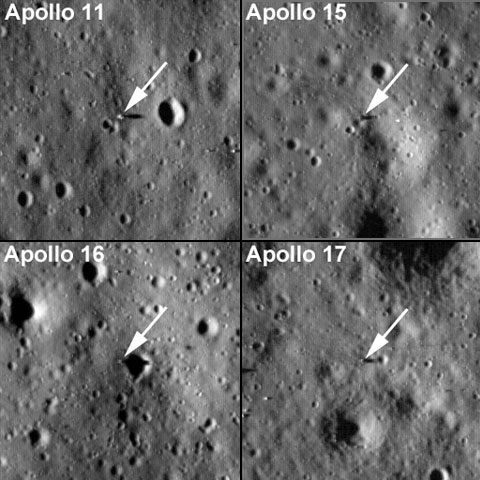
NASA's Lunar Reconnaissance Orbiter, or LRO, has returned its first imagery of the Apollo moon landing sites. The pictures show the Apollo missions' lunar module descent stages sitting on the moon's surface, as long shadows from a low sun angle make the modules' locations evident.
The Lunar Reconnaissance Orbiter Camera, or LROC, was able to image five of the six Apollo sites, with the remaining Apollo 12 site expected to be photographed in the coming weeks.
The satellite reached lunar orbit June 23 and captured the Apollo sites between July 11 and 15. Though it had been expected that LRO would be able to resolve the remnants of the Apollo mission, these first images came before the spacecraft reached its final mapping orbit. Future LROC images from these sites will have two to three times greater resolution.
Photo credit: All images credit: NASA/Goddard/Arizona State University
"The LROC team anxiously awaited each image," said LROC principal investigator Mark Robinson of Arizona State University. "We were very interested in getting our first peek at the lunar module descent stages just for the thrill -- and to see how well the cameras had come into focus. Indeed, the images are fantastic and so is the focus."
Although these pictures provide a reminder of past NASA exploration, LRO's primary focus is on paving the way for the future. By returning detailed lunar data, the mission will help NASA identify safe landing sites for future explorers, locate potential resources, describe the moon's radiation environment and demonstrate new technologies.
"Not only do these images reveal the great accomplishments of Apollo, they also show us that lunar exploration continues," said LRO project scientist Richard Vondrak of NASA's Goddard Space Flight Center in Greenbelt, Md. "They demonstrate how LRO will be used to identify the best destinations for the next journeys to the moon."
The spacecraft's current elliptical orbit resulted in image resolutions that were slightly different for each site but were all around four feet per pixel. Because the deck of the descent stage is about 12 feet in diameter, the Apollo relics themselves fill an area of about nine pixels. However, because the sun was low to the horizon when the images were made, even subtle variations in topography create long shadows. Standing slightly more than ten feet above the surface, each Apollo descent stage creates a distinct shadow that fills roughly 20 pixels.
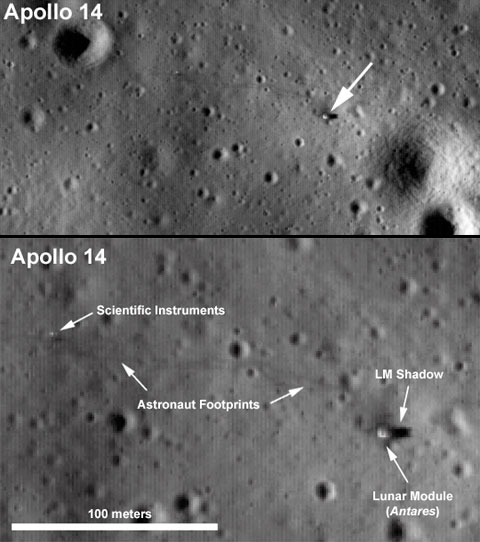
The image of the Apollo 14 landing site had a particularly desirable lighting condition that allowed visibility of additional details. The Apollo Lunar Surface Experiment Package, a set of scientific instruments placed by the astronauts at the landing site, is discernable, as are the faint trails between the module and instrument package left by the astronauts' footprints.
Launched on June 18, LRO carries seven scientific instruments, all of which are currently undergoing calibration and testing prior to the spacecraft reaching its primary mission orbit. The LROC instrument comprises three cameras -- two high-resolution Narrow Angle Cameras and one lower resolution Wide Angle Camera. LRO will be directed into its primary mission orbit in August, a nearly-circular orbit about 31 miles above the lunar surface.
Goddard built and manages LRO, a NASA mission with international participation from the Institute for Space Research in Moscow. Russia provided the neutron detector aboard the spacecraft.
Robert Pearlman Editor
Posts: 56814 From: Houston, TX Registered: Nov 1999
They ended up about 30 meters shy of peering into Cone crater itself, surely a disappointment at the time, but absolutely no reflection on the success of the traverse and the scientific results gleaned after the mission.
The LRO camera imagery clearly shows that that the astronauts just barely missed the rim of Cone crater by less than 100 feet.
"The fact that they did not look into the crater or return a photo of the inside of the crater in no way affected the science return of the mission," Robinson told this Coalition reporter. "Those guys did a really great job up there! I'd like to see the armchair critics out there do any better."
Robert Pearlman Editor
Posts: 56814 From: Houston, TX Registered: Nov 1999
posted 08-20-2009 12:21 PM
Lunar Reconnaissance Orbiter Camera (LROC) release
Trail of Discovery at Fra Mauro
A month has already passed since LROC acquired its first images of the Apollo landing sites. In this time the Moon completed one rotation beneath LRO's orbit, thus providing another set of overflights. Because LRO is not in synch with the lunar day we see the same ground with different lighting -- this time the Sun is 24 degrees higher above the horizon providing a clearer view with fewer shadows. Albedo contrasts are greater, and more clearly show soil disturbances from landing, astronaut surface operations, and blast off.
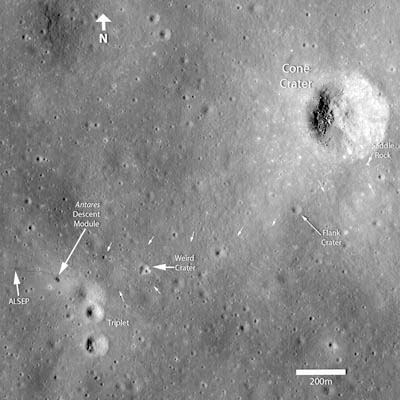
Apollo 14 Astronauts Alan Shepard and Edgar Mitchell explored the Fra Mauro highlands, which are composed of ejecta from the massive Imbrium impact. During two lunar surface extravehicular activities, Shepard and Mitchell deployed an Apollo Lunar Surface Experiments Package (ALSEP), tested the Modular Equipment Transporter (MET) -- a small wheeled cart used to transport samples and equipment) -- and collected almost 90 kg of invaluable lunar rock and soil. The ALSEP is visible about 180 meters west of the lunar module, note the well worn footpath connecting the two artifacts.
During the second EVA, the astronauts performed what is known as a "radial traverse" across the ejecta field and up to the rim of Cone crater. When impact craters form, rocks excavated from the deepest parts of the crater fall near the rim; surface rocks end up away from the crater. Thus, as explorers move up a crater's ejecta blanket, they can sample a complete stratigraphic section of geologic materials providing priceless insights about the composition and nature of the lunar subsurface. Think of an impact crater as a natural roadcut exposing rocks from depth.
In this LROC image, you can follow nearly the whole path walked by the two astronauts. The term "radial traverse" does not quite do the crew of Apollo 14 justice. Their journey sounds like a stroll in the park, however the reality is quite the contrary. The hike up Cone crater was quite challenging. For the first time, astronauts traveled out of the sight of their lunar module while hiking uphill over 1400 meters with only a poor map, dragging the tool cart (MET), and wearing their bulky spacesuits. It was an amazing feat that the two astronauts made it to the top of Cone ridge and acquired all their samples.
They ended up about 30 meters shy of peering into Cone crater itself, surely a disappointment at the time, but absolutely no reflection on the success of the traverse and the scientific results gleaned after the mission.
Fra Mauro was one of only two highlands sites to be visited during Project Apollo, and the samples collected at the Apollo 14 landing site continue to provide lunar scientists with important insights into the geology of the Moon. Nearly all of the Apollo 14 samples are breccias (or rocks formed from pieces of other rocks, often held together by an impact-melt matrix). Since the Fra Mauro formation is ejecta from the Imbrium basin-forming event, age-dating the samples returned by Shepard and Mitchell in terrestrial laboratories indicated that the Imbrium basin formed approximately 3.85 billion years ago, providing a crucial absolute age date for the formation of the Imbrium basin.
Despite the momentous discoveries made by the Apollo 14 and Apollo 16 crews as they explored the highlands, there is still much we do not know. In particular, lunar scientists are eager to use the remote sensing data returned by the Lunar Reconnaissance Orbiter, Kaguya, and Chandrayaan-1 to look for evidence of highland rock types which may be underrepresented in the current Apollo sample collection. Since we only explored two highland locations located in close proximity, it is possible that there are highland rock types which have not yet been sampled. By identifying the location of any under-sampled rock types on the lunar surface using orbital data, the scientific results obtained by these new lunar scouts will help to determine the places on the Moon where we need to send future human explorers.
Annotated figure showing the positions of various landmarks surrounding the Apollo 14 landing site. The small white arrows highlight locations where the astronauts' path can be clearly seen. Click to enlarge. Credit: NASA/GSFC/Arizona State University
Scott Member
Posts: 3338 From: Houston, TX Registered: May 2001
Credit: NASA/Goddard Space Flight Center/Arizona State University
Apollo 12 and Surveyor 3
Four months after the success of Apollo 11, NASA launched Apollo 12 in November 1969. Almost exactly 40 years later, the Lunar Reconnaissance Orbiter has seen the landing site.
Engineering and safety constraints in place for these earliest manned lunar missions dictated landing Apollo 12 at an equatorial site on a flat lava plain (known as maria on the moon). NASA selected a site near where the unmanned Surveyor 3 had landed two years earlier, in western Oceanus Procellarum.
Of course, landing within walking distance of the now inactive robotic lander (operational from April 20 to May 3, 1967) would prove pinpoint landing capability and allow the astronauts to return parts from the Surveyor for engineering assessment. The Surveyor 3 site also provided the opportunity to sample debris from the Copernicus crater impact, and what appeared from crater counts to be relatively young mare basalt.
Astronauts Pete Conrad and Alan Bean piloted Intrepid to a landing within 200 meters of Surveyor 3 on Nov. 14, 1969. During their brief stay of almost 32 hours, the two astronauts performed two moonwalks, each a little less than four hours long.
On the first moonwalk, they deployed an Apollo Lunar Surface Experiment Package (ALSEP), which returned scientific data directly to Earth for more than seven years. Next, the explorers headed to the northwest to collect soil and rock samples. In all they collected about about 15 kg (about 33 lbs) of lunar samples on this first excursion.
The next day Conrad and Bean headed out on the first lunar geologic traverse. They traveled west, skirting around Head crater, then south to Bench crater. At both locations the astronauts collected rock and soil samples and photographed the interiors of the two craters. After Bench their furthest point (about 400 meters, or 437 yards) from the LM was Sharp crater. Their next goal was a rendezvous with the Surveyor 3 spacecraft, some 450 meters to the East. They extensively documented the condition of the Surveyor and collected hardware samples for terrestrial analysis, providing crucial data for present-day designers of lunar surface hardware.
The Surveyor landed on the interior slope of what was later called Surveyor crater. There was some worry that as the astronauts removed parts for return to the Earth the spacecraft might slide downhill, so they always stayed up-slope. The iconic image of the Apollo astronaut examining the Surveyor with the LM in the background reminds us of the important role that both robots and humans can play in planetary exploration.
In all, the Apollo 12 crew returned over 32 kg (more than 60 lbs) of lunar samples. From these precious samples scientists learned that the Copernicus crater impact occurred some 810 million years ago; four different types of local basalts were sampled with ages much younger than those from Apollo 11, and a small sample of highlands rock previewed the complexity of the lunar highlands to be sampled on later Apollo missions. All in all Apollo 12 was an incredible success.
Scott Member
Posts: 3338 From: Houston, TX Registered: May 2001
A review was held yesterday, September 9th, during which it was verified LRO is ready to proceed to the 50km polar mapping orbit and begin the prime mission. On September 15th LRO will execute the Mission Orbit Insertion (MOI) propulsive maneuver and establish the nominal mission orbit..."
Robert Pearlman Editor
Posts: 56814 From: Houston, TX Registered: Nov 1999
Today [Sept. 15] at 3:32pm ET LRO executed a 3 minute propulsion burn near the periselene of our last commissioning phase orbit. This placed LRO in a 50 km (mean) circular polar orbit about the Moon. With this maneuver LRO has begun its primary 1 year Exploration mission.
Robert Pearlman Editor
Posts: 56814 From: Houston, TX Registered: Nov 1999
posted 09-16-2009 03:43 AM
NASA release
NASA to Release First Results from Lunar Mission Thursday, Sept. 17
NASA will showcase new images from the Lunar Reconnaissance Orbiter's seven instruments and provide updates about the topography of the moon's south pole during a news conference at 1 p.m. EDT Thursday, Sept. 17. NASA also will provide an update about the spacecraft's status and mission plans. The briefing will take place at NASA's Goddard Space Flight Center in Greenbelt, Md., and will be broadcast live on NASA Television and the agency's Web site.
Panelists are:
Craig Tooley, Lunar Reconnaissance Orbiter project manager, Goddard Space Flight Center
Michael Wargo, chief lunar scientist, Exploration Systems Mission Directorate, NASA Headquarters, Washington
Richard Vondrak, Lunar Reconnaissance Orbiter project scientist, Goddard
David Smith, Lunar Orbiter Laser Altimeter principal investigator, Goddard
Robert Pearlman Editor
Posts: 56814 From: Houston, TX Registered: Nov 1999
posted 09-17-2009 12:30 PM
NASA release
NASA Lunar Satellite Begins Detailed Mapping of Moon's South Pole
NASA reported Thursday that its Lunar Reconnaissance Orbiter, or LRO, has successfully completed its testing and calibration phase and entered its mapping orbit of the moon. The spacecraft already has made significant progress toward creating the most detailed atlas of the moon's south pole to date. Scientists released preliminary images and data from LRO's seven instruments.
"The LRO mission already has begun to give us new data that will lead to a vastly improved atlas of the lunar south pole and advance our capability for human exploration and scientific benefit," said Richard Vondrak, LRO project scientist at NASA's Goddard Space Flight Center in Greenbelt, Md.
LRO is scheduled for a one-year exploration mission in a polar orbit of about 31 miles above the lunar surface, the closest any spacecraft has orbited the moon. During the next year, LRO will produce a complete map of the lunar surface in unprecedented detail, search for resources and safe landing sites for human explorers, and measure lunar temperatures and radiation levels.
"The LRO instruments, spacecraft, and ground systems continue to operate essentially flawlessly," said Craig Tooley, LRO project manager at Goddard "The team completed the planned commissioning and calibration activities on time and also got a significant head start collecting data even before we moved to the mission's mapping orbit."
The south pole of the moon is of great interest to explorers because potential resources such as water ice or hydrogen may exist there. Permanently shadowed polar craters that are bitterly cold at their bottoms may hold deposits of water ice or hydrogen from comet impacts or the solar wind. The deposits may have accumulated in these "cold-trap" regions over billions of years. If enough of these resources exist to make mining practical, future long-term human missions to the moon potentially could save the considerable expense of hauling water from Earth.
First results from LRO's Lunar Exploration Neutron Detector, or LEND, indicate that permanently shadowed and nearby regions may harbor water and hydrogen. Additional observations will be needed to confirm this. LEND relies on a decrease in neutron radiation from the lunar surface to indicate the presence of water or hydrogen.
"If these deposits are present, an analysis of them will help us understand the interaction of the moon with the rest of the solar system," Vondrak said.
Data from LRO's Lunar Orbiter Laser Altimeter, or LOLA, however, indicates that exploring these areas will be challenging because the terrain is very rough. The roughness is probably a result of the lack of atmosphere and absence of erosion from wind or water, according to David Smith, LOLA principal investigator at Goddard.
LRO's other instruments also are providing data to help map the moon's terrain and resources. According to the first measurements from the Diviner instrument, large areas in the permanently shadowed craters are about minus 400 degrees Fahrenheit (33 Kelvin), more than cold enough to store water ice or hydrogen for billions of years.
The Lunar Reconnaissance Orbiter Camera is providing high-resolution images of permanently shadowed regions while lighting conditions change as the moon's south pole enters lunar summer.
LRO's Lyman Alpha Mapping Project, or LAMP, also is preparing to search for surface ice and frost in the polar regions. The instrument provides images of permanently shadowed regions illuminated only by starlight and the glow of interplanetary hydrogen emission. LAMP has provided information to confirm the instrument is working well on both the lunar night and day sides.
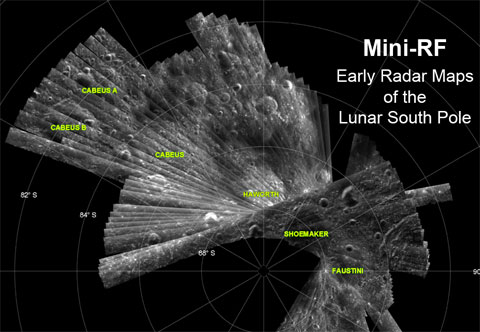
The Mini RF Technology Demonstration on LRO has confirmed communications capability and produced detailed radar images of potential targets for LRO's companion mission, the Lunar Crater Observation and Sensing Satellite, which will impact the moon's south pole on Oct. 9.
Meanwhile, LRO's Cosmic Ray Telescope for the Effects of Radiation instrument is exploring the lunar radiation environment and its potential effects on humans during record high, "worst-case" cosmic ray intensities accompanying the extreme solar minimum conditions of this solar cycle.
Goddard built and manages LRO, a NASA mission with international participation from the Institute for Space Research in Moscow. Russia provides the neutron detector aboard the spacecraft.
Credit: NASA/APL/LPI
Robert Pearlman Editor
Posts: 56814 From: Houston, TX Registered: Nov 1999
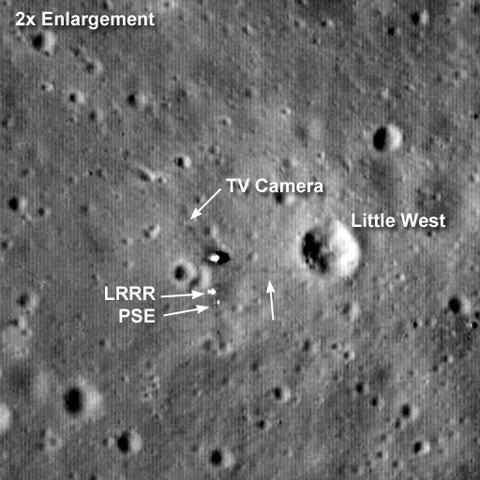
A month after LROC's first image of the Apollo 11 landing site was acquired, LRO passed over again providing LROC a new view of the historic site. This time the Sun was 28 degrees higher in the sky, making for smaller shadows and bringing out subtle brightness differences on the surface. The look and feel of the site has changed dramatically.
The astronaut path to the TV camera is visible, and you may even be able to see the camera stand (arrow). You can identify two parts of the Early Apollo Science Experiments Package (EASEP) - the Lunar Ranging Retro Reflector (LRRR) and the Passive Seismic Experiment (PSE). Neil Armstrong's tracks to Little West crater (33 m diameter) are also discernable (unlabeled arrow). His quick jaunt provided scientists with their first view into a lunar crater.
Explore the full resolution LROC NAC image and find the landing site on your own.
Credit: NASA/GSFC/Arizona State University
Scott Member
Posts: 3338 From: Houston, TX Registered: May 2001
Surveyor 1 was the first in a series of seven US missions to the Moon that preceded Apollo; five of the seven missions were successful. Surveyor 1 was launched on May 30, 1966 and landed on June 2, 1966. The mission's objectives were to soft land on the Moon and to collect information on the lunar regolith. This first Surveyor spacecraft carried only a television camera system (later missions carried additional instruments). The spacecraft landed on a relatively smooth mare surface in Oceanus Procellarum (the Ocean of Storms). The Surveyor 1 landing site is also one of the areas identified by Project Constellation as a high-priority target for future human lunar exploration.
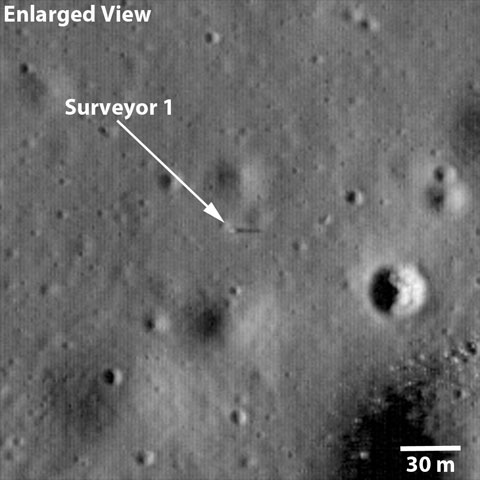
The scene shows the spacecraft (annotated with an arrow) just south of a subdued 40 m diameter crater and about 110 m northwest of a 190 m diameter crater lined with boulders. The landing site is in the northeast corner of the Flamsteed Ring, a 100 km diameter impact crater almost completely buried by mare lavas such that all that remains exposed is the upper part of the original crater rim.
Surveyor 1 collected over 11,000 images, most during the first lunar day between landing and July 7, 1966. The spacecraft continued to operate until January 7, 1967. The Surveyor images demonstrated that the lunar surface was strong enough to support a landed vehicle or a human. The detailed images also indicated that the surface was composed of a granular material interpreted to be produced by the impact of various size meteors over billions of years.
Explore the full-resolution NAC image of the Surveyor 1 site.







 posted 12-22-2004 07:31 PM








 advertisement