|
Author
|
Topic: Refrigerator-sized Early Ammonia Servicer (EAS) jettisoned from ISS, falls into ocean
|
Robert Pearlman
Editor Posts: 42988
From: Houston, TX
Registered: Nov 1999
|
 posted 07-19-2007 09:47 AM
   
Space.com: 'Refrigerator-Sized' Object to be Tossed From Space Station 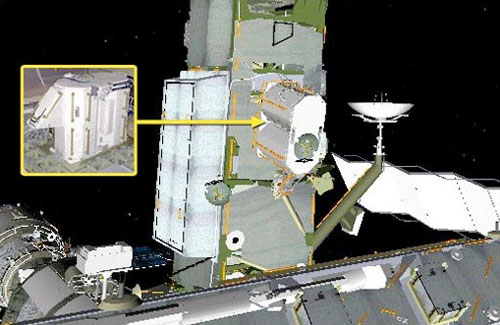
On July 23, Expedition 15 crewmember Clayton Anderson will journey outside of the space station to throw two large hunks of unneeded equipment towards Earth, officials said during a press conference today at NASA's Johnson Space Center in Houston, Texas."This is the first time we've ever done a jettison quite like this on the space station," said Bob Dempsey, NASA's lead flight director for Expedition 15, adding that smaller jettisons have been performed on past ISS and Hubble Space Telescope missions. During the upcoming spacewalk, Anderson will jettison a 1,400-pound (635-kilograms) refrigerator-sized container of ammonia, or Early Ammonia Servicer (EAS), away from the station at a gentle pace of one mile per hour (1.6 kph). He'll also toss a 212-pound (96-kilogram) stanchion used to attach a camera to the space laboratory toward the Earth. And the Houston Chronicle: Space junk likely to hit Earth NASA says it has little choice but to jettison two pieces of junk hardware � including a 1,400-pound container filled with ammonia coolant � from the international space station early next week.Some fragments will likely survive a fiery re-entry through the atmosphere and strike the ground, the space agency said Wednesday. The six- to seven-hour spacewalk by NASA's Clay Anderson and Russian cosmonaut Fyodor Yurchikhin, in which the container and a 218-pound brace for a communications antenna will be discarded, is scheduled to start at 5:30 a.m. CDT Monday. The ammonia container will probably circle Earth for at least 300 days before it plummets through the atmosphere. The container is massive enough that some fragments will likely hit the ground or the ocean rather than burn up. The brace should disintegrate. |
MCroft04
Member Posts: 1634
From: Smithfield, Me, USA
Registered: Mar 2005
|
posted 07-19-2007 08:53 PM
Any details on exactly how and in which direction the objects will be jettisoned to improve the probability that they will burn up and not hit the earth? |
Robert Pearlman
Editor Posts: 42988
From: Houston, TX
Registered: Nov 1999
|
posted 07-19-2007 09:28 PM
By design, both are intended to hit the Earth. The priority to their release is that they do not collide with other spacecraft (including the International Space Station). They will both hit the Earth, though only one (the EAS) is large enough to possibly have pieces hit the ground (or ocean). The stanchion will simply burn up. It is my understanding that there is neither anything Clay Anderson can do to control where they will intercept the Earth, nor will it be known where that will be until after their release and their degrading orbits are tracked. |
Moonwalker1954
Member Posts: 245
From: Montreal, Canada
Registered: Jul 2004
|
posted 07-20-2007 11:31 AM
I don't know, this might be a dumb question but wouldn't be possible to throw them AWAY from Earth in the vastness of space? Is it just a question of speed and acceleration or is there other reasons for not doing so?Pierre-Yves |
gliderpilotuk
Member Posts: 3398
From: London, UK
Registered: Feb 2002
|
posted 07-20-2007 12:27 PM
Why can't they be reloaded into the shuttle and brought back (for recycling)?Paul |
Robert Pearlman
Editor Posts: 42988
From: Houston, TX
Registered: Nov 1999
|
posted 07-20-2007 01:54 PM
Pierre-Yves, if you remember during the Apollo years, the Saturn V's S-IVB stage was needed to accelerate the CSM to enter Translunar Injection (TLI) at an escape velocity of 25,000 mph. Though the refrigerator-size Ammonia Early Servicer is weightless in space, it still retains its mass, and therefore its inertia. No matter how hard Clay Anderson were to push, there would be no way he could accelerate the AES to escape velocity.Paul, to quote the Houston Chronicle article, "Originally, the coolant tank was to return to Earth aboard a shuttle. But the 14 remaining shuttle station assembly flights will be filled by equipment that leaves no room for the container or the brace." |
Moonwalker1954
Member Posts: 245
From: Montreal, Canada
Registered: Jul 2004
|
posted 07-21-2007 11:54 PM
Thank you Robert. That makes sense.Pierre-Yves
|
Robert Pearlman
Editor Posts: 42988
From: Houston, TX
Registered: Nov 1999
|
posted 07-23-2007 10:08 AM
Bon voyage, Early Ammonia Servicer! See you (maybe) in about a year...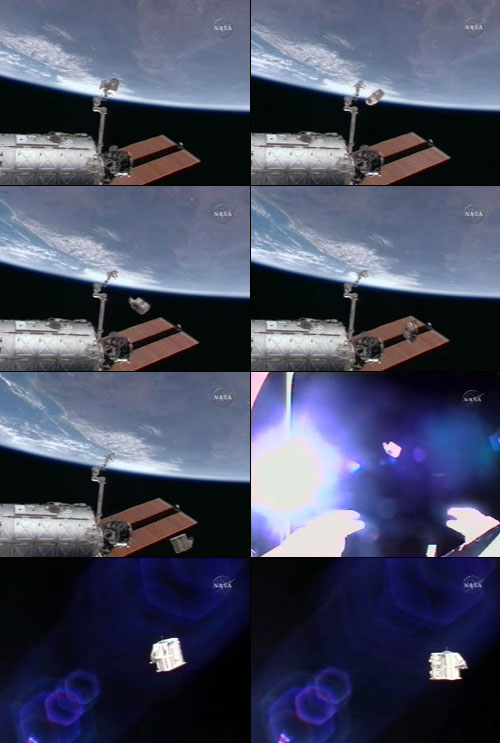
|
Robert Pearlman
Editor Posts: 42988
From: Houston, TX
Registered: Nov 1999
|
posted 07-31-2007 10:50 PM
From Tariq Malik's LiveScience.com blog: Apparently the naming policy for objects in the night sky includes rechristening massive chunks of drifting space trash.Astronauts aboard the International Space Station have renamed two hefty pieces of defunct hardware that were tossed out from the orbital laboratory during a July 23 spacewalk in honor of the man that cut them loose. �Good news for us, two new satellites�Nebraska 1 and Nebraska 2,� ISS Expedition 15 commander Fyodor Yurchikhin christened the space junk last week. He named them in honor of Nebraska-native Clayton Anderson, a NASA astronaut and Expedition 15 flight engineer who created the new orbital debris. |
Robert Pearlman
Editor Posts: 42988
From: Houston, TX
Registered: Nov 1999
|
posted 07-22-2008 10:35 AM
Universe Today: Large Chunk of ISS Space Junk Becomes Easy to Observe A huge piece of space debris, weighing 1400 lb (635 kg) and the size of two refrigerators, is gradually falling to Earth, giving observers on the ground a great opportunity to see it. The junk was jettisoned from the International Space Station (ISS) in 2007 and it is expected to re-enter the atmosphere later this year or early 2009. The Early Ammonia Servicer (EAS) was dropped from the ISS after a seven hour spacewalk and pushed in the opposite direction of the space station's orbit shortly before a re-boost by a Soyuz resupply vehicle. This ensured the EAS would pose no danger to the ISS or crew on future orbits. Now the container is beginning its final few months in space and the bets are on as to where it will crash to Earth...When the EAS was jettisoned, it was barely visible to the naked eye as it sped overhead with a magnitude of +4 to +4.5. Two days ago on July 20th, veteran satellite observer Marco Langbroek of Leiden, the Netherlands reported observing the EAS at an observable magnitude of +2.0. But it is moving very fast due to its decreased altitude. Watch the EAS pass Altair in this high quality piece of video astronomy by Kevin Fetter (July 15th, 2008) Currently, the EAS can be seen over Europe, and next week North America will be able to spot it. |
lm5eagle
Member Posts: 429
From:
Registered: Jul 2007
|
posted 07-22-2008 11:01 AM
quote:
Originally posted by gliderpilotuk:
Why can't they be reloaded into the shuttle and brought back (for recycling)?
This seems to me to be a most logical question to ask. Surely shuttles must be returning with sufficient space in their payload bays to accommodate items of this size. The proposed method of disposal has a tone of irresponsibility given that there seems to be a likelihood of something striking the Earth's surface (and whoever happens to be standing at the point of contact, however low the probability of this happening!). |
Robert Pearlman
Editor Posts: 42988
From: Houston, TX
Registered: Nov 1999
|
posted 07-22-2008 11:15 AM
quote:
Originally posted by lm5eagle:
Surely shuttles must be returning with sufficient space in their payload bays to accommodate items of this size.
You cannot just throw something the size and mass of the EAS into the payload bay like you would a package into your car's trunk. You need to restrain it such that it can't move during reentry, both so it doesn't damage other items in the bay (not to mention the bay itself) and doesn't offset your load balances. That requires launching with a carrier on which the EAS can be attached and as earlier explained by the Houston Chronicle (see above), there just wasn't room for such on the remaining shuttle flights. |
ejectr
Member Posts: 1751
From: Killingly, CT
Registered: Mar 2002
|
posted 07-22-2008 12:50 PM
Why not just leave it attached to the station where it was? |
Robert Pearlman
Editor Posts: 42988
From: Houston, TX
Registered: Nov 1999
|
posted 07-22-2008 12:58 PM
quote:
Originally posted by ejectr:
Why not just leave it attached to the station where it was?
If left attached, the EAS would have obstructed the move of the P6 truss to the end of the station's main truss. |
ejectr
Member Posts: 1751
From: Killingly, CT
Registered: Mar 2002
|
posted 07-22-2008 05:49 PM
Ah yes, I do remember that now that you mention it. They've been doing so much up there, I forgot all about that. |
robsouth
Member Posts: 769
From: West Midlands, UK
Registered: Jun 2005
|
posted 07-24-2008 11:07 AM
OK a question for all the orbital mechanics experts out there. If the EAS or any other fairly heavy object was thrown from a spacecraft and aimed straight down at the Earth by pushing it away in that direction, would it come straight down or would some weird orbital science mean that it would somehow loop back up and around the Earth. |
Jay Chladek
Member Posts: 2272
From: Bellevue, NE, USA
Registered: Aug 2007
|
posted 07-24-2008 11:43 AM
Pointing it straight down wouldn't do anything as the object would still have orbital velocity (17,000 miles per hour while the downward velocity would only be a few feet per second). Think of it as like throwing a can from a car on the M1 (assuming you aren't stuck in a queue) at a road sign right next to the car. You toss it right at the sign as you pass and it will miss and fall behind because you didn't account for the velocity of the car. As such, you need to release before you get to the sign to hit it. In orbit, the velocity of a spacecraft is much higher in order to freefall around the Earth, so a throw with a human arm doesn't impart enough speed to alter the orbit all that much. Imparting it with that downward motion would give it a little different orbit. Depending on when the object was released, if it ends up in a slightly closer orbit to the Earth then the ISS, then it would fly slightly faster and extend out in front of the ISS further and further as time progresses.Orbital mechanics would probably also dictate that the object would reach an apogee equal to that of the ISS's orbit (with the perigee being lower) on the first few passes after a downward throw, until air drag begins to affect the speed and cause the object to begin to slow down due to orbital decay. The big thing that has to be considered when releasing an object that large from the ISS is that it is done in such a way that the object doesn't come back in an orbit and smack the station (or even have a near miss). As such, I believe when the Boiler was released, it was pushed out behind the station so its speed would be a little slower and the distance would extend on each orbit to a safer margin. |
robsouth
Member Posts: 769
From: West Midlands, UK
Registered: Jun 2005
|
posted 07-25-2008 04:20 AM
Jay excellent explanation of what would happen. I did think it would be something like that; the can from the car is a good analogy. So it's not just a case of throwing it overboard, all the factors have to be taken into consideration. |
Robert Pearlman
Editor Posts: 42988
From: Houston, TX
Registered: Nov 1999
|
posted 10-21-2008 01:30 PM
The reentry of Early Ammonia Servicer (EAS) is now expected in the November 1-2 time frame. Detailed predictions are not expected to start until four days before reentry.As of today, the EAS was orbiting approximately 135 by 140 miles (220 by 225 km). |
Jay Chladek
Member Posts: 2272
From: Bellevue, NE, USA
Registered: Aug 2007
|
posted 10-23-2008 03:47 AM
Wherever it lands (assuming any part of it survives reentry), I just hope Clay doesn't get charged with littering.  If any of it does survive though, I hope it comes visit the state it was named after. If any of it does survive though, I hope it comes visit the state it was named after. |
Robert Pearlman
Editor Posts: 42988
From: Houston, TX
Registered: Nov 1999
|
posted 10-30-2008 11:28 AM
T-4 days to reentry...According to the U.S. Space Surveillance Network, which issued its first official forecast today, the Early Ammonia Servicer (EAS) will reenter the Earth's atmosphere around midnight on Sunday with an impact point in the Southern Ocean, between Australia and Antarctica. The confidence level in this prediction is classified as "low". The next forecast will be released at T-3 days. |
Mr Meek
Member Posts: 353
From: Chattanooga, TN
Registered: Dec 2007
|
posted 10-30-2008 11:48 AM
Can we get Taco Bell to drag out the target again? I don't have any lunch plans for this weekend. 
|
Robert Pearlman
Editor Posts: 42988
From: Houston, TX
Registered: Nov 1999
|
posted 11-02-2008 08:14 PM
The Early Ammonia Servicer (EAS) is expected to reenter the Earth's atmosphere sometime tonight (for the background, scroll up)."Our estimates say that something on the order of about 15 objects would survive, ranging in size from about 40 grams [1.4 ounces] to about 17.5 kilograms [38.6 pounds]," explained International Space Station (ISS) program manager Mike Suffredini in an interview with collectSPACE.com on Friday. "It's possible that our GN2 [gaseous nitrogen] tanks would survive the entry, at least partially, and that's the piece we consider the heaviest piece to reenter and perhaps survive." "More importantly, there is an ammonia tank and of course the ammonia tank is full of ammonia, it is expected it would rupture. Whether or not the rupture would be such that it would then burn up or whether or not it would survive intact enough that when you saw it, you'd go 'That possibly was a tank, too', I don't know. I wouldn't expect it to be a full tank of ammonia. It won't survive that." "It is possible that a piece of the ammonia tank would be on the ground, so if anybody found any parts on the ground and didn't know what they were, I wouldn't handle them," cautioned Suffredini. NASA does not have a stated desire for the return of the pieces, though Suffredini did say there may be interest by the agency to study the recovered parts in order to gain a better understanding of the reentry behavior of the hardware. Should pieces of the EAS reach land outside the U.S., NASA advised that "local authorities should report it to the U.S. Department of State via diplomatic channels."
|
Robert Pearlman
Editor Posts: 42988
From: Houston, TX
Registered: Nov 1999
|
posted 11-03-2008 08:16 AM
The 1,400-pound (635-kilogram) refrigerator-sized Early Ammonia Servicer (EAS) reentered Earth's atmosphere on Sunday at 10:51 p.m. CST, mostly disintegrating but possibly dropping as many as 15 pieces into the Southern Ocean, south of Tasmania, between Australia and New Zealand.Jettisoned from the International Space Station (ISS) by astronaut Clay Anderson in July 2007, the ammonia-filled container was part of the outpost's coolant system. It was discarded because it had exceeded its on-orbit lifespan, potentially posing a risk if returned on the shuttle, and to allow the reconfiguration of the station's truss structure. 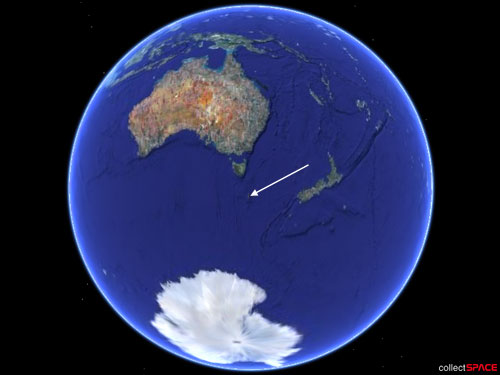
If parts survived, they impacted an area centered at 48� South, 151� East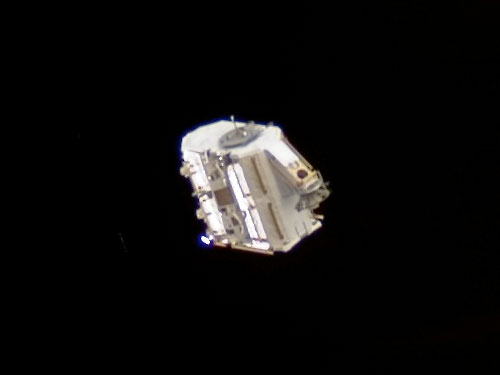
The Early Ammonia Servicer soon after jettison from the ISS in July 2007. |
Jay Chladek
Member Posts: 2272
From: Bellevue, NE, USA
Registered: Aug 2007
|
posted 11-04-2008 11:23 AM
As Maxwell Smart might say..."Missed it by THAT much." So what was the distance from actual impact to the original proposed impact point? |
MCroft04
Member Posts: 1634
From: Smithfield, Me, USA
Registered: Mar 2005
|
posted 11-04-2008 08:39 PM
Went down right at a mid-ocean spreading center. At least it won't be subducted into a trench in the near term! |








 advertisement