|
Author
|
Topic: TMA-20/ISS 26: Paolo Nespoli's ESA patch
|
Robert Pearlman Editor Posts: 23493 From: Houston, TX Registered: Nov 1999
|
posted October 08, 2010 06:46 AM
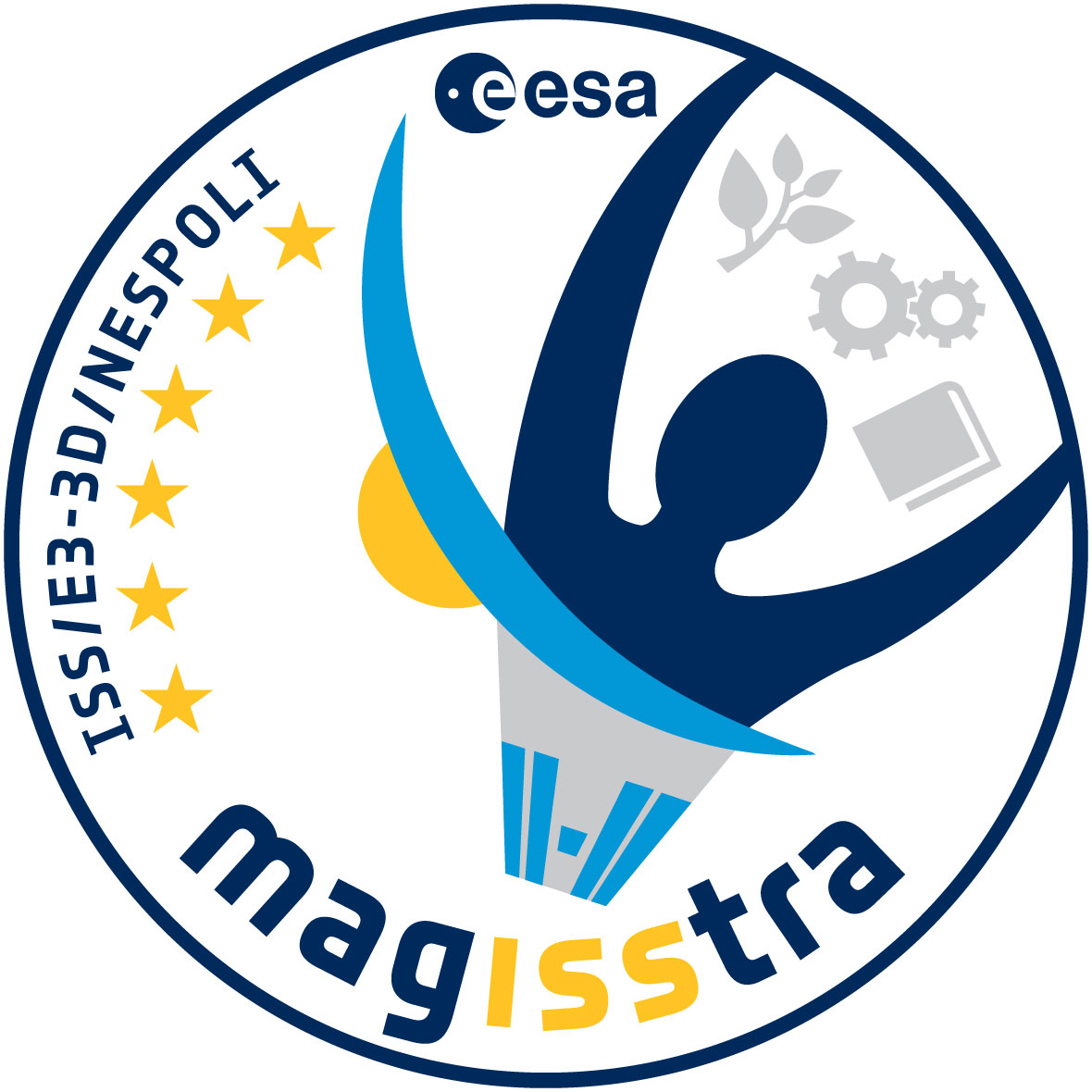
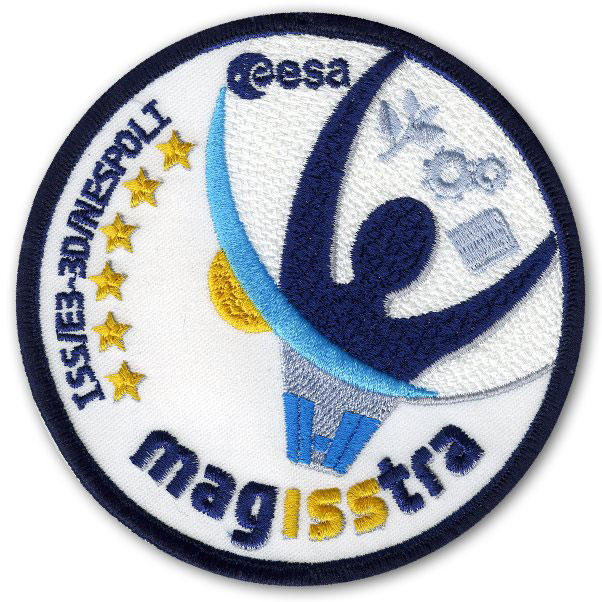
European Space Agency release MagISStra patch ESA astronaut Paolo Nespoli is assigned to fly on Soyuz TMA-20 to the ISS, scheduled for December 2010, as part of the Expedition 26 crew. Expedition 27 begins with the Soyuz TMA-01M undocking in March 2011. Nespoli and his two crewmates, Roscosmos cosmonaut Dmitri Kondratyev and NASA astronaut Catherine Coleman, remain on the ISS and are joined by three new crewmembers, Andrei Borisenko, Alexander Samokutyayev and NASA's Ronald Garan (NASA), who arrive shortly after the TMA-01M undocking on TMA-21 in March 2011. Nespoli and his crew remain on the ISS as part of the Expedition 27 crew until May/June 2011, returning their TMA-20 spacecraft. Nespoli's mission is called 'MagISStra', combining the Latin word 'magistra', a female teacher, with the acronym of the International Space Station. This Latin flavour not only brings in Italian culture as an ingredient of the European outlook, but also echoes the humanistic value of the mission. Since the beginning of the spaceflight adventure, humankind has pursued new frontiers to find its place in the Universe. Europe's astronaut will take with him this human sense of exploration to the Station. The Latin word 'magister', for a male teacher, means 'master' in English, and also 'expert', 'proficient' or 'fully in control', all of which refer to the very high level of competence demanded for each astronaut mission. The name also reflects the special link with education, one of the three elements of Nespoli's flight. The logo shows how the human presence in space benefits people on Earth. A human figure dominates the scene, embracing the three elements around which the mission revolves: science, technology and education. This figure, representing the astronaut himself, projects from the ISS to the planet in a sense of sharing, of bringing back applications to Earth, symbolised by three icons between the arms: a plant as scientific research, mechanical gears as technological development and a book as knowledge. The ISS emerges from its acronym in the mission name and a sunrise seen over the crescent Earth conveys optimism about the extension of the ISS operational life to 2020. The coded text on the left, ISS/E3-3D/NESPOLI, is how the mission is identified within the Multilateral Crew Operations Panel, top-level forum for coordination and resolution of crew matters. E3 stands for the third long-duration European mission in space, and 3D refers to the ESA-developed 3D camera that Nespoli will use on the orbital complex. The six stars represent the six crew, the six months that Nespoli will stay in space and also the European character (the stars are similar to those on the EU flag). The white background symbolises the ingenuity of the human being and the willingness to learn more and search for new discoveries with an open mind. |

KSCartist Member Posts: 2300 From: Titusville, FL USA Registered: Feb 2005
|
posted October 08, 2010 07:44 AM
Simple, yet powerful design. Anytime I see a great patch, I wish I had designed it. Just goes to show I have a lot to learn about expanding my imagination. |
hoorenz Member Posts: 536 From: The Netherlands Registered: Jan 2003
|
posted October 10, 2010 06:11 AM
bell-ISS-imo! |
ejectr Member Posts: 1444 From: Brimfield, MA Registered: Mar 2002
|
posted October 10, 2010 06:39 AM
quote: Originally posted by KSCartist: Just goes to show I have a lot to learn about expanding my imagination.
Don't make me laugh. You have nothing to be ashamed of with your patch designs. |
KSCartist Member Posts: 2300 From: Titusville, FL USA Registered: Feb 2005
|
posted October 10, 2010 09:03 AM
I'm not ashamed of anything. But I realized that I would have never thought of this design. You never stop learning. |
hoorenz Member Posts: 536 From: The Netherlands Registered: Jan 2003
|
posted November 04, 2010 10:24 AM
 |
hoorenz Member Posts: 536 From: The Netherlands Registered: Jan 2003
|
posted November 08, 2010 09:17 AM
Image of MagISStrata patch worn by Paolo Nespoli |
spaceman Member Posts: 787 From: Walsall, West Midlands, UK Registered: Dec 2002
|
posted November 08, 2010 09:56 AM
Is this an official version of the patch as I notice grey highlights that aren't on the original design and the arc of the earth is extended with a grey line?A patch on ebay although I doubt official either is technically more accurate and looks a good quality (I'm not promoting their sales). |
lucspace Member Posts: 224 From: Hilversum, The Netherlands Registered: Oct 2003
|
posted November 08, 2010 10:58 AM
The photo shows the ESA produced official version.The fairly new eBay seller you cite, is one with little regard for copyright, who is currently reproducing lots of (mainly Soviet/Russian) patches. Those have nothing to do with original space patches. |
hoorenz Member Posts: 536 From: The Netherlands Registered: Jan 2003
|
posted November 08, 2010 11:42 AM
In the ESA picture you can clearly see that Nespoli is wearing the version with added gray lines and shading. |
carl walker Member Posts: 73 From: Netherlands Registered: Feb 2006
|
posted November 08, 2010 04:16 PM
The one with the shadow/highlights is the official patch. I am told that Paolo wanted to have a 3D-type effect (to represent his work with the ESA 3D stereo camera), and this is the current solution found in the embroidered version. Hope that helps. The eBay one cited here is nothing to do with ESA. |
hoorenz Member Posts: 536 From: The Netherlands Registered: Jan 2003
|
posted November 11, 2010 03:45 PM
A second official ESA version showed up. It does not have the extended gray Earth limb. The sun has a shadow, the stars don't (opposite from the other version). This one originates from EAC in Cologne. |
hoorenz Member Posts: 536 From: The Netherlands Registered: Jan 2003
|
posted November 12, 2010 02:27 AM
Turns out the previously posted patch (as well as the one worn by Paolo Nespoli in the ESA image) was a first sample, of which only a few were produced. The second version is the final product. |