|
Author
|
Topic: Identifying space shuttle tiles by markings
|
Hart Sastrowardoyo
Member Posts: 3445
From: Toms River, NJ
Registered: Aug 2000
|
 posted 09-20-2000 08:17 PM
   
Short of calling Rockwell, is there a website where one can ask them, "I saw a tile with serial numbers XXXX-XXXX and was wondering if you could tell which orbiter and what flights it had flown, if any?" |
Robert Pearlman
Editor Posts: 42981
From: Houston, TX
Registered: Nov 1999
|
posted 09-20-2000 11:27 PM
The numbers on a tile reference where on the orbiter the tile should be installed. When a tile is beyond reuse, technicians use the number to order an exact (to shape and size) replacement. Unless whoever recovered the tile also recovered its corresponding scrap paperwork, the chances of identifying when a tile last flew are very low. If s/he does have the paperwork then one indicator would be to look for the OV number and the date of removal. Though not always the case, you can sometimes determine a most recent flight by comparing the date of removal to the orbiter's mission dates and finding the closest match. |
garymilgrom
Member Posts: 1966
From: Atlanta, GA
Registered: Feb 2007
|
posted 03-20-2007 11:40 AM
Why do some tiles not have the OV number on them? Is there a place to enter the tile number and find out what location it is located in on the orbiter? |
Robert Pearlman
Editor Posts: 42981
From: Houston, TX
Registered: Nov 1999
|
posted 04-02-2007 03:25 PM
Tiles without markings can be for several reasons, from the numbers having been worn off to their never being added. There is not, to my knowledge, a publicly accessible guide or database by which tile numbers can be researched. I have seen paperwork that offers specific information for particular orbiter and flight configurations, but nothing online. |
Robert Pearlman
Editor Posts: 42981
From: Houston, TX
Registered: Nov 1999
|
posted 04-22-2011 01:13 PM
collectSPACE Resources: Locating space shuttle tiles by number Think of the space shuttle orbiter as a big puzzle with each of its heat shield tiles a puzzle piece.All space shuttle thermal protection system (TPS) tiles are assigned a serial number identifying where on the orbiters they are to be installed. Each tile is individually made to fit a specific location... |
Joel Katzowitz
Member Posts: 808
From: Marietta GA USA
Registered: Dec 1999
|
posted 08-21-2011 09:06 AM
I recently acquired a flown tile with it's supporting paperwork and I have a few questions regarding it's history.With all of the recent controversy over FOIA inquiries to NASA concerning tiles, should I even open that can of worms? I read online that the TPS NO. "AFT-4-21-119" on my paperwork can be decoded as the -4- indicates the orbiter number (OV-104) and the -21- indicates the next sequential mission for that vehicle. Obviously inferring that the tile was removed following the 20th mission (STS-86). According the tile maps I've seen, my tile was removed from the top surface of the body flap hence AFT. Can anyone confirm this theory? The tile surface is coated with a black silicone material as opposed to a hard shell. The surface of my tile feels soft and spongy like rubber or silicone. It has "blisters" raised on it with what appear to be wear marks. I read a description on line regarding a similar tile that mentioned the coating was there to mitigate airflow issues over the tile. I have been independently researching these questions but have haven't uncovered any satisfying answers. Thanks for any input. Editor's note: Threads merged. |
Joel Katzowitz
Member Posts: 808
From: Marietta GA USA
Registered: Dec 1999
|
posted 08-24-2011 07:56 PM
I've been able to uncover some additional information about this tile which I'll be happy to share.There are a couple of areas on the top of the body flap where tiles have been damaged by impingement from the down-firing RCS thrusters. To reduce the degradation, NASA has coated the surface of those susceptible tiles with black RTV. The RTV maintains it's elasticity after ascent and provides protection from the plumes. The blistering and pitting on this specimen is a result of long term thruster activity. |
brody1140
New Member Posts: 1
From: melbourne, Fl
Registered: Jul 2012
|
posted 07-03-2012 10:22 AM
I have an early shuttle tile with the following codes on it: V070 - 193017-438
DC4255
LWNG-4-05-063
P-362 Can anyone please tell me which shuttle it was flown on? |
garymilgrom
Member Posts: 1966
From: Atlanta, GA
Registered: Feb 2007
|
posted 07-03-2012 10:44 AM
There is no way to tell. All we can know is that it's from the lower elevons.More information here
|
Skuz9c1
New Member Posts: 9
From: Wyoming, Michigan, USA
Registered: Oct 2011
|
posted 07-03-2012 06:24 PM
Sorry, to hijack this thread a little, but I have a tile where the numbers don't match up to the list NASA put out above.They are:
VT-70-006006
-040-009463 It is Black if that makes a difference. |
Greggy_D
Member Posts: 977
From: Michigan
Registered: Jul 2006
|
posted 07-04-2012 10:34 AM
I believe that since your tile starts with VT, it is actually a test article. |
garymilgrom
Member Posts: 1966
From: Atlanta, GA
Registered: Feb 2007
|
posted 07-04-2012 11:55 AM
Yes that's a test piece which sounds similar to this one: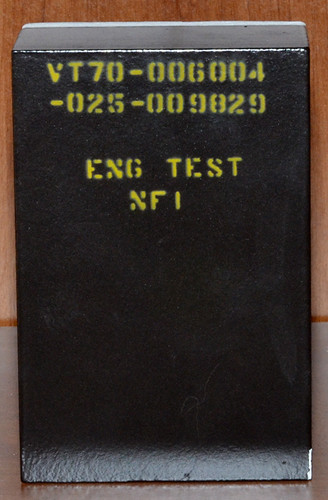 |
Skuz9c1
New Member Posts: 9
From: Wyoming, Michigan, USA
Registered: Oct 2011
|
posted 07-04-2012 07:57 PM
Thanks Gregg and Gary, I had a hunch that's what it was. But, since it wasn't on the NASA list, I wanted to make sure. |
Spaceguy5
Member Posts: 427
From: Pampa, TX, US
Registered: May 2011
|
posted 07-05-2012 12:51 AM
I have a VT tile as well. Assumed that it was a test piece, good to know that I was right. |
garymilgrom
Member Posts: 1966
From: Atlanta, GA
Registered: Feb 2007
|
posted 07-05-2012 06:44 AM
Anyone know what the NFI or NF1 stands for? Perhps not for installation? I have some other test pieces where these letters are marked on the rear of the tile too (most tiles have the entire number marked on both sides of the tile). |
dragon001
Member Posts: 47
From: Allentown, PA, USA
Registered: Apr 2012
|
posted 12-29-2012 01:09 AM
Curious if someone can confirm that VT are actual test articles... I found this site, about half way down: I'm trying to locate VT70-191037-027, I see that it is on the wing but I would like to see if I can get a picture of exactly where. In the general location anyway... ...to which someone replied: This is an more interesting tile than average. Its located on the door that normally covers the orbiter's left-hand main landing gear - specifically towards the front of the door and towards its outer edge where the door hinge is located. The tile is of a type know as LI-900 which covers the bulk of the underside of the orbiters, and is a High-temperature Reusable Surface Insulation (HRSI) black tile. |
garymilgrom
Member Posts: 1966
From: Atlanta, GA
Registered: Feb 2007
|
posted 12-29-2012 07:46 AM
I cannot confirm that ALL tiles marked VT were used for testing but here is another one, different from the black one above. I believe this tile was used during transport of Columbia (the first orbiter) to KSC before tile installation was complete. These "delivery tiles" ensured smooth airflow so as not to disrupt thermal tiles already in place. The back of this tile has the SIF pad and red RTV glue.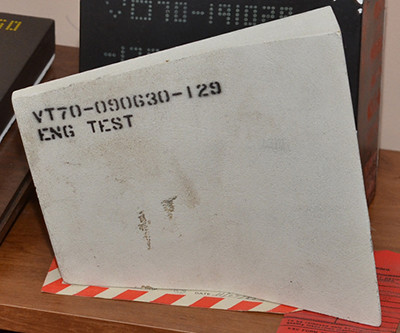 |
garymilgrom
Member Posts: 1966
From: Atlanta, GA
Registered: Feb 2007
|
posted 12-29-2012 07:49 AM
Columbia showing what I believe are "real" thermal tiles plus delivery tiles and untiled areas while under construction in Palmdale.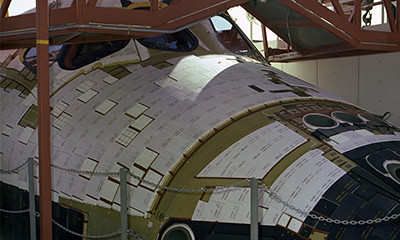 |
garymilgrom
Member Posts: 1966
From: Atlanta, GA
Registered: Feb 2007
|
posted 12-29-2012 08:09 AM
Here are photos of the left landing door of Atlantis. First is overall, second is closer view of the hinge area and LH identification, last is close up showing markings. I can see no tiles marked VT in this area.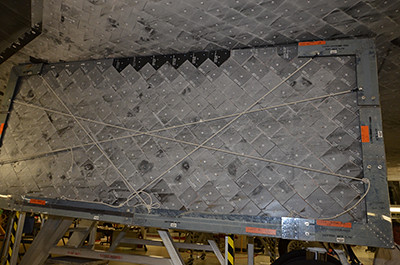 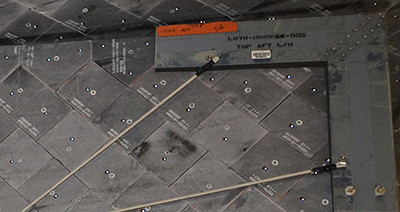 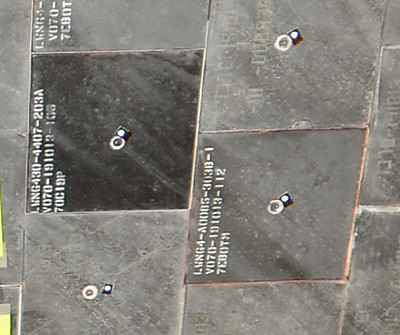 Finally - Joel here are some tiles labelled AFT that are near the fuel line door: 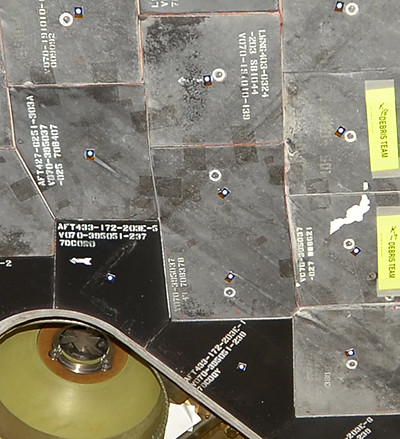 |
Rocket Chris
Member Posts: 342
From:
Registered: Nov 2009
|
posted 12-29-2012 12:22 PM
LWNG = Left Wing |
CMikeW
Member Posts: 89
From: United States
Registered: Apr 2013
|
posted 07-08-2016 01:08 PM
Is it possible to find out if a tile was installed on an orbiter and when, how many flights it took and when it was removed? Where do I look or who do I ask? Thanks.Editor's note: Threads merged. |
CMikeW
Member Posts: 89
From: United States
Registered: Apr 2013
|
posted 07-08-2016 03:15 PM
quote:
Originally posted by brody1140:
I have an early shuttle tile with the following codes on it...
LWNG means left wing, 4 means OV-104 Atlantis, 05 means the paperwork was generated during the ground operations between the fourth and fifth flight of OV-104, -063 is the sequence number of the paperwork. Hope this helps. |
JBoe
Member Posts: 959
From: Churchton, MD
Registered: Oct 2012
|
posted 07-08-2016 03:20 PM
This is good stuff! I really enjoy learning about what all these numbers mean. What are the smaller white circles next to the larger ones? |
Hart Sastrowardoyo
Member Posts: 3445
From: Toms River, NJ
Registered: Aug 2000
|
posted 07-08-2016 11:43 PM
Looking at my photos from the Hubble@25 Social on the Intrepid, the real black tiles on Enterprise began with MISC, as the dummy tiles had no writing on them.There is a section on Enteprise's side which contained both the blanket as well as real white tiles with a numeric code, but it was too high up to see what those numbers and letters are. |
pupnik
Member Posts: 114
From: Maryland
Registered: Jan 2014
|
posted 07-15-2016 06:09 PM
quote:
Originally posted by CMikeW:
Is it possible to find out if a tile was installed on an orbiter and when, how many flights it took and when it was removed? Where do I look or who do I ask?
Some tiles come with paperwork (or more commonly copies of paperwork) about the inspection and removal of a tile. Even that paperwork won't provide a complete history though, it only let's you know which specific flight the paperwork was generated from.If a tile is unblemished and in great condition it probably wasn't ever on an orbiter. If it's grey and worn it's most likely been flown (slight chance it could be an engineering article). But I've never heard of anyone having any luck tracking a complete history for a tile, it doesn't seem to have been tracked by the contractors. Statistically speaking though, if it's a tile not in an "unusual" spot (like ET door, landing gear door, other easily damaged areas) then it is probably a tile original to when the orbiter was first constructed. In fact if you go visit an orbiter today the majority of tiles you see will be the same tiles from the day it rolled off the line. |
thisismills
Member Posts: 263
From: Michigan
Registered: Mar 2012
|
posted 07-27-2016 12:28 PM
Over the years have accumulated a small collection of shuttle TPS tile location maps for reference. |
Little-Gizzmo
Member Posts: 11
From: Salem, Baden-Württemberg, Germany
Registered: Nov 2016
|
posted 12-20-2017 02:37 AM
I won a space shuttle tile on a auction last month. Unfortunately I could not find any information about it. Obviously it is an unflown sample tile.Maybe someone of you could give me some advice regarding type and history. The ID starts with SDK. It displays some areas of red glue on the back. Thank you! |
Rocket Chris
Member Posts: 342
From:
Registered: Nov 2009
|
posted 05-18-2018 01:56 PM
I have a shuttle tile and from the stamps at the back as well as from the Rockwell ID it is suggested to be from Challenger, de-integrated after Spacelab 61-A flight.I already made a FOIA request at NASA, they pleased me to forward my inqury to NARA and now I got a reply that the Problem Report (scrap declaration) cannot be found. There are several documents, more engineering related but the KSC Problem Report related to the tile's replacement is specifically not present. Does anyone have an idea where possibly to find this documented KSC report? |








 advertisement