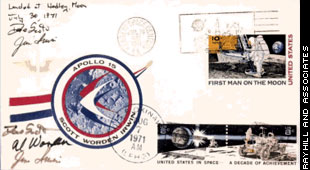
Realizing there may be a market for space flown philatelic items, German stamp dealer Hermann Sieger set out in 1970 to recruit an Apollo crew to carry a small number of postmarked envelopes — called "covers" by collectors — to the moon.
In pursuit of his idea, Sieger approached Walter Eierman, who previously had conducted several memorabilia deals with the astronauts.
Eierman, working on Sieger's behalf, was able to interest the crew of Apollo 15.
In exchange for $7,000 each and on that the condition the covers were not to be sold until after the Apollo program was over, David Scott, James Irwin and Alfred Worden agreed to carry Sieger's 100 covers to the lunar surface.
The crew stowed 300 similar covers for themselves.
Due to weight constraints, all the items carried aboard the Apollo spacecraft needed to be manifested. Although the Apollo 15 crew was later to claim an innocent oversight, the covers, carried in Scott's spacesuit pocket, were not recorded pre-flight.
This might not have been a problem had it not been for Sieger, who soon after the mission upon receiving his 100 covers, began selling them throughout Europe for $1,500 (US) each.
When the news of the sale reached the United States, the crew attempted to retrieve the covers from Sieger but were unsuccessful. In an effort to save their careers, the astronauts returned the $7000 they had each received, but pressure from a
congressional inquiry left NASA little choice but to suspend each from active flight status.
The space agency also confiscated the 298 covers (two from the crew's original 300 were reportedly destroyed pre-flight) that they still had in their possession.
To prevent similar incidents from occurring again, NASA
drafted rules as to what astronauts would be allowed to take with them into space. Future crew members would be bound not to publicize the contents of their "Personal Preference Kit" (PPKs) until they retired from the corps. The astronauts were also required to sign an agreement restricting transfer of their flown memorabilia to gifts and donations — sale of memorabilia was strictly prohibited.
The Apollo 15 covers may have never been seen or heard of again, and indeed were not until 11 years later.
In 1983, the U.S. Postal Service anounced plans to fly 260,000 covers aboard the space shuttle. Worden, seeing the similarities between his confiscated covers and those set to fly on STS-8, sued the government for the return of his crew's 298 cachets. In an out-of-court settlement, the covers were returned to the crew.
Upon their receipt, the entire crew drafted, signed and had notarized a letter of provenance for each cover.
Identification
There are differences in appearance between Sieger's 100 covers and the 298 that were returned to the crew.
The Sieger covers have handwritten notes as having been "Landed at Hadley, Moon, July 30, 1971" on their front upper left corner. On their reverse is a typed, notarized inscription:
This is to certify that this cover was onboard the Falcon at the Hadley-Apennine, Moon, July 30-August 2, 1971
In comparison, the astronauts' 298 covers are stamped in the front upper left corner:
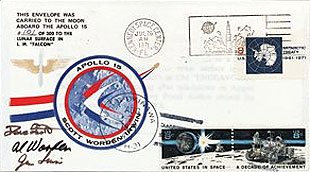
This envelope was carried to the Moon aboard the Apollo 15 #____ of 300 to the Lunar Surface in L. M. "Falcon"
The covers are also autographed by the crew on the front lower left corner. Inserted into each cover is a card which reads:
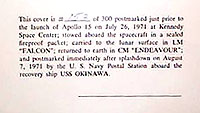
This cover is #____ of 300 postmarked just prior to the launch of Apollo 15 on July 26, 1971 at Kennedy Space Center; stowed aboard the spacecraft in a sealed fireproof packet; carried to the lunar surface in LM "FALCON"; returned to earth in CM "ENDEAVOUR"; and postmarked immediately after splashdown on August 7, 1971 by the U. S. Navy Postal Station aboard the recovery ship USS OKINAWA. |
Some of these cards are found signed by a crew member.
Additionally, on the reverse of each, a small handwritten serial number is found. These were assigned by NASA at the time of their confiscation.
A veteran collector, Howard C. Weinberger is the author of "The Robbins Medallions: Flown Treasure from the Apollo Space Program" and "Collecting the Robbins Medallions."