November 8, 2026 — "If anybody is interested in visiting the moon, I'd encourage you to go online and apply."
NASA Administrator Jared Isaacman repeated the news that the space agency announced hours earlier on Saturday (Nov. 7). "We released today an open call for the next astronaut class."
For only the 25th time in its history, NASA is again looking for qualified Americans to become astronauts. The selected candidates are expected to graduate from their basic training just as the Artemis program gears up to establish a moon base at the lunar south pole.
Under the Artemis program, NASA is preparing to send astronauts on increasingly difficult missions to explore more of the moon than was possible during the Apollo landings over 50 years ago. The agency plans to build a moon base to support an enduring human presence on the surface.
"For those who apply, becoming a NASA astronaut is more than a career opportunity," said Scott Tingle, chief astronaut and chair of the selection board at Johnson Space Center in Houston, in a statement. "It is a chance to join a legacy of explorers who have pushed the boundaries of discovery and play a role in the missions that will shape humanity's future in space."
"The next generation of astronaut candidates could help write history," said Tingle, "while inspiring future scientists, engineers and explorers."
ASCAN (astronaut candidate) hopefuls have until Thursday, Dec. 3 at 11:59 p.m. EST to submit their applications on the federal USAJobs website.
To be eligible, applicants need to be U.S. citizens with a master's degree in a science, technology, engineering or mathematics field. Alternatively, they can have at least two years of work towards a doctoral program in a similar field; an M.D., or be a physician assistant/nurse practitioner, or hold a related medical degree; or have or will graduate by July 2027 from a nationally-recognized test pilot school.
They must also have at least three years of professional experience in their field after completing their degree. Pilots need 750 hours of flight time in high-performance jets, 1,500 total flight hours in other fixed-wing aircraft or 1,000 total hours in rotary-wing aircraft.
For medical doctors, residency training may count toward the professional experience requirement if completed by July 2027. All candidates must pass a NASA long-duration astronaut flight physical and demonstrate strong leadership, teamwork and communication skills.
Since 1959 and the selection of the "original" Mercury 7, NASA has chosen 370 people to train as astronaut candidates. The agency currently has 32 active members in its astronaut corps. In addition to flying into space, astronauts fulfill technical assignments, such as overseeing the development of new spacecraft and serving as CapCom (capsule communicator) in Mission Control.
The 24th group of astronauts, nicknamed "The Platypi," were selected from an initial pool of more than 8,000 applications. The 10 men and women are on track to graduate and join the corps in 2027, after undergoing instruction in survival, planetary geology, basic spacecraft systems and, if not pilots, flight training.
"The mission is waiting. And the only thing missing from the greatest adventure humanity has ever embarked upon is you," said Matt Anderson, NASA's deputy administrator. |
|
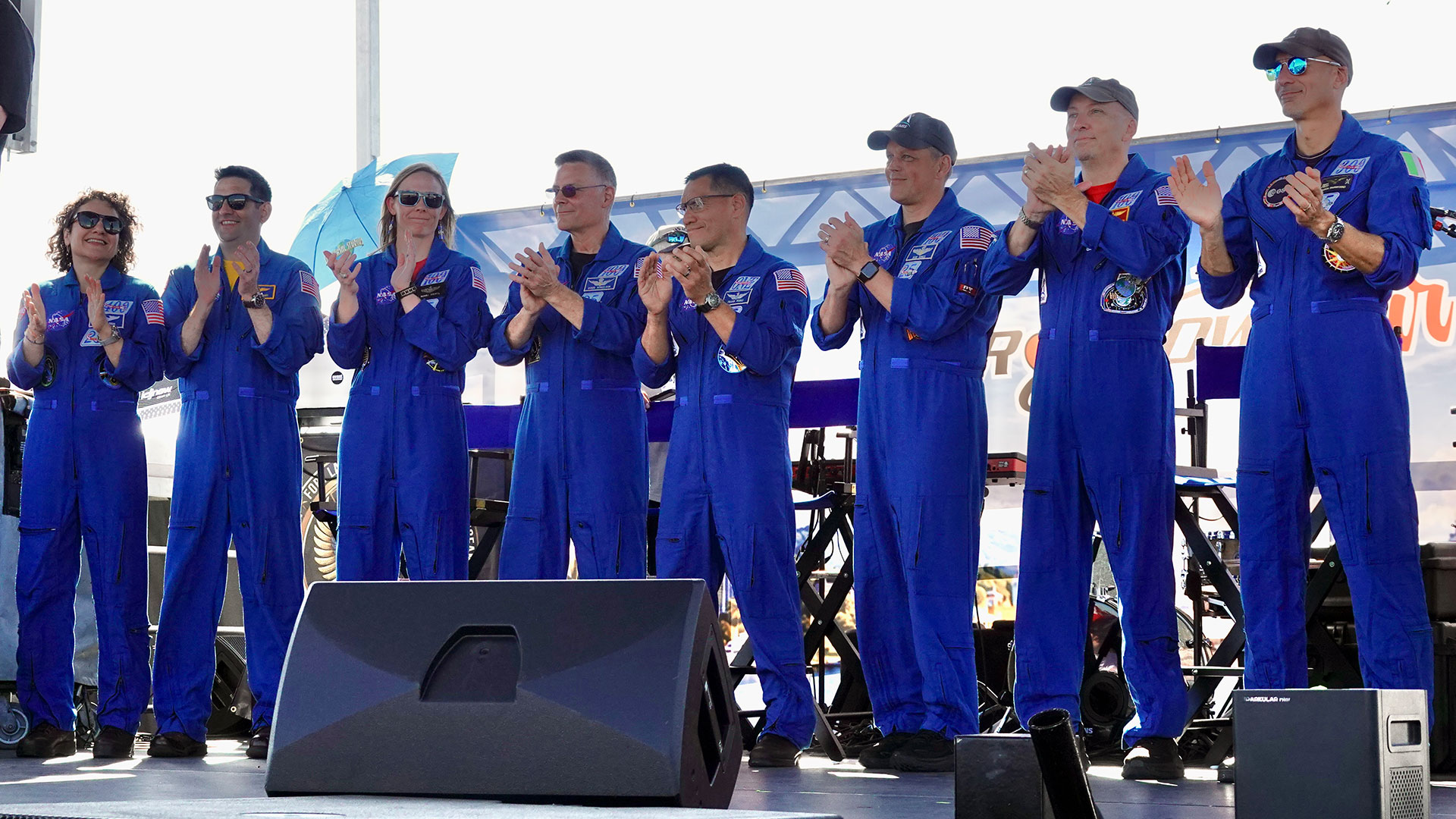
Members of NASA's current active astronaut corps, including three members of the Artemis III prime crew, appear on stage at the MAX POWER air show and expo at Kennedy Space Center in Florida on Saturday, Nov. 7, 2026, the same day the agency began recruiting for its 25th class of astronauts. (Mark Usciak/collectSPACE)
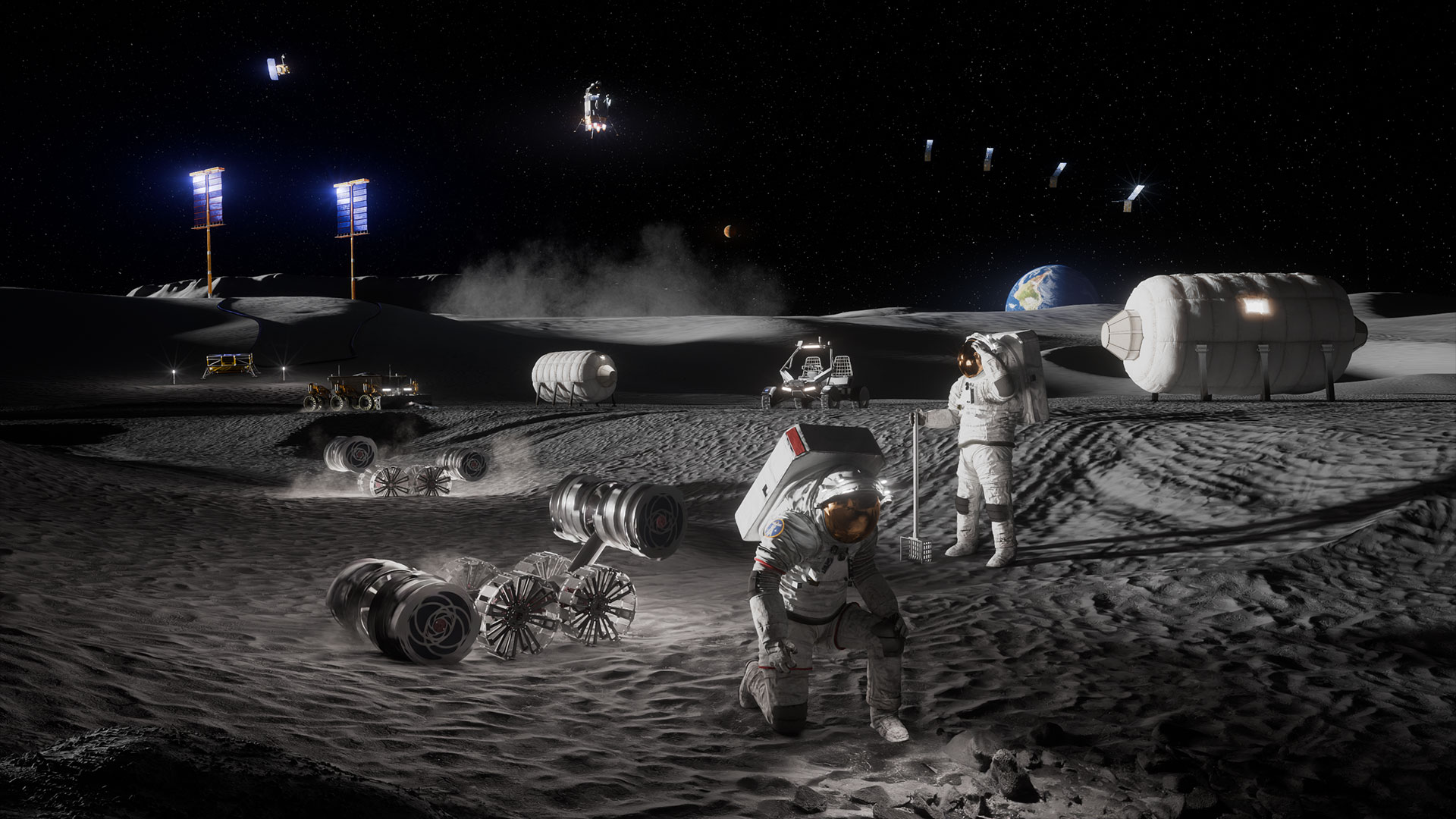
Artist's concept depicting astronauts, habitats, rovers, power systems and cargo operations supporting sustained activities at a Moon Base to be established near the lunar south pole. (NASA) |