August 31, 2026 — NASA has revealed the first component of its Moon Base to be delivered with the next U.S. astronauts to step foot on the lunar surface.
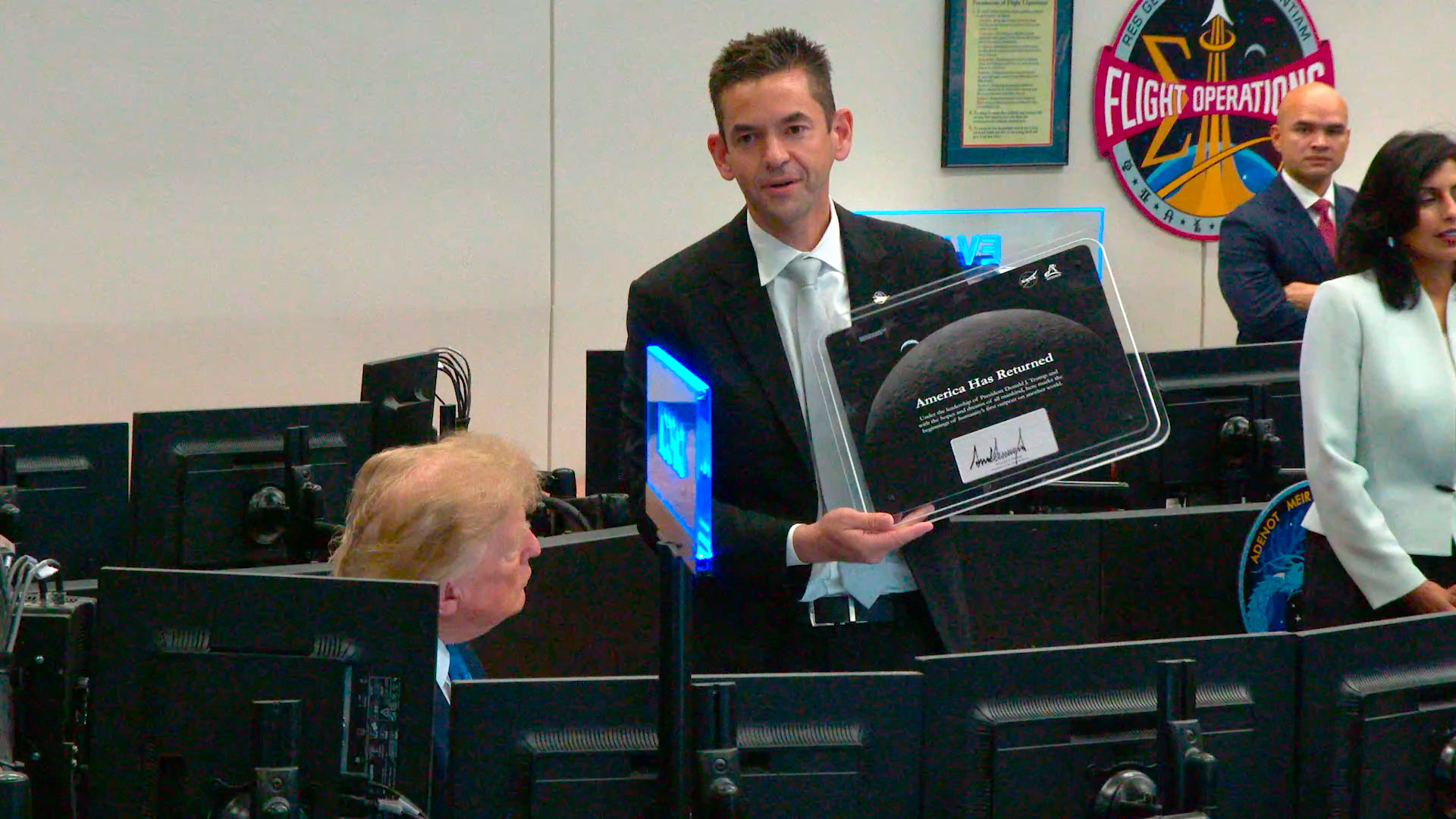
The space agency on Friday (Aug. 28) debuted the commemorative plaque that will be mounted to the "cornerstone" of its planned, human-tended installation at the moon's south pole. The aluminum plate made its debut during a visit by President Donald Trump to Mission Control at NASA's Johnson Space Center.
"Mr. President, we have one more surprise for you today," said NASA Administrator Jared Isaacman, who accompanied Trump on his trip to Houston. "The first astronauts to return to the moon will carry this cornerstone [plaque] and place it on the surface of the moon."
"We were hoping you would sign it for us," said Isaacman.
Based on NASA's television coverage of the event, the plaque appears to be roughly 18 inches long by 15 inches tall. Made of a thin sheet of metal mounted to a plexiglass mat, the plate is decorated with an acrylic graphic of "Earthset" as captured by the Artemis II crew in April. The original photograph has been altered to ghost-in an image of an American flag set against the blackness of space.
The NASA insignia and Artemis program logo appear in the upper right corner.
Centered on the plaque in bold typeface is the phrase, "America Has Returned." The text then reads, "Under the leadership of President Donald J. Trump and with the hopes and dreams of all mankind, here marks the beginnings of humanity's first outpost on another world."
Below that is a white box where the president added his autograph.
"I have to give a good signature for this," said Trump as he took a seat at the flight director's console in the International Space Station control room to add his mark using a thick black ink marker.
The plaque is the latest dedicatory item that NASA has prepared to fly on the first Artemis moon landing, currently targeted for the Artemis IV mission in 2028. Trump recently presented NASA with another: an American flag that flew over the U.S. Capitol Building in Washington to be deployed on the lunar surface.
NASA also pledged to bring a fragment of a moon rock that was brought to Earth by the Apollo 11 astronauts in 1969 and then flown on the space shuttle to the International Space Station in 2009 in celebration of the first moon landing's 40th anniversary.
"When Americans return to the moon, a piece of this rock will go with them to be returned to its home," said NASA astronaut Michael Barratt, who was aboard the orbiting outpost at the time.
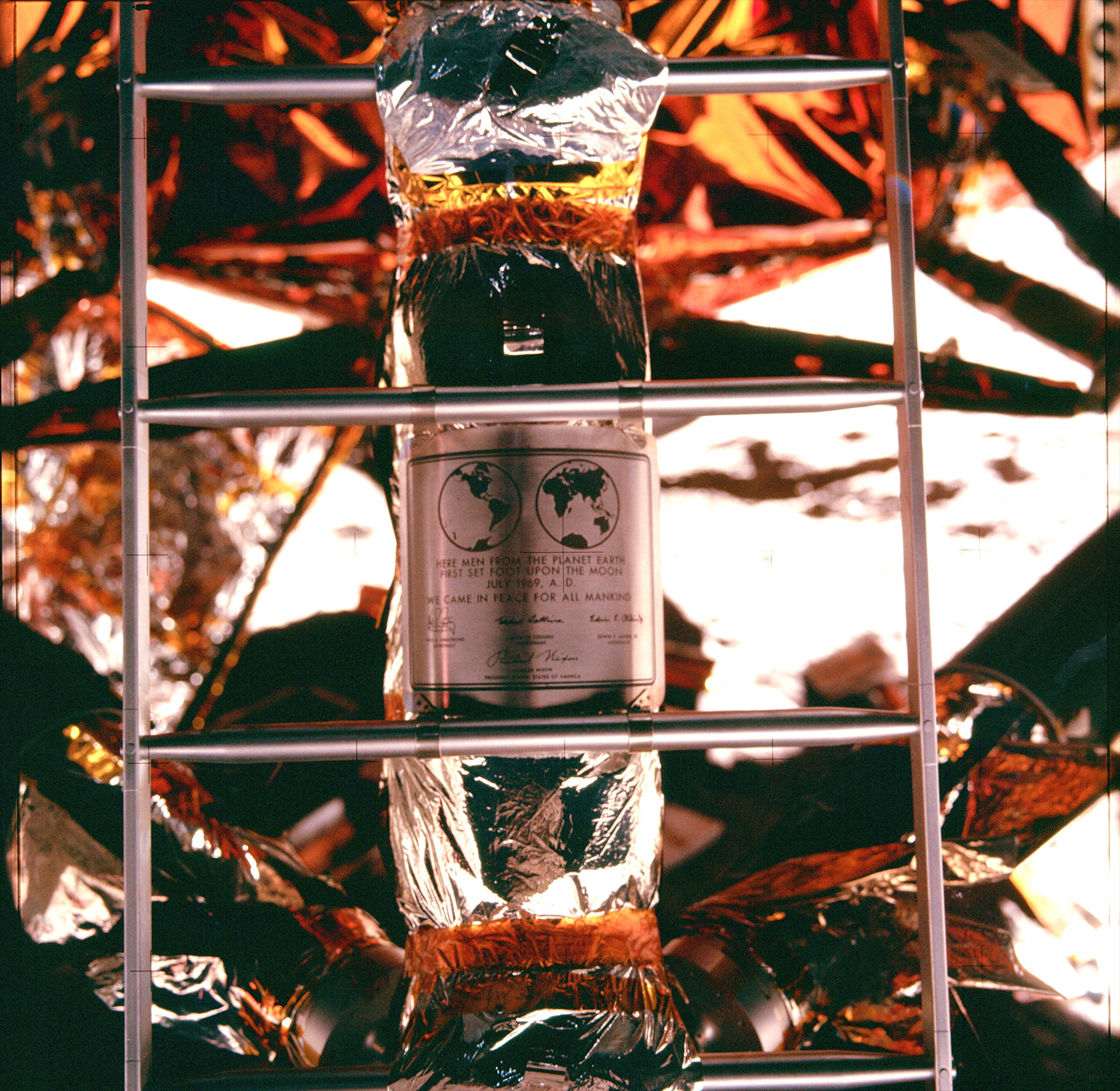
If the Artemis plaque makes it successfully to the moon, Trump will become the second president to have his signature on the lunar surface. The Apollo 11 and Apollo 17 landers each flew with President Richard Nixon's facsimile autograph etched with the crew's signatures on a stainless-steel plaque mounted to a leg of the lunar module.
The Apollo 17 plaque read in part, "Here man completed his first explorations of the moon December 1972, A.D. May the spirit in which we came be reflected in the lives of all mankind."
The Artemis plaque's flight would also mark the second time Trump's signature has crossed the distance between Earth and the moon. In 2020, during a visit to the Kennedy Space Center in Florida, Trump autographed a hatch assembly for the Artemis II Orion spacecraft. The autograph was later covered over by insulation and as such could not be seen during the 10-day lunar flyby mission. |
|
NASA Administrator Jared Isaacman holds up a commemorative metal plaque signed by President Donald Trump that will be added to the cornerstone of the agency's planned Moon Base. (NASA)
The commemorative plaque mounted to the Apollo 11 lunar module included the facsimile signatures of the mission crew and President Richard Nixon. (NASA) |