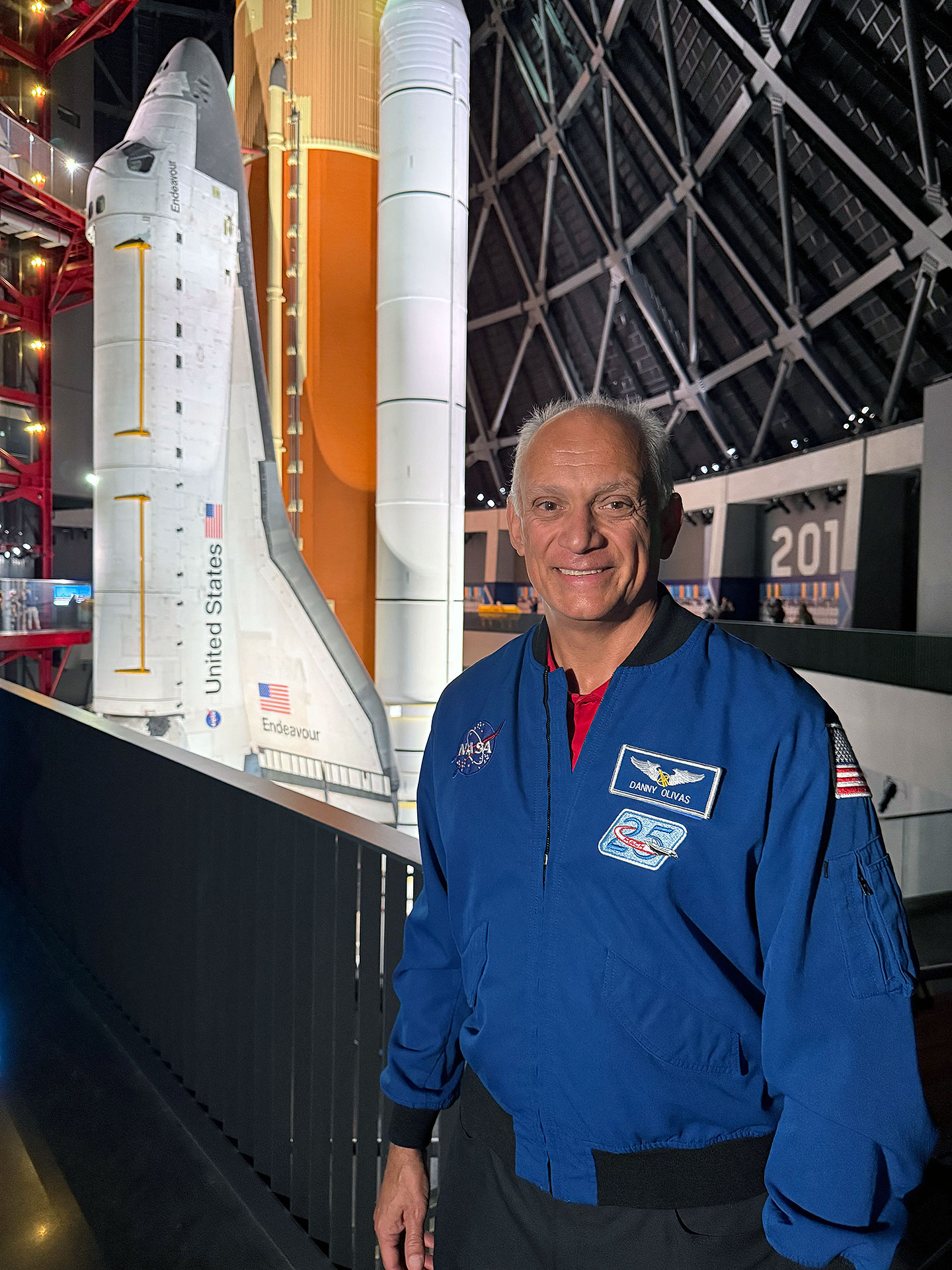
June 24, 2026 — Danny Olivas did not launch aboard Endeavour, but as a space shuttle astronaut he was thrilled to be among the first people to see the orbiter on vertical display.
On Wednesday (June 24), Olivas joined members of the media for an early look at the towering display in the California Science Center's new Samuel Oschin Air and Space Center in Los Angeles. The center will open to the public on Nov. 13.
As an engineer specializing in materials science, Olivas worked with Endeavour in the wake of the 2003 Columbia tragedy, using the components from the intact orbiter to help identify the debris recovered from the fallen spacecraft. That work continued even after the shuttle program ended and Endeavour was delivered to the California Science Center in 2012.
Mosty recently, Olivas led a group of graduate students "crawling around underneath the elevons, looking at the elevon actuators" while Endeavour was on horizontal display to further their research into high-temperature entry environment exposure on metal systems.
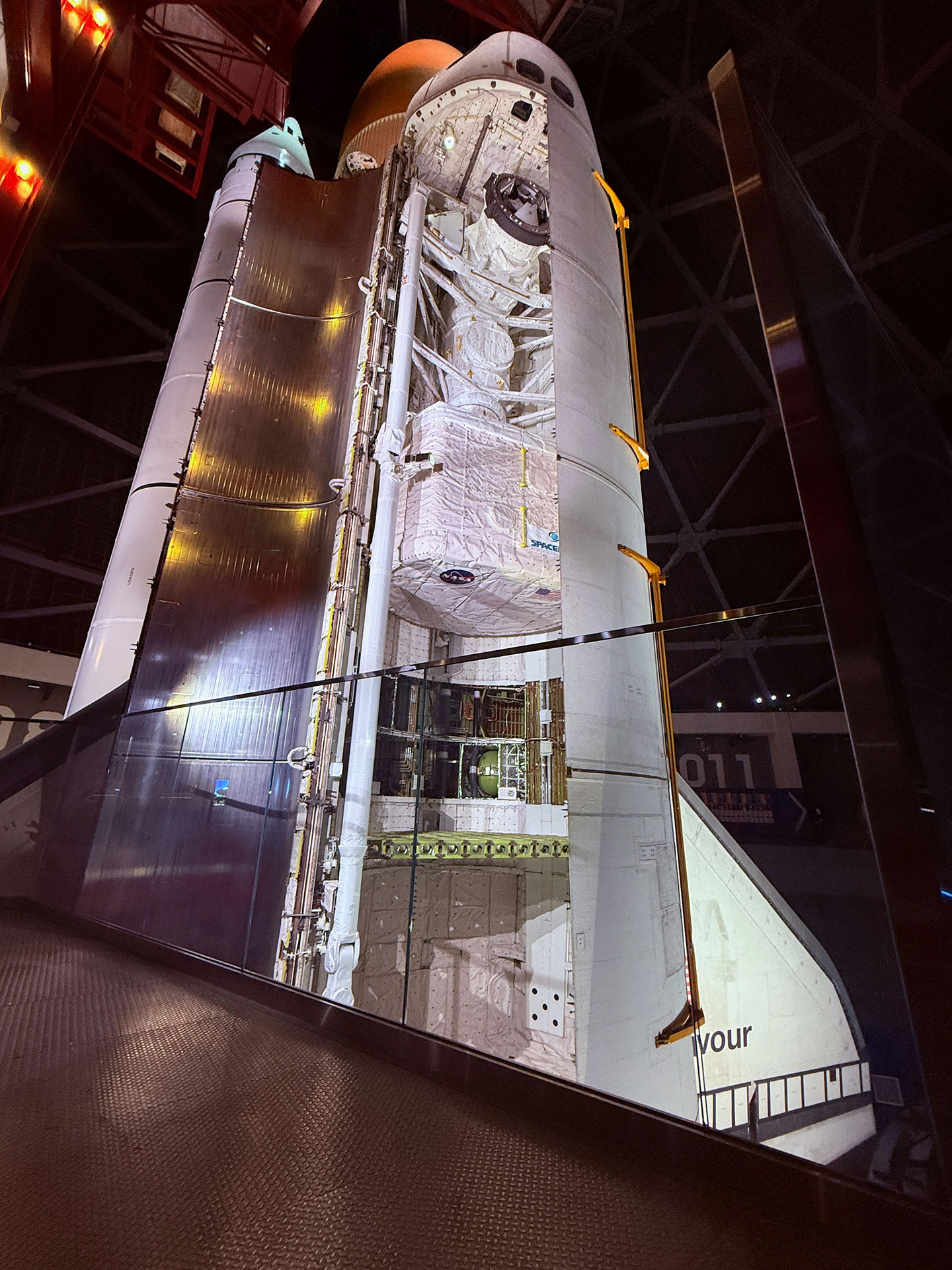
"For me, the shuttle is beautiful, but its real beauty is if you peel the skin back and see what actually makes it work," Olivas told collectSPACE. "it's really important."
Fortunately, the California Science Center seems to have had the same idea with its Endeavour display, leaving a payload bay door open and some of the flooring in the cargo hold exposed to reveal what made the vehicle "the most complicated machine ever built."
collectSPACE spoke with Olivas in front of Endeavour just minutes after he got his first look at the new launch pad-like exhibit.
collectSPACE (cS): Without giving away what happens, what did you think of the reveal? Was that the first time you had seen it?
Danny Olivas: The very first time. In fact, the science center asked me if I wanted information in advance and I said, "Nope, surprise me like everybody else."
What I really loved about it was that it is a testament to all of the people who worked in our space program who don't wear blue flight suits, but are every bit the heroes. All of the people who put her together, especially being down here in Southern California — I mean, she was born here, and here is where she's going to continue to inspire for the next generation. it was very inspiring.
cS: Assuming you have seen Discovery and Atlantis...
Olivas: Absolutely.
cS: ...how would rank the three shuttle displays?
Olivas: I would rank this one a one.
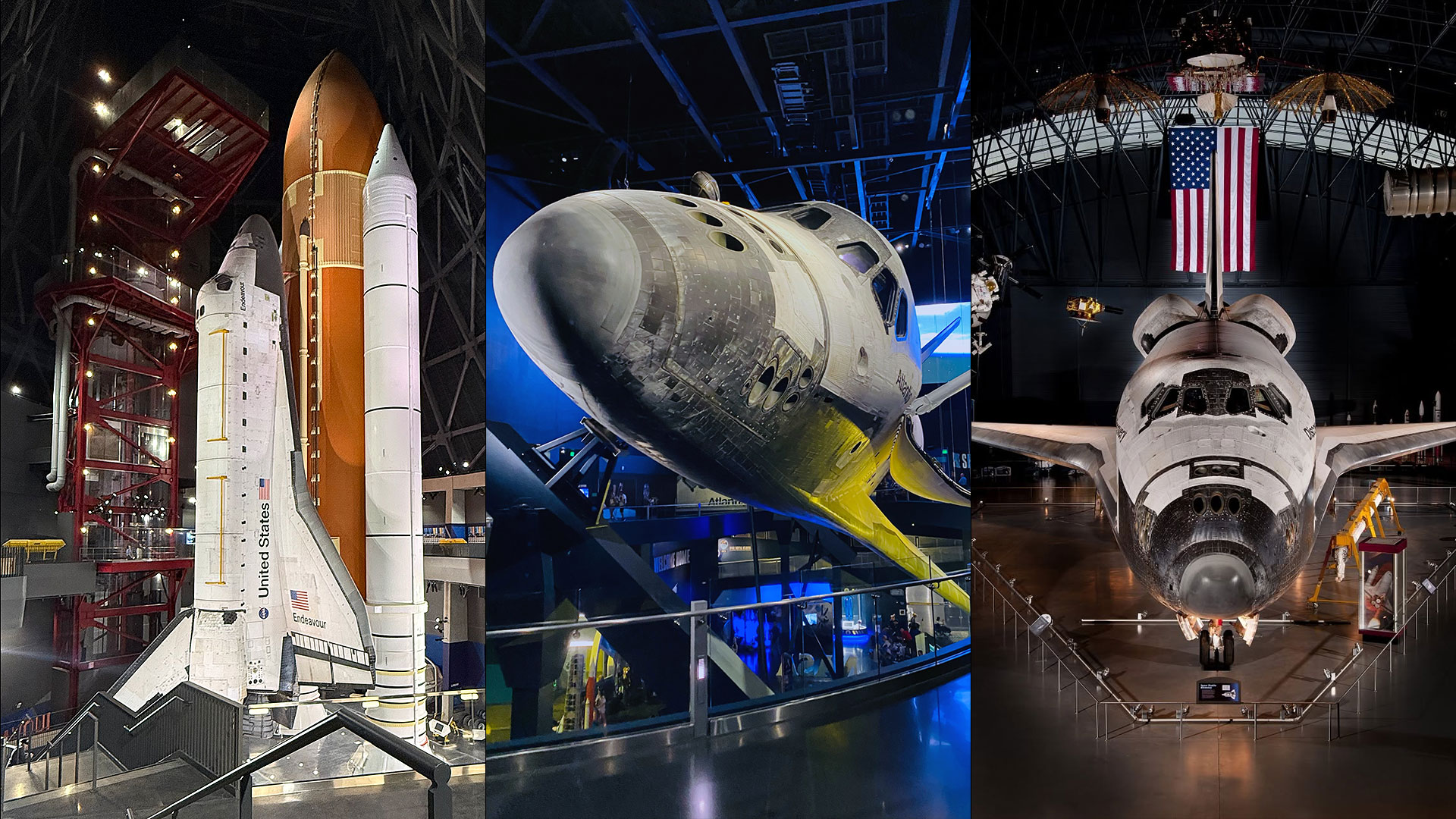
I would rank Discovery a one, and I would rank Atlantis a one. And here's the reason why: you get to see the space shuttle in its three phases of flight. Here [at the California Science Center] you see Endeavour, basically, what she would look like on the launch pad. People get an opportunity to see and experience the enormity of the entire stack.
You go to Kennedy Space Center [in Florida], and you see Atlantis, basically what she would look like in orbit. And then you go to National Air and Space Museum outside of Dulles [Virginia] and you see what Discovery looked like when she was on the runway after coming home. It's really like a full circle.
I don't think you can put one in front of the other, because all three complement each other tremendously.
cS: You mentioned the experience of seeing the shuttle on the launch pad. How does seeing Endeavour in this configuration today compare to the first time you arrived at the pad to launch into space?
Olivas: As I mentioned to Jeff [Rudolph, CEO and president of the California Science Center] earlier today, this exhibit is second only to launch.
I think the things that are missing here are more of the visceral experiences that you have when you first show up on the launch pad. You can hear all the creaking and moaning of the vehicle, like it is trembling, ready to take off. And filled up with propellant, you can see all the condensation dripping down from the sides. The analogy would be a thoroughbred race horse inside the gates, just ready and waiting to take off, with sweat on its body... that's the one thing that you're missing.
Beyond that, you get to see her beauty here. You know, during TCDT [the terminal countdown demonstration test], when the shuttle wasn't tanked, we had an opportunity to visit with our family members and get up-close and personal. I think that people are going to have that exact same experience here.
cS: What do you think others who are not astronauts are going to take away from seeing Endeavour on display?
Olivas: What I really appreciate about the California Science Center is that admission is free, so this is the most accessible exhibit for inspiration on the planet. You can't ask for any more than free, right? Especially when it caters to the children in the Southern California area, where a lot of people grow up without the kind of means and opportunities like we have in Houston, for example, being able to hop over to NASA and visit Rocket Park. So, I think when kids come to visit Endeavour, they're going to have the same feeling
It is not to me about seven people in blue flight suits going up into space; it's about hundreds of thousands of people from across our country that make spaceflight happen,That's to me where the inspiration is at, because we want to encourage kids to continue to dream. They can make even what appears to be an impossible task happen through the pursuit of hard work and dedication. |
|
Former NASA astronaut Danny Olivas with the newly-revealed space shuttle Endeavour display in the California Science Center's new Samuel Oschin Air and Space Center. (collectSPACE)
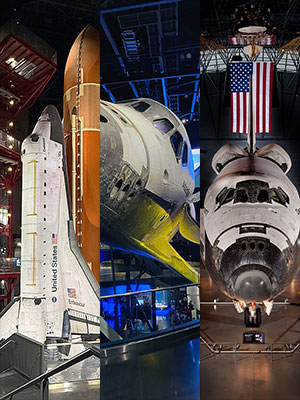
As astronaut Danny Olivas points out, the space shuttle museum displays now reflect the orbiters' three phases of flight: Endeavour at launch, Atlantis in orbit and Discovery landing. (collectSPACE / Kennedy Space Center Visitor Complex / Smithsonian)
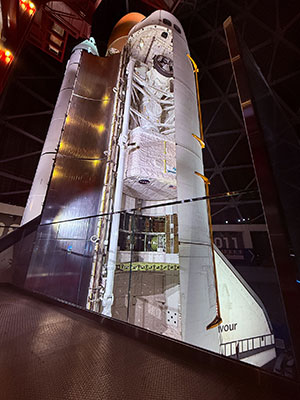
The California Science Center has left open one of Endeavour's payload bay doors and removed some of the cargo hold's flooring to reveal the "real beauty" of how it worked. (collectSPACE) |