April 25, 2026 — NASA has assigned its first crew to launch on a mission "13" since Apollo 13 "had a problem" on the way to the moon 56 years ago.
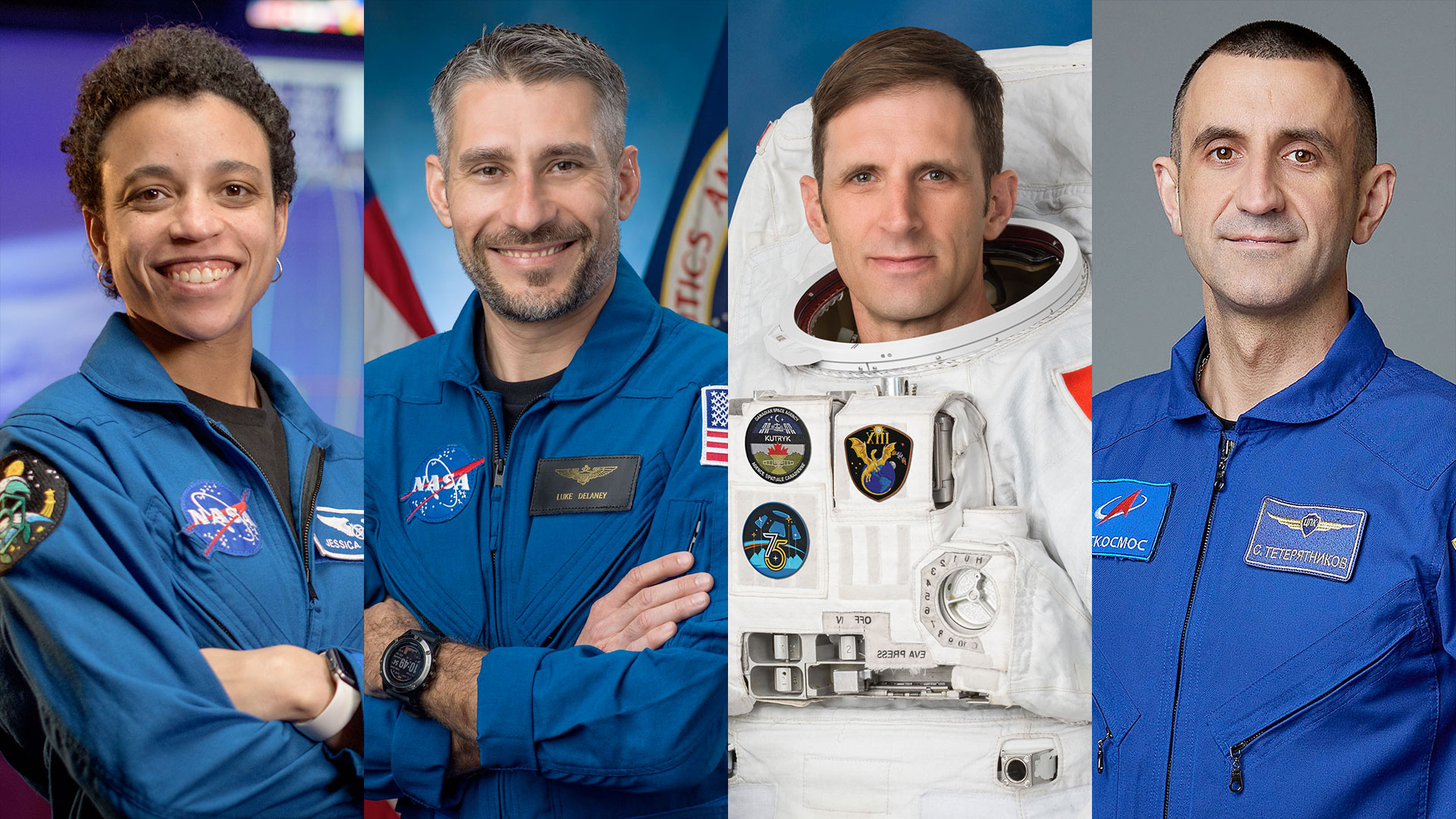
Jessica Watkins and Luke Delaney with NASA, Joshua Kutryk with the Canadian Space Agency and Roscosmos cosmonaut Sergey Teteryatnikov will lift off for the International Space Station as Crew-13 on a SpaceX Dragon spacecraft in mid-September. The four will serve as members of the station's Expedition 75 and 76 crews, before returning to Earth about five months later.
"This flight is the 13th crew rotation with SpaceX," NASA's announcement read. "The crew will conduct scientific investigations and technology demonstrations to help prepare humans for future exploration missions to the moon and Mars, and benefit people on Earth."
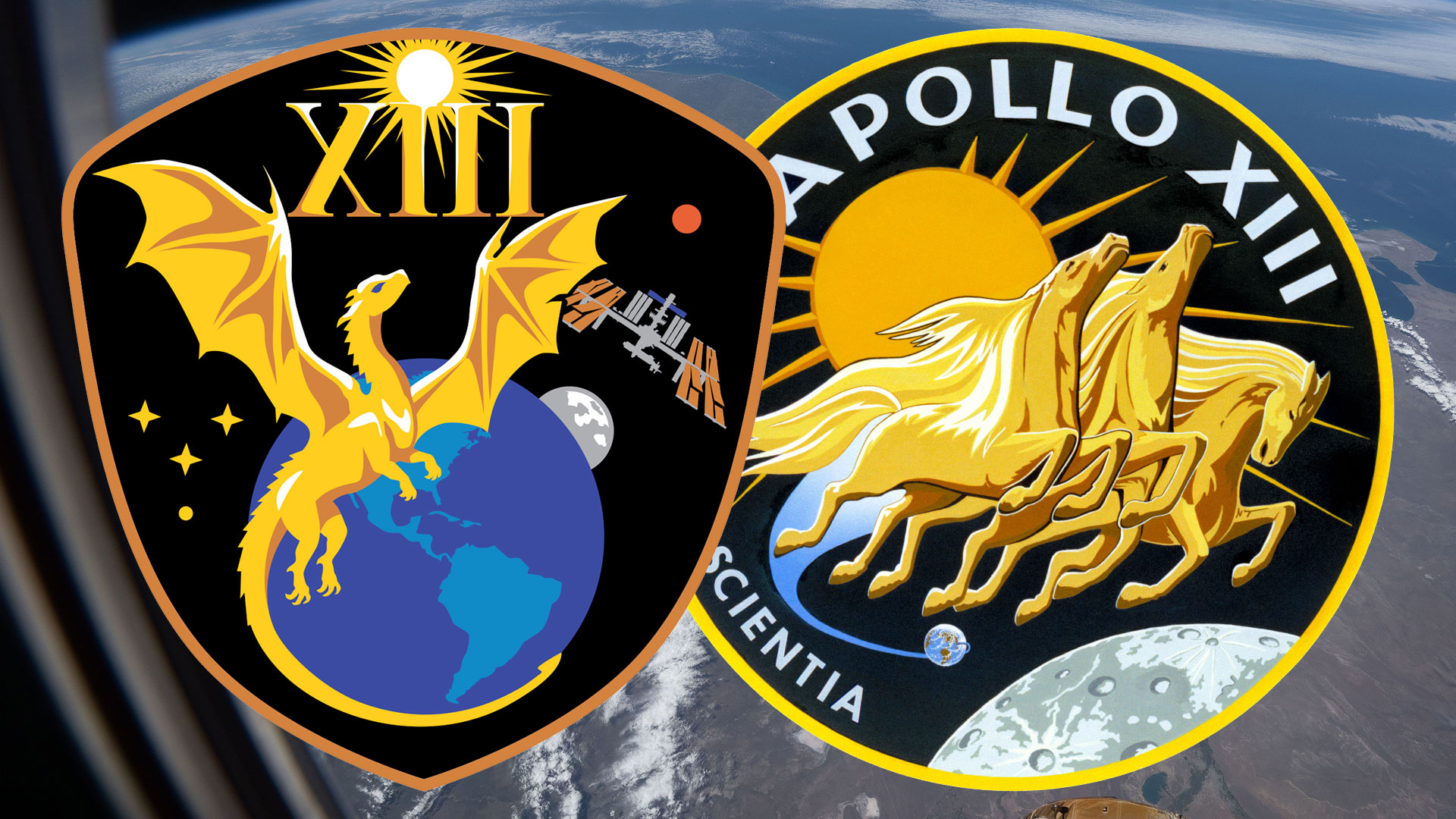
Rather than give into triskaidekaphobia (the fear or avoidance of 13), the crew is embracing it, or at least their connection to the last U.S. launch to be similarly numbered. The Crew-13 mission patch includes visual nods to the insignia worn by Apollo 13 astronauts Jim Lovell, Fred Haise and Jack Swigert in April 1970.
Imitation is an option
"NASA's SpaceX Crew-13 patch looks ardently toward the future of space exploration while honoring the legacy of those who came before," reads the official description of the emblem.
At the center of the Crew-13 patch is a golden dragon, which is both a reference to the name of SpaceX's capsule and the golden horses depicted on the Apollo 13 insignia. (Lovell and his crewmates worked with NASA contract artist Norman Tiller and muralist and sculptor Lumen Winter, who proposed the equestrian design, to create their flight badge.)
The dragon's tail on the Crew-13 patch wraps around Earth in a manner reminiscent of the blue contrail that connects Earth with the horses on the Apollo 13 insignia. In the 1970 artwork, it was a nod to the Roman and Greek god Apollo; today, is a "bridge between Earth, the International Space Station, the moon and Mars," per NASA's caption.
The use of roman numerals for "XIII" (13) and the lack of crew names on the Crew-13 patch also mimic elements of the design from almost six decades ago, where as the golden stars are symbolic of the Crew-13 families and the overall capsule shape (as opposed to a circle) references the "possibilities born out of human collaboration toward a common goal," according to the space agency.
It comes after 12
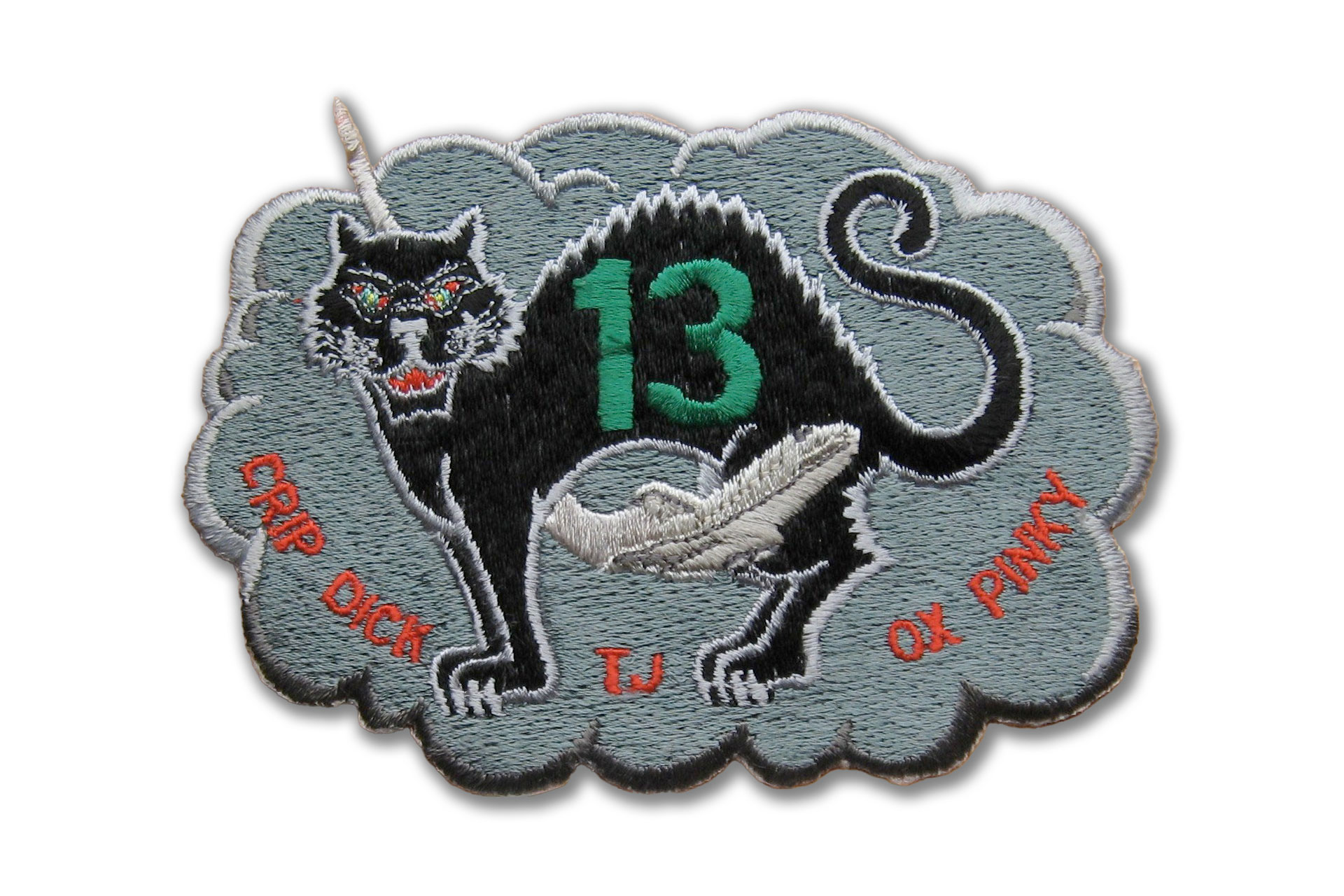
Prior to Crew-13, NASA managers leaned into the superstition and devised a less intuitive but more data-driven designation that went into effect after the ninth space shuttle mission. Hence, what would have been STS-13 became STS-41-C, where the '4' was the fiscal year (1984), the '1' was the launch site (Kennedy Space Center in Florida) and 'C' the order of launch (C was the third planned flight of the year).
"I mentioned it was 41-C that originally it was STS-13, and my friend Jim Beggs, who was the Administrator of NASA, had triskaidekaphobia, and he said, 'There's not going to be [another] Apollo 13 or a Shuttle 13, so come up with a new numbering system.' So we did come up with this complex system for numbering the shuttles during that period of time," said Bob Crippen, STS-41C commander, in a NASA oral history interview.
NASA later reverted back to a straightforward numerical designation after the loss of the space shuttle Challenger and the STS-51L crew in January 1986. As such, there was an STS-113, which launched aboard space shuttle Endeavour in 2002, but not before having to make late crew changes due to medical issues. The last time that NASA faced the same decision was on Apollo 13.
"We were joking a lot about being number 113," commander Ken Bowersox told the press at the time. He added that to play it safe, the mission patch used Roman numerals (CXIII).
On board the International Space Station, the 13th crewed expedition began on April 1, 2006, ten days before the 36th anniversary of the Apollo 13 launch.
The Russian space program launched six crewed missions designated as number 13. At least one of those times, the head of the country's space agency suggested it be skipped.
"Many people have superstitious beliefs," said Roscosmos director Anatoly Perminov, according to his press secretary, in 2008. "That's why I think that it is a good idea to change the number of the next space ship."
Despite the concern, Soyuz TMA-13 went forward as planned. As did Soyuz 13, Soyuz T-13 and Soyuz TM-13 before it.
Soyuz TMA-13M launched Reid Wiseman and Soyuz MS-13 landed with Christina Koch. Both U.S. astronauts went on to fly aboard NASA's Artemis II mission earlier this month, a crewed fly by of the moon that broke the distance record set by the Apollo 13 astronauts. |
|
NASA's SpaceX Crew-13 mission patch pays homage to the Apollo 13 insignia, united by a common numerical. (NASA/collectSPACE)
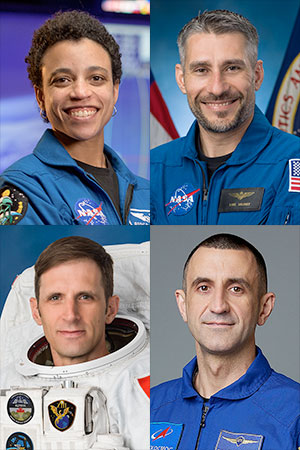
NASA's SpaceX Crew-13 members Jessica Watkins, Luke Delaney, Joshua Kutryk and Sergey Teteryatnikov. (NASA/CSA/Roscosmos)
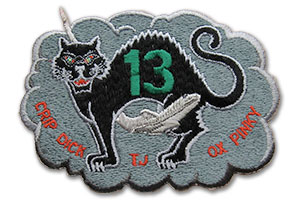
The STS-13 crew, re-designated STS-41-C, created this patch that highlights superstitions and triskaidekaphobia. (collectSPACE) |