Posts: 56943 From: Houston, TX Registered: Nov 1999
posted 08-11-2025 06:40 PM
NASA release
NASA Explores Industry Possibilities to Raise Swift Mission's Orbit
To drive the development of key space-based capabilities for the United States, NASA is exploring an opportunity to demonstrate technology to raise a spacecraft's orbit to a higher altitude. Two American companies – Cambrian Works of Reston, Virginia, and Katalyst Space Technologies of Flagstaff, Arizona – will develop concept design studies for a possible orbit boost for the agency's Neil Gehrels Swift Observatory.
Since its launch in 2004, NASA's Swift mission has led the agency's fleet of space telescopes in investigating changes in the high-energy universe. The spacecraft's low Earth orbit has been decaying gradually, which happens to most satellites over time. Because of recent increases in the Sun's activity, however, Swift is experiencing additional atmospheric drag, speeding up its orbital decay. This lowering orbit presents an opportunity for NASA to advance a U.S. industry capability, while potentially extending the science lifetime of the Swift mission. The concept studies will help determine whether extending Swift's critical scientific capabilities would be more cost-effective than replacing those capabilities with a new observatory.
"NASA Science is committed to leveraging commercial technologies to find innovative, cost-effective ways to open new capabilities for the future of the American space sector," said Nicky Fox, associate administrator, Science Mission Directorate, NASA Headquarters in Washington. "To maintain Swift's role in our portfolio, NASA Science is uniquely positioned to conduct a rare in-space technology demonstration to raise the satellite's orbit and solidify American leadership in spacecraft servicing."
The concept studies are being developed under Phase III awards through NASA's Small Business Innovation Research (SBIR) Program, managed by the agency's Space Technology Mission Directorate, to American small businesses from a pool of existing participants. This approach allows NASA to rapidly explore affordable possibilities to boost Swift on a shorter development timeline than would otherwise be possible, given the rapid rate at which Swift's orbit is decaying.
At this time NASA does not have plans for an orbit boost mission and could still allow the spacecraft to reenter Earth's atmosphere, as many satellites do at the end of their lifetimes. NASA is studying a potential Swift boost to support innovation in the American space industry, while gaining a better understanding of the available options, the technical feasibility, and the risks involved.
NASA will also work with Starfish Space of Seattle, Washington, to analyze the potential of performing a Swift boost using an asset under development on an existing Phase III SBIR award. Starfish is currently developing the Small Spacecraft Propulsion and Inspection Capability (SSPICY) demonstration for NASA, with the primary objective of inspecting multiple U.S.-owned defunct satellites in low Earth orbit.
"Our SBIR portfolio exists for circumstances like this – where investments in America's space industry provide NASA and our partners an opportunity to develop mutually beneficial capabilities," said Clayton Turner, associate administrator, Space Technology Mission Directorate, NASA Headquarters. "Whether we choose to implement the technologies in this circumstance, understanding how to boost a spacecraft's orbit could prove valuable for future applications."
Swift was designed to observe gamma-ray bursts, the universe's most powerful explosions, and provide information for other NASA and partner telescopes to follow up on these events. Its fast and flexible observations have been instrumental in advancing how scientists study transient events to understand how the universe works. For more than two decades, Swift has led NASA's missions in providing new insights on these events, together broadening our understanding of everything from exploding stars, stellar flares, and eruptions in active galaxies, to comets and asteroids in our own solar system and high-energy lightning events on Earth.
"Over its extremely productive lifetime, Swift has been a key player in NASA's network of space telescopes – directing our fleet to ensure we keep a watchful eye on changes in the universe, both far off and close to home," said Shawn Domagal-Goldman, acting director, Astrophysics Division, NASA Headquarters. "Now, this long-lived science mission is presenting us with a new opportunity: partnering with U.S. industry to rapidly explore efficient, state-of-the-art solutions that could extend Swift's transformative work and advance private spacecraft servicing."
Cambrian and Katalyst have each been awarded $150,000 under Phase III SBIR contracts for concept design studies. The NASA SBIR program is part of America's Seed Fund, the nation's largest source of early-stage, non-dilutive funding for innovative technologies. Through this program, entrepreneurs, startups, and small businesses with less than 500 employees can receive funding and non-monetary support to build, mature, and commercialize their technologies, advancing NASA missions and helping solve important problems facing our country.
NASA's Goddard Space Flight Center in Greenbelt, Maryland, manages the Swift mission in collaboration with Penn State, the Los Alamos National Laboratory in New Mexico, and Northrop Grumman Space Systems in Dulles, Virginia. Other partners include the UK Space Agency, University of Leicester and Mullard Space Science Laboratory in the United Kingdom, Brera Observatory in Italy, and the Italian Space Agency.
Robert Pearlman Editor
Posts: 56943 From: Houston, TX Registered: Nov 1999
posted 09-25-2025 09:45 AM
NASA release
NASA Awards Company to Attempt Swift Spacecraft Orbit Boost
NASA has awarded Katalyst Space Technologies of Flagstaff, Arizona, a contract to raise a spacecraft's orbit. Katalyst's robotic servicing spacecraft will rendezvous with NASA's Neil Gehrels Swift Observatory and raise it to a higher altitude, demonstrating a key capability for the future of space exploration and extending the Swift mission's science lifetime.
NASA's Swift launched in 2004 to explore the universe's most powerful explosions, called gamma-ray bursts. The spacecraft's low Earth orbit has been decaying gradually, which happens to satellites over time. However, because of recent increases in the Sun's activity, Swift is experiencing more atmospheric drag than anticipated, speeding up its orbital decay. While NASA could have allowed the observatory to reenter Earth's atmosphere, as many missions do at the end of their lifetimes, Swift's lowering orbit presents an opportunity to advance American spacecraft servicing technology.
"This industry collaboration to boost Swift's orbit is just one of many ways NASA works for the nation every day," said Nicky Fox, associate administrator, Science Mission Directorate, NASA Headquarters in Washington. "By moving quickly to pursue innovative commercial solutions, we're further developing the space industry and strengthening American space leadership. This daring mission also will demonstrate our ability to go from concept to implementation in less than a year — a rapid-response capability important for our future in space as we send humans back to the Moon under the Artemis campaign, to Mars, and beyond."
The orbit boost is targeted for spring 2026, though NASA will continue to monitor any changes in solar activity that may impact this target timeframe. A successful Swift boost would be the first time a commercial robotic spacecraft captures a government satellite that is uncrewed, or not originally designed to be serviced in space.
"Given how quickly Swift's orbit is decaying, we are in a race against the clock, but by leveraging commercial technologies that are already in development, we are meeting this challenge head-on," said Shawn Domagal-Goldman, acting director, Astrophysics Division, NASA Headquarters. "This is a forward-leaning, risk-tolerant approach for NASA. But attempting an orbit boost is both more affordable than replacing Swift's capabilities with a new mission, and beneficial to the nation — expanding the use of satellite servicing to a new and broader class of spacecraft."
Swift leads NASA's fleet of space telescopes in studying changes in the high-energy universe. When a rapid, sudden event takes place in the cosmos, Swift serves as a "dispatcher," providing critical information that allows other "first responder" missions to follow up to learn more about how the universe works. For more than two decades, Swift has led NASA's missions in providing new insights on these events, together broadening our understanding of everything from exploding stars, stellar flares, and eruptions in active galaxies, to comets and asteroids in our own solar system and high-energy lightning events on Earth.
NASA has awarded Katalyst $30 million to move forward with implementation under a Phase III award as an existing participant in NASA's Small Business Innovation Research (SBIR) Program, managed by the agency's Space Technology Mission Directorate. This approach allowed NASA to pursue an orbit boost for Swift on a shorter development timeline than would otherwise be possible, given the rapid rate at which Swift's orbit is decaying.
"America's space economy is brimming with cutting-edge solutions, and opportunities like this allow NASA to tap into them for real-world challenges," said Clayton Turner, associate administrator, NASA's Space Technology Mission Directorate, NASA Headquarters. "Orbital decay is a common, natural occurrence for satellites, and this collaboration may open the door to extending the life of more spacecraft in the future. By working with industry, NASA fosters rapid, agile technology development, advancing capabilities to benefit the missions of today and unlock the discoveries of tomorrow."
Robert Pearlman Editor
Posts: 56943 From: Houston, TX Registered: Nov 1999
posted 06-27-2026 10:32 AM
NASA release
Partners, NASA Ready for June Launch of Swift Boost Mission
A mission to raise the orbit of NASA's Neil Gehrels Swift Observatory is poised for launch no earlier than Tuesday, June 30, 6:23 a.m. EDT (10:23 p.m. UTC+12), from Kwajalein Atoll, part of the Republic of the Marshall Islands in the South Pacific Ocean.
A robotic servicing satellite called LINK, built by Katalyst Space, will blast into orbit on a Northrop Grumman Pegasus XL rocket. LINK will rendezvous with, grapple, and slowly raise Swift's altitude over several months, preventing it from re-entering Earth's atmosphere later this year.
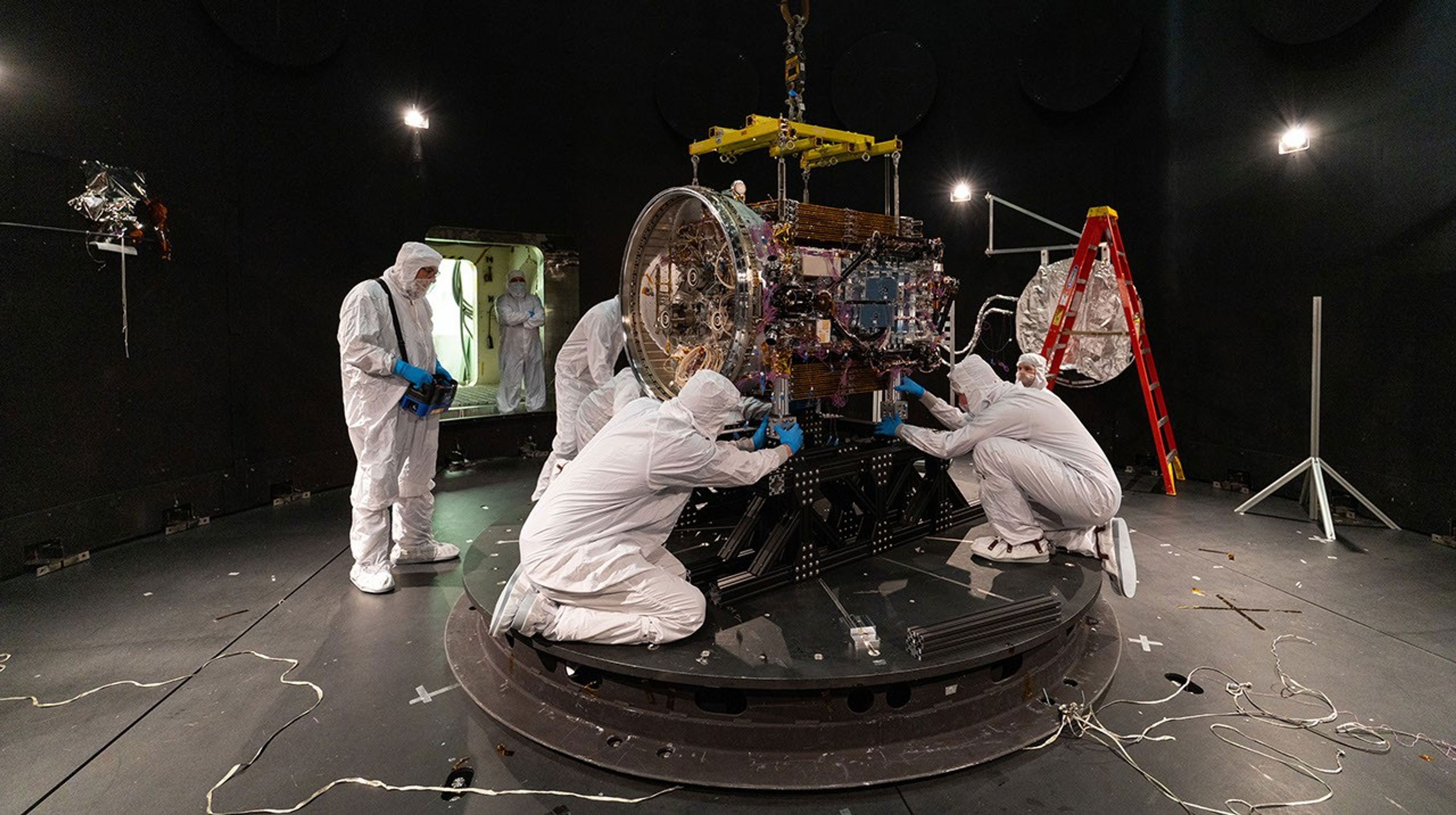
Above: Katalyst engineers attach LINK to a baseplate inside the Space Environment Simulator at NASA Goddard on Tuesday, April 28, 2026. Once all the air was pumped out of the 27-foot-diameter chamber, the team practiced firing the satellite's ion thrusters and operated one of the robotic arms while they cycled through space-like hot and cold temperatures. (NASA/Sophia Roberts)
"Swift is NASA's multitool when it comes to studying the cosmos," said S. Bradley Cenko, principal investigator, Swift, NASA's Goddard Space Flight Center in Greenbelt, Maryland. "It observes the sky using a wide range of light and rapidly points at short-lived outbursts, alerting other facilities in space and on the ground to help coordinate follow-up observations. For the last two decades, Swift has been a key player in NASA's efforts to understand how the universe works, and we're looking forward to getting back to that work after the boost is complete."
Our planet's atmosphere creates drag on all spacecraft in low Earth orbit, gradually reducing their altitudes if they don't have propulsion systems to counteract the effect.
A recent bout of increased solar activity magnified this impact on Swift, which launched in November 2004.
Rather than allowing Swift to re-enter the atmosphere as many missions do, NASA is using the opportunity to advance the U.S. commercial satellite servicing industry.
In September, the agency contracted Katalyst to attempt to boost the observatory. The company would have less than one year to design, build, test, and launch a satellite to meet, grab, and lift Swift to nearly its original orbit.
"Swift wasn't designed to be serviced," said Ghonhee Lee, CEO of Katalyst. "By demonstrating we can quickly and cost-effectively extend its lifetime, we're creating a blueprint for servicing spacecraft that were never designed for on-orbit maintenance. If we're going to build an enduring presence beyond Earth, we need the capability to manipulate our environment in space. That means deploying robotic spacecraft that can reposition, repair, refuel, and refit satellites after launch."
The LINK spacecraft weighs about 880 pounds and stands about 5 feet tall, about a third of Swift's overall size. Nearly 20 feet of solar panels will power three ion thrusters and a trio of robotic arms.
LINK completed environmental testing that mimicked launch and space-like conditions at NASA Goddard this spring, as well as additional preflight assessments at Katalyst's facility in Broomfield, Colorado.
For the boost to have its best chance of success, Swift needs to stay above an altitude of about 185 miles.
By the end of last year, however, orbital predictions generated by NASA showed the observatory reaching that threshold as early as July.
To slow Swift's descent, the operations team at Penn State's Eberly College of Science altered how they managed and oriented the spacecraft.
Unlike during normal operating procedures, where Swift looks at spots on the sky that are scientifically interesting, the team now selects targets that steer Swift into the most streamlined position. They also reduced power consumption as much as possible to place the satellite's large solar panels in a more aerodynamic orientation.
Recent orbital predictions show these changes will keep Swift above critical altitude until this fall.
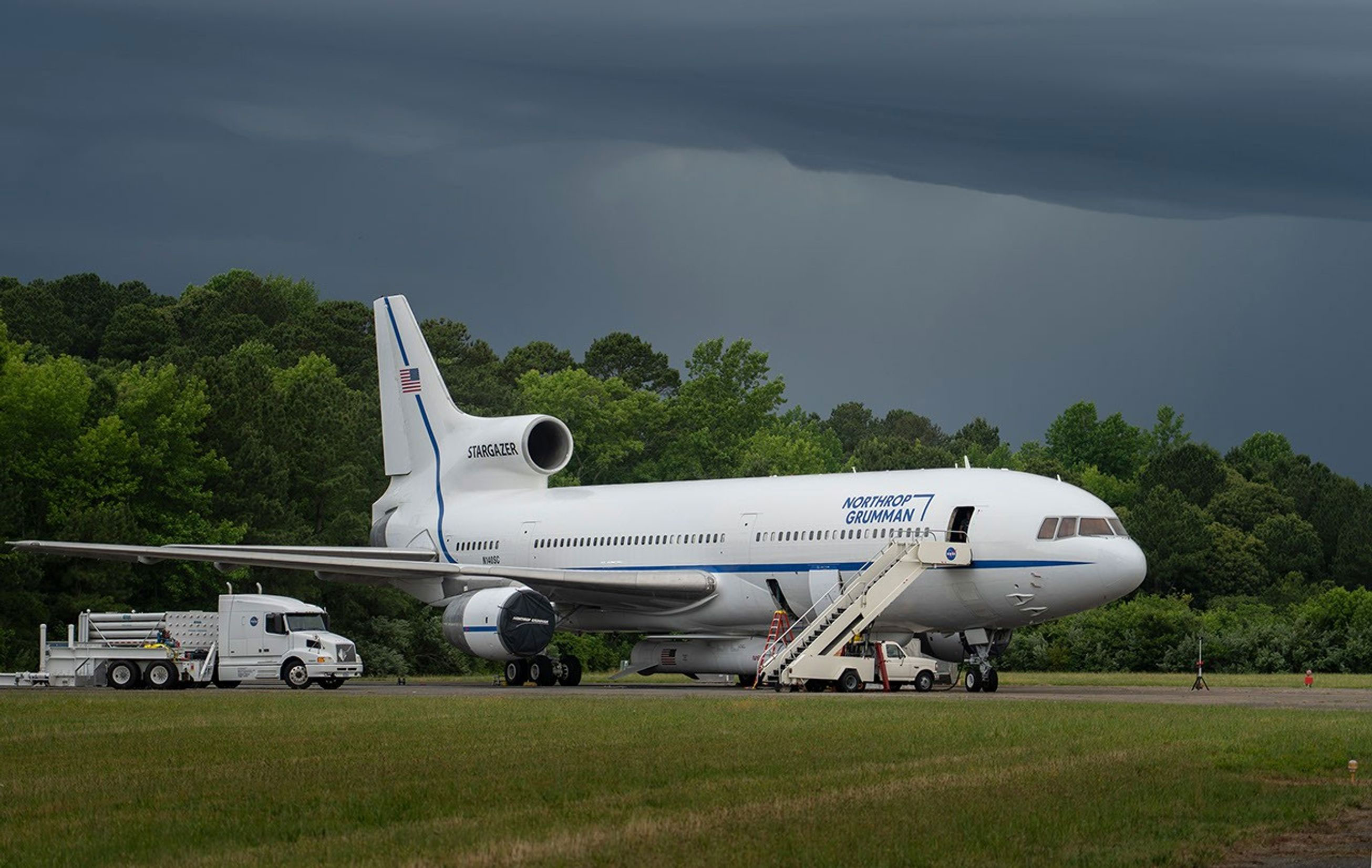
Above: Stargazer, Pegasus XL, and LINK await takeoff on Wednesday, June 17, 2026, at NASA's Wallops Flight Facility in Virginia. Engineers control the temperature and humidity inside the nose cone of the rocket to keep the satellite and avionics safe from weather and changing environmental conditions during flight. (NASA/Ron Beard)
The satellite will launch aboard the Pegasus XL.
"We can deploy Pegasus from almost anywhere in the world using our Stargazer, a modified L-1011 aircraft," said Wes Collier, vice president of launch systems at Northrop Grumman. "That combination of flexibility and responsive access to space will help LINK quickly reach Swift, giving the teams time to complete the boost."
Earlier this month, engineers loaded LINK into the Pegasus XL and attached the rocket to Stargazer at NASA's Wallops Flight Facility in Virginia. The aircraft and its payload departed for Kwajalein Atoll on Thursday, June 18, where it now awaits launch.
Once in orbit, LINK will undergo several weeks of commissioning as Katalyst evaluates the spacecraft's propulsion, navigation, and sensor systems. It then will slowly approach and survey Swift before grabbing the observatory with its robotic arms and slowly raising the orbit to nearly 370 miles.
"This is a high-risk, high-reward mission," said Shawn Domagal-Goldman, division director, Astrophysics, NASA Headquarters in Washington. "Swift plays a notable role in our fleet. We have much to gain by attempting this boost, which is more affordable than trying to replace Swift's capabilities and allows NASA to advance the nation's satellite servicing industry, for the benefit of all."
Robert Pearlman Editor
Posts: 56943 From: Houston, TX Registered: Nov 1999
posted 07-03-2026 12:01 PM
NASA release
Mission To Boost NASA's Swift Launches
A mission to raise the altitude of NASA's Neil Gehrels Swift Observatory is underway after launching at 8:36 p.m. Marshall Islands Time (4:36 a.m. EDT), Friday, July 3, from Kwajalein Atoll in the South Pacific Ocean.
LINK, a robotic servicing spacecraft built by Katalyst Space, launched into orbit on a Northrop Grumman Pegasus XL rocket, which was deployed by the company's Stargazer, a modified L-1011 aircraft, at an altitude of about 40,000 feet.
Our planet's atmosphere creates drag for spacecraft in low Earth orbit, gradually reducing their altitude if they don't have propulsion systems to maintain their positions. Recent solar activity magnified this effect on Swift, and its orbit decayed faster than anticipated.
In September, NASA contracted Katalyst to boost Swift. The company needed to design, build, test, and launch LINK and meet, grab, and lift Swift in less than a year.
Now that LINK has reached orbit, the Katalyst team's first step is to acquire a signal from the spacecraft, confirming its solar panels have deployed and the power systems are working.
Robert Pearlman Editor
Posts: 56943 From: Houston, TX Registered: Nov 1999
posted 07-03-2026 04:16 PM
NASA release
Teams Make Contact With Spacecraft Set to Boost NASA's Swift
Teams have successfully established communications with Katalyst Space's robotic servicing spacecraft LINK, which is designed to raise the orbit of NASA's Neil Gehrels Swift Observatory to a higher altitude.
Making contact with LINK was the spacecraft's first in-orbit operation, after launch and separation Friday from Northrop Grumman's Pegasus XL rocket and power-on.
Over the next several weeks, Katalyst will perform checkout procedures for LINK, including assessments of its propulsion, sensor, and navigation systems.
LINK will then approach Swift and complete a survey of the 21-year-old observatory, before capturing and lifting it over the course of several months.
Robert Pearlman Editor
Posts: 56943 From: Houston, TX Registered: Nov 1999
posted 07-30-2026 10:31 AM
NASA release
Commissioning Update for Spacecraft to Boost NASA's Swift
Over the past weekend, Katalyst's LINK servicing spacecraft experienced issues with attitude control, causing the spacecraft to spin and resulting in sporadic communications. Preliminary investigation shows that two of LINK's three reaction wheels currently are not operable, and there is some loss of functionality in its cold gas thruster system. LINK is designed to approach, capture, and boost NASA's Neil Gehrels Swift Observatory to a higher orbital altitude.
LINK's other major subsystems are functioning as expected. The spacecraft remains power positive and in communication with the Katalyst team.
The team is working to stop LINK's spin over the next few days, using the spacecraft's electric propulsion thrusters. After reestablishing stable attitude and further investigating spacecraft status, Katalyst plans to update LINK's guidance, navigation, and control to accommodate the spacecraft's new configuration. Working closely with NASA teams, they will then evaluate revised plans to approach and capture Swift, depending on safety of the approach and LINK's health.
Robert Pearlman Editor
Posts: 56943 From: Houston, TX Registered: Nov 1999
posted 08-19-2026 01:30 PM
NASA release
NASA Updates Next Steps for Commercial Swift Boost Mission
Due to an ongoing commercial spacecraft attitude control issue, NASA and Katalyst Space announced Wednesday (Aug. 19) the LINK spacecraft will not capture or boost an agency satellite to a higher altitude to extend its science mission as planned. However, LINK still will attempt to conduct rendezvous and proximity operations with NASA's Neil Gehrels Swift Observatory to demonstrate key capabilities for the future of space exploration.
"NASA should be willing to move quickly and take smart risks when the potential return is worth it, and that is exactly what we did with this mission," said NASA Administrator Jared Isaacman. "This is not the outcome we were working toward, but it does not change why this mission was worth attempting. The team moved with extraordinary speed to give Swift a chance to carry out more science while advancing capabilities America will need for satellite servicing in the future. We are going to learn everything we can from LINK's rendezvous attempt and put those lessons to work on the missions that follow."
NASA and Katalyst are working closely to assess next steps for rendezvous and gather as much data as possible to inform future satellite servicing operations.
"We knew this was a high-risk, high-reward mission – a first-of-its kind attempt, developed on an unprecedented timeline driven by the Sun's activity," said Shawn Domagal-Goldman, director, Astrophysics Division, NASA Headquarters in Washington. "We were all hoping for more science from Swift. But we knew the takeaways from this mission would be worthwhile either way, and we have gained so much through the series of accomplishments up to this point."
Without intervention, NASA anticipates Swift is likely to re-enter Earth's atmosphere later this year. As part of the agency's previous planning for Swift's end of life, NASA will continue to prioritize finding new options to react rapidly to cosmic events, using current missions to help fill the gap in the meantime.
"Building, testing, and operating this mission has already strengthened America's space industry pipeline, advancing in-space servicing capabilities in completely new ways," Domagal-Goldman said. "NASA is committed to supporting our commercial vendors as they take on difficult tasks with the agency, to push the boundaries of what's possible. We're so proud of this team for: getting to the launch pad in record time, in a record-setting year for NASA astrophysics launches; its innovative problem-solving up to this point; and the dedication to the exciting capabilities this mission will attempt to demonstrate next."







 posted 08-11-2025 06:40 PM



 advertisement