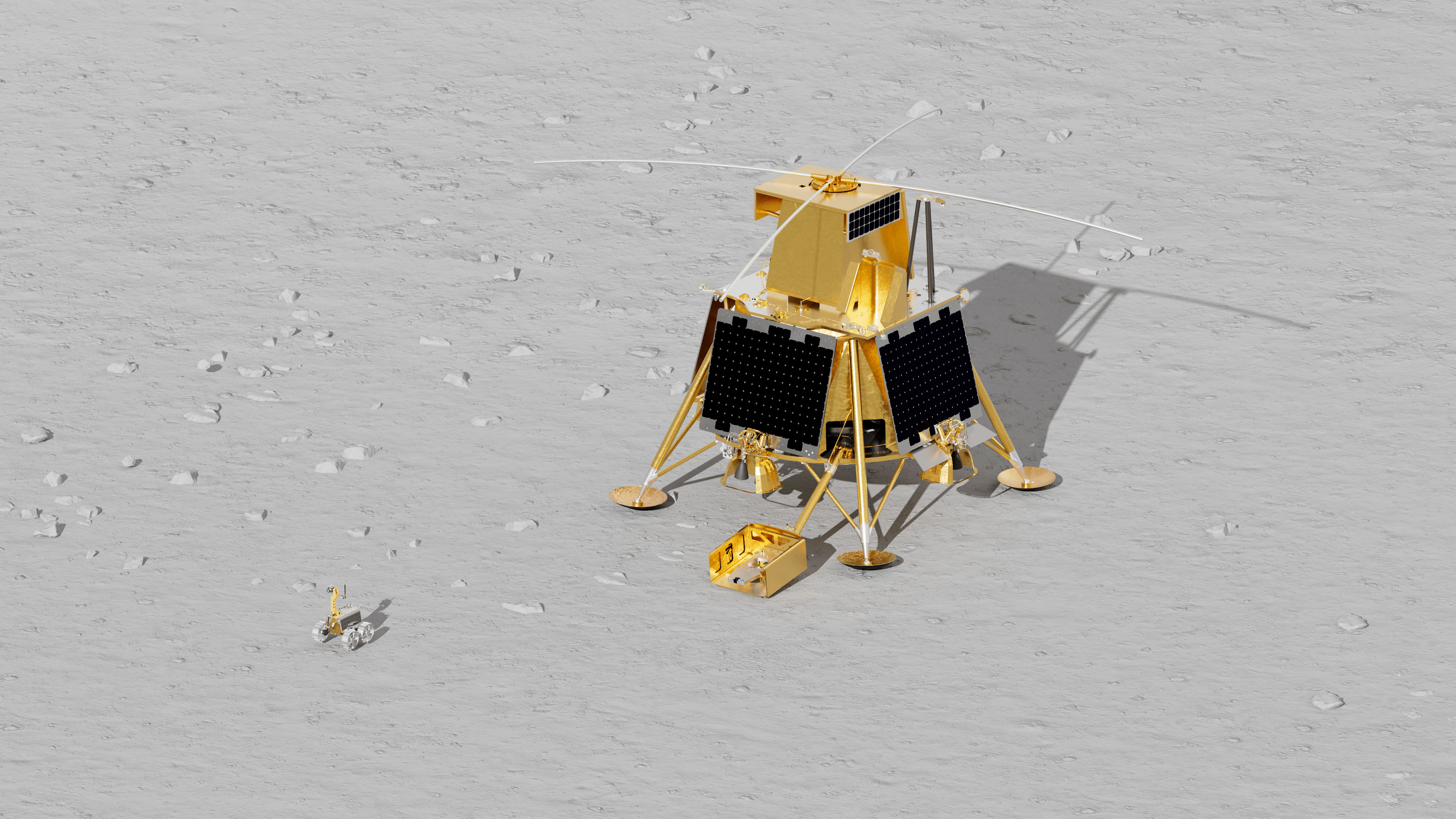
|
|

|
|
Author
|
Topic: Firefly Blue Ghost Mission 2 to the moon
|
Robert Pearlman
Editor Posts: 55629
From: Houston, TX
Registered: Nov 1999
|
 posted 03-14-2023 03:19 PM
   
NASA release NASA Picks Firefly Aerospace for Robotic Delivery to Far Side of MoonTo carry multiple payloads to the far side of the Moon including a satellite to orbit that area, NASA has selected Firefly Aerospace of Cedar Park, Texas. The commercial lander will deliver two agency payloads, as well as communication and data relay satellite for lunar orbit, which is an ESA (European Space Agency) collaboration with NASA. The contract award, for just under $112 million, is a commercial lunar delivery targeted to launch in 2026 through NASA's Commercial Lunar Payload Services, or CLPS, initiative, and part of the agency's Artemis program.  Above: Rendering of Firefly's Blue Ghost transfer vehicle deploying the European Space Agency's Lunar Pathfinder satellite to lunar orbit. ESA's Lunar Pathfinder is designed and developed by Surrey Satellite Technology Limited. ESA collaborated with NASA for delivery through the CLPS initiative. (Firefly Aerospace) This delivery targets a landing site on the far side of the Moon for the two payloads, a place that permanently faces away from Earth. Scientists consider this one of the best locations in the solar system for making radio observations shielded from the noise generated by our home planet. The sensitive observations need to take place during the fourteen earth-day long lunar night. One of these payloads delivered to the lunar surface aims to take advantage of this radio-quiet zone to make low-frequency astrophysics measurements of the cosmos – focusing on a time known as the "Dark Ages," a cosmic era that began some 370,000 years after the Big Bang and lasted until the first stars and galaxies formed. Since there is no line of sight and no direct communication with Earth from the far side of the Moon, Firefly also is required to provide communication services. "NASA continues to look at ways to learn more about our universe," said Nicola Fox, associate administrator, Science Mission Directorate at NASA Headquarters in Washington. "Going to the lunar far side will help scientists understand some of the fundamental physics processes that occurred during the early evolution of the universe." Firefly is responsible for end-to-end delivery services, including payload integration, delivery from Earth to the surface and orbit of the Moon, and NASA payload operations for the first lunar day. This is the second award to Firefly under the CLPS initiative. This award is the ninth surface delivery task award issued to a CLPS vendor, and the second to the far side. "We look forward to Firefly providing this CLPS delivery," said Joel Kearns, the deputy associate administrator for exploration in NASA's Science Mission Directorate. "This lunar landing should enable new scientific discoveries from the far side of the Moon during the lunar night. This particular group of payloads should not only generate new science but should be a pathfinder for future investigations exploiting this unique vantage point in our solar system." The three payloads slated for delivery are expected to weigh in total about 1,090 pounds (494.5 kilograms). These payloads are: - Lunar Surface Electromagnetics Experiment-Night (LuSEE-Night): A pathfinder to understand the Moon's radio environment and to potentially take a first look at a previously unobserved era in our cosmic history. It will use deployable antennas and radio receivers to observe sensitive radio waves from the Dark Ages for the first time. LuSEE-Night, is a collaboration between the Department of Energy's (DOE) Brookhaven National Laboratory, the University of California, Berkeley, Space Science Laboratory, and NASA's Science Mission Directorate. It is managed for NASA by the Planetary Missions Program Office at NASA's Marshall Space Flight Center in Huntsville, Alabama.
- Lunar Pathfinder: A communications and data relay satellite that will provide communication services to lunar missions via S-band and UHF links to lunar assets on the surface and in orbit around the Moon and an X-band link to Earth. ESA's Lunar Pathfinder is designed and developed by Surrey Satellite Technology Limited. ESA collaborated with NASA for delivery through the CLPS initiative.
- User Terminal (UT): This payload will institute a new standard for S-Band Proximity-1 space communication protocol and establish space heritage. It will be used to commission the Lunar Pathfinder and ensure its readiness to provide communications service to LuSEE-Night. It consists of software-defined radio, an antenna, a network switch, and a sample data source. UT is in development by NASA's Jet Propulsion Laboratory in Southern California.
|
Robert Pearlman
Editor Posts: 55629
From: Houston, TX
Registered: Nov 1999
|
posted 03-14-2023 04:15 PM
Firefly Aerospace release Firefly Awarded $112 Million NASA Contract for Payload Delivery to Lunar Orbit and the Far Side of the MoonFirefly Aerospace, Inc., an end-to-end space transportation company, was awarded a $112 million NASA contract to deliver multiple lunar payloads in 2026. As Firefly's second task order won under NASA's Commercial Lunar Payload (CLPS) initiative, the company will use its Blue Ghost spacecraft in a two-stage configuration to first place a satellite into lunar orbit and then deliver two research payloads on the far side of the Moon. "Our second lunar mission is something we're celebrating as a Firefly team, as a NASA commercial provider, and most importantly, as an all-American company committed to making space exploration an achievable dream for everyone," said Bill Weber, CEO of Firefly Aerospace. "This mission will debut Firefly's unique two-stage Blue Ghost spacecraft, offering NASA and other customers multiple deployment options as we collectively build the infrastructure for ongoing lunar operations and planetary exploration." The NASA-provided payloads Firefly is delivering will advance lunar research and infrastructure in conjunction with NASA's Moon-to-Mars roadmap. Before landing on the Moon, the company's Blue Ghost transfer vehicle will deploy the European Space Agency's Lunar Pathfinder satellite into lunar orbit to provide communications for future spacecraft, robots, and human explorers. After touching down on the far side of the Moon, the Blue Ghost lunar lander will deliver and operate NASA's S-Band User Terminal, ensuring uninterrupted communications for lunar exploration, and a research-focused payload that measures radio emissions to provide insight into the origins of the universe. Along with the NASA payloads, Firefly's mission is offering payload delivery and orbital services for additional government and commercial customers. The robust and versatile design of the company's Blue Ghost transfer vehicle and its propellant reserve will enable a variety of mission opportunities, including lunar sample return to Earth, further exploration to nearby planets like Mars and Venus, and long-duration orbital services, such as communications and surveying. "Firefly's ability to provide additional capabilities to multiple customers on the same mission lowers costs, further expands space exploration, and provides a win-win for everyone involved," said Jana Spruce, Vice President of Spacecraft at Firefly Aerospace. "We welcome additional partners to join us on this historic mission as our society embarks on a new era of commercial development in cislunar space and beyond." Firefly's first mission, Blue Ghost Mission 1, is on track for launch in 2024 and will deliver 10 NASA-sponsored payloads and two commercial payloads to Mare Crisium, a low-lying basin on the Moon's near side. Customers interested in payload delivery and orbital services available on Blue Ghost can find more information here. |
Robert Pearlman
Editor Posts: 55629
From: Houston, TX
Registered: Nov 1999
|
posted 12-10-2025 10:50 AM
Firefly Aerospace release Firefly Aerospace Adds Volta's Wireless Power Receiver to Blue Ghost Mission on Far Side of the MoonFirefly Aerospace today (Dec. 10, 2025) announced a new commercial payload agreement with Volta Space Technologies to host a wireless power receiver on Firefly's Blue Ghost Mission 2 lander on the far side of the Moon. The payload will serve as a technology demonstration for Volta's planned lunar power network, called LightGrid. 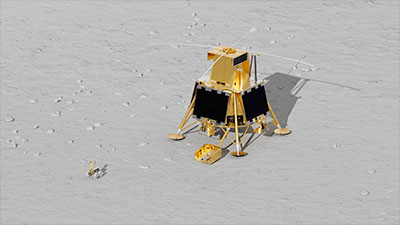 Above: Hosted onboard Firefly's Blue Ghost lander, Volta's LightPort will demonstrate technologies to survive the lunar night and support a lunar orbit power grid. "Firefly is proud to welcome Volta to our second Blue Ghost mission and serve as a core partner in the ongoing development of lunar power utilities," said Jason Kim, CEO of Firefly Aerospace. "Our international mission will enable critical technology demonstrations that lay the groundwork for lasting operations on the Moon. Longer term, our Blue Ghost landers and Elytra orbiters are well equipped to support Volta's larger vision for a lunar power network, and we look forward to seeing the evolution of our collaboration in the years ahead." Volta's planned LightGrid consists of a network of satellites in lunar orbit that collect solar energy and transmit it via laser to receivers known as LightPorts that are integrated on customer landers, rovers, and infrastructure on the Moon's surface. The Volta payload hosted on Blue Ghost Mission 2 will be used to test and validate the first LightPort, demonstrating how surface users can tap into Volta's power grid. The mission will further demonstrate how Volta's dedicated laser-receiver system can be integrated into centralized surface power generation architectures to enable local surface-to-surface power distribution and provide redundant power capabilities as the lunar ecosystem develops. "Partnering with Firefly on Blue Ghost Mission 2 is an important step forward for Volta and the future of lunar infrastructure," said Justin Zipkin, CEO of Volta. "This collaboration allows us to prove our LightPort receiver in a real lunar environment and move one step closer to delivering a fully integrated power grid for the Moon." 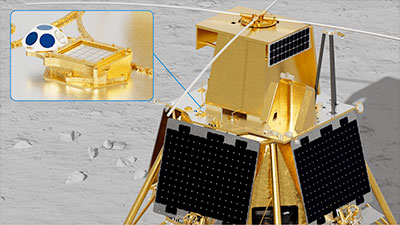 Above: Rendering of Volta's LightPort payload integrated on the top deck of Firefly's Blue Ghost lunar lander. With the addition of Volta based in Montreal, Canada, Blue Ghost Mission 2 will now carry six payloads from five different countries. Other payloads flying on Firefly's mission include NASA's LuSEE-Night radio telescope and User Terminal and the European Space Agency's Lunar Pathfinder satellite as part of Firefly's NASA Commercial Lunar Payload Services task order. Firefly also onboarded additional government and commercial payloads, including the United Arab Emirates Mohammed Bin Rashid Space Centre Rashid Rover 2 and Fleet Space Technologies' SPIDER payload. These payloads aim to provide insights into the geological properties and minerals on the Moon, enhance lunar surface mobility, improve lunar communications, and uncover new insights about the origins of the universe. Blue Ghost Mission 2 will also initiate Firefly's Ocula lunar imaging service through Firefly's Elytra Dark vehicle that is equipped with high-resolution telescopes. Elytra will first serve as a Blue Ghost transfer vehicle and communications relay for the mission and then remain operational in lunar orbit for more than five years to provide ultraviolet and visible spectrum imaging – a key capability to identify mineral deposits on the Moon's surface, map future landing sites with higher fidelity, and enable cislunar situational awareness. Qualification testing for the fully stacked Blue Ghost and Elytra spacecraft structure is well underway for Blue Ghost Mission 2. The team has also begun assembling flight hardware and has accepted and tested a majority of the payloads at Firefly's spacecraft facility. | |
Contact Us | The Source for Space History & Artifacts
Copyright 1999-2025 collectSPACE. All rights reserved.

Ultimate Bulletin Board 5.47a
|
|
|
 advertisement advertisement
|