Space News
space history and artifacts articles

Messages
space history discussion forums

Sightings
worldwide astronaut appearances

Resources
selected space history documents

  collectSPACE: Messages
  Satellites - Robotic Probes
  OSIRIS-APEX extended mission to Apophis

Post New Topic  Post A Reply
profile | register | preferences | faq | search

next newest topic | next oldest topic
Author Topic:   OSIRIS-APEX extended mission to Apophis
Robert Pearlman
Editor

Posts: 55560
From: Houston, TX
Registered: Nov 1999

posted 04-25-2022 02:03 PM     Click Here to See the Profile for Robert Pearlman   Click Here to Email Robert Pearlman     Edit/Delete Message   Reply w/Quote
University of Arizona release
NASA gives green light for OSIRIS-REx spacecraft to visit another asteroid

The extended mission, dubbed OSIRIS-APEX, will study the near-Earth asteroid Apophis, which will have a close encounter with Earth in 2029.

NASA's OSIRIS-REx spacecraft will swing by Earth to deliver a sample from asteroid Bennu on Sept. 24, 2023. But it won't clock out after that.

Above: This is an artists illustration of the OSIRIS-REx spacecraft firing thrusters near the surface of the asteroid Apophis. (University of Arizona/Heather Roper)

NASA has extended the University of Arizona-led mission, which will be renamed OSIRIS-APEX, to study near-Earth asteroid Apophis for 18 months. Apophis will make a close approach to Earth in 2029.

The University of Arizona will lead the mission, which will make its first maneuver toward Apophis 30 days after the OSIRIS-REx spacecraft delivers the sample it collected from Bennu back in October 2020. At that point, the original mission team will split – the sample analysis team will analyze the Bennu sample, while the spacecraft and instrument team transitions to OSIRIS-APEX, which is short for OSIRIS-Apophis Explorer.

Regents Professor of Planetary Sciences Dante Lauretta will remain principal investigator of OSIRIS-REx through the remaining two-year sample return phase of the mission. Planetary sciences assistant professor and OSIRIS-REx deputy principal investigator Dani DellaGiustina will then become principal investigator of OSIRIS-APEX. The extension adds another $200 million to the mission cost cap.

The mission team did an exhaustive search for potential asteroid targets. The OSIRIS-REx spacecraft was built for what's called a rendezvous mission, meaning instead of making a single flyby of an object and quickly snapping images and collecting data, it was designed to "get up close and personal with the object." DellaGiustina said. "Our spacecraft is really phenomenal at that."

"Apophis is one of the most infamous asteroids," DellaGiustina said. "When it was first discovered in 2004, there was concern that it would impact the Earth in 2029 during its close approach. That risk was retired after subsequent observations, but it will be the closest an asteroid of this size has gotten in the 50 or so years asteroids have been closely tracked, or for the next 100 years of asteroids we have discovered so far. It gets within one-tenth the distance between the Earth and moon during the 2029 encounter. People in Europe and Africa will be able to see it with the naked eye, that's how close it will get. We were stoked to find out the mission was extended."

OSIRIS-REx was launched in 2016 to collect a sample from Bennu that will help scientists learn about the formation of the solar system and Earth as a habitable planet. OSIRIS-REx is the first NASA mission to collect and return a sample from a near-Earth asteroid.

OSIRIS-APEX will not collect a sample, but when it reaches Apophis, it will study the asteroid for 18 months and collect data along the way. It also will make a maneuver similar to the one it made during sample collection at Bennu, by approaching the surface and firing its thrusters. This event will expose the asteroid's subsurface, to allow mission scientists to learn more about the asteroid's material properties.

The scientists also want to study how the asteroid will be physically affected by the gravitational pull of Earth as it makes its close approach in 2029.

They also want to learn more about the composition of the asteroid. Apophis is about the same size as Bennu – nearly 1000 feet at its longest point – but it differs in what's called its spectral type. Bennu is a B-type asteroid linked to carbonaceous chondrite meteorites, whereas Apophis is an S-type asteroid linked to ordinary chondrite meteorites.

"The OSIRIS-REx mission has already achieved so many firsts and I am proud it will continue to teach us about the origins of our solar system," said University of Arizona President Robert C. Robbins. "The OSIRIS-APEX mission extension keeps the University of Arizona in the lead as one of the premier institutions in the world to study small bodies with spacecraft and demonstrates again our incredible capacity in space sciences."

DellaGiustina is also excited that the mission provides an excellent opportunity for early career scientists to gain professional development. OSIRIS-REx veterans will work closely with these early career scientists as mentors in the early mission phases. By the time the spacecraft arrives at Apophis, the next generation will step into leadership roles on OSIRIS-APEX.

"OSIRIS-APEX is a manifestation of a core objective of our mission to enable the next generation of leadership in space exploration. I couldn't be prouder of Dani and the APEX team," Lauretta said. "Dani first started working with us in 2005 as an undergraduate student. To see her take on the leadership of the mission to asteroid Apophis demonstrates the outstanding educational opportunities at the University of Arizona."

Robert Pearlman
Editor

Posts: 55560
From: Houston, TX
Registered: Nov 1999

posted 09-24-2023 08:25 AM     Click Here to See the Profile for Robert Pearlman   Click Here to Email Robert Pearlman     Edit/Delete Message   Reply w/Quote
NASA release
OSIRIS-REx spacecraft departs for new mission

NASA’s OSIRIS-REx spacecraft completed its final task for this mission when it released its sample capsule toward Earth on Sunday (Sept. 24). About 20 minutes after doing so, the spacecraft fired its engines to divert past Earth toward its new mission to asteroid Apophis and was renamed OSIRIS-APEX.

Roughly 1,000 feet wide, Apophis will come within 20,000 miles of Earth – less than one-tenth the distance between Earth and the moon – in 2029. OSIRIS-APEX is scheduled to enter orbit of Apophis soon after the asteroid’s close approach of Earth to see how the encounter affected the asteroid's orbit, spin rate and surface.

Robert Pearlman
Editor

Posts: 55560
From: Houston, TX
Registered: Nov 1999

posted 11-26-2025 08:30 AM     Click Here to See the Profile for Robert Pearlman   Click Here to Email Robert Pearlman     Edit/Delete Message   Reply w/Quote
University of Arizona release
OSIRIS-APEX spacecraft takes selfie with Earth during flyby

After successfully scooping up a sample from asteroid Bennu and sending it to Earth for study in 2023, NASA's OSIRIS-REx spacecraft became OSIRIS-APEX and was tasked with a new mission: study asteroid Apophis, another near-Earth asteroid that could pose a threat as a potential impactor of Earth far in the future.

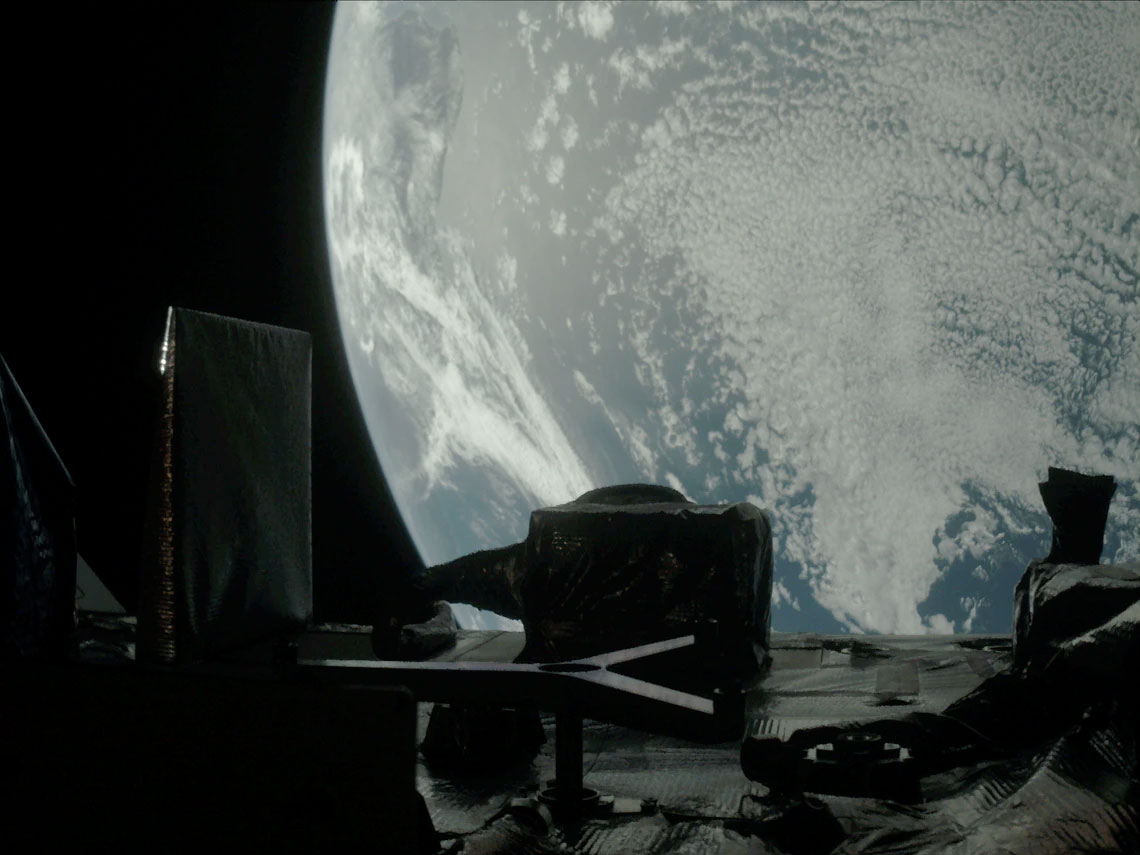
Above: On the left, this image shows SamCam, provided by the U of A to track the spacecraft’s sample head during its primary mission. The Y-shaped sample return capsule release mechanism is visible in the center in its deployed position. The OSIRIS-REx Laser Altimeter, provided by the Canadian Space Agency to create detailed 3D topographical maps of Bennu, is behind the release mechanism. To the right, one of the spacecraft's two navigation cameras, or NavCams, is visible. (NASA/Goddard/University of Arizona/Lockheed Martin)

On Sept. 23, the OSIRIS-APEX (Origins, Spectral Interpretation, Resource Identification, and Security – Apophis Explorer) spacecraft swung by Earth within 2,136 miles (3,438 kilometers) before heading into deep space for another trip around the sun. This so-called Earth gravity assist – the first of three such maneuvers planned for the remainder of the mission – is essential to ensure the spacecraft will rendezvous with Apophis in 2029.

During its approach and as it passed Earth, OSIRIS-APEX looked home using its suite of three cameras, built at the University of Arizona Lunar and Planetary Laboratory, to capture images and data of our planet to help calibrate its instruments.

The maneuver is not only critical for getting the spacecraft to its target but also ensures it will be ready for the research operations it is tasked with once it gets to Apophis, according to the mission's principal investigator, Dani Mendoza DellaGiustina, an assistant professor at LPL.

Above: About nine hours after its closest approach, OSIRIS-APEX took this image of Australia and the Pacific Ocean from about 142,000 miles away on Sept. 24. This color composite combines six images from the MapCam imager, which is part of the OSIRIS-REx Camera Suite, or OCAMS, operated by the University of Arizona. (NASA/Goddard/University of Arizona)

"This is not just about cool pictures, but about collecting data and important science milestones," she said. "Most importantly, the fly-by offered a rare opportunity for us to calibrate our instruments."

The robot geologist that is OSIRIS-APEX has been through a lot since its encounter with Bennu – from punching the asteroid to enduring cycles of heating and cooling each time the spacecraft swung around the sun and back into cooler regions of space.

"It is very important for the science team to understand how its history has affected the instruments since it was built and launched," DellaGiustina said. "When it touched down on Bennu, the spacecraft got pretty dusty, and some of that dust settled on instrument lenses. One of our most important tasks is to recalibrate our instruments and make sure they're ready to take measurements at Apophis."

An unexpected boon

Since the imaging suite on the OSIRIS-REx spacecraft was designed for its primary mission – studying asteroid Bennu, one of the darkest objects in the solar system – the fine layer of dust acquired during the sample acquisition provides an unexpected boon to its upcoming observation campaign at Apophis, DellaGiustina said.

"Now we're going to an object that's about 10 times brighter," she said. "So the dust actually benefits us in some ways, in that it just sort of darkens everything a little bit. (With the data acquired during the flyby), we can quantify that effect and figure out how exactly we're going to adjust some of our instrument settings accordingly."
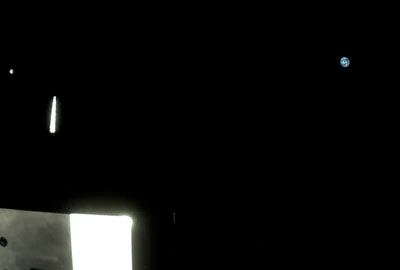
Above: OSIRIS-APEX was about 370,000 miles from Earth when it captured this view of the moon (on the far left) and Earth (on the far right) on Sept. 24, 2025. Sunlight reflects off the spacecraft’s instruments in the foreground. (NASA/Goddard/University of Arizona/Lockheed Martin)

During its cruise period, between sample return and its rendezvous with Apophis, the spacecraft spends a total of six years transiting the inner solar system. Most of the time, it flies through empty space, far away from any celestial bodies. However, the spacecraft makes several close passes by Earth to steer it towards Apophis.

"We have done three Earth gravity slingshots, and we have two more to go," DellaGiustina said. "Each of those maneuvers is targeted to do something slightly different."

A slingshot is a rare opportunity to use an object – in this case, Earth and the moon – to fill the frame of the spacecraft's imaging instruments. In addition to a suite of cameras, these also include spectrometers – detectors designed not to record images, but to analyze light signatures that offer clues about the chemical and physical makeup of whatever they are pointed at. While the team can use stars to perform at least some degree of the necessary calibrations, spectral instruments require an object to fill the frame.

"We only have two more opportunities to get so close to an object before we arrive at Apophis – in this case, Earth – that it actually fills the fields of view of the spot spectrometers, so this most recent one is the chance that we have to understand if and how their behavior has changed," she said.

Other changes in the spacecraft's configuration result from the actions performed as part of its previous mission. During the spacecraft's primary mission, the StowCam instrument was used to verify that the sample material from asteroid Bennu was safely stowed in the sample return capsule for the journey back to Earth. No longer obstructed by the capsule, StowCam now provides a view of the instrument panel. StowCam also collected imagery as OSIRIS-APEX approached and departed from Earth.

Valuable opportunities

Earth flybys present valuable opportunities for the OSIRIS-APEX mission team, which consists both of OSIRIS-REx veterans and new members, to get up to speed performing operational and observational tasks and brush up on skills during an otherwise uneventful cruise phase, DellaGiustina explained.

"This is their opportunity to begin training in the processes and procedures that we will use to observe our target, and while it's not Apophis in this case, we're using a lot of the same software," she said. "We also have to build certain sequences to have the instruments acquire data, and we're working through all those processes. There is a lot of stuff we haven't done in quite a while.

"The bottom-line is we have a healthy, happy spacecraft," she added. "It survived the perihelion passages and everything indicates it's in great shape. We have incredible data coming in from the spacecraft, pulling off this set of observations was a lot of work done by a pretty small number of people, and so to see everything be such a success, is really satisfying."

All times are CT (US)

next newest topic | next oldest topic

Administrative Options: Close Topic | Archive/Move | Delete Topic
Post New Topic  Post A Reply
Hop to:

Contact Us | The Source for Space History & Artifacts

Copyright 1999-2025 collectSPACE. All rights reserved.


Ultimate Bulletin Board 5.47a


advertisement