Ken Havekotte
Member Posts: 4043
From: Merritt Island, Florida, Brevard
Registered: Mar 2001
|
 posted 03-25-2026 08:04 PM
   
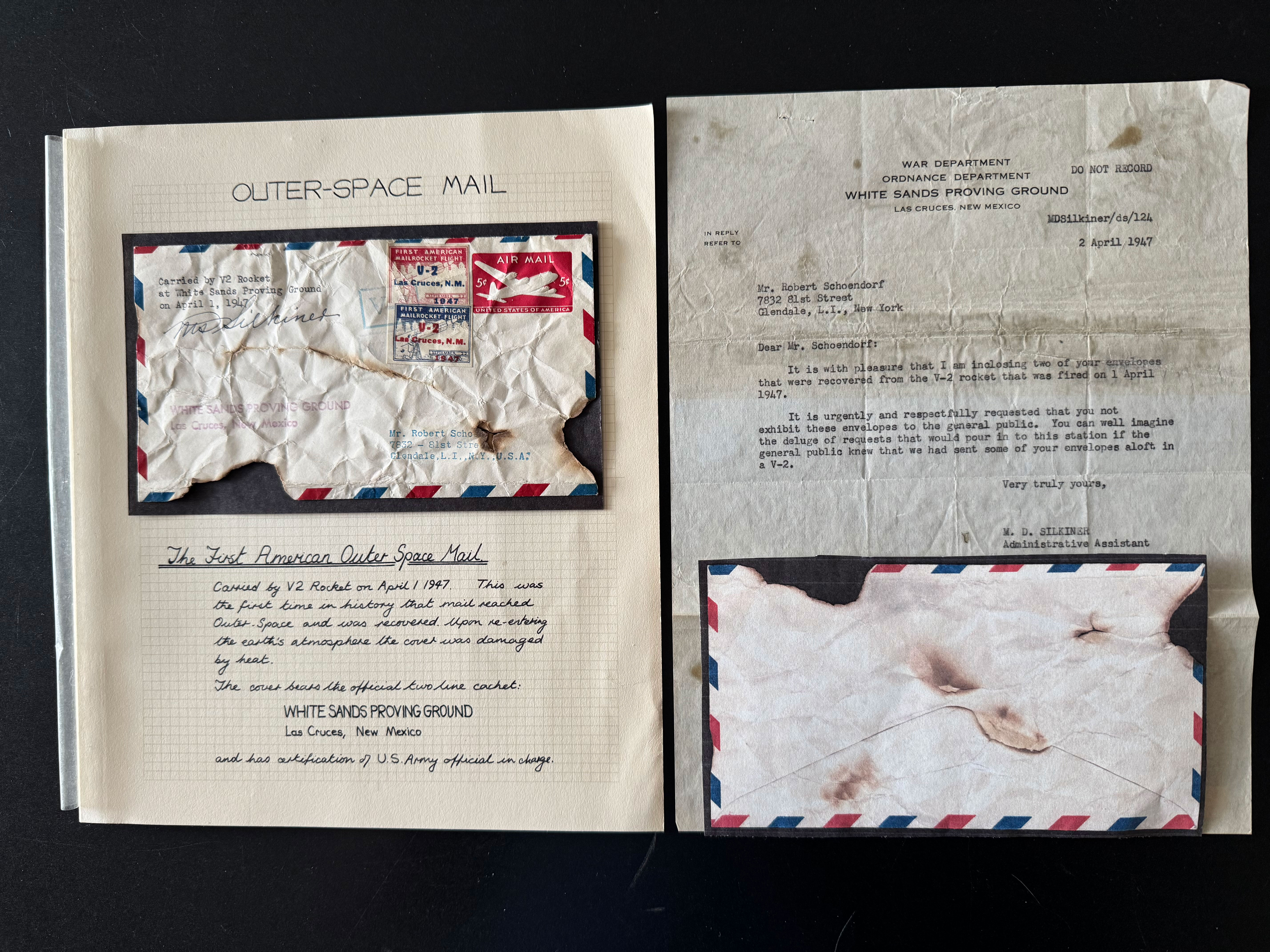
Finally at last one of two historic covers have surfaced this month relating to the early missile and rocket development era of post-world war 1940's. It would be nearly eight decades that such a "holy grail" cover would come to light.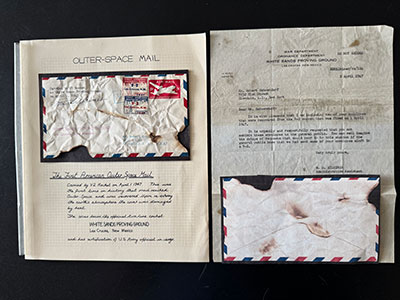 After receiving an exciting email by a Swiss philatelic expert early this month, it became possible in having an opportunity to acquire one of those elusive flown V-2 airmail covers without being in an auction. It was for V-2 Flight #22 that flew from the old White Sands Proving Ground (WSPG), New Mexico, on April 1, 1947 (See Space Cover of the Week 39).
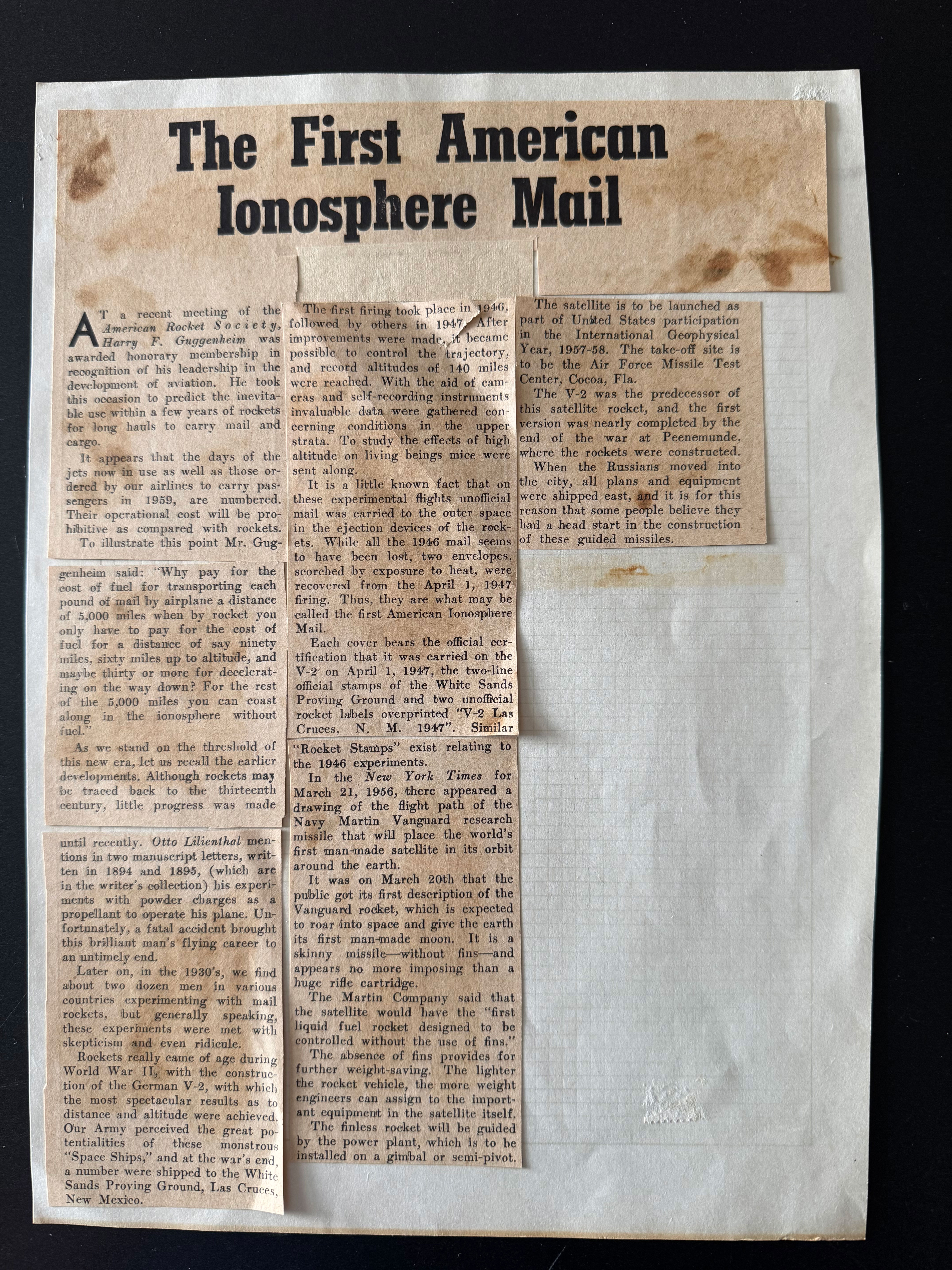
For now, to make a long story short, the flown V-2 cover is only one of two that became the first rocket mail to reach outer space. Aviation pioneer Harry Guggenheim, a distinguished American that provided research grants to U.S. rocket pioneer Robert Goddard, said during a meeting of the American Rocket Society in 1956 that he supported this advanced new era of rocket mail possibilities, of which, never came to be. The article in Stamps Magazine goes on to verify that the same two covers were indeed the first ionosphere mail to reach outer space. As to the captured German-made V-2 rockets by the Soviets after World War II, the Russians did not start test flying V-2's until October 1947. So the Americans were the first to actually reach outer space six months before. The ionosphere, located about 30 to 600+ miles above the earth's surface, is an ionized part of the upper atmosphere that serves as a boundary between earth's neutral atmosphere and space itself. 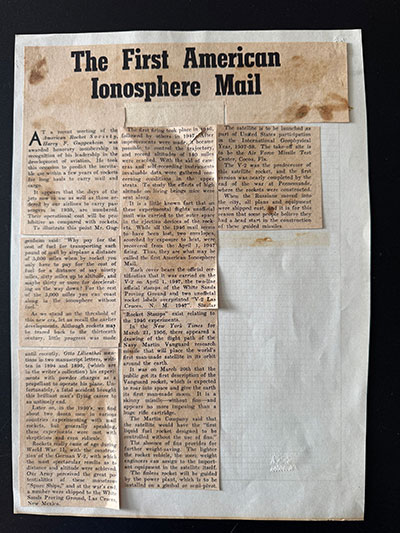 As reported earlier, some V-2 rocket mail did fly in October 1946 from White Sands. They never survived the rigors of supersonic rocket travel when being destroyed by an intense fiery explosion from a hard nose-dive landing in the Chilhuahuan Desert of southern New Mexico.
V-2 rocket flight #22 with two mail covers aboard was a nominal flight reaching just over 80 miles high with a range of 24 miles. Engine burn time was almost a minute into the flight. Once reaching a speed of over March 4, it became like a suborbital ballistic missile, as it starts its return back to earth. Right before impact, the rocket's speed had been significantly slower, but still supersonic at 1,800 mph when it hit the desert ground falling back from space.
When the twin covers were located in the rocket's instrumentation or equipment bay of the nose cone area after flight, they both had been damaged and engulfed by impact heat exposure. But amazingly enough, when recovered, both covers did survive with some scorched heat markings and burned-off envelope cover edges.
To help more with their authenticity, note the letter mailed to avid rocket mail collector Robert Schoendorf of Glendale, Long Island, New York. It was sent from the War Department's Ordnance division at WSPG at Las Cruces, NM, on April 2, 1947. The typewritten letter, believed to be an original, was addressed to Schoendorf with the following text: It is with pleasure that I am inclosing two of your envelopes that were recovered from the V-2 rocket that was fired on 1 April 1947. It is urgently and respectfully requested that you not exhibit these envelopes to the general public. You can well imagine the deluge of requests that would poor into this station if the general public knew that we had sent some of your envelopes aloft in a V-2. Very truly yours, M. D. Silkiner, Administrative Assistant. The burnt covers have also been recorded in rocket mail transport history catalogs (EZ) throughout Europe, the U.S., and other rocket mail bearing countries. Famed rocket mail collector Walter Hopferwieser of Germany may wish to add further to this topic with some new background and recent information. |








 advertisement