advertisements advertisements
|

|
US Postal Service returns to deep space for 2026 Priority Mail stamps
December 13, 2025 — Given its latest pair of stamps revealed for the new year, maybe the U.S. Postal Service should consider relabeling its expedited deliveries as "interstellar."
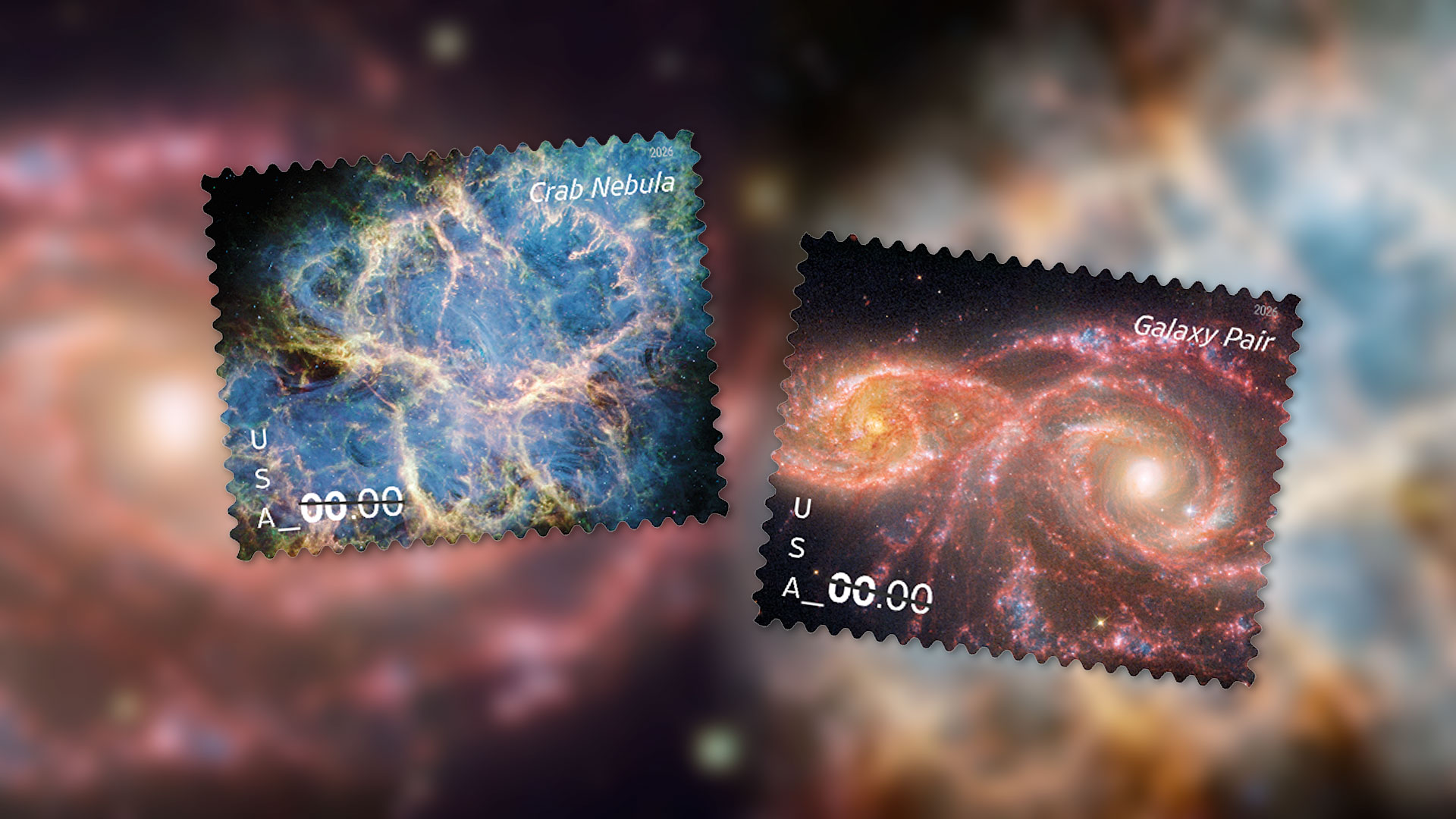
For the third year in a row, Priority Mail stamps in 2026 will feature images of the universe as captured by orbiting observatories. The Priority Mail and Priority Mail Express postage depict views of the Crab Nebula and a galaxy pair, respectively.
"[These] new Priority Mail [and] Priority Mail Express stamps celebrate America's continued exploration of deep space with breathtaking images captured by NASA's James Webb Space Telescope," the USPS revealed on Friday (Dec. 12).
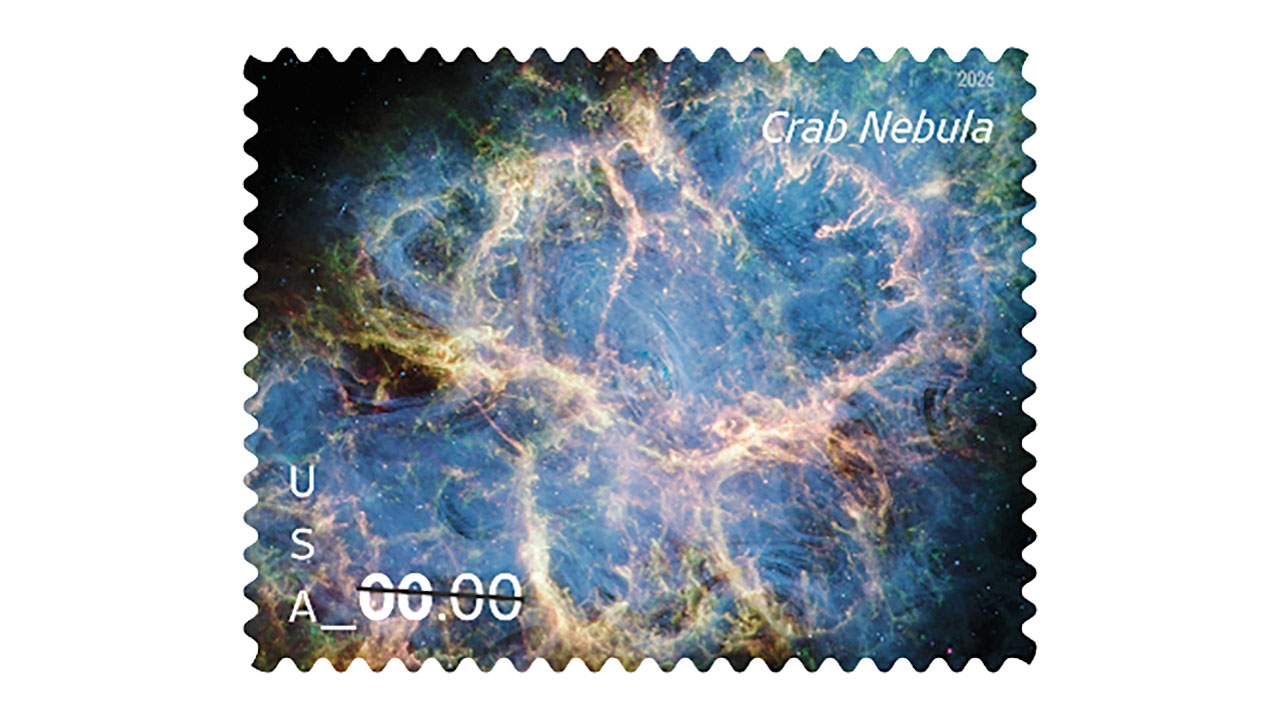
Domestic Priority Mail packages are delivered within one to three business days, according to the postal service. By comparison, the vision of the Crab Nebula on the 2026 Priority Mail postage stamp took 6,500 light years to reach Earth and has been available for use since 2023 when NASA originally released the image.
"Webb's sensitivity and spatial resolution allow us to accurately determine the composition of the ejected material, particularly the content of iron and nickel, which may reveal what type of explosion produced the Crab Nebula," said Tea Temim at Princeton University, who led the team that used the telescope's Near-Infrared Camera (NIRCam) and Mid-Infrared Instrument (MIRI) to learn more about the nebula's origins.
In the infrared observation, what NASA describes as a "crisp, cage-like structure of fluffy gaseous filaments" is rendered in a red-orange hue. In the central regions of the nebula, yellow-white and green emissions from dust grains were mapped out by Webb for the first time.
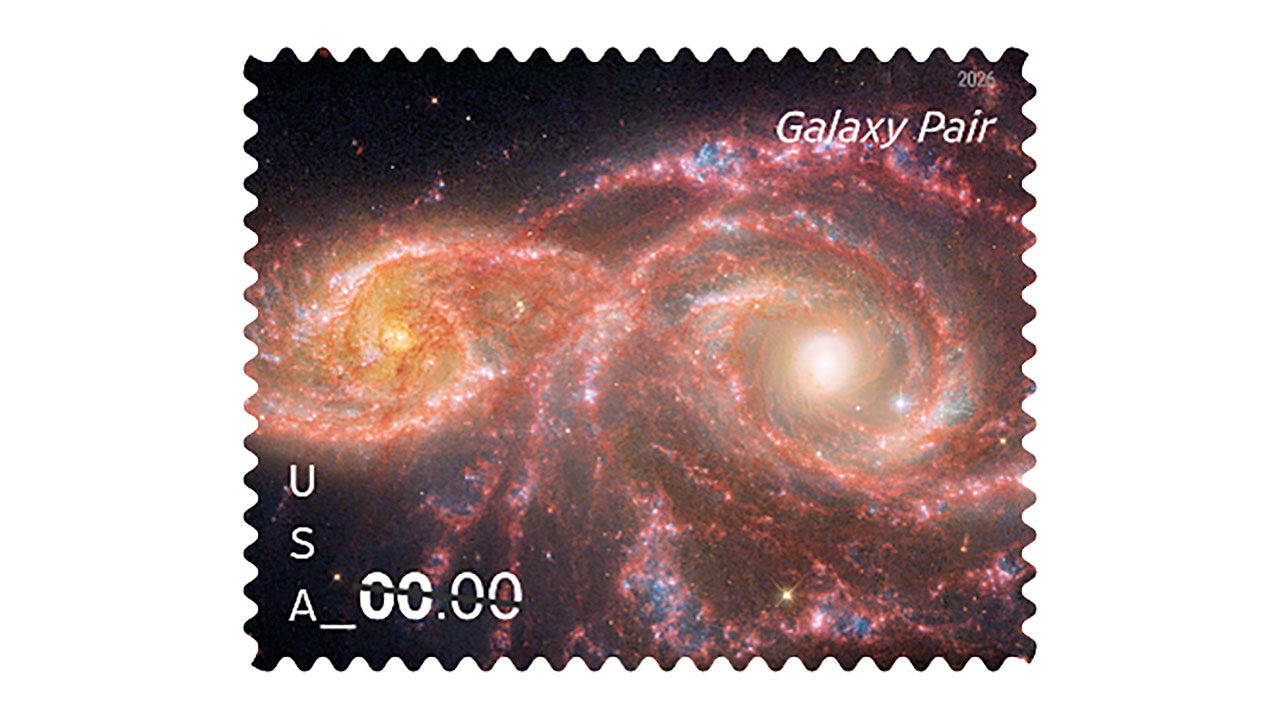
Priority Mail Express is the USPS's fastest service, offering one to three day delivery (including Sundays and holidays), which may explain why two galaxies "passing in the night" was chosen for the rate's 2026 postage stamp. A composite, which uses the mid-infrared light from Webb and the visible and ultraviolet light from the Hubble Space Telescope, the "Galaxy Pair" depicts the smaller spiral IC 2163 passing behind NGC 2207, the spiral galaxy at right, millions of years ago.
Looking even more closely at the vista, bright red lines may indicate where material from the two galaxies may have slammed together. The scene, which NASA featured online in 2024, is located some 80 million light years from Earth.
Greg Breeding, an art director for the USPS, selected the NASA photos for the new issues, as he did for the 2024 ("Pillars of Creation" and "Cosmic Cliffs") and 2025 ("Spiral Galaxy" and "Star Cluster") stamps. The Webb was also the subject of a 2022 Forever denomination stamp that featured an artist's rendering of the deployed observatory in deep space.
A release date for the two 2026 stamps is pending the approval of the Postal Regulatory Commission of new Priority Mail and Priority Mail Express Flat Rate Envelope rates. The change, as proposed by the USPS, would raise prices by about 6.6 percent for Priority Mail and 5.1 percent for Priority Mail Express, up from the 2025 prices of $10.10 and $31.40 per postage stamp, respectively. |
|
The U.S. Postal Service 2026 Priority Mail postage stamp features a Webb Space Telescope image of the Crab Nebula. (USPS)
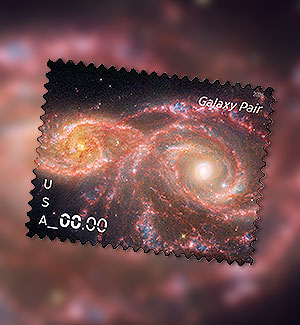
The U.S. Postal Service 2026 Priority Mail Express stamp features a Webb Space Telescope image of a "Galaxy Pair." (USPS) |
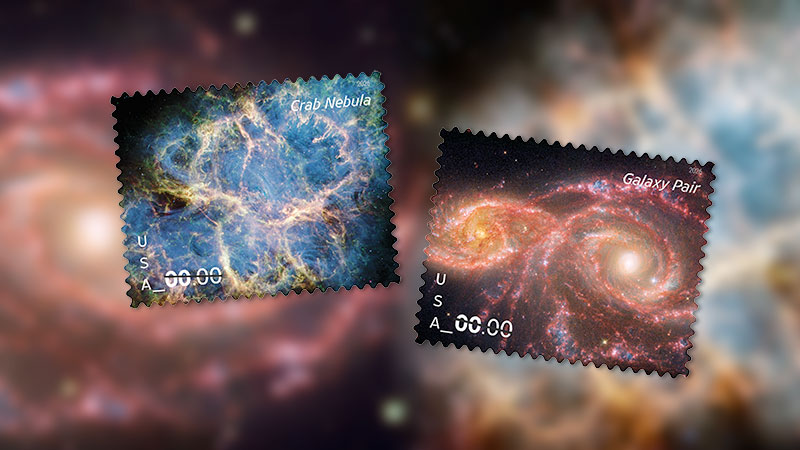
The USPS will issue Priority Mail stamps in 2026 with images by the Webb Space Telescope. (NASA, ESA, CSA, STScI; montage by collectSPACE) |
|

© collectSPACE. All rights reserved.
|
|
|
|