Space Newsspace history and artifacts articlesMessagesspace history discussion forumsSightingsworldwide astronaut appearancesResourcesselected space history documents
advertisements
Perseverance rover sets record for distance driven on another world
October 13, 2026
— A newly-surpassed planetary exploration record places into perspective that not all distances logged off-Earth are astronomically large.
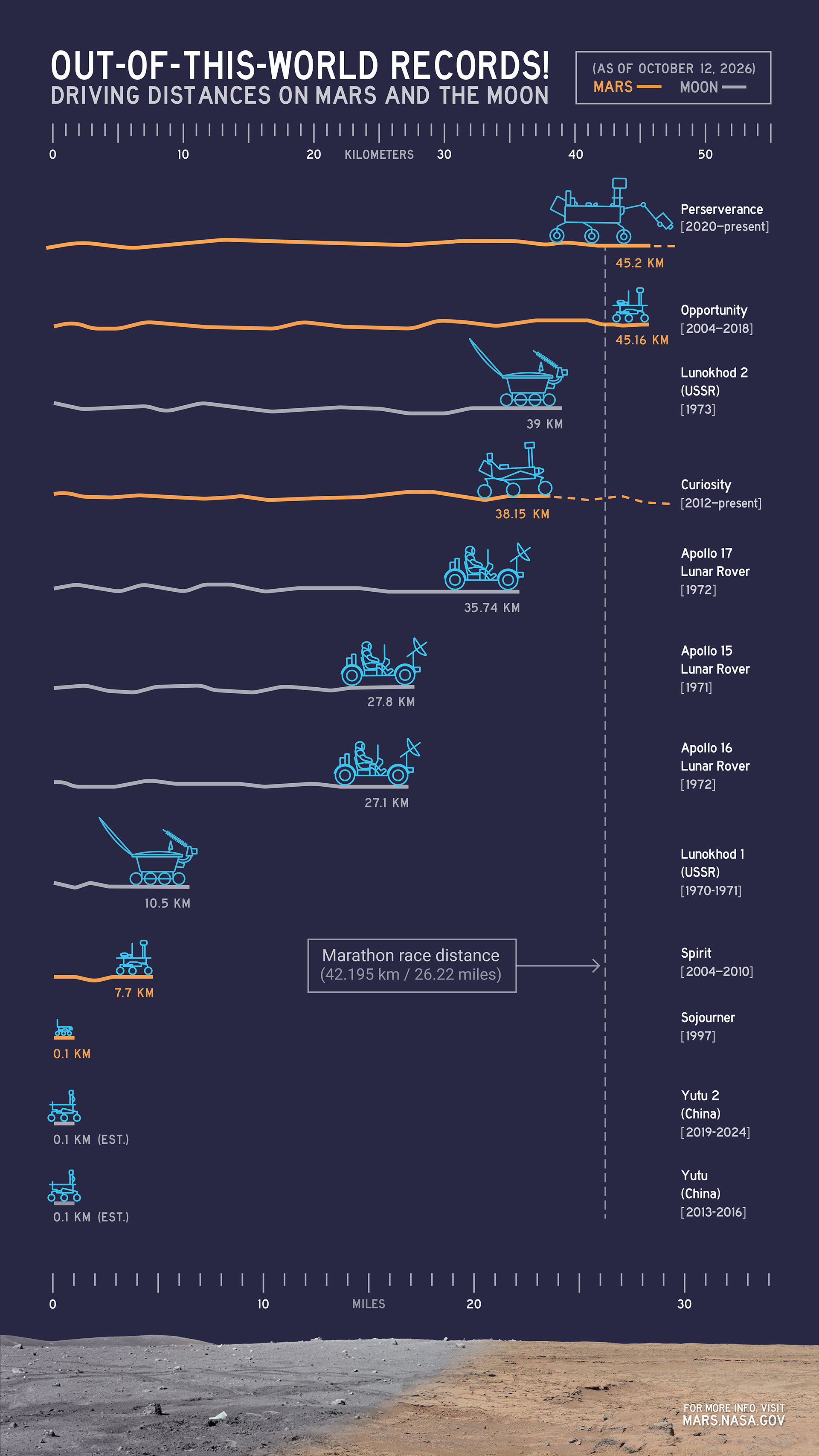
NASA's Perseverance Mars rover has now driven farther than any other vehicle on the surface of another world. The six-wheeled robotic explorer rolled past the earlier distance record set by its smaller predecessor, Opportunity, on Oct. 11.
Perseverance's odometer reached 28.10 miles (45.22 kilometers), taking the lead.
By Earthly standards, a vehicle with less than 30 miles would be considered anything but well-traveled. It is not uncommon for people to cover that same distance on a "quick trip" in their car to a convenience store, let alone on their daily commute to their place of work.
Perseverance, in contrast, reached its milestone mile on its 2,006th Martian day, or sol, of its mission, covering in five and a half years a distance that took Opportunity almost 15. The older rover explored Mars from 2004 to 2018. Perseverance landed inside Jezero Crater three years after Opportunity came to a stop on the western rim of Endeavour Crater.
Perseverance's relative fast pace is largely a result of its self-driving capability. The larger, newer rover has driven more than 90 percent of its total distance using its onboard AutoNav system to assess the terrain ahead, compared with about five percent for the first AutoNav employed by Opportunity and its twin, Spirit. And unlike the earlier models, Perseverance's AutoNav can "think while driving" at near its top speed covering as much as 1,351 feet (412 meters) in a single day.
At the time it rolled past the Opportunity record, Perseverance was traveling to an area called "Idubi" through the region off the western rim of Jezero Crater nicknamed "Lac de Charmes." There, the rover is investigating what may be some of the oldest terrain ever explored in the solar system.
"It is an honor to be working on Perseverance at a moment when the technology has evolved to the point that drives like these are routine," said Steven Lee, the project manager of the Curiosity and Perseverance rovers at NASA's Jet Propulsion Laboratory, iin a statement. "The original mission called for no more than 12.4 miles of driving. We've blown well past that, and with all mobility systems fully operational and favorable extended-ground-life test results, we expect Perseverance to keep adding to this record for many years to come."
Perseverance's first mission extension began this month, continuing its traverse along Jezero's rim through to the end of 2028.
"Given the autonomy to just go, Perseverance is a better driver than the one that landed, and we're not done," said Mark Maimone, deputy team chief for robotic operations on Perseverance. "Our newest software teaches Perseverance to steer less and roll more, and to check its own position against orbital maps mid-drive."
"The next frontier is sunlight itself. Glare in the navigation cameras is why we park by mid-afternoon if we're driving toward the Sun, and if we can teach the rover to see past those artifacts, every rover that follows gets a longer working day," said Maimone.
In third place behind Opportunity is the former Soviet Union's Lunokhod 2 rover, which logged its distance record on the moon. The second of two uncrewed lunar rovers launched by Russia, Lunokhod 2 traveled 24.2 miles (39 km) in less than five months, from January to May 1973, based on an analysis of the rover's tracks as seen by NASA's Lunar Reconnaissance Orbiter decades later.
Perseverance's fellow Mars Science Laboratory (MSL), Curiosity, is nearing the Lunokhod record, currently trailing by only half a mile (0.85 km). Then comes the three lunar roving vehicles that U.S. astronauts drove on the moon during the Apollo 15, 16 and 17 missions.
Gene Cernan and Harrison Schmitt, the last two people to walk on the moon to date, drove 22.2 miles (35.7 kilometers) in December 1972.
Bringing up the rear on the chart of driving distances on Mars and the moon are Lunokhod 1 at 6.5 miles (10.2 km), NASA's Spirit and Sojourner Red Planet rovers at 4.8 miles (7.7 km) and 0.06 miles (0.1 km) respectively, and China's two Yutu lunar rovers, which have roved the moon for less than a mile (an estimated 0.1 km) each, according to NASA.
NASA infographic illustrating the distances driven by rovers on the surface of the moon and Mars. Of the vehicles represented, the Mars rovers Perseverance and Curiosity are still operational and are moving across the surface; the figures shown for those two are distances driven as of Oct. 11, 2026. (NASA/JPL-Caltech)
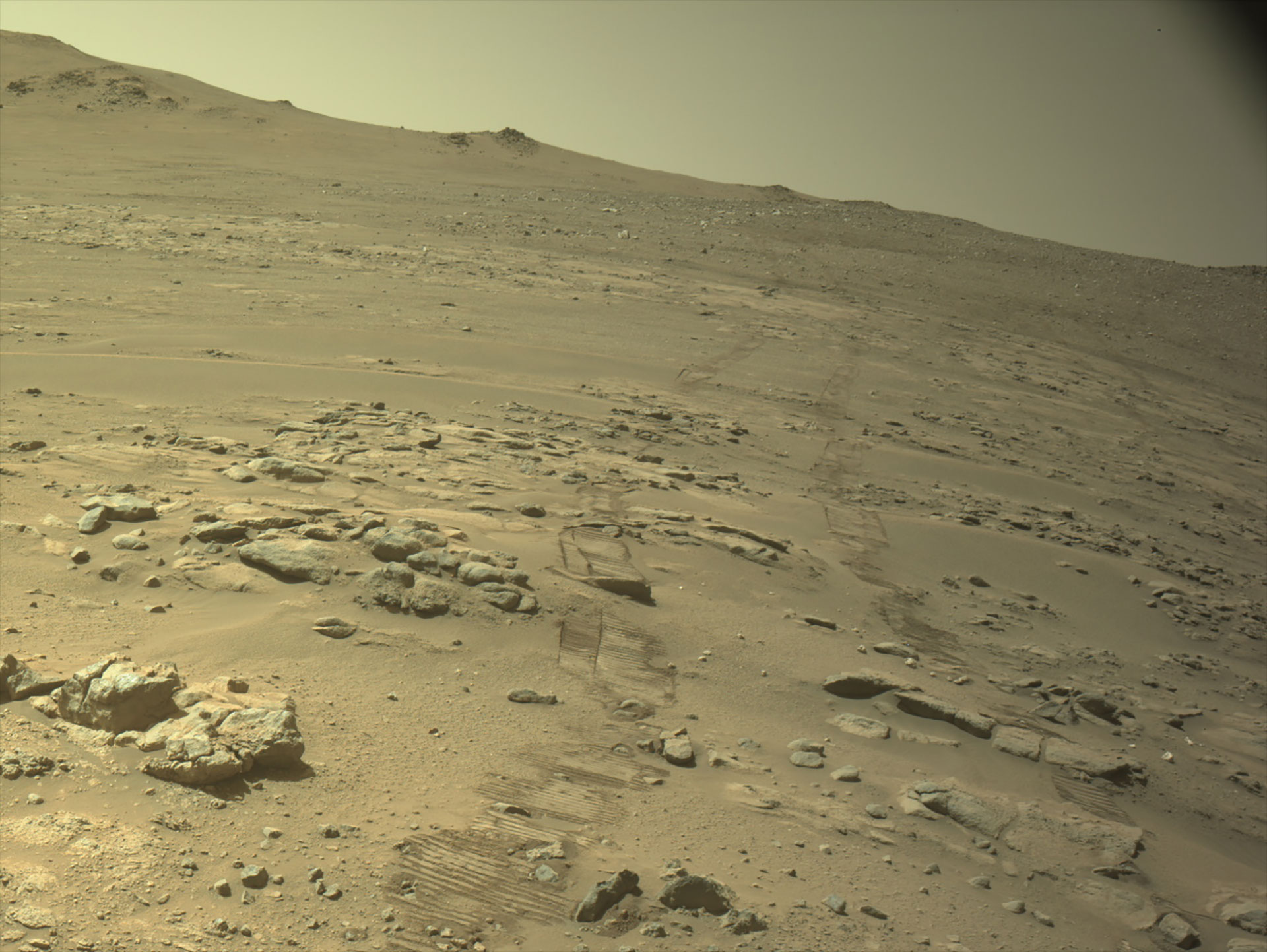
One of Perseverance's navigation cameras captured this shot on Oct. 11, 2026, the Martian day, or sol, that a 299.6-foot (91.31-meter) drive pushed the rover's total mileage past Opportunity's 28.06-mile (45.16-kilometer) record on Mars. (NASA/JPL-Caltech)