advertisements advertisements
|

|
Artemis Moon Tree: Survived space. Killed by winter. Now for sale.
October 12, 2026 — It survived the powerful vibrations of a rocket launch, was exposed to cosmic radiation for more than three weeks, held up to the stress of four times the force of gravity and made it home after a record-setting journey.
It cleared those challenges only to be done in by something much more terrestrial.
"[It] did not survive the intense winter," reads the Mini Museum website, the online shop now offering pieces of it for sale.
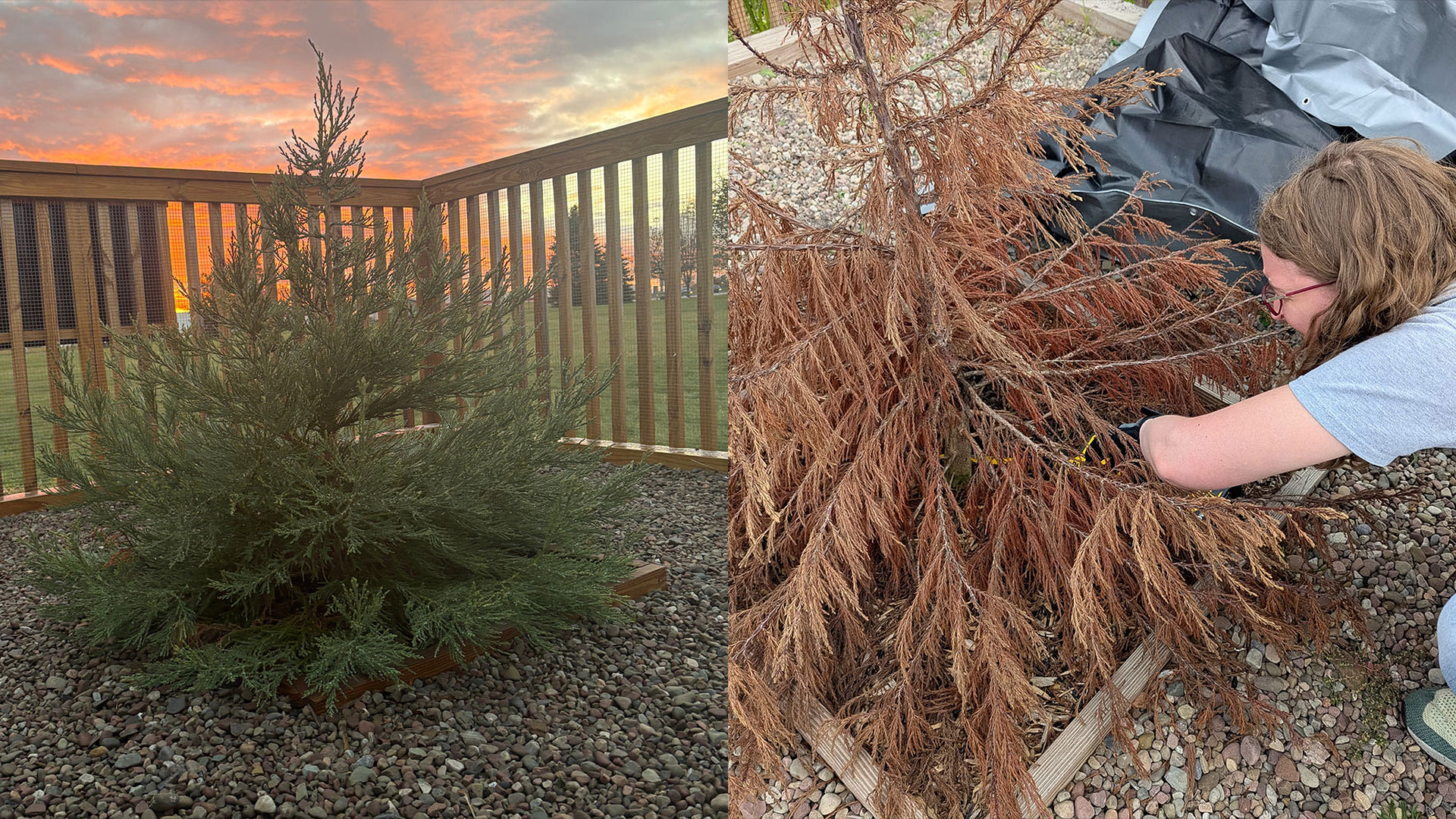
So what is it? An Artemis Moon Tree, or more specifically "GS N-1 5," a young giant sequoia that was grown from a seed flown around the moon on NASA's Artemis I uncrewed mission from Nov. 16 to Dec. 11, 2022. Back on Earth, it was germinated by the U.S. Department of Agriculture's Forest Service. The seedling was then given to a school in Upstate New York, where it was planted in 2024.
"The program was led by teachers at the school, with the hope of engaging students with the piece of space exploration taking root on their campus. Arti [the nickname given the tree] grew fast, gaining 30 inches in its first year on campus. Unfortunately, the winter of 2025 and early 2026 was especially extreme. Arti was unable to survive," reads Mini Museum's description.
This past summer, the school's officials contacted Mini Museum to see if Arti's educational mission could continue beyond its death. The company is known for packaging samples of natural and human-made history to become classroom displays and collectibles. Like they have done for fossils and meteorites, pieces of historic buildings and parts of spacecraft, Mini Museum turned Arti into five types of desktop presentations.
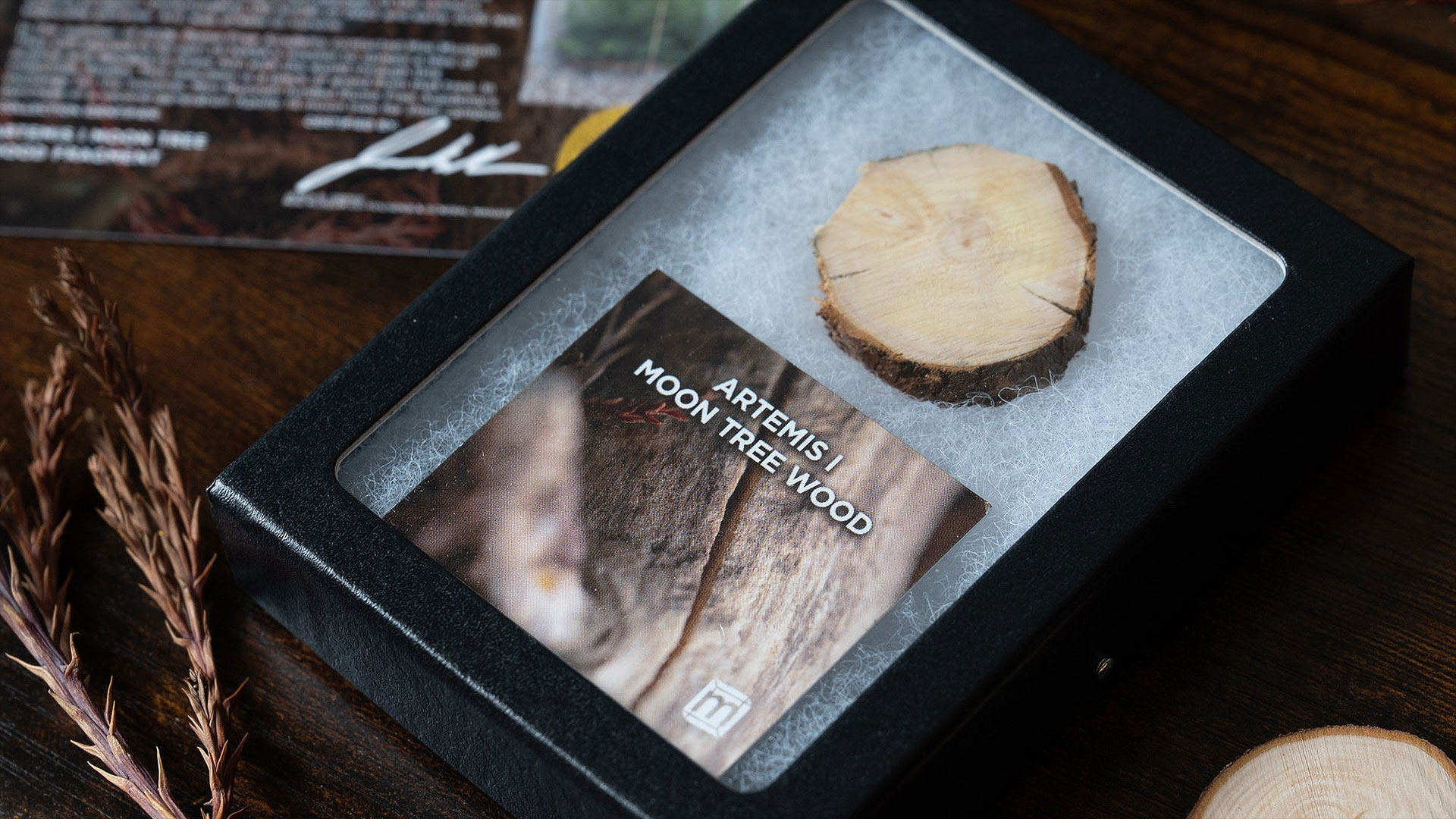
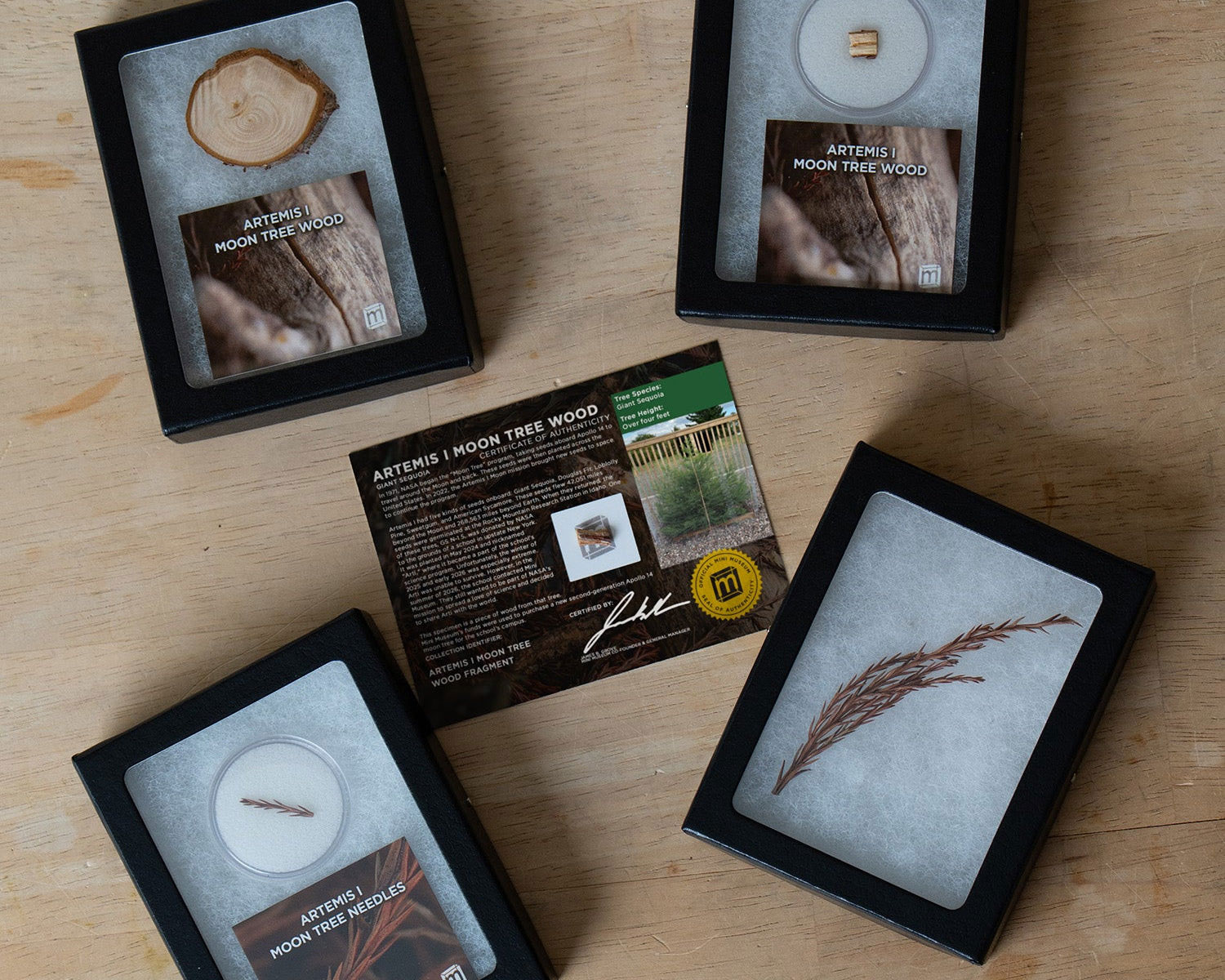
Now for sale are fragments and cross-sections of the tree's trunk, branches and needles, with prices ranging from $29 to $199. Each Artemis Moon Tree piece comes in its own glass-topped case and includes a certificate of authenticity.
Mini Museum has also produced "classroom cards," which mount a small piece of Arti wood directly to the certificate. The cards are intended for distribution to students, so while they are priced at $5 each, there is a minimum order of at least 20 cards ($100).
Arti was not the only giant sequoia seed aboard Artemis I, nor was it the only type of tree seed flown. The mission also had loblolly pine, American sycamore, sweetgum and Douglas-fir seeds; enough to grow 1,000 to 1,200 trees. Among the first chosen stewards were 245 seedlings that went to schools, institutions and other locations in 41 of the 50 states, as well as Washington, D.C. and 13 NASA facilities and centers.
Tree seeds were also flown with the astronauts on Artemis II, the 10-day flyby of the moon earlier this year. In light of that crew including the first Canadian to leave low Earth orbit, the Canadian Space Agency flew 2,600 seeds from five Canadian tree species to be similarly planted at schools and other public centers.
The Artemis Moon Tree program was inspired by the actions of an Apollo 14 astronaut more than 50 years ago. Stuart "Stu" Roosa, a former Forest Service smoke jumper, launched with hundreds of tree seeds on the 1971 mission. Many of Roosa's Moon Trees are still standing, as are now second-generation trees planted from the seeds and cuttings from the originals.
Wood from fallen Apollo 14 Moon Trees has been used in the production of a one-of-a-kind guitar, in an oil painting created for the 50th anniversary of the mission, as part of a hand-crated pen and in earlier Mini Museum $29 displays.
"Part of this exchange [with the school] was also to procure a new Moon Tree, a second-generation sapling from the original Apollo 14 space seed program. Mini Museum has provided the funds for this new tree, which will become a part of the school's science program," reads the website. |
|
A cross-section of a former giant sequoia tree that was grown from a seed carried on NASA's Artemis I mission around the moon is among Mini Museum's Artemis Moon Tree offerings. (Mini Museum)
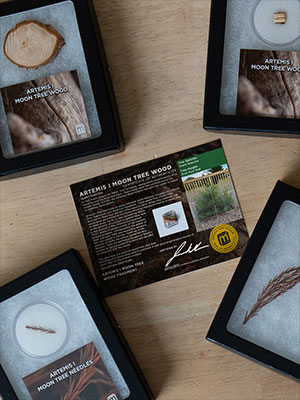
Mini Museum's Artemis I Moon Tree displays include cross-sections (upper left) and wood fragments (upper right) from the trunk, as well as branches (lower right) and needles. (Mini Museum) |
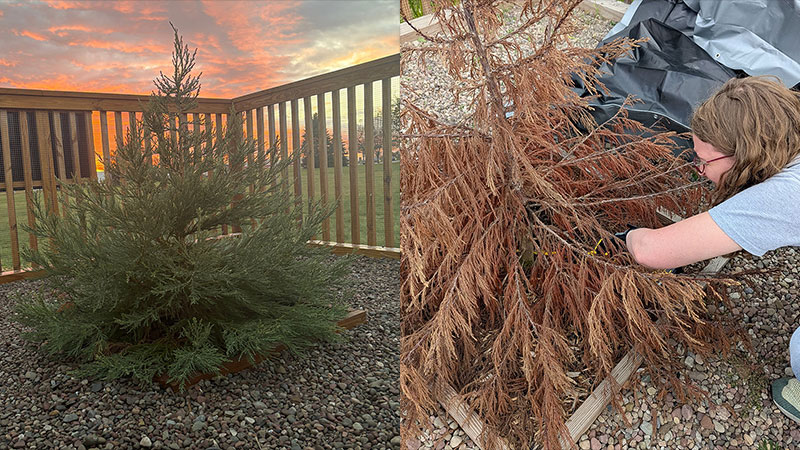
"Arti," the Artemis Moon Tree, is seen growing at a school in Upper State New York and after it died due to a harsh 2025-26 winter. (Mini Museum) |
|

© collectSPACE. All rights reserved.
|
|
|
|