advertisements advertisements
|

|
Euros flown to space station being sold for ESA education fund
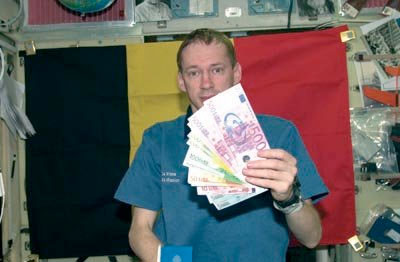
ESA astronaut Frank De Winne on board the International Space Station in November 2002 with the Euro banknotes. (ESA) |
Oct. 8, 2003 — The European Space Agency (ESA) on Oct. 20 will begin auctioning three sets of euro banknotes and 15 national sets of euro coins, all of which were flown onboard the International Space Station during the Belgian Soyuz mission "Odissea" in October 2002.
Signed prior to flight by European Central Bank President Willem Duisenberg, the banknotes were marked by Frank De Winne onboard the space station with the official ISS and Odissea mission ink stamps. Following their return to Earth, the notes and coins were further certified as having flown by De Winne.
"I am honored to be part of this initiative," De Winne said, adding that the effort was "a contribution helping students to develop their knowledge of space activities and to build the European space community of the future."
The "Euro From Space" initiative is part of a campaign to support ESA's ISS Education Fund, which was founded to encourage students from the agency's 15 member states to study, understand and support science and technology by tapping into the excitement of space exploration.
The fund underwrites the the development, production and distribution of teaching materials in all 11 ESA languages for primary and secondary school students.
"I hope these coins and banknotes will subsequently raise a substantial sum — to be used for educational purposes, since education is the key to our future," said Duisenberg.
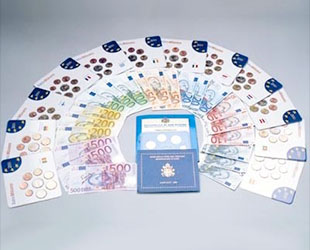
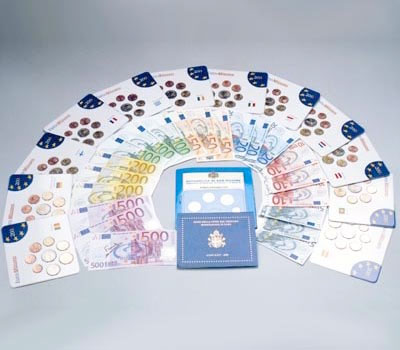
International Space Station-flown banknotes and coin sets. (ESA) |
Bids of no less than 5,000 euro ($5,900) will be accepted beginning Oct. 20 through a dedicated fax line. All pledges received by ESA must be honored, regardless if it results in a winning high bid.
On Oct. 31, the top 18 donors will each receive from ESA and the European Central Bank one of the euro sets taken to the ISS, in the following order:
The three highest bidders will each receive a set of banknotes (each containing 7 banknotes: 5, 10, 20, 50, 100, 200 and 500 euros).
The next 15 bidders will each receive a set of coins (including 8 coins: 1, 2, 5, 10, 20 and 50 cents and 1 and 2 euros).
Coins will be distributed in order: Vatican, Monaco, San Marino, Ireland, Finland, Portugal, Belgium, Luxembourg, Netherlands, Austria, Greece, Spain, Germany, Italy, France.
"The first euro sets to have travelled in space are unique symbols of the importance for Europe of investing in the education of its youth," said Jörg Feustel-Büechl, Director of the ESA Human Spaceflight Directorate.
Visit the European Space Agency website for the official rules or to make a donation to the ISS Education Fund. |

© collectSPACE. All rights reserved.

|
|
|
|