advertisements advertisements
|

|
Toyohiro Akiyama, first Japanese citizen and journalist in space, dies
September 1, 2026 — The first Japanese citizen to launch into space, Toyohiro Akiyma was also the first commercially-sponsored cosmonaut and the world's first journalist to file reports while on a spaceflight.
Akiyama, 84, died on Wednesday (Aug. 26) of lower gastrointestinal bleeding, news agencies in Japan reported. A funeral was held with his close relatives in attendance.
As a correspondent for the Tokyo Broadcasting System (TBS), Akiyama was chosen out of his 162 fellow employees who applied to fly to space in celebration of the network's 40th anniversary. He trained at the Gagarin Cosmonaut Training Center in Star City, located outside of Moscow, and was assigned to the Soyuz TM-11 crew.
On Dec. 2, 1990, Akiyama lifted off with Soviet-era cosmonauts Viktor Afanasyev and Musa Manarov atop a Soyuz U2 rocket that had been adorned with the Japanese flag and ads from various Japanese companies, including Sony. After a nine-minute ascent — which was filmed on board for TBS to broadcast — and a two-day rendezvous, the three crew members arrived at the Mir space station. Afanasyev and Musa began a 175-day stay as on the outpost's 11th expedition.
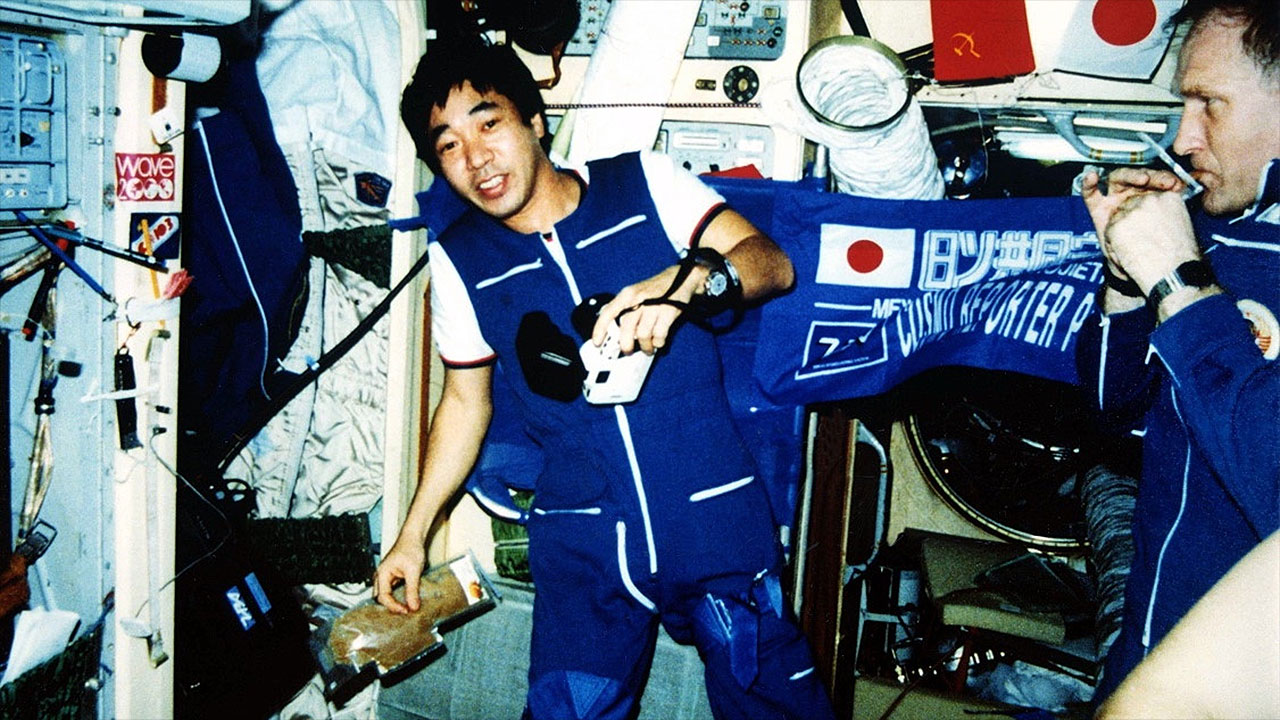
Akiyama's time aboard Mir was only a week long. Every day he recorded a 10-minute video and two 20-minute audio spots. These "To the Universe" broadcasts were aired on TBS. Unfortunately, Akiyama initially became very nauseous, suffering from both space adaptation syndrome (also known as "space sickness") and nicotine withdrawal (he was a chain cigarette smoker) leading to his early accounts of spaceflight to be less than enthusiastic.
He described the water surrounding Japan as "look[ing] very muddy" and suggested that only the "fat" tree frogs that were sent from his country enjoyed weightlessness. "Thin Japanese frogs act as if they would rather be back in Yokohama," he said, according to The New York Times that dubbed him "the space antihero" at the time.
Not all of Akiyama's reports were negative. As time went on, he apologized for his poor attitude and shared footage of Mount Fuji to his viewers' delight. He commented on how most of Japan "looks like it has moss all over," except for the northern island of Hokkaido, which "looks like delicious kelp."
At first, the Japanese public responded by tuning in daily, but as the week went by, interest dwindled. TBS had hoped its investment in Akiyama's mission — reported to be between $12 million and $37 million (US) — would raise its international profile, but other than a brief bump in viewership, the corporation's plans did not pan out.
Akiyama landed back on Earth on Dec. 10, 1990, touching down on the steppe of Kazakhstan with cosmonauts Gennady Manakov and Gennady Strekalov on board Soyuz TM-10. Akiyama logged 7 days, 21 hours, and 54 minutes on his first and only spaceflight.
Toyohiro Akiyama was born on July 22, 1942 in Tokyo. He earned a bachelor's degree at the International Christian University in Mitaka, Tokyo before joining TBS. From 1967 to 1971, he worked for the BBC World Service and then became a correspondent for the TBS division of foreign news.
He was the network's chief correspondent in Washington D.C. for the four years leading up to his spaceflight.
Akiyama was the 239th person to orbit Earth and 246th to cross the boundary into space (including suborbital fliers), according to the Registry of Space Travelers by the Association of Space Explorers.
The first Japanese career astronaut to reach space and orbit Earth was Mamoru Mohri, who followed Akiyama two years later. (Mohri was expected to be first, but the Challenger tragedy in 1986 delayed his flight on the U.S. space shuttle.)
After his own return from space, Akiyama became deputy director of TBS's news division but left the company in 1995 over how commercialized TV was becoming. He joined with other journalists to make a film about the state of the Ural Sea and then became a mushroom and organic rice farmer.
Akiyama was forced to evacuate his home and give up his farming activities in the wake of the Great East Japan Earthquake in 2011. He turned to teaching at the Kyoto University of Art and Design (today, Kyoto University of the Arts), serving as a professor until 2023.
Akiyama wrote numerous books concerning both his spaceflight and then later his experiences as a farmer and being displaced from the Fukushima Prefecture. These titles included "Space Correspondent: Nine Days / Complete Record of the First Japanese Astronaut's Experience" and "This Is Space Correspondent! I Went to Space!" both in 1991 and "The Diary of a Nuclear-Powered Refugee: From the Land of Wrath" in 2011.
In recognition of his 1990 spaceflight, Akiyama was awarded the Soviet Order of Friendship of Peoples medal and later, the Russian medal "For Merit in Space Exploration" in 2011. He also was bestowed with the Tokyo Metropolitan Cultural Honor in 1991.
Akiyama was married to Kyoko Akiyama in 1970 and they had two children, Ken and Naoko. The couple was divorced in 1995. |
|
Toyohiro Akiyama, Soyuz TM-11 crewmate, in the Mir space station while reporting for the Tokyo Broadcasting System. (Roscosmos)
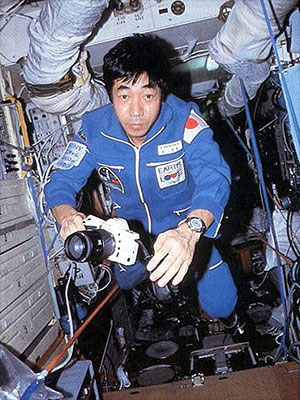
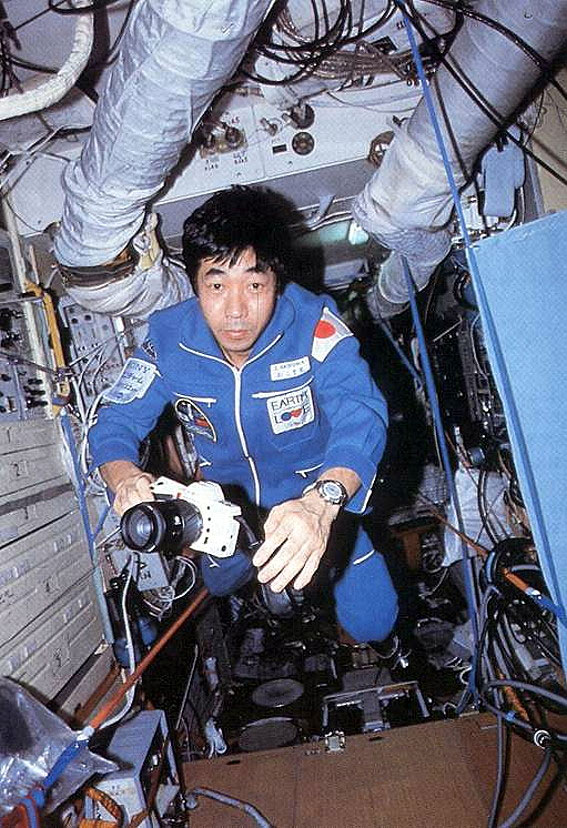
Toyohiro Akiyama floats inside the Mir space station. (Roscosmos)
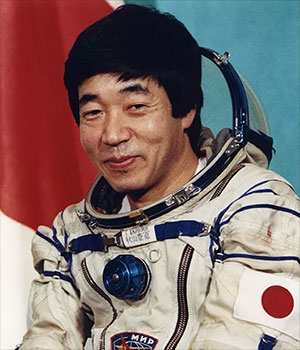
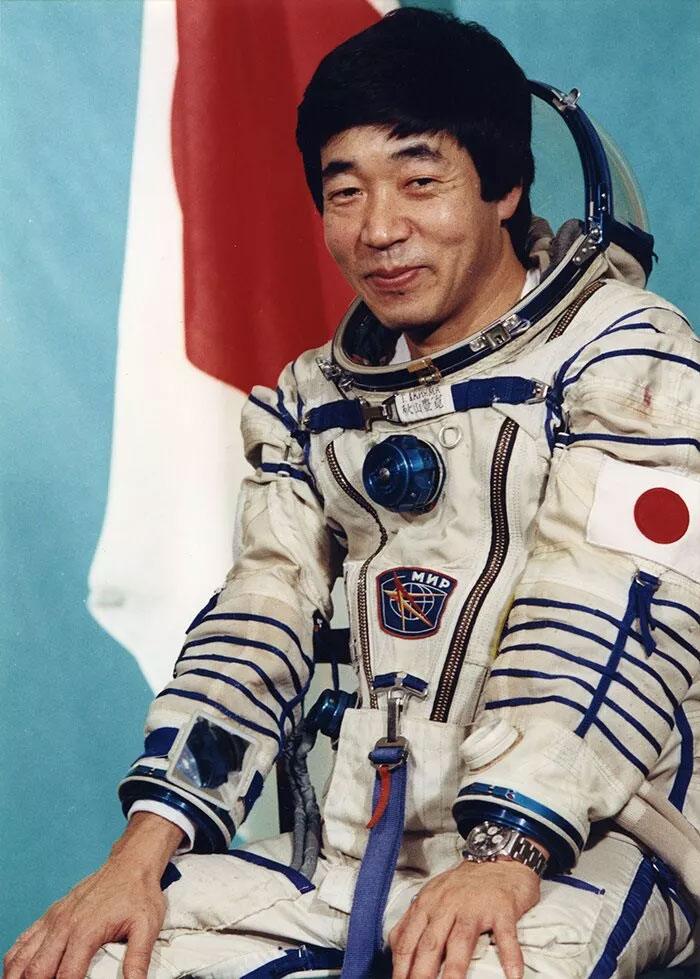
Toyohiro Akiyama, Soyuz TM-11 crew member. (Roscosmos) |
|

© collectSPACE. All rights reserved.
|
|
|
|