Space Newsspace history and artifacts articlesMessagesspace history discussion forumsSightingsworldwide astronaut appearancesResourcesselected space history documents
advertisements
SpaceX Crew-12 tethers to Earth with 'Planet Gaia' zero-g indicator
February 13, 2026
— As NASA astronaut Jessica Meir and her three crewmates entered low Earth orbit on Friday (Feb. 13), they became temporary satellites around the planet, each bringing their individual motivations to their shared eight month mission on the International Space Station.
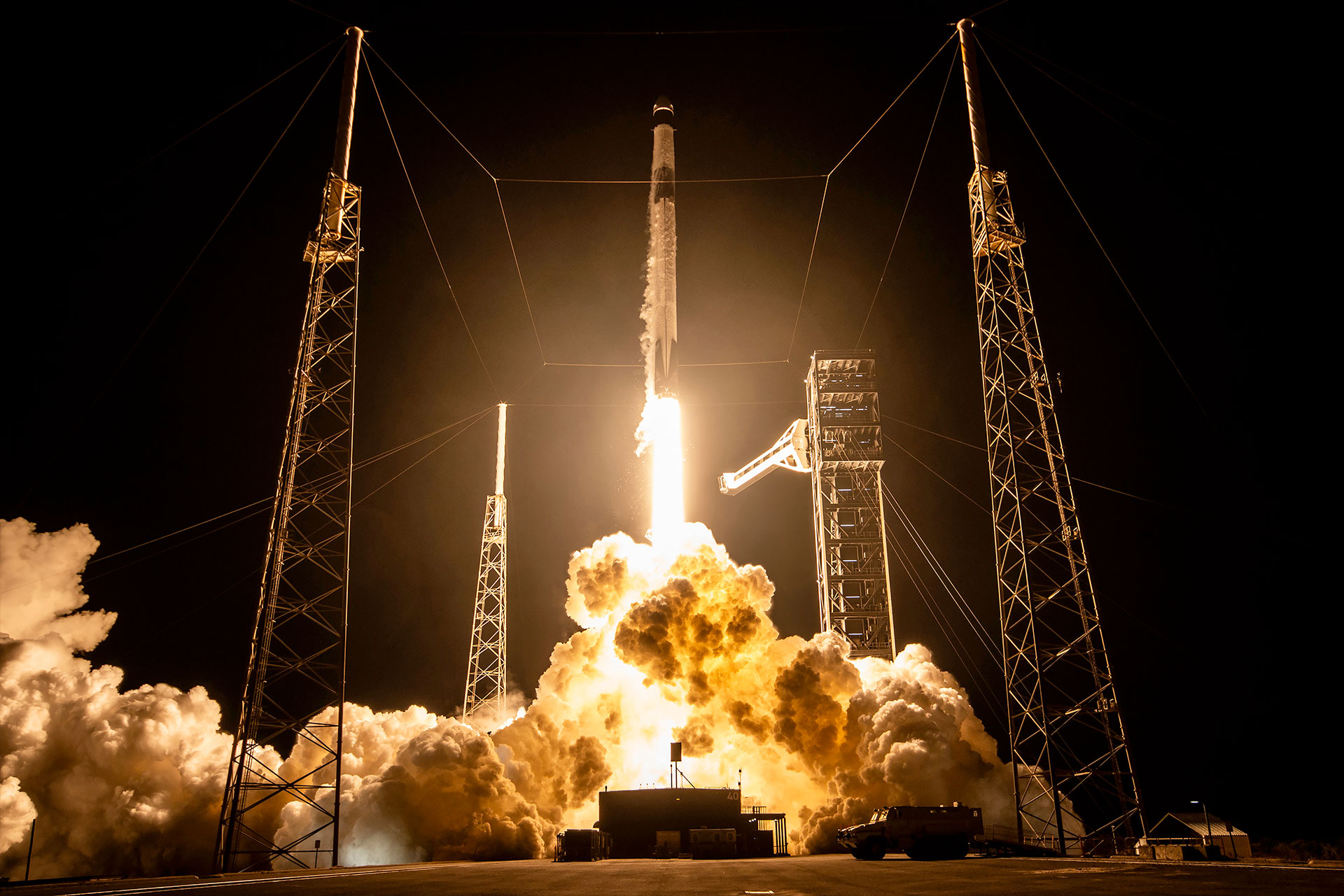
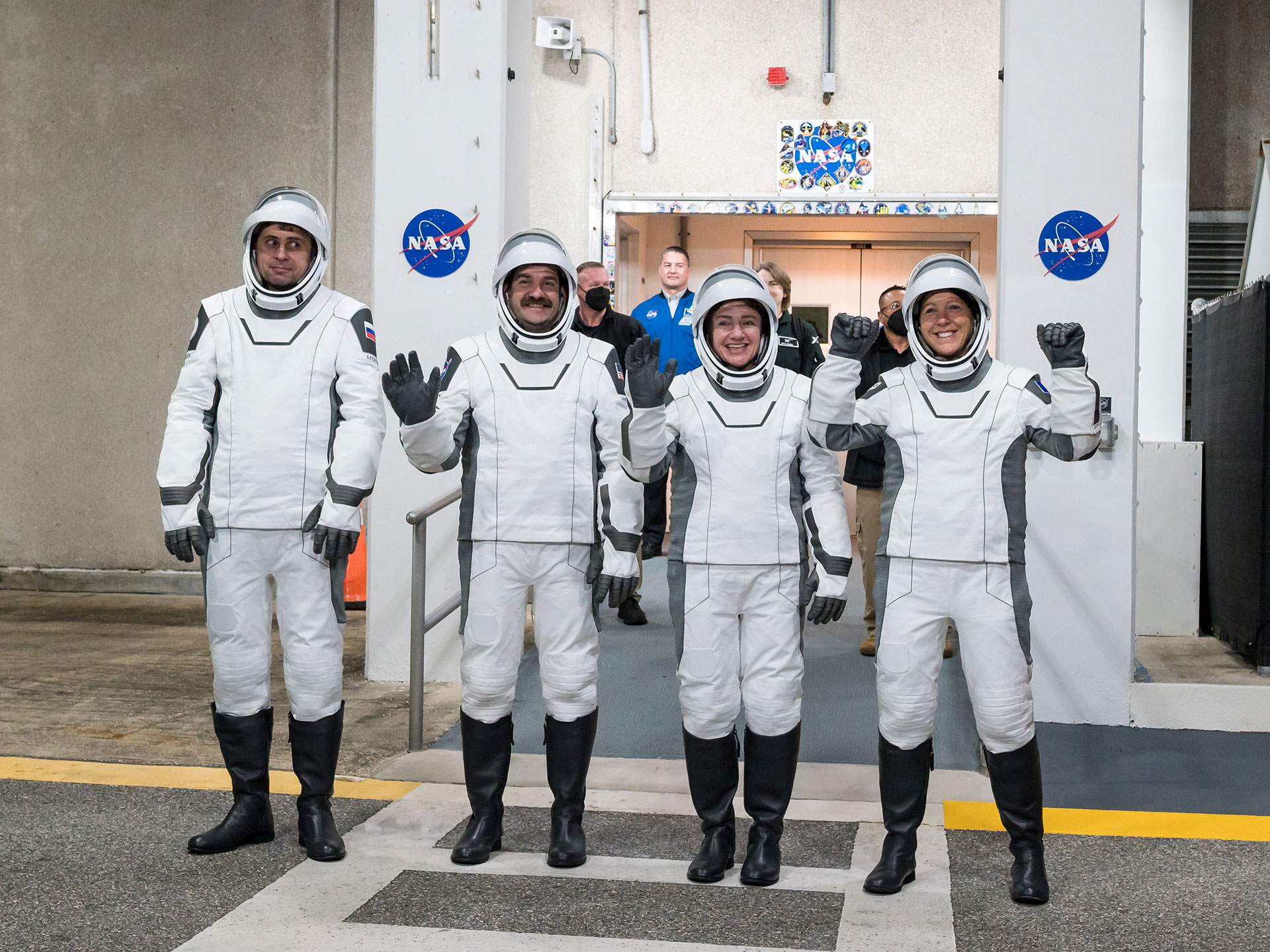
Lifting off on SpaceX's Crew Dragon spacecraft "Freedom" at 5:15 a.m. EST (1015 GMT), a Falcon 9 rocket set the four fliers on a path to deliver them to the space station on Saturday. Only the second human spaceflight to depart from Space Launch Complex 40 (SLC-40) at Cape Canaveral Space Force Station in Florida, Crew-12 includes commander Meir and pilot Jack Hathaway of NASA, ESA astronaut Sophie Adenot and Roscosmos cosmonaut Andrey Fedyaev, both mission specialists.
They reached space in about nine minutes.
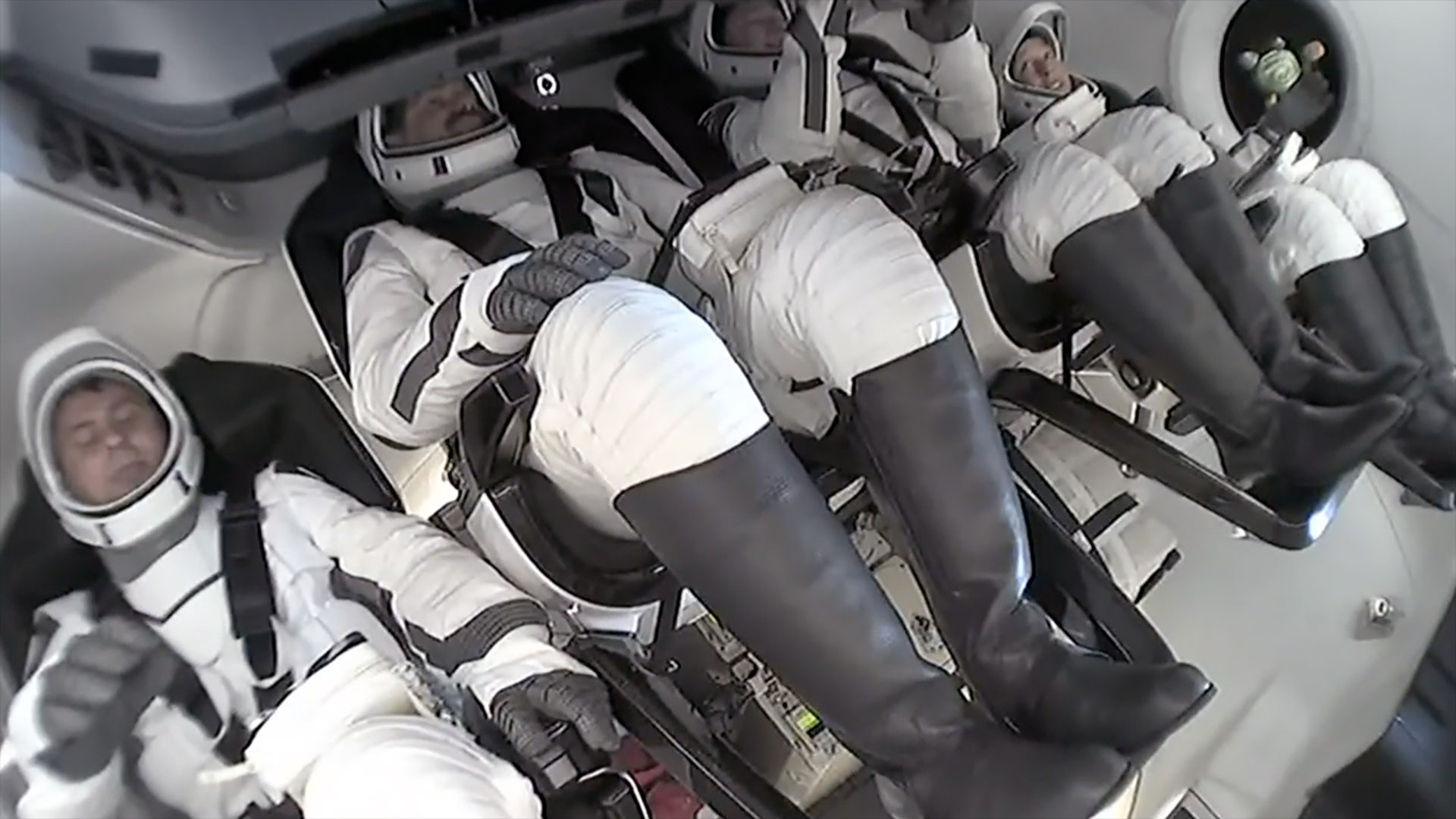
"Our microgravity indicator consists of four satellites orbiting a crocheted Earth, all handmade elements by Jack's daughter and my childhood best friend," said Meir as Adenot let go of the ZGI (zero-g indicator), allowing it to float at the end of its tether. "Each crew member selected a personal symbol, or satellite. A tether links each satellite to Earth, representing our connection to our family, friends and our one shared home."
"We present to you 'Planet Gaia' and her moons," said Meir.
From fungi to fruit
Each crew member's choice of "moon" gave a glimpse at things they hold dear.
Meir, 48, has a background in biology and is on her second mission to the space station. In 2019, she and Christina Koch made history performing the first all-female EVA (extravehicular activity or spacewalk). If all goes to plan, Meir and Koch will talk to each other again, this time as Meir is on the ISS and Koch is flying by the moon on NASA's upcoming Artemis II mission.
For her satellite, Meir chose to have crocheted a panda holding a mushroom.
"Two adorable symbols of environmental importance and a cultural fascination," she said. "Pandas are modern icons of species preservation and international diplomacy and a pivotal character in my childhood. Mushrooms, the fungi, are the great decomposers, with all life on Earth depending on them to keep our soil healthy and food cycle functioning."
Hathaway, 43, is on his first spaceflight. A commander in the U.S. Navy with more than 2,500 flight hours in more than 30 types of aircraft, including over 500 carrier landings and 39 combat missions, Hathaway is the first ISS resident to sport a full mustache in more than a decade.
"I chose a moon that my daughter hand-crocheted," said Hathaway. 'Each color woven into the design represents a member of our family or a cherished shared activity."
"By bringing this piece with me, I keep our bond close, allowing me to relive happy memories while looking forward to the ones we'll create when I return," he said.
Like Hathaway, Adenot, 43, is also a first-time flier. She is the 780th person to fly above 50 miles (80 kilometers), the 644th human to enter Earth orbit, the 11th French national to leave Earth and the second French woman to do so. France's first female helicopter test pilot, she chose "εpsilon" as the name of her ESA science mission on the space station, reflecting "the power of small, yet impactful contributions and how multiple parts unite to create a whole."
Her moon is a familiar yellow staple found in many kitchens.
"Bananas are the worst world's most common, ordinary fruit, shared by billions of people across every continent. Yet, on orbit, fresh fruit is rare, so I wanted a playful reminder of our kitchens and homes. A familiar piece of Earth drifting weightless with us," Adenot said.
Rounding out Crew-12, Fedyaev, 44, previously lived on the space station on Expedition 68/69 in 2023. A retired major in the Russian Air Force, Fedyaev took the place of another cosmonaut, Oleg Artemyev, on the mission in December 2025. Officially, it was said that Artemyev had been transferred to another job, though unconfirmed reports out of Russia suggested that he violated U.S. export laws by allegedly photographing SpaceX documents.
"I chose my part because this particular thing reminds me of a Soviet-era movie I watched as a kid," Fedyaev radioed to SpaceX's flight controllers in Hawthorne, California in Russian. "I challenge you to guess what movie it is."
Links and legacies
Fedyaev's tease follows a similar bit of vagueness by the members of Crew-11, whose zero-g indicator, a plush white seal, was only seen for a few seconds and which has a full meaning only known to the astronauts. Dragon commander Zena Cardman initially only said from space that it "honors a shared memory with our lead trainer Paul Weiss."
Once back on Earth, Cardman politely refused to share more details. "Forgive me, [but] I won't read you in on the exact inside joke," she told collectSPACE.
"Planet Gaia" is also the second crocheted ZGI to fly on a U.S. mission. Almost a year ago, in March 2025, the members of Crew-10 selected a crocheted origami crane as their zero-gravity indicator.
Similarly, this mission's doll is the second to represent our home planet. In 2019, SpaceX chose Celestial Buddies' "Little Earth Buddy" to fly on its first uncrewed test flight of its Crew Dragon spacecraft (Demo-1).
The tradition of flying plush dolls or other toys as a means of demonstrating the crew was in the microgravity environment of outer space began in the former Soviet Union and the very first human spaceflight 65 years ago. Cosmonaut Yuri Gagarin brought with him a doll to see float during his historic Vostok mission.
When Meir, Hathaway, Adenot and Fedyaev board the space station, they will become part of the Expedition 74 crew, joining NASA astronaut Chris Williams and Roscosmos cosmonauts Sergey Kud-Sverchkov and Sergey Mikaev. The Soyuz MS-28 trio arrived in November 2025, flying with both a crocheted cat named "Gizmo" and a student-made cosmonaut stuffed toy as their zero-g indicators.
European Space Agency (ESA) astronaut Sophie Adenot (at right) releases the Crew-12 zero-g indicator, a hand-crocheted world and its moon, "Planet Gaia," after entering Earth orbit on their way to the International Space Station on Friday, Feb. 13, 2026. (NASA)
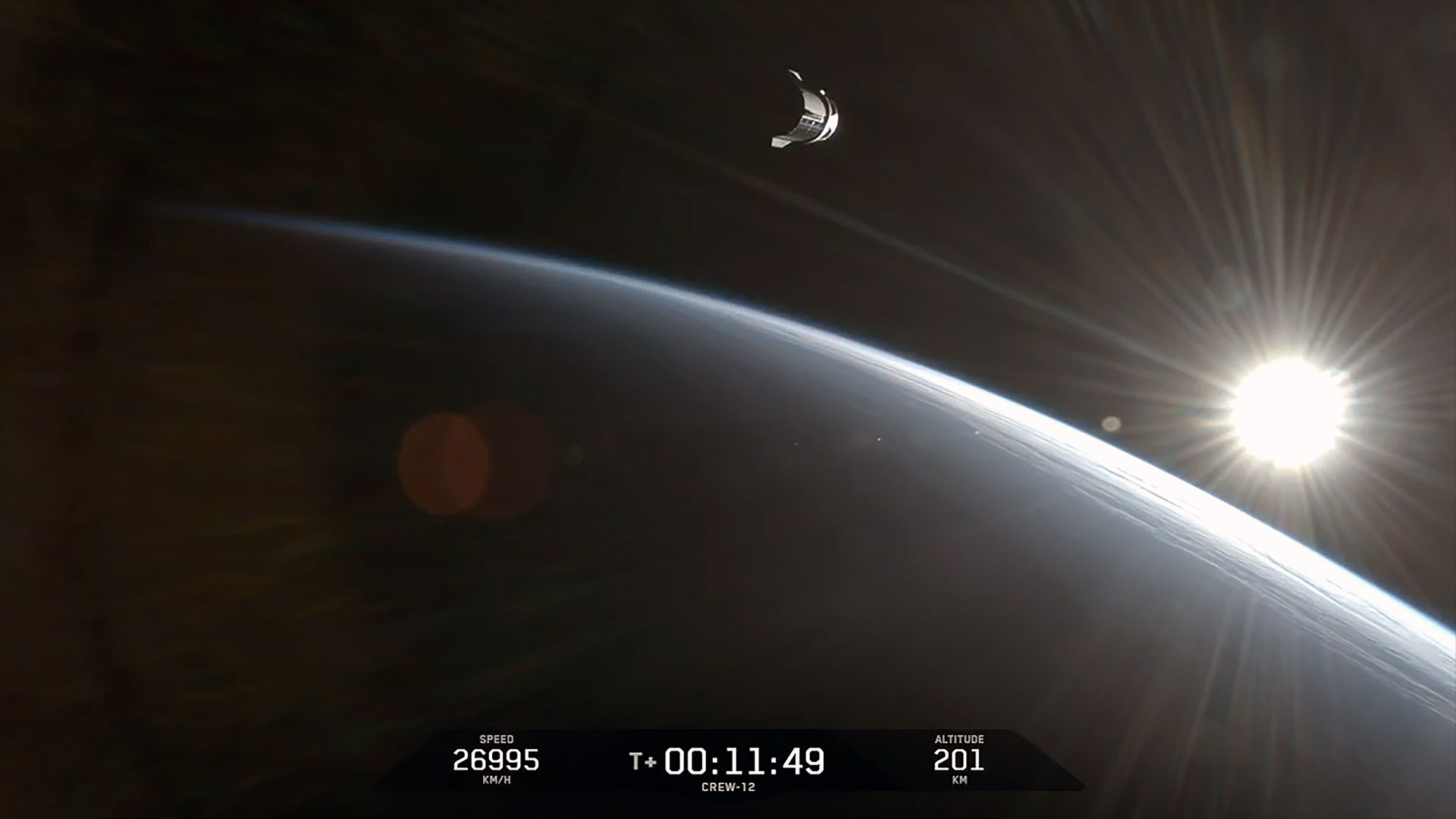
SpaceX's Crew Dragon spacecraft "Freedom" with Crew-12 aboard is seen in Earth orbit, heading to the International Space Station after separating from its Falcon 9 rocket on Feb. 13, 2026. (NASA)
A SpaceX Falcon 9 rocket carrying the Crew Dragon "Freedom" and Crew-12 bound for the International Space Station, lifts off from Space Launch Complex-40 (SLC-40) at the Cape Canaveral Space Force Station in Florida on Friday, Feb. 13, 2026. (SpaceX)
SpaceX Crew-12 members Andrey Fedyaev of Roscosmos, Jack Hathaway and Jessica Meir of NASA and Sophie Adenot with the European Space Agency pose before leaving for the launch pad at Kennedy Space Center, Feb. 13, 2026. (NASA/Aubrey Gemignani)