February 6, 2026 — Fifty-year-old freeze-dried spaghetti with meat sauce never looked so good.
Like many space history enthusiasts, Ryan Nagata was drawn to the displays of astronauts' spacesuits and space food when he would visit museums as a kid. There was just something about them both that provided, as he described it, "a very tangible, human connection to the space program."
Since then, Nagata has become one of the world's foremost artists skilled in replicating NASA's Apollo spacesuits. His work has been praised by the men who walked on the moon, as well as by those portraying them on TV and in the movies (Adam Savage owns one of Nagata's suits and parts that Nagata fabricated were used in the Neil Armstrong biopic "First Man" starring Ryan Gosling).
So it seems only natural that he has now turned his attention to his other boyhood fascination: space food. On Friday (Feb. 6), Nagata launched an Etsy shop to offer a full menu of Apollo and early space shuttle-era dishes.
"This store is something I wanted to set up to sell smaller, non-spacesuit items I'm inspired to make," Nagata said in an interview with collectSPACE. "Judging by the popularity of [authentic] space food items at auctions, I'm not the only person who has that interest."
All in the packaging
The first space food item that Nagata attempted to recreate is also one that tops people's minds when they think about space, especially if they grew up during the mid-1960s Gemini program.
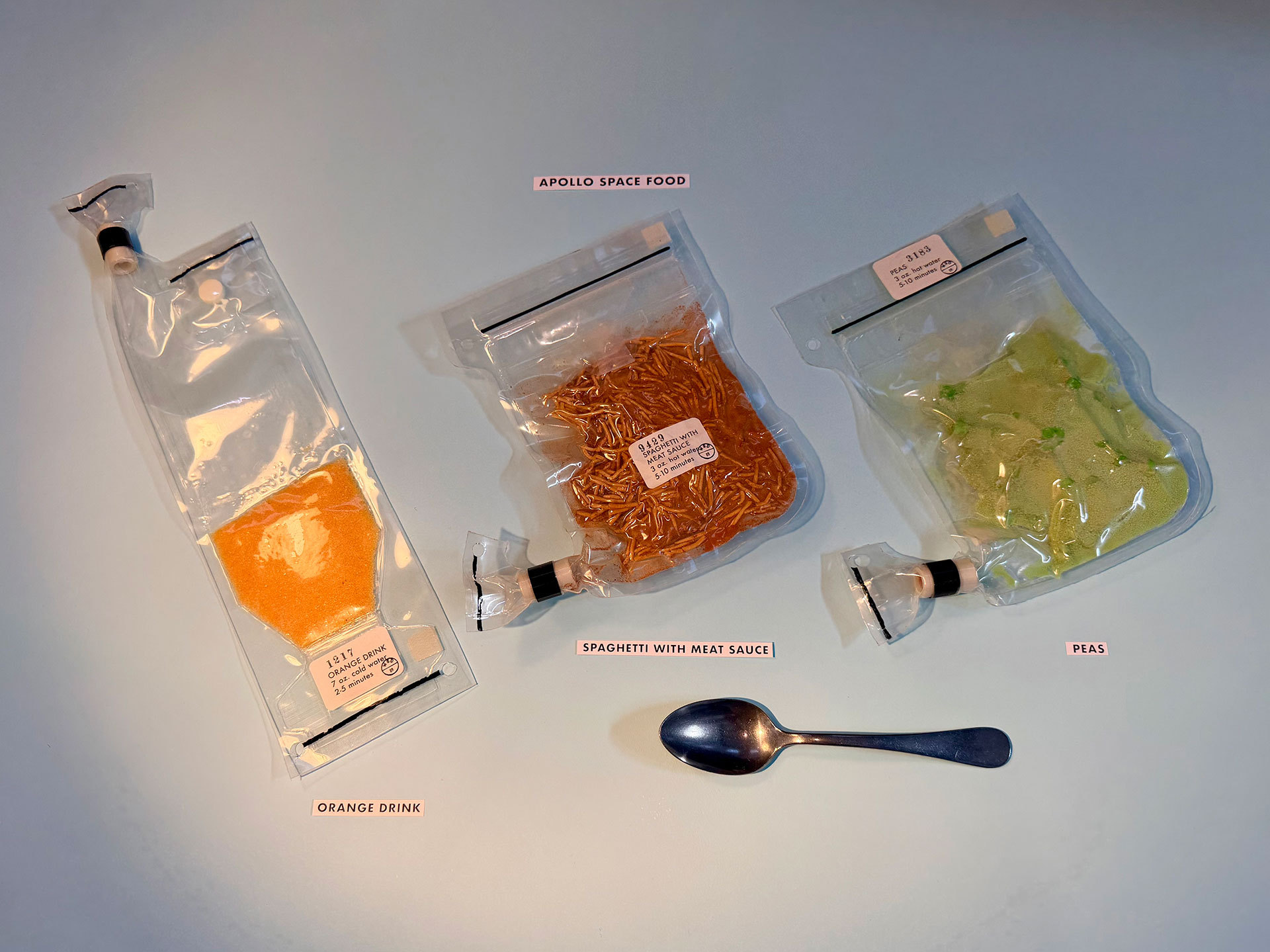
"Orange Drink (Tang) became sort of synonymous with space flight so I started with that," he said. "The drinks were also the easiest items to replicate because they pretty much look like colored sand."
First introduced during the Mercury spacecraft's water supply to offset its metallic taste, Nagata's powdered citric drink comes packaged as it was when it was first sipped on the moon. The "fold-out" food package originally developed by NASA's food systems team and the Whirlpool Corporation enabled crews to reconstitute and consume dehydrated food in space.
The package had a water-injection valve on top and a fold-out tube on the bottom.
"The packaging was definitely harder to make than its contents," said Nagata. "Making these packages involved a lot of trial and error, custom-cut metal templates and modified heat sealing equipment. I also used a technique I learned when I was working at SpaceX, which I won't talk about, but that makes it sound intriguing, doesn't it?"
"My packages are very accurate looking, but they don't have as many layers as the real ones. They were three-ply I believe and mine are two. The inner-most layer is actually food safe (the same polyethylene as food storage bags), but I do not know if my heat seals would hold if you put water inside."
"That would be a fun test," he said.
Problemsome peaches
Nagata paid equally close attention to recreating the contents of each package.
"Most of the freeze-dried food on Apollo was molded into rectangular blocks. I have a few real examples in my collection so I knew the dimensions. I cast a number of generic chunky 'food' blocks that I hand painted to represent various meals," Nagata said.
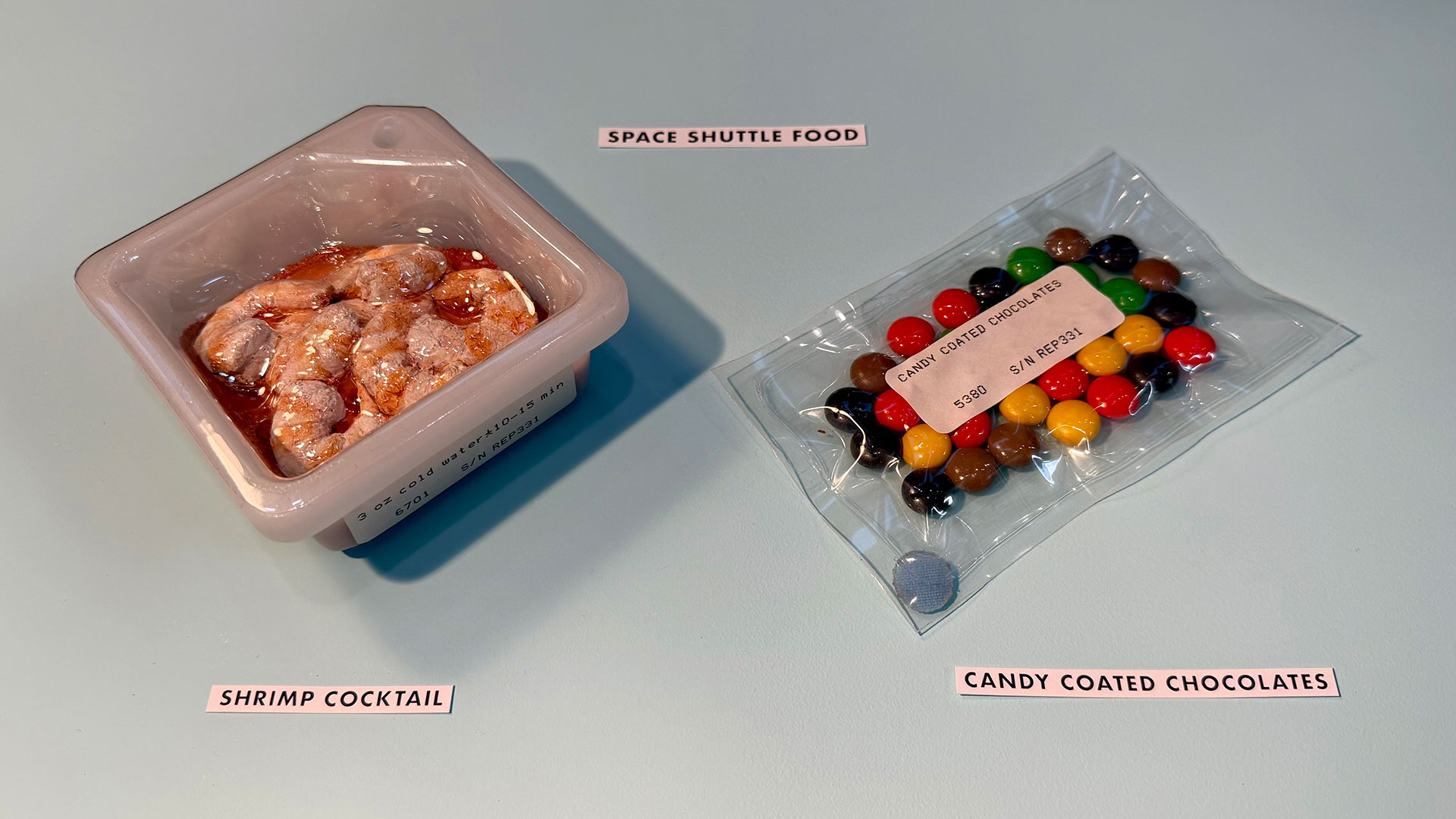
Eventually, he found ways to produce the many different types and textures of foods. He duplicated noodles by extruding air-dry clay from a pasta extruder. The candy-coated chocolates (NASA-speak for M&M's) were 3D printed ("I tried to put the letter 'N' on the candies [for 'Nagata'] to avoid potential trademark issues, but I liked the look of just the plain candies better, so I went with that).
Perhaps surprisingly, the food that gave him the most problems was the peaches.
"The [Apollo-era] peaches were by far the hardest item to get right. The first version I did was a painted resin block and it did not have the look of real freeze-dried peaches, which are sort of spongy with very subtle color variations," Nagata told collectSPACE.
"I ended up sculpting and painting individual peach slices out of foam clay and smashing them into the mold. The result looks exactly like the real thing,"
Happy (historic) meals
All of the replica foods in Nagata's Etsy shop can be ordered individually for $100 to $200 each. He is also offering sets, inspired by some of the most famous meals eaten in space.
"I planned to do the Apollo 11 'First Meal on the Moon' from the beginning. I stumbled across a photo of the Apollo 8 'Christmas Meal' so I knew I had to make that one, too," he told collectSPACE.
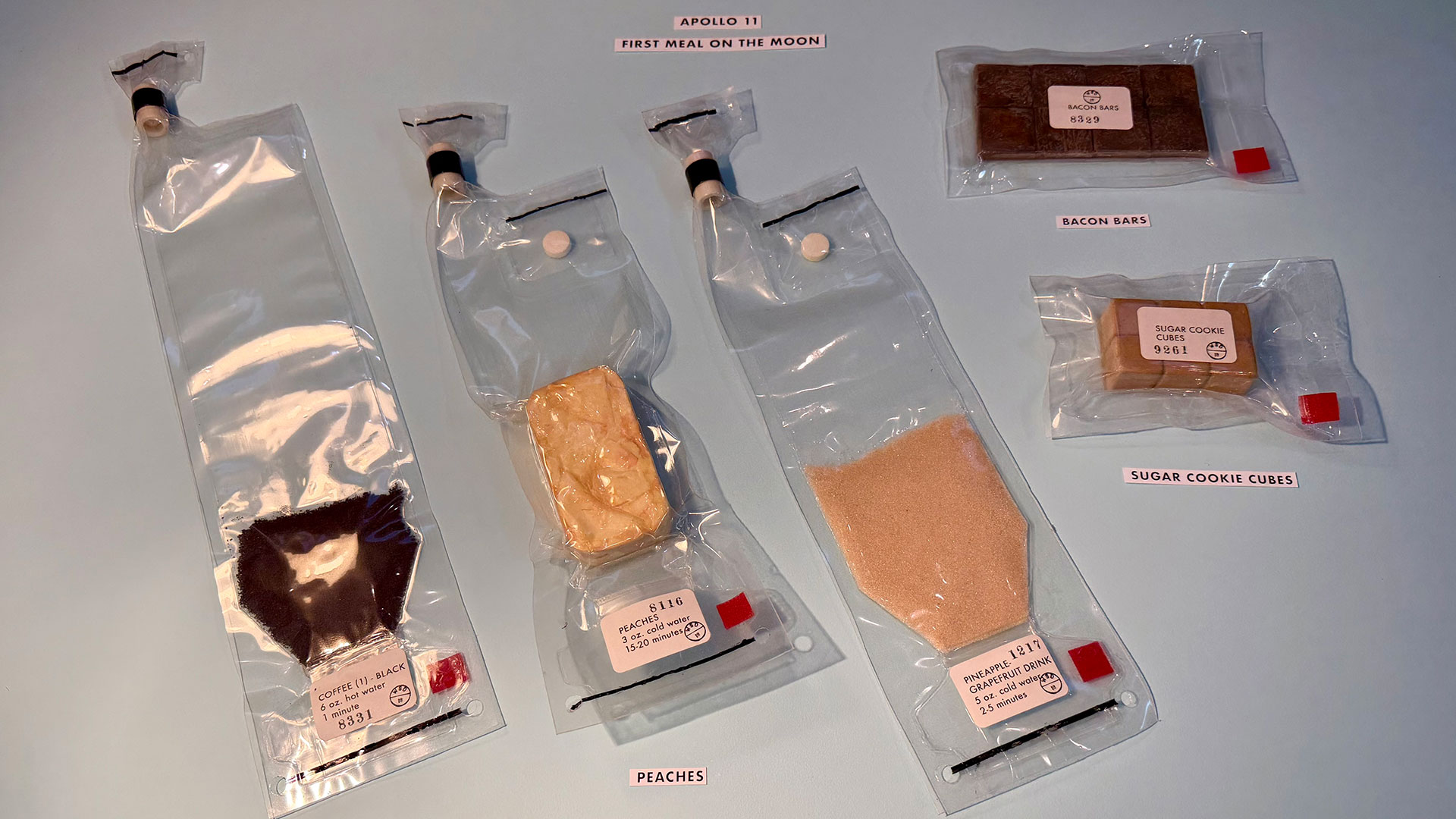
After Neil Armstrong and Buzz Aldrin safely landed at the Sea of Tranquility on July 20, 1969, they partook in a supper — the first-ever eaten on another world — that consisted of bacon bars, peaches, sugar cookie cubes, pineapple-grapefruit drink and coffee. Nagata is offering the five-piece replicated set for $700.
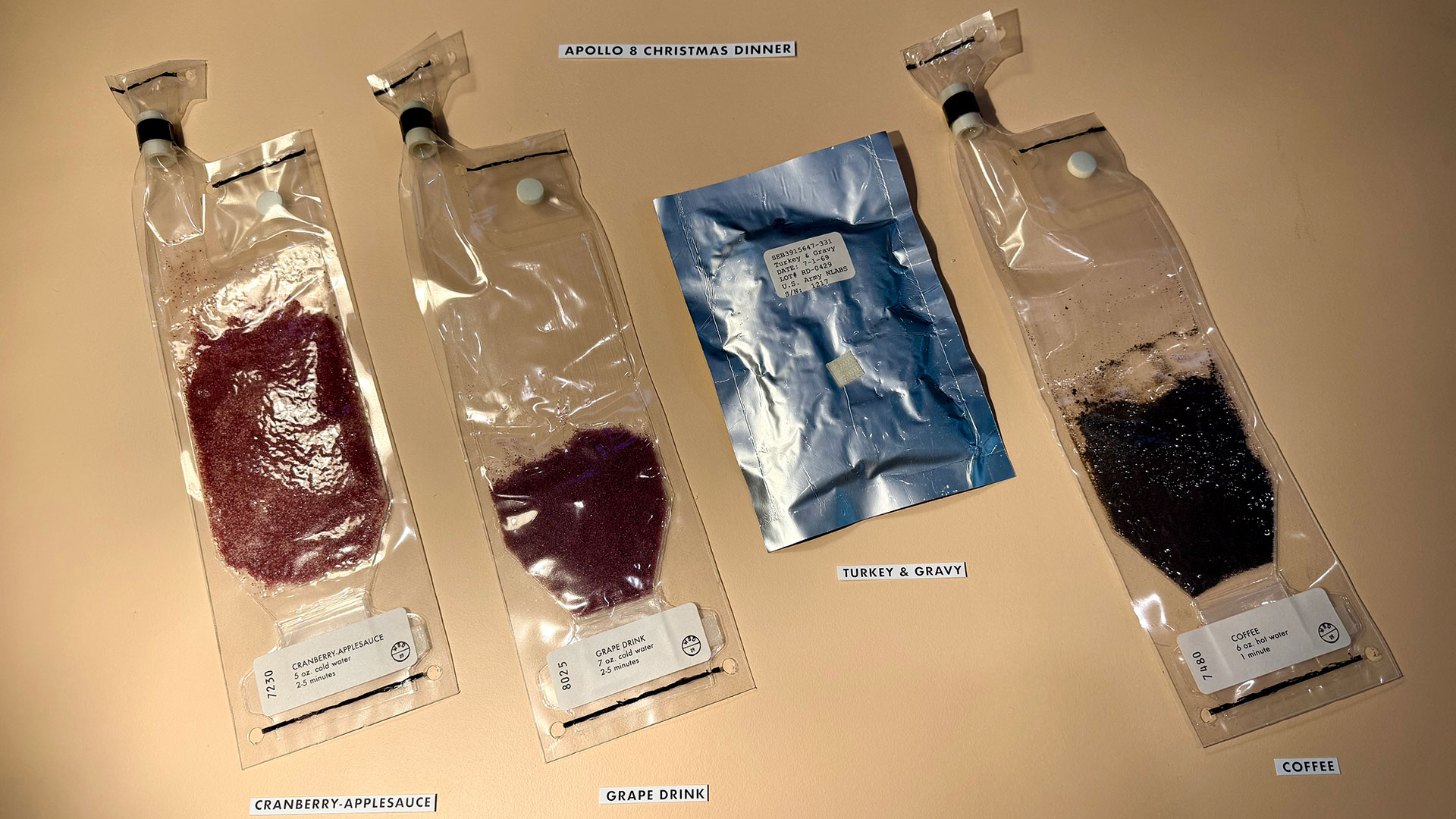
Perhaps the second most momentous spread in space history, the Apollo 8 "Christmas Meal" ($500 from Nagata) is what Frank Borman, Jim Lovell and Bill Anders found awaiting them after entering lunar orbit on Dec. 24, 1968. The Apollo 8 crew enjoyed a dinner of thermostablized ("wet") turkey and gravy, cranberry applesauce, grape drink and coffee (they may have also each found a small bottle of brandy, but that is a story, and a possible replica, for another time).
You can also make your own pairings. For example, a comparative set might be the Apollo spoon bowl-packaged shrimp cocktail with the early space shuttle-era plastic food dish shrimp cocktail. Which one looks more appetizing to you?
Next on the menu
Nagata said all of his offerings on Etsy are open editions and that, pending other projects needing his time, he can make a few packs over the course of a few days.
As for adding food selections from programs other than Apollo and shuttle, he is open to ideas.
"The Gemini food wouldn't be hard to do since it was very similar to Apollo. In fact, my Apollo 8 meal has the wider, Gemini-style labels on it because they were still using those at that time. I thought about making Mercury food, but the plain metal toothpaste tubes aren't that visually interesting. I may do that as part of a set that shows the evolution of space food, though," he said. "If I did that, I would probably do some ISS food as well."
At the end of the day, the food locker is wide open, so long as he can see it.
"I don't think there would be anything too difficult to replicate, but I only replicated items I could find actual photographs of or had some direct reference," said Nagata. I know of several items that were carried on missions that I wanted to make replicas of (like fruit cocktail for instance), but I could find no photograph of a sample, either vintage or present day from a museum or private collection."
"Without being able to see how the contents looked or what the label said, I didn't want to just make stuff up. I'm very particular about that," he said. |
|
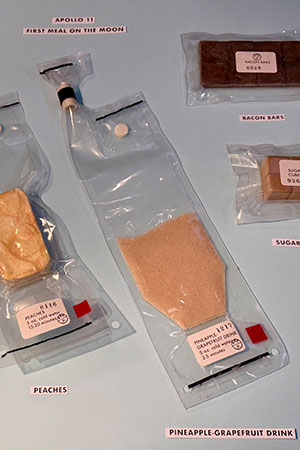
Coffee, peaches, pineapple-grapefruit drink, bacon bars and sugar cookie cubes — the first meal on the moon — can now be yours, as replicated by artist Ryan Nagata. (Ryan Nagata)
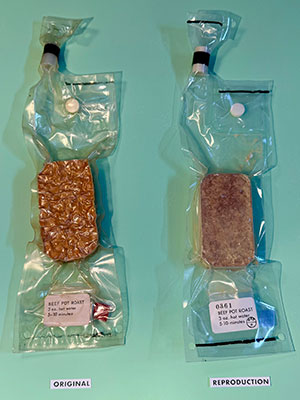
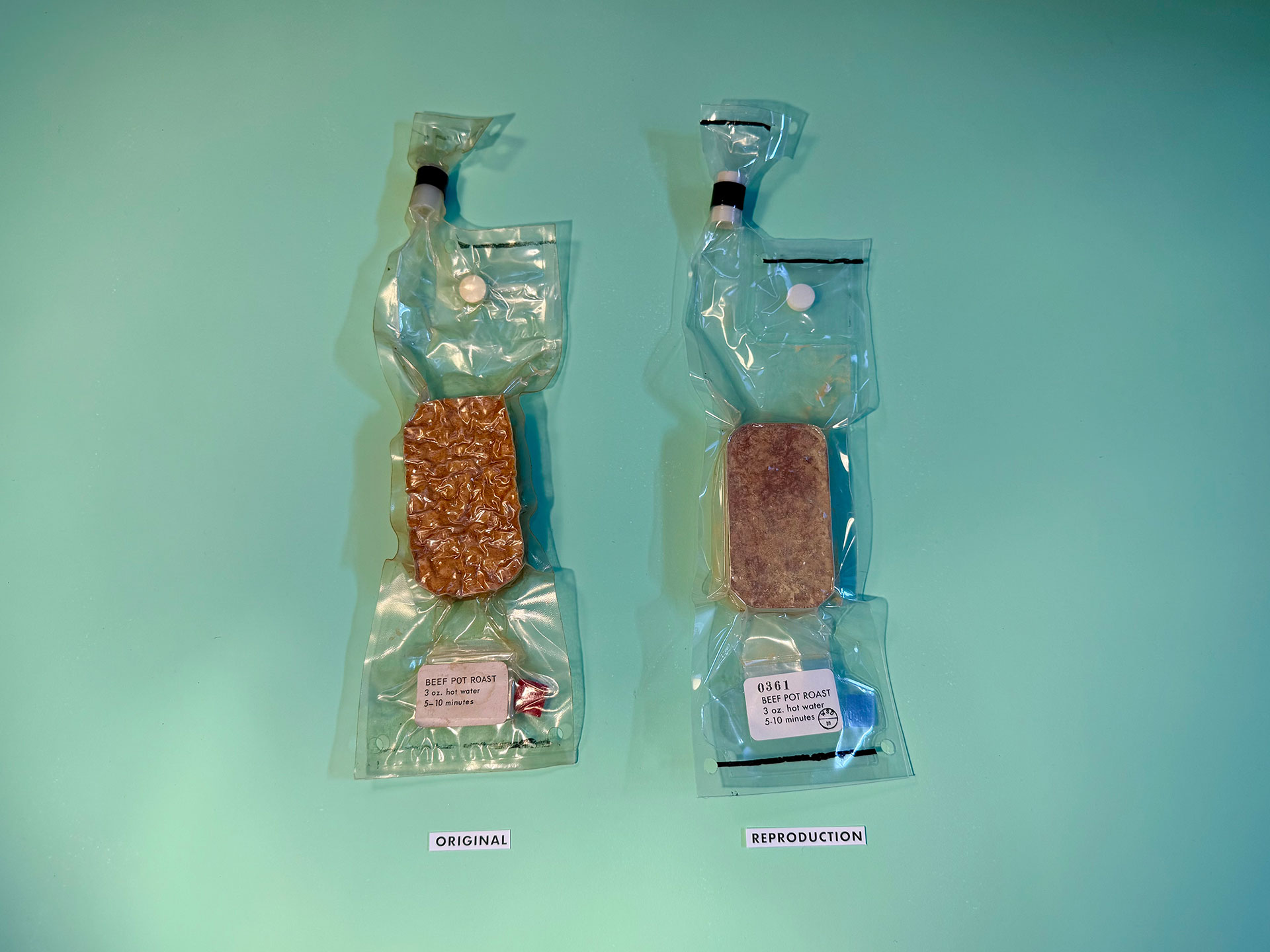
An authentic example of Apollo-era beef pot roast (at left) and artist Ryan Nagata's replica of the same, on sale on Etsy. (Ryan Nagata)
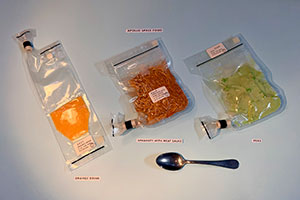
Orange Drink (aka Tang, left) was the first and easiest of the space food items Ryan Nagata reproduced. Making replica spaghetti was more of a challenge, using an actual pasta extruder. (Ryan Nagata)
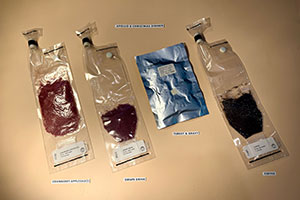
Ryan Nagata's replicas of the Christmas meal enjoyed by the crew of Apollo 8 around the moon in December 1968. (Ryan Nagata)
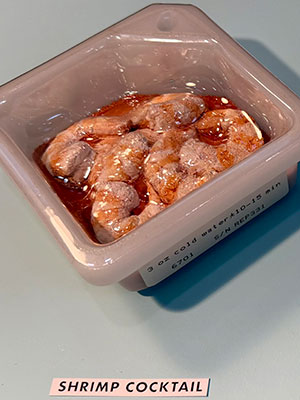
In addition to Apollo menu items, Ryan Nagata also replicated early space shuttle foods, including shrimp cocktail. (Ryan Nagata) |