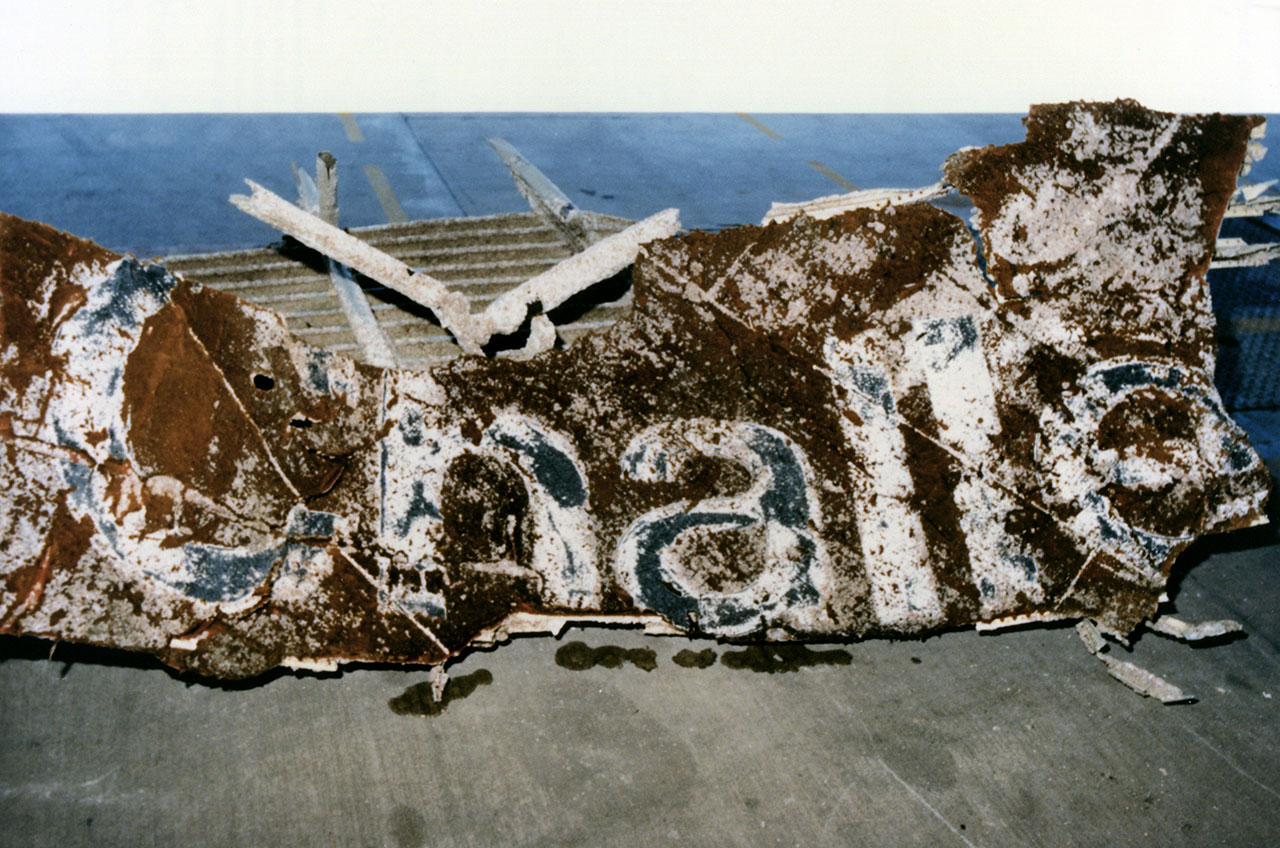
January 26, 2001 — Charles Starowesky was aboard the USS Aubrey Fitch off the Florida coast on Jan. 28, 1986, when NASA's space shuttle Challenger broke apart just 73 seconds into flight.
Deployed by the United States Coast Guard, Starowesky and his fellow guardsmen were among the first to arrive at the waters below the plume in the sky. The Aubrey Fitch, soon to be joined by eight other Navy and Coast Guard vessels, was tasked with recovering the space shuttle's wreckage — to become evidence for the investigation into what claimed the lives of seven American astronauts.
It would be weeks before the causes behind the tragedy were determined and every piece of the vehicle pulled out of the water was essential. Both the NASA and the Coast Guard had issued pleas to the public to report finding any remnant. NASA ordered that all the material collected be stored inside a hangar at Patrick Air Force Base, Florida.
This included the 6 by 6 by 2.5-inch piece of thermal tile that Starowesky fished from the ocean with a bucket and kept for himself.
The "ultimate" Christmas gift
Thirteen years later, Starowesky posted his space shuttle Challenger "souvenir" to the internet auction website eBay with hopes of cashing in on his morbid memorabilia.
"I wouldn't be selling [this] but have found myself in a bit of financial distress," Starowesky wrote in his description published on eBay.
Set at a minimum bid of $199, Starowesky offered the tile, along with 40 pictures he took during the recovery efforts. He also offered to include a copy of the letter he received from the Coast Guard commander awarding him and his crew mates the Coast Guard Unit Commendation Award for helping with the recovery effort.
Starowesky described the tile as the "ultimate Christmas gift for the space enthusiast or collector."
Title 18, United States Code, Section 641
Ultimately 15 tons of debris from space shuttle Challenger were recovered. The remainder — comprising 55 percent of the orbiter, five percent of its crew cabin and 65 percent of its payload — still rest on the ocean floor.
During the investigation it was discovered that the black thermal tiles, much like the type that Starowesky saved, provided important clues. As each was serialized, NASA was able to identify tiles nearest to the suspected hot gas leak from the right solid rocket booster.
Whether Starowesky's personal piece would have helped the investigation is unknown. With the investigation over and the cause now known, the government's concern over Challenger is now more out of respect for the lost crew.
As NASA never relinquished ownership of the fallen space shuttle, possession of Challenger debris qualifies as theft of government property. All parts recovered, even today, are interred with the original retrieved wreckage inside two underground missile silos at the Cape Canaveral Air Force Station in Florida.
After being alerted to Starowesky's sale, the NASA Office of Inspector General demanded the tile's return.
Though Starowesky claimed ignorance — "I had no idea it was illegal to possess or sell this item, and would gladly return [it] to proper authorities," he claimed at the time of the sale — he pled guilty in a U.S. District Court on Aug. 22, 2000. The ex-guardsman was charged with violating Title 18, U.S. Code Section 641, the theft of government property, almost one year after listing the tile on eBay.
Sentenced to two years probation, Starowesky could have received a steeper penalty — a maximum $10,000 fine, 10 years in prison or a combination of both.
Starowesky not alone
With the rise of online auction websites, the marketplace for memorabilia connected to historic tragedies has grown. Recent interest in items such as the Titanic and Nazi war memorabilia has drawn out more space shuttle Challenger debris in private hands.
While Starowesky's case was the most recent, NASA has pursued other recovered fragments.
Another seller listed what he described as an "authentic Challenger O-ring" in January 1999. That sale was halted by the auction website shortly after being alerted that the item, real or not, was illegal to sell.
Those currently in possession of Challenger material are urged to contact the NASA Office of Inspector General to arrange return of the debris.