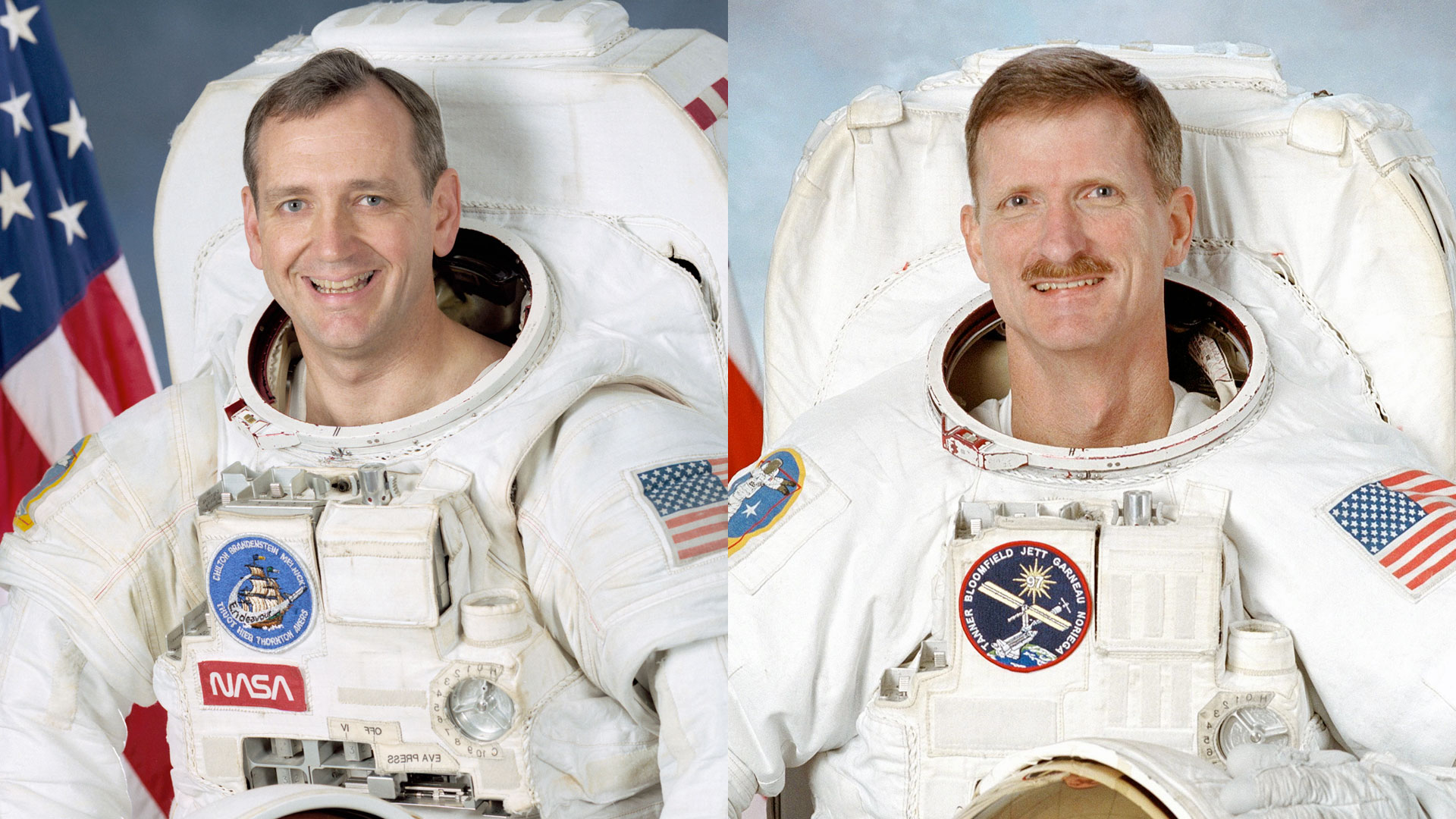
January 9, 2026 — Two veteran NASA spacewalkers are being honored with their induction into the U.S. Astronaut Hall of Fame this spring.
Tom Akers and Joe Tanner, who each flew on four space shuttle missions, will take to the stage at the Kennedy Space Center Visitor Complex in Florida, where they be hailed for their service to the space program. The May 16 public ceremony will be held under the display of the orbiter Atlantis, Tanner's first and Akers' last ride into Earth orbit.
"The U.S. Astronaut Hall of Fame welcomes two distinguished astronauts whose careers exemplify excellence, leadership and service to human spaceflight," Curt Brown, Astronaut Scholarship Foundation (ASF) chairman and Hall of Fame member, said in a statement released by the visitor complex. "Joe Tanner and Tom Akers made lasting contributions to NASA and the advancement of our nation's space program, and both have continued to extend their impact beyond NASA as educators and mentors."
"Their dedication and commitment reflect the very best of the astronaut corps, and we are honored to induct them into the U.S. Astronaut Hall of Fame at Kennedy Space Center Visitor Complex," said Brown, who became a NASA astronaut in the same class as Akers and flew with Tanner on Atlantis.
The third man
Out of Akers' four spacewalks, his first made EVA (extravehicular activity) history and his last corrected the vision of a world-famous observatory.
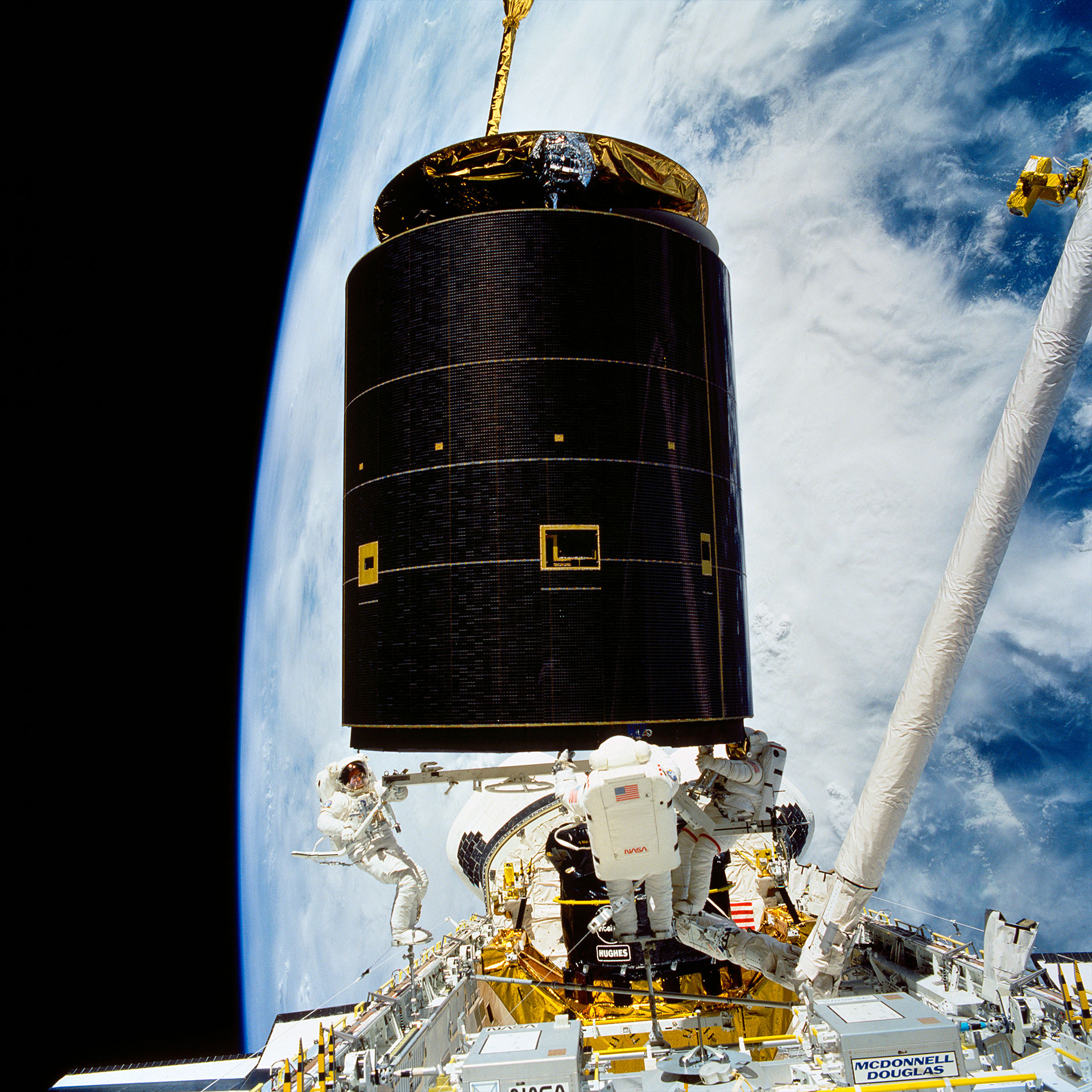
After overseeing the deployment of NASA's Ulysses solar probe on his first mission, STS-41 on space shuttle Discovery in 1990, Akers second launch and first spacewalk was on the maiden flight of Endeavour two years later. Originally planned to test construction techniques for the then still to come International Space Station, Akers instead joined his STS-49 crewmates, Rick Hieb and Pierre Thuot, in an unprecedented three-person EVA to catch a communications satellite that was in need of a new upper stage.
Hieb, Thuot and Akers formed a human tripod and reached up with their gloved hands to grab hold of and then secure the satellite in the shuttle's payload bay.
Akers followed that feat on his third mission, which repaired the Hubble Space Telescope in 1993. Working with his fellow STS-61 mission specialist (and Hall of Fame member) Kathy Thornton, Akers replaced the Hubble's power-providing solar arrays with new, more efficient panels and, on his fourth and final spacewalk, installed COSTAR (the Corrective Optics Space Telescope Axial Replacement), a set of "contact lenses" for the telescope's flawed primary mirror.
Akers' fourth and last mission, STS-79 on Atlantis in 1996, marked the fourth time that a shuttle had docked to Russia's Mir space station and the first time a U.S. spacecraft delivered an astronaut to orbit and brought brought back another in his or her place. Akers oversaw the transfer of 7,700 pounds (3,500 kg) of supplies between the outpost and orbiter.
In total, Akers spent nearly 34 days in space, including almost 30 hours outside on spacewalks. When not flying, he served as deputy director of flight and mission operations and was technical assistant to the director of Johnson Space Center.
After retiring from NASA in 1997 (and the Air Force in 1999 at the rank of colonel), Akers taught mathematics at the University of Missouri Rolla (today, the Missouri University of Science and Technology). He left teaching in 2010, but continues to deliver presentations encouraging students to pursue STEM (science, technology, engineering and mathematics) education.
From wings to tethers
Tanner had been flying for Johnson Space Center for eight years when he was selected to become an astronaut in 1992.
A naval aviator who became a research pilot for the aircraft operations division at Johnson in 1984, Tanner logged more than 8,900 hours at the controls of military and NASA aircraft. He first traded his wings for a spacesuit in 1994, when he launched on Atlantis on the third mission to carry the Atmospheric Laboratory for Applications and Sciences (ATLAS), a series of Spacelab flights that studied the energy of the sun and how it affects Earth's climate and environment.
Tanner conducted his first two spacewalks on NASA's second mission to service the Hubble Space Telescope, STS-82 on Discovery in 1997. He and Greg Harbaugh replaced degraded instruments with spares, refined control of both the observatory and its solar arrays and placed thermal blankets around the light shield portion of the telescope.
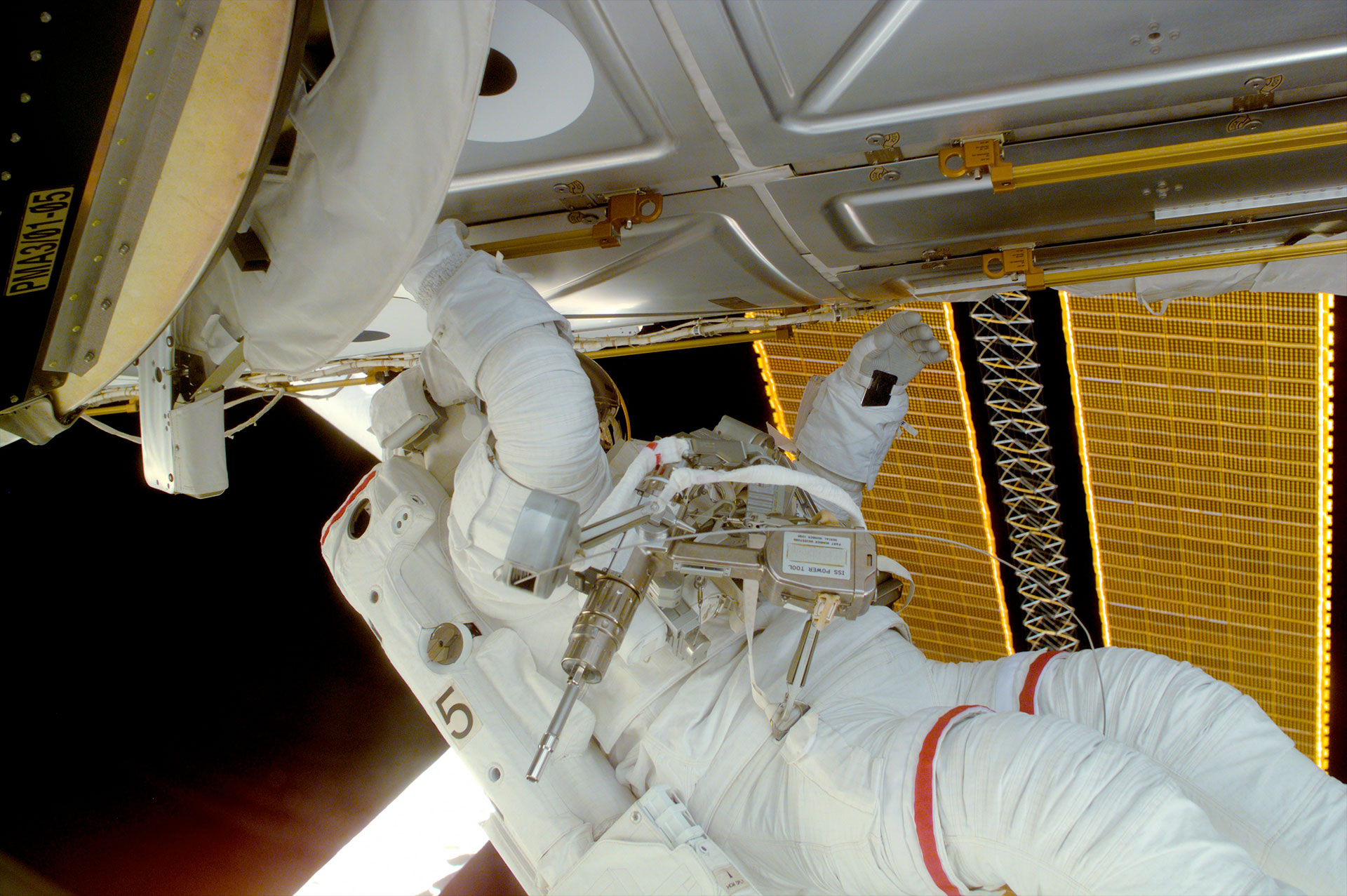
As an STS-97 mission specialist on Endeavour in 2000, Tanner made his first of two visits to the International Space Station. On a trio of spacewalks, he and Carlos Noriega completed the installation of the first set of U.S. solar arrays and prepared a docking port for the U.S. Destiny laboratory.
Six years later, Tanner returned to the station as a member of Atlantis' STS-115 crew. Working with Heide Stefanyshyn-Piper, he ran cables connecting a new segment to the ISS's backbone. The P3/4 truss was the first with a rotary joint, making Tanner responsible for installation of half of the electrical power on the orbiting outpost.
Over the course of his four missions, Tanner logged 43 days in space, including 46 and a half hours on seven spacewalks. Between flights, he served in mission control, becoming the first ground IV (intravehicular officer on Earth, rather in space) for an EVA outside the International Space Station) and helped revamp the process for selecting new astronauts.
Tanner retired from NASA in 2008 and accepted a faculty position in the aerospace engineering sciences department at the University of Colorado, where he spent eight years educating and mentoring students to become future leaders in the aerospace industry.
112 and 113
A separately-ticketed formal gala, organized by the ASF, will celebrate Akers and Tanner at the Kennedy Space Center Visitor Complex's Apollo/Saturn V Center.
The ASF administered the committee of Astronaut Hall of Fame members, former NASA officials, historians and journalists who selected the 2026 class. To be eligible, astronauts must have made their first flight at least 15 years before the induction, must be U.S. citizens and either a NASA trained shuttle commander, pilot, mission specialist or a space station commander or flight engineer who has orbited Earth at least once.
Founded in 1990, the U.S. Astronaut Hall of Fame is part of the Heroes & Legends attraction at the Kennedy Space Center Visitor Complex. Akers and Tanner's likenesses, etched in glass and mounted with their embroidered mission patches, will go on display alongside the previous 111 inductees' plaques. |
|
Veteran NASA spacewalkers Tom Akers (left) and Joe Tanner have been named the U.S. Astronaut Hall of Fame 2026 class. (NASA)
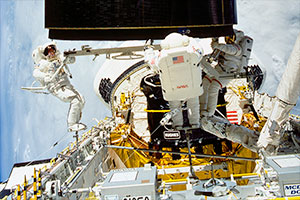
Tom Akers (at center with his back to the camera) takes part in the only three-person spacewalk in history with his STS-49 crewmates Rick Hieb (at left) and Pierre Thuot (at right) capturing by hand the Intelsat communications satellite above space shuttle Endeavour's payload bay in 1992. (NASA)
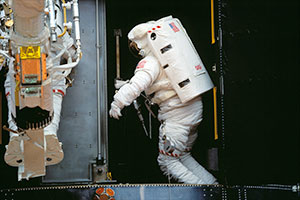
STS-61 mission specialist Tom Akers inside the equipment bay of the Hubble Space Telescope durig the installation of the COSTAR corrective optics or "contact lenses" in 1993. (NASA)
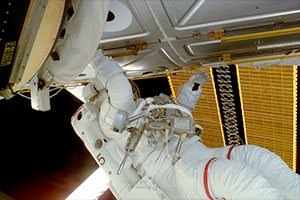
NASA astronaut Joe Tanner, STS-97 mission specialist, is seen on a spacewalk, backdropped by a section of the first U.S. solar array wing for the International Space Station in 2000. (NASA)
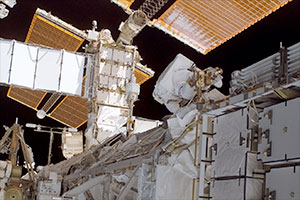
STS-115 mission specialist Joe Tanner works near the Solar Alpha Rotary Joint (SARJ) on the P3/4 truss outside of the International Space Station in 2006. (NASA) |