Posts: 56472 From: Houston, TX Registered: Nov 1999
posted 02-27-2026 12:18 AM
NASA video
Following the rollback of the Artemis II SLS (Space Launch System) rocket and Orion spacecraft on Wednesday, Feb. 25, experts will discuss the work ahead for the Artemis II test flight around the Moon and provide broader updates on the Artemis campaign.
NASA participants include:
Administrator Jared Isaacman
Associate Administrator Amit Kshatriya
Lori Glaze, acting associate administrator for NASA's Exploration Systems Development Mission Directorate
Robert Pearlman Editor
Posts: 56472 From: Houston, TX Registered: Nov 1999
posted 02-27-2026 09:34 AM
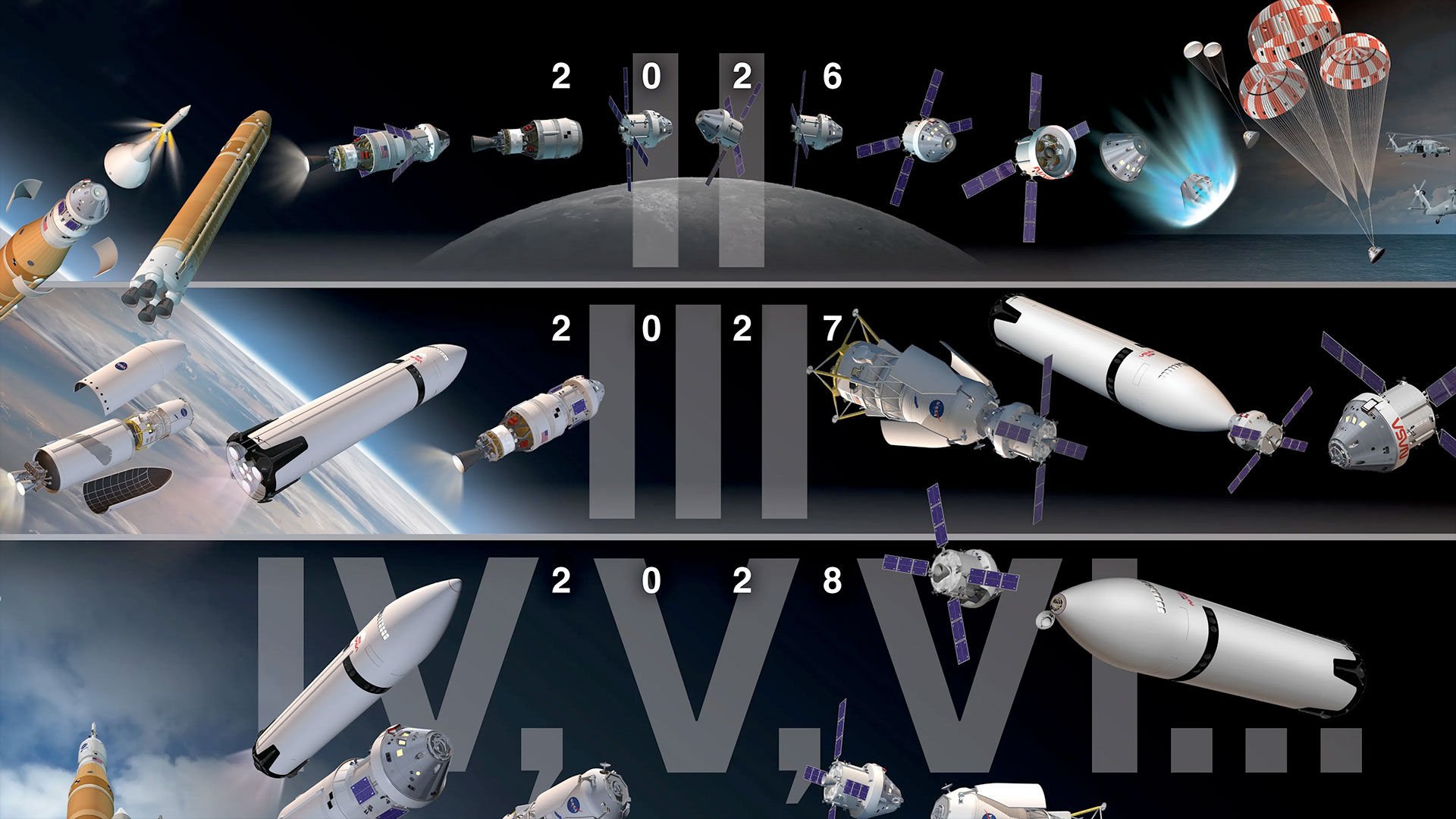
NASA is moving to increase the flight rate of the Artemis program. To that end, it is standardizing the design of the Space Launch System to a Block 1 configuration and then aiming for one mission every 10 months (or so):
Artemis II proceeds as planned in April
Artemis III in 2027 is now an Earth orbit mission to test rendezvousing with one or both HLS landers (SpaceX Starship and Blue Origin Blue Moon) and ideally test components of the new spacesuits
Artemis IV and V land on the moon; both missions targeted for 2028, as possible
The Administration, Congress and industry have already agreed to this approach.
As NASA continues to press forward with sending its first crew of astronauts to fly by the moon in more than 50 years, it is also making changes to its Artemis schedule, increasing its cadence from one lunar mission every three years to at least one annually.
With the Artemis II launch now targeted for April, pending the repair of a helium flow issue with the mission's Space Launch System (SLS) upper stage, NASA's leadership is looking to address safety and budget concerns by adding an additional mission to its manifest before attempting a landing on the moon in 2028.
issman1 Member
Posts: 1228 From: UK Registered: Apr 2005
posted 02-27-2026 10:15 AM
A more sensible plan but it seems that Gateway station is no longer needed.
SkyMan1958 Member
Posts: 1445 From: CA. Registered: Jan 2011
posted 02-27-2026 04:43 PM
Well, it now looks like we have an "Apollo 9 lite", to go with our "Apollo 8 lite".
As an American taxpayer, I for one am glad that we're going to scrap the Gateway project. Talk about a lobbyist's wet dream. It always struck me as lunacy to build a base in orbit instead of building one on the surface of the Moon. There are only so many tax dollars to spend, so it makes sense to focus on the final goal, which is a long term base on the Moon (I hesitate to call it a settlement).
Robert Pearlman Editor
Posts: 56472 From: Houston, TX Registered: Nov 1999
posted 02-27-2026 05:35 PM
Gateway has not been an either/or with a moon base for some time. Both were planned, and the earlier is now essentially built and waiting to launch.
It would not surprise me if we go ahead with putting the HALO and PPE elements into lunar orbit (using a Falcon Heavy, as planned) and then turn it over to our international and commercial partners to use and expand as desired. After all, Jeremy Hansen is on board Artemis II in barter for Canada's provision of a robotic arm to the Gateway. There is less use for a robotic arm of that nature on the surface of the moon.
oly Member
Posts: 1540 From: Perth, Western Australia Registered: Apr 2015
posted 02-27-2026 08:55 PM
The value of Gateway is often overlooked because people do not see why it is needed to go to the moon. Apollo never needed a gateway, so why have one now?
Gateway should be viewed as the next step in exploration in space. The ability to live in space for a quarter of a century has been achieved with ISS. Gateway takes that further away from Earth, removed from the protective envelope of Earth's protective shield. We do not know how to do that yet.
Being able to live and work in deep space is something we eventually need to be able to do, if we want to go beyond the Earth/Moon bubble.
The plan was for Gateway to ALSO act as a staging post for lunar missions. We already know that Earth-Moon missions are possible, and Gateway opens up more of the lunar surface as possible landing sites, including the polar regions. Gateway negates the safety and need for free return trajectories.
Many of the reasons cited as negatives for Gateway are actually positives. Rescue from the lunar surface from Gateway could take a long time if the relative positions of the Gateway and the lunar site were not ideally aligned. Critics pointed out that this was a bad idea, when theoretically, rescue via an Earth-launched vehicle could be done sooner. However, good engineers will see this as something that could and should be built into the system, because we need to learn how to do this one day.
Gateway was sold as a multinational collaboration for the “broader strategic aim of Artemis”. All four of the partner nations dedicated their money, skills, and resources to deliver their part of the Gateway. ESA is supplying the International Habitation Module (IHAB) as well as refuelling and communications systems. Canada is building Gateway's robotic arm, Canadarm3, the UAE is producing an airlock module, and Japan is contributing life support systems and habitation components.
Should Gateway be cancelled, the US abandoning the most multinational component of the Artemis program, at a time when trust in U.S. alliances is under unprecedented strain, could be far-reaching. Could it drive the coalition of partner nations to undertake their own program?
Having a platform to use for testing and research of equipment, systems, processes and procedures, away from Earth's protection, but close enough for supply, repair, and servicing, is important because we just do not know yet how much of each we need.
Can we produce the things we need to live sustainably in space, make the parts we need to repair our home, and repeatedly travel from the Moon to Earth via Gateway, with the capability we already have? These are questions that need answering eventually.
Not every mission needed to go via Gateway to the Moon. It seems crazy to fly a bulldozer to the Moon via Gateway. But having that capability expands the horizon of space capability more than repeating the idea of every rocket launch having to use up most of its energy, just to go the first 400 miles, of the 240000 mile trip, every time.
I have never been fully committed to the idea of Artemis and the SLS, mainly because I view it as many steps backwards and also the irony behind using rocket engines and solid rocket motors, originally designed to be reusable, strap them on to a very large tank, to use on a multi-billion dollar launch one time and dump them in the ocean, when the folks next door are building rockets that can be reused. Many would consider this idea dysfunctional. NASA promoted commercial spaceflight, and now the launch capabilities of companies like Blue Origin and SpaceX allow them to get payloads like Orion into space using reusable rockets.
To me, the constant changing of direction and moving of goal posts does more damage than needed. This latest announcement sets the idea of signing up to do multinational collaborations with NASA back, doing so is more problematic now, and it seems to be yet another misstep. The list of collaborative programs that the U.S. has abandoned is growing very fast these days.
Gateway may not have been the best plan, but it was a plan that many signed up to because of the plan laid out by NASA, which drove many years of design and development that now seems to be destined to collect dust in the back of a hangar. Now is a time that maintaining the commitment with other nations seems an important consideration in the decision making process.
Headshot Member
Posts: 1479 From: Vancouver, WA, USA Registered: Feb 2012
posted 03-03-2026 03:52 PM
This incremental approach is very sound and I am glad that there are rational people in power at NASA that understands this.
Jumping WAY ahead. I believe, however, that it will also affect the selection of landing sites on the Moon for Artemis IV and V. My belief is that Artemis IV's landing attempt will be made at a relatively "safe" site on the Moon's near side somewhere in the mid-southern latitudes. If that mission is successful, then Artemis V will probably target one of the nine landing candidate areas the South Pole region currently under scrutiny.
SpaceAngel Member
Posts: 609 From: Maryland Registered: May 2010
posted 03-21-2026 08:07 PM
What will become of the second launch tower for the Artemis/SLS; i.e. the one being currently constructed?
Robert Pearlman Editor
Posts: 56472 From: Houston, TX Registered: Nov 1999
posted 03-21-2026 08:08 PM
Jared Isaacman has said its construction is being halted, but NASA will consider other uses for its hardware.
taneal1 Member
Posts: 282 From: Orlando, FL Registered: Feb 2004
posted 04-27-2026 07:21 AM
Presumably, the Gateway rectilinear orbit will not be used for lunar missions with either the Blue Moon or Starship landers. Can the current Orion spacecraft service module engine perform the LOI and TEI burns from Apollo-type lunar orbits?
Has the ICPS become permanent, with no future replacement?
Robert Pearlman Editor
Posts: 56472 From: Houston, TX Registered: Nov 1999
posted 04-27-2026 07:29 AM
Yes, the European Service Module engine can perform the necessary burns, depending on the desired orbit. The engine is a reused (at first), modified space shuttle orbital maneuvering system (OMS) engine.
Jared Isaacman said he is looking at multiple options, including replacing the ICPS with Vulcan's dual-engine Centaur upper stage and/or performing rendezvous in Earth orbit or high lunar orbit.
Jim Behling Member
Posts: 2047 From: Cape Canaveral, FL Registered: Mar 2010
posted 04-27-2026 08:47 AM
quote:Originally posted by Robert Pearlman: Yes, the European Service Module engine can perform the necessary burns, depending on the desired orbit.
Not for Apollo low lunar orbit type missions. That is why the halo orbit was chosen. Orion and ESM was based on the Constellation conop where the Altair lunar lander performed the LOI burn and Orion only had to do TEI. This was done so that Altair could do uncrewed missions without Orion.
The HLS providers never liked the halo orbit. One of the options is its to meet the lander in earth orbit like Constellation. SLS would be overkill for this, hence the RFI for Commercial lunar launch services.
Delta7 Member
Posts: 1796 From: Bluffton IN USA Registered: Oct 2007
posted 05-02-2026 07:33 PM
With the Lunar Gateway now put on indefinite hold, is the plan to leave one or two crewmembers aboard the Orion spacecraft, or is the Orion capable of remaining in lunar orbit while all crewmembers descend to the lunar surface? At some point I'd think they'd need more than just two people at a time to accomplish the task of setting up a lunar base.
If the plan is to leave at least one astronaut to tend to Orion, will he or she be someone with a pilot background? Or will all crewmembers be considered having the skill to fly Orion, including in the case of an emergency, or God forbid they have to leave the landing crew behind?
Robert Pearlman Editor
Posts: 56472 From: Houston, TX Registered: Nov 1999
posted 05-02-2026 08:31 PM
At this point, there is just not enough information to answer questions like these. If decisions have been made within NASA, they have yet to be announced, but more likely everything is in the trade space right now.
Before the manifest change, NASA did talk about later Artemis crews landing with four people, leaving no one in orbit. Orion is designed to fly autonomously, as demonstrated on Artemis I.







 posted 02-27-2026 12:18 AM



 advertisement