|
|

|
|
Author
|
Topic: NASA's Artemis III (Orion/HLS in LEO)
|
Robert Pearlman
Editor Posts: 56976
From: Houston, TX
Registered: Nov 1999
|
 posted 03-11-2021 03:30 PM
   
NASA release Artemis IIINASA's Artemis III mission will launch four astronauts into Earth orbit aboard an Orion spacecraft on top of the Space Launch System (SLS) rocket to test rendezvous and docking capabilities between Orion and commercial spacecraft needed to land the Artemis IV crew on the moon in 2028. |
Robert Pearlman
Editor Posts: 56976
From: Houston, TX
Registered: Nov 1999
|
posted 03-11-2021 03:38 PM
NASA photo release (credit: NASA/Michael DeMocker) At NASA’s Michoud Assembly Facility in New Orleans, technicians from Orion prime contractor Lockheed Martin have welded together three cone-shaped panels on Orion’s crew module for the Artemis III mission. The crew module’s primary structure, the pressure vessel, is comprised of seven machined aluminum alloy pieces that are welded together through a weld process that produces a strong, air-tight habitable space for astronauts during the mission. Once welding of the Artemis III crew module primary structure is complete, it will be shipped to NASA’s Kennedy Space Center in Florida where it will undergo further assembly beginning this fall.  

|
Robert Pearlman
Editor Posts: 56976
From: Houston, TX
Registered: Nov 1999
|
posted 12-06-2022 01:50 PM
NASA release NASA advances moon rocket production for Artemis III, future missionsNASA is moving forward with Space Launch System (SLS) production and assembly activities for future Artemis missions.  Above: Teams at NASA’s Michoud Assembly Facility in New Orleans move the engine section flight hardware to the agency’s Pegasus barge Sunday, Dec. 4. The barge will ferry the engine section of NASA’s Space Launch System (SLS) rocket for Artemis III to the agency’s Kennedy Space Center in Florida. Teams at Kennedy will finish outfitting the engine section, which comprises the tail-end of the 212-foot-tall core stage, before integrating it with the rest of the stage. (NASA/Michael DeMocker) The agency is optimizing manufacturing capabilities by enabling SLS core stage lead contractor Boeing to use facilities at NASA's Kennedy Space Center in Florida to perform some core stage assembly and outfitting activities beginning with the Artemis III rocket. In tandem, teams will continue all core stage manufacturing activities at NASA's Michoud Assembly Facility in New Orleans. As the SLS program transitions from rocket development efforts to operations, NASA and Boeing evaluated how to improve upon the time required to produce each core stage and best use space at Michoud. "We're making progress developing, manufacturing, and assembling elements for future Artemis missions," said Jim Free, associate administrator for the Exploration Systems Development Mission Directorate. "Our collective workforce across NASA centers and industry partners plays a key role in accomplishing NASA's long-term plans for exploring the Moon." Beginning with production for Artemis III, NASA and Boeing will use Michoud, where the SLS core stages are currently manufactured, to produce and outfit the core stage elements, and available space at Kennedy for final assembly and integration. This opportunity provides for multiple mission elements to be manufactured and outfitted at the same time and for the workforce at Michoud to begin building the rocket's exploration upper stage, which will enable SLS to send even heavier and larger cargo to the Moon on the same missions with astronauts beginning with Artemis IV. All five major core stage structures will be manufactured at Michoud using current robotic welding tools and fixtures and complete all thermal protection system spray applications at Michoud. There, the forward skirt, the intertank, liquid oxygen tank, and the liquid hydrogen will continue to be outfitted and joined to form the upper part of the core stage. Upon completion, these structures, which comprise the top four-fifths of the 212-foot-tall stage, will be shipped to Kennedy's Vehicle Assembly Building (VAB) where they will be joined and vertically integrated in High Bay 2. Once the engine section structure is manufactured, it will be transported to Kennedy's Space Station Processing Facility for outfitting in the facility. When the engine section is completely outfitted, it and the stage's four RS-25 engines will be moved to the VAB's High Bay 2 for integration with the rest of the core stage, where technicians can more easily move it for stacking and assembly operations. Four of five major core stage parts for Artemis II have been joined, and teams are outfitting the last part, the engine section, and will soon connect it and the RS-25 engines to complete the stage at Michoud. The Artemis II stage is scheduled to be completed and delivered to Kennedy in 2023. The engine section for the Artemis III SLS core stage is expected to arrive at Kennedy in mid-December. |
Robert Pearlman
Editor Posts: 56976
From: Houston, TX
Registered: Nov 1999
|
posted 01-18-2023 11:06 AM
NASA photo updates April 18, 2022 - The core stage liquid hydrogen tank for the Artemis III mission completed proof testing, and technicians returned it to the main factory building at NASA's Michoud Assembly Facility in New Orleans where it will undergo more outfitting.  July 27, 2022 — Teams completed the welding of the Artemis III core stage liquid oxygen tank dome at the NASA's Michoud Assembly Facility in New Orleans.  October 26, 2022 — Technicians at NASA's Michoud Assembly Facility move the intertank of NASA's Space Launch System rocket for Artemis III to Cell G to await application of the thermal protection system.  December 15, 2022 — The engine section of the Space Launch System rocket's core stage for NASA's Artemis III mission is moved on a work stand into the high bay of the Space Station Processing Facility (SSPF) at NASA's Kennedy Space Center in Florida.  |
Robert Pearlman
Editor Posts: 56976
From: Houston, TX
Registered: Nov 1999
|
posted 05-04-2023 02:26 PM
Aerojet Rocketdyne release Aerojet Rocketdyne Delivers Propulsion for Artemis III MissionAerojet Rocketdyne recently completed the four RS-25 engines that will power the core stage of NASA's super heavy-lift Space Launch System (SLS) rocket during the Artemis III mission.  "The Artemis III mission is pivotal in our nation's goal to return American astronauts to the surface of the Moon, establish a sustained presence there and pave the way for crewed missions to Mars," said Eileen P. Drake, Aerojet Rocketdyne CEO and president. "As our nation makes this next giant leap in its space program, it is leveraging the extensive knowledge and lessons learned that were gained during our earlier exploration efforts, including the Apollo, Space Shuttle and Artemis I missions. We are truly standing on the shoulders of those who pioneered the exploration of deep space." The four RS-25 engines that will power the SLS rocket's core stage during the Artemis III mission have been upgraded following their service during the shuttle program and will now generate about 2 million pounds of combined thrust. The Artemis III RS-25 engines safely flew 138 individual astronauts to orbit and supported 26 Space Shuttle missions, including: - Multiple International Space Station assembly missions
- STS-95: The flight of then-U.S. Senator John Glenn, one of NASA's original Mercury astronauts
- STS-114: The Space Shuttle program's return to flight following the Columbia accident
- STS-125: The final Hubble servicing mission
 In addition to the RS-25 engines, Aerojet Rocketdyne has delivered all of its other propulsion systems for the Artemis III SLS rocket and a majority of the propulsion systems for the Orion spacecraft. Additional Aerojet Rocketdyne propulsion on the Artemis III mission includes the RL10 engine and 12 MR-106 reaction control system thrusters that will support the SLS's second stage, called the Interim Cryogenic Propulsion Stage. Aerojet Rocketdyne also supplies major propulsion elements for NASA's Orion spacecraft, including the Orion Main Engine; the jettison motor on the Launch Abort System; eight auxiliary engines for trajectory control and positioning on the service module; and 12 reaction control system engines that guide the Orion crew module's atmospheric re-entry. Aerojet Rocketdyne's Artemis III propulsion contributions are designed, built and tested at various sites across the country, including Los Angeles, California; NASA's Stennis Space Center in Mississippi; West Palm Beach, Florida; Redmond, Washington; Huntsville, Alabama; and Orange, Virginia. The pressurized tanks used for Orion's life support systems and flotation system for recovery at sea were manufactured and delivered by Aerojet Rocketdyne's ARDÉ subsidiary, located in Carlstadt, New Jersey. |
Robert Pearlman
Editor Posts: 56976
From: Houston, TX
Registered: Nov 1999
|
posted 08-17-2023 11:36 AM
United Launch Alliance (ULA) photo release Check out ULA photos from the arrival of ICPS-3 [Interim Cryogenic Propulsion Stage-3], the upper stage that will propel Artemis III astronauts.  

|
Robert Pearlman
Editor Posts: 56976
From: Houston, TX
Registered: Nov 1999
|
posted 01-05-2024 05:50 PM
NASA photo release Teams move the core stage liquid hydrogen tank for the Artemis III mission to a priming cell near the Vertical Assembly Building at NASA’s Michoud Assembly Facility in New Orleans Nov. 21, 2023. Technichians will sand down and prepare the suface of the tank before coating it in a primer. Primer is applied to the barrel section of the tank by an automated robotic tool, whereas the forward and aft domes are primed manually. Once priming is complete, technicians with NASA and Boeing, the SLS core stage prime contractor, will apply a foam-based thermal protection system, which protects the propellant tank from the extreme temperatures it will face during launch and flight while also regulating the super-chilled propellant within it.  

|
Robert Pearlman
Editor Posts: 56976
From: Houston, TX
Registered: Nov 1999
|
posted 01-09-2024 07:02 PM
collectSPACE NASA delays Artemis II and III astronaut moon missions to 2025, '26NASA has delayed the return of astronauts to the moon to address engineering issues and provide more time for the development of new vehicles and equipment. ... NASA also pushed back Artemis III, its first mission to land astronauts on the moon since the Apollo program did so more than 50 years ago, from late 2025 to September 2026. The delay acknowledges development challenges that have been experienced by NASA's commercial partners, including SpaceX for the human landing system and Axiom Space for next-generation lunar spacesuits.  |
Robert Pearlman
Editor Posts: 56976
From: Houston, TX
Registered: Nov 1999
|
posted 09-03-2024 06:59 PM
NASA photo release The transport carrier containing the European Service Module for NASA's Artemis III mission arrives at the Neil A. Armstrong Operations and Checkout Building at NASA's Kennedy Space Center in Florida on Tuesday, Sept. 3, 2024.  |
Robert Pearlman
Editor Posts: 56976
From: Houston, TX
Registered: Nov 1999
|
posted 05-22-2025 09:37 AM
NASA release Orange coat complete: Moon rocket on the moveTeams transport the core stage for NASA's Artemis III mission after applying thermal protection foam. Technicians at NASA's Michoud Assembly Facility in New Orleans, Louisiana, have completed spraying Thermal Protection System (TPS) foam on the Core Stage 3 liquid hydrogen tank.  Why it matters: TPS, which is what gives the rocket its orange color, insulates the stage from extreme temperatures during launch and maintains the liquid hydrogen at minus 423 degrees Fahrenheit (217 degrees Celsius) while on the pad. This third core stage built by Boeing will power the Artemis III mission. What they're saying: "There are better process controls in place than we've ever had before, and there are specialized production technicians who must have certifications to operate the system. It's quite an accomplishment and a lot of pride in knowing that we've completed this step of the build process," said Boeing's Brian Jeansonne, the integrated product team senior leader for the thermal protection system at NASA Michoud. |
Robert Pearlman
Editor Posts: 56976
From: Houston, TX
Registered: Nov 1999
|
posted 05-28-2025 09:23 PM
Lockheed Martin release Orion Roars to Life: Successful Power On Paves Way for Artemis IIIIn a major milestone for NASA's Artemis campaign, the Orion team recently powered on the Artemis III spacecraft's computers for the very first time.
This activity was the initial time the two vehicle management computers and the six power and data units were installed in the crew module, loaded with flight software, powered on and tested.
These core avionic systems, known as the "brain and heart" of the Orion capsule, are essential to test to ensure crew module subsystems are safe and reliable for flight.
Unprecedented Power Each of Orion's redundant flight computers are 20,000 times faster than the one on Apollo, and are substantially faster than flight computers on the space shuttle and the International Space Station. Its triple-redundant data network and gigabit ethernet technology enable rapid communication between systems, making it an ideal platform for deep space exploration.
"Over the next few months, our team will continue integrating the 70 components that make up the spacecraft avionics suite, connecting them with nearly 400 harnesses," said Nathan Varn, director of Orion assembly at Lockheed Martin. "We'll then put the vehicle through a series of functional tests to ensure all components are ready to move on to environmental testing, where the spacecraft is pushed to its limits." |
Robert Pearlman
Editor Posts: 56976
From: Houston, TX
Registered: Nov 1999
|
posted 04-16-2026 08:38 PM
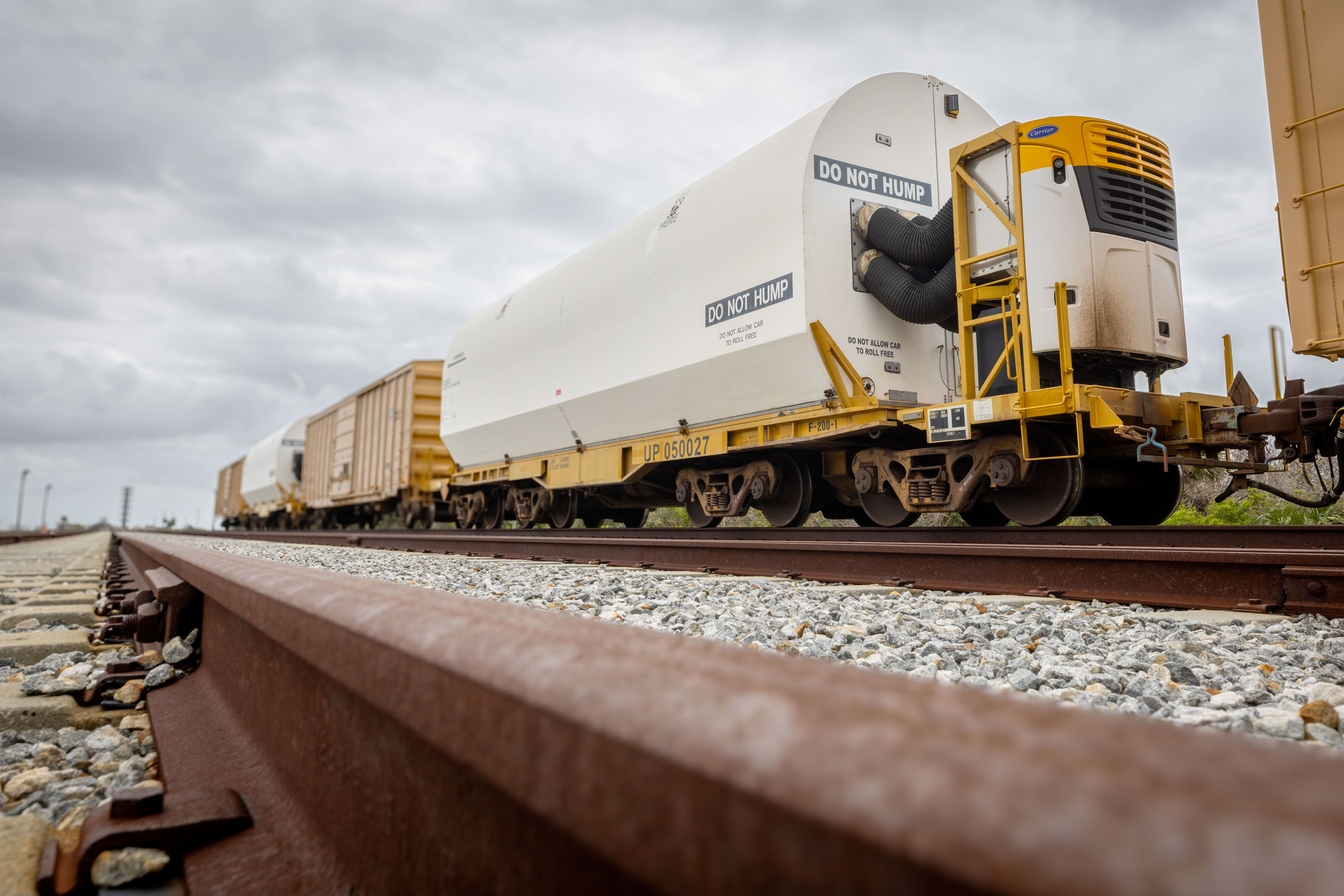
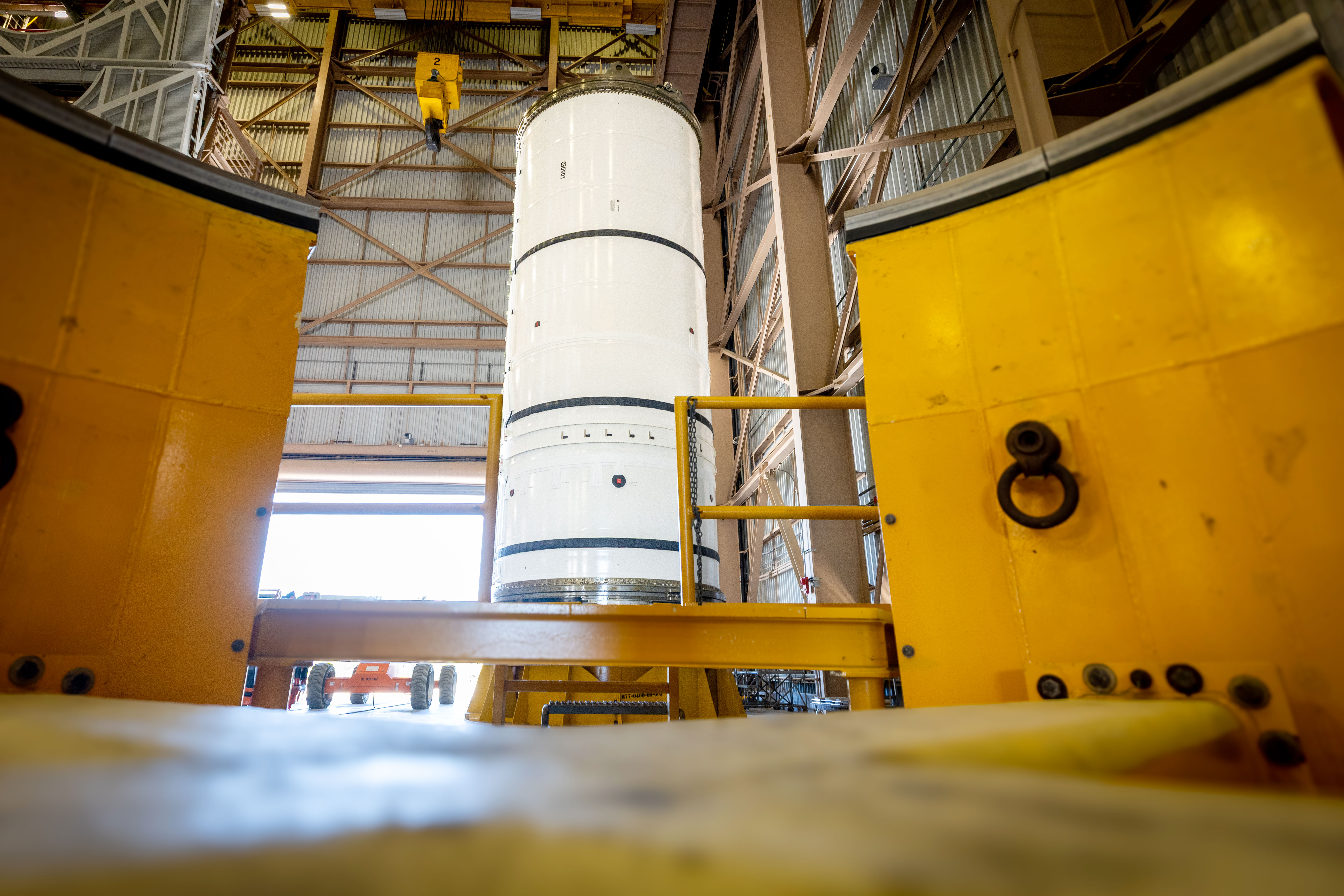
NASA photo release SRB aft skirts arrive, forward segment unboxedThe solid rocket booster aft skirt segments for the Artemis III SLS (Space Launch System) rocket arrived at a rail yard near NASA's Kennedy Space Center in Florida on Wednesday, April 8, 2026. Comprising the bottom of the twin, five-segment solid rocket boosters, the aft skirt segments traveled by train to the Florida spaceport and will be transferred from the rail yard to Kennedy’s Rotation, Processing and Surge Facility (RPSF) for processing. Separately, the left-hand forward solid rocket booster segment was removed from its shipping container ahead of processing inside the RPSF on Wednesday, April 15, 2026. 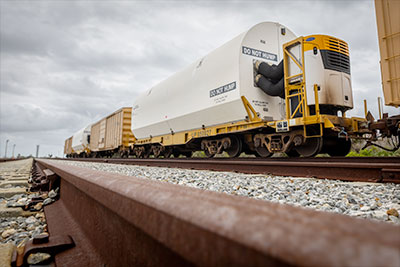 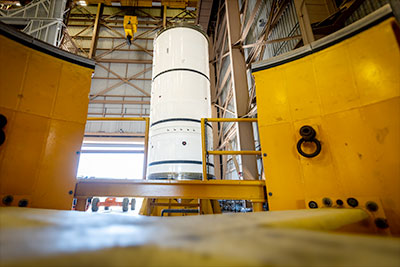
|
Robert Pearlman
Editor Posts: 56976
From: Houston, TX
Registered: Nov 1999
|
posted 04-16-2026 08:43 PM
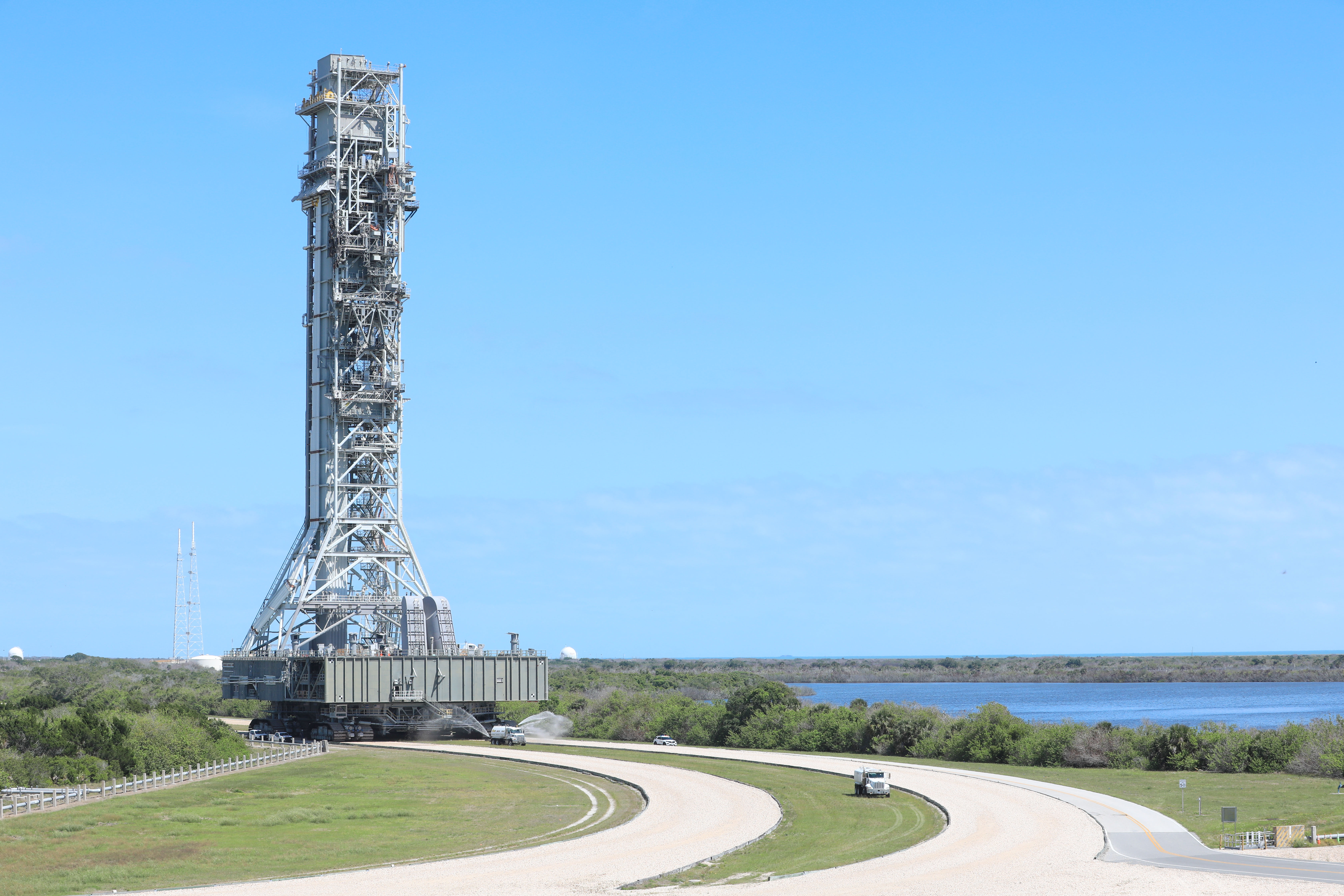
NASA photo release Mobile Launcher rollsFollowing the conclusion of NASA's Artemis II test flight, teams at the agency's Kennedy Space Center in Florida are shifting focus to Artemis III, which is targeted to launch next year, by rolling the mobile launcher from Launch Complex 39B to NASA's Kennedy Vehicle Assembly Building (VAB) in Florida in preparation for rocket stacking operations. 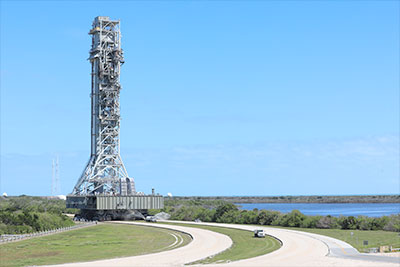 The mobile launcher began its approximately 4-mile trek on top of the agency's crawler-transporter 2 at 8:11 a.m. EDT Thursday, April 16, two weeks after sending NASA astronauts and Artemis II crew members Reid Wiseman, Victor Glover, Christina Koch, and (CSA) Canadian Space Agency astronaut Jeremy Hansen on their record-setting journey around the moon and back. Once it returns to the VAB, teams will continue to perform additional checkouts, inspections and data analysis and begin making repairs to the flame hole panels, elevators, pneumatic panels, and umbilicals that were damaged. Application of lessons learned from Artemis I to harden and reinforce ground support equipment at the pad proved successful as the mobile launcher and launch pad sustained minimal damage from the 8.8 million pounds of thrust expelled at booster ignition. The mobile launcher paused operations on Thursday to give ground teams an opportunity to rest, and will resume operations and proceed to the VAB on Friday, April 17. |
Robert Pearlman
Editor Posts: 56976
From: Houston, TX
Registered: Nov 1999
|
posted 04-20-2026 04:01 PM
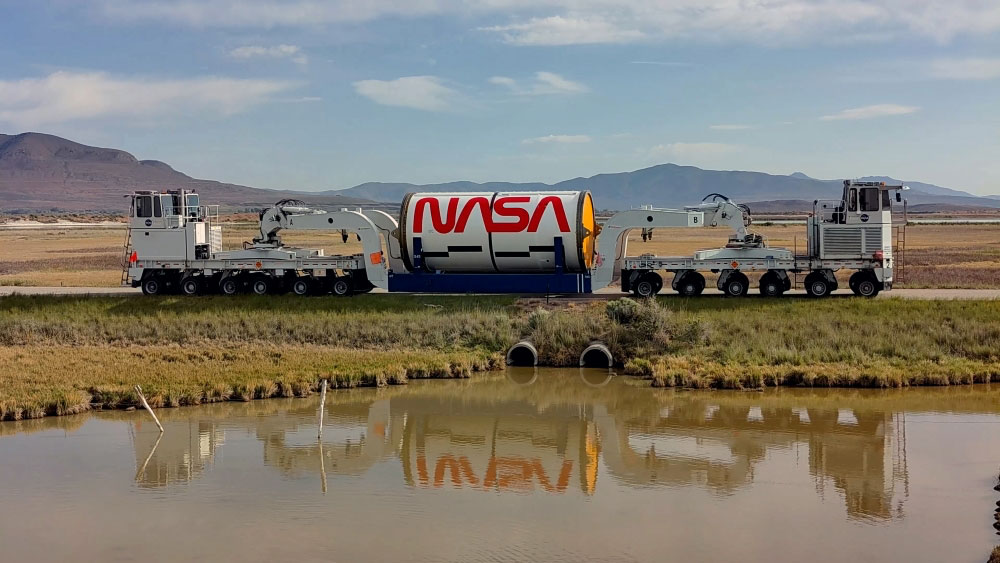
NASA release NASA Rolls Out Artemis III Moon Rocket Core StageNASA rolled out the core stage, or the largest section, of the SLS (Space Launch System) rocket that will launch the crewed Artemis III mission in 2027. The stage departed from the agency's Michoud Assembly Facility in New Orleans on Monday (April 20) for shipment to NASA's Kennedy Space Center in Florida, marking key progress on the path to the agency's first crewed lunar landing mission to the Moon under the Artemis program in two years. 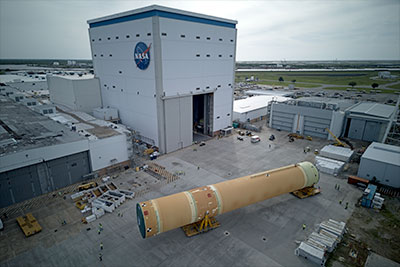 Above: NASA moved the core stage, or the largest section, of the SLS (Space Launch System) rocket that will launch the crewed Artemis III mission in 2027 from the agency’s Michoud Assembly Facility to the agency’s Pegasus barge in New Orleans on April 20. (NASA/Michael DeMocker) Using highly specialized transporters, engineers maneuvered the top four-fifths of the SLS core stage, the section containing the liquid hydrogen tank, liquid oxygen tank, intertank, and forward skirt, from inside NASA Michoud to the agency's Pegasus barge for delivery to NASA Kennedy. After arrival, teams will complete the stage outfitting and vertical integration, and the agency's Exploration Ground Systems Program will stack the rocket's components in preparation for launch.
"Seeing this SLS rocket hardware roll out is a powerful reminder of our progress toward returning humans to the lunar surface," said Lori Glaze, acting associate administrator, Exploration Systems Development Mission Directorate at NASA Headquarters in Washington. "This is the backbone of Artemis III. As it heads to Florida for final integration, we are one step closer to testing the critical capabilities needed to land Americans on the Moon, and ultimately, paving the way for our first crewed missions to Mars."
At 212 feet tall, the completed core stage will consist of the top four fifths of the rocket combined with its engine section. The top four-fifths include the two propellant tanks that collectively hold more than 733,000 gallons of super-chilled liquid propellant to fuel four RS-25 engines. During launch and flight, the fully integrated stage will operate for more than eight minutes, producing more than 2 million pounds of thrust to propel astronauts inside NASA's Orion spacecraft into orbit. |
Robert Pearlman
Editor Posts: 56976
From: Houston, TX
Registered: Nov 1999
|
posted 04-28-2026 09:57 AM
Core Stage Arrives at KennedyThe largest rocket section for the Artemis III mission arrived at the Kennedy Space Center in Florida on Monday (April 27). The SLS (Space Launch System) core stage traveled 900 miles on the Pegasus barge from NASA's Michoud Assembly Facility in New Orleans, where the stage was manufactured, to complete assembly at Kennedy. The top four-fifths of the 212-foot-long core stage — the section containing the liquid hydrogen tank, liquid oxygen tank, intertank, and forward skirt — was off-loaded from the barge and moved to the Vehicle Assembly Building on Tuesday. Inside, the stage will join the previously delivered boat-tail and engine section in the facility's High Bay 2 to complete the full core assembly. Photo credit: Fred Karst (cS: GACspaceguy) 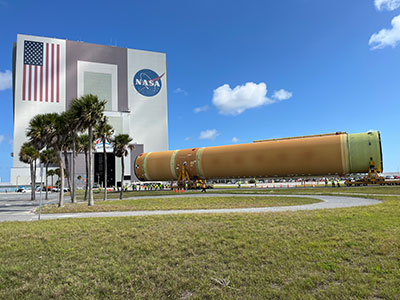 |
Robert Pearlman
Editor Posts: 56976
From: Houston, TX
Registered: Nov 1999
|
posted 05-13-2026 11:29 AM
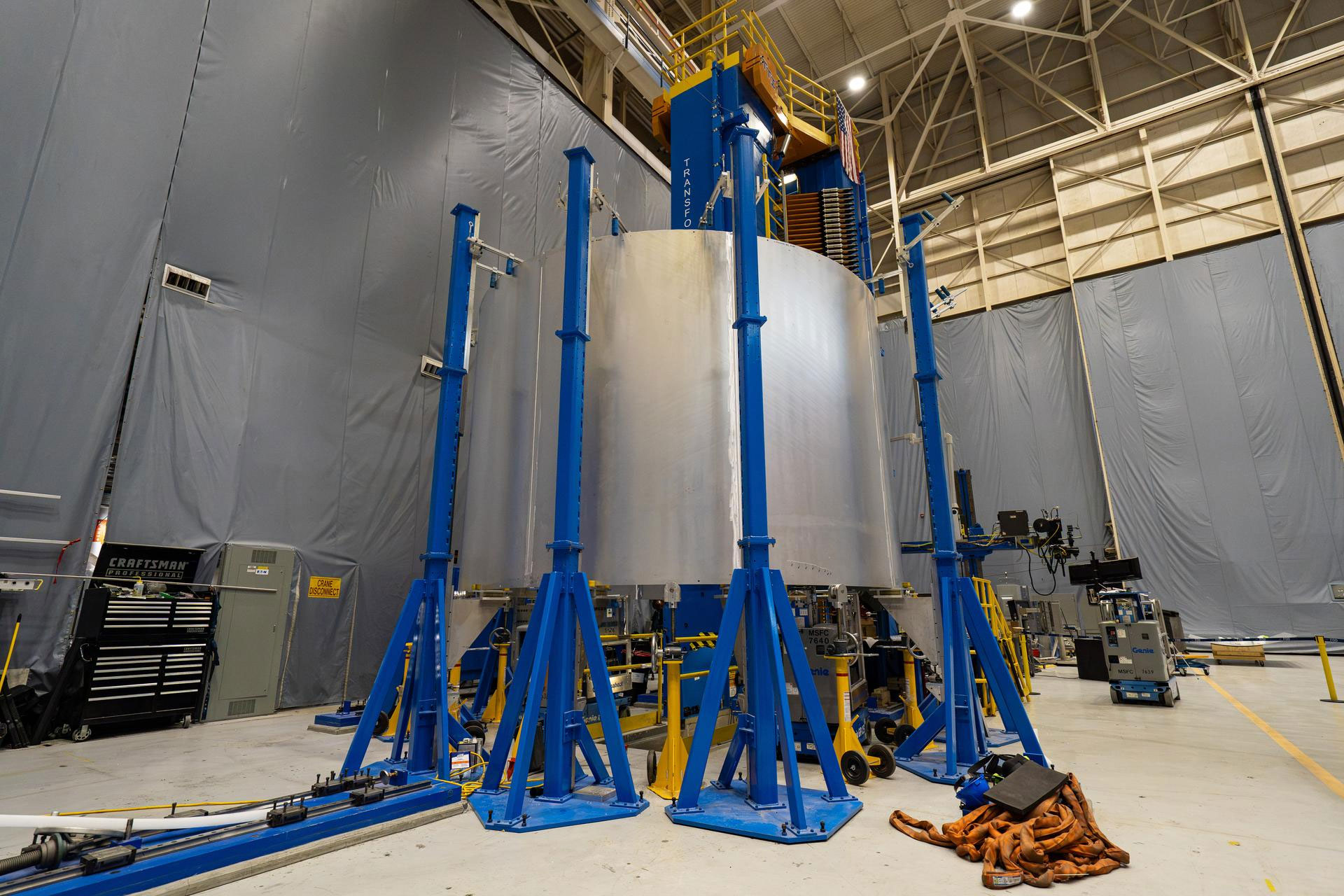
NASA release NASA Outlines Preliminary Artemis III Mission PlansNASA is moving quickly to define next year's Artemis III mission in Earth orbit, a crewed flight that will test rendezvous and docking capabilities between the agency's Orion spacecraft and commercial landers from Blue Origin and SpaceX. Since a February announcement adding an Artemis mission ahead of crewed landing missions to the Moon's South Pole region, engineers have been evaluating mission profile options and operational considerations for Artemis III to ensure the test flight helps the agency and its partners reduce risk ahead of the next Americans landing on the Moon during Artemis IV. "While this is a mission to Earth orbit, it is an important stepping stone to successfully landing on the Moon with Artemis IV. Artemis III is one of the most highly complex missions NASA has undertaken," said Jeremy Parsons, Moon to Mars acting assistant deputy administrator, NASA's Exploration Systems Development Mission Directorate in Washington. "For the first time, NASA will coordinate a launch campaign involving multiple spacecraft integrating new capabilities into Artemis operations. We're integrating more partners and interrelated operations into this mission by design, which will help us learn how Orion, the crew, and ground teams all interact together with hardware and teams from both providers before we send astronauts to the Moon's surface and build a Moon Base there." The mission is planned to carry out a series of objectives designed to demonstrate critical systems needed for a future lunar landing. During the Artemis III mission, the SLS (Space Launch System) rocket will launch the Orion spacecraft from NASA's Kennedy Space Center in Florida with four crew members. Instead of using the interim cryogenic propulsion stage as the upper stage of the rocket, NASA will use a "spacer," a representation of the mass and overall dimensions of an upper stage but without propulsive capabilities. The spacer will maintain the same overall dimensions and interface connection points as the upper stage between the Orion stage adapter and launch vehicle stage adapter. Design and fabrication activities for the spacer are progressing rapidly at NASA's Marshall Space Flight Center in Huntsville, Alabama. Material for the barrel section and the upper and lower rings is currently being machined at Marshall in preparation for upcoming welding operations. After the rocket delivers Orion to orbit, the spacecraft's European-built service module will provide propulsion to circularize Orion's orbit around the planet in low Earth orbit. This orbit increases overall mission success by allowing more launch opportunities for each element as compared to a lunar mission — SLS carrying Orion and its crew, SpaceX's Starship human landing system pathfinder, and Blue Origin's Blue Moon Mark 2 human landing system pathfinder. Informed by Blue Origin and SpaceX capabilities, NASA also is defining the concept of operations for the mission. While some decisions are yet to be determined, astronauts could potentially enter at least one lander test article. The crew will spend more time aboard Orion than during Artemis II, further advancing the evaluation of life support systems, and for the first time will demonstrate the docking system performance. The mission will inform lander rendezvous and habitation concepts and mission operations in preparation for future surface missions. The agency also plans to test an upgraded heat shield during Orion's return to Earth to enable more flexible and robust reentry profiles for future missions. Over the coming weeks, NASA will continue to refine specific plans for the flight, including a timeline for identifying astronauts to train for mission operations, options to evaluate Axiom's AxEMU spacesuit lander interfaces ahead of lunar surface missions, mission duration, and potential science operations for the flight. NASA has asked for industry input on potential solutions to improve the communications with the ground during the mission since the Deep Space Network will not be used. The agency also is seeking both international and domestic interest in potentially flying CubeSats to deploy in Earth orbit, and may share other opportunities as the concept of operations for the mission is further defined. |
Robert Pearlman
Editor Posts: 56976
From: Houston, TX
Registered: Nov 1999
|
posted 06-03-2026 10:53 AM
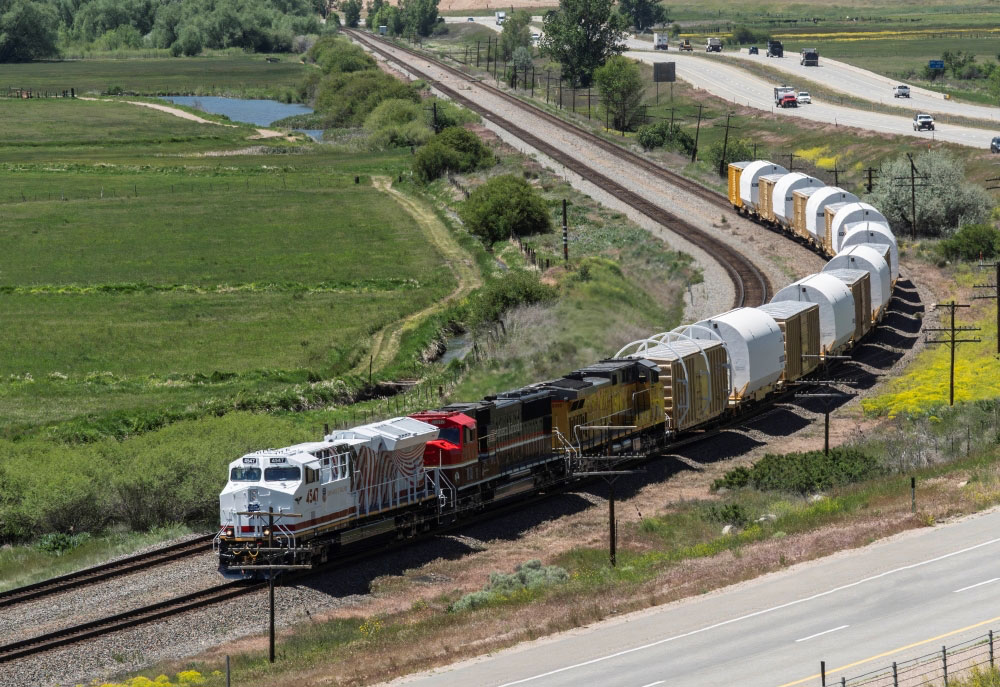
Northrop Grumman release Northrop Grumman Ships Final Artemis III Booster Segments, Igniting Humanity's Next Great Leap In SpaceProven solid rocket motors continue to drive America's return to the Moon and beyond Northrop Grumman shipped the final eight twin solid rocket booster motor segments for NASA's Artemis III mission to Kennedy Space Center, Florida, where they will be stacked this summer. The solid rocket boosters' proven performance is ready now to support NASA's goal of sustained lunar exploration and eventual missions to Mars. 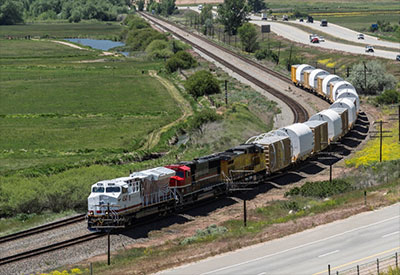 Above: Northrop Grumman's twin solid rocket booster segments enroute to Kennedy Space Center. (Northrop Grumman) Upon arrival, the booster segments will join the previously delivered segments shipped in April to be the first hardware assembled on the mobile launch platform. Northrop Grumman's industry-leading solid rocket boosters generate 7.2 million pounds of thrust at lift-off, providing much of the thrust needed for NASA's Space Launch System (SLS) during the Artemis III mission, which will send astronauts and critical cargo aboard the Orion spacecraft to test rendezvous operations in low-Earth orbit with human landing systems. With uniquely equipped facilities and a highly skilled workforce, the company can accelerate solid rocket motor production to meet NASA's increased Artemis mission launch cadence while supporting broader national security and space exploration objectives. 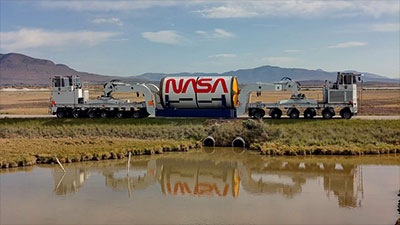 Above: Northrop Grumman technicians prepare the Artemis III center center solid rocket motor segment, featuring the iconic NASA "worm" logo painted directly onto the surface. (Northrop Grumman) |
Robert Pearlman
Editor Posts: 56976
From: Houston, TX
Registered: Nov 1999
|
posted 06-09-2026 05:27 PM
collectSPACE NASA names Artemis III crew to test moon landers in Earth orbitNASA's first astronauts to fly to the moon in more than 50 years handed off the baton to the next four people to launch on an Orion spacecraft on Tuesday (June 9). Artemis II crewmates Reid Wiseman, Victor Glover and Christina Koch, who with Canadian Space Agency astronaut Jeremy Hansen flew on a 10-day flyby of the moon, handed the symbolic metal bar to the newly-announced Artemis III crew: NASA astronaut and commander Randy Bresnik, Italian astronaut and pilot Luca Parmitano of the European Space Agency (ESA) and mission specialists Frank Rubio and Andre Douglas, both with NASA. 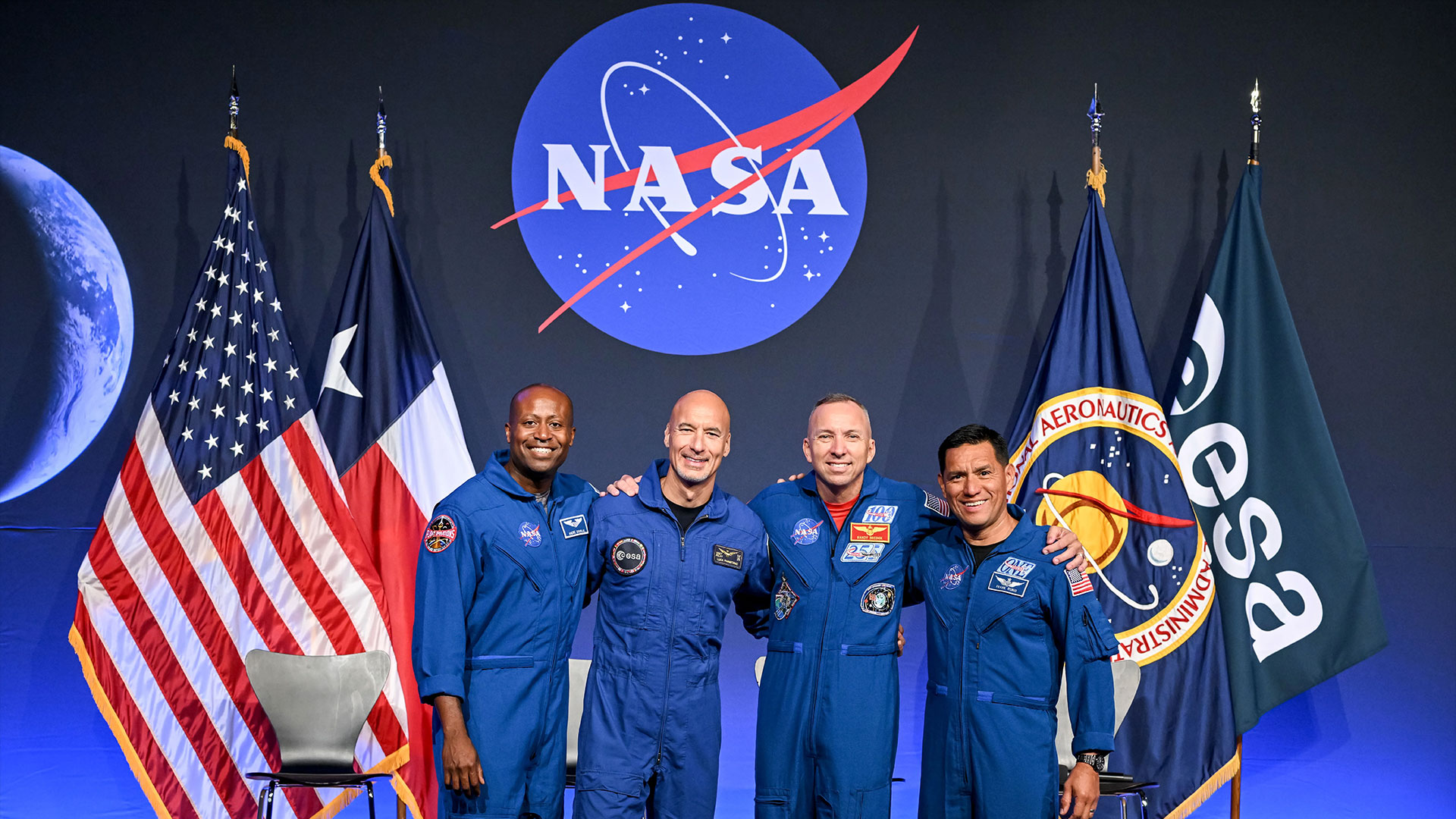 |
Robert Pearlman
Editor Posts: 56976
From: Houston, TX
Registered: Nov 1999
|
posted 06-19-2026 01:02 PM
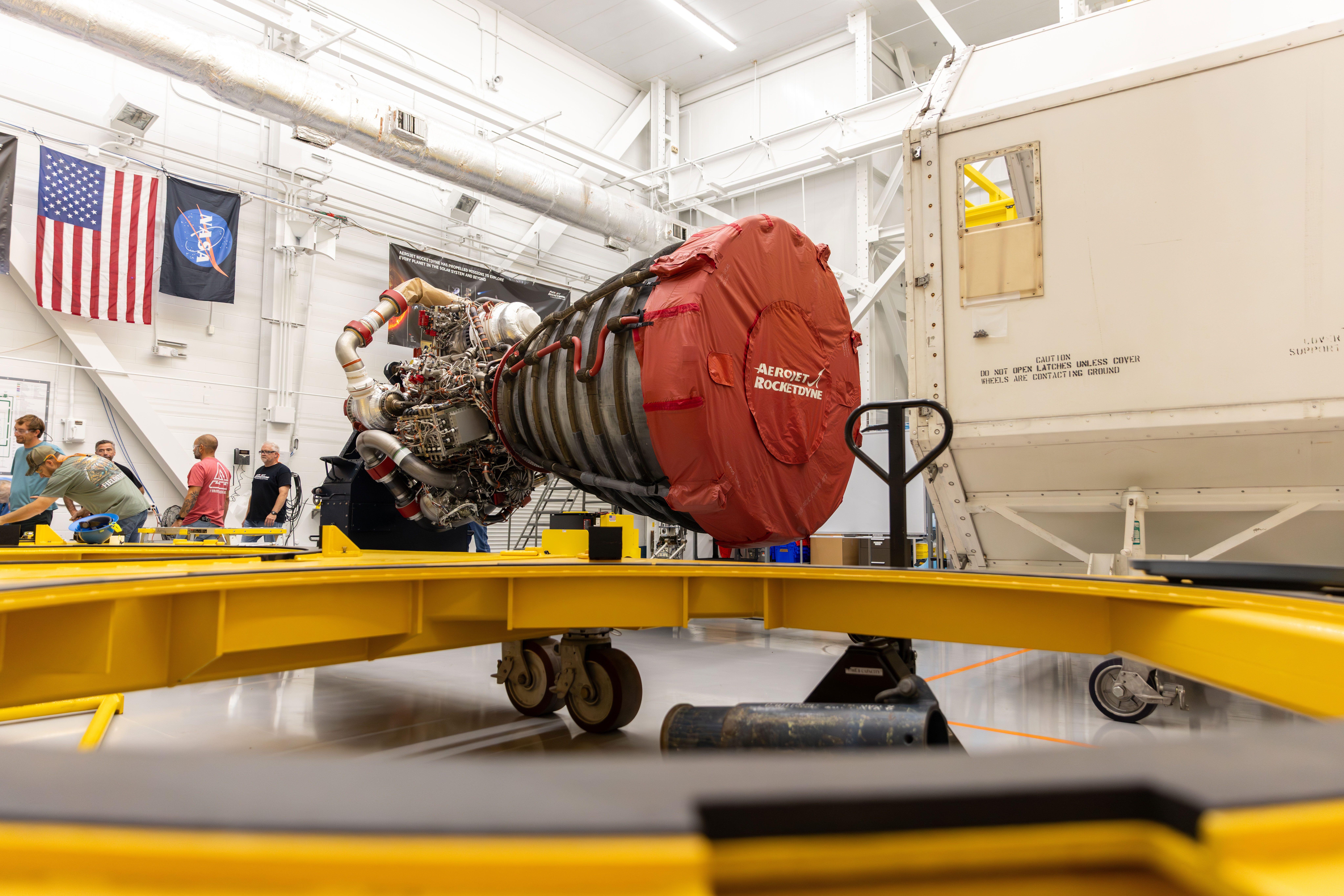
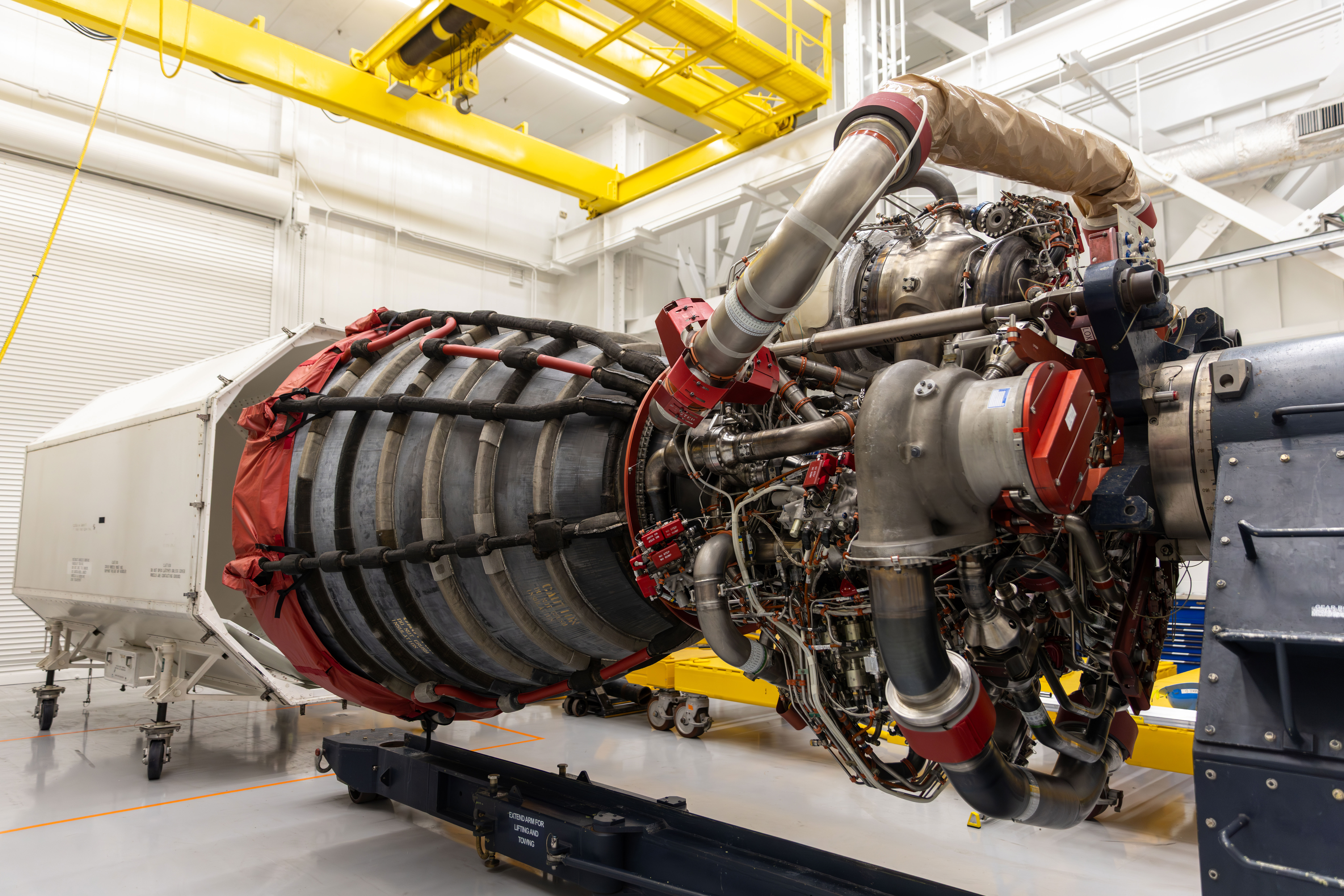
NASA photo release RS-25 engines arriveTeams at NASA's Kennedy Space Center in Florida offload the first of four RS-25 SLS (Space Launch System) rocket engines for the agency's Artemis III mission on Tuesday, June 16, 2026, inside the center's Vehicle Assembly Building. 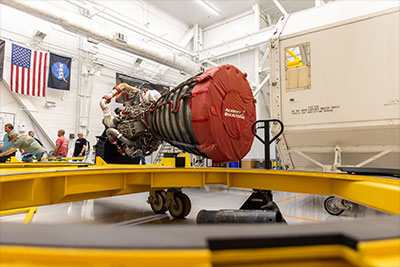 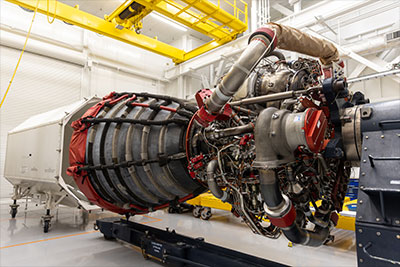
|
Robert Pearlman
Editor Posts: 56976
From: Houston, TX
Registered: Nov 1999
|
posted 08-05-2026 04:31 PM
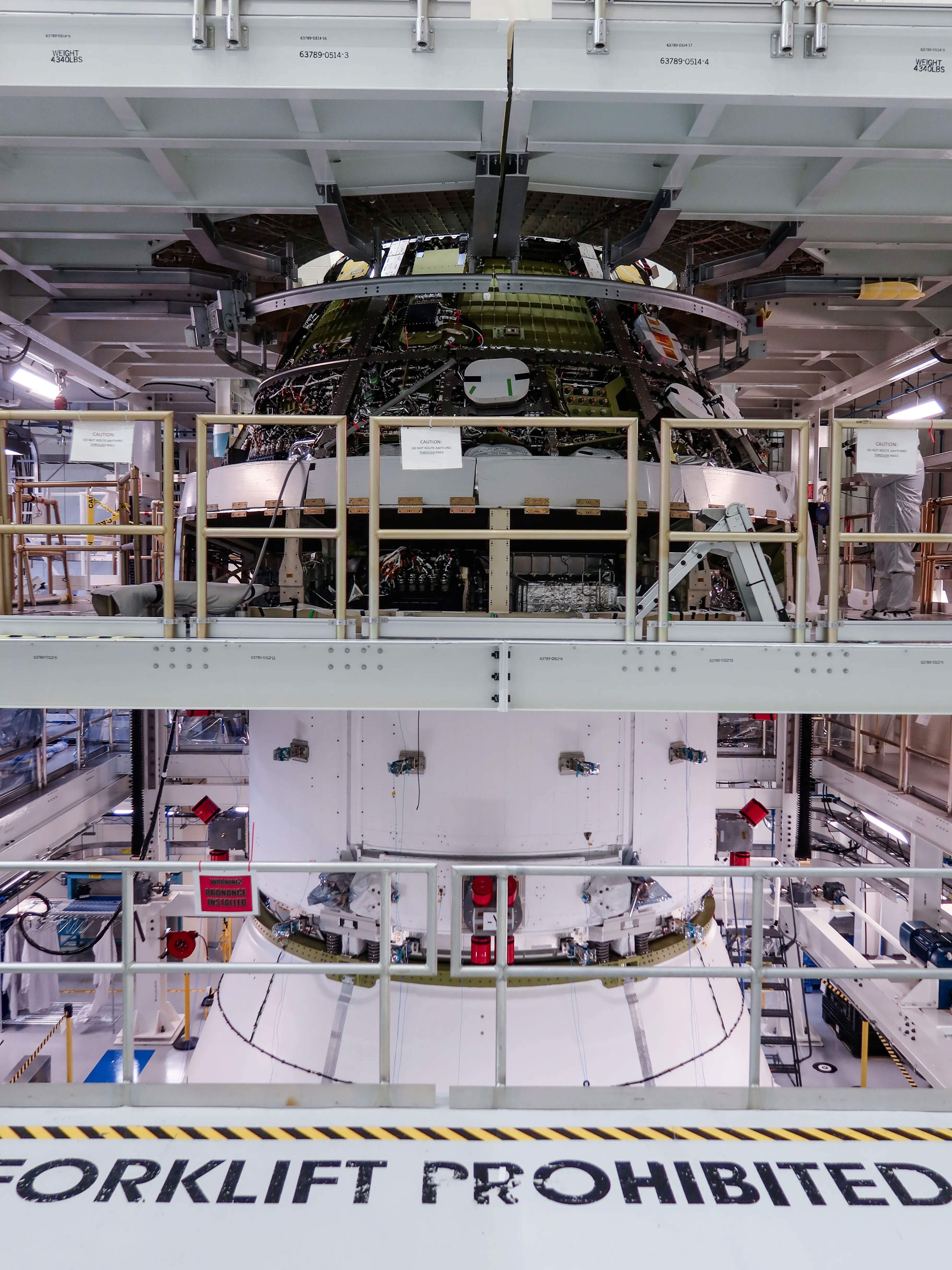
NASA release NASA Joins Artemis III Orion Modules; Rocket Hardware UpdateNASA is advancing toward Artemis III's crewed demonstration mission with accelerated, measurable progress across all fronts, outpacing Artemis II integration timelines as teams ready the Orion spacecraft and SLS (Space Launch System) rocket for next year's mission in low Earth orbit. 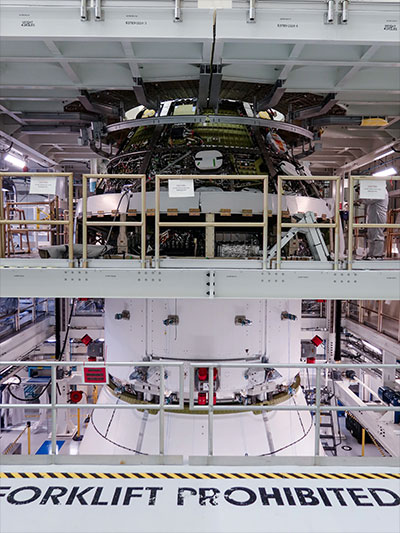 Above: The Orion crew and service modules for the Artemis III mission on Friday, July 31, 2026, after engineers joined the modules inside the Neil A. Armstrong Operations and Checkout Building at NASA’s Kennedy Space Center in Florida. (NASA/Amanda Stevenson) The Orion crew and service modules were joined together on July 30 inside the Neil Armstrong Operations and Checkout Building at the agency's Kennedy Space Center in Florida. After successfully completing hardware installations and testing in the Operations and Checkout Building, engineers connected the two major components of Orion that will fly NASA astronauts Randy Bresnik, Andre Douglas, and Frank Rubio and ESA (European Space Agency) astronaut Luca Parmitano on Artemis III. The crew module will carry and sustain astronauts, while the service module will power and propel Orion during the mission to test rendezvous and docking capabilities with test versions, or test articles, of commercial human landing systems from Blue Origin and SpaceX. With the crew and service modules integrated, the team will soon power up the combined spacecraft for the first time. After power on tests are complete, the team will continue integrated testing of Orion and complete final hardware installations. SLS Hardware Processing Also at NASA Kennedy, SLS integration preparations are advancing as NASA's Exploration Ground System teams completed inspections and checkouts on the solid rocket booster motor segments inside the center's Rotation, Processing, and Surge Facility. Teams began stacking the twin SLS solid rocket booster segments inside Kennedy's Vehicle Assembly Building in early July, beginning with the left-hand aft assembly. 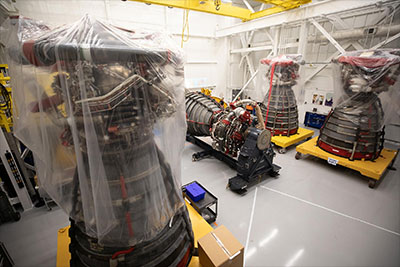 Above: All four RS-25 SLS (Space Launch System) rocket engines, built by L3 Harris Technologies, were delivered to NASA’s Vehicle Assembly Building at Kennedy Space Center in Florida for the Artemis III mission on Tuesday, July 21, 2026. (NASA/Ben Smegelsky) The final RS-25 engine was delivered on July 21 from NASA's Stennis Space Center near Bay St. Louis, Mississippi, and technicians will work to integrate the engine with the core stage this summer. At NASA's Marshall Space Flight Center in Huntsville, Alabama, technicians recently completed the eighth and final friction stir weld on the barrel section for the spacer that will fly on the Artemis III mission. With the welds complete, the barrel was lifted from the Vertical Weld Tool, and inspection activities are now underway. The next major milestone will be the installation of the spacer's top and bottom structural rings. For Artemis III, NASA will use a non‑propulsive spacer in place of the interim cryogenic propulsion stage. The spacer maintains the same overall dimensions and interface connection points as the upper stage, allowing it to be integrated between the Orion stage adapter and the launch vehicle stage adapter without modification to the vehicle's configuration. The remaining interim cryogenic propulsion stage has been reassigned to the Artemis IV mission. 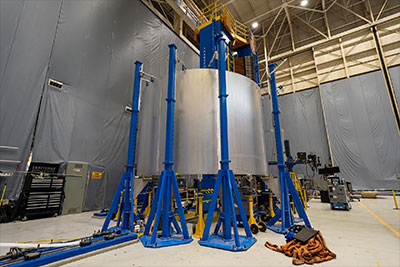 Above: Taken Thursday, July 23, 2026, at NASA’s Marshall Space Flight Center in Huntsville, Alabama, these images show the spacer that will be used on NASA’s SLS (Space Launch System) rocket for the Artemis III mission. (NASA/Sam Lott) Mission Efficiencies for Artemis III, Beyond NASA is repurposing the Orion stage adapter and launch vehicle stage adapter structural test articles for the Artemis III mission. Both structural test articles completed testing at Marshall prior to Artemis I, and engineers at Marshall are now carrying out detailed inspections and upgrades to ensure both structures meet flight requirements. This work represents a rapid and efficient response to evolving mission needs, leveraging newly fabricated structural hardware produced from legacy materials and modern manufacturing techniques to maintain schedule. Efficiency gains extend beyond new and repurposed hardware. Components are also reused from the Orion crew module that flew on the Artemis II mission, enabling cost and time savings. Reusing will enable earlier hardware installation by about three months and will also accelerate the Artemis IV schedule by making the components originally built for Artemis III available more than six months ahead. Additionally, more than 250 components from the Artemis II Orion spacecraft will be reused to support Artemis IV and Artemis V missions. NASA also is applying lessons learned from previous Artemis missions to streamline rocket and spacecraft processing and integration. Efficient processing of the solid rocket booster motor segments allowed for acceleration of their preparedness for integration by almost four months for Artemis III. Ground equipment was hardened and reinforced on the mobile launcher, and washdowns were completed immediately following the Artemis II launch to avoid corrosion. This contributed to a nearly 50% reduction in turnaround time to return the tower to the Vehicle Assembly Building for its next mission. Reusing upgraded ground systems supports a more frequent launch cadence. NASA will launch the SLS rocket and Orion spacecraft alongside its commercial partners to demonstrate critical systems needed for future lunar landings, beginning with Artemis IV in 2028. |
Robert Pearlman
Editor Posts: 56976
From: Houston, TX
Registered: Nov 1999
|
posted 08-27-2026 08:12 PM
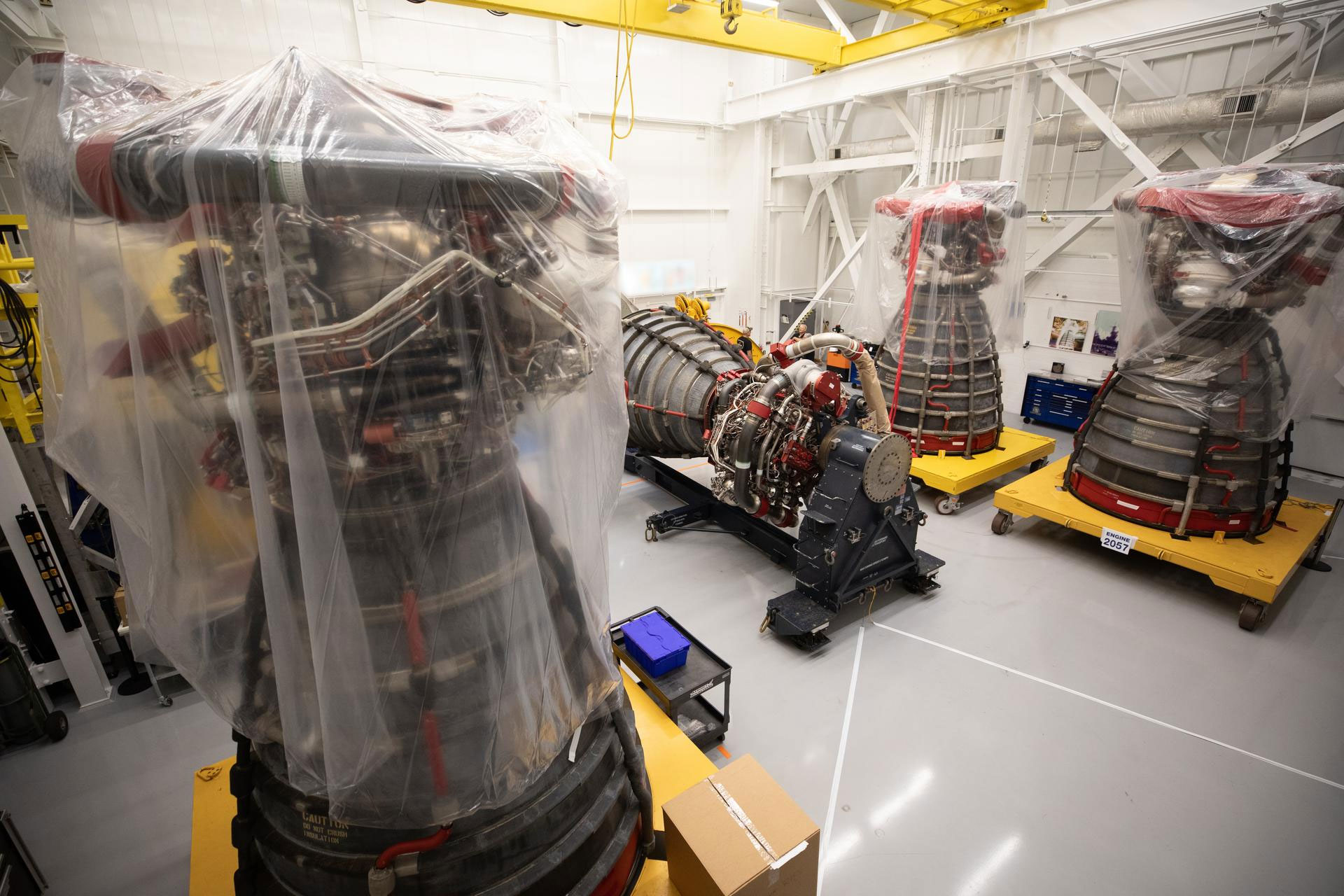
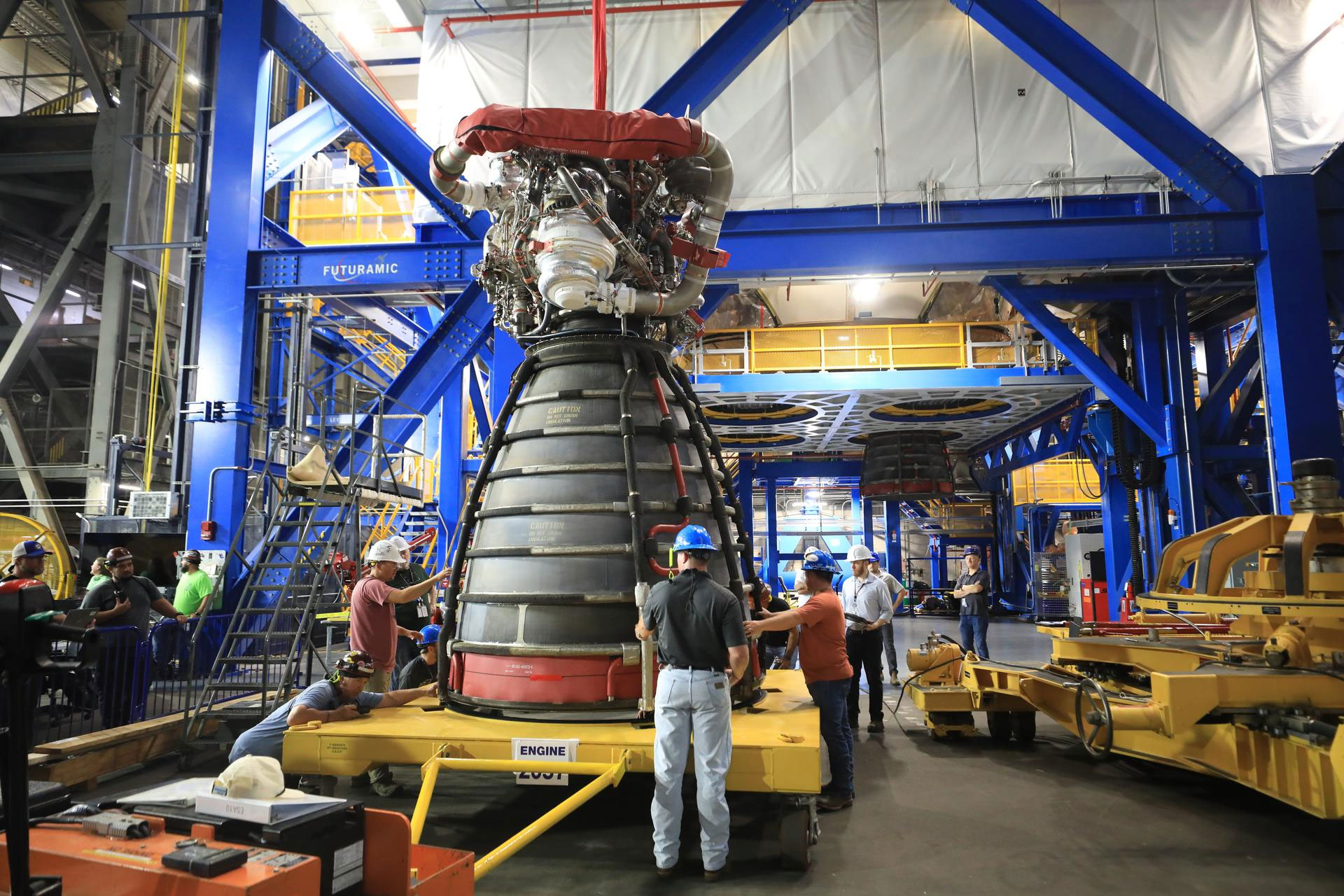
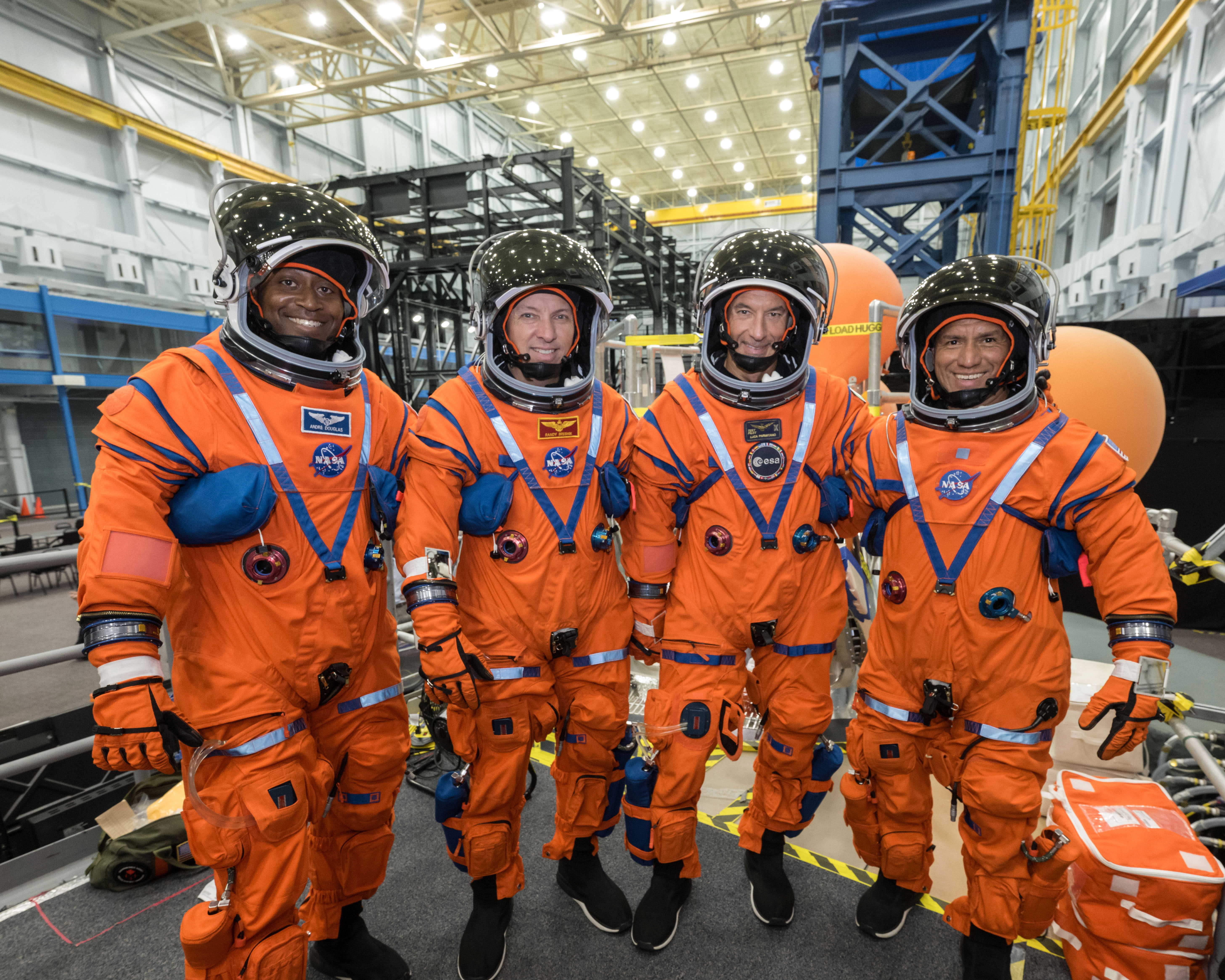
NASA release NASA Starts Artemis III Engine Install; Boosters, Crew Training AdvanceTechnicians at NASA's Kennedy Space Center in Florida began the installation of the four RS-25 engines in the core stage of the agency's SLS (Space Launch System) rocket that will launch the Artemis III crew next year. 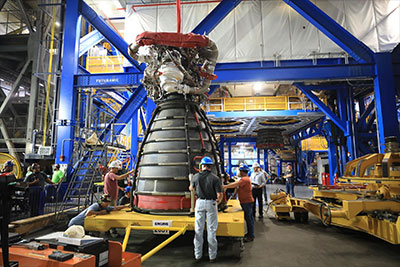 Above: Technicians prepare to transfer the #2 RS-25 SLS (Space Launch System) rocket engine (front) to the work stand with the #3 engine (back) for integration with the Artemis III core stage rocket on Tuesday, Aug. 25, 2026, inside the Vehicle Assembly Building at NASA's Kennedy Space Center in Florida. (NASA/Clayton Rougelot) The milestone on Aug. 24 marks the next phase of core stage integration following the mating of the engine section to the top four-fifths of the stage earlier this summer. Inside High Bay 2 at the spaceport's Vehicle Assembly Building (VAB), teams will continue installing the remaining engines, as well as the propulsion and electrical systems throughout the stage. Weighing in at approximately 7,700 pounds, each engine produces nearly 500,000 pounds of thrust. All four engines are located at the base of the SLS and are integrated inside the engine section. Built to withstand the extreme conditions during launch, this section protects the engines from severe temperatures. During ascent, the engines fire continuously for more than eight minutes, consuming propellant from the core stage's two massive propellant tanks at a rate of approximately 1,500 gallons per second. Each RS-25 engine carries a unique serial number that traces its detailed flight history. The four engines assigned to Artemis III, including E2054, E2057, E2048, and E2052, previously powered multiple shuttle missions. Engine 2048 helped power NASA astronaut Randy Bresnik's previous mission on space shuttle Atlantis during the STS-129 mission. The engine also powered Space Shuttle Discovery on STS-95 in 1998, which was the mission that returned 77-year-old space pioneer U.S. Sen. John Glenn to orbit, making him the oldest person to fly in space at the time. Technicians also continue to integrate the twin solid rocket booster motor segments atop the mobile launcher inside the VAB. Teams began stacking the segments in early July and are now more than halfway complete after streamlining processes and procedures learned from previous Artemis launches. Progress on the Orion spacecraft continues after the recent integration of the crew and service modules. Technicians recently installed the umbilical connector, which bridges the electrical, data, and fluid systems between the two modules, and installed its electrical connectors and fluid lines. Teams powered on the spacecraft for the first time since joining the two components to ensure electrical connectivity through the umbilical mechanism and that the communications of the subsystems between the crew and service module work as planned. Crew training underway After being assigned to the Artemis III mission on June 9, NASA astronauts Bresnik, Andre Douglas, Frank Rubio, and ESA (European Space Agency) astronaut Luca Parmitano began an intensive training flow that covers Orion systems and operations, science objectives, leadership and team‑building exercises, as well as joint training with commercial human landing system providers. The crew's training is organized around major phases of the mission, including ascent, orbit and rendezvous operations, entry, and both pre‑ and post‑landing readiness. 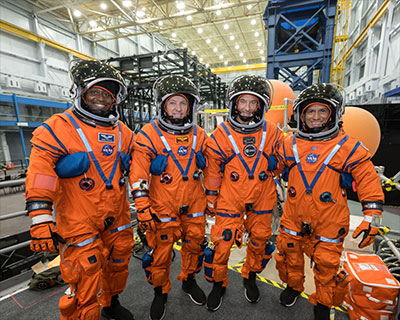 Above: From left, Artemis III crew members, NASA astronauts Andre Douglas and Randy Bresnick, ESA (European Space Agency) astronaut Luca Parmitano, and NASA astronaut Frank Rubio participate in training at NASA's Johnson Space Center in Houston on Wednesday, Aug. 19, 2026. (NASA/Bill Stafford) Crew members are working in the Orion mockup at NASA's Johnson Space Center in Houston, practicing daily spacecraft operations, such as mealtime routines, using equipment like the food warmer and potable water dispenser. They also are refining their camera skills to capture and share imagery from their mission in low Earth orbit. The crew recently completed an introductory water survival class focused on hardware used during off‑nominal landings, along with a post‑landing emergency exiting course that introduced splashdown procedures and initial post‑landing conditions. This week in NASA's Neutral Buoyancy Lab, they donned their spacesuits and practiced exiting Orion in an upright configuration. The practice allowed the crew to demonstrate the proper use of their Orion Crew Survival System suits, survival hardware, life raft, and more. The Artemis III crew also began integrated simulations with the flight control team, including the first simulation with the four crew members together. In these sessions, crew members and controllers rehearse mission timelines and respond to a variety of situations they could face in space, strengthening coordination, decision‑making, and procedures. | |
Contact Us | The Source for Space History & Artifacts
Copyright collectSPACE. All rights reserved.

Ultimate Bulletin Board 5.47a
|
|
|
 advertisement advertisement
|