Topic: SpaceX Dragon CRS-33 flight to space station
Robert Pearlman Editor
Posts: 56072 From: Houston, TX Registered: Nov 1999
posted 08-18-2025 06:56 PM
SpaceX CRS-33 Mission Overview
A SpaceX Falcon 9 rocket will launch the CRS-33 Dragon spacecraft to deliver cargo to and from the International Space Station for NASA.
The 13th flight under NASA's Commercial Resupply Services-2 contract with SpaceX, the CRS-33 Dragon will carry research, logistics and hardware for the Expedition 73 crew including:
InSPA-Auxilium Bioprinter — to demonstrate 3D printing an implantable medical device that could be used to deliver drugs to support nerve regeneration.
Microgravity Associated Bone Loss-B (MABL-B) — to assess the effects of microgravity on bone marrow mesenchymal stem cells (MSCs) in the presence of a signaling pathway inhibitor known as IL-6.
Metal 3D printer — to develop an additive manufacturing machine that demonstrates the capabilities of this technology to perform metal deposition in 3D under sustained microgravity conditions and manufacture test specimens.
MVP Cell-07 — to examine the behavior in microgravity of bioprinted or engineered liver tissue constructs that contain blood vessels.
Robert Pearlman Editor
Posts: 56072 From: Houston, TX Registered: Nov 1999
posted 08-24-2025 07:19 AM
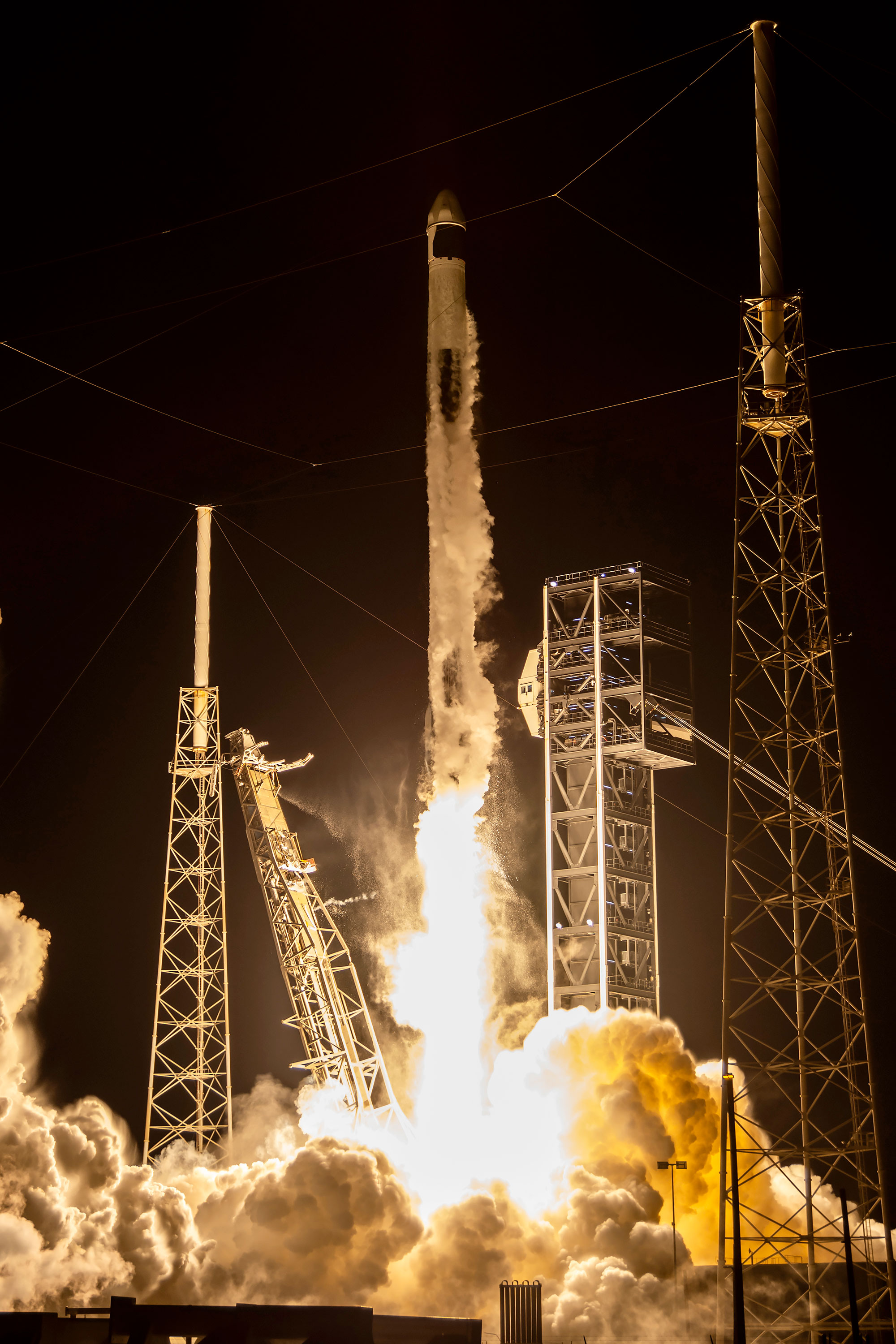
NASA release (photo: SpaceX)
NASA Science, Cargo Launch on 33rd SpaceX Resupply Mission to Station
Following a successful launch of NASA's SpaceX 33rd commercial resupply mission, new scientific experiments and cargo for the agency are bound for the International Space Station.
The SpaceX Dragon spacecraft, carrying more than 5,000 pounds of supplies to the orbiting laboratory, lifted off at 2:45 a.m. EDT on Sunday, on the company's Falcon 9 rocket from Space Launch Complex 40 at Cape Canaveral Space Force Station in Florida.
"Commercial resupply missions to the International Space Station deliver science that helps prove technologies for Artemis lunar missions and beyond," said acting NASA Administrator Sean Duffy. "This flight will test 3D printing metal parts and bioprinting tissue in microgravity - technology that could give astronauts tools and medical support on future Moon and Mars missions."
The spacecraft is scheduled to dock autonomously at approximately 7:30 a.m. to the forward port of the space station's Harmony module.
In addition to food, supplies, and equipment for the crew, Dragon will deliver several experiments, including bone-forming stem cells for studying bone loss prevention and materials, to 3D print medical implants that could advance treatments for nerve damage on Earth. Dragon also will deliver bioprinted liver tissue to study blood vessel development in microgravity, as well as supplies to 3D print metal cubes in space.
These are just a sample of the hundreds of biology and biotechnology, physical sciences, Earth and space science investigations conducted aboard the orbiting laboratory. This research benefits people on Earth while laying the groundwork for other agency deep space missions. As part of NASA's Artemis campaign, the agency will send astronauts to the Moon to prepare for future human exploration of Mars, inspiring the world through discovery in a new Golden Age of innovation and exploration.
During the mission, Dragon also will perform a reboost demonstration of station to maintain its current altitude. The hardware, located in the trunk of Dragon, contains an independent propellant system separate from the spacecraft to fuel two Draco engines using existing hardware and propellant system design. The boost kit will help sustain the orbiting lab's altitude starting in September with a series of burns planned periodically throughout the fall of 2025. During NASA's SpaceX 31st commercial resupply services mission on Nov. 8, 2024, the Dragon spacecraft performed its first demonstration of these capabilities.
The Dragon spacecraft is scheduled to remain at the space station until December, when it will depart the orbiting laboratory and return to Earth with research and cargo, splashing down off the coast of California.
Robert Pearlman Editor
Posts: 56072 From: Houston, TX Registered: Nov 1999
posted 08-25-2025 07:29 AM
Dragon docks to space station
SpaceX's CRS-33 Dragon spacecraft docked to the forward port of the International Space Station's Harmony module on Monday (Aug. 25) at 8:05 a.m. EDT (1205 GMT).
Robert Pearlman Editor
Posts: 56072 From: Houston, TX Registered: Nov 1999
posted 09-04-2025 09:17 AM
Dragon boosts space station
On Wednesday (Sept. 3), SpaceX’s CRS-33 Dragon completed an initial burn to test the spacecraft's new capability to help maintain the altitude of the International Space Station.
Two Draco engines located in the trunk of Dragon, which contains an independent propellant system, were used to adjust the space station's orbit through a maneuver lasting 5 minutes and 3 seconds. The initial test burn increased the station's altitude by around one mile at perigee, or low point of station's orbit, leaving the station in an orbit of 260.9 by 256.3 miles.
The new boost kit in Dragon will help sustain the orbiting lab's altitude through a series of longer burns planned periodically throughout the fall of 2025.
Robert Pearlman Editor
Posts: 56072 From: Houston, TX Registered: Nov 1999
posted 02-26-2026 10:46 PM
Dragon departs space station
On Thursday (Feb. 26) at 12:05 p.m. EST (1705 GMT), the SpaceX CRS-33 Dragon spacecraft undocked from the forward-facing port of the International Space Station's Harmony module following a command from ground controllers at SpaceX.
After re-entering Earth's atmosphere, the spacecraft is scheduled to splash down at approximately 2:44 a.m. EST on Friday off the coast of California.
At 11:44 p.m. PST on Feb. 26, the unpiloted SpaceX Dragon spacecraft splashed down off the coast of California, marking the return of the company's 33rd Commercial Resupply Services mission to the International Space Station for NASA.







 posted 08-18-2025 06:56 PM



 advertisement