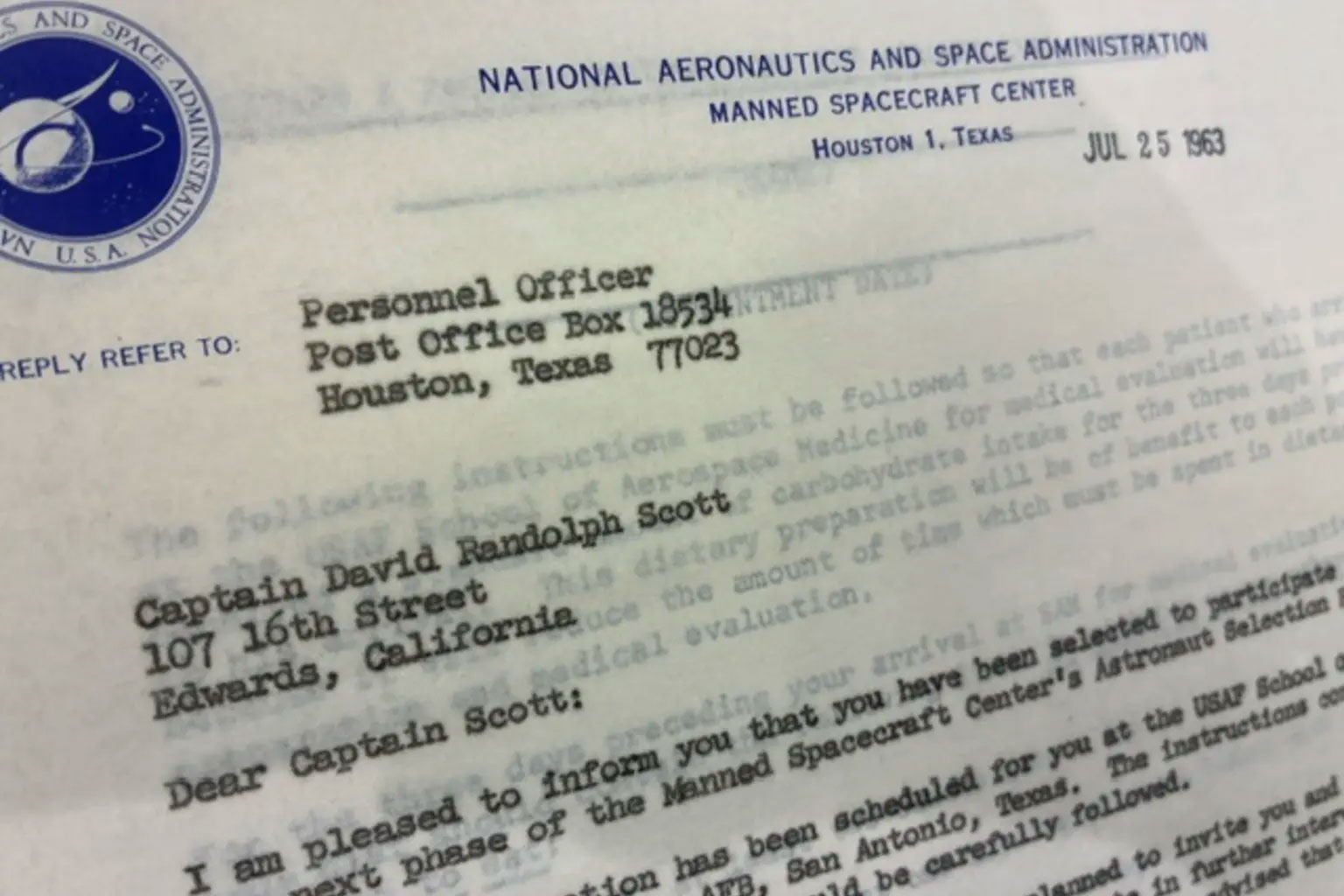
Rose Library displays family artifacts of an early NASA astronautImagine receiving a letter announcing that you've advanced to the next stage in the selection process for a highly prestigious job. Only you can't tell anyone. And, in the days leading up to more tests and interviews for the position, you have to follow a strict dietary protocol that includes eating three to five candy bars a day.
That was the reality of David Scott, a U.S. Air Force test pilot who went on to fly in NASA's Gemini 8, Apollo 9 and Apollo 15 missions and became the seventh person to set foot on the moon. He is the father of Tracy Scott, associate teaching professor in Emory's Department of Sociology, who was two years old in 1963, when the selection letter and instructions from NASA landed in her family's mailbox.
Visitors are invited to peruse the letter and more on Tuesday, Sept. 15, from 1-3 p.m. during Stuart A. Rose Manuscript, Archives and Rare Book Library's free open-house series, "Miscellaneous Monthly."
Each open house showcases items from the Rose Library's collections related to a different theme each month. September's theme is "Space."
In addition to other items from the Scott family's NASA years, the library will feature first editions of two science-fiction novels: "The Skylark of Space" by E.E. Smith, published in 1946, and "Dawn: Xenogenesis" by Octavia Butler, from 1987.
Tracy Scott donated her family's artifacts related to the space program to the Rose Library in 2020. The collection includes an assortment of personal correspondence, NASA materials, images, audiovisual items and memorabilia collected by her parents over decades.
Students taking her course, "Moon Bound in the '60s: A Sociology of the Apollo Era," use items in the collection to study the historical and social contexts of the early U.S. Gemini and Apollo missions.
Tracy Scott learned about the candy bar directive from her students during a class visit to the library five years ago. "I hadn't really looked at that letter before I donated it," she says. "A group of students called me over, and they're like, 'This is so weird. Why did he have to eat three candy bars a day?'" To find out, she went to the source. Her father, who is now 94 years old, told her that the candy bars were to test the candidates for sugar tolerance and diabetes.
It was one of many physical and psychological tests required of early NASA candidates. "You have to remember," she says, "they didn't know what was going to happen to people in space."
The first moon walk wouldn't take place until 1969.
The astronaut-selection process was shrouded in secrecy, says Tracy Scott, pointing out the passage in the 1963 letter to her father that asks him not to share his status with other candidates.
"It was all secret, hush-hush," she says, explaining that NASA didn't want rejected candidates going to the press.
Her mother, Lurton Scott, and the other wives of candidates kept those secrets and prepared the meals following the strict dietary rules prescribed by NASA.
Tracy Scott notes that was just the start of what became full-time jobs for those whose husbands joined NASA. In addition to running their households during the astronauts' long absences, the wives "talked to the press and made speeches" in support of the space agency, she says.
After the Apollo 15 mission to the moon, she adds, they even "paid State Department visits to other countries, where they had their own itinerary, their own staff. As one of my students said, 'They were like first ladies.'"
Tracy Scott collects primary source documents from the Apollo 15 and Gemini 8 era to study the communities and culture that enabled the success of the moon missions.
She partnered with the Emory Center for Digital Scholarship to create the Apollo 15 Learning Hub, an interactive, online collection about the 1971 moon mission commanded by her father.
The Rose Library open house offers the public a chance to browse through memorabilia from that era in person.
"I hope visitors see that this is more than the story of an astronaut going into space," Tracy Scott says. "It's the community behind that, and the world behind that."







 posted 09-03-2026 08:37 PM



 advertisement