|
|

|
|
Author
|
Topic: Space Cover 881: Agassiz station
|
Antoni RIGO
Member Posts: 404
From: Palma de Mallorca, Is. Baleares - SPAIN
Registered: Aug 2013
|
 posted 11-07-2026 02:54 AM    
Space Cover of the Week, Week 881 (November 8, 2026) 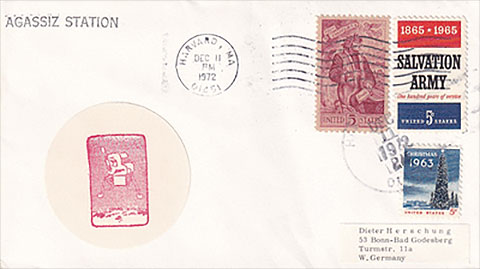 Space Cover 881: Agassiz stationIs there an official list of all tracking stations involved in Apollo program? And for other space centers, organizations, institutions involved in Apollo program? Along the years I have seen many space covers for a wide range of Earth locations linked in some way with Apollo missions. Above a space cover from AGASSIZ STATION (upper left corner) from Harvard, MA on Dec 11, 1972 with two cancels (mechanical and hand, this last one very poor) commemorating Apollo 17 Moon landing. A red rubber stamp cachet completes visually the space event.
Agassiz station was not a tracking station but an astronomical observatory, originally called Oak Ridge Observatory, and was operated by Harvard Observatory, in Massachusetts. Obviously, this is not a main space Apollo cover or a key Apollo cover but this is another one what explains how deep was the program Apollo in the scientific community. Did you know it? Do you have other covers from Agassiz station? If so, please share them in collectSPACE. For sure, all will be happy to see them. Thanks. |
yeknom-ecaps
Member Posts: 1014
From: Northville MI USA
Registered: Aug 2005
|
posted 11-07-2026 09:10 AM
Unfortunately no, there is not a single source of tracking/support stations for any space missions. NASA and the Department of Defense had their own lists and that only covered the "main" stations. There were also "educated guesses" on other locations being involved. Collector Bob Ekas and cover servicer Bob Boudwin did a lot of research - remember this was without the Internet - to look through the NASA and US Department of Defense publications and phone calls to multiple NASA and DOD public affairs offices to attempt to make up such a list. Bob Ekas published that list for collectors, and for a time, produced a publication known as "The Dish." The address list was a compilation of address and locations that collectors could send covers to. It was organized by type of station and each address was assigned an "Ekas number." Jack McMahon listed the tracking stations in his catalog with the Ekas numbers. There were categories, such as "C" for commercial communication tracking sites (e.g., COMSAT), "D" for Deep Space Network, "E" for Eastern Test Range stations, "N" for NORAD stations, "O" for observatories, "S" for NASA STDN stations, etc. Without having any real guide to what sites were directly involved or not collectors sent to many/all of them. Interestingly, you find a lot of the tracking station covers having the Ekas number (e.g. E-1, S-4, etc.) written on the back of the covers so the collector could track which stations actually serviced their covers. For example, the Palomar Observatory was on the list but did not play a role at all. Many of the commercial communication stions were either secondary or backup data carriers which may or may not have been used. Specific to your question, The George R. Agassiz Station (Oak Ridge Observatory) in Harvard, Massachusetts, was directly involved in the Apollo missions by serving as a key ground tracking site for the Lunar Laser Ranging Experiment during the Apollo 11, 14, and 15 missions but not Apollo 12, 13, 16, and 17 missions.
|
Axman
Member Posts: 986
From: Derbyshire UK
Registered: Mar 2023
|
posted 11-07-2026 09:36 AM
It gets even more confused because there were at least three tracking networks used during Apollo. - The STADAN network, which evolved from the Mercury minitrak aerial network, and transitioned into the STADN network.
- The Manned Spaceflight Network (MSFN).
- Deep Space Network (DSN) with parabolic dishes.
Lists of tracking stations are available from separate sources but none tally with each other. |
Antoni RIGO
Member Posts: 404
From: Palma de Mallorca, Is. Baleares - SPAIN
Registered: Aug 2013
|
posted 11-08-2026 04:53 AM
Tom, many thanks for your post with a lot of information about philatelic sources to get space covers. How a humble space cover can lead to such an extraordinarily dense answer. Thanks again.And yes Alan, three kind of stations participated in Apollo program: STADAN, MSN and DSN network. Space communications were established by different layers, and split by functions along all phases of lunar travel. |
thisismills
Member Posts: 631
From: Michigan
Registered: Mar 2012
|
posted 11-08-2026 09:23 AM
Wonderful topic on tracking stations.As Tom mentioned, Ekas' publication The Dish was a significant source of information for collectors. I'll share scans of The Dish that I have in my collection. The Dish ArchiveIncluded issues are: Apollo
1969 - Apollo 11
1970 - Apollo 12
1970 - Apollo 13
1972 - Apollo 16
1972 - Apollo 17 Other
1975 - December
1976 - March, June, September, December
1977 - two issues
1978 - one issue |
Antoni RIGO
Member Posts: 404
From: Palma de Mallorca, Is. Baleares - SPAIN
Registered: Aug 2013
|
posted 11-10-2026 06:24 AM
Many thanks Jeff.Source provided is of a high level. | |
Contact Us | The Source for Space History & Artifacts
Copyright collectSPACE. All rights reserved.

Ultimate Bulletin Board 5.47a
|
|
|
 advertisement |