Space News
space history and artifacts articles

Messages
space history discussion forums

Sightings
worldwide astronaut appearances

Resources
selected space history documents

  collectSPACE: Messages
  Stamps & Covers
  Space Cover 863: Mike Love and the X-24B

Post New Topic  Post A Reply
profile | register | preferences | faq | search

next newest topic | next oldest topic
Author Topic:   Space Cover 863: Mike Love and the X-24B
randyc
Member

Posts: 982
From: Highlands Ranch, CO USA
Registered: May 2003

posted 07-05-2026 04:32 PM     Click Here to See the Profile for randyc   Click Here to Email randyc     Edit/Delete Message   Reply w/Quote
Space Cover of the Week, Week 863 (July 5, 2026)

Space Cover 863: Mike Love and the X-24B Program

While there was a previous Space Cover of the Week about lifting body pilots, the topic of this week's entry is the X-24B lifting body and Lieutenant Colonel Mike Love, one of the test pilots who flew the X-24B. But before discussing the history of Mike Love here's a brief description of the X-24B lifting body program.
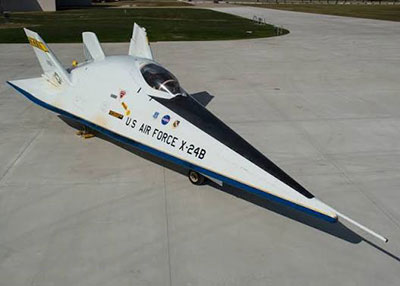
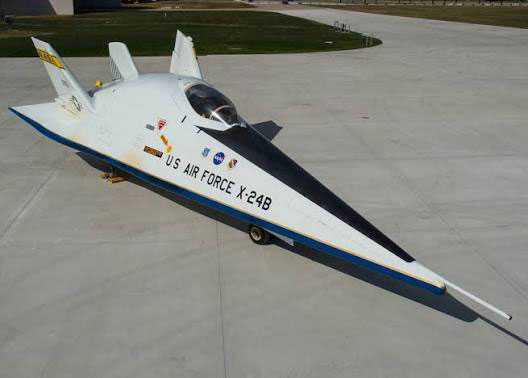
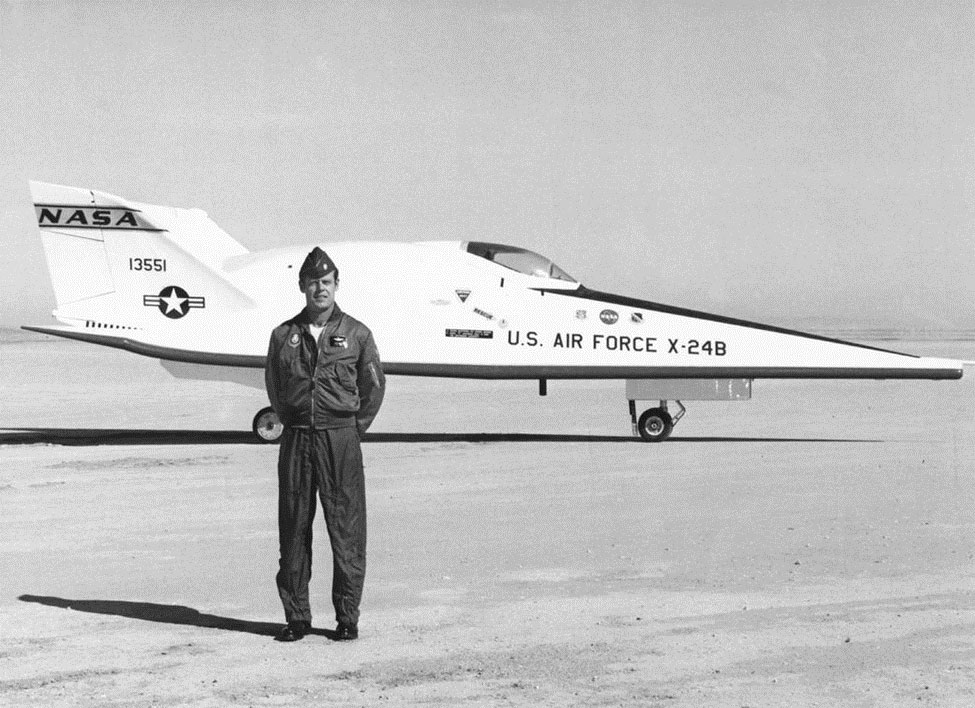
The X-24B was a joint NASA and U.S. Air Force rocket-plane program (1973–1975) that proved spacecraft could glide back from space and make precise, unpowered landings on regular runways. It was a wingless "lifting body," with a teardrop shape that directly inspired the landing design of the Space Shuttle.

The X-24B's design evolved from a family of potential re-entry shapes proposed by the Air Force Flight Dynamics Laboratory, each with higher lift-to-drag ratios.

To reduce the costs of constructing a research vehicle, the Air Force returned the X-24A to Martin for modifications that converted its bulbous shape into one resembling a "flying flatiron" – a rounded top, flat bottom, and a double-delta planform that ended in a pointed nose.

John Manke was first to fly the X-24B, a glide flight on August 1,1973. He was also the pilot on the first powered mission on November 15, 1973.

Among the final flights with the X-24B were two precise landings on the main concrete runway at Edwards, which showed that accurate unpowered re-entry vehicle landings were operationally feasible. These missions, flown by John Manke and Air Force Major Mike Love, represented the final milestone in a program that helped write the flight plan for the space shuttle landings.

The final powered flight with the X-24B was on September 23,1975, flown by Bill Dana. It was also the last rocket-powered lifting body flight flown at Dryden.

Top speed reached by the X-24B was 1,164 mph (Mach 1.75) by Mike Love on October 25,1974. The highest altitude reached was 74,100 feet by John Manke on May 22, 1975.

How the Program Worked

The Concept: A "lifting body" is an aircraft that gets all its lift from its specially shaped body, rather than from wings. This design protects the craft from burning up during atmospheric re-entry.

The Process: A modified B-52 bomber carried the X-24B to an altitude of 45,000 feet and dropped it. The X-24B then ignited its XLR-11 rocket engine, climbing to speeds of up to 1,164 mph.

The Landing: After its fuel ran out, the pilot guided the aircraft in a steep, unpowered glide. The pilot would dive to build speed and pull up just before hitting the runway—a maneuver called a "flare" that slowed the craft safely to a halt.

Precision Runway Landings: On August 5, 1975, test pilot John Manke made history by executing the first-ever unpowered, precision landing on a concrete runway.

Space Shuttle Validation: The success of the X-24B proved that large, heavy spacecraft could be landed exactly where needed. This gave NASA the confidence to build the Space Shuttle to land on concrete runways rather than relying solely on parachute landings in the ocean.

Flight Record: The X-24B flew 36 times before the program ended, with the final powered flight occurring on September 23, 1975.
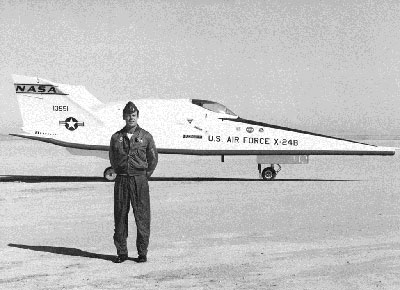
Now on to Lieutenant Colonel Mike Love. After graduating from the United States Air Force Academy in Colorado Springs, Colorado, Mike Love entered pilot training at Moore AFB, Texas. He was subsequently assigned to the 494th Tactical Fighter Squadron at Lakenheath RAF Station, England and the 510th Tactical Fighter Squadron, Bien Hoa AB, South Vietnam. In 1967 he was assigned to the 429th Tactical Fighter Squadron at Cannon AFB, New Mexico; the 355th Tactical Fighter Squadron at Phu Cat AB, South Vietnam; and later with the 481st Tactical Fighter Squadron at Cannon AFB. During his time in Vietnam he was awarded the Distinguished Flying Cross with two Oak Leaf clusters.

Colonel Love attended the Aerospace Research Pilot School at Edwards AFB in 1968 and remained at the school as an instructor. In 1972 he was assigned to the 6512th Test Squadron at Edwards as a project pilot for the X-24B. Colonel Love was one of two project pilots on the joint NASA - Air Force X-24B lifting body program and made a total of 12 flights in the X-24B from October 4, 1973 until July 15, 1975. On October 25, 1974 Love flew the X-24B to a speed of Mach 1.75, a record for the X-24B.

Tragically Love was killed while attempting an emergency landing in an RF-4C on March 1, 1976.

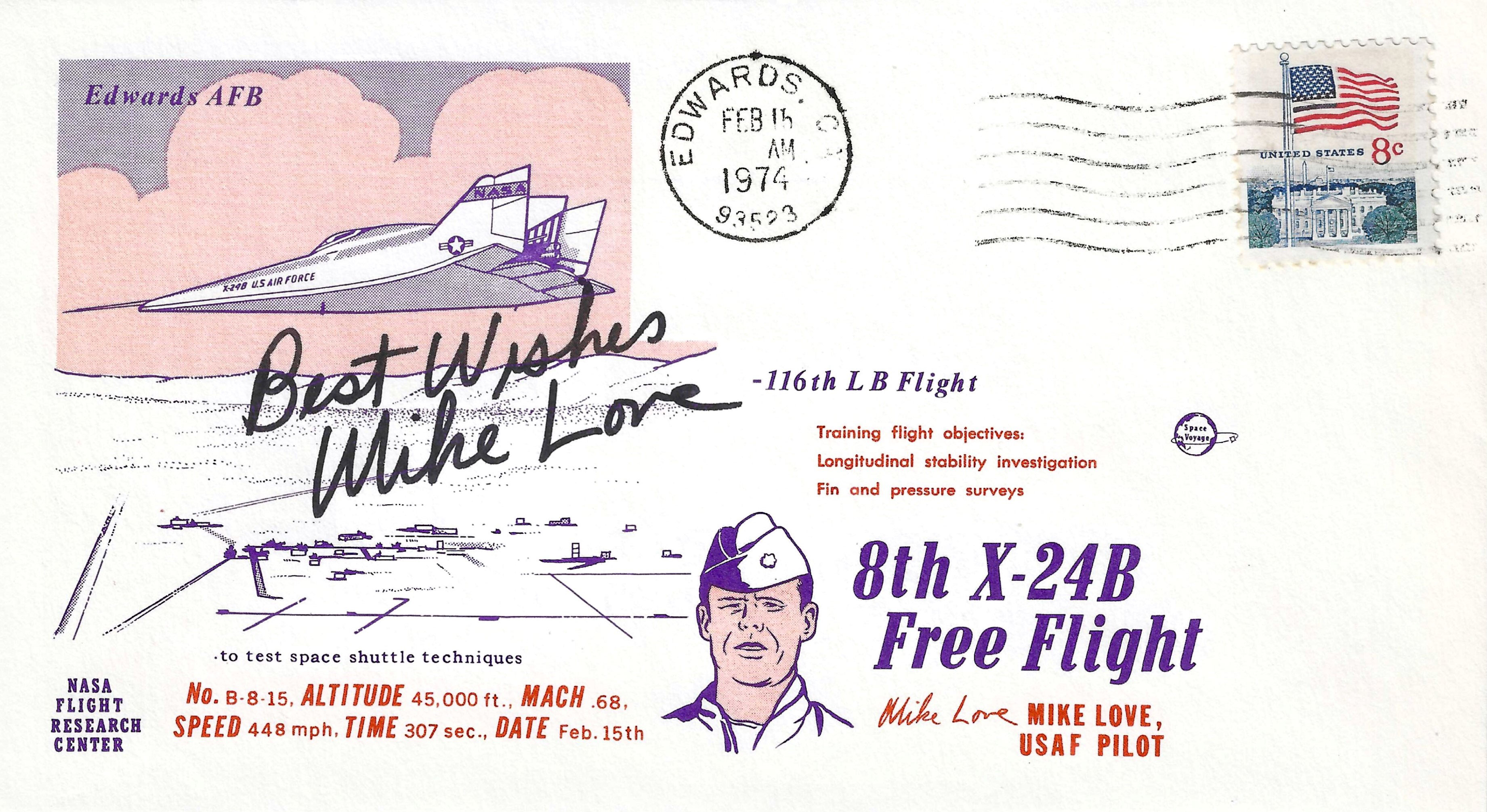
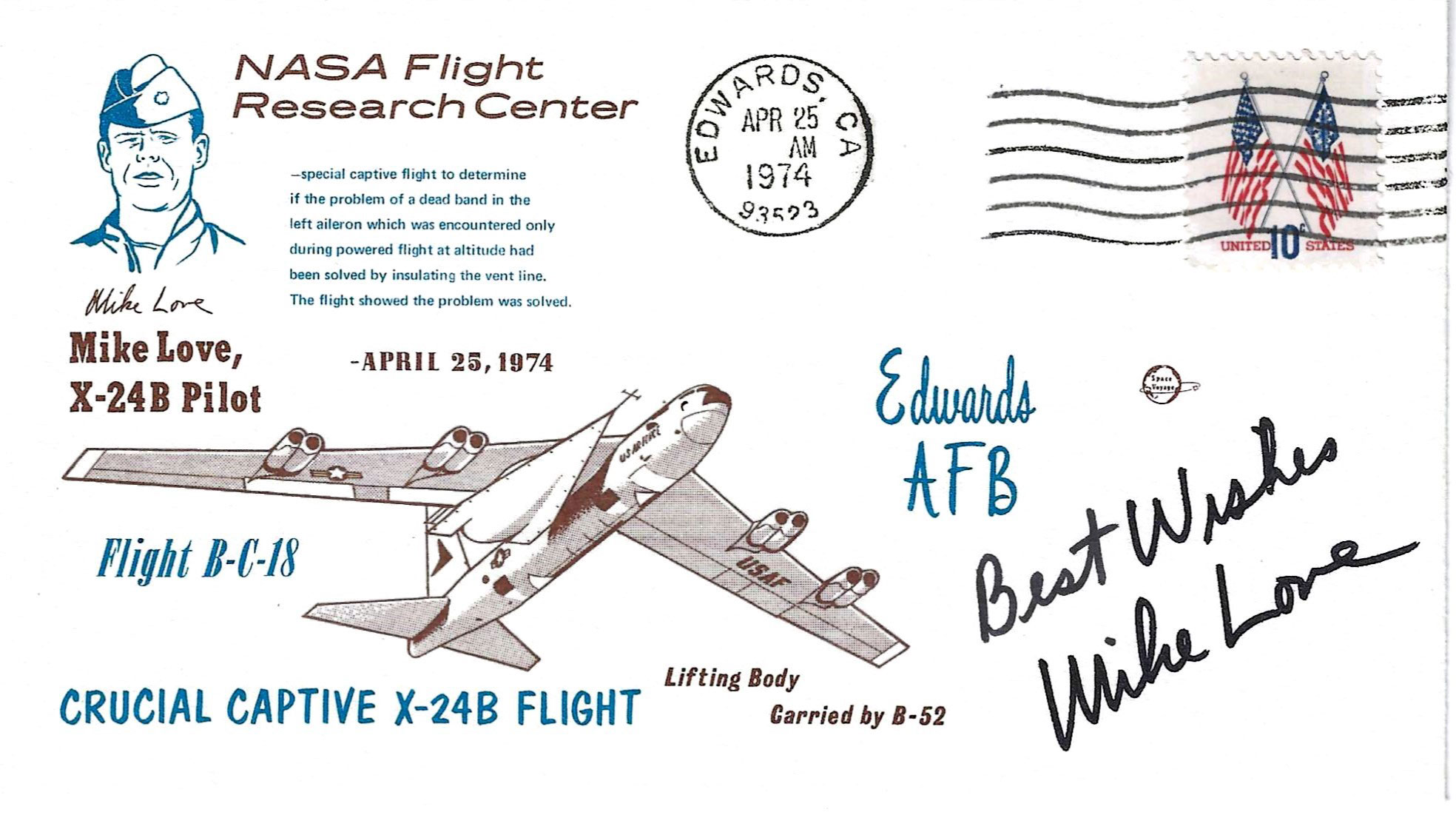
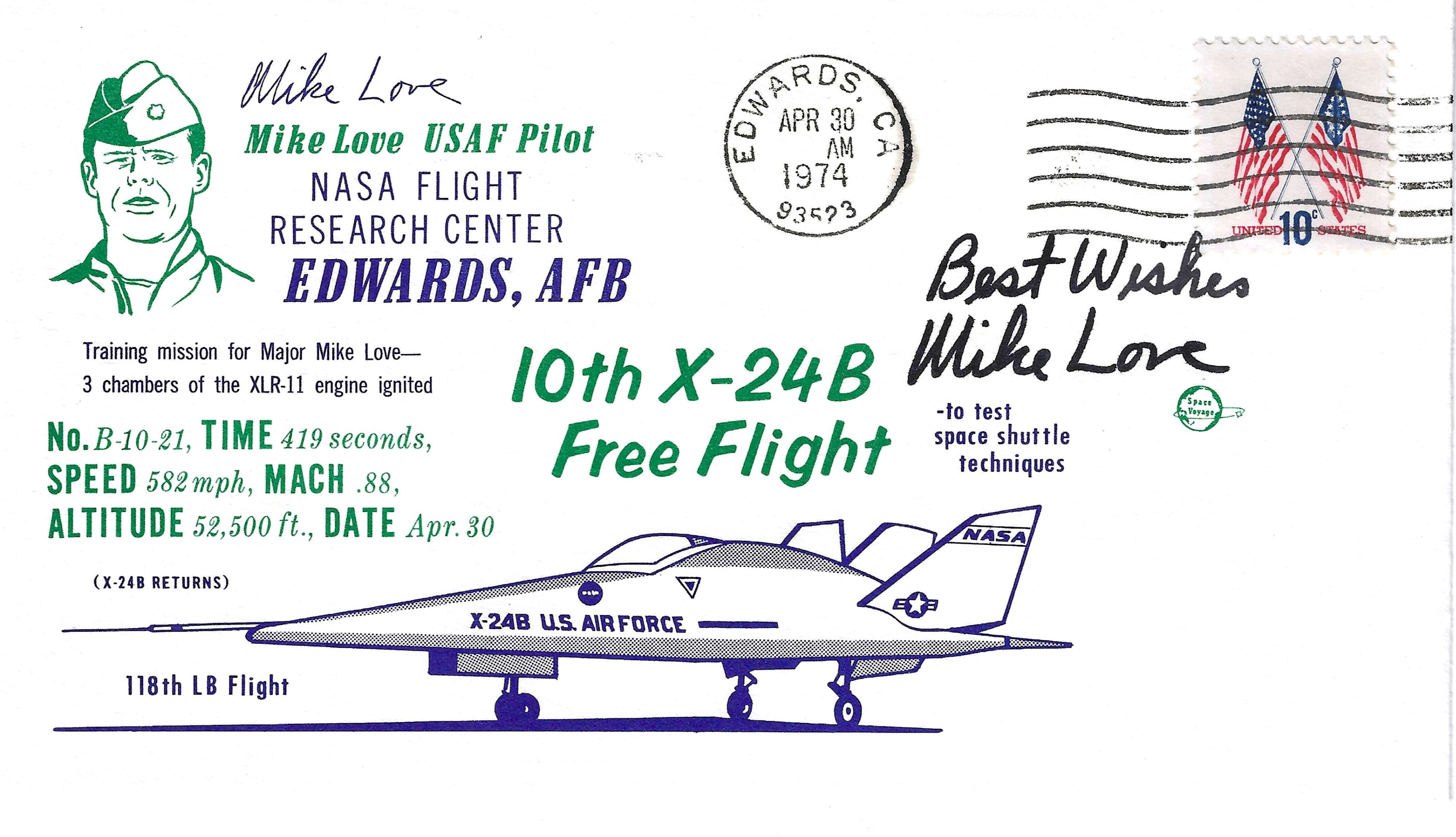
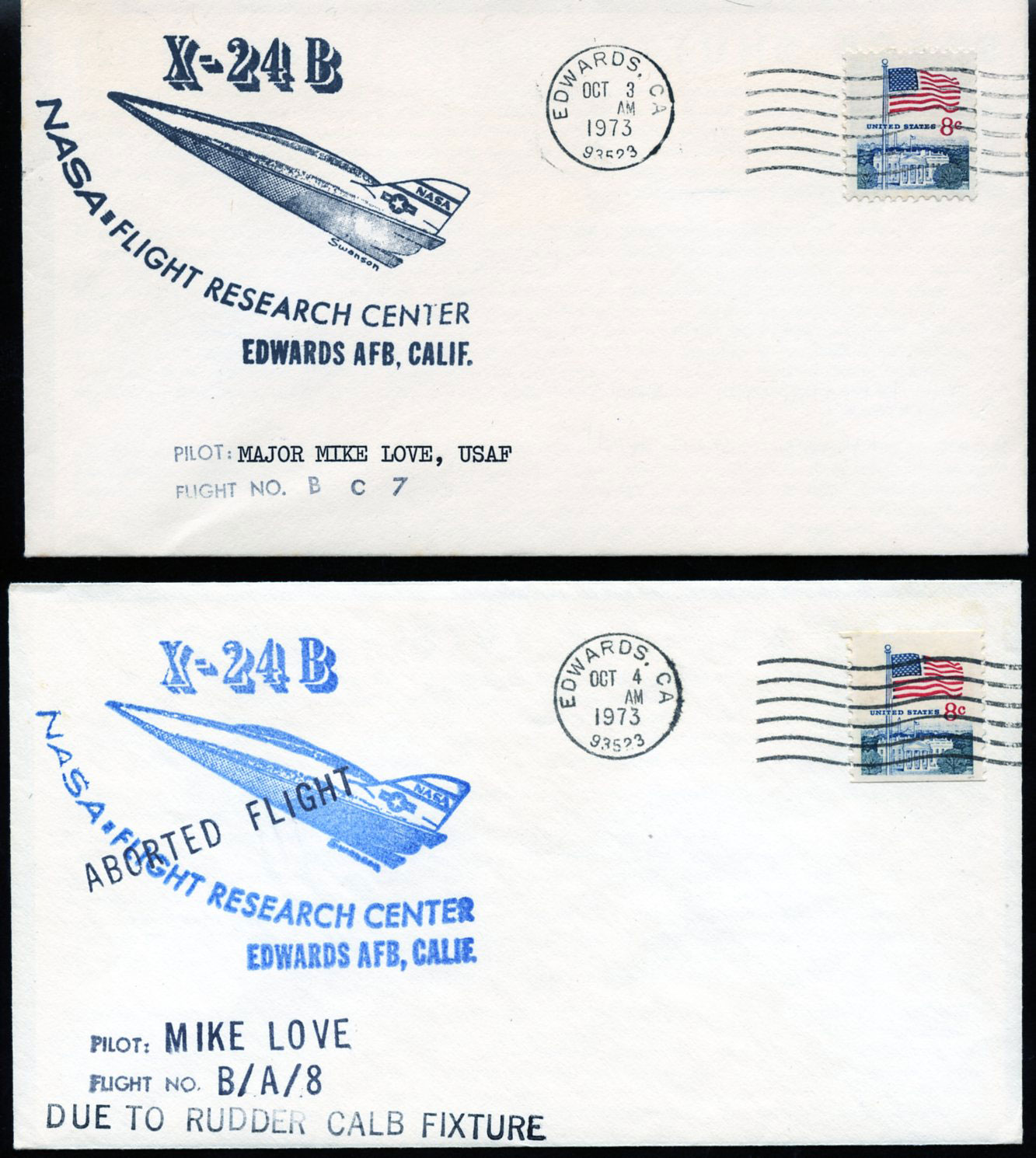
The first cover, shown above, with a Robert Rank Space Voyage cachet and signed by Mike Love, commemorates his second flight in the X-24B when he reached an altitude of 45,000 feet and a top speed of 449.9 miles per hour. The covers below, also with Robert Rank Space Voyage cachets, commemorate his flights on April 25, 1974 and April 30,1974 when he flew to an altitude of 52,034 feet with a top speed of 577.9 miles per hour.
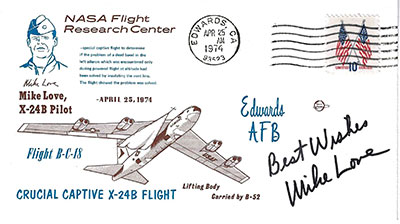
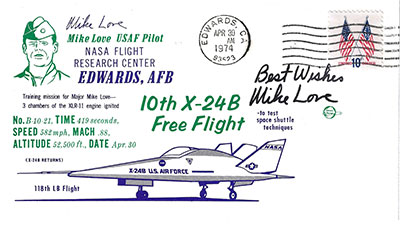
I'm sure other lifting body cover collectors have covers signed by Mike Love. I encourage them to post their favorites in tribute to his ultimate sacrifice 50 years ago supporting aeronautical research and testing.

Axman
Member

Posts: 935
From: Derbyshire UK
Registered: Mar 2023

posted 07-06-2026 05:30 AM     Click Here to See the Profile for Axman   Click Here to Email Axman     Edit/Delete Message   Reply w/Quote
The very top cover proclaims the 116th LB flight. I'm presuming LB stands for lifting body. Also, the cover states it is the 8th free flight of the X-24B.

That leaves 108 previous lifting body flights to be accounted for.

I am aware (because I've collected covers for them) of the six ASSET (X-20 Dynasoar) flights 1963-1965, and the three PRIME (X-23A) flights 1966-1967.

That still leaves 99 other lifting body flights I don't know anything about. Which craft and/or programs did those 'missing' flights occur with?

micropooz
Member

Posts: 1899
From: Washington, DC, USA
Registered: Apr 2003

posted 07-06-2026 06:26 AM     Click Here to See the Profile for micropooz   Click Here to Email micropooz     Edit/Delete Message   Reply w/Quote
Alan, the reference to the 116th lifting body flight comes from the log of manned "heavyweight" lifting body flights. Those flights were performed by the M2-F2, M2-F3, HL-10, X-24A, and X-24B lifting bodies between 1966 and 1975. It does not include the ASSET and PRIME (X-23) unmanned flights.

I've emailed a copy of the log to you. Copies of the log can also be found in NASA SP-4303 and SP-4220.

So, you might notice in the above paragraph, the mention of "heavyweight" and that we started with the M2-F2. The "lightweight" M2-F1 was a manned plywood lifting body flown between 1963 and 1966. It was towed to a few feet off the runway by a souped-up Pontiac Catalina car, or to higher altitudes by a C-47 cargo plane.

There were somewhere around 400 ground and air towed flights made, and no complete log exists of those flights. Probably the most complete and accurate log is in SP-4220. SCOTWs 20, 134, 175, and 738 have been written on the M2-F1.

Totally confusing? Agreed!

Axman
Member

Posts: 935
From: Derbyshire UK
Registered: Mar 2023

posted 07-06-2026 06:37 AM     Click Here to See the Profile for Axman   Click Here to Email Axman     Edit/Delete Message   Reply w/Quote
Thanks Dennis.

Bob M
Member

Posts: 2114
From: Atlanta-area, GA USA
Registered: Aug 2000

posted 07-06-2026 06:46 AM     Click Here to See the Profile for Bob M   Click Here to Email Bob M     Edit/Delete Message   Reply w/Quote
Alan - you may have opened a Pandora's Box here with questions about X-aircraft and especially the NASA Lifting Body aircraft - as there are a lot of us X-plane and Lifting Body aircraft enthusiasts lurking here. Dennis has started it well in adding to Randy's excellent tribute to Mike Love.

There were six Lifting Body aircraft (M2-F1, M2-F2, M2-F3, HL-10, X-24A and X-24B, with Mike Love being one of the 14 pilots who flew at least one of the six. We have covered the Lifting Bodies well here previously.

Bob M
Member

Posts: 2114
From: Atlanta-area, GA USA
Registered: Aug 2000

posted 07-06-2026 04:47 PM     Click Here to See the Profile for Bob M   Click Here to Email Bob M     Edit/Delete Message   Reply w/Quote
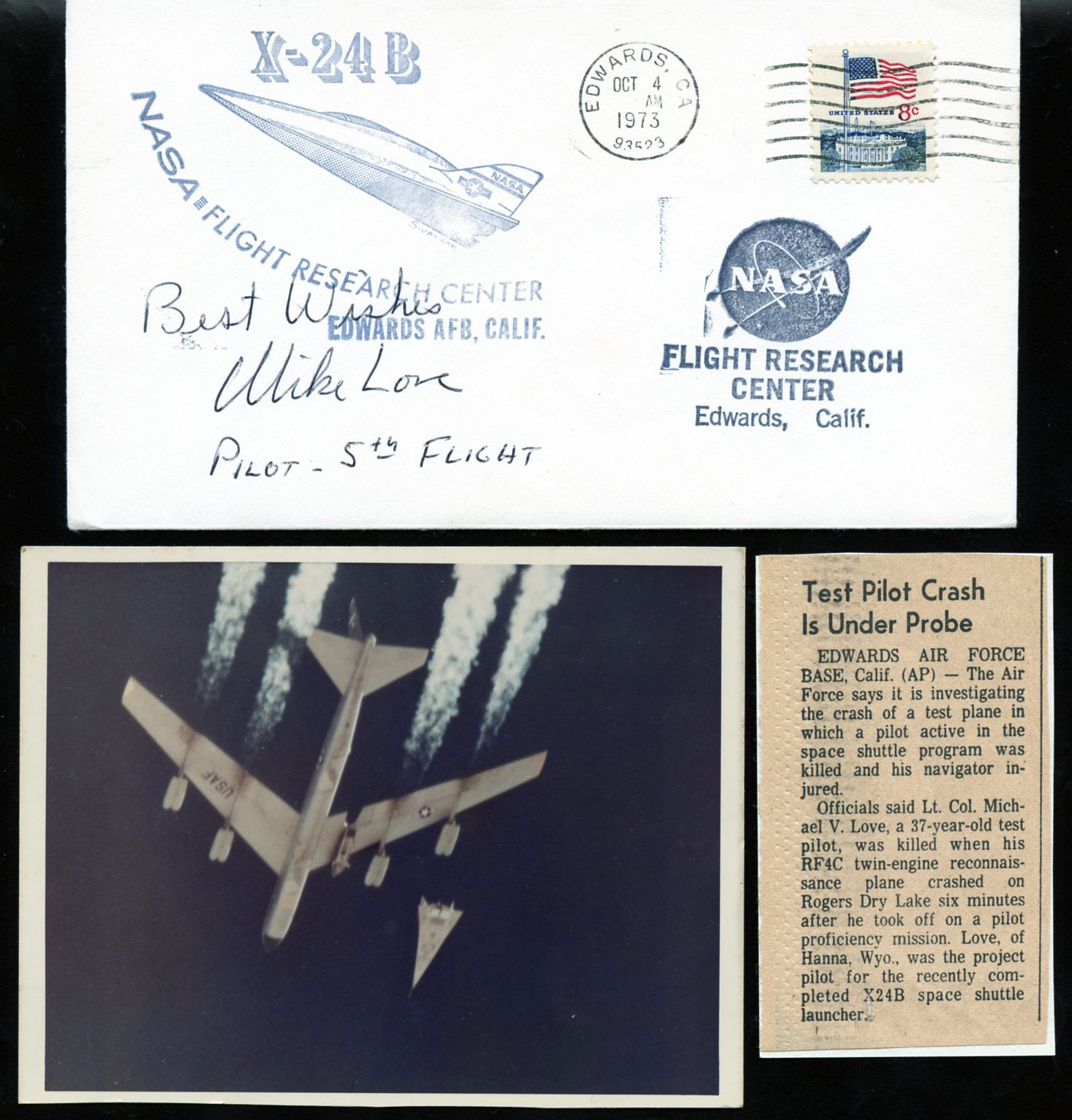
Mike Love flew 12 of the X-24B's 36 total free flights, with his first flight on October 4, 1973. The previous day, he and the X-24B carried out a planned captive flight under the wing of the B-52 mothership - the seventh time the X-24B had been carried aloft. Then on October 4, two flights took place, with the first flight aborted because of a rudder problem. But later that morning, everything went as planned and the X-24B was released by the mothership resulting in Love's first flight and the fifth free flight of the X-24B Program.

Along with his autographed first flight cover is an impressive photo of the X-24B Lifting Body immediately after its release from the mothership. And also a news clipping from my newspaper telling of his crash and death that occurred on March 1, 1976.

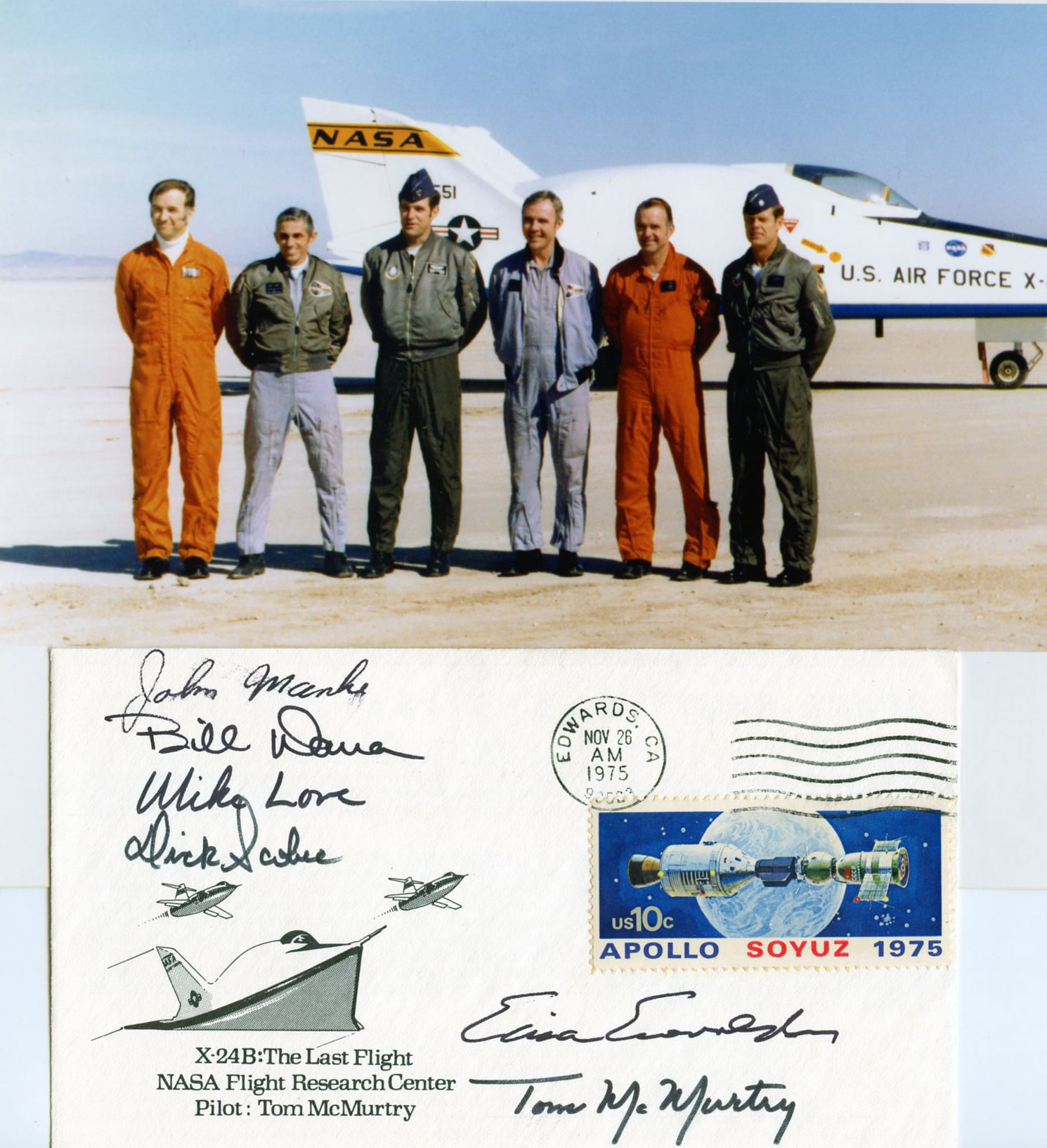
In this photo the six X-24B pilots stand in front of the X-24B at Edwards AFB. Dick Scobee, later to perish on Challenger, is third from the left, with Mike Love at far right, he to also perish, just 4 months after the final X-24B flight.

This final X-24B flight cover, with a special NASA Flight Research Center Public Affairs Office cachet, is autographed by the six X-24B pilots.

All times are CT (US)

next newest topic | next oldest topic

Administrative Options: Close Topic | Archive/Move | Delete Topic
Post New Topic  Post A Reply
Hop to:

Contact Us | The Source for Space History & Artifacts

Copyright collectSPACE. All rights reserved.


Ultimate Bulletin Board 5.47a


advertisement