|
|

|
|
Author
|
Topic: Space Cover 856: Anniversary of infamous year
|
randyc
Member Posts: 979
From: Highlands Ranch, CO USA
Registered: May 2003
|
 posted 05-03-2026 01:51 PM
   
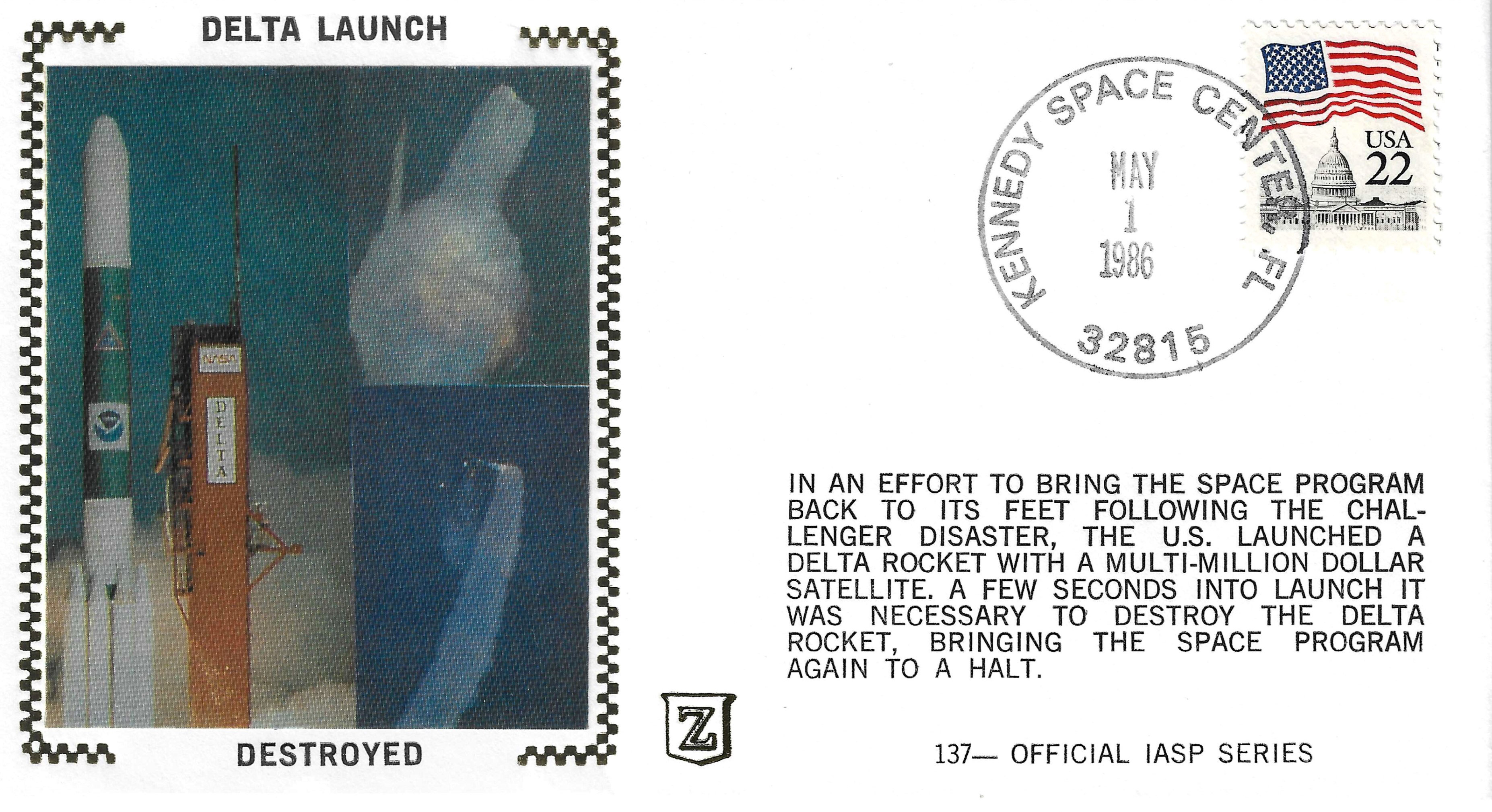
Space Cover of the Week, Week 856 (May 3, 2026) Space Cover 856: 40th Anniversary of an Infamous YearToday's Space Cover of the Week topic is about the 40th anniversary of an infamous year in the history of the United States' space program – 1986. While most, if not all followers of the space program know about the space shuttle Challenger disaster on January 28, 1986, many might not recall or know about two other launch failures that occurred in succession using two different launch vehicles. While much of the space industry was still following the recovery operations and failure investigation of the STS-51L mission, the unmanned space program was still preparing for the launch of payloads later that year. The next launch after STS-51L was scheduled in April from Vandenberg Air Force Base (VAFB) using a Titan 34D launch vehicle. The payload was a top secret KH-9 reconnaissance satellite, and because there was no cross-over between the STS-51L mission and the Titan 34D mission launch preparations proceeded as planned. However, on April 18, 1986, only 8 seconds after liftoff, the rocket exploded, showering the launch pad with flaming solid rocket motor propellant and other debris. Like Challenger the failure was caused by hot gases leaking past O-rings in a field joint in one of the solid rocket motors as the joint flexed when the motor was ignited. The next scheduled unmanned launch was planned in May using a Delta launch vehicle carrying the GOES-6 weather satellite for the National Oceanic and Atmospheric Administration (NOAA). Having worked on the Delta program for McDonnell Douglas Astronautics Company (MDAC) at Cape Canaveral Air Force Station (CCAFS), Florida and Huntington Beach, California I was particularly interested in following this launch (I was working for MDAC in the Special Space group designing the Motor Attach Fitting (MAF) separation system for the Italian Research Interim Stage (IRIS) in 1986). Because of the failures of the shuttle and Titan launch vehicles earlier in the year and the public's interest in this launch it was televised live on one of the major networks. On May 3, 1986, as I watched the launch proceed, I was expecting another successful Delta launch since there had been 43 consecutive successes since the Delta 134 failure on September 13, 1977. However, 71 seconds into the flight the launch vehicle began to yaw right, and as aerodynamic forces caused the launch vehicle to break apart, range safety sent the destruct signal and the vehicle, along with the GOES-6 satellite, were destroyed. Shuttle, Titan, Delta; all had launch failures within the first five months of the year. Three different launch vehicles, three launches, three failures. I recall that some felt that this was too coincidental and that sabotage needed to be considered. However sabotage was quickly ruled out as the three investigations found the root causes of the failures. I was personally involved in the failure investigation of Delta 178. Several years earlier, from 1980-1982, I was the Chief Hydraulic Test Engineer on the Delta program working in the Delta Mission Checkout Operations (DMCO) group in Huntington Beach, CA which was responsible for testing, troubleshooting and correcting test anomalies of the electrical, hydraulic and propulsion systems of the first and second stages before they were shipped to Cape Canaveral Air Force Station. Because of my experience reviewing and analyzing the hydraulic system data during hydraulic systems tests and simulated flight tests when I worked in the DMCO group I was asked to review the flight data from the hydraulic system to determine if a failure in the hydraulic system caused the rapid movement of the first stage main engine that caused the vehicle to lose control. After several days of data analysis I concluded that the first stage hydraulic system was not the cause of the failure. The failure was later found to be a fault in the electrical system that caused the vehicle to shutdown control of the main engine. The cover shown above has a Zaso 'silk' cachet showing the launch of Delta 178 and two photos of the launch vehicle breaking apart and exploding. However, the date of cancellation, May 1, 1986, is incorrect since the actual launch date was May 3, 1986. A similar Zaso cachet cover also has the incorrect May 1 date. It's unusual that a cover is cancelled two days before the actual launch, unless there was a scrub and the cover was cancelled before the scrub. However in this case there wasn't a scrub so why the cover was cancelled two days before the launch is a mystery. There aren't many covers for the Delta 178 launch and the Titan launch In April 1986. If a member of collectSPACE has covers for the Delta 178 launch with the correct launch date and the Titan launch please post them. |
Antoni RIGO
Member Posts: 385
From: Palma de Mallorca, Is. Baleares - SPAIN
Registered: Aug 2013
|
posted 05-03-2026 02:52 PM
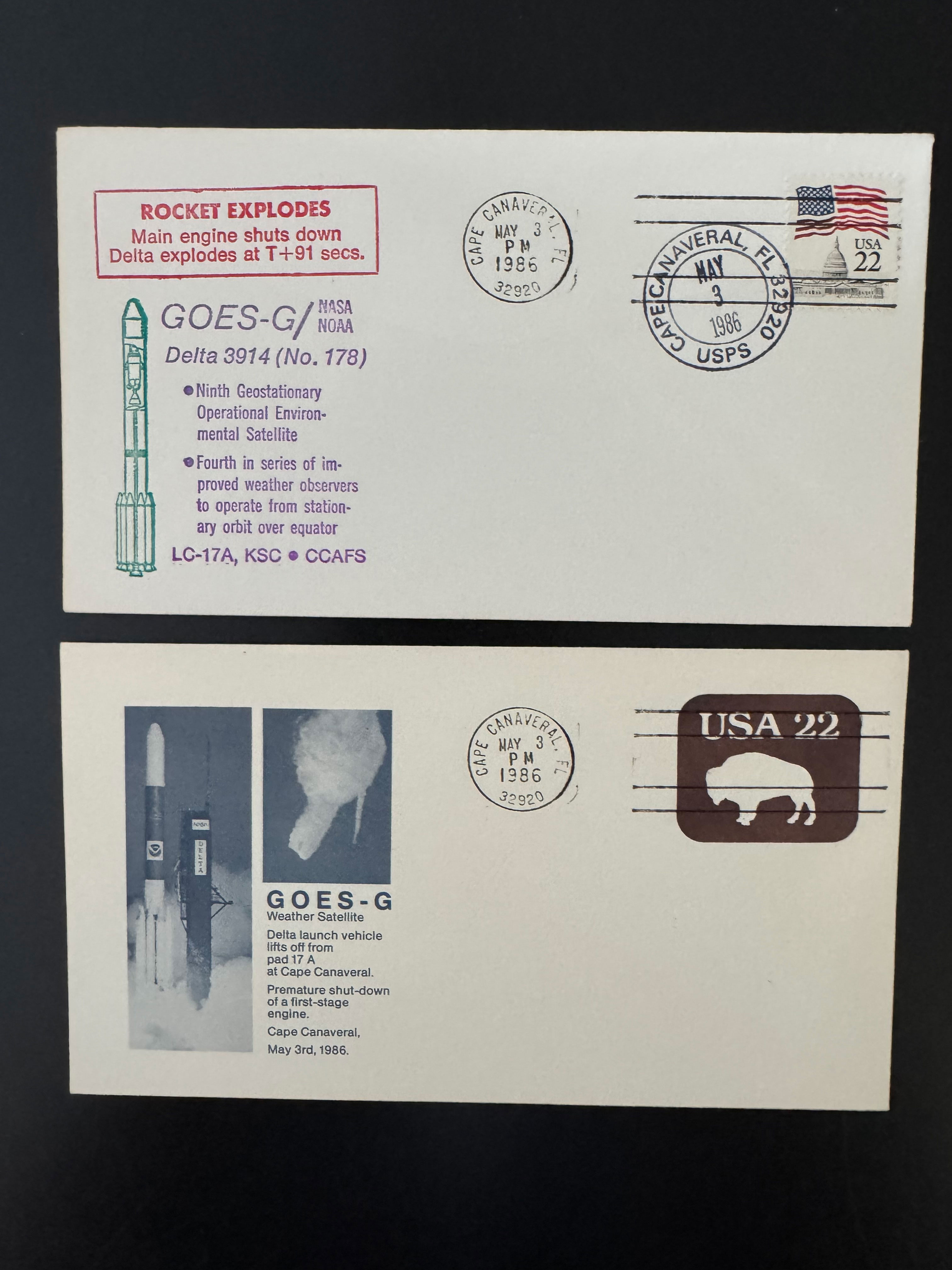
Randy, thanks for the post and all information provided.Below, Bob Whitney and E. Colle covers dated May 3, 1986 Cape Canaveral for launch of GOES-6. 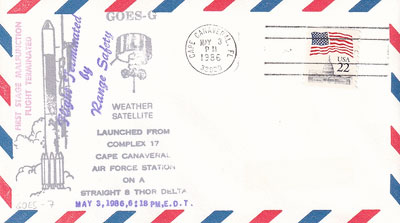 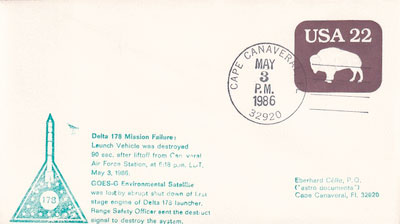
|
micropooz
Member Posts: 1891
From: Washington, DC, USA
Registered: Apr 2003
|
posted 05-03-2026 05:59 PM
Randy, thank you for the reminder about the infamous year of 1986 (and I mean that in a good way, not a cynical way). Like you, I had a lot invested in the events of that year, and it hit hard. I apologize to those looking for cover images from me for that year – I don't have any, can't handle them.As mentioned in prior SCOTW entries, I was at JSC training shuttle flight crews to deploy PAM payloads at that time. We had finally gotten STS-61C (and its PAM payload) off the ground in January 1986, and that was a great relief. One of my fellow PAM trainers and I were out at the USAF facility in Sunnyvale, California on January 28 to start planning joint integrated simulations with them for the upcoming STS-61H Skynet satellite deployment that summer. As we were in the hall waiting for our meeting room to be unlocked, a guy came by and asked if we were from JSC. When we said "yes" he broke the news to us about what had just happened with STS-51L that morning. We didn't train the 51L crew (they were flying an IUS payload, not a PAM payload), but both of us had trained some of the 51L crewmembers for prior flights. It hurt beyond description, but we still had to go through a couple of days of meetings before heading back to Houston to grieve with our loved ones and co-workers. And grieving included having to listen to journalists like Dan Rather every night on the evening news, gym-teacher relatives, and music-major neighbors all squawking, repeatedly, about how much NASA had messed up when they didn't even understand what they were talking about. Then the Titan blew up. Then the Delta blew up. And somewhere in all of that, Russia's Chernobyl nuclear power plant blew up, all within a few months. And all that brought even more squawks from all quarters about how we (and technology in general) had screwed up. 1986 was truly an infamous year. But the lesson learned was that bad things always seem to come in clusters in this endeavor. And we will eventually recover to move on to bigger and better things. Thanks again Randy, this has been cathartic! Now, back to space covers... |
Bob M
Member Posts: 2103
From: Atlanta-area, GA USA
Registered: Aug 2000
|
posted 05-06-2026 03:45 PM
To add to the infamous year of 1986 in space, Stephen Thorne, USN, a member of the NASA Astronaut Class of 1985/Group 10, was killed in a stunt plane accident on May 24, 1986, while flying as a passenger. This being just four months after the loss of Challenger and crew. |
Ken Havekotte
Member Posts: 4059
From: Merritt Island, Florida, Brevard
Registered: Mar 2001
|
posted 05-09-2026 07:07 PM
This week's topic of 1986 being an infamous year I can well remember. The launch of Delta 3914 (# 178 flight vehicle) was just over a month after shuttle Challenger's tragedy. It was a very sad day for me, too, as Randy and Dennis indicated how it was for them. But first, let me express my admiration to them both for their key participation with our country's Delta and PAM programs.
Even though the launch attempt was by an unmanned expendable rocket with a GOES-G (#3) weather satellite, being the first rocket launch since the Challenger incident, there were a lot of press reporters and other observers at the Cape's press site 1 (CCAFS) in heavy attendance. I was one of them.
After the vehicle had exploded in flight, I recall standing near NASA's Dick Young, the PAO press coordinator, with his head down shaking it side by side. All of us at PS1 were shocked and so disappointed that GOES-G never made it into orbit due later to a rocket engine failure. At 30 miles downrange, speeding 1400 mph, with an altitude of just over 10 miles, the vehicle was destroyed by a range safety officer at his duty station from the Range Control Center.
Knowing about the failure of Titan 34D on the West Coast firing range, it was a triple blow to everyone. We were hoping that Delta/GOES would be a positive "new kick-off start" in reviving our space program, but it was not to be. For this somewhat "routine" expendable launch vehicle flight, the news media came out in droves from all over hoping for a post-Challenger good result, instead, it became a big letdown in so many ways. The U.S. failed again, three times, in trying to get back in space, were some of the nation's press headlines.The cover depicted above, as Randy indicated, is a John Zaso/IASP "silk cachet" Series that my firm served as a volunteer cancel servicer. I have no idea of why it wasn't posted on May 3rd instead of the 1st. The KSC hand cancel application type, which was most likely applied by my own hand, was provided at the Kennedy Space Center's postal branch unit off-site at the Orlando International Airport.
The top cover below has my own three-color rubber stamp cachet added and the cover at bottom was done by a joint arrangement with SCCS and an European space cover dealer. 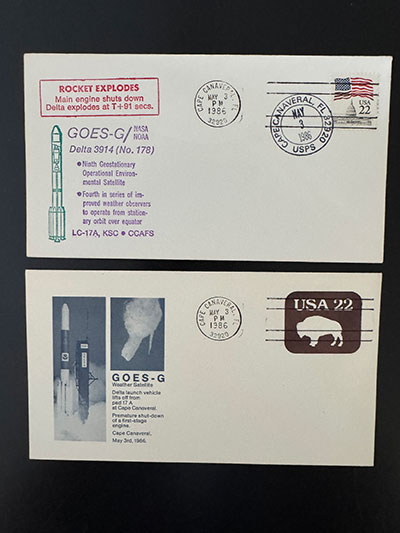 | |
Contact Us | The Source for Space History & Artifacts
Copyright collectSPACE. All rights reserved.

Ultimate Bulletin Board 5.47a
|
|
|
 advertisement advertisement
|