Space Newsspace history and artifacts articlesMessagesspace history discussion forumsSightingsworldwide astronaut appearancesResourcesselected space history documents
advertisements
Ex-SpaceX flight doc, two cosmonauts launch on Soyuz MS-29 to ISS
July 14, 2026
— The first former SpaceX employee to fly into space as a NASA astronaut lifted off on a Russian Soyuz spacecraft on Tuesday (July 14), flying with two cosmonauts, including the first to have flown on a SpaceX Dragon capsule.
Anil Menon, who previously supported human spaceflights as a flight surgeon for the U.S. Air Force, NASA and then SpaceX, launched with Soyuz MS-29 commander Pyotr Dubrov and flight engineer Anna Kikina, the first Russian to fly on a U.S. commercial crew spacecraft.
Dubrov, Kikina and Menon rode atop a Soyuz 2.1a rocket from Site 31 at Russia's Baikonur Cosmodrome in Kazakhstan. The flight began a planned eight-month mission for the three crew members, beginning with a two-orbit, three-hour trip to the space station.
Soyuz MS-29 is expected to complete an autonomous docking with the Prichal module on the Russian side of the ISS at 1:56 p.m. EDT (1756 GMT) on Tuesday.
Once the pressure is equalized between the two spacecraft and the hatches are opened, Dubrov, Kikina and Menon will be greeted by and become part of the space station's 74th resident crew, including commander Sergey Kud-Sverchkov and flight engineers Sergei Mikaev and Andrey Fedyaev of Roscosmos, NASA astronauts Chris Williams, Jessica Meir and Jack Hathaway, and European Space Agency Sophie Adenot.
Dubrov, Kikina and Menon, together with Meir, Hathaway, Adenot and Fedyaev will transition to Expedition 75 after Kud-Sverchkov, Mikaev and Williams undock on Soyuz MS-28 to return to Earth later this month. Dubrov, Kikina and Menon are to remain aboard the station through April 2027.
During their stay on the station, the Soyuz MS-29 trio will conduct research and technology demonstrations aimed at advancing human space exploration and benefiting life on Earth. For example, Menon will continue refining the in-space production of semiconductor crystals to enable the large-scale manufacturing of components needed for high-performance computers, artificial intelligence (AI) and improved medical devices, according to NASA.
Tapping into his medical experience, Menon will also perform ultrasound studies using augmented reality and AI methods that could eliminate the need for medical support from Earth on future space missions. He will be a test subject helping to better understand how blood flow is affected in space to protect future astronauts.
Menon, Dubrov and Kikina could also be assigned to go on spacewalks, including excursions to upgrade the station's solar arrays and to service equipment on the exterior of the Russian modules.
They will also oversee the arrival and departure of visiting vehicles, including Japan's second HTV-X resupply ship later this summer and SpaceX's Crew-13 (Jessica Watkins and Luke Delaney of NASA, Josh Kutryk of the Canadian Space Agency and Sergey Teteryatnikov of Roscosmos) in September.
Selected in the same 2012 cosmonaut class, Dubrov, 48, and Kikina, 41, are each on their second long-duration stay on the ISS. Dubrov logged 355 days during a single mission span of three Expeditions, 64 through 66, from 2021 to 2022. Kikina, the only woman in Roscosmos' active cosmonaut corps, launched aboard SpaceX's Crew-5 mission in 2022 and spent 157 days on the Expedition 68 crew.
Menon, 49, was recruited with NASA's 23rd class of candidates ("The Flies") in 2021, three years before his wife, Anna, flew into space as a SpaceX operations engineer and medical officer aboard the privately-funded Polaris Dawn mission. Subsequently, she was also chosen to join NASA's astronaut corps in 2025 and is still undergoing basic training to qualify for a flight assignment.
"In that training, there is chance she could do CapCom training, so I am now secretly putting it out into the world," Menon told collectSPACE, describing his hopes that his wife might serve as the ISS crew's connection with Mission Control during his stay on the station. "I think that would be awesome."
Soyuz MS-29 is Russia's 75th spacecraft in its class to launch for the station since 2000 and the 158th Soyuz to fly since 1967.
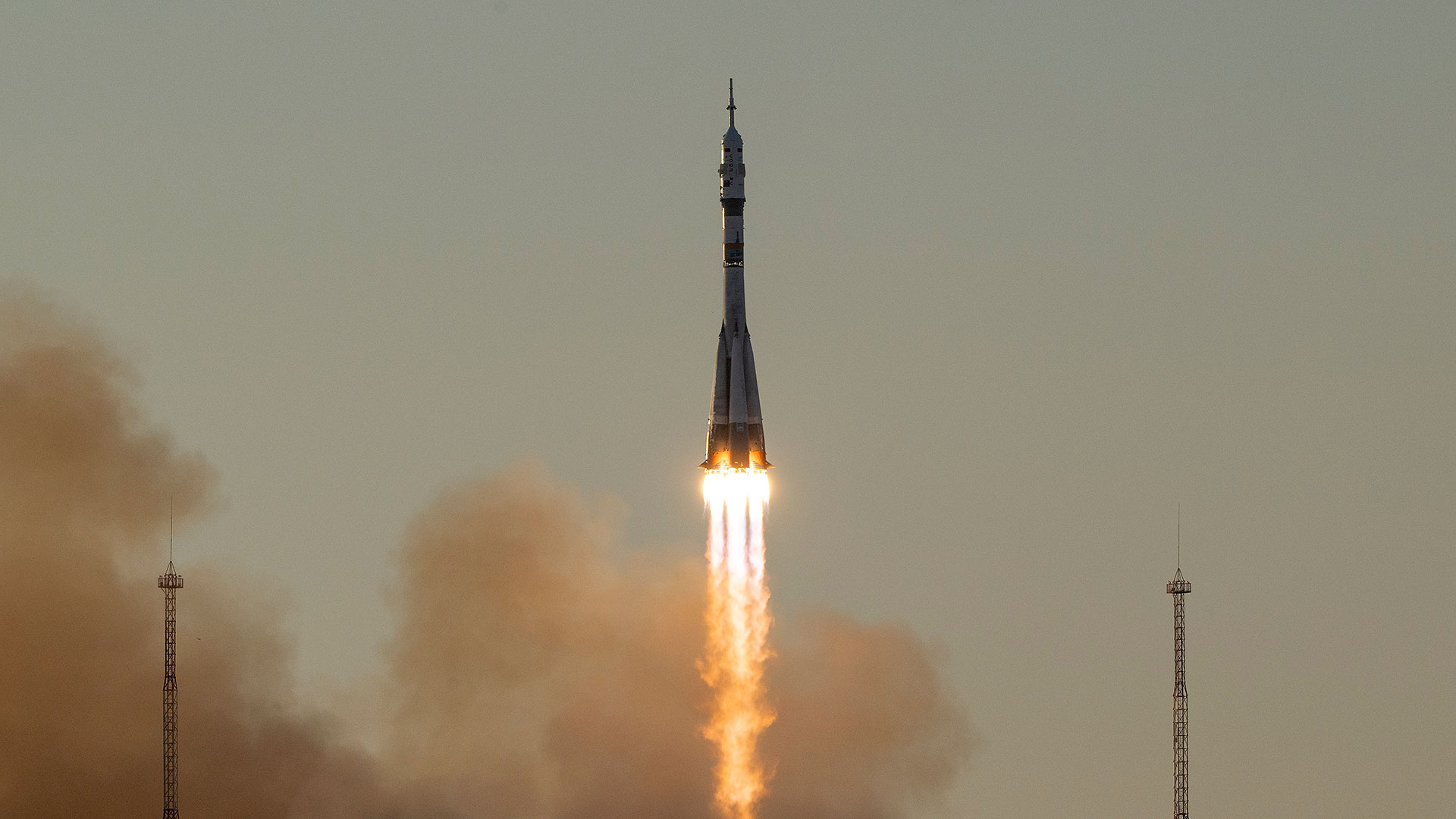
Russia's Soyuz MS-29 spacecraft, atop a Soyuz 2.1a rocket, lifts off with Pytor Dubrov, Anna Kikina and Anil Menon for the International Space Station on July 14, 2026, from the Baikonur Cosmodrome in Kazakhstan. (NASA/Bill Ingalls)
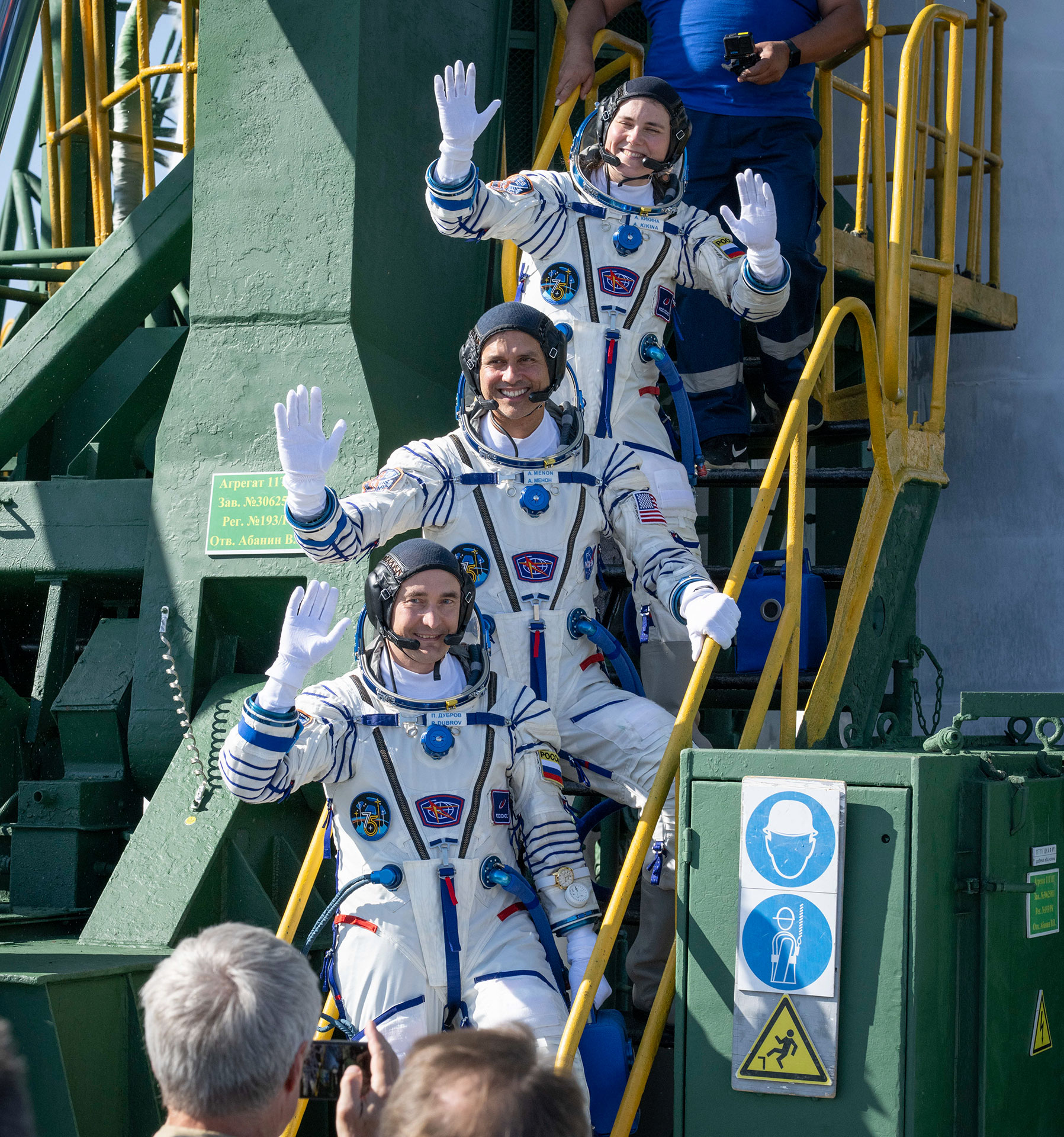
Soyuz MS-29 crew members Pytor Dubrov (at bottom), Anil Menon and Anna Kikina wave from the base of their Soyuz 2.1a at Site 31 prior to boarding the rocket for launch. (NASA/Bill Ingalls)
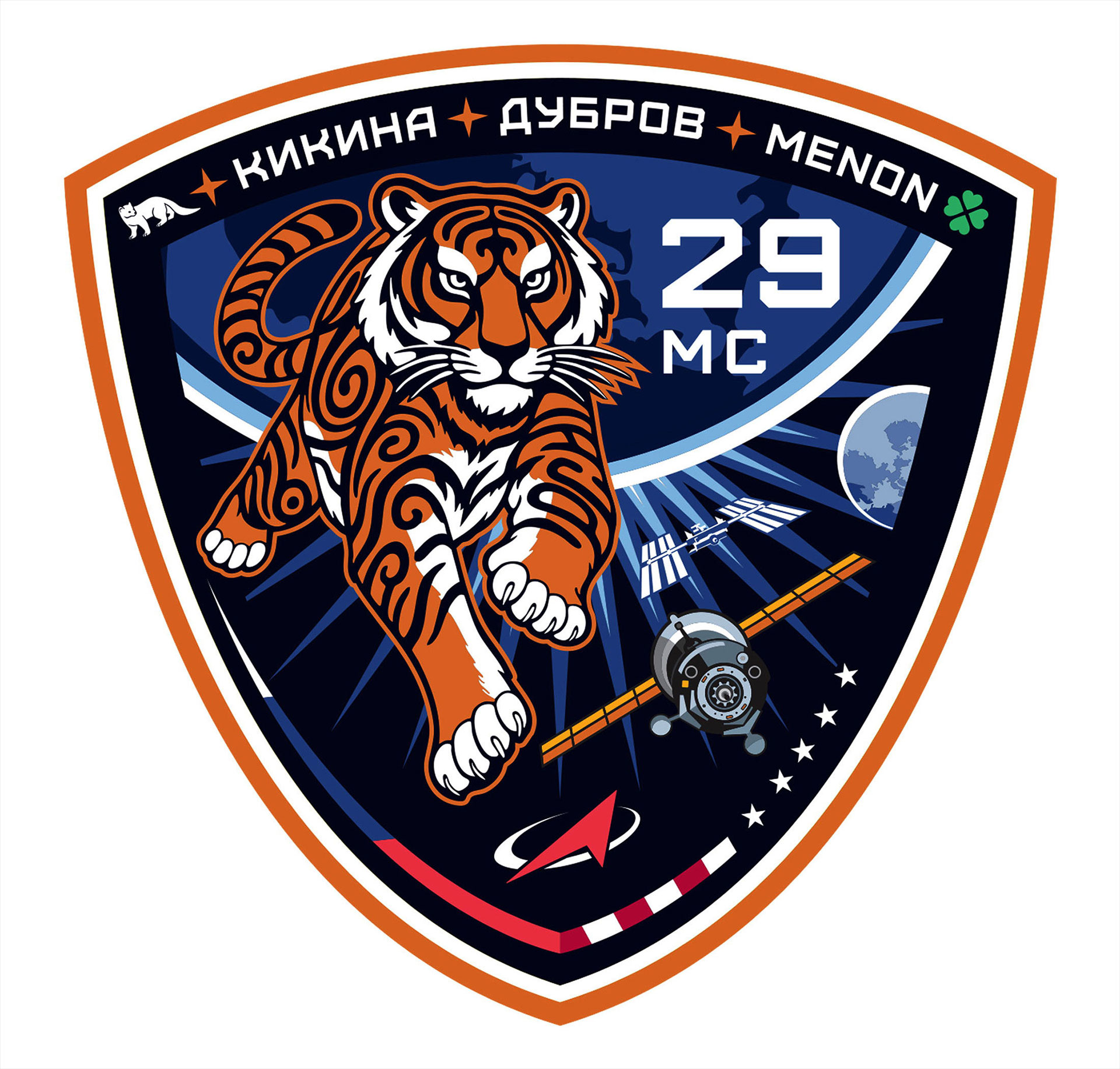
The Soyuz MS-29 mission patch includes icons (tiger, sable and four-leaf clover) representing the crew members. (Roscosmos)
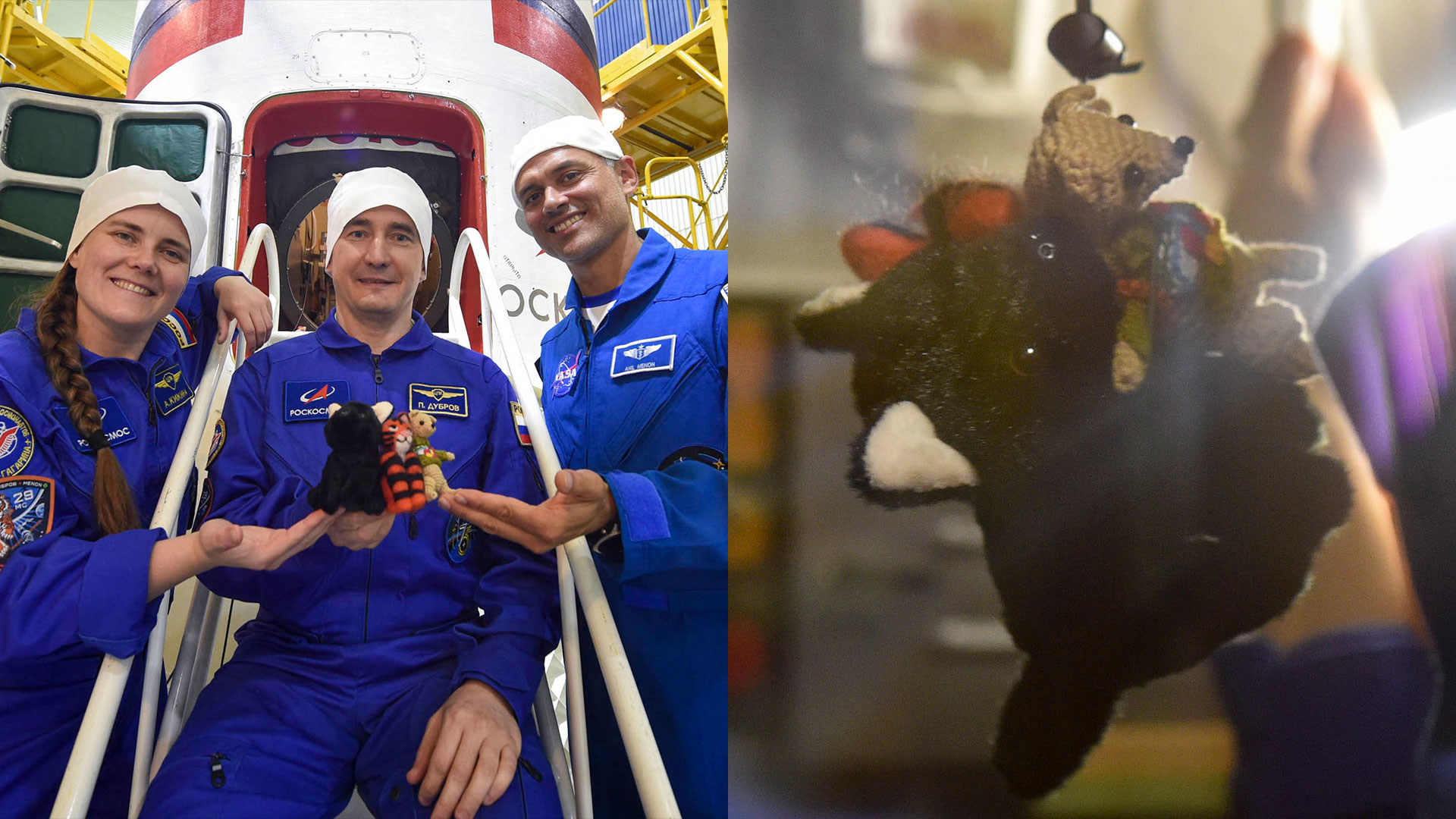
The Soyuz MS-29 crew described their traditional zero-g indicator as "one piece in three parts." Here they show off the components: a black German Shepard representing Anil Menon's recently passed dog; "Tigris," the crew's tiger mascot; and a handmade sable added by Anna Kikina. (Roscosmos)