June 3, 2026 — NASA's MAVEN mission has ended as it began: with a mystery.
The twelfth spacecraft to enter orbit around the red planet, the Mars Atmosphere and Volatile Evolution, or MAVEN, probe has spent more than 11 years studying what became of the planet's missing atmosphere. To that end, it was successful in revealing the increase of erosion during large solar storms and how the solar wind continually strips Mars' atmosphere away.
MAVEN was the only spacecraft that could simultaneously take measurements of both the Sun and the Martian atmospheric response, which it was continuing to do when NASA unexpectedly lost all contact with the probe on Dec. 6, 2025.
A brief fragment of telemetry pointed to MAVEN being in "safe mode" but rotating at a higher than normal rate when it last emerged from behind Mars, indicating a disruption in its orbit trajectory. A review board convened by the agency concluded that due to this rotation, the batteries on the spacecraft had drained, causing the communications system to lose power, leaving MAVEN in an unrecoverable state.
The board's preliminary findings did not address a potential root cause for the rotation, which is still being sought. A final report is expected later this year.
"I think the team really has experienced the loss of a loved one with the end of the mission here," said Mike Moreau, project manager for MAVEN at NASA's Goddard Space Flight Center in Maryland, in a media teleconference on Wednesday (June 3). "it was the first in a series of highly successful planetary missions that launched on time, under budget and have been phenomenally successful in achieving their science objectives."
"So we're very proud to have been a part of the MAVEN mission," he said.
Launched on Nov. 18, 2013 atop a United Launch Alliance Atlas V rocket from the Cape Canaveral Air Force Station (today Space Force Station) in Florida, MAVEN took 11 months to travel to Mars and settle into its science orbit before beginning atmospheric observations. In addition to improving our understanding of how the Sun and space weather affect Mars, the solar-powered probe also found several types of auroras that light up the Martian sky when energetic particles interact with the planet's atmosphere.
On Earth, proton auroras only occur in very small regions near the poles, whereas at Mars they can occur everywhere.
In another set of discoveries, while taking advantage of a global dust storm that formed in 2018, MAVEN was also used to learn more about how dust trapped in the upper atmosphere affected the escape of water into space. The observations confirmed that heating from dust storms can loft water molecules far higher into the atmosphere than usual, leading to a sudden surge in water being lost.
MAVEN also measured "atmospheric sputtering" for the first time at any planet. Like the splash caused by doing a cannonball into a pool, ions crash into the Martian atmosphere at high enough speeds that they splash gas molecules out of the atmosphere. MAVEN's 11 years of collected data revealed the presence of sputtered argon, a noble gas, at high altitudes in the exact locations that the energetic particles crashed into the atmosphere, showing sputtering in real time.
Understanding the atmosphere is needed before humans can be sent there to explore and find a home on the planet.
"The data collected from MAVEN will continue to provide valuable insight into Mars for decades to come," Louise Prockter, director of the planetary science division at NASA Headquarters in Washington, said in a statement. "The science MAVEN has given us is key to informing what kind of radiation protection and safety measures we must take before sending humans to Mars."
The mission's science team produced more than 800 publications, and additional papers are planned.
In addition to studying the atmosphere, MAVEN also contributed to NASA's efforts to observe comet 3I/ATLAS as it flew by Mars, as well as was a key component in agency's Mars Relay Network, communicating not only its own data but also data from the InSight lander and rovers Curiosity and Perseverance back to Earth.
MAVEN holds records for the largest data volume returned from Mars and the most data to be relayed from another planet in a single day. With MAVEN offline, the network now relies on Mars Odyssey (launched in 2001) and Mars Reconnaissance Orbiter (2006) missions, with NASA's Mars Telecommunications Orbiter slated to join in 2028. |
|
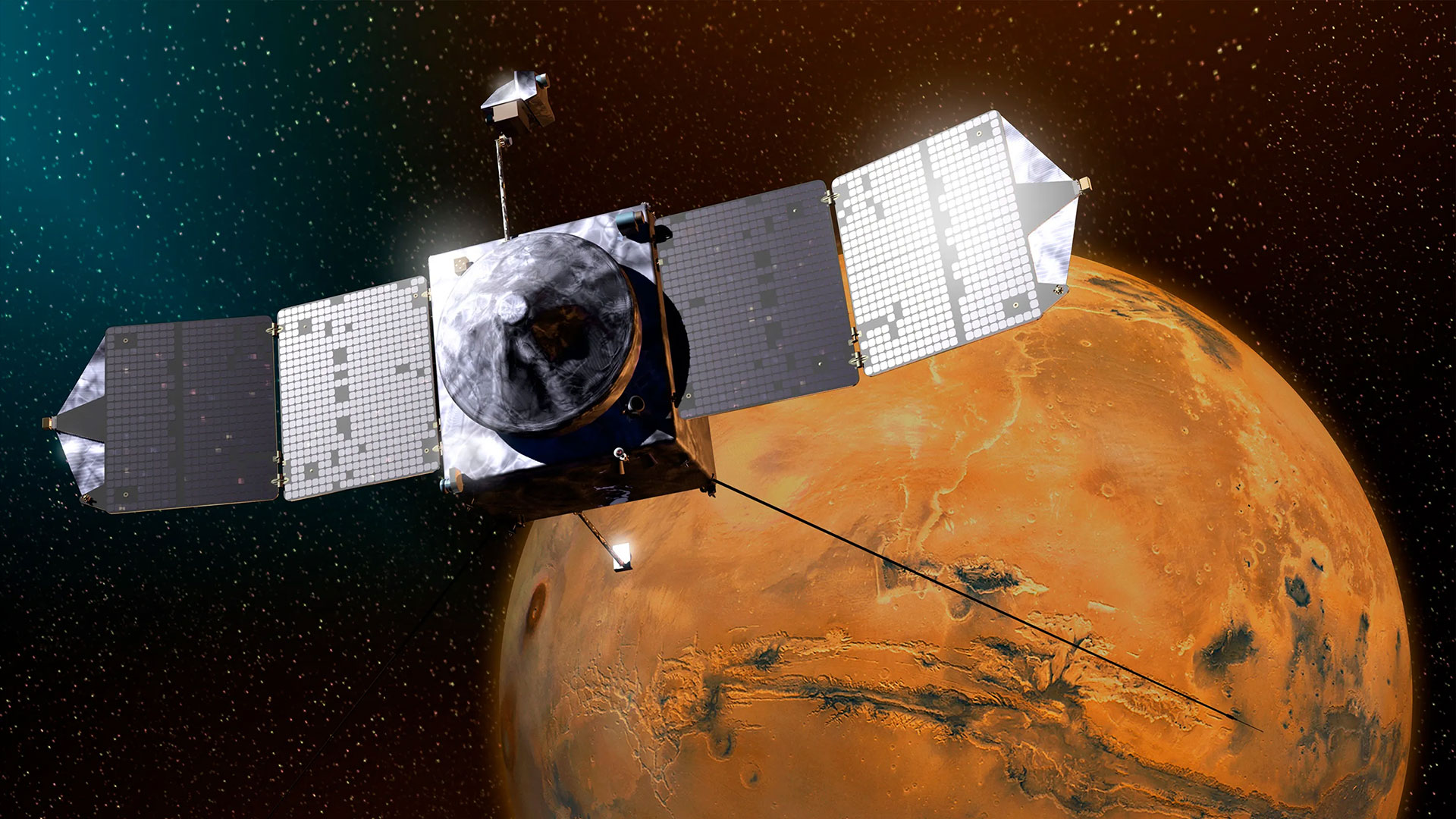
Artist's rendering of NASA's MAVEN spacecraft at Mars. The probe entered orbit around the planet in 2014 and has completed over 11 years of observing the Martian upper atmosphere, ionosphere and interactions with the Sun and solar wind to explore the loss of Mars' atmosphere. (NASA/Goddard/University of Colorado/Laboratory for Atmospheric and Space Physics)
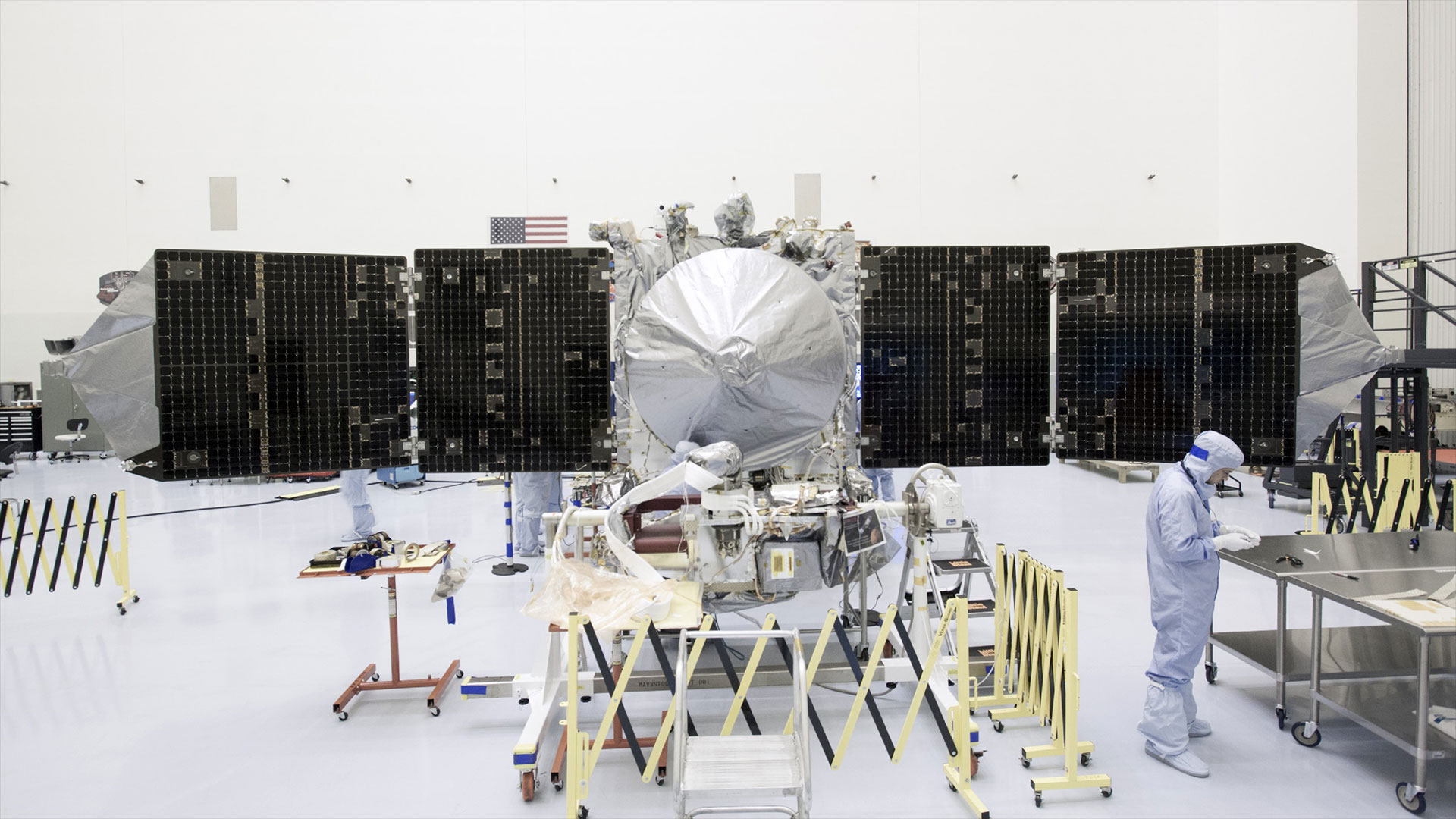
NASA's MAVEN, or Mars Atmosphere and Volatile Evolution, probe is seen prior to its launch in 2013. (NASA/Jim Grossmann)
Insignia for the Mars Atmosphere and Volatile Evolution (MAVEN) mission to study the Red Planet's upper atmosphere. (NASA) |