advertisements advertisements
|

|
Mike Melvill, commercial astronaut who piloted SpaceShipOne, dies
March 21, 2026 — Mike Melvill, a record-setting test pilot who in 2004 became the first person to launch on a privately-funded vehicle on a suborbital spaceflight, has died at the age of 85.
Just two months later, Melvill and his fellow pilot Brian Binnie won a $10 million prize by flying the same craft, Scaled Composites' SpaceShipOne, twice to space within a two-week period.
"Scaled is incredibly sad to hear of the passing of our good friend Mike Melvill, who passed away Thursday night (March 19)," the company wrote in a social media post. "We at Scaled are fortunate to have had the opportunity to know him. Our condolences go to the Melvill family."
"Very sad — it seems impossible that there are still Apollo astronauts alive, while my two SpaceShipOne astronauts are now gone," aerospace designer and Scaled's founder [Burt] Rutan, told journalist Leonard David. Binnie died in 2022 at the age of 69.
On June 21, 2004, before a large crowd that gathered at Mojave Airport (today Air and Space Port) in northern California, Melvill climbed aboard the rocket-powered spaceplane while it hung under its carrier ship, White Knight. At 47,000 feet (14.3 kilometers) altitude, the two vehicles separated and Melvill ignited SpaceShipOne.
The rocket fired for one minute and six seconds, boosting Melvill to 180,000 feet (54.9 km), but along the way forcing him to fight against a roll due to wind shear. SpaceShipOne then coasted to 328,491 feet (100.1 km), just above the Kármán line, the 62-mile-high internationally-accepted boundary between Earth and space.
To celebrate, Melvill reached into his flight suit's pocket and pulled out a handful of M&M's candies, which floated about the cabin. He landed back at the airport one hour and 27 minutes after he left the ground.
Then on Sept. 29, 2004, Melvill was back at the controls for his second trip into space. Again, SpaceShipOne and White Knight climbed to altitude, but this time, after separation and rocket ignition, the spaceplane entered a rapid roll, which continued all the way to apogee at 337,569 feet (102.9 km).
Melvill landed safely one hour and 23 minutes after he took off. The flight met the requirements for the Ansari X PRIZE, setting up Binnie to repeat Melvill's feat on Oct. 4, 2004, winning the $10 million for Scaled and investor Paul G. Allen.
"That was a really good ride. I feel like I nailed it," said Melvill after he touched down. "But right up at the top I got a surprise when it really spun up and did a little victory roll."
"That was fun," he added. "I shut the engine down at 11 seconds before it would have shut down automatically, so we would have gone a long way higher than we really did."
Rather than continue flying, SpaceShipOne was donated to the Smithsonian's National Air and Space Museum in Washington, D.C., where it is on display today in the Boeing Milestones of Flight Hall.
In 2007, Melvill retired. "Blue skies and tailwinds, Mike," the team at Scaled wrote.
Melvill was the 13th person to fly a suborbital spaceflight above 50 miles and the 441st person worldwide to enter space, according to the Registry of Space Travelers maintained by the Association of Space Explorers. He logged a total of 7 minutes outside Earth's atmosphere on his two flights.
Michael Winston Melvill was born on Nov. 30, 1940, in Johannesburg, South Africa. He attended Hilton College before immigrating to the United States with his family from England in 1967. He became a U.S. citizen in 1972.
He met and was hired by Rutan in 1978 and four years later became Rutan's lead test pilot. Melvill was on the team that resulted in the Rutan Voyager completing the first nonstop, non-refueled flight around the world in 1988 and was the only person other than its flight crew (Rutan's brother Dick and Jeana Yeager) to fly the lightweight aircraft.
Melvill made his own round-the-world the flight in a Rutan Long-Eze aircraft on the "Around the World in 80 Nights" EAA Friendship Tour with Dick Rutan in 1997.
In October 2000, he set three national and three world altitude records in Rutan's high-altitude long-endurance aircraft, Proteus, flying above 63,000 feet (19.2 km). Four years later, he set national and world speed records over a 1,240-mile (2,000-km) closed course in the Catbird, a single-engine aircraft also designed by Rutan.
After his first SpaceShipOne suborbital spaceflight in June 2004, Melvill was awarded the U.S. Department of Transportation's first-ever pair of commercial astronaut wings. He, along with Rutan, Binnie and other team members, were then honored with the Collier's Trophy by the National Aeronautic Association.
In 2005, together with Rutan and Binnie, he received the Explorers Medal, the highest honor conveyed by The Explorers Club, and the Collins Trophy for Current Achievement presented by the National Air and Space Museum.
Melvill's achievement led to the advent of commercial suborbital spaceflights. SpaceShipTwo crossed the U.S,-defined 50-mile (80 km) boundary into space for the time in December 2018. A larger and advanced version of SpaceShipOne, the vehicle was developed by Scaled and is still operated by Richard Branson's Virgin Galactic.
Melvill donated his flight suit, helmet, oxygen mask, gloves and boots that he wore on both SpaceShipOne flights to the Smithsonian. He donated other mementos, including one of his flown M&M's candies and his commercial astronaut wings, to the EAA Aviation Museum in Oshkosh, Wisconsin.
Melvill married his childhood sweetheart, fellow lifetime EAA member and former Rutan Aircraft Factory co-worker, Sally, in 1961, and they had two sons. |
|
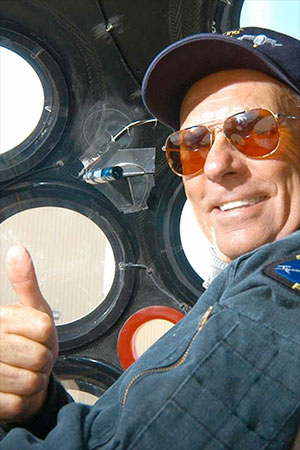
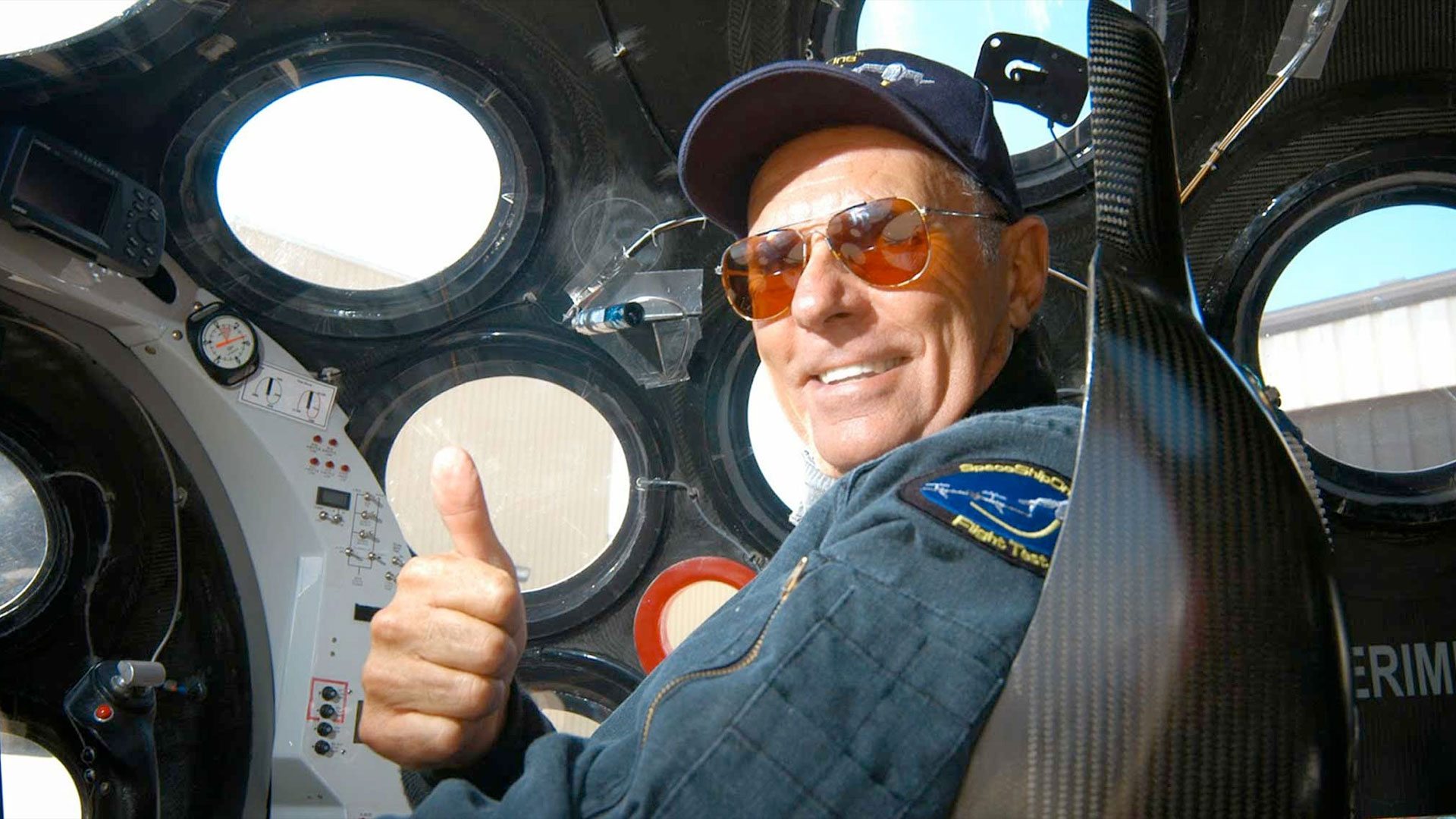
Mike Melvill gives a thumbs up from the cockpit of SpaceShipOne, the rocket-powered spaceplane that earned him the first pair of U.S. commercial astronaut wings in 2004. (Scaled Composites)
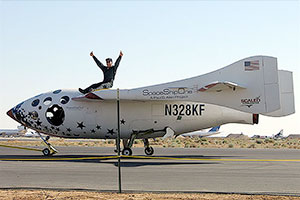
Mike Melvill celebrates from atop SpaceShipOne after landing from space in Mojave, California on June 21, 2004. (collectSPACE)
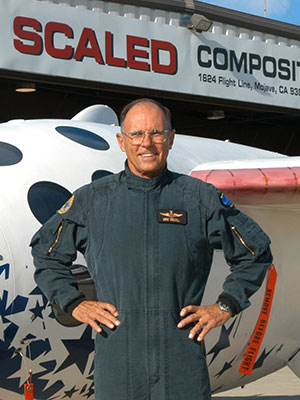
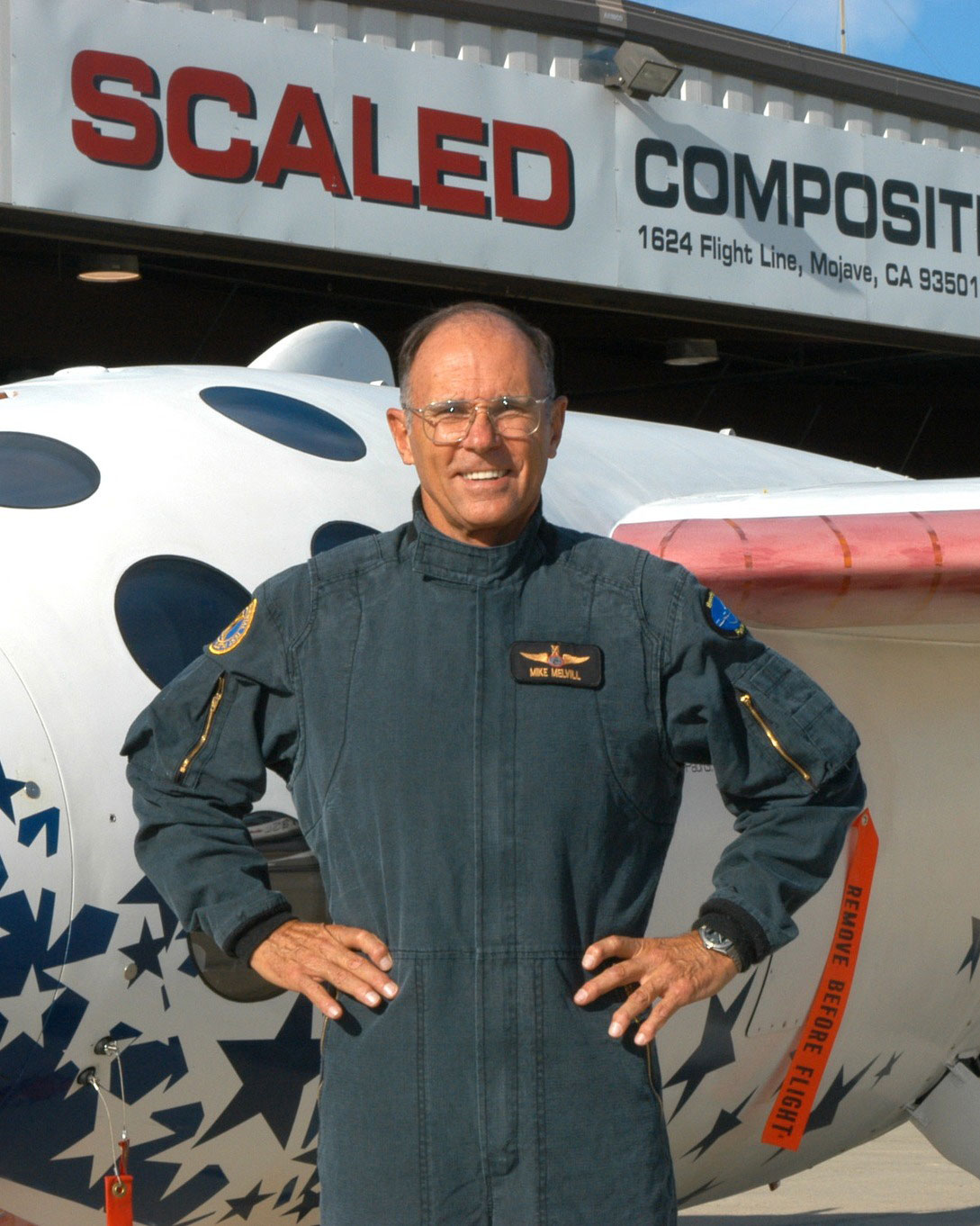
Mike Melvill poses in front of SpaceShipOne. (Scaled Composites)
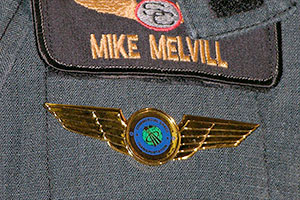
Mike Melvill's U.S. commercial astronaut wings as he was the first to earn aboard SpaceShipOne on June 21, 2004. (collectSPACE) |
|

© collectSPACE. All rights reserved.
|
|
|
|