February 9, 2025 — A small American flag that in 1971 was smuggled to the surface of the moon is now set to return there, this time in an official, albeit one-way, capacity. The flag's new journey mounted on a robotic rover has the endorsement of the astronaut who unknowingly enabled its earlier roundtrip.
Astrolab, the Hawthorne, California-based moon and Mars mobility company, is flying the flag on its FLIP (Flex Lunar Innovation Platform) rover, which is set to launch to the lunar south pole as soon as this summer. Astrolab chief executive officer Jaret Matthews recently oversaw the flag's preparation for the mission.
"We're honored to announce Astrolab is bringing an American flag back to the moon," the company announced on its social media accounts. "Originally flown to the lunar surface on Apollo 15 inside the EVA suit of NASA astronaut David Scott, the flag will be part of an embroidered patch on our FLIP rover."
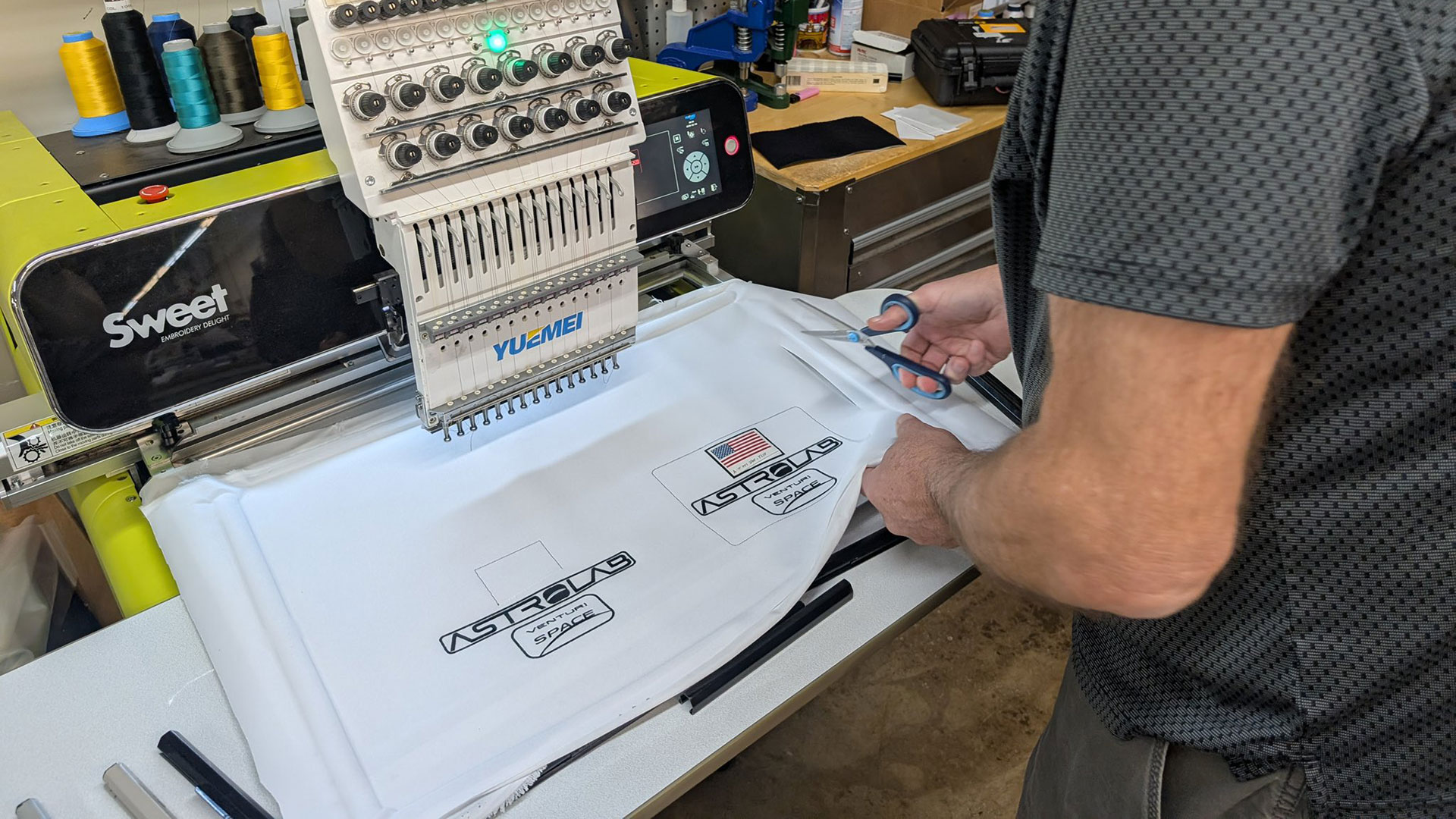
On Feb. 3, Matthews hand delivered the flag to A-B Emblem in Weaverville, North Carolina to incorporate it into FLIP's flight patch. A-B Emblem has been the exclusive supplier to NASA's astronaut office since 1970. The company has made most of the sewn patches carried and worn on NASA's human missions, including the embroidered patches flown on Apollo 15.
Astrolab released photos and video of the 2.5-by-1.5-inch (6.4 by 3.8 cm) flag being attached to its larger embroidered display. The American flag was originally silkscreened onto Beta cloth, a fire-retardant, silica-based woven fabric.
Undercover OPS
The flag, and others just like it, were first learned of by the public in 2017, when one was sold at auction for almost $25,000.
According to the lot description, the small flags were held in a secret stash inside the equipment that Scott wore on his back. A pouch was mounted behind a larger American flag that adorned the astronaut's portable life support system's (PLSS) oxygen purge system (OPS).
"According to management, a member of the [Johnson Space Center] Crew Systems Division (CSD) had prepared the flags and secretly stowed them in a Beta cloth package on a structural support bracket inside the OPS," wrote Scott in a letter included with the flag. "This [hidden pouch] was apparently unknown to anybody else until the OPS was disassembled after the mission by some other member of the CSD and the flag package was discovered."
Scott was presented with some of the flags (and a bracket that held them in place) as mementos at the same meeting where he first learned of their existence. A federal law passed in 2012 reaffirmed Apollo-era astronauts' title to their souvenirs of the missions.
Scott wore the OPS (with the flags) on his three excursions on the lunar surface. The OPS was worn to supply his spacesuit with oxygen in the case of a failure in the suit or PLSS or if an emergency EVA had been needed.
Later, Apollo 15 command module pilot Al Worden used Scott's OPS for a first-of-its-kind deep-spacewalk.
In total, the flags spent more than 12 days in space, including almost 67 hours on the moon. During the 18 hours and 35 minutes they were outside on the surface, they traveled 17 miles (28 km) as Scott walked on the moon and drove the Apollo lunar roving vehicle (LRV).
On the FLIP side
"Thank you to our strategic partner Venturi for the connection with David," wrote Astrolab officials, "and to David Scott himself for entrusting us with delivering this piece of space history back to the lunar surface."
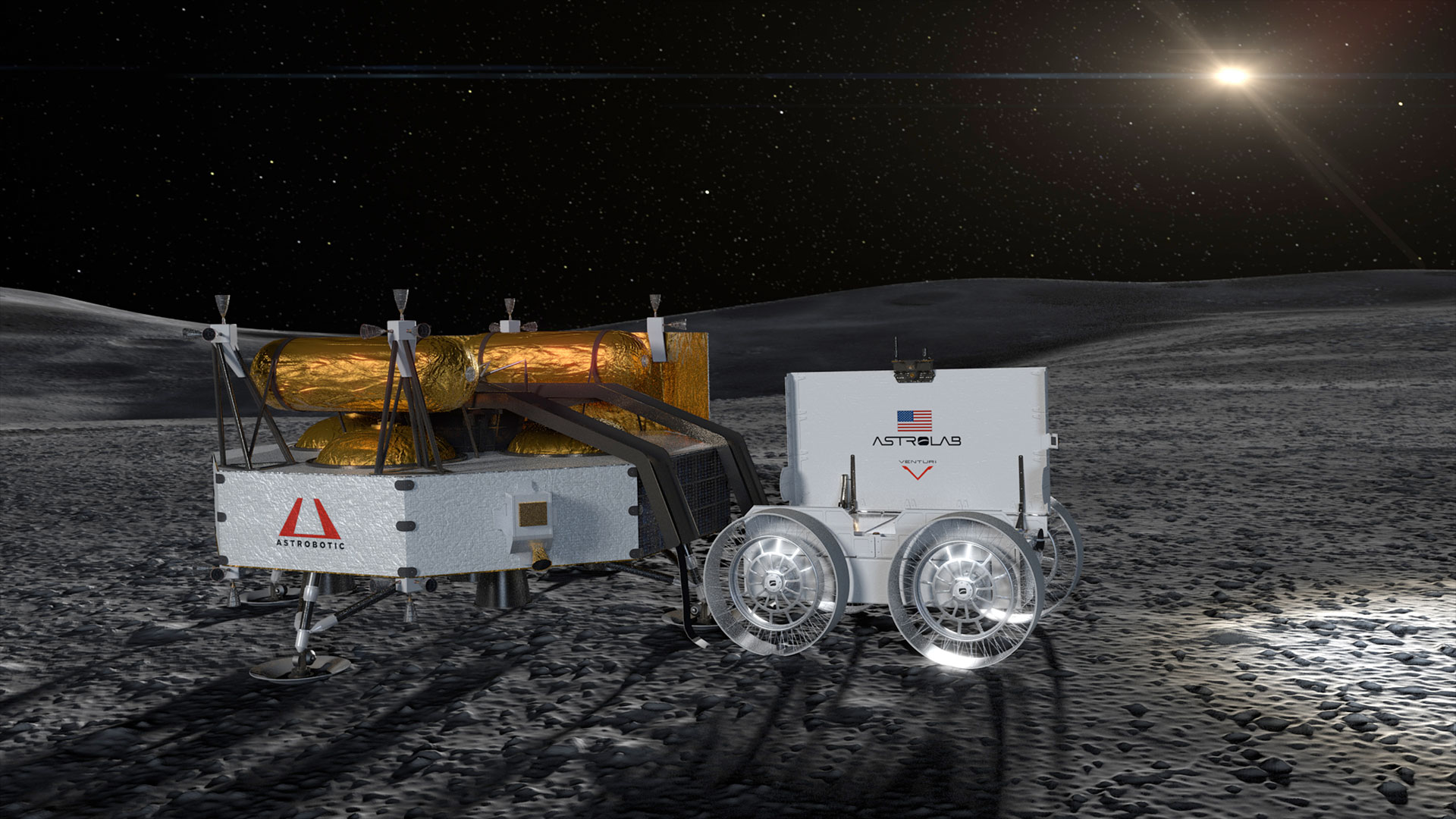
Astrolab's photos appear to show that Scott initialed and inscribed the flag to FLIP. Under the stars and stripes, A-B Emblem embroidered the Astrolab and Venturi Space logos. An animation of the FLIP rover on the moon suggests that the flag may be mounted on the opposite side of the rover's deployable solar cells panel.
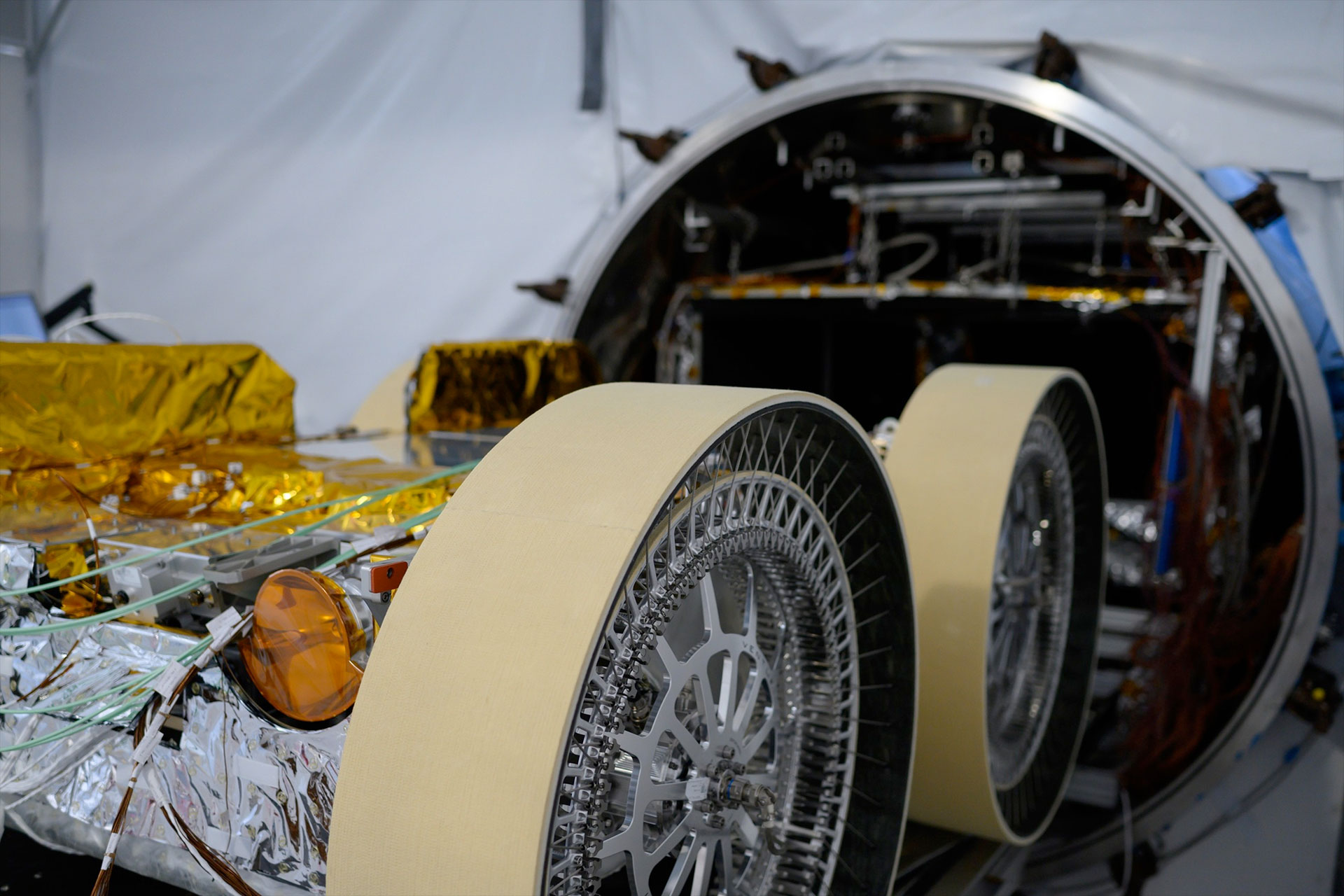
FLIP is targeted to land at the moon's south pole on Pittsburg-based Astrobotic Technology's Griffin Mission 1. The rover was designed to demonstrate telerobotic operations, mobility on the moon, solar power generation and thermal resilience as the foundation for Astrolab's larger FLEX rover. The company will use FLIP to perform experiments in perception, guidance and navigation and communication.
In addition to the Apollo 15-flown flag, the FLIP rover is also carrying a crystal etched with letters from students as part of a lunar time capsule organized by Uplift Aerospace; a coin-sized artifact by UNESCO and Barrelhand engineered to survive over a million years on the moon and featuring works such as the Mona Lisa and the original French edition of "Le Petit Prince"; a payload by LifeShip containing a digital DNA and plant seed bank; and an art piece by commercial astronaut Sian Proctor.
The Apollo 15 flag is now part of a growing collection of Apollo artifacts that have been or are going to be flown back to the moon. Flags that were intended to fly on Apollo missions before the program was canceled have been on board Intuitive Machines' Nova-C landers that touched down on the moon in 2024 and 2025, as well as will launch on NASA's Artemis II mission as soon as next month. The Smithsonian's National Air and Space Museum also sent parts from a recovered rocket engine used on the Apollo 11 mission on NASA's Artemis I mission in 2022. |
|
A small American flag that flew to the moon on Apollo 15 in 1971 is seen being incorporated into the Astrolab FLIP flight patch before it is returned to the lunar surface on the company's rover. (Astrolab)
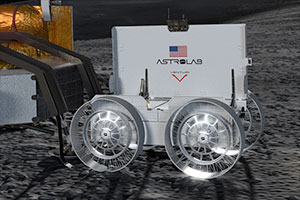
Rendering of Astrolab's FLIP (Flex Lunar Innovation Platform) rover on the moon next Astrobotic's Griffin Mission 1 lander. (Astrolab)

Astrolab chief executive officer Jaret Matthews (at left) with Apollo 15 commander David Scott, who has approved of a U.S. flag that flew with him to the moon 55 years ago returning there on the FLIP (Flex Lunar Innovation Platform) rover. (Astrolab)
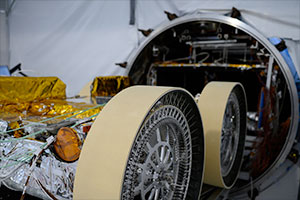
Astrolab's FLIP (Flex Lunar Innovation Platform) rover is seen after thermal testing in November 2025. (Astrolab) |