NASA Celebrating 90 Years: Robert Goddard's Rocket and the Launch of SpaceflightNinety years ago, on March 16, 1926, a rocket lifted off – not with a bang, but with a subtle, quiet flame — and forever changed the scope of scientific exploration. This event ties directly to the birth of NASA more than 30 years later.
Less than a century ago, astronomers relied entirely on ground-based observations to further scientific study. Today, descendants of that first liquid-fueled rocket provide eyes on cosmic phenomena, unravel mysteries of the early universe, and even take a closer look at what makes our own planet tick.
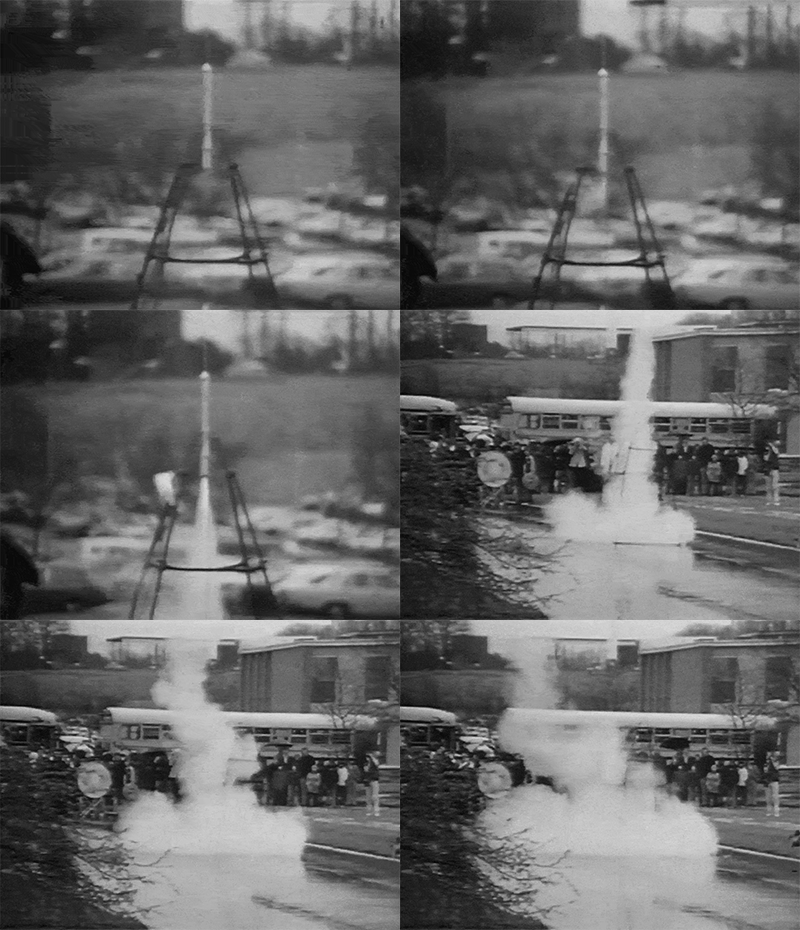
Above: Employees at NASA's Goddard Space Flight Center in Greenbelt, Maryland, recreated the first liquid-fueled rocket launch in front of Building 8 in 1976. Credit: NASA Goddard/Robert Garner
None of this would be possible without the experiments of Massachusetts physics professor Robert Goddard, best known for inventing the liquid-fueled rocket. The namesake of NASA's Goddard Space Flight Center in Greenbelt, Maryland, he dreamed as early as 1909 of creating an interplanetary vehicle. While he couldn't achieve that in his lifetime, his inventions in the first half of the 20th century became the engineering foundation for the rockets that first took humans to the moon in the 1960s and for today's rockets, which look further into space than ever before.
Prior to Goddard's experimentation, rockets had not changed much in several centuries. Chinese engineers invented them as war machines in the 13th century, using solid gunpowder as fuel. But Goddard realized that liquid propellants offered a number of advantages over solid-fueled rockets. He began to test rockets fueled by liquid gasoline and liquid oxygen.
The new design posed a number of challenges. For instance, he had to find a way to mix the fuel with oxygen. Otherwise it wouldn't burn fast enough to produce the necessary thrust to lift the weight of the rocket. He also had to find a mechanical solution to pressurize the fuel chamber so it would continually feed fuel to the engine. Each solution he found brought with it a new challenge to solve.
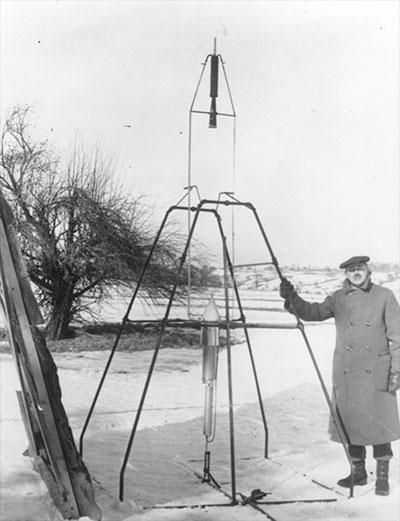
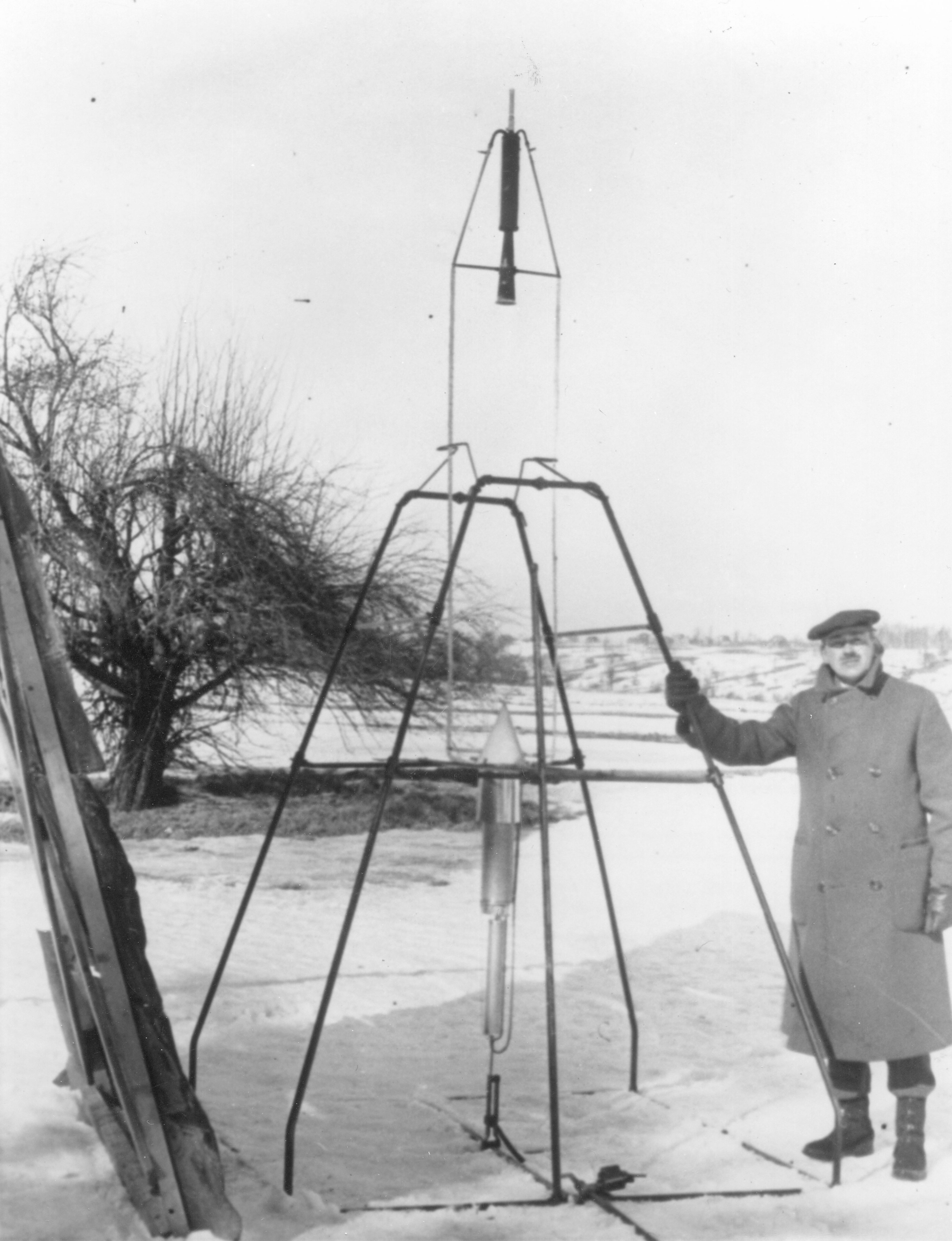
Above: Robert Goddard stands next to his first liquid-fueled rocket prior to its launch on March 16, 1926. Credit: Clark University Robert H. Goddard Archive
After nearly 17 years of work, Goddard successfully launched his creation on March 16, 1926.
"It looked almost magical as it rose, without any appreciably greater noise or flame, as if it said, 'I've been here long enough; I think I'll be going somewhere else, if you don't mind,'" Goddard wrote in his journal the next day.
Most rockets today use liquid fuels because they provide more thrust per unit of fuel and they allow engineers to time how long the rocket will remain lit more precisely. For example, the Atlas V, on which many NASA missions launch – such as the Magnetospheric Multiscale Mission, which launched in 2015 – and the Ariane V, on which NASA's James Webb Space Telescope will launch in 2018, both use liquid fuels in one or more of their stages.
Over the course of his career, as well as posthumously, Goddard was awarded more than 200 patents for his inventions, many of which pertained to rocketry. These also included the invention of multistage rockets, which contain multiple fuel tanks and engine segments that can be jettisoned as they are emptied.
Goddard's work didn't stop there. He continued to improve upon his rocket concepts until his death in 1945. The U.S. failed to recognize the full potential of his work until after his death – in fact, some of his ideas about reaching outer space were ridiculed during his lifetime. But the first liquid-fueled rocket flight was as significant to space exploration as the Wright brothers' first flight was to air travel, and 90 years later, his patents are still integral to spaceflight technology.







 posted 03-15-2016 10:00 PM





 advertisement